
Close Lucintel Chat
Didn't Find What You're Looking for?
Call us at +1972 636 5056 or write at helpdesk@Lucintel.com
Ask an Expert Provide Custom Requirements Download Sample Report Search Available Reports
  • helpdesk@Lucintel.com
  • |
  • Call Lucintel +1 972 636 5056
  • |
  • Login
  • |
  • Register
  • |
  • Search
  • |
'
...

The Impact of COVID-19 is included in N-Propanol Market Report. Buy it today to get an advantage.

Request the impact of COVID-19 on your product or industry


N-Propanol Market Trends and Forecast

The future of the global N-propanol market looks promising with opportunities in the coating, food additive, pharmaceutical, cosmetic, printing ink, and chemical intermediate markets. The global N-propanol market is expected to grow with a CAGR of 4.3% from 2025 to 2031. The major drivers for this market are the increasing demand for pharmaceutical formulations, the rising use in coating applications, and the growing adoption in personal care products.

• Lucintel forecasts that, within the type category, ethylene hydrogenation method is expected to witness higher growth over the forecast period.
• Within the application category, pharmaceutical is expected to witness the highest growth.
• In terms of region, APAC is expected to witness the highest growth over the forecast period.
Gain valuable insights for your business decisions with our comprehensive 150+ page report. Sample figures with some insights are shown below.
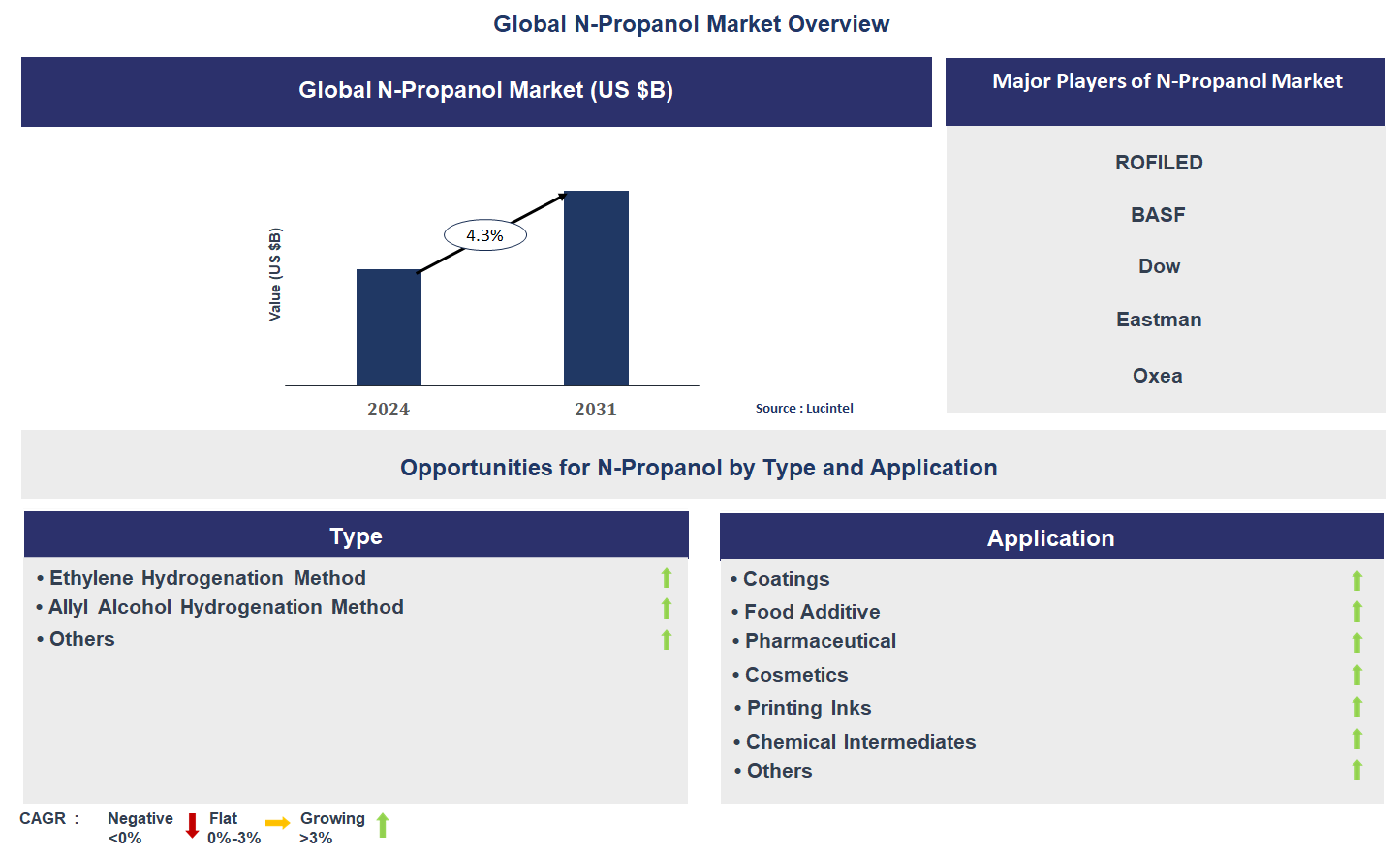
N-Propanol Market Trends and Forecast

Emerging Trends in the N-Propanol Market

The N-propanol market is at the crossroads today, with multiple trends emerging to shape its future course. These trends are a natural response to economic pressures on the global economy, increased environmental awareness, and changing technological needs from the end-use industries. The market is shifting away from being a bulk commodity and is increasingly characterized by specialization, sustainability, and technological integration. This evolution is creating a more dynamic and competitive environment in which innovation and flexibility are emerging as major differentiators for marketplace participants.
• Shift to Bio-Based Production: One major trend is the shift to bio-based N-propanol. This is being fueled by tough environmental regulations and a worldwide pressure for green chemicals. Bio-based N-propanol is made from renewable feedstocks such as biomass and crop waste, lessening the industry’s dependence on petrochemicals. This shift aligns not only with green chemistry principles but also provides a stable supply chain that is less exposed to crude oil price fluctuations.
• Increasing Requirement for High-Purity Grades: The enhanced complexity of end-use industries, and especially the pharmaceutical and electronics industries, is driving a high demand for high-purity N-propanol. Such industries need solvents that are free of impurities to deliver high-quality products and prevent contamination. Producers are investing in sophisticated purification techniques to match these high specifications, and this is causing a premium sector of the market.
• Emergence in New Applications: N-propanol is emerging in new applications outside its original use in coatings and inks. It is being increasingly used in the pharmaceutical sector as a drug-formulation solvent and in the food and beverage sector as a flavor and fragrance compound. These new uses are broadening the market and opening up new growth opportunities, cutting the industry’s reliance on a few major sectors.
• Technological Integration in Manufacturing: The sector is seeing the integration of sophisticated technologies such as artificial intelligence (AI) and machine learning to streamline the production of N-propanol. These technologies are capable of improving process efficiency, saving energy, and enhancing product yield. This is transforming manufacturing processes into more cost-friendly and sustainable ones, providing a competitive advantage to firms that adopt these technologies.
• Emphasis on Solvent Reuse and Recycling: Due to the high production cost and environmental issues, there is increased emphasis on solvent reuse and recycling. Businesses are implementing closed-loop systems and sophisticated distillation procedures to recycle and regenerate used N-propanol. This not only minimizes waste and environmental degradation but also contributes to reduced operating expenses, making the production more economically feasible and sustainable.
These trends are essentially redefining the N-propanol market from a commodities-driven business to one that is more specialty and technology-oriented. The emphasis is moving away from volume production to the generation of value-added, high-purity products. The market becomes more segmented with firms concentrating on particular niches such as bio-based production or high-purity grades. Success will increasingly be based on the ability of a company to innovate and to be consistent with the global sustainability agenda.
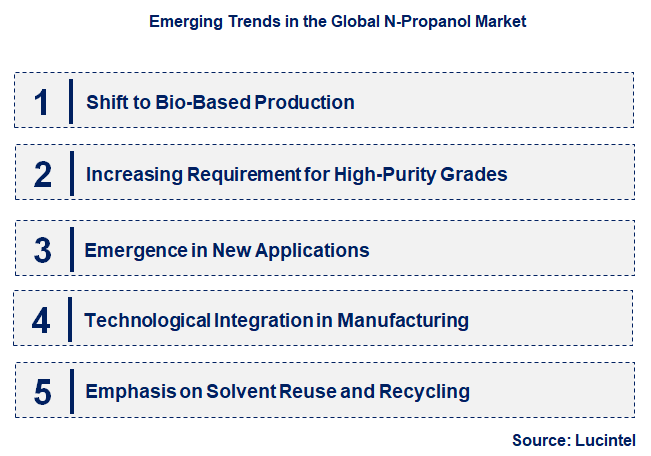
Emerging Trends in the N-Propanol Market

Recent Development in the N-Propanol Market

The N-propanol market is in the midst of transformative change, driven by a fundamental shift in the global chemical market. These trends are in response to changing market requirements, regulatory constraints, and pressure towards more sustainability. They are affecting the whole value chain, from raw material supply to end-use applications. The stability and growth of the market are ever more dependent on a firm’s capacity to adjust to these new realities, invest in innovation, and establish a robust supply chain.
• Capacity Upgradation by Major Players: One of the major developments is the upgradation of N-propanol production capacity by major chemical players. This is a strategic step to address the growing global demand and gain a stronger foothold in the market. This upgradation is focused in industries such as the US and Asia-Pacific, where industrial growth is high. This development is generating a more competitive environment and providing a stable supply of N-propanol to major industries.
• Strategic Emphasis on Bio-Based Manufacturing: Major chemical companies are investing heavily in developing and commercializing bio-based N-propanol. This is in the form of new pilot plants and collaboration to test manufacturing from renewable feedstocks. This follows an effort to lower carbon emissions and adherence to tighter environmental regulations in Europe and North America.
• Integration in Green Solvents: N-propanol is increasingly being identified and utilized as a green solvent in numerous industrial processes. One of the most important developments is its application in new low-VOC paints and coatings formulations. This comes straight from regulations placed on the use of conventional, highly toxic solvents. This trend is establishing new markets for N-propanol and increasing its demand as a safer and more environmentally friendly option.
• Advanced Purification Technologies: Recent achievements also include commercialization of new purification technologies that have the capability to produce ultra-high-purity N-propanol. This is an important breakthrough for the electronics sector, where trace impurities can destroy delicate components. Advanced distillation and filtration technologies are being employed by companies to obtain the purity levels necessary for semiconductor cleaning and production as well as other electronic components.
• Diversification into New End-User Industries: The market is witnessing a significant trend of N-propanol being applied in new end-user industries. It is increasingly applied in more antiseptic and disinfectant preparations, spurred by increased concern for hygiene. It is also picking up as a specialty solvent in the agrochemical market for manufacturing herbicides and pesticides.
Together, these advancements are collectively reorienting the N-propanol industry towards a more specialized, high-value, and sustainable paradigm. They point to a departure from conventional, bulk-commodity manufacturing and towards a culture of innovation and sustainability. This is fostering a more competitive and robust industry, where performance depends on a firm’s capacity to diversify its uses and invest in cutting-edge production technologies.

Strategic Growth Opportunities in the N-Propanol Market

The N-propanol market offers various strategic growth opportunities based on the molecule’s versatility as a solvent and chemical intermediate. The most attractive opportunities for growth are in high-value, special-purpose applications that are aligned with worldwide trends towards sustainability, technology, and changes in consumer behavior. The firms that are able to pivot strategically to serve the emerging sectors’ needs will be best positioned to take advantage of new market dynamics.
• Pharmaceutical and Life Sciences: The biggest opportunity for growth is in the pharmaceutical sector, where N-propanol is employed as a solvent for drug formulation, extraction, and purification. With the development of the global pharmaceuticals industry, led by the aging population and growing R&D, demand for high-purity N-propanol will increase. Pharmaceutical-grade N-propanol with strict quality controls can be developed and marketed by companies to tap the high-margin segment.
• Paints, Coatings, and Adhesives: The classic use is still an area of growth, mainly in developing economies where infrastructure development and construction are on the rise. N-propanol is a good solvent which enhances the drying and application characteristics of paints and coatings. The potential is to create specialized blends of N-propanol to suit particular performance and environmental needs for various coatings and adhesives.
• Printing Inks and Packaging: N-propanol demand in printing inks is robust, particularly for use in flexible packaging printing and specialty printing. N-propanol yields good solvency for colorants and resins, producing bright, consistent prints. The opportunity here is in supplying N-propanol to converters that are moving toward more environmentally friendly, water-based ink systems to comply with regulations for lower VOC emissions.
• Cosmetics and Personal Care: N-propanol finds application as a solvent and antimicrobial in cosmetic and personal care products such as hand sanitizers, fragrances, and hair care products. The worldwide emphasis on hygiene and grooming has developed into a big opportunity, especially following recent public health experiences. Firms can sell N-propanol as a safe and reliable ingredient for these consumer products.
• Aerospace and Automotive Sector: The aerospace and automotive sectors are an expanding driver of demand for N-propanol. It serves as a de-icing fluid for aircraft and as part of special coatings for automotive components. As these sectors continue to develop with new materials and processes, demand for high-performance solvents such as N-propanol will be sustained, generating a solid and worthwhile market segment.
These growth opportunities are driving the N-propanol market away from a commodity-type of business toward a specialty chemical business. This shift is benefiting companies with high technical capabilities, solid R&D, and emphasis on high-purity, added-value products. The market is becoming more resilient as it broadens to new high-growth markets, lessening its exposure to variation in a sole end-user industry.

N-Propanol Market Driver and Challenges

The N-propanol industry is influenced by a mix of strong drivers and considerable challenges. Growth in the market is essentially driven by its flexibility and its essential position in the growth of industrial segments. Yet, the same is moderated by inherent difficulties around raw material volatility, safety, and competition. Having insight into this mutual play of influences is necessary to understand the state of the market in the present and its direction for the future.
The factors responsible for driving the N-propanol market include:
1. Increasing Demand from End-Use Industries: The main force behind the N-propanol market is its extensive application in fast-growing industries such as paints and coatings, pharmaceuticals, and printing inks. With these industries growing faster in the world, they generate a steady and rising demand for N-propanol as a major solvent and intermediate.
2. Urbanization and Industrialization: The high rate of urbanization and industrialization in developing nations such as India and China is a key growth driver. This creates a high demand for such products as paints, adhesives, and construction chemicals, all of which consume N-propanol.
3. Transition to Green Solvents: Harsh environmental laws designed to lower volatile organic compound (VOC) emissions are compelling a shift from conventional solvents. The comparatively low toxicity and efficiency of N-propanol make it a viable alternative, making it a favored green solvent and increasing its market demand.
4. Pharmaceutical Industry Growth: The relentless growth of the global pharmaceutical and life sciences sector, fueled by a rising population that is aging and healthcare-focused, is a major driver. As a critical solvent in drug synthesis, N-propanol’s consistent demand is guaranteed.
5. Technology Advances in Manufacturing: New advances in production processes, including oxo-synthesis, are increasing the efficiency and economy of production of N-propanol. These advances are improving product yield and purity, making N-propanol a more competitive and affordable solution for more applications.
Challenges in the N-propanol market are:
1. Raw Material Price Volatility: One major challenge is volatility in feedstock prices, especially that of propylene, a by-product of refining crude oil. Volatility in crude oil prices would have a direct bearing on the cost of production of N-propanol, and manufacturers would find it hard to sustain consistent profit margins and pricing.
2. Health and Safety Issues: N-propanol is a combustible, hazardous substance that must be handled and stored with appropriate care. Such intrinsic health and safety issues mandate substantial investment in safety measures, specialized facilities, and employee training. This incurs higher operating costs and serves as an entry barrier for new market entrants.
3. Competition from Substitutes: Competition in the market for N-propanol arises from other solvents, most notably isopropanol, which tends to be cheaper. The presence of these alternatives, as well as the creation of new, more sustainable substitutes, can restrict potential growth in the N-propanol market in some applications.
The N-propanol market is in a precarious equilibrium. While intense drivers from major end-use sectors and widespread worldwide movement toward sustainability are propelling the market ahead, it is susceptible to the pitfalls of raw material volatility, safety issues, and competition. Market participants will be successful if they invest in technological advancement and strategic diversification to gain a stable and remunerative position in a changing and developing industry.

List of N-Propanol Companies

Companies in the market compete on the basis of product quality offered. Major players in this market focus on expanding their manufacturing facilities, R&D investments, infrastructural development, and leverage integration opportunities across the value chain. With these strategies N-propanol companies cater increasing demand, ensure competitive effectiveness, develop innovative products & technologies, reduce production costs, and expand their customer base. Some of the N-propanol companies profiled in this report include-
• ROFILED
• BASF
• Dow
• Eastman
• Oxea
• Sasol
• Wu Jiang Chemical
• Nanjing Rongxin Chemical
• Chang Chun Group
• Ningbo Juhua Chemical

N-Propanol Market by Segment

The study includes a forecast for the global N-propanol market by type, application, and region.

N-Propanol Market by Type [Value from 2019 to 2031]:


• Ethylene Hydrogenation Method
• Allyl Alcohol Hydrogenation Method
• Others

N-Propanol Market by Application [Value from 2019 to 2031]:


• Coatings
• Food Additive
• Pharmaceutical
• Cosmetics
• Printing Inks
• Chemical Intermediates
• Others

N-Propanol Market by Region [Value from 2019 to 2031]:


• North America
• Europe
• Asia Pacific
• The Rest of the World

Country Wise Outlook for the N-Propanol Market

The international N-propanol industry is undergoing changes, influenced by an intricate mix of local industrial policy initiatives, shifting consumer patterns, and developments in chemical manufacturing. As a general-purpose solvent and chemical intermediate, N-propanol’s fortunes are inextricably linked to the fortunes of major end-use markets like paints and coatings, drugs, and printing inks. A significant trend is the move towards greener and bio-based production processes due to the pressures of environmental regulations as well as business sustainability aspirations.
• United States: The U.S. N-propanol market is growing steadily, driven by high demand from the pharmaceutical, coatings, and adhesives industries. The manufacturing strength in the country and increased emphasis on specialty chemical production are major drivers. There is a clear trend toward using low-volatile organic compound (VOC) solvent blends, which has created interest in bio-based versions of N-propanol. This is consistent with tighter environmental regulations.
• China: Being the world’s largest N-propanol consumer and producer, China’s market is marked by high industrial production. Nevertheless, the market is challenged by volatility of demand from downstream applications such as the pharmaceuticals and textiles industries. Although prices have exhibited some fluctuations, there is a definite trend towards better-quality production to underpin the country’s growing manufacturing capacity. Recent investment in new N-propanol plants indicates the country’s approach to continuing its market leadership and minimizing import dependency for such chemical intermediates.
• Germany: Germany’s N-propanol market is characterized by concentration on high-purity use and environmental legality. The nation is a top consumer in Europe, driven by its advanced chemical and pharmaceutical manufacturing sectors. German companies are leaders in creating environmentally friendly production processes, such as bio-fermentation and renewable biomass pilot plants. These initiatives are a direct reaction to tough European regulations and a company-wide focus on green chemistry.
• India: The Indian N-propanol market is witnessing strong growth, driven by India’s growth of rapid industrialization and urbanization. n-Propanol demand is accelerating in the paints and coatings, automotive, and construction industries. The government’s "Make in India" policy has spurred local manufacturing, which is slowly eroding the nation’s dependence on imports. One of the major developments is the increasing level of awareness and uptake of N-propanol in the pharmaceuticals and foods industries, as a solvent and as an additive in foods, respectively.
• Japan: The Japanese market is an established market for N-propanol with a balanced supply-demand matrix. The demand is mainly driven by its established electronics, automotive, and chemical sectors. A prominent trend is the application of N-propanol as a prime raw material to manufacture fluoropolymers, which are essential for high-performance automotive components. The market is also witnessing consistent demand from the personal care and cosmetics industries.

Lucintel Analytics Dashboard

Features of the Global N-Propanol Market

Market Size Estimates: N-propanol market size estimation in terms of value ($B).
Trend and Forecast Analysis: Market trends (2019 to 2024) and forecast (2025 to 2031) by various segments and regions.
Segmentation Analysis: N-propanol market size by type, application, and region in terms of value ($B).
Regional Analysis: N-propanol market breakdown by North America, Europe, Asia Pacific, and Rest of the World.
Growth Opportunities: Analysis of growth opportunities in different types, applications, and regions for the N-propanol market.
Strategic Analysis: This includes M&A, new product development, and competitive landscape of the N-propanol market.
Analysis of competitive intensity of the industry based on Porter’s Five Forces model.

Lucintel Consulting Services

FAQ

Q1. What is the growth forecast for N-propanol market?
Answer: The global N-propanol market is expected to grow with a CAGR of 4.3% from 2025 to 2031.
Q2. What are the major drivers influencing the growth of the N-propanol market?
Answer: The major drivers for this market are the increasing demand for pharmaceutical formulations, the rising use in coating applications, and the growing adoption in personal care products.
Q3. What are the major segments for N-propanol market?
Answer: The future of the N-propanol market looks promising with opportunities in the coating, food additive, pharmaceutical, cosmetic, printing ink, and chemical intermediate markets.
Q4. Who are the key N-propanol market companies?
Answer: Some of the key n-propanol companies are as follows:
• ROFILED
• BASF
• Dow
• Eastman
• Oxea
• Sasol
• Wu Jiang Chemical
• Nanjing Rongxin Chemical
• Chang Chun Group
• Ningbo Juhua Chemical
Q5. Which N-propanol market segment will be the largest in future?
Answer: Lucintel forecasts that, within the type category, ethylene hydrogenation method is expected to witness higher growth over the forecast period.
Q6. In N-propanol market, which region is expected to be the largest in next 5 years?
Answer: In terms of region, APAC is expected to witness the highest growth over the forecast period.
Q7. Do we receive customization in this report?
Answer: Yes, Lucintel provides 10% customization without any additional cost.

This report answers following 11 key questions:

Q.1. What are some of the most promising, high-growth opportunities for the N-propanol market by type (ethylene hydrogenation method, allyl alcohol hydrogenation method, and others), application (coatings, food additive, pharmaceutical, cosmetics, printing inks, chemical intermediates, and others), and region (North America, Europe, Asia Pacific, and the Rest of the World)?
Q.2. Which segments will grow at a faster pace and why?
Q.3. Which region will grow at a faster pace and why?
Q.4. What are the key factors affecting market dynamics? What are the key challenges and business risks in this market?
Q.5. What are the business risks and competitive threats in this market?
Q.6. What are the emerging trends in this market and the reasons behind them?
Q.7. What are some of the changing demands of customers in the market?
Q.8. What are the new developments in the market? Which companies are leading these developments?
Q.9. Who are the major players in this market? What strategic initiatives are key players pursuing for business growth?
Q.10. What are some of the competing products in this market and how big of a threat do they pose for loss of market share by material or product substitution?
Q.11. What M&A activity has occurred in the last 5 years and what has its impact been on the industry?

For any questions related to N-Propanol Market, N-Propanol Market Size, N-Propanol Market Growth, N-Propanol Market Analysis, N-Propanol Market Report, N-Propanol Market Share, N-Propanol Market Trends, N-Propanol Market Forecast, N-Propanol Companies, write Lucintel analyst at email: helpdesk@lucintel.com. We will be glad to get back to you soon.
                                           Table of Contents

            1. Executive Summary

            2. Market Overview

                        2.1 Background and Classifications
                        2.2 Supply Chain

            3. Market Trends & Forecast Analysis

                        3.1 Macroeconomic Trends and Forecasts
                        3.2 Industry Drivers and Challenges
                        3.3 PESTLE Analysis
                        3.4 Patent Analysis
                        3.5 Regulatory Environment
                        3.6 Global N-Propanol Market Trends and Forecast

            4. Global N-Propanol Market by Type

                        4.1 Overview
                        4.2 Attractiveness Analysis by Type
                        4.3 Ethylene Hydrogenation Method : Trends and Forecast 2025 to 2031
                        4.4 Allyl Alcohol Hydrogenation Method : Trends and Forecast 2025 to 2031
                        4.5 Others : Trends and Forecast 2025 to 2031

            5. Global N-Propanol Market by Application

                        5.1 Overview
                        5.2 Attractiveness Analysis by Application
                        5.3 Coatings : Trends and Forecast 2025 to 2031
                        5.4 Food Additive : Trends and Forecast 2025 to 2031
                        5.5 Pharmaceutical : Trends and Forecast 2025 to 2031
                        5.6 Cosmetics : Trends and Forecast 2025 to 2031
                        5.7 Printing Inks : Trends and Forecast 2025 to 2031
                        5.8 Chemical Intermediates : Trends and Forecast 2025 to 2031
                        5.9 Others : Trends and Forecast 2025 to 2031

            6. Regional Analysis

                        6.1 Overview
                        6.2 Global N-Propanol Market by Region

            7. North American N-Propanol Market

                        7.1 Overview
                        7.2 North American N-Propanol Market by Type
                        7.3 North American N-Propanol Market by Application
                        7.4 The United States N-Propanol Market
                        7.5 Canadian N-Propanol Market
                        7.6 Mexican N-Propanol Market

            8. European N-Propanol Market

                        8.1 Overview
                        8.2 European N-Propanol Market by Type
                        8.3 European N-Propanol Market by Application
                        8.4 German N-Propanol Market
                        8.5 French N-Propanol Market
                        8.6 Italian N-Propanol Market
                        8.7 Spanish N-Propanol Market
                        8.8 The United Kingdom N-Propanol Market

            9. APAC N-Propanol Market

                        9.1 Overview
                        9.2 APAC N-Propanol Market by Type
                        9.3 APAC N-Propanol Market by Application
                        9.4 Chinese N-Propanol Market
                        9.5 Indian N-Propanol Market
                        9.6 Japanese N-Propanol Market
                        9.7 South Korean N-Propanol Market
                        9.8 Indonesian N-Propanol Market

            10. ROW N-Propanol Market

                        10.1 Overview
                        10.2 ROW N-Propanol Market by Type
                        10.3 ROW N-Propanol Market by Application
                        10.4 Middle Eastern N-Propanol Market
                        10.5 South American N-Propanol Market
                        10.6 African N-Propanol Market

            11. Competitor Analysis

                        11.1 Product Portfolio Analysis
                        11.2 Operational Integration
                        11.3 Porter’s Five Forces Analysis
                                    • Competitive Rivalry
                                    • Bargaining Power of Buyers
                                    • Bargaining Power of Suppliers
                                    • Threat of Substitutes
                                    • Threat of New Entrants
                        11.4 Market Share Analysis

            12. Opportunities & Strategic Analysis

                        12.1 Value Chain Analysis
                        12.2 Growth Opportunity Analysis
                                    12.2.1 Growth Opportunity by Type
                                    12.2.2 Growth Opportunity by Application
                        12.3 Emerging Trends in the Global N-Propanol Market
                        12.4 Strategic Analysis
                                    12.4.1 New Product Development
                                    12.4.2 Certification and Licensing
                                    12.4.3 Mergers, Acquisitions, Agreements, Collaborations, and Joint Ventures

            13. Company Profiles of the Leading Players Across the Value Chain

                        13.1 Competitive Analysis
                        13.2 ROFILED
                                    • Company Overview
                                    • N-Propanol Market Business Overview
                                    • New Product Development
                                    • Merger, Acquisition, and Collaboration
                                    • Certification and Licensing
                        13.3 BASF
                                    • Company Overview
                                    • N-Propanol Market Business Overview
                                    • New Product Development
                                    • Merger, Acquisition, and Collaboration
                                    • Certification and Licensing
                        13.4 Dow
                                    • Company Overview
                                    • N-Propanol Market Business Overview
                                    • New Product Development
                                    • Merger, Acquisition, and Collaboration
                                    • Certification and Licensing
                        13.5 Eastman
                                    • Company Overview
                                    • N-Propanol Market Business Overview
                                    • New Product Development
                                    • Merger, Acquisition, and Collaboration
                                    • Certification and Licensing
                        13.6 Oxea
                                    • Company Overview
                                    • N-Propanol Market Business Overview
                                    • New Product Development
                                    • Merger, Acquisition, and Collaboration
                                    • Certification and Licensing
                        13.7 Sasol
                                    • Company Overview
                                    • N-Propanol Market Business Overview
                                    • New Product Development
                                    • Merger, Acquisition, and Collaboration
                                    • Certification and Licensing
                        13.8 Wu Jiang Chemical
                                    • Company Overview
                                    • N-Propanol Market Business Overview
                                    • New Product Development
                                    • Merger, Acquisition, and Collaboration
                                    • Certification and Licensing
                        13.9 Nanjing Rongxin Chemical
                                    • Company Overview
                                    • N-Propanol Market Business Overview
                                    • New Product Development
                                    • Merger, Acquisition, and Collaboration
                                    • Certification and Licensing
                        13.10 Chang Chun Group
                                    • Company Overview
                                    • N-Propanol Market Business Overview
                                    • New Product Development
                                    • Merger, Acquisition, and Collaboration
                                    • Certification and Licensing
                        13.11 Ningbo Juhua Chemical
                                    • Company Overview
                                    • N-Propanol Market Business Overview
                                    • New Product Development
                                    • Merger, Acquisition, and Collaboration
                                    • Certification and Licensing

            14. Appendix

                        14.1 List of Figures
                        14.2 List of Tables
                        14.3 Research Methodology
                        14.4 Disclaimer
                        14.5 Copyright
                        14.6 Abbreviations and Technical Units
                        14.7 About Us
                        14.8 Contact Us

                                               List of Figures


            Chapter 1

                        Figure 1.1: Trends and Forecast for the Global N-Propanol Market

            Chapter 2

                        Figure 2.1: Usage of N-Propanol Market
                        Figure 2.2: Classification of the Global N-Propanol Market
                        Figure 2.3: Supply Chain of the Global N-Propanol Market

            Chapter 3

                        Figure 3.1: Trends of the Global GDP Growth Rate
                        Figure 3.2: Trends of the Global Population Growth Rate
                        Figure 3.3: Trends of the Global Inflation Rate
                        Figure 3.4: Trends of the Global Unemployment Rate
                        Figure 3.5: Trends of the Regional GDP Growth Rate
                        Figure 3.6: Trends of the Regional Population Growth Rate
                        Figure 3.7: Trends of the Regional Inflation Rate
                        Figure 3.8: Trends of the Regional Unemployment Rate
                        Figure 3.9: Trends of Regional Per Capita Income
                        Figure 3.10: Forecast for the Global GDP Growth Rate
                        Figure 3.11: Forecast for the Global Population Growth Rate
                        Figure 3.12: Forecast for the Global Inflation Rate
                        Figure 3.13: Forecast for the Global Unemployment Rate
                        Figure 3.14: Forecast for the Regional GDP Growth Rate
                        Figure 3.15: Forecast for the Regional Population Growth Rate
                        Figure 3.16: Forecast for the Regional Inflation Rate
                        Figure 3.17: Forecast for the Regional Unemployment Rate
                        Figure 3.18: Forecast for Regional Per Capita Income
                        Figure 3.19: Driver and Challenges of the N-Propanol Market

            Chapter 4

                        Figure 4.1: Global N-Propanol Market by Type in 2019, 2024, and 2031
                        Figure 4.2: Trends of the Global N-Propanol Market ($B) by Type
                        Figure 4.3: Forecast for the Global N-Propanol Market ($B) by Type
                        Figure 4.4: Trends and Forecast for Ethylene Hydrogenation Method in the Global N-Propanol Market (2019-2031)
                        Figure 4.5: Trends and Forecast for Allyl Alcohol Hydrogenation Method in the Global N-Propanol Market (2019-2031)
                        Figure 4.6: Trends and Forecast for Others in the Global N-Propanol Market (2019-2031)

            Chapter 5

                        Figure 5.1: Global N-Propanol Market by Application in 2019, 2024, and 2031
                        Figure 5.2: Trends of the Global N-Propanol Market ($B) by Application
                        Figure 5.3: Forecast for the Global N-Propanol Market ($B) by Application
                        Figure 5.4: Trends and Forecast for Coatings in the Global N-Propanol Market (2019-2031)
                        Figure 5.5: Trends and Forecast for Food Additive in the Global N-Propanol Market (2019-2031)
                        Figure 5.6: Trends and Forecast for Pharmaceutical in the Global N-Propanol Market (2019-2031)
                        Figure 5.7: Trends and Forecast for Cosmetics in the Global N-Propanol Market (2019-2031)
                        Figure 5.8: Trends and Forecast for Printing Inks in the Global N-Propanol Market (2019-2031)
                        Figure 5.9: Trends and Forecast for Chemical Intermediates in the Global N-Propanol Market (2019-2031)
                        Figure 5.10: Trends and Forecast for Others in the Global N-Propanol Market (2019-2031)

            Chapter 6

                        Figure 6.1: Trends of the Global N-Propanol Market ($B) by Region (2019-2024)
                        Figure 6.2: Forecast for the Global N-Propanol Market ($B) by Region (2025-2031)

            Chapter 7

                        Figure 7.1: Trends and Forecast for the North American N-Propanol Market (2019-2031)
                        Figure 7.2: North American N-Propanol Market by Type in 2019, 2024, and 2031
                        Figure 7.3: Trends of the North American N-Propanol Market ($B) by Type (2019-2024)
                        Figure 7.4: Forecast for the North American N-Propanol Market ($B) by Type (2025-2031)
                        Figure 7.5: North American N-Propanol Market by Application in 2019, 2024, and 2031
                        Figure 7.6: Trends of the North American N-Propanol Market ($B) by Application (2019-2024)
                        Figure 7.7: Forecast for the North American N-Propanol Market ($B) by Application (2025-2031)
                        Figure 7.8: Trends and Forecast for the United States N-Propanol Market ($B) (2019-2031)
                        Figure 7.9: Trends and Forecast for the Mexican N-Propanol Market ($B) (2019-2031)
                        Figure 7.10: Trends and Forecast for the Canadian N-Propanol Market ($B) (2019-2031)

            Chapter 8

                        Figure 8.1: Trends and Forecast for the European N-Propanol Market (2019-2031)
                        Figure 8.2: European N-Propanol Market by Type in 2019, 2024, and 2031
                        Figure 8.3: Trends of the European N-Propanol Market ($B) by Type (2019-2024)
                        Figure 8.4: Forecast for the European N-Propanol Market ($B) by Type (2025-2031)
                        Figure 8.5: European N-Propanol Market by Application in 2019, 2024, and 2031
                        Figure 8.6: Trends of the European N-Propanol Market ($B) by Application (2019-2024)
                        Figure 8.7: Forecast for the European N-Propanol Market ($B) by Application (2025-2031)
                        Figure 8.8: Trends and Forecast for the German N-Propanol Market ($B) (2019-2031)
                        Figure 8.9: Trends and Forecast for the French N-Propanol Market ($B) (2019-2031)
                        Figure 8.10: Trends and Forecast for the Spanish N-Propanol Market ($B) (2019-2031)
                        Figure 8.11: Trends and Forecast for the Italian N-Propanol Market ($B) (2019-2031)
                        Figure 8.12: Trends and Forecast for the United Kingdom N-Propanol Market ($B) (2019-2031)

            Chapter 9

                        Figure 9.1: Trends and Forecast for the APAC N-Propanol Market (2019-2031)
                        Figure 9.2: APAC N-Propanol Market by Type in 2019, 2024, and 2031
                        Figure 9.3: Trends of the APAC N-Propanol Market ($B) by Type (2019-2024)
                        Figure 9.4: Forecast for the APAC N-Propanol Market ($B) by Type (2025-2031)
                        Figure 9.5: APAC N-Propanol Market by Application in 2019, 2024, and 2031
                        Figure 9.6: Trends of the APAC N-Propanol Market ($B) by Application (2019-2024)
                        Figure 9.7: Forecast for the APAC N-Propanol Market ($B) by Application (2025-2031)
                        Figure 9.8: Trends and Forecast for the Japanese N-Propanol Market ($B) (2019-2031)
                        Figure 9.9: Trends and Forecast for the Indian N-Propanol Market ($B) (2019-2031)
                        Figure 9.10: Trends and Forecast for the Chinese N-Propanol Market ($B) (2019-2031)
                        Figure 9.11: Trends and Forecast for the South Korean N-Propanol Market ($B) (2019-2031)
                        Figure 9.12: Trends and Forecast for the Indonesian N-Propanol Market ($B) (2019-2031)

            Chapter 10

                        Figure 10.1: Trends and Forecast for the ROW N-Propanol Market (2019-2031)
                        Figure 10.2: ROW N-Propanol Market by Type in 2019, 2024, and 2031
                        Figure 10.3: Trends of the ROW N-Propanol Market ($B) by Type (2019-2024)
                        Figure 10.4: Forecast for the ROW N-Propanol Market ($B) by Type (2025-2031)
                        Figure 10.5: ROW N-Propanol Market by Application in 2019, 2024, and 2031
                        Figure 10.6: Trends of the ROW N-Propanol Market ($B) by Application (2019-2024)
                        Figure 10.7: Forecast for the ROW N-Propanol Market ($B) by Application (2025-2031)
                        Figure 10.8: Trends and Forecast for the Middle Eastern N-Propanol Market ($B) (2019-2031)
                        Figure 10.9: Trends and Forecast for the South American N-Propanol Market ($B) (2019-2031)
                        Figure 10.10: Trends and Forecast for the African N-Propanol Market ($B) (2019-2031)

            Chapter 11

                        Figure 11.1: Porter’s Five Forces Analysis of the Global N-Propanol Market
                        Figure 11.2: Market Share (%) of Top Players in the Global N-Propanol Market (2024)

            Chapter 12

                        Figure 12.1: Growth Opportunities for the Global N-Propanol Market by Type
                        Figure 12.2: Growth Opportunities for the Global N-Propanol Market by Application
                        Figure 12.3: Growth Opportunities for the Global N-Propanol Market by Region
                        Figure 12.4: Emerging Trends in the Global N-Propanol Market

                                               List of Tables


            Chapter 1

                        Table 1.1: Growth Rate (%, 2023-2024) and CAGR (%, 2025-2031) of the N-Propanol Market by Type and Application
                        Table 1.2: Attractiveness Analysis for the N-Propanol Market by Region
                        Table 1.3: Global N-Propanol Market Parameters and Attributes

            Chapter 3

                        Table 3.1: Trends of the Global N-Propanol Market (2019-2024)
                        Table 3.2: Forecast for the Global N-Propanol Market (2025-2031)

            Chapter 4

                        Table 4.1: Attractiveness Analysis for the Global N-Propanol Market by Type
                        Table 4.2: Market Size and CAGR of Various Type in the Global N-Propanol Market (2019-2024)
                        Table 4.3: Market Size and CAGR of Various Type in the Global N-Propanol Market (2025-2031)
                        Table 4.4: Trends of Ethylene Hydrogenation Method in the Global N-Propanol Market (2019-2024)
                        Table 4.5: Forecast for Ethylene Hydrogenation Method in the Global N-Propanol Market (2025-2031)
                        Table 4.6: Trends of Allyl Alcohol Hydrogenation Method in the Global N-Propanol Market (2019-2024)
                        Table 4.7: Forecast for Allyl Alcohol Hydrogenation Method in the Global N-Propanol Market (2025-2031)
                        Table 4.8: Trends of Others in the Global N-Propanol Market (2019-2024)
                        Table 4.9: Forecast for Others in the Global N-Propanol Market (2025-2031)

            Chapter 5

                        Table 5.1: Attractiveness Analysis for the Global N-Propanol Market by Application
                        Table 5.2: Market Size and CAGR of Various Application in the Global N-Propanol Market (2019-2024)
                        Table 5.3: Market Size and CAGR of Various Application in the Global N-Propanol Market (2025-2031)
                        Table 5.4: Trends of Coatings in the Global N-Propanol Market (2019-2024)
                        Table 5.5: Forecast for Coatings in the Global N-Propanol Market (2025-2031)
                        Table 5.6: Trends of Food Additive in the Global N-Propanol Market (2019-2024)
                        Table 5.7: Forecast for Food Additive in the Global N-Propanol Market (2025-2031)
                        Table 5.8: Trends of Pharmaceutical in the Global N-Propanol Market (2019-2024)
                        Table 5.9: Forecast for Pharmaceutical in the Global N-Propanol Market (2025-2031)
                        Table 5.10: Trends of Cosmetics in the Global N-Propanol Market (2019-2024)
                        Table 5.11: Forecast for Cosmetics in the Global N-Propanol Market (2025-2031)
                        Table 5.12: Trends of Printing Inks in the Global N-Propanol Market (2019-2024)
                        Table 5.13: Forecast for Printing Inks in the Global N-Propanol Market (2025-2031)
                        Table 5.14: Trends of Chemical Intermediates in the Global N-Propanol Market (2019-2024)
                        Table 5.15: Forecast for Chemical Intermediates in the Global N-Propanol Market (2025-2031)
                        Table 5.16: Trends of Others in the Global N-Propanol Market (2019-2024)
                        Table 5.17: Forecast for Others in the Global N-Propanol Market (2025-2031)"

            Chapter 6

                        Table 6.1: Market Size and CAGR of Various Regions in the Global N-Propanol Market (2019-2024)
                        Table 6.2: Market Size and CAGR of Various Regions in the Global N-Propanol Market (2025-2031)

            Chapter 7

                        Table 7.1: Trends of the North American N-Propanol Market (2019-2024)
                        Table 7.2: Forecast for the North American N-Propanol Market (2025-2031)
                        Table 7.3: Market Size and CAGR of Various Type in the North American N-Propanol Market (2019-2024)
                        Table 7.4: Market Size and CAGR of Various Type in the North American N-Propanol Market (2025-2031)
                        Table 7.5: Market Size and CAGR of Various Application in the North American N-Propanol Market (2019-2024)
                        Table 7.6: Market Size and CAGR of Various Application in the North American N-Propanol Market (2025-2031)
                        Table 7.7: Trends and Forecast for the United States N-Propanol Market (2019-2031)
                        Table 7.8: Trends and Forecast for the Mexican N-Propanol Market (2019-2031)
                        Table 7.9: Trends and Forecast for the Canadian N-Propanol Market (2019-2031)

            Chapter 8

                        Table 8.1: Trends of the European N-Propanol Market (2019-2024)
                        Table 8.2: Forecast for the European N-Propanol Market (2025-2031)
                        Table 8.3: Market Size and CAGR of Various Type in the European N-Propanol Market (2019-2024)
                        Table 8.4: Market Size and CAGR of Various Type in the European N-Propanol Market (2025-2031)
                        Table 8.5: Market Size and CAGR of Various Application in the European N-Propanol Market (2019-2024)
                        Table 8.6: Market Size and CAGR of Various Application in the European N-Propanol Market (2025-2031)
                        Table 8.7: Trends and Forecast for the German N-Propanol Market (2019-2031)
                        Table 8.8: Trends and Forecast for the French N-Propanol Market (2019-2031)
                        Table 8.9: Trends and Forecast for the Spanish N-Propanol Market (2019-2031)
                        Table 8.10: Trends and Forecast for the Italian N-Propanol Market (2019-2031)
                        Table 8.11: Trends and Forecast for the United Kingdom N-Propanol Market (2019-2031)

            Chapter 9

                        Table 9.1: Trends of the APAC N-Propanol Market (2019-2024)
                        Table 9.2: Forecast for the APAC N-Propanol Market (2025-2031)
                        Table 9.3: Market Size and CAGR of Various Type in the APAC N-Propanol Market (2019-2024)
                        Table 9.4: Market Size and CAGR of Various Type in the APAC N-Propanol Market (2025-2031)
                        Table 9.5: Market Size and CAGR of Various Application in the APAC N-Propanol Market (2019-2024)
                        Table 9.6: Market Size and CAGR of Various Application in the APAC N-Propanol Market (2025-2031)
                        Table 9.7: Trends and Forecast for the Japanese N-Propanol Market (2019-2031)
                        Table 9.8: Trends and Forecast for the Indian N-Propanol Market (2019-2031)
                        Table 9.9: Trends and Forecast for the Chinese N-Propanol Market (2019-2031)
                        Table 9.10: Trends and Forecast for the South Korean N-Propanol Market (2019-2031)
                        Table 9.11: Trends and Forecast for the Indonesian N-Propanol Market (2019-2031)

            Chapter 10

                        Table 10.1: Trends of the ROW N-Propanol Market (2019-2024)
                        Table 10.2: Forecast for the ROW N-Propanol Market (2025-2031)
                        Table 10.3: Market Size and CAGR of Various Type in the ROW N-Propanol Market (2019-2024)
                        Table 10.4: Market Size and CAGR of Various Type in the ROW N-Propanol Market (2025-2031)
                        Table 10.5: Market Size and CAGR of Various Application in the ROW N-Propanol Market (2019-2024)
                        Table 10.6: Market Size and CAGR of Various Application in the ROW N-Propanol Market (2025-2031)
                        Table 10.7: Trends and Forecast for the Middle Eastern N-Propanol Market (2019-2031)
                        Table 10.8: Trends and Forecast for the South American N-Propanol Market (2019-2031)
                        Table 10.9: Trends and Forecast for the African N-Propanol Market (2019-2031)

            Chapter 11

                        Table 11.1: Product Mapping of N-Propanol Suppliers Based on Segments
                        Table 11.2: Operational Integration of N-Propanol Manufacturers
                        Table 11.3: Rankings of Suppliers Based on N-Propanol Revenue

            Chapter 12

                        Table 12.1: New Product Launches by Major N-Propanol Producers (2019-2024)
                        Table 12.2: Certification Acquired by Major Competitor in the Global N-Propanol Market

.

Buy full report or by chapter as follows

Limited Time Offer

Price by License Type:
[-] Hide Chapter Details
[Chapter Number] [Chapter Name] [Chapter Number Of Pages] [Chapter Price]
Title/Chapter Name Pages Price
Full Report: N-Propanol Market Report: Trends, Forecast and Competitive Analysis to 2031 Full Report $ 2,990
A 150 Page Report
Lucintel has been in the business of market research and management consulting since 2000 and has published over 1000 market intelligence reports in various markets / applications and served over 1,000 clients worldwide. This study is a culmination of four months of full-time effort performed by Lucintel's analyst team. The analysts used the following sources for the creation and completion of this valuable report:
  • In-depth interviews of the major players in this market
  • Detailed secondary research from competitors’ financial statements and published data 
  • Extensive searches of published works, market, and database information pertaining to industry news, company press releases, and customer intentions
  • A compilation of the experiences, judgments, and insights of Lucintel’s professionals, who have analyzed and tracked this market over the years.
Extensive research and interviews are conducted across the supply chain of this market to estimate market share, market size, trends, drivers, challenges, and forecasts. Below is a brief summary of the primary interviews that were conducted by job function for this report.
 
Thus, Lucintel compiles vast amounts of data from numerous sources, validates the integrity of that data, and performs a comprehensive analysis. Lucintel then organizes the data, its findings, and insights into a concise report designed to support the strategic decision-making process. The figure below is a graphical representation of Lucintel’s research process. 
 

Please sign in below to get report brochure - N-Propanol Market Report.

At Lucintel, we respect your privacy and maintain the confidentiality of information / data provided by you
(Please enter your corporate email. * These fields are mandatory )

Follow us on