
Market Report · June 29, 2026

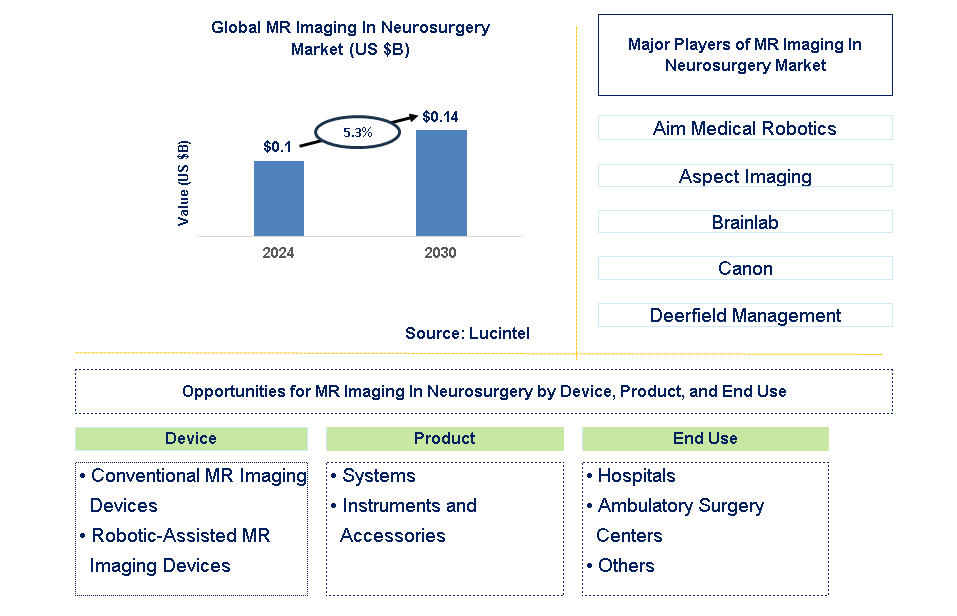
Key data points: The market size in 2030 = $0.14 billion, growth forecast = 5.3% annually for the next 6 years. Scroll below to get more insights. This market report covers trends, opportunities, and forecasts in the global mr imaging in neurosurgery market to 2030 by device (conventional MR imaging devices and robotic-assisted MR imaging devices), product (systems and instruments and accessories), end use (hospitals, ambulatory surgery centers, and others), and region (North America, Europe, Asia Pacific, and the Rest of the World)
We'll send your sample report shortly.
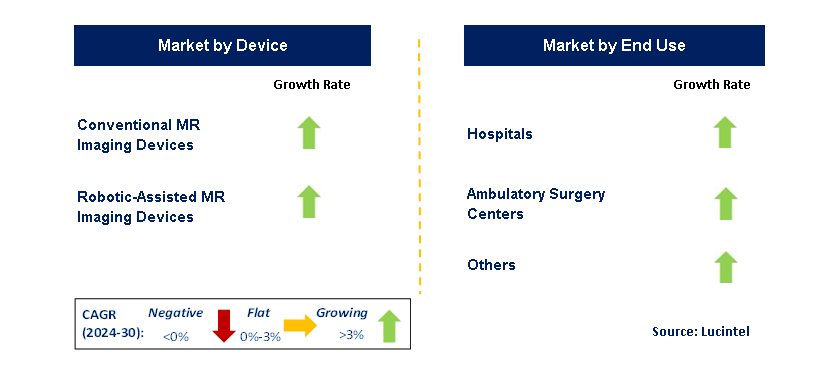
• Lucintel forecasts that, within the device category, conventional MR imaging devices is expected to witness a higher growth over the forecast period.
• Within the end use category, hospital will remain the largest segment.
• In terms of regions, North America will remain the largest region due to increasing prevalence of neurological conditions, growing adoption of new technologies, and strong presence of leading MR imaging manufacturers in the region. Gain valuable insights for your business decisions with our comprehensive 150+ page report.
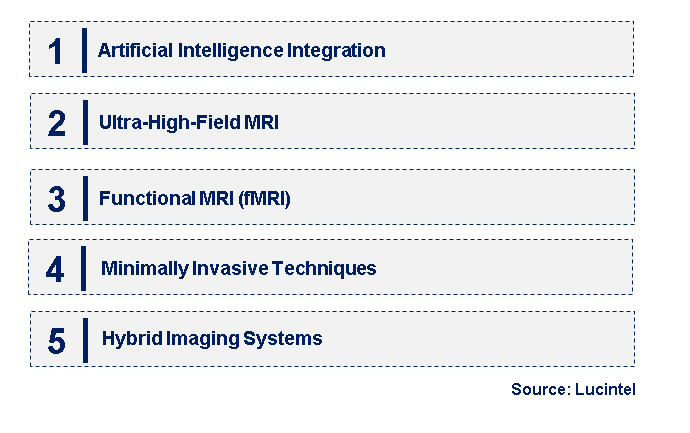
• Artificial Intelligence Integration: There is a growing trend to incorporate AI into MR imaging systems to improve image analysis, use the machines more productively, and even anticipate certain outcomes. This evolution has enhanced the accuracy of diagnoses, reduced the time required for image analysis, and helped develop achievable treatment strategies in surgery.
• Ultra-High-Field MRI: Ultra-high-field MRI systems, approaching 7T, are gaining acceptance and providing novel resolution and contrast. This advancement allows for clearer views of the anatomy and pathology of the brain, thereby facilitating better execution of pre-planned operations.
• Functional MRI (fMRI): fMRI is increasingly used to map brain connectivity for functional purposes, particularly in designing and assessing neurosurgical strategies. This procedure is valuable for identifying functional regions of the brain that could cause impairments if disturbed during surgery.
• Minimally Invasive Techniques: Technological progress in MR imaging has also facilitated the development of minimally invasive neurosurgery techniques. Intraoperative imaging support improves the efficacy of less invasive interventions, reduces the invasiveness of procedures, and offers safer options with earlier recovery times.
• Hybrid Imaging Systems: Hybrid imaging systems have proven effective in practice, where MR imaging is fused with other modalities for PET or CT studies. Analyzing this type of imaging method enhances functional and structural integration, which is crucial in neurosurgical diagnosis and treatment management. These trends suggest that plastic surgery increasingly utilizes innovative channels in the neuroscientific correction of MR imaging technologies, thereby minimizing operative interference and expanding the range of surgical processes. Novel technologies and hybrid solutions are becoming essential for safe and efficient treatment in compliance with modern requirements.
• High MRI Field Strengths: Newly announced Hermes MRI systems offer much greater resolution than most common designs. These systems allow for more defined views of brain anatomy, helping physicians make better diagnoses and formulate treatment methods.
• Artificial Intelligence in MR Imaging: The development of MR systems continues as image analysis technology is enhanced by interpretation algorithms. Furthermore, the use of AI-driven tools improves workflow processes and augments patient therapies.
• Innovative Real-Time Imaging Systems: Recent advancements in real-time MR imaging during neurosurgery have significantly increased procedural accuracy. Surgeons are better able to navigate, and there is a lower risk of complications during complex procedures due to live feedback.
• Concatenated Imaging: Recently developed hybrid imaging systems that combine PET or CT imaging with MR imaging have enhanced the effectiveness of diagnosis and treatment planning. These systems are characterized by the fusion of functional and structural imaging.
• Minimally Invasive MR Methods: The evolution of novel MR imaging techniques favors minimally invasive strategies in neurosurgery. Enhanced imaging technologies allow for more bronchoscopic interventions to be performed accurately and non-invasively, thus reducing recovery time and minimizing patient pain. The latest advancements are positively transforming MR imaging in the neurosurgery field. Such improvements assist in enhancing imaging processes, improving operational accuracy, and ensuring better patient treatment. Continuous technological advancement is raising the standards of neurosurgical interventions.
• High-Resolution Imaging: The development of high-resolution MR imaging systems presents vast opportunities for enhancement. With these systems, NVUs can be visualized with greater clarity, supporting better diagnosis and facilitating improved surgical responses.
• AI and Machine Learning: There is significant potential for growth in the market by developing artificial intelligence and machine learning technologies to aid in MR imaging. These technologies enhance image processing, streamline routine processes, and enable predictive analysis, resulting in faster and more effective neurosurgeries.
• Real-Time Imaging Solutions: Enhancing real-time MR imaging capabilities represents another potential growth area. Such solutions are invaluable in neurosurgical procedures, allowing continuous monitoring during operations, enhancing navigation, and minimizing possible complications even in complex procedures.
• Hybrid Imaging Systems: The development of hybrid MR imaging systems that permit connectivity with other modalities will lead to more accurate and dependable treatment planning. Such integration enhances the performance of neurosurgical procedures and reduces inaccuracies.
• Minimally Invasive Techniques: There is a high demand for MR imaging devices suitable for less invasive neurosurgical techniques. Therapeutic measures that are less invasive lead to quicker recovery periods and reduced chances of complications, making them highly appreciated by patients and medical practitioners. These growth opportunities are shaping the MR imaging in neurosurgery market by upgrading technology, improving patient conditions, and broadening the application of services offered. They present opportunities for meaningful development and investment in the field.
• Technological Progress: The market has rapidly evolved due to technological innovations such as high-field MRI machines and the integration of AI into imaging systems, resulting in better imaging and diagnostics. These improvements aid in surgical planning and enhance outcomes in neurosurgery.
• Surging Need for Accuracy: This has increased the demand for cutting-edge MR imaging technologies as more patients insist on precision in neurosurgery. Thanks to high-resolution imaging and real-time guidance in the surgical theatre, better surgical outcomes and more customized treatment approaches have been achieved.
• Increasing Incidence of Neurological Disorders: The expansion of the advanced MR imaging equipment market is driven by growing awareness of neurological disorders. Advanced imaging techniques are essential for timely and accurate diagnosis and management.
• Investments in Healthcare: Increased healthcare spending, influenced by vaccination and healthcare activism, shapes market dynamics. This shift alters business models, particularly in regions lacking adequate medical imaging systems, supported by government and private funding.
• Research and Development: Advances in functional and magnetic resonance imaging are proliferating due to technological innovations in research and development. Ongoing improvements in techniques and systems aim to enhance imaging accuracy and facilitate neurosurgical procedures. Challenges in the MR imaging in neurosurgery market include:
• High Prices: One significant barrier to the widespread adoption of advanced MR imaging systems is their high cost and maintenance requirements. This challenge affects both healthcare providers and patients, leading to lower technology adoption rates.
• Regulatory Hurdles: Obtaining regulatory clearance for new imaging devices can be a lengthy and complex process. Compliance with regulatory requirements often delays the launch of new products in the market.
• Technical Complexity: Advanced MR imaging systems are technologically demanding, which may hinder their acceptance and use in clinical settings. Overcoming these challenges while maximizing supportive drivers can positively impact market developments and innovations in MR imaging.
• Aim Medical Robotics
• Aspect Imaging
• Brainlab
• Canon
• Deerfield Management
• Esaote
• Faulhaber
• Fonar Corporation
• Fujifilm Holdings Corporation
• General Electric
• Conventional MR Imaging Devices
• Robotic-Assisted MR Imaging Devices
• Systems
• Instruments and Accessories
• Hospitals
• Ambulatory Surgery Centers
• Others
• North America
• Europe
• Asia Pacific
• The Rest of the World
• United States: Recently, the U.S. has begun adopting progressive 7T MRI systems, which provide superior image resolution for precise surgical planning. The integration of artificial intelligence into these systems further enhances image analysis and interpretation, improving patient outcomes and efficiencies in neurosurgery.
• China: China is advancing by introducing affordable MR imaging technologies for mass healthcare. The state is also improving its research capabilities regarding MR imaging to develop new non-invasive strategies for neurosurgery and intraoperative MRI guidance systems.
• Germany: Recent developments in Germany include new MR imaging systems with improved functional imaging capabilities, which are instrumental in evaluating the brain's activity and abnormalities. Additionally, German institutions are exploring synergies, such as integrating MR imaging with other modalities like PET scans to enhance treatment and diagnosis in neurosurgery.
• India: In India, there is a focus on enhancing MR imaging capabilities in both public and private hospitals. The goal is to broaden the scope of high-quality imaging services and incorporate sophisticated MR imaging systems used in modern neurosurgical techniques, thereby improving patient diagnosis and care in a growing healthcare market.
• Japan: Japan is advancing MR imaging capabilities through the introduction of ultra-high-field MRI systems and enhancements in imaging software that improve spatial resolution and speed. These developments are crucial for accurate targeting during brain surgery, increasing safety and success rates, even in complex neurosurgical scenarios.


• AiM Medical Robotics
• Aspect Imaging
• Brainlab
• Canon
• Deerfield Management
• Esaote
• FAULHABER
• Fonar Corporation
• Fujifilm Holdings Corporation
• General Electric Q6. Which MR imaging in neurosurgery market segment will be the largest in future? Answer: Lucintel forecasts that conventional MR imaging devices is expected to witness higher growth over the forecast period. Q7. In MR imaging in neurosurgery market, which region is expected to be the largest in next 5 years? Answer: North America will remain the largest region due to increasing prevalence of neurological conditions, growing adoption of new technologies, and strong presence of leading MR imaging manufacturers in the region. Q.8 Do we receive customization in this report? Answer: Yes, Lucintel provides 10% customization without any additional cost.


Choose a license that fits your team. Instant PDF delivery.
Prices exclude taxes. Instant delivery. Custom licensing available on request.
Market Report · June 29, 2026
Market Report · May 18, 2026
Trusted partner for strategic intelligence and business growth


Receive a complimentary market analysis tailored to your industry. Our analysts will identify key growth opportunities and competitive dynamics specific to your business.

Market size, growth rate, and key trend analysis for your specific sector.

Top competitor positioning and market share analysis.

Strategic recommendations backed by data-driven insights.
Get curated market intelligence and competitive moves straight to your inbox.
By subscribing, you agree to receive our monthly insights. Unsubscribe anytime.
Receive a complimentary market analysis tailored to your industry. Our analysts will identify key growth opportunities and competitive dynamics specific to your business.
Market size, growth rate, and key trend analysis for your specific sector.
Top competitor positioning and market share analysis.
Strategic recommendations backed by data-driven insights.
Get curated market intelligence, emerging trends, and competitive moves straight to your inbox each month.
By subscribing, you agree to receive our monthly insights. Unsubscribe anytime.
We'll send your sample report shortly.