
Market Report · June 29, 2026

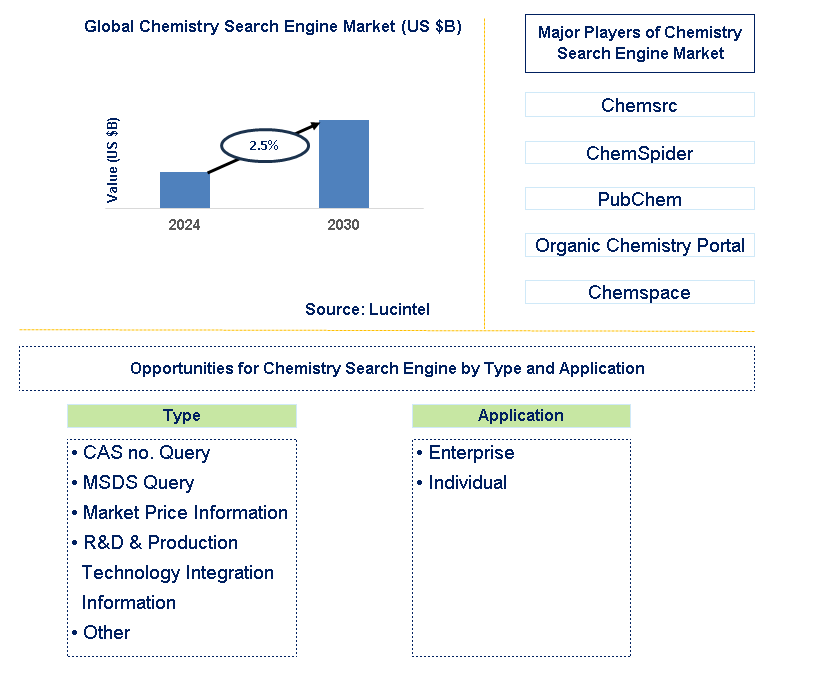
Key data points: The growth forecast = 2.5% annually for the next 6 years. Scroll below to get more insights. This market report covers trends, opportunities, and forecasts in the global chemistry search engine market to 2030 by type (CAS no. query, MSDS query, market price information, R&D & production technology integration information, and other), application (enterprise and individual), and region (North America, Europe, Asia Pacific, and the Rest of the World)
We'll send your sample report shortly.
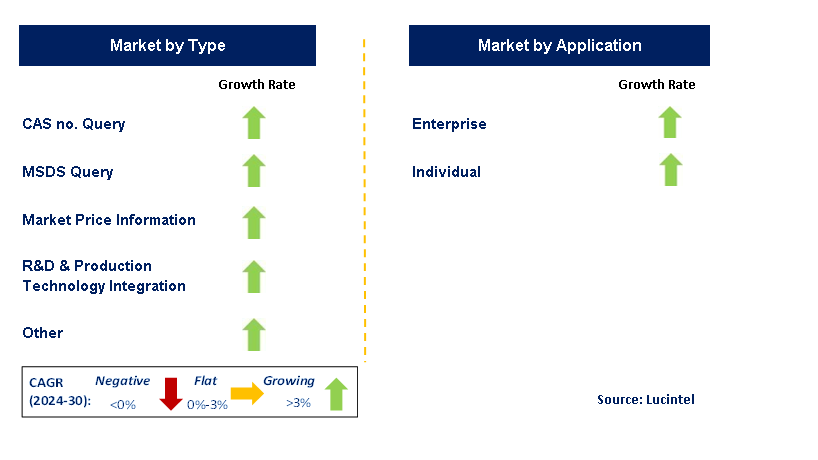
• Lucintel forecasts that, within the type category, AS no. query is expected to witness the highest growth over the forecast period.
• Within the application segment, enterprise is expected to witness a higher growth.
• In terms of regions, North America is expected to witness highest growth over the forecast period. Gain valuable insight for your business decisions with our comprehensive 150+ page report
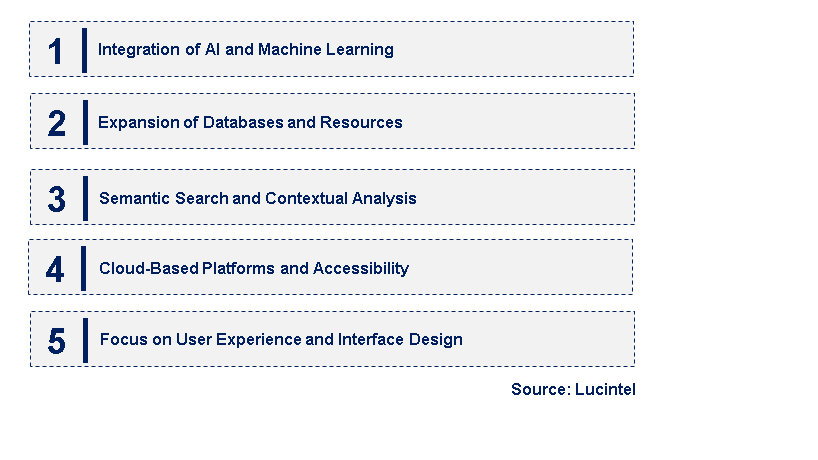
• Integration of AI and Machine Learning: AI and machine learning are increasingly being integrated into chemistry search engines to enhance search accuracy and relevance. These technologies enable more advanced querying, predictive analytics, and personalized search results, improving the overall user experience and efficiency in finding chemical information.
• Expansion of Databases and Resources: There is a trend towards expanding the scope of databases and resources available through chemistry search engines. This includes incorporating a wider range of chemical compounds, research papers, patents, and industry data to provide more comprehensive and diverse information for researchers and professionals.
• Semantic Search and Contextual Analysis: Semantic search technologies are being used to improve the precision of search results by understanding the context and intent behind queries. Contextual analysis helps users find more relevant and accurate information, making search engines more effective for complex chemical queries and research tasks.
• Cloud-Based Platforms and Accessibility: Cloud-based platforms are becoming more prevalent, offering greater flexibility and accessibility for chemistry search engines. These platforms enable users to access data and tools from anywhere, facilitate real-time updates, and support collaborative research efforts through integrated cloud services.
• Focus on User Experience and Interface Design: There is an increased emphasis on enhancing user experience and interface design in chemistry search engines. Improved user interfaces, intuitive navigation, and customizable features are being implemented to make search engines more user-friendly and efficient for both novice and expert users. These emerging trends are reshaping the chemistry search engine market by driving advancements in AI, database expansion, semantic search, cloud-based solutions, and user experience. These innovations are making chemical information retrieval more accurate, comprehensive, and accessible.
• AI-Powered Search Enhancements: The integration of AI into chemistry search engines is improving search capabilities by offering predictive search suggestions, error detection, and context-aware results. AI algorithms help refine search accuracy and speed up the retrieval of relevant chemical information.
• Growth in Data Sources: There has been a significant expansion in the types and volumes of data sources included in chemistry search engines. New platforms are incorporating a wider array of chemical databases, scholarly articles, and industry reports, providing users with more comprehensive data access.
• Advanced Filtering and Sorting Features: Recent developments include the implementation of sophisticated filtering and sorting features that allow users to narrow down search results based on specific criteria such as chemical properties, publication date, and relevance. These features enhance the efficiency of the search process.
• Collaboration Tools and Integration: Modern chemistry search engines are incorporating collaboration tools and integration capabilities with other research management systems. These features support teamwork, data sharing, and integration with laboratory information management systems (LIMS), improving overall research productivity.
• Enhanced Mobile and Remote Access: The development of mobile-friendly and remote-access capabilities is allowing users to access chemistry search engines from various devices and locations. This flexibility supports on-the-go research and collaboration, catering to the needs of today’s mobile and remote workforce. These recent key developments are advancing the chemistry search engine market by enhancing AI capabilities, expanding data sources, improving search functionalities, integrating collaboration tools, and supporting mobile access. These advancements are making chemical information retrieval more efficient and accessible.
• Expansion into Emerging Markets: Targeting emerging markets presents a growth opportunity as these regions develop their scientific research infrastructure. By offering localized content and support, companies can tap into new user bases and address growing research needs in these areas.
• Development of Specialized Search Engines: Creating search engines tailored to specific subfields of chemistry, such as medicinal chemistry or environmental chemistry, can address niche market needs. Specialized platforms can provide more relevant data and tools for targeted research applications.
• Integration with Big Data and Analytics: Leveraging big data and analytics technologies can enhance search engine capabilities by providing deeper insights into chemical data and trends. This integration supports advanced data analysis and predictive modeling, benefiting researchers and industry professionals.
• Enhancing Collaboration Features: Investing in collaboration features, such as shared workspaces and integrated communication tools, can enhance research productivity and foster teamwork. These features support collaborative projects and data sharing among researchers, institutions, and organizations.
• Focus on User Education and Training: Providing educational resources and training for users can help maximize the effectiveness of chemistry search engines. Training programs and tutorials can assist users in navigating advanced features and utilizing search engines more effectively for their research needs. These strategic growth opportunities highlight areas where the chemistry search engine market can expand and innovate. By focusing on emerging markets, specialized solutions, big data integration, collaboration features, and user education, companies can drive growth and enhance the value of their search engine offerings.
• Technological Advancements: Advances in AI, machine learning, and big data technologies are driving innovation in chemistry search engines. These technologies improve search accuracy, enhance data analysis capabilities, and enable more sophisticated querying and information retrieval.
• Increasing Research and Development Activities: The growing demand for chemical research and development across industries is fueling the need for advanced search engines. Researchers require efficient tools to access and analyze vast amounts of chemical data for innovation and discovery.
• Expansion of Digital Data Resources: The expansion of digital data resources and online databases is driving the development of more comprehensive and effective chemistry search engines. Access to a broader range of data sources enhances the value and utility of search engines.
• Focus on Efficiency and Productivity: The need for improved research efficiency and productivity is driving the adoption of advanced search engine features. Enhanced search functionalities, real-time updates, and integration with other research tools support faster and more effective information retrieval.
• Growing Importance of Data Compliance: Increasing regulatory requirements for data compliance and accuracy are pushing the development of search engines that ensure adherence to industry standards and regulations. Compliance features are becoming essential for users in regulated industries. Challenges in the chemistry search engine market are:
• Data Security and Privacy Concerns: The reliance on digital platforms raises concerns about data security and privacy. Protecting sensitive chemical information and ensuring compliance with data protection regulations are critical challenges for search engine providers.
• High Implementation Costs: The cost of developing and maintaining advanced search engines can be significant. High implementation costs may pose a barrier for some organizations, particularly smaller research institutions or companies.
• Integration Complexity: Integrating search engines with existing research management systems and workflows can be complex and challenging. Ensuring seamless data flow and compatibility between systems is crucial for successful implementation and user adoption. The drivers and challenges impacting the chemistry search engine market shape its development and growth. By addressing challenges related to data security, costs, and integration while leveraging drivers such as technological advancements and expanding data resources, companies can enhance their search engine solutions and drive market success.
• Chemsrc
• ChemSpider
• PubChem
• Organic Chemistry Portal
• Chemspace
• ChemicalBook
• CWM Global Search
• CHEMnetBASE
• ChemDiv
• Chemaxon
• CAS no. Query
• MSDS Query
• Market Price Information
• R&D & Production Technology Integration Information
• Other
• Enterprise
• Individual
• North America
• Europe
• Asia Pacific
• The Rest of the World
• United States: In the U.S., recent developments include the integration of AI and machine learning technologies into chemistry search engines. These innovations are improving search accuracy and relevance by enabling more sophisticated querying and data analysis. Additionally, there is a focus on expanding databases to include a broader range of chemical compounds and research articles.
• China: China is experiencing growth in the chemistry search engine market with a focus on enhancing search capabilities and data coverage. Chinese companies are developing platforms that provide detailed chemical information and research insights, supporting both local and international research initiatives. There is also an emphasis on integrating these search engines with educational and industrial applications.
• Germany: Germany is advancing its chemistry search engine market by incorporating advanced data analytics and semantic search technologies. German platforms are offering improved search functionalities, including context-aware searches and enhanced filtering options. There is also a push towards greater collaboration with European research institutions to expand the scope of available chemical data.
• India: In India, the chemistry search engine market is growing with the introduction of cost-effective and scalable solutions. Indian companies are focusing on developing platforms that offer localized content and support for regional research needs. These platforms are also integrating features for better collaboration and knowledge sharing among researchers and institutions.
• Japan: Japan is seeing developments in its chemistry search engine market with a focus on high-performance computing and big data analytics. Japanese platforms are leveraging these technologies to provide deeper insights and more comprehensive chemical data. There is also a growing emphasis on integrating search engines with Japan’s advanced chemical research and development activities.


• Chemsrc
• ChemSpider
• PubChem
• Organic Chemistry Portal
• Chemspace
• ChemicalBook
• CWM Global Search
• CHEMnetBASE
• ChemDiv
• Chemaxon Q5. Which chemistry search engine market segment will be the largest in future? Answer: Lucintel forecasts that CAS no. query is expected to witness the highest growth over the forecast period. Q6. In chemistry search engine market, which region is expected to be the largest in next 5 years? Answer: North America is expected to witness highest growth over the forecast period. Q7. Do we receive customization in this report? Answer: Yes, Lucintel provides 10% customization without any additional cost.


Choose a license that fits your team. Instant PDF delivery.
Prices exclude taxes. Instant delivery. Custom licensing available on request.
Market Report · June 29, 2026
Market Report · May 18, 2026
Trusted partner for strategic intelligence and business growth


Receive a complimentary market analysis tailored to your industry. Our analysts will identify key growth opportunities and competitive dynamics specific to your business.

Market size, growth rate, and key trend analysis for your specific sector.

Top competitor positioning and market share analysis.

Strategic recommendations backed by data-driven insights.
Get curated market intelligence and competitive moves straight to your inbox.
By subscribing, you agree to receive our monthly insights. Unsubscribe anytime.
Receive a complimentary market analysis tailored to your industry. Our analysts will identify key growth opportunities and competitive dynamics specific to your business.
Market size, growth rate, and key trend analysis for your specific sector.
Top competitor positioning and market share analysis.
Strategic recommendations backed by data-driven insights.
Get curated market intelligence, emerging trends, and competitive moves straight to your inbox each month.
By subscribing, you agree to receive our monthly insights. Unsubscribe anytime.
We'll send your sample report shortly.