
Report Feature
Mortise Lock Market Trends and Forecast
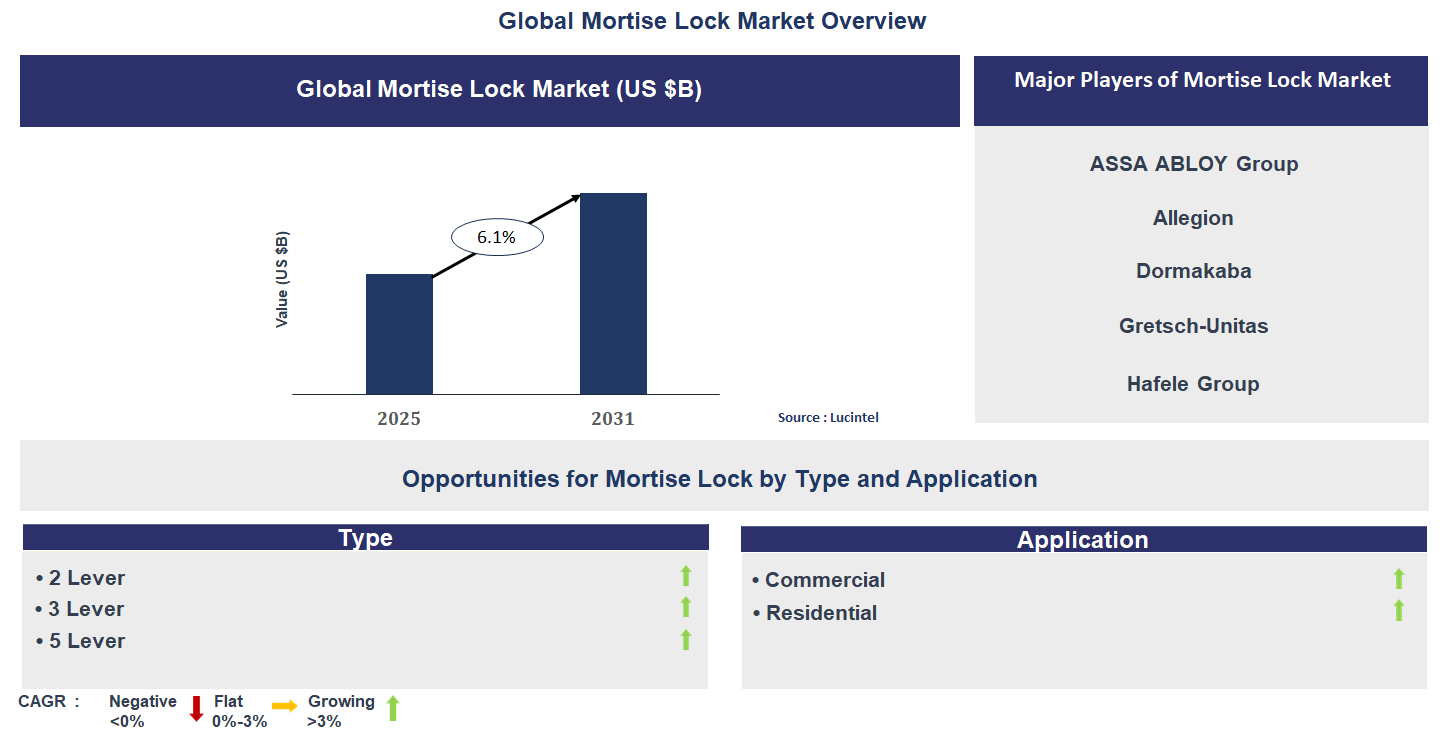
The future of the global mortise lock market looks promising with opportunities in the commercial and residential markets. The global mortise lock market is expected to grow with a CAGR of 6.1% from 2025 to 2031. The major drivers for this market are the increasing demand for enhanced security solutions, the rising demand for smart locks, and the growing focus on integrated smart building systems.• Lucintel forecasts that, within the type category, 5 lever is expected to witness the highest growth over the forecast period.
• Within the application category, residential is expected to witness higher growth.
• In terms of region, APAC is expected to witness the highest growth over the forecast period. Gain valuable insights for your business decisions with our comprehensive 150+ page report. Sample figures with some insights are shown below.
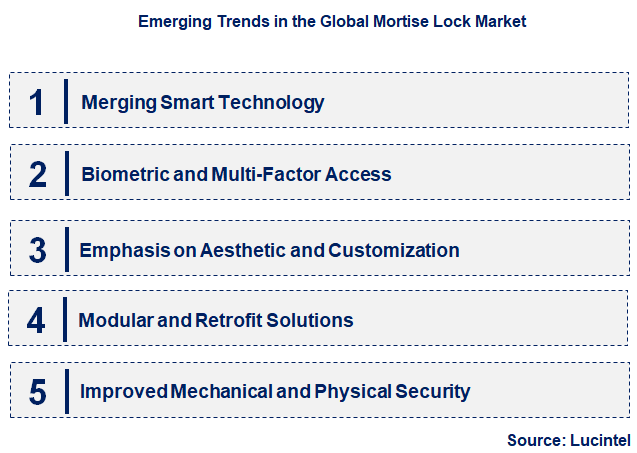
Emerging Trends in the Mortise Lock Market
The mortise lock industry is experiencing a fundamental transformation from mechanically based products to advanced, networked security solutions. This is being led by the fast pace of IoT technology development, the escalated world security threat landscape, and the desire from consumers for ease of use and integration within intelligent environments. These new trends are not just incremental innovations; they are a complete redefinition of the products function, utility, and market position, with the mechanical robustness of the mortise lock as a building block for advanced digital capabilities.• Merging Smart Technology: The emergence of the smart home ecosystem is compelling manufacturers to create hybrid smart mortise locks that merge the physical power of a conventional mortise body with digital access capabilities. Users can now control and monitor their locks from anywhere, get real-time access updates, and allow temporary digital keys through a smartphone app. The effect is profound, turning the lock from a mere barrier into an intelligent access system, strongly appealing to technology-aware residential and hospitality markets and warranting premium prices.
• Biometric and Multi-Factor Access: Security concerns are spurring demand for more secure and tamper-resistant access verification. Biometric systems, built directly into the mortise handle set, put an end to the weakness of simple keys or plain PIN codes. The direction is shifting toward multi-factor authentication, where access may be based on a combination of credentials. This offers a much higher degree of security and convenience, which is especially appealing for commercial offices, high-security apartments, and institutions that need audited access logs.
• Emphasis on Aesthetic and Customization: Since the mortise lock is part of the door hardware that can be seen, its aesthetic appeal and compatibility with the overall architectural design has also become the principal buying consideration, particularly in high-end applications. Manufacturers are reacting by providing varied materials (stainless steel, brass, zinc alloy) and finishes (matte black, satin nickel, antique brass) and custom-designed trim and handles. This trend not only brings the mortise lock from a utilitarian product to a design feature but also allows manufacturers to make their products stand out in a competitive marketplace.
• Modular and Retrofit Solutions: The complexity of installing a conventional mortise lock may be a limiting factor. To overcome this, the market is moving towards modular designs where the installer is able to simply replace the cylinder or core (Interchangeable Core Lock) or replace a mechanical mortise lock with a smart or electrified trim. This simplifies maintenance, rekeying, and technology adoption far more efficiently and economically for end-users, which extends the life of the mortise lock body and addresses the huge replacement and renovation market.
• Improved Mechanical and Physical Security: In spite of the recent growth of smart locks, the core function of the mortise lock remains physical security. Manufacturers continually enhance the mechanical part with high-grade anti-picking mechanisms, strengthened materials (such as hardened steel), and high-tech cylinder designs. It guarantees that the underlying mechanical security of the mortise lock is still superior to lower-complexity lock types, offering an essential fail-safe mechanism, particularly in smart or electrified versions, and adhering to high standards of commercial security requirements. All these five major trends—Smart Integration, Biometric Access, Aesthetic Focus, Modular Design, and Improved Physical Security—are collectively transforming the mortise lock industry. The industry is moving away from an entirely mechanical landscape into a hybrid mechatronic security industry. The inherent robustness of the mortise mechanism provides a solid physical underpinning upon which sophisticated digital features are superimposed. This transformation enhances the value proposition of the lock by providing unmatched security, adaptable aesthetics, and complete integration with smart living and commercial building management systems.
Recent Development in the Mortise Lock Market
The mortise lock has long been regarded as the gold standard for robust mechanical security, particularly in commercial and high-end residential applications due to its complex internal mechanism housed within the door. Unlike simpler cylindrical locks, the mortise lock offers superior durability and a combination of latch and deadbolt functions within a single, heavy-duty case. In recent years, its market has seen dynamic shifts, driven primarily by the sweeping tide of smart home technology and evolving consumer demands for enhanced convenience without compromising on traditional strength.• Hybrid Smart Lock Integration: Manufacturers are rapidly introducing hybrid mortise locks that combine the traditional, heavy-duty mechanical core with advanced electronic features like keypads, biometric scanners, and Bluetooth/Wi-Fi connectivity. This integration allows users to retain the mortise lock’s superior physical security and aesthetic compatibility with various handles, while gaining keyless access, remote control via a smartphone app, and real-time activity logs. The impact is a significant expansion of the mortise locks application into the burgeoning smart home and hospitality sectors, bridging the gap between time-tested hardware and modern digital access control.
• Adoption of Biometric and Multi-Factor Authentication: The incorporation of biometric authentication (e.g., fingerprint or facial recognition) and MFA capabilities is a major security upgrade. These features eliminate vulnerabilities associated with lost or copied keys and easily guessed passcodes by requiring unique biological identifiers or multiple verification steps. This development is primarily impacting the commercial and high-security residential segments, where the need for quick, trackable, and highly secure access control is paramount.
• Focus on High-Grade and Anti-Tamper Materials: There is a growing emphasis on using high-grade, resilient materials like stainless steel (SS304) and zinc alloys, along with innovative internal design features to enhance resistance against physical attacks. Innovations include anti-pick technology, reinforced strike plates, and mechanisms resistant to drilling or prying. This focus on durability and anti-tamper design directly addresses rising security concerns, ensuring the mortise lock maintains its reputation for mechanical superiority over less robust alternatives.
• Modular and Retrofit Design Solution: New mortise lock designs are increasingly modular, allowing for easier and more versatile installation, as well as simpler retrofit integration of smart components into existing mechanical bodies. This makes upgrading an old, purely mechanical mortise lock system with smart technology less disruptive and more cost-effective for end-users. This trend significantly improves market accessibility and adoption for modern mortise lock technology, particularly in renovation projects and historical buildings, by lowering the barrier to entry for smart security upgrades.
• Increased Aesthetic Customization and Finish Options: To cater to high-end architectural and interior design trends, manufacturers are offering an expansive range of aesthetic customization options for trim, faceplates, and handle styles, including trending finishes like matte black, satin nickel, and antique brass. This allows the lock hardware to seamlessly complement a wide variety of door materials and architectural themes. This development enhances the mortise locks appeal in premium markets, ensuring it remains the preferred choice where design and visual appeal are just as crucial as security performance. These five key developments are collectively redefining the modern mortise lock market by focusing on a synthesis of its traditional strengths and contemporary technological demands. The introduction of hybrid smart locks, biometrics, and modular designs directly counters the competitive threat posed by purely electronic smart locks, establishing the smart-enabled mortise lock as a distinct, premium segment.
Strategic Growth Opportunities in the Mortise Lock Market
The time-honored strength and reliability of the mortise lock combined with contemporary technological incorporation have provided dramatic strategic growth opportunities in many end-user applications. The growth of the market is being driven not only by new building construction but, most importantly, by the need for high-end security, increased convenience, and integrated system user-friendliness in various types of buildings.• Smart Retrofitting: For the high-end residential segment, owners require superior security without sacrificing the architectural integrity of their property. The competitive advantage is in hybrid solutions that enable consumers to retrofit smart capabilities such as remote monitoring and biometric authentication onto their current, high-quality mechanical mortise locks. This speaks most directly to the renovation market by presenting a premium, non-destructive upgrade pathway, sidestepping the expense and intricacy of a complete door hardware replacement and setting up the mortise lock as the de facto luxury smart security standard.
• Networked Access Control Systems: Hotels require robust, high-volume, and easily managed access control. The opportunity is to provide networked smart mortise locks that are optimized for high-traffic environments, offering seamless guest experience (mobile check-in and key) and crucial centralized audit trails for hotel management. The mortise locks durability makes it ideal for constant use, while its smart features streamline operations, minimize key management costs, and enhance overall guest security and satisfaction.
• Commercial Offices and Corporate Campuses: Security and compliance are crucial in the business world. Strategic expansion comes in the form of delivering next-generation mortise locks that use biometric verification (fingerprint, facial recognition) for increased security and accurate time-and-attendance monitoring. The high-security locks, commonly with limited keyway choice, offer enhanced protection for secure areas and are critical for security regulation compliance, making the mortise lock the best solution for controlled, auditable, and multi-layered corporate access.
• Life Safety and Egress Products: Facilities such as hospitals and universities present special requirements for emergency exit and high-security conditions. The business opportunity is to adapt mortise locks with options such as panic bar integration and heavy-duty fire-rating ratings. The lock needs to provide instant mechanical opening from the inside in an emergency while offering secure, frequently electronically controlled, entry from the outside. This specialized niche involves compliance with intricate regulations, making specialized mortise locks key elements in a buildings life safety system.
• Affordable Smart Access: The expanding multi-family dwelling market requires long-lasting, easy-to-maintain access solutions that attract tenants. The strategic value is delivering cost-effective, standard smart mortise locks a property manager can operate remotely for tenant move-in/move-out without altering physical keys. The mortar bodys inherent longevity reduces maintenance expense, and the smart aspects enhance tenant attractiveness, generating high-volume sales to property managers and developers looking for effective building management. These application-focused growth opportunities are substantially broadening the Mortise Lock markets revenue streams and changing its focus from a generic mechanical product to one that is a specialized solution provider. By customizing features to each industrys unique security, operational, and aesthetic requirements—from high-security corporate biometrics to simplicity-oriented hotel keycards—producers are increasing the total addressable space of the market.
Mortise Lock Market Driver and Challenges
The mortise lock market stands at a crossroads, driven by the interaction between technological development, economic factors, and changing security standards. The major drivers are compelling the market towards integration and modernization, while key challenges impose constraints related to competition, complexity, and cost. Understanding these forces is essential, as the markets future trajectory will be determined by how effectively manufacturers can leverage drivers like the smart home trend while mitigating challenges such as the higher initial investment required for advanced mechatronic products. The factors responsible for driving the mortise lock market include: 1. Rising Global Security Concerns: Growing consciousness of burglary, theft, and the necessity of regulated entry in domestic and commercial properties worldwide fuel the demand for high-security locks. Mortise locks, with their solid construction and greater tamper resistance over less complex lock models, are naturally situated to respond to this demand. The implication is a continued emphasis on increased mechanical strength and the incorporation of elements such as drill-resistance and anti-picking technology to make the mortise lock the choice for high-end and high-risk applications. 2. Expansion in Smart Home and IoT Integration: Increased growth in smart home systems and the need for connected devices are driving demand for electronic or hybrid mortise locks. Consumers are demanding greater convenience from keyless entry, remote monitoring, and voice-control integration. It is a great technology driver that compels conventional makers to invest significantly in mechatronic R&D to make products supporting Wi-Fi, Bluetooth, and biometric functions, thus redefining the mortise lock as an active participant of a complete security solution. 3. Urbanization and Construction Rush: Giant infrastructure construction, especially in emerging markets such as India and China, combined with continuous construction and renovation processes within developed economies, poses a constant demand for door hardware. Mortise locks are the standard for most commercial and luxury doors because of their versatility and compatibility with different types of doors. 4. Commercial and Institutional Demand for Audited Access: Commercial office buildings, hotels, hospitals, and schools have a need for strong access control that can accommodate hundreds of users, display real-time status, and record detailed audit trails. Electrified and intelligent mortise locks, through networkability and integration with advanced access control software, are the best answer. This driver requires product development geared to meeting fire and egress codes, central management software, and integration with property management systems (PMS). 5. Selection of Higher Durability and Longevity: Mortise locks are more durable and less prone to damage compared to cylindrical or tubular locks because of the way they are built and installed within the door pocket. In the business world, where locks experience high volumes of usage each day, durability plays a significant role in reducing maintenance and replacement expenses. The market driver helps to reinforce the mortise lock position as a premium product that has a lower total cost of ownership for its entire life compared to the frequently shorter life of more straightforward or less durable lock mechanisms. Challenges in the mortise lock market are: 1. High Upfront Cost and Complexity in Installation: In contrast to cheaper substitutes such as cylindrical or deadbolt locks, a mortise lock and its fitment are far more complicated and costly. The technology involves a deep mortise pocket being cut into the edge of the door. This greater upfront cost discourages price-conscious consumers and mass-market housebuilders. The challenge pushes manufacturers to come up with simpler, modular, or retrofit products and improved installation tools to lower labor costs and increase the products attractiveness in mainstream building. 2. Alternative Lock Type Competition: The mortise lock is confronted with mounting competition from simpler, easier-to-install, and at times lower-cost smart deadbolts or lever locks, especially in the mass residential segment. These options tend to provide an equivalent amount of smart features with less involved installation. To combat this, the market for mortise locks has to focus constantly on its higher physical security and multi-functionality (latch and deadbolt integrated into a single mechanism) and present itself based on value and performance, not just features or price. 3. Cybersecurity and Data Privacy Issues: For electronic and smart mortise locks, hacking vulnerabilities, unauthorized access to data, and system failures pose important challenges. A security breach may make an entire buildings access compromised. Manufacturers would need to spend big on strong encryption, secure firmware updates, and offline robustness to deflect cyber threats and establish consumer confidence. Fixing this issue is important since a failed smart lock mechanism reflects directly on the essential value proposition of security. The combined impact of the drivers and challenges is a market experiencing fast-paced, but restricted, premiumization. Key drivers—security demand and technology integration—are driving the mortise lock into a high-value, smart, mechatronic product mainly for the commercial and premium residential markets. The restrictive high initial cost and installation complexity, however, serve as a brake on mass-market take up, driving demand towards simpler options for price-sensitive applications.List of Mortise Lock Companies
Companies in the market compete on the basis of product quality offered. Major players in this market focus on expanding their manufacturing facilities, R&D investments, infrastructural development, and leverage integration opportunities across the value chain. With these strategies mortise lock companies cater increasing demand, ensure competitive effectiveness, develop innovative products & technologies, reduce production costs, and expand their customer base. Some of the mortise lock companies profiled in this report include-• ASSA ABLOY Group
• Allegion
• Dormakaba
• Gretsch-Unitas
• Hafele Group
• Franz Schneider Brakel
• CES
• Taymor
• Zhejiang Hongli Locks
• SELECO
Mortise Lock Market by Segment
The study includes a forecast for the global mortise lock market by type, application, and region.Mortise Lock Market by Type [Value from 2019 to 2031]:
• 2 Lever
• 3 Lever
• 5 Lever
Mortise Lock Market by Application [Value from 2019 to 2031]:
• Commercial
• Residential
Mortise Lock Market by Region [Value from 2019 to 2031]:
• North America
• Europe
• Asia Pacific
• The Rest of the World
Country Wise Outlook for the Mortise Lock Market
The world mortise lock market is witnessing a dramatic shift, advancing beyond mechanical security to adopting digitalization and smart technology. The reasons behind this shift are growing global concerns for security, the pace of urbanization, and the spread of integrated building management and smart home systems. Although the native robustness and advanced security characteristics of the traditional mortise lock mechanism ensure its ongoing applicability, current innovations are mainly targeting hybrid configurations that also include electronic, biometric, and IoT capabilities.• United States: The US market is defined by a robust trend toward intelligent mortise locks that both fit seamlessly into established home automation and security environments such as Apple HomeKit or Google Assistant. Features such as remote access, activity logging, and keyless entry dominate, typically in the form of retrofitting electronic capabilities into mechanical mortise bodies. This reflects strong consumer demand for convenience and security both within the high-end residential and commercial segments.
• China: China is a leading world manufacturing center for mortise locks, with high-volume production of classic mechanical and ever more advanced smart types. Current developments emphasize technological convergence, and Chinese producers are investing heavily in biometric and facial recognition smart mortise locks both domestically and for export. Urbanization and huge infrastructure development keep demand high for varied, price-competitive locking products.
• Germany: The German market focuses on high-precision engineering, toughness, and compliance with strict security and quality standards (e.g., DIN norms). Innovations are based on sophisticated mechanical anti-picking technology and the strength of mortise locks construction, typically employing advanced materials. There is ongoing, though slower, use of electronic and mechatronic mortise locks for commercial and institutional building access control systems, with an emphasis on reliability and longevity.
• India: The mortise lock market in India is growing at a rapid pace with a booming construction sector, growing disposable incomes, and rising consumer awareness of contemporary security products. The emphasis is on affordability against improved security, with demand driving for high-security multi-lever mechanical and economic digital mortise locks for the mass residential segment. Government policies such as Make in India are also promoting domestic manufacturing and R&D.
• Japan: Japans market is characterized by high penetration of high-tech electronic and smart lock systems, frequently combined with high-level building security and disaster response protocols. The latest trends lean more towards minimalist, high-tech mortise locks that provide multiple access methods (keycard, mobile, PIN, biometric) and retain a slim, unobtrusive profile. The focus is on ultra-smooth user experience, energy-saving performance, and high reliability in access control for residential and commercial skyscrapers.

Features of the Global Mortise Lock Market
Market Size Estimates: Mortise lock market size estimation in terms of value ($B). Trend and Forecast Analysis: Market trends (2019 to 2024) and forecast (2025 to 2031) by various segments and regions. Segmentation Analysis: Mortise lock market size by type, application, and region in terms of value ($B). Regional Analysis: Mortise lock market breakdown by North America, Europe, Asia Pacific, and Rest of the World. Growth Opportunities: Analysis of growth opportunities in different types, applications, and regions for the mortise lock market. Strategic Analysis: This includes M&A, new product development, and competitive landscape of the mortise lock market. Analysis of competitive intensity of the industry based on Porter’s Five Forces model.
FAQ
Q1. What is the growth forecast for mortise lock market? Answer: The global mortise lock market is expected to grow with a CAGR of 6.1% from 2025 to 2031. Q2. What are the major drivers influencing the growth of the mortise lock market? Answer: The major drivers for this market are the increasing demand for enhanced security solutions, the rising demand for smart locks, and the growing focus on integrated smart building systems. Q3. What are the major segments for mortise lock market? Answer: The future of the mortise lock market looks promising with opportunities in the commercial and residential markets. Q4. Who are the key mortise lock market companies? Answer: Some of the key mortise lock companies are as follows:• ASSA ABLOY Group
• Allegion
• Dormakaba
• Gretsch-Unitas
• Hafele Group
• Franz Schneider Brakel
• CES
• Taymor
• Zhejiang Hongli Locks
• SELECO Q5. Which mortise lock market segment will be the largest in future? Answer: Lucintel forecasts that, within the type category, 5 lever is expected to witness the highest growth over the forecast period. Q6. In mortise lock market, which region is expected to be the largest in next 5 years? Answer: In terms of region, APAC is expected to witness the highest growth over the forecast period. Q7. Do we receive customization in this report? Answer: Yes, Lucintel provides 10% customization without any additional cost.
Table of Contents
List of Figures
List of Tables
Methodology
- In-depth interviews of the major players in this market
- Detailed secondary research from competitors’ financial statements and published data
- Extensive searches of published works, market, and database information pertaining to industry news, company press releases, and customer intentions
- A compilation of the experiences, judgments, and insights of Lucintel’s professionals, who have analyzed and tracked this market over the years.


Buy Now
Choose a license that fits your team. Instant PDF delivery.
Prices exclude taxes. Instant delivery. Custom licensing available on request.
Key Questions
- • What are some of the most promising, high-growth opportunities for the mortise lock market by type (2 lever, 3 lever, and 5 lever), application (commercial and residential), and region (North America, Europe, Asia Pacific, and the Rest of the World)?
- • Which segments will grow at a faster pace and why?
- • Which region will grow at a faster pace and why?
- • What are the key factors affecting market dynamics? What are the key challenges and business risks in this market?
- • What are the business risks and competitive threats in this market?
- • What are the emerging trends in this market and the reasons behind them?
- • What are some of the changing demands of customers in the market?
- • What are the new developments in the market? Which companies are leading these developments?
- • Who are the major players in this market? What strategic initiatives are key players pursuing for business growth?
- • What are some of the competing products in this market and how big of a threat do they pose for loss of market share by material or product substitution?
- • What M&A activity has occurred in the last 5 years and what has its impact been on the industry? For any questions related to Mortise Lock Market, Mortise Lock Market Size, Mortise Lock Market Growth, Mortise Lock Market Analysis, Mortise Lock Market Report, Mortise Lock Market Share, Mortise Lock Market Trends, Mortise Lock Market Forecast, Mortise Lock Companies, write Lucintel analyst at email: helpdesk@lucintel.com. We will be glad to get back to you soon.


