
'
...

The Impact of COVID-19 is included in Mortar Ammunition Market Report. Buy it today to get an advantage.

Request the impact of COVID-19 on your product or industry


Mortar Ammunition Market Trends and Forecast

The future of the global mortar ammunition market looks promising with opportunities in the infantry support, artillery support, counter-insurgency, and urban warfare markets. The global mortar ammunition market is expected to reach an estimated $7 billion by 2035 with a CAGR of 3.6% from 2026 to 2035. The major drivers for this market are the increasing demand for defense spending, the rising military modernization programs efforts, and the growing need for mortar ammunition.

• Lucintel forecasts that, within the fuze type category, point detonating is expected to witness the highest growth over the forecast period.
• Within the application category, infantry support is expected to witness the highest growth.
• In terms of region, APAC is expected to witness the highest growth over the forecast period.
Gain valuable insights for your business decisions with our comprehensive 150+ page report. Sample figures with some insights are shown below.
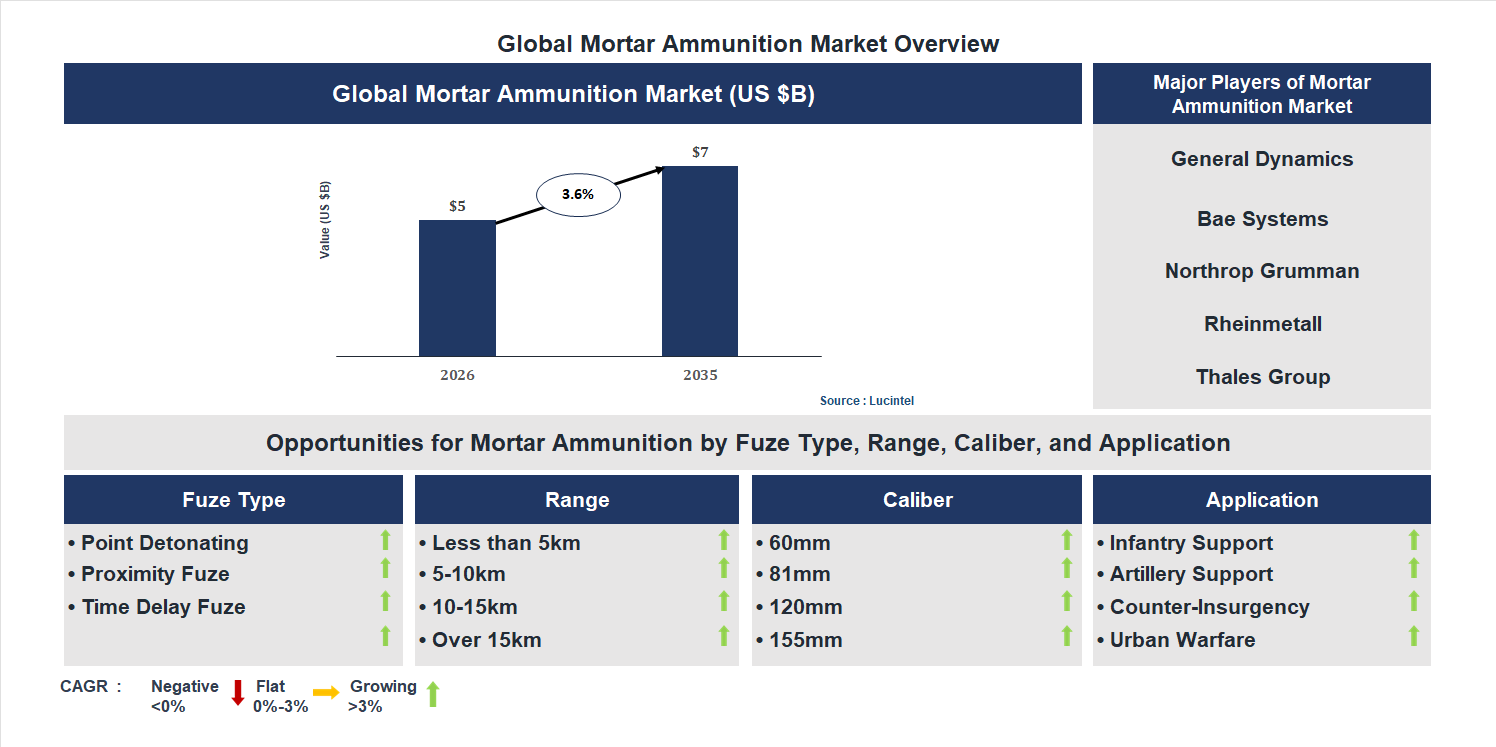
Mortar Ammunition Market Trends and Forecast

Emerging Trends in the Mortar Ammunition Market

The mortar ammunition market is undergoing a rapid evolution as technological breakthroughs redefine the capabilities of traditional indirect fire systems. Modern warfare demands a shift from traditional "area fire" to high-precision engagement to maximize effects while minimizing collateral damage. These emerging trends are creating a more lethal, efficient, and interconnected battlefield environment for global infantry forces.

• Precision Guidance Systems: Integrating GPS and laser seekers into mortar rounds for surgical strike accuracy. The adoption of precision-guided munitions is the most transformative trend, allowing mortars to strike specific targets with minimal rounds. This capability reduces the logistical burden of transporting massive amounts of shells and minimizes the risk of friendly fire. Impact is seen in the increased effectiveness of small units operating independently in complex or urban terrains.
• Extended Range Propulsion: Developing advanced propellant charges to significantly increase the maximum engagement distance. Militaries are seeking to outrange adversaries by utilizing new propellant technologies and aerodynamic shell designs that push traditional mortar limits. These developments allow fire support teams to remain further from the front lines, enhancing their survivability against counter-battery fire. This trend is reshaping tactical planning by providing deeper reach for organic battalion-level assets.
• Insensitive Munitions Technology: Utilizing stable explosive fills to enhance safety during transport and storage. There is a growing trend toward using insensitive munitions that are less likely to detonate accidentally when hit by fire or shrapnel. This advancement significantly improves the safety of soldiers handling the ammunition and protects supply depots from catastrophic secondary explosions. The impact is a more resilient supply chain and safer operational environments for frontline troops.
• Digital Fire Integration: Linking mortar crews with real-time drone data and digital battlefield networks. Mortar ammunition is increasingly being integrated into digital ecosystems where target data from unmanned aerial vehicles is fed directly to crews. This trend facilitates near-instantaneous fire missions and allows for rapid adjustments based on live surveillance. Impact is measured by a dramatic reduction in the time between target identification and successful engagement on the battlefield.
• Multi-Purpose Modular Warheads: Creating versatile ammunition capable of switching between explosive, smoke, or illumination. Manufacturers are developing modular shell designs that allow for different effects to be achieved using a common body or fuze system. This flexibility enables commanders to respond to changing tactical situations without needing to carry a vast variety of specialized ammunition types. The impact is a streamlined logistics process and enhanced mission adaptability for light infantry units.

The convergence of guidance, range, and safety technologies is fundamentally reshaping the market into a high-tech sector. These trends ensure that mortars remain a critical, cost-effective tool for modern commanders while providing capabilities previously reserved for larger artillery.
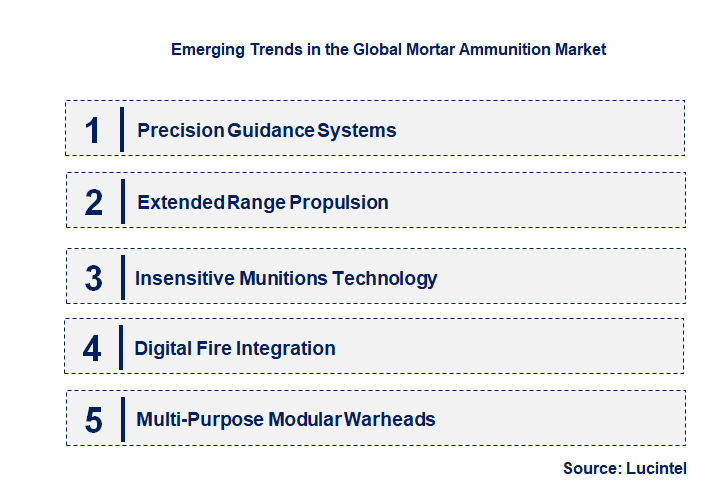
Emerging Trends in the Mortar Ammunition Market

Recent Developments in the Mortar Ammunition Market

The mortar ammunition market is currently shaped by industrial expansion and technological integration designed to meet the demands of modern high-intensity conflict. From massive increases in production capacity to the introduction of "smart" technology, these developments are revitalizing a traditional weapon category. Governments and private contractors are collaborating to ensure that mortar systems remain relevant in an era of persistent surveillance.

• Production Capacity Expansion: Establishing new manufacturing lines to meet the unprecedented global demand for shells. Leading defense firms are investing heavily in automated factories to overcome recent supply chain bottlenecks and replenish depleted national stockpiles. This development ensures that militaries can sustain long-term operations without facing critical shortages of basic high-explosive rounds. The impact is a more robust industrial base capable of rapid scaling during periods of heightened international tension.
• Smart Fuze Integration: Implementing programmable fuzes that allow for air-burst or delayed-impact options. The development of sophisticated electronic fuzes enables mortar rounds to be optimized for specific targets, such as troops in trenches or light armored vehicles. This versatility significantly increases the lethality of standard mortar shells without requiring entirely new ammunition designs. The impact is a force multiplier for infantry units, providing them with more effective tools for diverse scenarios.
• Loitering Munition Synergy: Developing mortar-launched drones that combine traditional fire support with aerial reconnaissance. A groundbreaking development is the creation of mortar rounds that deploy small loitering munitions or sensors upon reaching the target area. This allows for persistent overwatch and the ability to strike moving targets that are hidden from traditional line-of-sight. The impact is a blurring of the lines between traditional artillery and unmanned aerial systems, providing unique tactical advantages.
• Interoperability and Standardization: Harmonizing ammunition specifications across allied nations to ensure cross-platform compatibility. Efforts within NATO and other regional alliances are focusing on ensuring that 120mm and 81mm rounds can be shared across different mortar systems. This development simplifies logistics during multinational operations and allows for more flexible procurement strategies among partner countries. The impact is enhanced collective defense and more efficient resource management during large-scale military exercises or deployments.
• Material Science Advancements: Utilizing new alloys and composites to improve shell fragmentation and range. The use of high-strength, lightweight materials in shell construction is allowing for larger explosive payloads and better aerodynamic performance. These advancements result in more predictable fragmentation patterns, which increases the "kill zone" of each round while maintaining structural integrity during high-pressure launches. The impact is a more lethal and reliable weapon system for ground troops.

These developments are impacting the market by transitioning mortar ammunition from a simple commodity to a sophisticated, technology-driven asset. The shift toward higher production and smarter capabilities ensures that mortar systems remain the primary choice for responsive, organic fire support.

Strategic Growth Opportunities in the Mortar Ammunition Market

The mortar ammunition market offers diverse growth opportunities as militaries seek to fill the gap between small arms and heavy artillery. Growth is particularly strong in applications that prioritize mobility, precision, and integration with digital warfare assets. As defense budgets rise globally, specialized applications are becoming the primary drivers for new investment and long-term procurement contracts.

• Precision Strike Applications: Capturing market share through the development of low-cost guided mortar rounds. The demand for surgical strike capability at the battalion level is creating a lucrative opportunity for manufacturers of GPS and laser-guided kits. These products offer a more affordable alternative to expensive missiles while providing similar accuracy for fixed and stationary targets. The impact is a significant expansion of the guided munitions segment within the broader ammunition market.
• Rapid Deployment Forces: Supplying lightweight ammunition for airborne and mountain infantry units globally. Specialized units require high-impact firepower that can be carried over difficult terrain or dropped by parachute. There is a growing opportunity for ammunition that maximizes lethality-to-weight ratios, allowing light forces to remain combat-effective without heavy vehicle support. This impacts the market by driving innovation in compact, high-energy propellants and lightweight shell casings.
• Vehicle-Mounted Mortar Systems: Providing high-volume, automated ammunition for integrated mobile fire platforms. The rise of automated 120mm mortar systems on armored vehicles creates a demand for specialized ammunition compatible with autoloader mechanisms. These systems require high-quality, consistent rounds that can be fired at rapid rates without jamming or overheating. This opportunity is driving growth in the heavy-caliber segment as armies move toward mechanized, mobile fire support.
• Urban Combat Solutions: Developing specialized smoke and thermobaric rounds for complex architectural environments. Modern conflict increasingly occurs in densely populated areas where traditional high explosives may be restricted or ineffective. Strategic growth exists in creating specialized rounds that can clear buildings or provide visual obscuration without causing excessive structural damage. The impact is a more diverse product portfolio that addresses the specific challenges of 21st-century urban warfare.
• Training and Simulation: Manufacturing low-cost practice rounds and electronic simulation kits for force readiness. As live-fire costs rise, there is a substantial opportunity for realistic, low-cost training variants that mimic the ballistics of combat rounds. Additionally, integrating sensor-enabled practice shells with digital training systems allows for more effective crew evaluation without the use of high explosives. This impacts the market by providing steady, long-term revenue streams through recurring training contracts.

These opportunities are impacting the market by encouraging specialized production lines and fostering niche technologies that cater to specific operational needs. This fragmentation allows for targeted growth and innovation across multiple sectors of the global defense industry.

Mortar Ammunition Market Driver and Challenges

The major drivers and challenges include various technological, economic, and regulatory factors. As global security dynamics shift, the market must navigate the complexities of rapid innovation while managing the physical constraints of industrial production and international trade laws. These elements collectively determine the pace of market growth and the direction of future ammunition development.

The factors responsible for driving the mortar ammunition market include:-
• Rising Geopolitical Tensions: Increasing demand for immediate fire support due to regional border conflicts. Heightened friction in Eastern Europe and the Asia-Pacific region is forcing nations to stockpile large quantities of mortar shells. This urgency drives procurement cycles and encourages governments to sign long-term supply agreements to ensure national security. The impact is a sustained increase in market valuation as countries prioritize military readiness over other expenditures.
• Military Modernization Programs: Upgrading legacy systems with advanced technology to improve battlefield effectiveness. Many nations are replacing outdated equipment with modern digital mortars that require sophisticated, high-performance ammunition. This transition acts as a primary catalyst for the adoption of precision and extended-range rounds that offer superior tactical advantages. The implication is a shift in market demand from traditional "dumb" shells to high-tech "smart" munitions.
• Increased Defense Budgets: Providing the necessary capital for large-scale procurement and research initiatives. Global defense spending has reached record levels, allowing for significant investment in the next generation of indirect fire systems. This financial influx enables manufacturers to pursue risky research and development projects that were previously underfunded. The result is a more competitive market where innovation is rewarded with massive government contracts.
• Advancements in Electronics: Enabling the miniaturization of guidance and sensor components for mortar shells. The rapid evolution of consumer and industrial electronics has made it possible to fit complex computers into small mortar fuzes. This technological driver has lowered the cost of precision ammunition, making it accessible to a wider range of military customers. The implication is the democratization of "smart" weaponry for smaller and medium-sized armed forces.
• Counter-Terrorism Operations: Driving the need for portable and responsive fire support in remote areas. Ongoing internal security and counter-insurgency missions require weapon systems that can be easily transported to rugged or isolated locations. Mortars provide the ideal balance of portability and power for these operations, ensuring a steady demand for 60mm and 81mm rounds. This driver keeps the light and medium-caliber segments consistently profitable.

The challenges facing the mortar ammunition market include:-
• Supply Chain Disruptions: Facing shortages of critical raw materials like nitrocellulose and specialized metals. The production of mortar ammunition is heavily dependent on specific chemicals and high-grade alloys that are currently in short supply globally. These bottlenecks lead to significant delivery delays and price volatility, making it difficult for manufacturers to meet contract deadlines. The implication is a constant struggle to maintain production stability in a fractured global market.
• Manufacturing Capacity Constraints: Struggling to scale production quickly enough to meet sudden surges in demand. Many existing ammunition factories were designed for peacetime requirements and lack the automation needed for high-volume wartime output. Expanding these facilities requires massive capital investment and long lead times for specialized machinery. This challenge results in a "supply gap" where demand far outpaces the physical ability to produce shells.
• Stringent Export Controls: Navigating complex international regulations and trade barriers for sensitive defense technology. The sale of advanced mortar ammunition is heavily restricted by national and international laws to prevent the proliferation of high-tech weaponry. These regulatory hurdles can delay or even cancel lucrative international contracts, limiting the growth potential of top-tier manufacturers. The implication is a highly regulated market environment that requires significant legal and administrative expertise.

The market is defined by a tension between the urgent need for modernization and the physical limits of the industrial base. While drivers like high budgets and new technology propel the industry forward, material shortages and regulatory barriers act as significant stabilizers that temper overall growth rates.

List of Mortar Ammunition Companies

Companies in the market compete on the basis of product quality offered. Major players in this market focus on expanding their manufacturing facilities, R&D investments, infrastructural development, and leverage integration opportunities across the value chain. With these strategies mortar ammunition companies cater increasing demand, ensure competitive effectiveness, develop innovative products & technologies, reduce production costs, and expand their customer base. Some of the mortar ammunition companies profiled in this report include-
• General Dynamics
• Bae Systems
• Northrop Grumman
• Rheinmetall
• Thales Group
• Elbit Systems
• Lockheed Martin

Mortar Ammunition Market by Segment

The study includes a forecast for the global mortar ammunition market by fuze type, range, caliber, application, and region.

Mortar Ammunition Market by Fuze Type [Value from 2019 to 2035]:


• Point Detonating
• Proximity Fuze
• Time Delay Fuze

Mortar Ammunition Market by Range [Value from 2019 to 2035]:


• Less than 5km
• 5-10km
• 10-15km
• Over 15km

Mortar Ammunition Market by Caliber [Value from 2019 to 2035]:


• 60mm
• 81mm
• 120mm
• 155mm

Mortar Ammunition Market by Application [Value from 2019 to 2035]:


• Infantry Support
• Artillery Support
• Counter-Insurgency
• Urban Warfare

Mortar Ammunition Market by Region [Value from 2019 to 2035]:


• North America
• Europe
• Asia Pacific
• The Rest of the World

Country Wise Outlook for the Mortar Ammunition Market

The global mortar ammunition market is currently experiencing a significant transformation driven by escalating geopolitical tensions and the urgent need for military modernization. Major powers are focusing on enhancing the lethality, range, and precision of their indirect fire capabilities to adapt to modern multi-domain battlefields. These regional advancements reflect a strategic shift toward high-intensity readiness and localized production.

• United States: Accelerating procurement of precision-guided 120mm rounds for enhanced combat lethality. The U.S. Army is prioritizing the acquisition of advanced mortar systems and smart munitions to maintain tactical superiority. Recent contracts focus on high-explosive and GPS-guided rounds that provide rapid, accurate fire support while reducing logistical footprints. This shift supports decentralized operations where small units require highly effective, organic indirect fire capabilities in contested environments.
• China: Integrating digital fire control with high-volume production of advanced medium-caliber munitions. China is rapidly modernizing its mortar inventory by pairing digital targeting systems with new-generation 81mm and 120mm rounds. The focus is on increasing the volume of automated manufacturing to ensure deep stockpiles for high-intensity regional conflicts. These developments are designed to improve the responsiveness and destructive power of People’s Liberation Army infantry and motorized units.
• Germany: Expanding domestic production facilities to supply NATO with standardized 120mm ammunition. Germany has recently opened dedicated factories to address the critical shortage of artillery and mortar shells within European defense frameworks. The focus is on producing high-quality, standardized 120mm rounds that offer extended range and improved safety features. This industrial expansion aims to bolster European strategic autonomy and provide reliable supply chains for allied nations.
• India: Boosting indigenous manufacturing through strategic partnerships and local technology development programs. India is aggressively pursuing self-reliance by establishing joint ventures to produce mortar ammunition locally under the "Make in India" initiative. Recent efforts emphasize the development of extended-range 81mm rounds and specialized fuzes to enhance indigenous firepower. These advancements are critical for maintaining readiness along mountainous borders where portable, high-impact mortars are tactically essential.
• Japan: Developing lightweight mortar rounds to support rapid reaction and island defense strategies. Japan is focusing on the modernization of its mortar capabilities to suit the requirements of amphibious and mobile operations. The development of advanced 81mm and 120mm ammunition emphasizes weight reduction and high fragmentation to counter evolving regional security threats. These improvements allow for faster deployment by helicopter or small vessels, aligning with Japan’s proactive defense posture.

Lucintel Analytics Dashboard

Features of the Global Mortar Ammunition Market

Market Size Estimates: Mortar ammunition market size estimation in terms of value ($B).
Trend and Forecast Analysis: Market trends (2019 to 2025) and forecast (2026 to 2035) by various segments and regions.
Segmentation Analysis: Mortar ammunition market size by various segments, such as by fuze type, range, caliber, application, and region in terms of value ($B).
Regional Analysis: Mortar ammunition market breakdown by North America, Europe, Asia Pacific, and Rest of the World.
Growth Opportunities: Analysis of growth opportunities in different fuze types, range, caliber, applications, and regions for the mortar ammunition market.
Strategic Analysis: This includes M&A, new product development, and competitive landscape of the mortar ammunition market.
Analysis of competitive intensity of the industry based on Porter’s Five Forces model.

Lucintel Consulting Services

FAQ

Q1. What is the mortar ammunition market size?
Answer: The global mortar ammunition market is expected to reach an estimated $7 billion by 2035.
Q2. What is the growth forecast for mortar ammunition market?
Answer: The global mortar ammunition market is expected to grow with a CAGR of 3.6% from 2026 to 2035.
Q3. What are the major drivers influencing the growth of the mortar ammunition market?
Answer: The major drivers for this market are the increasing demand for defense spending, the rising military modernization programs efforts, and the growing need for mortar ammunition.
Q4. What are the major segments for mortar ammunition market?
Answer: The future of the mortar ammunition market looks promising with opportunities in the infantry support, artillery support, counter-insurgency, and urban warfare markets.
Q5. Who are the key mortar ammunition market companies?
Answer: Some of the key mortar ammunition companies are as follows:
• General Dynamics
• Bae Systems
• Northrop Grumman
• Rheinmetall
• Thales Group
• Elbit Systems
• Lockheed Martin
Q6. Which mortar ammunition market segment will be the largest in future?
Answer: Lucintel forecasts that, within the fuze type category, point detonating is expected to witness the highest growth over the forecast period.
Q7. In mortar ammunition market, which region is expected to be the largest in next 8 years?
Answer: In terms of region, APAC is expected to witness the highest growth over the forecast period.
Q8. Do we receive customization in this report?
Answer: Yes, Lucintel provides 10% customization without any additional cost.

This report answers following 11 key questions:

Q.1. What are some of the most promising, high-growth opportunities for the mortar ammunition market by fuze type (point detonating, proximity fuze, and time delay fuze), range (less than 5km, 5-10km, 10-15km, and over 15km), caliber (60mm, 81mm, 120mm, and 155mm), application (infantry support, artillery support, counter-insurgency, and urban warfare), and region (North America, Europe, Asia Pacific, and the Rest of the World)?
Q.2. Which segments will grow at a faster pace and why?
Q.3. Which region will grow at a faster pace and why?
Q.4. What are the key factors affecting market dynamics? What are the key challenges and business risks in this market?
Q.5. What are the business risks and competitive threats in this market?
Q.6. What are the emerging trends in this market and the reasons behind them?
Q.7. What are some of the changing demands of customers in the market?
Q.8. What are the new developments in the market? Which companies are leading these developments?
Q.9. Who are the major players in this market? What strategic initiatives are key players pursuing for business growth?
Q.10. What are some of the competing products in this market and how big of a threat do they pose for loss of market share by material or product substitution?
Q.11. What M&A activity has occurred in the last 5 years and what has its impact been on the industry?

For any questions related to Mortar Ammunition Market, Mortar Ammunition Market Size, Mortar Ammunition Market Growth, Mortar Ammunition Market Analysis, Mortar Ammunition Market Report, Mortar Ammunition Market Share, Mortar Ammunition Market Trends, Mortar Ammunition Market Forecast, Mortar Ammunition Companies, write Lucintel analyst at email: helpdesk@lucintel.com. We will be glad to get back to you soon.
                                           Table of Contents

            1. Executive Summary

            2. Market Overview

                        2.1 Background and Classifications
                        2.2 Supply Chain

            3. Market Trends & Forecast Analysis

                        3.1 Macroeconomic Trends and Forecasts
                        3.2 Industry Drivers and Challenges
                        3.3 PESTLE Analysis
                        3.4 Patent Analysis
                        3.5 Regulatory Environment
                        3.6 Global Mortar Ammunition Market Trends and Forecast

            4. Global Mortar Ammunition Market by Fuze Type

                        4.1 Overview
                        4.2 Attractiveness Analysis by Fuze Type
                        4.3 Point Detonating : Trends and Forecast (2019 to 2035)
                        4.4 Proximity Fuze : Trends and Forecast (2019 to 2035)
                        4.5 Time Delay Fuze : Trends and Forecast (2019 to 2035)

            5. Global Mortar Ammunition Market by Range

                        5.1 Overview
                        5.2 Attractiveness Analysis by Range
                        5.3 Less than 5km : Trends and Forecast (2019 to 2035)
                        5.4 5-10km : Trends and Forecast (2019 to 2035)
                        5.5 10-15km : Trends and Forecast (2019 to 2035)
                        5.6 Over 15km : Trends and Forecast (2019 to 2035)

            6. Global Mortar Ammunition Market by Caliber

                        6.1 Overview
                        6.2 Attractiveness Analysis by Caliber
                        6.3 60mm : Trends and Forecast (2019 to 2035)
                        6.4 81mm : Trends and Forecast (2019 to 2035)
                        6.5 120mm : Trends and Forecast (2019 to 2035)
                        6.6 155mm : Trends and Forecast (2019 to 2035)

            7. Global Mortar Ammunition Market by Application

                        7.1 Overview
                        7.2 Attractiveness Analysis by Application
                        7.3 Infantry Support : Trends and Forecast (2019 to 2035)
                        7.4 Artillery Support : Trends and Forecast (2019 to 2035)
                        7.5 Counter-Insurgency : Trends and Forecast (2019 to 2035)
                        7.6 Urban Warfare : Trends and Forecast (2019 to 2035)

            8. Regional Analysis

                        8.1 Overview
                        8.2 Global Mortar Ammunition Market by Region

            9. North American Mortar Ammunition Market

                        9.1 Overview
                        9.2 North American Mortar Ammunition Market by Fuze Type
                        9.3 North American Mortar Ammunition Market by Application
                        9.4 The United States Mortar Ammunition Market
                        9.5 Canadian Mortar Ammunition Market
                        9.6 Mexican Mortar Ammunition Market

            10. European Mortar Ammunition Market

                        10.1 Overview
                        10.2 European Mortar Ammunition Market by Fuze Type
                        10.3 European Mortar Ammunition Market by Application
                        10.4 German Mortar Ammunition Market
                        10.5 French Mortar Ammunition Market
                        10.6 Italian Mortar Ammunition Market
                        10.7 Spanish Mortar Ammunition Market
                        10.8 The United Kingdom Mortar Ammunition Market

            11. APAC Mortar Ammunition Market

                        11.1 Overview
                        11.2 APAC Mortar Ammunition Market by Fuze Type
                        11.3 APAC Mortar Ammunition Market by Application
                        11.4 Chinese Mortar Ammunition Market
                        11.5 Indian Mortar Ammunition Market
                        11.6 Japanese Mortar Ammunition Market
                        11.7 South Korean Mortar Ammunition Market
                        11.8 Indonesian Mortar Ammunition Market

            12. ROW Mortar Ammunition Market

                        12.1 Overview
                        12.2 ROW Mortar Ammunition Market by Fuze Type
                        12.3 ROW Mortar Ammunition Market by Application
                        12.4 Middle Eastern Mortar Ammunition Market
                        12.5 South American Mortar Ammunition Market
                        12.6 African Mortar Ammunition Market

            13. Competitor Analysis

                        13.1 Product Portfolio Analysis
                        13.2 Operational Integration
                        13.3 Porter’s Five Forces Analysis
                                    • Competitive Rivalry
                                    • Bargaining Power of Buyers
                                    • Bargaining Power of Suppliers
                                    • Threat of Substitutes
                                    • Threat of New Entrants
                        13.4 Market Share Analysis

            14. Opportunities & Strategic Analysis

                        14.1 Value Chain Analysis
                        14.2 Growth Opportunity Analysis
                                    14.2.1 Growth Opportunity by Fuze Type
                                    14.2.2 Growth Opportunity by Range
                                    14.2.3 Growth Opportunity by Caliber
                                    14.2.4 Growth Opportunity by Application
                                    14.2.5 Growth Opportunity by Region
                        14.3 Emerging Trends in the Global Mortar Ammunition Market
                        14.4 Strategic Analysis
                                    14.4.1 New Product Development
                                    14.4.2 Certification and Licensing
                                    14.4.3 Mergers, Acquisitions, Agreements, Collaborations, and Joint Ventures

            15. Company Profiles of the Leading Players Across the Value Chain

                        15.1 Competitive Analysis Overview
                        15.2 General Dynamics
                                    • Company Overview
                                    • Mortar Ammunition Market Business Overview
                                    • New Product Development
                                    • Merger, Acquisition, and Collaboration
                                    • Certification and Licensing
                        15.3 Bae Systems
                                    • Company Overview
                                    • Mortar Ammunition Market Business Overview
                                    • New Product Development
                                    • Merger, Acquisition, and Collaboration
                                    • Certification and Licensing
                        15.4 Northrop Grumman
                                    • Company Overview
                                    • Mortar Ammunition Market Business Overview
                                    • New Product Development
                                    • Merger, Acquisition, and Collaboration
                                    • Certification and Licensing
                        15.5 Rheinmetall
                                    • Company Overview
                                    • Mortar Ammunition Market Business Overview
                                    • New Product Development
                                    • Merger, Acquisition, and Collaboration
                                    • Certification and Licensing
                        15.6 Thales Group
                                    • Company Overview
                                    • Mortar Ammunition Market Business Overview
                                    • New Product Development
                                    • Merger, Acquisition, and Collaboration
                                    • Certification and Licensing
                        15.7 Elbit Systems
                                    • Company Overview
                                    • Mortar Ammunition Market Business Overview
                                    • New Product Development
                                    • Merger, Acquisition, and Collaboration
                                    • Certification and Licensing
                        15.8 Lockheed Martin
                                    • Company Overview
                                    • Mortar Ammunition Market Business Overview
                                    • New Product Development
                                    • Merger, Acquisition, and Collaboration
                                    • Certification and Licensing

            16. Appendix

                        16.1 List of Figures
                        16.2 List of Tables
                        16.3 Research Methodology
                        16.4 Disclaimer
                        16.5 Copyright
                        16.6 Abbreviations and Technical Units
                        16.7 About Us
                        16.8 Contact Us

                                               List of Figures


            Chapter 1

                        Figure 1.1: Trends and Forecast for the Global Mortar Ammunition Market

            Chapter 2

                        Figure 2.1: Usage of Mortar Ammunition Market
                        Figure 2.2: Classification of the Global Mortar Ammunition Market
                        Figure 2.3: Supply Chain of the Global Mortar Ammunition Market

            Chapter 3

                        Figure 3.1: Trends of the Global GDP Growth Rate
                        Figure 3.2: Trends of the Global Population Growth Rate
                        Figure 3.3: Trends of the Global Inflation Rate
                        Figure 3.4: Trends of the Global Unemployment Rate
                        Figure 3.5: Trends of the Regional GDP Growth Rate
                        Figure 3.6: Trends of the Regional Population Growth Rate
                        Figure 3.7: Trends of the Regional Inflation Rate
                        Figure 3.8: Trends of the Regional Unemployment Rate
                        Figure 3.9: Trends of Regional Per Capita Income
                        Figure 3.10: Forecast for the Global GDP Growth Rate
                        Figure 3.11: Forecast for the Global Population Growth Rate
                        Figure 3.12: Forecast for the Global Inflation Rate
                        Figure 3.13: Forecast for the Global Unemployment Rate
                        Figure 3.14: Forecast for the Regional GDP Growth Rate
                        Figure 3.15: Forecast for the Regional Population Growth Rate
                        Figure 3.16: Forecast for the Regional Inflation Rate
                        Figure 3.17: Forecast for the Regional Unemployment Rate
                        Figure 3.18: Forecast for Regional Per Capita Income
                        Figure 3.19: Driver and Challenges of the Mortar Ammunition Market

            Chapter 4

                        Figure 4.1: Global Mortar Ammunition Market by Fuze Type in 2019, 2025, and 2035
                        Figure 4.2: Trends of the Global Mortar Ammunition Market ($B) by Fuze Type
                        Figure 4.3: Forecast for the Global Mortar Ammunition Market ($B) by Fuze Type
                        Figure 4.4: Trends and Forecast for Point Detonating in the Global Mortar Ammunition Market (2019-2035)
                        Figure 4.5: Trends and Forecast for Proximity Fuze in the Global Mortar Ammunition Market (2019-2035)
                        Figure 4.6: Trends and Forecast for Time Delay Fuze in the Global Mortar Ammunition Market (2019-2035)

            Chapter 5

                        Figure 5.1: Global Mortar Ammunition Market by Range in 2019, 2025, and 2035
                        Figure 5.2: Trends of the Global Mortar Ammunition Market ($B) by Range
                        Figure 5.3: Forecast for the Global Mortar Ammunition Market ($B) by Range
                        Figure 5.4: Trends and Forecast for Less than 5km in the Global Mortar Ammunition Market (2019-2035)
                        Figure 5.5: Trends and Forecast for 5-10km in the Global Mortar Ammunition Market (2019-2035)
                        Figure 5.6: Trends and Forecast for 10-15km in the Global Mortar Ammunition Market (2019-2035)
                        Figure 5.7: Trends and Forecast for Over 15km in the Global Mortar Ammunition Market (2019-2035)

            Chapter 6

                        Figure 6.1: Global Mortar Ammunition Market by Caliber in 2019, 2025, and 2035
                        Figure 6.2: Trends of the Global Mortar Ammunition Market ($B) by Caliber
                        Figure 6.3: Forecast for the Global Mortar Ammunition Market ($B) by Caliber
                        Figure 6.4: Trends and Forecast for 60mm in the Global Mortar Ammunition Market (2019-2035)
                        Figure 6.5: Trends and Forecast for 81mm in the Global Mortar Ammunition Market (2019-2035)
                        Figure 6.6: Trends and Forecast for 120mm in the Global Mortar Ammunition Market (2019-2035)
                        Figure 6.7: Trends and Forecast for 155mm in the Global Mortar Ammunition Market (2019-2035)

            Chapter 7

                        Figure 7.1: Global Mortar Ammunition Market by Application in 2019, 2025, and 2035
                        Figure 7.2: Trends of the Global Mortar Ammunition Market ($B) by Application
                        Figure 7.3: Forecast for the Global Mortar Ammunition Market ($B) by Application
                        Figure 7.4: Trends and Forecast for Infantry Support in the Global Mortar Ammunition Market (2019-2035)
                        Figure 7.5: Trends and Forecast for Artillery Support in the Global Mortar Ammunition Market (2019-2035)
                        Figure 7.6: Trends and Forecast for Counter-Insurgency in the Global Mortar Ammunition Market (2019-2035)
                        Figure 7.7: Trends and Forecast for Urban Warfare in the Global Mortar Ammunition Market (2019-2035)

            Chapter 8

                        Figure 8.1: Trends of the Global Mortar Ammunition Market ($B) by Region (2019-2025)
                        Figure 8.2: Forecast for the Global Mortar Ammunition Market ($B) by Region (2026-2035)

            Chapter 9

                        Figure 9.1: Trends and Forecast for the North American Mortar Ammunition Market (2019-2035)
                        Figure 9.2: North American Mortar Ammunition Market by Fuze Type in 2019, 2025, and 2035
                        Figure 9.3: Trends of the North American Mortar Ammunition Market ($B) by Fuze Type (2019-2025)
                        Figure 9.4: Forecast for the North American Mortar Ammunition Market ($B) by Fuze Type (2026-2035)
                        Figure 9.5: North American Mortar Ammunition Market by Range in 2019, 2025, and 2035
                        Figure 9.6: Trends of the North American Mortar Ammunition Market ($B) by Range (2019-2025)
                        Figure 9.7: Forecast for the North American Mortar Ammunition Market ($B) by Range (2026-2035)
                        Figure 9.8: Trends and Forecast for the United States Mortar Ammunition Market ($B) (2019-2035)
                        Figure 9.9: Trends and Forecast for the Mexican Mortar Ammunition Market ($B) (2019-2035)
                        Figure 9.10: Trends and Forecast for the Canadian Mortar Ammunition Market ($B) (2019-2035)

            Chapter 10

                        Figure 10.1: Trends and Forecast for the European Mortar Ammunition Market (2019-2035)
                        Figure 10.2: European Mortar Ammunition Market by Fuze Type in 2019, 2025, and 2035
                        Figure 10.3: Trends of the European Mortar Ammunition Market ($B) by Fuze Type (2019-2025)
                        Figure 10.4: Forecast for the European Mortar Ammunition Market ($B) by Fuze Type (2026-2035)
                        Figure 10.5: European Mortar Ammunition Market by Range in 2019, 2025, and 2035
                        Figure 10.6: Trends of the European Mortar Ammunition Market ($B) by Range (2019-2025)
                        Figure 10.7: Forecast for the European Mortar Ammunition Market ($B) by Range (2026-2035)
                        Figure 10.8: Trends and Forecast for the German Mortar Ammunition Market ($B) (2019-2035)
                        Figure 10.9: Trends and Forecast for the French Mortar Ammunition Market ($B) (2019-2035)
                        Figure 10.10: Trends and Forecast for the Spanish Mortar Ammunition Market ($B) (2019-2035)
                        Figure 10.11: Trends and Forecast for the Italian Mortar Ammunition Market ($B) (2019-2035)
                        Figure 10.12: Trends and Forecast for the United Kingdom Mortar Ammunition Market ($B) (2019-2035)

            Chapter 11

                        Figure 11.1: Trends and Forecast for the APAC Mortar Ammunition Market (2019-2035)
                        Figure 11.2: APAC Mortar Ammunition Market by Fuze Type in 2019, 2025, and 2035
                        Figure 11.3: Trends of the APAC Mortar Ammunition Market ($B) by Fuze Type (2019-2025)
                        Figure 11.4: Forecast for the APAC Mortar Ammunition Market ($B) by Fuze Type (2026-2035)
                        Figure 11.5: APAC Mortar Ammunition Market by Range in 2019, 2025, and 2035
                        Figure 11.6: Trends of the APAC Mortar Ammunition Market ($B) by Range (2019-2025)
                        Figure 11.7: Forecast for the APAC Mortar Ammunition Market ($B) by Range (2026-2035)
                        Figure 11.8: Trends and Forecast for the Japanese Mortar Ammunition Market ($B) (2019-2035)
                        Figure 11.9: Trends and Forecast for the Indian Mortar Ammunition Market ($B) (2019-2035)
                        Figure 11.10: Trends and Forecast for the Chinese Mortar Ammunition Market ($B) (2019-2035)
                        Figure 11.11: Trends and Forecast for the South Korean Mortar Ammunition Market ($B) (2019-2035)
                        Figure 11.12: Trends and Forecast for the Indonesian Mortar Ammunition Market ($B) (2019-2035)

            Chapter 12

                        Figure 12.1: Trends and Forecast for the ROW Mortar Ammunition Market (2019-2035)
                        Figure 12.2: ROW Mortar Ammunition Market by Fuze Type in 2019, 2025, and 2035
                        Figure 12.3: Trends of the ROW Mortar Ammunition Market ($B) by Fuze Type (2019-2025)
                        Figure 12.4: Forecast for the ROW Mortar Ammunition Market ($B) by Fuze Type (2026-2035)
                        Figure 12.5: ROW Mortar Ammunition Market by Range in 2019, 2025, and 2035
                        Figure 12.6: Trends of the ROW Mortar Ammunition Market ($B) by Range (2019-2025)
                        Figure 12.7: Forecast for the ROW Mortar Ammunition Market ($B) by Range (2026-2035)
                        Figure 12.8: Trends and Forecast for the Middle Eastern Mortar Ammunition Market ($B) (2019-2035)
                        Figure 12.9: Trends and Forecast for the South American Mortar Ammunition Market ($B) (2019-2035)
                        Figure 12.10: Trends and Forecast for the African Mortar Ammunition Market ($B) (2019-2035)

            Chapter 13

                        Figure 13.1: Porter’s Five Forces Analysis of the Global Mortar Ammunition Market
                        Figure 13.2: Market Share (%) of Top Players in the Global Mortar Ammunition Market (2025)

            Chapter 14

                        Figure 14.1: Growth Opportunities for the Global Mortar Ammunition Market by Fuze Type
                        Figure 14.2: Growth Opportunities for the Global Mortar Ammunition Market by Range
                        Figure 14.3: Growth Opportunities for the Global Mortar Ammunition Market by Caliber
                        Figure 14.4: Growth Opportunities for the Global Mortar Ammunition Market by Application
                        Figure 14.5: Growth Opportunities for the Global Mortar Ammunition Market by Region
                        Figure 14.6: Emerging Trends in the Global Mortar Ammunition Market

                                               List of Tables


            Chapter 1

                        Table 1.1: Growth Rate (%, 2024-2025) and CAGR (%, 2026-2035) of the Mortar Ammunition Market by Fuze Type, Range, Caliber, and Application
                        Table 1.2: Attractiveness Analysis for the Mortar Ammunition Market by Region
                        Table 1.3: Global Mortar Ammunition Market Parameters and Attributes

            Chapter 3

                        Table 3.1: Trends of the Global Mortar Ammunition Market (2019-2025)
                        Table 3.2: Forecast for the Global Mortar Ammunition Market (2026-2035)

            Chapter 4

                        Table 4.1: Attractiveness Analysis for the Global Mortar Ammunition Market by Fuze Type
                        Table 4.2: Market Size and CAGR of Various Fuze Type in the Global Mortar Ammunition Market (2019-2025)
                        Table 4.3: Market Size and CAGR of Various Fuze Type in the Global Mortar Ammunition Market (2026-2035)
                        Table 4.4: Trends of Point Detonating in the Global Mortar Ammunition Market (2019-2025)
                        Table 4.5: Forecast for Point Detonating in the Global Mortar Ammunition Market (2026-2035)
                        Table 4.6: Trends of Proximity Fuze in the Global Mortar Ammunition Market (2019-2025)
                        Table 4.7: Forecast for Proximity Fuze in the Global Mortar Ammunition Market (2026-2035)
                        Table 4.8: Trends of Time Delay Fuze in the Global Mortar Ammunition Market (2019-2025)
                        Table 4.9: Forecast for Time Delay Fuze in the Global Mortar Ammunition Market (2026-2035)

            Chapter 5

                        Table 5.1: Attractiveness Analysis for the Global Mortar Ammunition Market by Range
                        Table 5.2: Market Size and CAGR of Various Range in the Global Mortar Ammunition Market (2019-2025)
                        Table 5.3: Market Size and CAGR of Various Range in the Global Mortar Ammunition Market (2026-2035)
                        Table 5.4: Trends of Less than 5km in the Global Mortar Ammunition Market (2019-2025)
                        Table 5.5: Forecast for Less than 5km in the Global Mortar Ammunition Market (2026-2035)
                        Table 5.6: Trends of 5-10km in the Global Mortar Ammunition Market (2019-2025)
                        Table 5.7: Forecast for 5-10km in the Global Mortar Ammunition Market (2026-2035)
                        Table 5.8: Trends of 10-15km in the Global Mortar Ammunition Market (2019-2025)
                        Table 5.9: Forecast for 10-15km in the Global Mortar Ammunition Market (2026-2035)
                        Table 5.10: Trends of Over 15km in the Global Mortar Ammunition Market (2019-2025)
                        Table 5.11: Forecast for Over 15km in the Global Mortar Ammunition Market (2026-2035)

            Chapter 6

                        Table 6.1: Attractiveness Analysis for the Global Mortar Ammunition Market by Caliber
                        Table 6.2: Market Size and CAGR of Various Caliber in the Global Mortar Ammunition Market (2019-2025)
                        Table 6.3: Market Size and CAGR of Various Caliber in the Global Mortar Ammunition Market (2026-2035)
                        Table 6.4: Trends of 60mm in the Global Mortar Ammunition Market (2019-2025)
                        Table 6.5: Forecast for 60mm in the Global Mortar Ammunition Market (2026-2035)
                        Table 6.6: Trends of 81mm in the Global Mortar Ammunition Market (2019-2025)
                        Table 6.7: Forecast for 81mm in the Global Mortar Ammunition Market (2026-2035)
                        Table 6.8: Trends of 120mm in the Global Mortar Ammunition Market (2019-2025)
                        Table 6.9: Forecast for 120mm in the Global Mortar Ammunition Market (2026-2035)
                        Table 6.10: Trends of 155mm in the Global Mortar Ammunition Market (2019-2025)
                        Table 6.11: Forecast for 155mm in the Global Mortar Ammunition Market (2026-2035)

            Chapter 7

                        Table 7.1: Attractiveness Analysis for the Global Mortar Ammunition Market by Application
                        Table 7.2: Market Size and CAGR of Various Application in the Global Mortar Ammunition Market (2019-2025)
                        Table 7.3: Market Size and CAGR of Various Application in the Global Mortar Ammunition Market (2026-2035)
                        Table 7.4: Trends of Infantry Support in the Global Mortar Ammunition Market (2019-2025)
                        Table 7.5: Forecast for Infantry Support in the Global Mortar Ammunition Market (2026-2035)
                        Table 7.6: Trends of Artillery Support in the Global Mortar Ammunition Market (2019-2025)
                        Table 7.7: Forecast for Artillery Support in the Global Mortar Ammunition Market (2026-2035)
                        Table 7.8: Trends of Counter-Insurgency in the Global Mortar Ammunition Market (2019-2025)
                        Table 7.9: Forecast for Counter-Insurgency in the Global Mortar Ammunition Market (2026-2035)
                        Table 7.10: Trends of Urban Warfare in the Global Mortar Ammunition Market (2019-2025)
                        Table 7.11: Forecast for Urban Warfare in the Global Mortar Ammunition Market (2026-2035)

            Chapter 8

                        Table 8.1: Market Size and CAGR of Various Regions in the Global Mortar Ammunition Market (2019-2025)
                        Table 8.2: Market Size and CAGR of Various Regions in the Global Mortar Ammunition Market (2026-2035)

            Chapter 9

                        Table 9.1: Trends of the North American Mortar Ammunition Market (2019-2025)
                        Table 9.2: Forecast for the North American Mortar Ammunition Market (2026-2035)
                        Table 9.3: Market Size and CAGR of Various Fuze Type in the North American Mortar Ammunition Market (2019-2025)
                        Table 9.4: Market Size and CAGR of Various Fuze Type in the North American Mortar Ammunition Market (2026-2035)
                        Table 9.5: Market Size and CAGR of Various Range in the North American Mortar Ammunition Market (2019-2025)
                        Table 9.6: Market Size and CAGR of Various Range in the North American Mortar Ammunition Market (2026-2035)
                        Table 9.7: Trends and Forecast for the United States Mortar Ammunition Market (2019-2035)
                        Table 9.8: Trends and Forecast for the Mexican Mortar Ammunition Market (2019-2035)
                        Table 9.9: Trends and Forecast for the Canadian Mortar Ammunition Market (2019-2035)

            Chapter 10

                        Table 10.1: Trends of the European Mortar Ammunition Market (2019-2025)
                        Table 10.2: Forecast for the European Mortar Ammunition Market (2026-2035)
                        Table 10.3: Market Size and CAGR of Various Fuze Type in the European Mortar Ammunition Market (2019-2025)
                        Table 10.4: Market Size and CAGR of Various Fuze Type in the European Mortar Ammunition Market (2026-2035)
                        Table 10.5: Market Size and CAGR of Various Range in the European Mortar Ammunition Market (2019-2025)
                        Table 10.6: Market Size and CAGR of Various Range in the European Mortar Ammunition Market (2026-2035)
                        Table 10.7: Trends and Forecast for the German Mortar Ammunition Market (2019-2035)
                        Table 10.8: Trends and Forecast for the French Mortar Ammunition Market (2019-2035)
                        Table 10.9: Trends and Forecast for the Spanish Mortar Ammunition Market (2019-2035)
                        Table 10.10: Trends and Forecast for the Italian Mortar Ammunition Market (2019-2035)
                        Table 10.11: Trends and Forecast for the United Kingdom Mortar Ammunition Market (2019-2035)

            Chapter 11

                        Table 11.1: Trends of the APAC Mortar Ammunition Market (2019-2025)
                        Table 11.2: Forecast for the APAC Mortar Ammunition Market (2026-2035)
                        Table 11.3: Market Size and CAGR of Various Fuze Type in the APAC Mortar Ammunition Market (2019-2025)
                        Table 11.4: Market Size and CAGR of Various Fuze Type in the APAC Mortar Ammunition Market (2026-2035)
                        Table 11.5: Market Size and CAGR of Various Range in the APAC Mortar Ammunition Market (2019-2025)
                        Table 11.6: Market Size and CAGR of Various Range in the APAC Mortar Ammunition Market (2026-2035)
                        Table 11.7: Trends and Forecast for the Japanese Mortar Ammunition Market (2019-2035)
                        Table 11.8: Trends and Forecast for the Indian Mortar Ammunition Market (2019-2035)
                        Table 11.9: Trends and Forecast for the Chinese Mortar Ammunition Market (2019-2035)
                        Table 11.10: Trends and Forecast for the South Korean Mortar Ammunition Market (2019-2035)
                        Table 11.11: Trends and Forecast for the Indonesian Mortar Ammunition Market (2019-2035)

            Chapter 12

                        Table 12.1: Trends of the ROW Mortar Ammunition Market (2019-2025)
                        Table 12.2: Forecast for the ROW Mortar Ammunition Market (2026-2035)
                        Table 12.3: Market Size and CAGR of Various Fuze Type in the ROW Mortar Ammunition Market (2019-2025)
                        Table 12.4: Market Size and CAGR of Various Fuze Type in the ROW Mortar Ammunition Market (2026-2035)
                        Table 12.5: Market Size and CAGR of Various Range in the ROW Mortar Ammunition Market (2019-2025)
                        Table 12.6: Market Size and CAGR of Various Range in the ROW Mortar Ammunition Market (2026-2035)
                        Table 12.7: Trends and Forecast for the Middle Eastern Mortar Ammunition Market (2019-2035)
                        Table 12.8: Trends and Forecast for the South American Mortar Ammunition Market (2019-2035)
                        Table 12.9: Trends and Forecast for the African Mortar Ammunition Market (2019-2035)

            Chapter 13

                        Table 13.1: Product Mapping of Mortar Ammunition Suppliers Based on Segments
                        Table 13.2: Operational Integration of Mortar Ammunition Manufacturers
                        Table 13.3: Rankings of Suppliers Based on Mortar Ammunition Revenue

            Chapter 14

                        Table 14.1: New Product Launches by Major Mortar Ammunition Producers (2019-2025)
                        Table 14.2: Certification Acquired by Major Competitor in the Global Mortar Ammunition Market

.

Buy full report or by chapter as follows

Price by License Type:
[-] Hide Chapter Details
[Chapter Number] [Chapter Name] [Chapter Number Of Pages] [Chapter Price]
Title/Chapter Name Pages Price
Full Report: Mortar Ammunition Market Report: Trends, Forecast and Competitive Analysis to 2035 Full Report $ 4,850
A 150 Page Report
Lucintel has been in the business of market research and management consulting since 2000 and has published over 1000 market intelligence reports in various markets / applications and served over 1,000 clients worldwide. This study is a culmination of four months of full-time effort performed by Lucintel's analyst team. The analysts used the following sources for the creation and completion of this valuable report:
  • In-depth interviews of the major players in this market
  • Detailed secondary research from competitors’ financial statements and published data 
  • Extensive searches of published works, market, and database information pertaining to industry news, company press releases, and customer intentions
  • A compilation of the experiences, judgments, and insights of Lucintel’s professionals, who have analyzed and tracked this market over the years.
Extensive research and interviews are conducted across the supply chain of this market to estimate market share, market size, trends, drivers, challenges, and forecasts. Below is a brief summary of the primary interviews that were conducted by job function for this report.
 
Thus, Lucintel compiles vast amounts of data from numerous sources, validates the integrity of that data, and performs a comprehensive analysis. Lucintel then organizes the data, its findings, and insights into a concise report designed to support the strategic decision-making process. The figure below is a graphical representation of Lucintel’s research process. 
 

Please sign in below to get report brochure - Mortar Ammunition Market Report.

At Lucintel, we respect your privacy and maintain the confidentiality of information / data provided by you
(Please enter your corporate email. * These fields are mandatory )

Follow us on