
Report Feature
Moisture Absorber Market Trends and Forecast
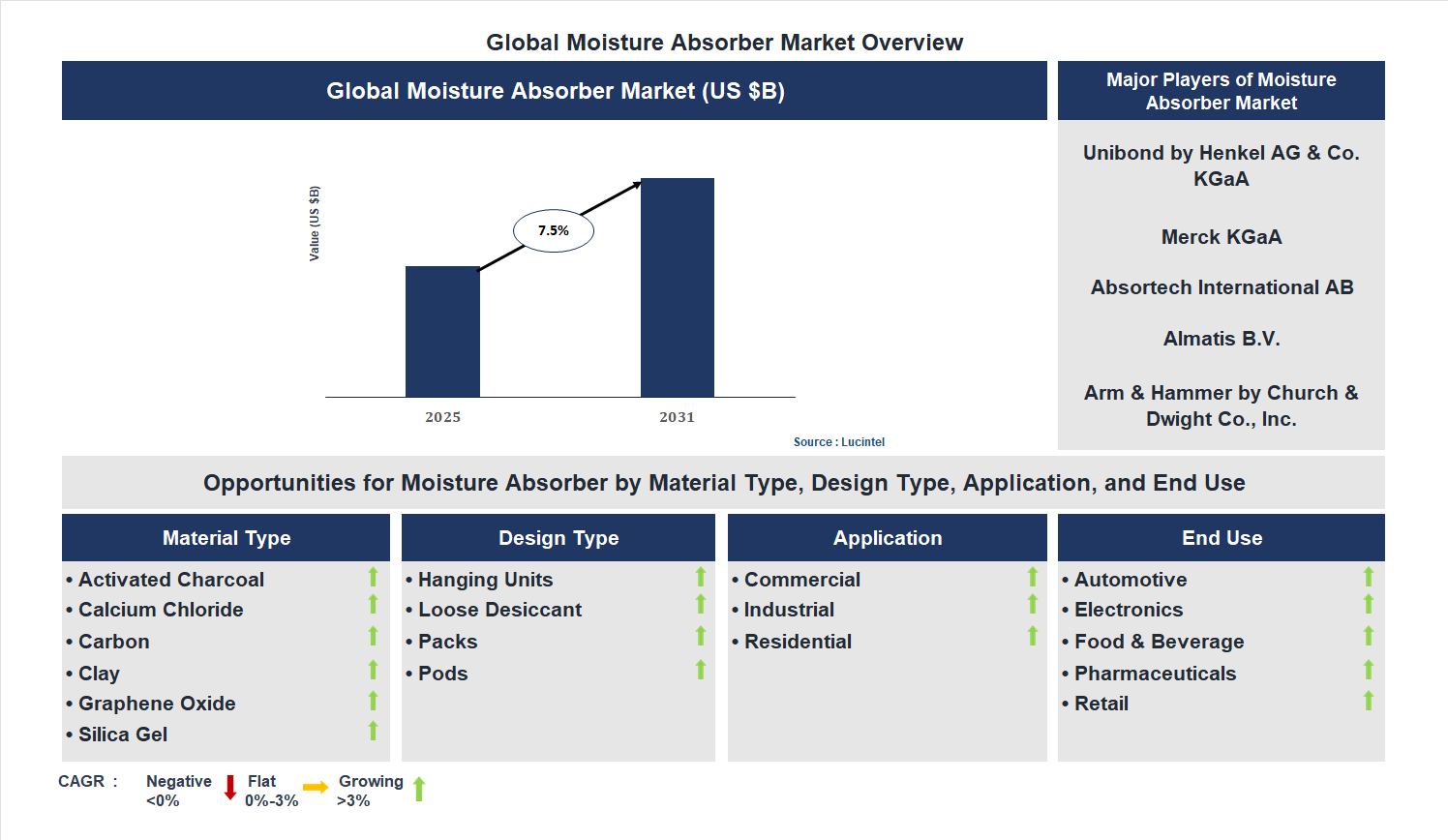
The future of the global moisture absorber market looks promising with opportunities in the automotive, electronics, food & beverage, pharmaceutical, and retail markets. The global moisture absorber market is expected to grow with a CAGR of 7.5% from 2025 to 2031. The major drivers for this market are the increasing demand for home moisture control, the rising use in industrial storage safety, and the growing adoption across residential packaging needs.• Lucintel forecasts that, within the material type category, calcium chloride is expected to witness the highest growth over the forecast period.
• Within the end use category, food & beverage is expected to witness the highest growth.
• In terms of region, APAC is expected to witness the highest growth over the forecast period. Gain valuable insights for your business decisions with our comprehensive 150+ page report. Sample figures with some insights are shown below.
Emerging Trends in the Moisture Absorber Market
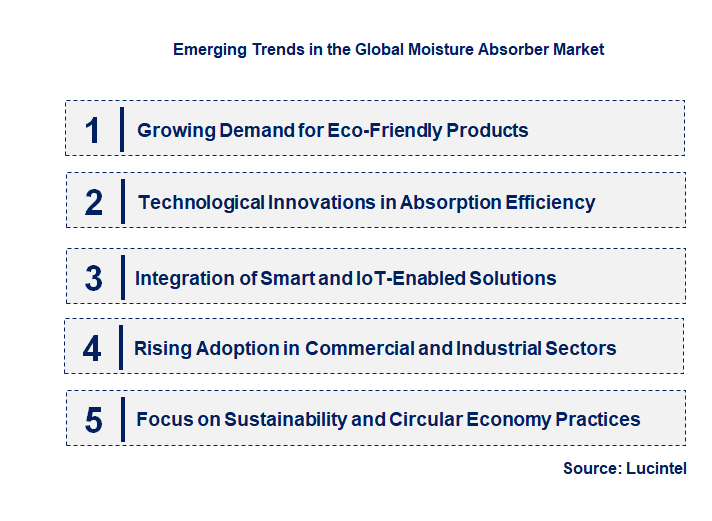
The moisture absorber market is experiencing rapid growth driven by increasing demand across various sectors such as residential, commercial, and industrial applications. As moisture-related issues become more prominent due to climate change and rising humidity levels, innovative solutions are emerging to address these challenges. Technological advancements, environmental considerations, and consumer preferences are shaping the future of this market. Companies are focusing on sustainable, efficient, and cost-effective moisture absorption products to meet evolving needs. These developments are not only expanding market size but also transforming how moisture control is approached globally, leading to more resilient and eco-friendly solutions.• Growing Demand for Eco-Friendly Products: The market is witnessing a shift towards environmentally sustainable moisture absorbers made from biodegradable and non-toxic materials. Consumers and industries are increasingly prioritizing eco-friendly options to reduce environmental impact. This trend encourages innovation in natural and recyclable materials, which offer effective moisture control while minimizing ecological footprints. As regulations tighten and consumer awareness rises, eco-friendly moisture absorbers are expected to dominate the market, fostering sustainable growth and aligning with global environmental goals.
• Technological Innovations in Absorption Efficiency: Advances in material science are leading to the development of highly efficient moisture absorbers with longer lifespan and faster absorption rates. Innovations such as silica gel enhancements, superabsorbent polymers, and nanomaterials improve performance and durability. These technological improvements enable better moisture control in sensitive environments like electronics, pharmaceuticals, and food storage. Enhanced efficiency reduces replacement frequency and operational costs, making these products more attractive to consumers and industries, thereby expanding market opportunities and driving competitive differentiation.
• Integration of Smart and IoT-Enabled Solutions: The incorporation of smart technology and Internet of Things (IoT) features into moisture absorbers is emerging as a significant trend. These intelligent solutions can monitor humidity levels in real-time, send alerts, and optimize moisture absorption processes automatically. Such innovations improve maintenance efficiency and prevent damage caused by excess moisture. The integration of IoT enhances user convenience and provides valuable data insights, making moisture absorbers more sophisticated and appealing for commercial and industrial applications, ultimately transforming traditional moisture control methods into smart, connected systems.
• Rising Adoption in Commercial and Industrial Sectors: Beyond residential use, there is a growing adoption of moisture absorbers in commercial and industrial sectors such as warehouses, manufacturing plants, and data centers. These sectors require reliable moisture control to prevent equipment failure, mold growth, and product spoilage. The demand is driven by stricter regulations, the need for quality assurance, and the high costs associated with moisture damage. This trend is expanding the market scope, encouraging the development of large-scale, high-capacity moisture absorption solutions tailored for industrial needs, thus fueling overall market growth.
• Focus on Sustainability and Circular Economy Practices: Companies are increasingly adopting sustainable practices, including recycling used moisture absorbers and developing products with renewable materials. The circular economy approach aims to minimize waste and maximize resource efficiency. This trend influences product design, manufacturing processes, and end-of-life management, aligning with global sustainability initiatives. As consumers and regulators demand greener solutions, market players are innovating to create recyclable and biodegradable moisture absorbers. This focus on sustainability not only enhances brand reputation but also ensures long-term market viability amid evolving environmental standards. In summary, these trends are collectively reshaping the moisture absorber market by promoting sustainability, technological advancement, and broader application across sectors. They are driving innovation, improving product performance, and aligning market offerings with environmental and consumer expectations. As a result, the market is becoming more dynamic, competitive, and sustainable, paving the way for continued growth and development in moisture control solutions worldwide.
Recent Development in the Moisture Absorber Market
The moisture absorber market has experienced significant growth driven by increasing demand across various industries such as packaging, agriculture, and electronics. As moisture control becomes critical for product longevity and quality, technological advancements and expanding applications are shaping the market landscape. Recent developments reflect a focus on sustainability, innovation, and regional expansion, which are influencing market dynamics. These changes are not only enhancing product efficiency but also opening new opportunities for manufacturers and consumers alike. Understanding these key developments provides insight into the future trajectory of the moisture absorber market and its potential for growth and innovation.• Technological Innovations: Development of eco-friendly moisture absorbers using biodegradable materials has improved sustainability. These innovations reduce environmental impact and meet regulatory standards, attracting eco-conscious consumers. Enhanced absorption capacity and longer shelf life are also notable, increasing product reliability and market appeal.
• Expansion into Emerging Markets: Companies are increasingly targeting emerging economies in Asia and Africa, where industrialization and urbanization drive demand. Local partnerships and tailored products are facilitating market entry, leading to rapid growth and diversification of the customer base.
• Product Diversification: Manufacturers are introducing specialized moisture absorbers for specific applications such as electronics, pharmaceuticals, and food packaging. This diversification allows for targeted solutions, improving product performance and expanding market reach.
• Regulatory and Standards Development: Governments and industry bodies are establishing stricter regulations regarding moisture control and environmental safety. Compliance with these standards is driving innovation and ensuring market players adopt sustainable practices, fostering trust and market stability.
• Digital and Smart Solutions: Integration of IoT and smart sensors in moisture absorbers is emerging, enabling real-time monitoring and data collection. These advanced solutions improve efficiency, reduce waste, and provide valuable insights for supply chain management, enhancing overall market competitiveness. In summary, recent developments in the moisture absorber market—spanning technological innovation, regional expansion, product diversification, regulatory compliance, and digital integration—are collectively driving growth and sustainability. These advancements are making moisture control more effective, environmentally friendly, and tailored to specific industry needs, thereby strengthening the markets future prospects.
Strategic Growth Opportunities in the Moisture Absorber Market
The moisture absorber market is experiencing rapid growth driven by increasing demand across various industries such as packaging, electronics, agriculture, HVAC, and pharmaceuticals. As moisture control becomes critical for product integrity, safety, and efficiency, companies are exploring innovative solutions to address these needs. Key applications are expanding, presenting significant opportunities for market players to innovate and capture new customer segments. These developments are shaping the future landscape of moisture absorbers, emphasizing sustainability, technological advancement, and customized solutions to meet diverse industry requirements.• Packaging Industry: Enhanced product preservation and shelf life : Moisture absorbers are vital in packaging to prevent spoilage, mold, and corrosion, especially in food, electronics, and pharmaceuticals. Innovations in biodegradable and eco-friendly absorbers are gaining traction, offering sustainable solutions that meet regulatory standards. This growth improves product quality, reduces waste, and extends shelf life, creating a competitive advantage for manufacturers.
• Electronics Industry: Protecting sensitive components : Moisture absorbers are crucial in electronics to prevent corrosion and damage caused by humidity. The development of advanced, compact, and highly efficient desiccants ensures better protection for delicate devices. This reduces warranty costs, enhances product reliability, and supports the miniaturization trend in electronic devices, driving market expansion.
• Agriculture Sector: Improving crop storage and preservation : Moisture absorbers help maintain optimal humidity levels in storage facilities, preventing mold, spoilage, and pest infestation. The adoption of natural and organic moisture control solutions aligns with sustainable farming practices. This application enhances crop quality, reduces post-harvest losses, and supports food security initiatives, fueling market growth.
• HVAC Systems: Enhancing indoor air quality and equipment efficiency : Moisture absorbers are used in HVAC systems to control humidity, prevent mold growth, and improve air quality. Innovations include smart moisture control systems that adapt to environmental changes, reducing energy consumption and maintenance costs. These advancements contribute to healthier indoor environments and energy-efficient building management.
• Pharmaceutical Industry: Ensuring drug stability and safety : Moisture control is critical in pharmaceutical manufacturing and storage to maintain drug efficacy and prevent microbial growth. The development of pharmaceutical-grade desiccants and moisture barriers ensures compliance with strict regulatory standards. This application safeguards product integrity, reduces recalls, and supports global health initiatives, expanding market opportunities. In summary, these key growth opportunities across applications are significantly impacting the moisture absorber market by driving innovation, improving product performance, and addressing industry-specific needs. As demand for moisture control solutions continues to rise, market players are poised to capitalize on these opportunities, fostering sustainable growth and technological advancement in the industry.
Moisture Absorber Market Driver and Challenges
The moisture absorber market is influenced by a variety of technological, economic, and regulatory factors that shape its growth and development. Advances in material science and innovative product designs have enhanced moisture absorption efficiency, driving consumer demand. Economic factors such as rising disposable incomes and increasing awareness of moisture-related issues contribute to market expansion. Regulatory standards concerning environmental safety and product safety influence manufacturing practices and product formulations. Additionally, global trends toward sustainable and eco-friendly products are impacting market strategies. Navigating these complex drivers and challenges is essential for stakeholders aiming to capitalize on opportunities while mitigating risks in this evolving industry. The factors responsible for driving the moisture absorber market include:• Technological Innovations: The development of advanced moisture-absorbing materials, such as silica gel, activated charcoal, and natural alternatives, has significantly improved product efficiency. These innovations enable longer-lasting and more effective moisture control solutions, appealing to both residential and commercial sectors. Enhanced manufacturing processes and product designs also contribute to cost reductions and increased consumer adoption. As technology continues to evolve, the market benefits from improved product performance, broader application scopes, and the ability to meet specific customer needs, thereby fueling overall market growth.
• Rising Consumer Awareness: Increasing awareness about the detrimental effects of excess moisture, such as mold growth, property damage, and health issues, has heightened demand for moisture absorbers. Consumers are actively seeking effective solutions to maintain optimal indoor air quality and protect their belongings. This heightened awareness is driven by educational campaigns, digital media, and real-life experiences with moisture-related problems. As a result, demand is expanding across residential, commercial, and industrial sectors, encouraging manufacturers to innovate and diversify their product offerings to meet evolving consumer needs.
• Urbanization and Housing Development: Rapid urbanization and expanding housing infrastructure in developing regions are key drivers of market growth. As urban populations grow, so does the need for moisture control solutions in new constructions and renovations. Moisture absorbers are increasingly incorporated into building materials, storage spaces, and HVAC systems to prevent dampness and mold. The surge in construction activities, coupled with the need for energy-efficient and sustainable building practices, propels demand for moisture management products, thereby expanding the market footprint globally.
• Regulatory and Environmental Standards: Stringent regulations concerning environmental safety, product labeling, and disposal practices influence the moisture absorber market. Governments and regulatory bodies are imposing standards to ensure products are eco-friendly, non-toxic, and biodegradable. Compliance with these standards encourages manufacturers to develop sustainable moisture absorbers, which can be more appealing to environmentally conscious consumers. Additionally, regulations related to packaging and waste management impact product design and marketing strategies, shaping the competitive landscape and fostering innovation within the industry.
• E-commerce and Distribution Channels: The growth of online retail platforms has revolutionized the distribution of moisture absorbers. E-commerce provides consumers with easy access to a wide range of products, detailed information, and competitive pricing. This channel expansion allows manufacturers to reach broader markets, including remote and underserved areas. The convenience of online shopping, coupled with targeted marketing and customer reviews, enhances consumer confidence and accelerates purchasing decisions. As digital penetration increases, the e-commerce channel is expected to become a dominant distribution method, further fueling market growth. The challenges facing this moisture absorber market include:
• Market Saturation and Intense Competition: As the moisture absorber market matures, many players are competing for market share, leading to saturation in certain segments. Price wars, product differentiation challenges, and brand loyalty issues complicate growth strategies. New entrants face difficulties establishing a foothold amid established brands with loyal customer bases. Additionally, the proliferation of generic and low-cost alternatives can erode profit margins and hinder innovation. Companies must invest heavily in marketing, R&D, and quality assurance to maintain competitiveness, which can strain resources and impact profitability.
• Environmental and Disposal Concerns: Despite regulatory efforts, environmental concerns related to the disposal of moisture absorbers, especially those containing silica gel or chemical agents, pose challenges. Improper disposal can lead to environmental pollution and health hazards. Increasing consumer awareness about sustainability pressures manufacturers to develop biodegradable and eco-friendly products, which may involve higher production costs and technological hurdles. Managing waste and ensuring eco-compliance require ongoing innovation and adherence to evolving environmental standards, adding complexity to manufacturing and supply chain operations.
• Fluctuating Raw Material Prices: The cost of raw materials such as silica, activated charcoal, and natural absorbents can be volatile due to supply chain disruptions, geopolitical issues, and environmental factors. Price fluctuations impact manufacturing costs and profit margins, forcing companies to adjust pricing strategies or seek alternative materials. Dependence on specific raw materials also exposes the market to risks associated with shortages or quality inconsistencies. Managing procurement costs and maintaining product quality amidst these fluctuations is a persistent challenge for industry players aiming for stable growth. In summary, the moisture absorber market is driven by technological advancements, increasing consumer awareness, urbanization, regulatory standards, and expanding distribution channels. However, it faces challenges such as market saturation, environmental concerns, and raw material price volatility. These factors collectively influence market dynamics, requiring stakeholders to innovate, adapt, and strategize effectively. The overall impact is a complex landscape of opportunities and risks, where proactive management and sustainable practices are essential for long-term success and growth in this evolving industry.
List of Moisture Absorber Companies
Companies in the market compete on the basis of product quality offered. Major players in this market focus on expanding their manufacturing facilities, R&D investments, infrastructural development, and leverage integration opportunities across the value chain. With these strategies moisture absorber companies cater increasing demand, ensure competitive effectiveness, develop innovative products & technologies, reduce production costs, and expand their customer base. Some of the moisture absorber companies profiled in this report include-• Unibond by Henkel AG & Co. KGaA
• Merck KGaA
• Absortech International AB
• Almatis B.V.
• Arm & Hammer by Church & Dwight Co., Inc.
• Ashirwad Chemicals
• Axens SA
• BASF SE
• Calgon Carbon Corporation by Kuraray Co., Ltd.
• Cilicant Private Limited
Moisture Absorber Market by Segment
The study includes a forecast for the global moisture absorber market by material type, design type, application, end use, and region.Moisture Absorber Market by Material Type [Value from 2019 to 2031]:
• Activated Charcoal
• Calcium Chloride
• Carbon
• Clay
• Graphene Oxide
• Silica Gel
Moisture Absorber Market by Design Type [Value from 2019 to 2031]:
• Hanging Units
• Loose Desiccant
• Packs
• Pods
Moisture Absorber Market by Application [Value from 2019 to 2031]:
• Commercial
• Industrial
• Residential
Moisture Absorber Market by End Use [Value from 2019 to 2031]:
• Automotive
• Electronics
• Food & Beverage
• Pharmaceuticals
• Retail
Moisture Absorber Market by Region [Value from 2019 to 2031]:
• North America
• Europe
• Asia Pacific
• The Rest of the World
Country Wise Outlook for the Moisture Absorber Market
The moisture absorber market has experienced significant growth driven by increasing demand for humidity control solutions across various industries, including pharmaceuticals, electronics, and food storage. Technological innovations and environmental concerns have prompted countries to adopt more sustainable and efficient moisture absorption methods. Market players are focusing on product development, expanding distribution channels, and exploring new applications to meet rising consumer and industrial needs. Regulatory standards and climate variations also influence market dynamics, prompting countries to adapt their strategies accordingly. The following summaries highlight recent developments in the moisture absorber market for the United States, China, Germany, India, and Japan.• United States: The U.S. market has seen a surge in demand for eco-friendly moisture absorbers, with innovations focusing on biodegradable materials. The growth of the electronics and pharmaceutical sectors has driven increased adoption of advanced moisture control solutions. Companies are investing in R&D to develop high-capacity, reusable products, and there is a rising trend toward customized moisture absorbers for specific industrial needs. Regulatory standards for environmental safety are also influencing product development and marketing strategies.
• China: China remains the largest market for moisture absorbers, with rapid industrialization and urbanization fueling demand. Recent developments include the integration of smart moisture control systems in manufacturing facilities and packaging industries. Local manufacturers are expanding their product portfolios to include more sustainable options, responding to government policies promoting environmental protection. The e-commerce sector has also contributed to increased sales of portable moisture absorbers for consumer use, boosting overall market growth.
• Germany: The German market emphasizes high-quality, durable moisture absorbers tailored for industrial applications such as automotive and electronics manufacturing. Recent advancements involve the adoption of nanotechnology to enhance absorption efficiency and lifespan. Germanys focus on sustainability has led to increased use of recyclable and biodegradable materials. The market also benefits from strict regulatory standards that promote environmentally friendly products, encouraging innovation and higher standards in product performance.
• India: India’s moisture absorber market is expanding rapidly due to rising demand in the food storage, pharmaceuticals, and electronics sectors. Recent developments include the introduction of cost-effective, natural moisture absorbers made from plant-based materials, aligning with the country’s focus on sustainable solutions. The growth of the e-commerce and logistics sectors has further boosted demand for portable and easy-to-use moisture control products. Government initiatives aimed at improving manufacturing standards are also fostering innovation and market expansion.
• Japan: Japan’s market is characterized by advanced technological integration and a focus on high-performance products. Recent developments include the use of smart sensors in moisture absorbers for real-time humidity monitoring and control. The country’s emphasis on environmental sustainability has led to increased adoption of biodegradable and reusable materials. Japan’s stringent safety and quality standards continue to drive innovation, with companies investing in research to develop more efficient, eco-friendly moisture absorption solutions suitable for sensitive electronics and pharmaceuticals.

Features of the Global Moisture Absorber Market
Market Size Estimates: Moisture absorber market size estimation in terms of value ($B). Trend and Forecast Analysis: Market trends (2019 to 2024) and forecast (2025 to 2031) by various segments and regions. Segmentation Analysis: Moisture absorber market size by various segments, such as by material type, design type, application, end use, and region in terms of value ($B). Regional Analysis: Moisture absorber market breakdown by North America, Europe, Asia Pacific, and Rest of the World. Growth Opportunities: Analysis of growth opportunities in different material types, design types, applications, end uses, and regions for the moisture absorber market. Strategic Analysis: This includes M&A, new product development, and competitive landscape of the moisture absorber market. Analysis of competitive intensity of the industry based on Porter’s Five Forces model.
FAQ
Q1. What is the growth forecast for moisture absorber market? Answer: The global moisture absorber market is expected to grow with a CAGR of 7.5% from 2025 to 2031. Q2. What are the major drivers influencing the growth of the moisture absorber market? Answer: The major drivers for this market are the increasing demand for home moisture control, the rising use in industrial storage safety, and the growing adoption across residential packaging needs. Q3. What are the major segments for moisture absorber market? Answer: The future of the moisture absorber market looks promising with opportunities in the automotive, electronics, food & beverage, pharmaceutical, and retail markets. Q4. Who are the key moisture absorber market companies? Answer: Some of the key moisture absorber companies are as follows:• Unibond by Henkel AG & Co. KGaA
• Merck KGaA
• Absortech International AB
• Almatis B.V.
• Arm & Hammer by Church & Dwight Co., Inc.
• Ashirwad Chemicals
• Axens SA
• BASF SE
• Calgon Carbon Corporation by Kuraray Co., Ltd.
• Cilicant Private Limited Q5. Which moisture absorber market segment will be the largest in future? Answer: Lucintel forecasts that, within the material type category, calcium chloride is expected to witness the highest growth over the forecast period. Q6. In moisture absorber market, which region is expected to be the largest in next 5 years? Answer: In terms of region, APAC is expected to witness the highest growth over the forecast period. Q7. Do we receive customization in this report? Answer: Yes, Lucintel provides 10% customization without any additional cost.
Table of Contents
List of Figures
List of Tables
Methodology
- In-depth interviews of the major players in this market
- Detailed secondary research from competitors’ financial statements and published data
- Extensive searches of published works, market, and database information pertaining to industry news, company press releases, and customer intentions
- A compilation of the experiences, judgments, and insights of Lucintel’s professionals, who have analyzed and tracked this market over the years.


Buy Now
Choose a license that fits your team. Instant PDF delivery.
Prices exclude taxes. Instant delivery. Custom licensing available on request.
Key Questions
- • What are some of the most promising, high-growth opportunities for the moisture absorber market by material type (activated charcoal, calcium chloride, carbon, clay, graphene oxide, and silica gel), design type (hanging units, loose desiccant, packs, and pods), application (commercial, industrial, and residential), end use (automotive, electronics, food & beverage, pharmaceuticals, and retail), and region (North America, Europe, Asia Pacific, and the Rest of the World)?
- • Which segments will grow at a faster pace and why?
- • Which region will grow at a faster pace and why?
- • What are the key factors affecting market dynamics? What are the key challenges and business risks in this market?
- • What are the business risks and competitive threats in this market?
- • What are the emerging trends in this market and the reasons behind them?
- • What are some of the changing demands of customers in the market?
- • What are the new developments in the market? Which companies are leading these developments?
- • Who are the major players in this market? What strategic initiatives are key players pursuing for business growth?
- • What are some of the competing products in this market and how big of a threat do they pose for loss of market share by material or product substitution?
- • What M&A activity has occurred in the last 5 years and what has its impact been on the industry? For any questions related to Moisture Absorber Market, Moisture Absorber Market Size, Moisture Absorber Market Growth, Moisture Absorber Market Analysis, Moisture Absorber Market Report, Moisture Absorber Market Share, Moisture Absorber Market Trends, Moisture Absorber Market Forecast, Moisture Absorber Companies, write Lucintel analyst at email: helpdesk@lucintel.com. We will be glad to get back to you soon.


