
Report Feature
Missile and Missile Defense System Market Trends and Forecast
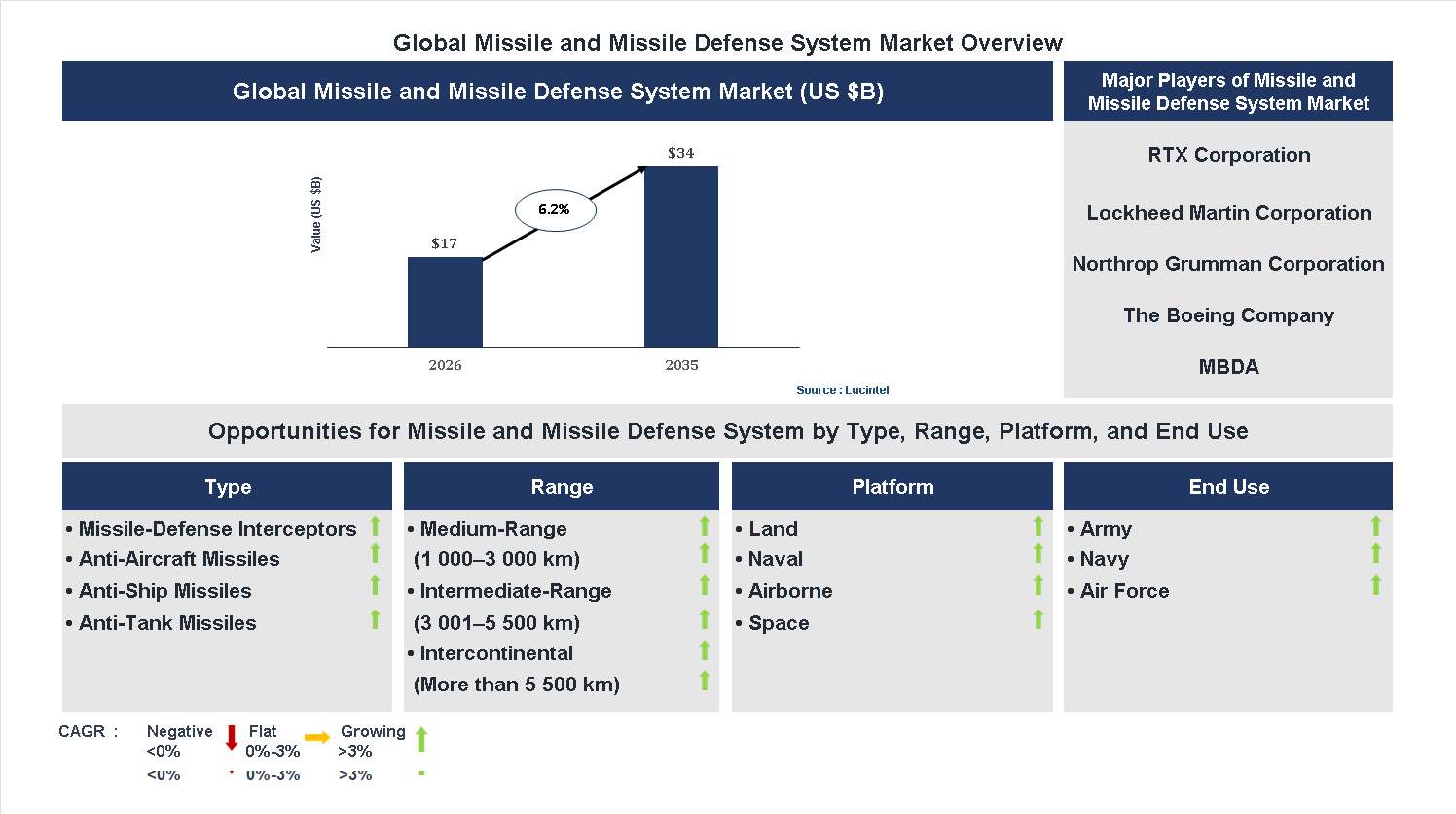
The future of the global missile and missile defense system market looks promising with opportunities in the army, navy, and air force markets. The global missile and missile defense system market is expected to reach an estimated $34 billion by 2035 with a CAGR of 6.2% from 2026 to 2035. The major drivers for this market are the increasing demand for advanced missile defense systems, the rising geopolitical tensions driving defense investments, and the growing adoption of integrated air defense technologies.• Lucintel forecasts that, within the type category, anti-aircraft missile is expected to witness the highest growth over the forecast period.
• Within the end use category, army is expected to witness the highest growth.
• In terms of region, APAC is expected to witness the highest growth over the forecast period. Gain valuable insights for your business decisions with our comprehensive 150+ page report. Sample figures with some insights are shown below.
Emerging Trends in the Missile and Missile Defense System Market
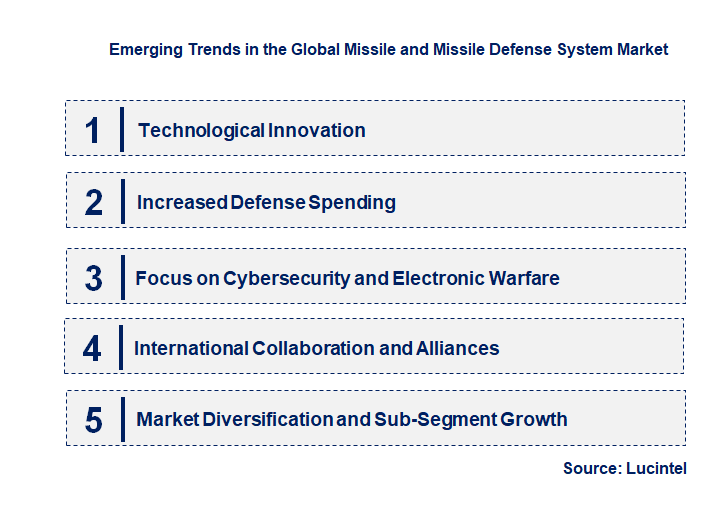
The missile and missile defense system market is experiencing rapid evolution driven by technological advancements, geopolitical shifts, and increasing defense budgets worldwide. Countries are investing heavily in modernizing their military capabilities to counter emerging threats, including advanced missile technology and cyber warfare. The integration of artificial intelligence, improved detection systems, and international collaborations are shaping the future landscape of missile defense. These developments are not only enhancing national security but also creating new opportunities for defense contractors and technology providers. As threats become more sophisticated, the market is poised for significant growth, innovation, and strategic realignments in the coming years.• Technological Innovation: The market is witnessing significant advancements in missile technology, including hypersonic missiles and autonomous systems. These innovations improve speed, accuracy, and survivability, making missile defense more challenging and necessitating equally advanced countermeasures. The integration of artificial intelligence and machine learning enhances targeting precision and decision-making speed, transforming missile defense capabilities. This trend drives continuous R&D investments and fosters collaboration between defense agencies and private tech firms, ultimately leading to more sophisticated and resilient missile systems.
• Increased Defense Spending: Governments worldwide are increasing their defense budgets to counter emerging missile threats. Countries like the U.S., China, and Russia are prioritizing missile defense modernization to safeguard strategic assets and borders. This surge in spending fuels market growth, procurement of advanced missile systems, and expansion of existing defense infrastructure. It also encourages public-private partnerships and stimulates innovation in missile detection, tracking, and interception technologies, ensuring that defense systems stay ahead of evolving threats.
• Focus on Cybersecurity and Electronic Warfare: As missile systems become more networked and reliant on digital technologies, cybersecurity and electronic warfare are gaining prominence. Protecting missile command and control systems from cyber-attacks is critical to maintaining operational integrity. Electronic warfare capabilities are being integrated to jam or deceive enemy missile systems, enhancing defensive measures. This trend emphasizes the importance of secure communication channels and resilient systems, prompting investments in cybersecurity solutions and electronic countermeasure technologies to safeguard missile defense networks.
• International Collaboration and Alliances: Countries are increasingly forming strategic alliances and participating in joint missile defense initiatives. NATO, for example, is enhancing its missile defense architecture through shared technology and coordinated operations. Such collaborations improve interoperability, reduce costs, and accelerate technological development. International partnerships also facilitate intelligence sharing and joint training exercises, strengthening collective security against missile threats. This trend underscores the importance of multilateral efforts in addressing complex missile defense challenges and fostering global stability.
• Market Diversification and Sub-segment Growth: The missile defense market is expanding into various sub-segments, including land-based systems, naval defense, and space-based sensors. Land-based missile interceptors are being upgraded for better range and accuracy, while naval systems are integrating missile defense modules for fleet protection. Space-based sensors are emerging as critical components for early threat detection. These diversified segments cater to different operational needs and geographic regions, creating new revenue streams and opportunities for specialized defense contractors. The growth of these sub-segments reflects a comprehensive approach to missile defense across multiple domains. These emerging trends are fundamentally reshaping the missile and missile defense system market by fostering innovation, increasing strategic collaborations, and expanding technological capabilities. The market is becoming more dynamic, interconnected, and resilient, driven by the need to counter sophisticated missile threats and ensure national security. As these trends continue to evolve, they will likely lead to more advanced, integrated, and effective missile defense solutions worldwide.
Recent Developments in the Missile and Missile Defense System Market
The missile and missile defense system market is experiencing rapid advancements driven by geopolitical tensions, technological innovations, and increasing defense budgets worldwide. Countries are investing heavily in developing sophisticated missile capabilities and defense systems to ensure national security. These developments are reshaping the global defense landscape, creating new opportunities for manufacturers and strategic partnerships. The evolving threat environment necessitates continuous innovation, making this market highly dynamic and competitive.• Growing Geopolitical Tensions: Increased regional conflicts and global power rivalries are prompting nations to enhance missile capabilities and defense systems, leading to higher market demand and technological innovation.
• Technological Innovations in Missile Defense: Advances in radar, AI, and missile tracking are improving interception accuracy, expanding the market for integrated missile defense solutions and boosting defense contractor revenues.
• Rising Defense Budgets: Governments worldwide are allocating more funds to missile and missile defense systems, enabling large-scale procurement, R&D investments, and fostering industry growth.
• Development of Hypersonic Missiles: The emergence of hypersonic missile technology is pushing defense systems to evolve rapidly, creating new markets for high-speed interception and advanced defense platforms.
• Strategic Collaborations and Alliances: International partnerships and joint ventures are accelerating technology sharing, standardization, and market expansion, strengthening global missile defense capabilities. These developments are significantly impacting the missile and missile defense system market by increasing demand, fostering innovation, and encouraging strategic collaborations. The market is becoming more competitive and technologically advanced, with substantial growth prospects driven by geopolitical needs and technological progress. Overall, these trends are shaping a resilient, dynamic industry poised for continued expansion.
Strategic Growth Opportunities in the Missile and Missile Defense System Market
The missile and missile defense system market is experiencing rapid growth driven by increasing geopolitical tensions, technological advancements, and the need for enhanced national security. Governments worldwide are investing heavily in modernizing their defense capabilities, leading to a surge in demand for advanced missile systems and defense solutions. This evolving landscape presents numerous opportunities for innovation, strategic partnerships, and market expansion across various applications, including military, aerospace, and homeland security sectors.• Increasing Demand for Advanced Ballistic Missile Defense Systems: The rising threat of ballistic missile attacks has prompted countries to invest in sophisticated missile defense systems such as THAAD, Aegis, and S-400. These systems offer enhanced detection, tracking, and interception capabilities, ensuring national security. The growing need for integrated defense solutions across borders and the development of multi-layered defense architectures are fueling market growth, with sub-segments like command and control systems and radar technology gaining prominence.
• Growing Adoption of Hypersonic Missile Technologies: Hypersonic missiles, capable of traveling at speeds exceeding Mach 5, present a significant challenge to existing missile defense systems. The development and deployment of hypersonic missile defense solutions are gaining momentum, driven by the need to counter emerging threats. This opportunity includes research into new materials, propulsion systems, and advanced sensors, fostering innovation in both offensive and defensive missile technologies, and expanding the market scope into new strategic domains.
• Expansion of Commercial and Civil Applications of Missile Technologies: Beyond military use, missile technology is increasingly applied in space exploration, satellite deployment, and aerospace research. The commercialization of missile systems for satellite launches and space missions opens new revenue streams. Sub-segments like small satellite launch vehicles and reusable missile platforms are gaining traction, providing cost-effective solutions and fostering collaboration between defense and commercial sectors, thus broadening market reach and technological development.
• Integration of Artificial Intelligence and Automation in Missile Defense: The incorporation of AI, machine learning, and automation enhances the accuracy, speed, and reliability of missile detection and interception systems. These technologies enable real-time data analysis, predictive maintenance, and autonomous decision-making, reducing response times and operational costs. The integration of AI-driven systems is a key growth driver, leading to smarter, more adaptable defense solutions and opening avenues for innovative product development and strategic partnerships.
• Increasing Focus on Regional and Homeland Security Applications: Countries are prioritizing missile defense for homeland security and regional stability, especially in volatile geopolitical zones. This focus drives investments in localized missile defense systems, border security, and integrated surveillance networks. Sub-segments like coastal missile defense and urban security systems are expanding, creating opportunities for tailored solutions that address specific regional threats. This trend enhances overall market resilience and fosters regional collaborations for comprehensive security strategies. The overall impact of these opportunities is a dynamic and expanding missile and missile defense system market, driven by technological innovation, strategic needs, and emerging threats. Companies and governments investing in these areas will shape future defense capabilities, ensuring enhanced security and technological leadership in a complex global landscape.
Missile and Missile Defense System Market Driver and Challenges
The missile and missile defense system market is influenced by a complex interplay of technological advancements, economic considerations, and regulatory frameworks. Rapid developments in missile technology and defense systems are driven by geopolitical tensions and the need for national security. Economic factors such as government defense budgets and international arms trade significantly impact market growth. Additionally, regulatory policies regarding arms control and export restrictions shape the development and deployment of missile systems. These drivers and challenges collectively determine the pace and direction of market expansion, requiring stakeholders to adapt to evolving technological, economic, and regulatory landscapes to maintain competitiveness and ensure security. The factors responsible for driving the missile and missile defense system market include:-• Technological Innovation: The continuous evolution of missile technology, including precision guidance, stealth capabilities, and advanced propulsion systems, propels market growth. Defense agencies seek cutting-edge systems to counter emerging threats, leading to increased R&D investments. Innovations such as hypersonic missiles and integrated defense networks enhance strategic capabilities, making systems more effective and reliable. This technological progress not only boosts market demand but also fosters international competition and collaboration, shaping future defense architectures.
• Geopolitical Tensions and Security Concerns: Rising geopolitical conflicts and regional tensions drive nations to bolster their missile defense capabilities. Countries facing threats from neighboring states or rogue actors prioritize the development and procurement of advanced missile systems. This heightened security environment results in increased defense budgets and procurement activities, fueling market growth. The need for rapid, reliable defense solutions to protect critical infrastructure and military assets remains a primary driver, influencing both government policies and industry investments.
• Government Defense Spending: Increased defense budgets worldwide, especially in North America, Europe, and Asia-Pacific, significantly impact the market. Governments allocate substantial funds for missile development, procurement, and modernization programs to maintain strategic superiority. These investments support domestic defense industries and foster technological innovation. Fluctuations in defense spending due to political or economic factors can influence market stability, but overall, sustained or growing budgets underpin long-term growth prospects.
• International Arms Trade and Alliances: The global arms trade and strategic alliances facilitate the transfer of missile technology and defense systems across borders. Countries often collaborate or share technology to strengthen regional security frameworks, expanding market opportunities. Defense pacts and alliances, such as NATO, promote joint procurement and development initiatives, boosting demand for missile defense systems. This interconnectedness accelerates technological exchange and market expansion, although it also raises concerns about proliferation and regulatory compliance.
• Regulatory and Export Control Policies: Stringent regulations governing missile technology exports and international arms control treaties influence market dynamics. Compliance with these policies can restrict or delay the deployment of certain systems, impacting manufacturers and buyers. Conversely, relaxed regulations or new treaties can open up markets and facilitate technology transfer. Navigating these regulatory landscapes is crucial for companies seeking to expand globally, making policy shifts a significant driver or barrier in the market. The challenges facing the missile and missile defense system market include:-
• Technological Complexity and High Development Costs: Developing advanced missile and missile defense systems involves significant technological challenges and substantial financial investments. The complexity of integrating multiple subsystems, ensuring reliability, and maintaining technological superiority demands extensive R&D and testing. High costs can limit entry for smaller players and slow down innovation, while delays or failures in development can impact market growth and defense readiness.
• Rapidly Evolving Threat Landscape: The emergence of new missile threats, such as hypersonic weapons and counter-space systems, requires continuous adaptation of defense systems. Keeping pace with these rapid technological changes is challenging, demanding ongoing innovation and substantial investment. Failure to address emerging threats effectively can compromise national security and diminish market confidence, creating a constant pressure on defense agencies and manufacturers.
• Regulatory and Political Barriers: International arms control agreements, export restrictions, and political considerations often hinder the transfer and deployment of missile systems. These regulatory barriers can delay procurement processes, increase costs, and limit market access for certain countries or companies. Political tensions and diplomatic issues further complicate international collaborations, impacting the global supply chain and market expansion efforts. The missile and missile defense system market is shaped by rapid technological advancements, geopolitical tensions, and substantial defense investments. While these drivers promote growth and innovation, challenges such as high development costs, evolving threats, and regulatory barriers pose significant hurdles. The markets future trajectory will depend on how effectively stakeholders navigate these factors, balancing technological progress with regulatory compliance and strategic security needs. Overall, the market remains dynamic, with opportunities for growth driven by global security imperatives, but it must also address complex challenges to sustain long-term development.
List of Missile and Missile Defense System Companies
Companies in the market compete on the basis of product quality offered. Major players in this market focus on expanding their manufacturing facilities, R&D investments, infrastructural development, and leverage integration opportunities across the value chain. With these strategies missile and missile defense system companies cater increasing demand, ensure competitive effectiveness, develop innovative products & technologies, reduce production costs, and expand their customer base. Some of the missile and missile defense system companies profiled in this report include-• RTX Corporation
• Lockheed Martin Corporation
• Northrop Grumman Corporation
• The Boeing Company
• MBDA
• Israel Aerospace Industries Ltd.
• Saab AB
• Kongsberg Gruppen ASA
• RAFAEL Advanced Defense Systems Ltd.
• Hanwha Aerospace
Missile and Missile Defense System Market by Segment
The study includes a forecast for the global missile and missile defense system market by type, range, platform, end use, and region.Missile and Missile Defense System Market by Type [Value from 2019 to 2035]:
• Missile-Defense Interceptors
• Anti-Aircraft Missiles
• Anti-Ship Missiles
• Anti-Tank Missiles
Missile and Missile Defense System Market by Range [Value from 2019 to 2035]:
• Medium-Range (1 000–3 000 km)
• Intermediate-Range (3 001–5 500 km)
• Intercontinental (More than 5 500 km)
Missile and Missile Defense System Market by Platform [Value from 2019 to 2035]:
• Land
• Naval
• Airborne
• Space
Missile and Missile Defense System Market by End Use [Value from 2019 to 2035]:
• Army
• Navy
• Air Force
Missile and Missile Defense System Market by Region [Value from 2019 to 2035]:
• North America
• Europe
• Asia Pacific
• The Rest of the World
Country Wise Outlook for the Missile and Missile Defense System Market
The missile and missile defense system market has experienced significant advancements driven by geopolitical tensions, technological innovations, and increased defense budgets worldwide. Countries are investing heavily in developing advanced missile technologies and robust defense systems to enhance national security. The evolving threat landscape, including regional conflicts and emerging missile capabilities, has accelerated research and deployment efforts. Governments are also focusing on integrating artificial intelligence, automation, and improved detection systems into missile defense architectures. These developments reflect a strategic shift towards more sophisticated, reliable, and rapid-response missile defense solutions to counter evolving threats effectively.• United States: The US missile and missile defense system market has seen substantial growth with the deployment of advanced systems like the THAAD and Aegis Ballistic Missile Defense. The country is investing in next-generation technologies, including hypersonic missile defense and integrated command systems, to maintain strategic superiority. Recent initiatives focus on enhancing interoperability among allied nations and expanding missile defense coverage in the Indo-Pacific region. The US also emphasizes research into AI-driven detection and response systems to improve reaction times and accuracy against emerging threats.
• China: China has rapidly advanced its missile technology, developing a range of ballistic and cruise missiles with increased range and precision. The country is investing heavily in missile defense systems such as the HQ-9 and the development of its own anti-ballistic missile capabilities. Recent developments include the deployment of layered missile defense networks around key strategic locations and the modernization of existing systems. China’s focus on indigenous innovation aims to reduce reliance on foreign technology and bolster its regional and global missile defense posture.
• Germany: Germany’s missile defense market is characterized by modernization and integration efforts within NATO frameworks. The country is upgrading its Patriot missile systems and investing in new radar and detection technologies to improve missile interception capabilities. Germany is also involved in collaborative European projects to develop advanced missile defense solutions, emphasizing interoperability and joint operational readiness. Recent developments include enhanced surveillance systems and increased funding for research into missile tracking and interception technologies to counter evolving threats.
• India: India has made significant strides in developing indigenous missile and missile defense systems, including the Agni and Prithvi missile series. The country is focusing on strengthening its layered missile defense with systems like the Akash-NG and the development of the Advanced Air Defence (AAD) and Terminal High Altitude Area Defense (THAAD) systems. Recent advancements include successful tests of hypersonic missile capabilities and the integration of missile defense with naval and air force assets. India’s strategic emphasis is on achieving self-reliance and establishing a credible deterrent against regional threats.
• Japan: Japan continues to enhance its missile defense capabilities amid regional tensions, particularly with North Korea and China. The country is deploying Aegis Ashore systems and upgrading existing missile interceptors to improve detection and interception accuracy. Japan is also investing in advanced radar and sensor technologies to strengthen early warning systems. Recent developments include joint exercises with allied nations and increased procurement of missile defense hardware to ensure rapid response and regional stability. Japan’s focus remains on maintaining a robust, technologically advanced missile defense network to safeguard its sovereignty.

Features of the Global Missile and Missile Defense System Market
Market Size Estimates: Missile and missile defense system market size estimation in terms of value ($B). Trend and Forecast Analysis: Market trends (2019 to 2025) and forecast (2026 to 2035) by various segments and regions. Segmentation Analysis: Missile and missile defense system market size by various segments, such as by type, range, platform, end use, and region in terms of value ($B). Regional Analysis: Missile and missile defense system market breakdown by North America, Europe, Asia Pacific, and Rest of the World. Growth Opportunities: Analysis of growth opportunities in different types, range, platforms, end uses, and regions for the missile and missile defense system market. Strategic Analysis: This includes M&A, new product development, and competitive landscape of the missile and missile defense system market. Analysis of competitive intensity of the industry based on Porter’s Five Forces model.
FAQ
Q1. What is the missile and missile defense system market size? Answer: The global missile and missile defense system market is expected to reach an estimated $34 billion by 2035. Q2. What is the growth forecast for missile and missile defense system market? Answer: The global missile and missile defense system market is expected to grow with a CAGR of 6.2% from 2026 to 2035. Q3. What are the major drivers influencing the growth of the missile and missile defense system market? Answer: The major drivers for this market are the increasing demand for advanced missile defense systems, the rising geopolitical tensions driving defense investments, and the growing adoption of integrated air defense technologies. Q4. What are the major segments for missile and missile defense system market? Answer: The future of the missile and missile defense system market looks promising with opportunities in the army, navy, and air force markets. Q5. Who are the key missile and missile defense system market companies? Answer: Some of the key missile and missile defense system companies are as follows:• RTX Corporation
• Lockheed Martin Corporation
• Northrop Grumman Corporation
• The Boeing Company
• MBDA
• Israel Aerospace Industries Ltd.
• Saab AB
• Kongsberg Gruppen ASA
• RAFAEL Advanced Defense Systems Ltd.
• Hanwha Aerospace Q6. Which missile and missile defense system market segment will be the largest in future? Answer: Lucintel forecasts that, within the type category, anti-aircraft missile is expected to witness the highest growth over the forecast period. Q7. In missile and missile defense system market, which region is expected to be the largest in next 8 years? Answer: In terms of region, APAC is expected to witness the highest growth over the forecast period. Q8. Do we receive customization in this report? Answer: Yes, Lucintel provides 10% customization without any additional cost.
Table of Contents
List of Figures
List of Tables
Methodology
- In-depth interviews of the major players in this market
- Detailed secondary research from competitors’ financial statements and published data
- Extensive searches of published works, market, and database information pertaining to industry news, company press releases, and customer intentions
- A compilation of the experiences, judgments, and insights of Lucintel’s professionals, who have analyzed and tracked this market over the years.


Buy Now
Choose a license that fits your team. Instant PDF delivery.
Prices exclude taxes. Instant delivery. Custom licensing available on request.
Key Questions
- • What are some of the most promising, high-growth opportunities for the missile and missile defense system market by type (missile-defense interceptors, anti-aircraft missiles, anti-ship missiles, and anti-tank missiles), range (medium-range (1 000–3 000 km), intermediate-range (3 001–5 500 km), and intercontinental (more than 5 500 km)), platform (land, naval, airborne, and space), end use (army, navy, and air force), and region (North America, Europe, Asia Pacific, and the Rest of the World)?
- • Which segments will grow at a faster pace and why?
- • Which region will grow at a faster pace and why?
- • What are the key factors affecting market dynamics? What are the key challenges and business risks in this market?
- • What are the business risks and competitive threats in this market?
- • What are the emerging trends in this market and the reasons behind them?
- • What are some of the changing demands of customers in the market?
- • What are the new developments in the market? Which companies are leading these developments?
- • Who are the major players in this market? What strategic initiatives are key players pursuing for business growth?
- • What are some of the competing products in this market and how big of a threat do they pose for loss of market share by material or product substitution?
- • What M&A activity has occurred in the last 5 years and what has its impact been on the industry? For any questions related to Missile and Missile Defense System Market, Missile and Missile Defense System Market Size, Missile and Missile Defense System Market Growth, Missile and Missile Defense System Market Analysis, Missile and Missile Defense System Market Report, Missile and Missile Defense System Market Share, Missile and Missile Defense System Market Trends, Missile and Missile Defense System Market Forecast, Missile and Missile Defense System Companies, write Lucintel analyst at email: helpdesk@lucintel.com. We will be glad to get back to you soon.


