
Market Report · July 31, 2026

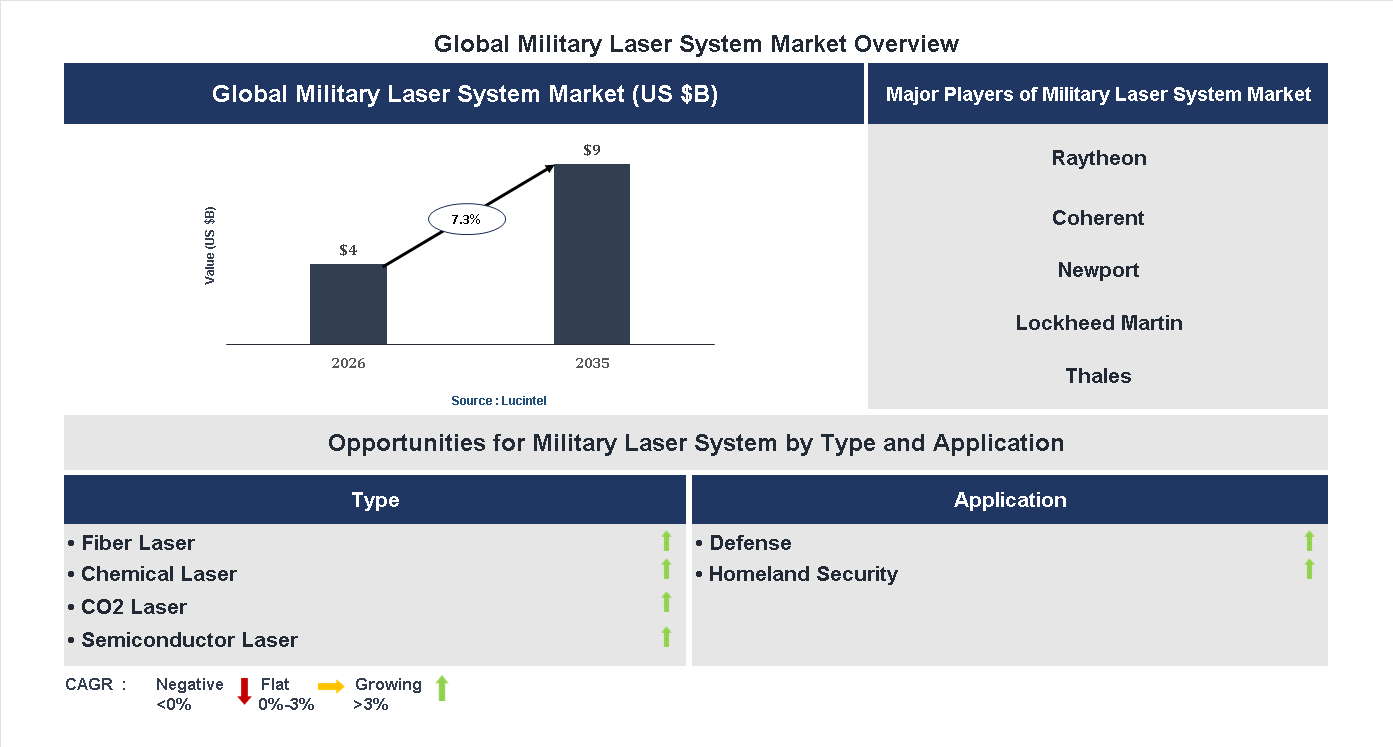
Key data points: The market size in 2035 = $9 billion, growth forecast = 7.3% annually for the next 8 years. Scroll below to get more insights. This market report covers trends, opportunities and forecasts in military laser system market to 2035 by type (fiber laser, chemical laser, CO2 laser, and semiconductor laser), application (defense and homeland security), and region (North America, Europe, Asia Pacific, and the Rest of the World)
We'll send your sample report shortly.
• Lucintel forecasts that, within the type category, fiber laser is expected to witness the highest growth over the forecast period.
• Within the application category, defense is expected to witness higher growth.
• In terms of region, APAC is expected to witness the highest growth over the forecast period. Gain valuable insights for your business decisions with our comprehensive 150+ page report. Sample figures with some insights are shown below.
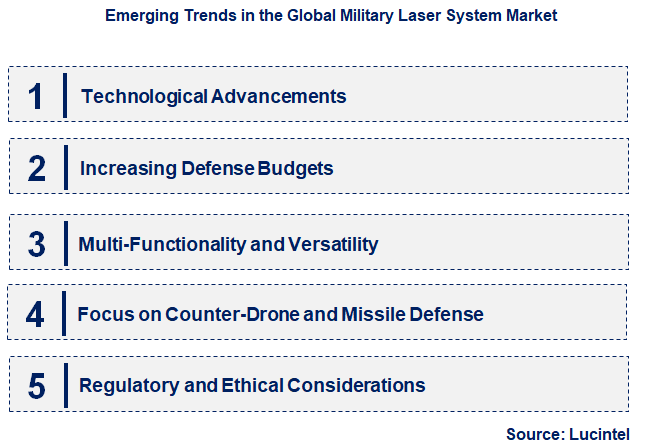
• Technological Advancements: The integration of high-power laser technology with artificial intelligence and automation is revolutionizing military laser systems. These innovations enable precise targeting, real-time threat assessment, and autonomous operation, significantly improving combat efficiency. The development of compact, portable laser systems also enhances deployment flexibility. As technology progresses, laser systems are becoming more effective against a broader range of targets, including drones, missiles, and electronic warfare assets. This trend is driving increased R&D investments and fostering collaborations between defense agencies and tech firms.
• Increasing Defense Budgets: Governments worldwide are allocating more funds to modernize their armed forces, with a focus on laser weapon systems. This surge in defense spending is driven by escalating geopolitical tensions and the need for advanced defense capabilities. Countries are investing in research, procurement, and deployment of laser systems to gain strategic advantages. The increased budgets facilitate the development of next-generation laser weapons, expand existing capabilities, and accelerate the integration of laser systems into military operations. This trend is expected to sustain market growth and foster innovation in laser technology.
• Multi-Functionality and Versatility: Modern military laser systems are evolving from single-purpose tools to multi-functional platforms capable of performing various roles such as target designation, missile defense, and electronic warfare. This versatility reduces the need for multiple systems, lowering costs and logistical complexities. The ability to adapt laser systems for different missions enhances operational flexibility and effectiveness. Manufacturers are focusing on developing adaptable laser modules and integrated systems that can be easily upgraded or reconfigured. This trend is reshaping the market by emphasizing multifunctionality as a key differentiator.
• Focus on Counter-Drone and Missile Defense: The proliferation of small drones and ballistic missiles has prompted a significant shift toward laser-based countermeasures. Laser systems offer a cost-effective, rapid-response solution for neutralizing aerial threats. The development of high-energy laser weapons specifically targeting drones and missile systems is gaining momentum. This focus is driven by the need to protect critical infrastructure and military assets from emerging aerial threats. As a result, the market is witnessing increased R&D efforts and deployment of laser countermeasure systems, positioning laser technology as a vital component of modern defense strategies.
• Regulatory and Ethical Considerations: The deployment of military laser systems raises concerns regarding safety, ethical use, and international regulations. Governments and international bodies are working to establish guidelines to prevent misuse and unintended harm, especially concerning space-based and autonomous laser systems. These regulations influence research, development, and deployment strategies, potentially slowing down some innovations or imposing restrictions. The evolving legal landscape underscores the importance of responsible innovation and international cooperation to ensure laser systems are used ethically and safely, shaping future market dynamics and technological development. These emerging trends are transforming the military laser system market by fostering innovation, increasing strategic importance, and prompting regulatory considerations. The market is becoming more dynamic, with advanced, versatile, and integrated laser solutions playing a central role in modern defense architectures. This evolution is set to enhance military capabilities globally while also raising important ethical and regulatory questions that will influence future growth and development.
• Growing Adoption of Directed Energy Weapons: The increasing deployment of directed energy weapons, including laser systems, is transforming military defense strategies. These systems offer precise targeting, rapid response, and reduced collateral damage, making them highly effective against drones, missiles, and other threats. The demand for such technology is driven by the need for cost-effective, scalable, and environmentally friendly defense solutions. This trend is expected to accelerate as countries seek to enhance their defensive and offensive capabilities with cutting-edge laser technology.
• Technological Innovations in Laser Precision and Power: Advances in laser technology, such as higher power outputs and improved beam quality, are expanding the operational scope of military laser systems. These innovations enable longer-range targeting, increased accuracy, and the ability to disable or destroy sophisticated threats. Enhanced power and precision are also facilitating new applications like laser communication and sensor systems. These technological breakthroughs are crucial for maintaining strategic superiority and are likely to drive market growth significantly.
• Integration of Artificial Intelligence and Automation: The incorporation of AI and automation into laser systems is revolutionizing military operations. AI enhances targeting accuracy, threat detection, and system responsiveness, while automation reduces human intervention, increasing operational efficiency. These integrations enable real-time decision-making and adaptive responses to complex combat scenarios. As AI-driven laser systems become more reliable and sophisticated, they are expected to play a pivotal role in future battlefield strategies, boosting the market’s growth potential.
• Increasing Focus on Lightweight and Portable Systems: The development of lightweight, portable laser systems is a key trend, driven by the need for mobility and flexibility in combat situations. These systems allow for rapid deployment, ease of use, and integration with various platforms such as drones and vehicles. Advances in miniaturization and power sources are making portable laser systems more viable, expanding their application scope. This trend enhances tactical versatility and is expected to significantly influence market expansion, especially in asymmetric warfare and special operations.
• Rising Investments in Research and Development: Governments and defense contractors are increasing R&D investments to develop next-generation laser systems with enhanced capabilities. Focus areas include increasing power output, improving durability, and reducing costs. These investments aim to create versatile, multi-functional laser platforms capable of countering emerging threats. The ongoing R&D efforts are fostering innovation, accelerating product development, and expanding the market’s technological landscape, ultimately strengthening military readiness and strategic advantage. These recent developments are significantly transforming the military laser system market by enhancing operational capabilities, increasing technological sophistication, and expanding application scopes. The integration of AI, innovations in power and precision, and the focus on portability are driving market growth and strategic advantages for defense forces worldwide. As investments continue and technology advances, the market is poised for rapid expansion, shaping the future of modern military defense systems.
• Expansion of Laser Targeting and Designator Systems: The increasing need for precise targeting in modern warfare is driving the adoption of laser designators and targeting systems. These systems improve accuracy for missile and artillery strikes, reducing collateral damage and increasing operational effectiveness. Advances in miniaturization and power efficiency are making these systems more versatile and easier to deploy across various military platforms, including drones and ground vehicles. This growth is supported by ongoing research into high-power laser technology for battlefield applications.
• Growing Adoption of Directed Energy Weapons for Defense: Directed energy weapons (DEWs) are gaining traction as a non-kinetic alternative for defense against drones, missiles, and small boats. These systems offer rapid response times, cost-effectiveness, and the ability to disable or destroy targets without traditional ammunition. Military investments are focused on increasing power output, portability, and integration with existing defense systems. The development of scalable DEWs is expected to revolutionize battlefield engagement strategies and enhance national security.
• Increasing Use of Laser-Based Surveillance and Reconnaissance Systems: Laser systems are increasingly used for high-resolution imaging, surveillance, and reconnaissance missions. Their ability to operate in various weather conditions and over long distances makes them ideal for border security, battlefield monitoring, and intelligence gathering. Innovations in laser sensor technology are improving data collection accuracy and processing speed. Governments are investing in these systems to enhance situational awareness and support strategic decision-making in complex operational environments.
• Integration of AI and Automation in Laser Systems: The incorporation of artificial intelligence and automation is transforming military laser systems into smarter, more autonomous units. AI enables real-time target recognition, threat assessment, and system calibration, reducing human error and response times. Automated laser systems can operate continuously in high-threat environments, providing persistent defense capabilities. This integration is expected to improve operational efficiency, reduce manpower requirements, and enable rapid deployment in dynamic combat scenarios.
• Rising Demand for Portable and Lightweight Laser Systems: The need for mobile, easy-to-deploy laser systems is increasing among modern armed forces. Portable laser designators, rangefinders, and countermeasure devices enhance battlefield flexibility and rapid response capabilities. Advances in lightweight materials and battery technology are making these systems more durable and energy-efficient. They are particularly valuable for special operations, reconnaissance missions, and vehicle-mounted applications, providing soldiers with reliable, high-performance laser tools in diverse operational settings. The overall impact of these growth opportunities is set to significantly enhance the capabilities, efficiency, and versatility of military laser systems. As technological innovations continue to emerge, the market is poised for substantial expansion, supporting modern defense strategies and ensuring national security in an evolving threat landscape.
• Technological Innovation: The continuous development of more precise, powerful, and versatile laser systems enhances military capabilities. Advances in beam control, miniaturization, and integration with other defense systems improve operational efficiency and effectiveness. These innovations enable militaries to deploy laser systems for various applications, including missile defense, target designation, and directed energy weapons, fostering market growth.
• Increasing Defense Budgets: Governments worldwide are allocating substantial funds toward modernizing their armed forces. Rising defense budgets, especially in North America and Asia-Pacific, facilitate investments in laser technology. This financial commitment accelerates research, development, and procurement of advanced laser systems, ensuring that military forces stay ahead of emerging threats.
• Evolving Threat Landscape: The increasing sophistication of adversaries missile and drone capabilities necessitates advanced countermeasure systems. Laser technology offers a cost-effective, rapid-response solution for neutralizing threats. The need for enhanced defense mechanisms against asymmetric warfare and unmanned systems propels demand for military laser systems.
• Strategic Military Modernization Initiatives: Countries are prioritizing modernization programs to upgrade their defense infrastructure. Incorporating laser systems into existing military platforms enhances operational versatility and strategic advantage. These initiatives drive the development and deployment of laser technologies across various branches of the armed forces, expanding market opportunities. The challenges facing the military laser system market include:-
• High Development and Procurement Costs: Developing advanced laser systems involves significant investment in research, testing, and manufacturing. The high costs can limit adoption, especially among countries with constrained defense budgets. Additionally, procurement expenses for integrated systems can hinder widespread deployment, impacting market growth.
• Regulatory and Export Restrictions: Stringent regulations governing the development, export, and use of military laser technology pose barriers. International treaties and national security concerns restrict the transfer of laser systems across borders, complicating global market expansion and collaboration among defense contractors.
• Technological Limitations and Reliability Issues: Despite advancements, laser systems face challenges related to power requirements, atmospheric interference, and system durability. Ensuring consistent performance in diverse operational environments remains a hurdle. These technological limitations can delay deployment and reduce confidence in laser systems, affecting market expansion. The military laser system market is driven by rapid technological innovations, increased defense spending, and the need for advanced threat mitigation solutions. However, high costs, regulatory barriers, and technological challenges temper growth prospects. The interplay of these factors creates a dynamic environment where strategic investments and technological breakthroughs are essential for market expansion. Overall, the markets future hinges on balancing innovation with overcoming financial and regulatory hurdles, shaping a landscape of significant opportunity amid persistent challenges.
• Raytheon
• Coherent
• Newport
• Lockheed Martin
• Thales
• Fiber Laser
• Chemical Laser
• CO2 Laser
• Semiconductor Laser
• Defense
• Homeland Security
• North America
• Europe
• Asia Pacific
• The Rest of the World
• United States: The U.S. has made substantial progress in developing high-energy laser systems for missile defense and aircraft protection. The Department of Defense has invested in projects like the Laser Weapon System (Laws) and the High Energy Laser Mobile Demonstrator (HEL MD). Recent advancements include increased power output, improved targeting accuracy, and integration with existing military platforms. The U.S. also focuses on deploying laser systems on naval ships and ground vehicles, aiming for rapid deployment and operational readiness. Collaborations with private firms have accelerated innovation, positioning the U.S. as a leader in military laser technology.
• China: China has rapidly advanced its military laser capabilities, emphasizing anti-drone and anti-missile applications. The country has developed portable laser weapon prototypes and integrated laser systems into its naval and land-based platforms. Recent developments include increased laser power, enhanced targeting systems, and the deployment of laser weapons in live-fire exercises. Chinas focus on indigenous innovation and military modernization has resulted in a robust laser research program, aiming to achieve strategic dominance in regional conflicts. The country also emphasizes the development of laser-based non-lethal weapons for crowd control and surveillance.
• Germany: Germany has concentrated on the integration of laser systems for naval and land-based defense applications. The country has developed compact, high-precision laser weapon modules suitable for installation on frigates and armored vehicles. Recent innovations include improved beam control, increased operational range, and better power efficiency. Germany collaborates with European partners to develop joint laser defense systems, emphasizing interoperability and technological standardization. The country’s focus remains on enhancing existing defense infrastructure with laser technology to provide scalable and sustainable military solutions.
• India: India has accelerated its efforts to develop laser-based defense systems, primarily targeting drone suppression and missile defense. The country has tested laser prototypes capable of disabling small aerial threats and enhancing battlefield situational awareness. Recent developments include the deployment of mobile laser systems and integration with existing missile defense frameworks. India’s defense research organizations are working on indigenous laser technology, aiming for self-reliance and strategic autonomy. The focus is on creating cost-effective, portable laser systems that can be rapidly deployed in diverse operational environments.
• Japan: Japan has prioritized the development of laser systems for missile defense and anti-drone applications, driven by regional security concerns. The country has made progress in miniaturizing laser technology for deployment on ships and ground units. Recent advancements include increased laser power, improved targeting precision, and integration with existing missile defense systems like Aegis. Japan collaborates with international partners to enhance its laser capabilities and ensure interoperability. The focus remains on creating versatile, reliable laser systems that can complement traditional missile defense strategies and address emerging threats in the Asia-Pacific region.


• Raytheon
• Coherent
• Newport
• Lockheed Martin
• Thales Q6. Which military laser system market segment will be the largest in future? Answer: Lucintel forecasts that, within the type category, fiber laser is expected to witness the highest growth over the forecast period. Q7. In military laser system market, which region is expected to be the largest in next 8 years? Answer: In terms of region, APAC is expected to witness the highest growth over the forecast period. Q8. Do we receive customization in this report? Answer: Yes, Lucintel provides 10% customization without any additional cost.


Choose a license that fits your team. Instant PDF delivery.
Prices exclude taxes. Instant delivery. Custom licensing available on request.
Market Report · July 31, 2026
Market Report · July 31, 2026
Market Report · July 31, 2026
Trusted partner for strategic intelligence and business growth


Receive a complimentary market analysis tailored to your industry. Our analysts will identify key growth opportunities and competitive dynamics specific to your business.

Market size, growth rate, and key trend analysis for your specific sector.

Top competitor positioning and market share analysis.

Strategic recommendations backed by data-driven insights.
Get curated market intelligence and competitive moves straight to your inbox.
By subscribing, you agree to receive our monthly insights. Unsubscribe anytime.
Receive a complimentary market analysis tailored to your industry. Our analysts will identify key growth opportunities and competitive dynamics specific to your business.
Market size, growth rate, and key trend analysis for your specific sector.
Top competitor positioning and market share analysis.
Strategic recommendations backed by data-driven insights.
Get curated market intelligence, emerging trends, and competitive moves straight to your inbox each month.
By subscribing, you agree to receive our monthly insights. Unsubscribe anytime.
We'll send your sample report shortly.