
Market Report · July 31, 2026

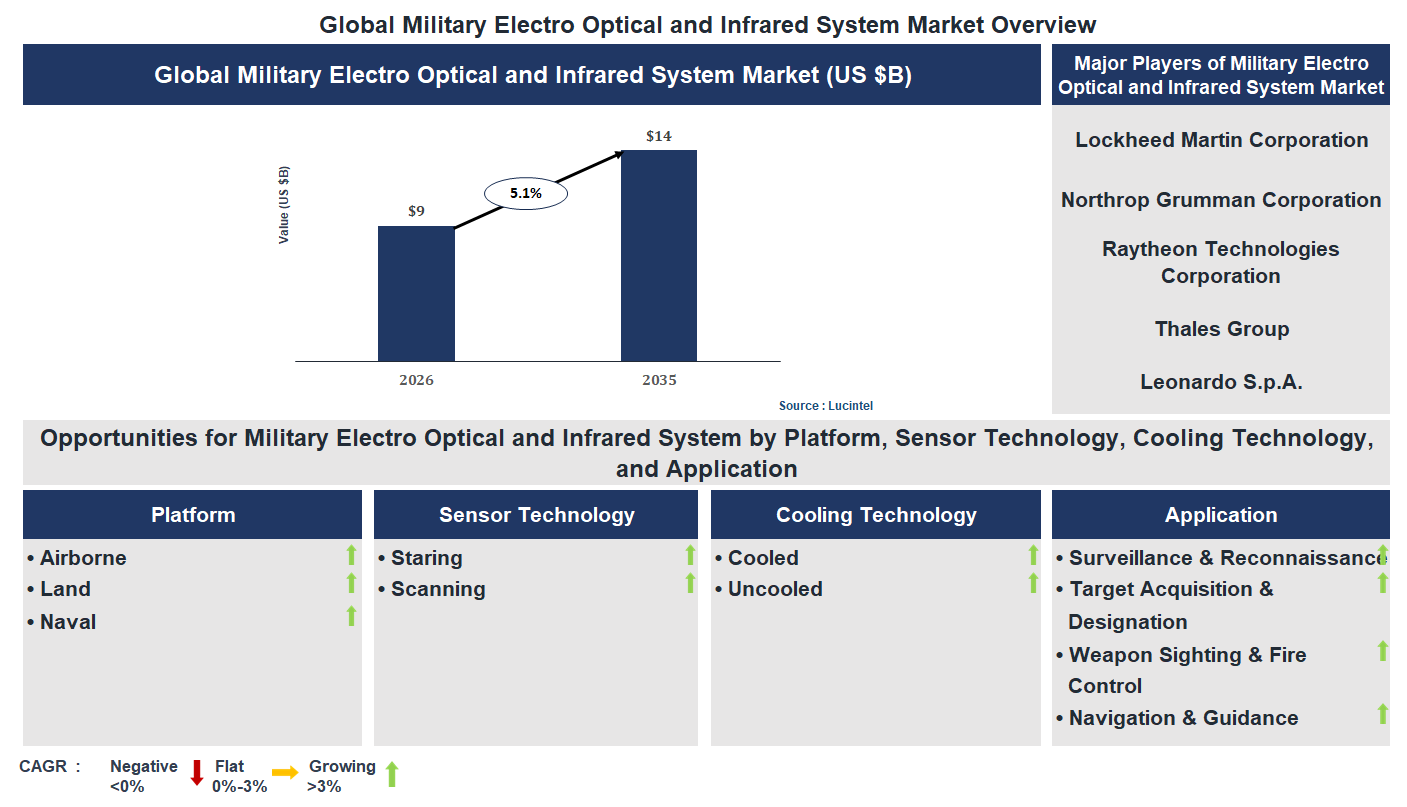
Key data points: The market size in 2035 = $14 billion, growth forecast = 5.1% annually for the next 8 years. Scroll below to get more insights. This market report covers trends, opportunities and forecasts in military electro optical and infrared system market to 2035 by platform (airborne, land, and naval), sensor technology (staring and scanning), cooling technology (cooled and uncooled), application (surveillance & reconnaissance, target acquisition & designation, weapon sighting & fire control, and navigation & guidance), and region (North America, Europe, Asia Pacific, and the Rest of the World)
We'll send your sample report shortly.
• Lucintel forecasts that, within the platform category, airborne is expected to witness the highest growth over the forecast period.
• Within the application category, surveillance & reconnaissance is expected to witness the highest growth.
• In terms of region, North America is expected to witness the highest growth over the forecast period. Gain valuable insights for your business decisions with our comprehensive 150+ page report. Sample figures with some insights are shown below.
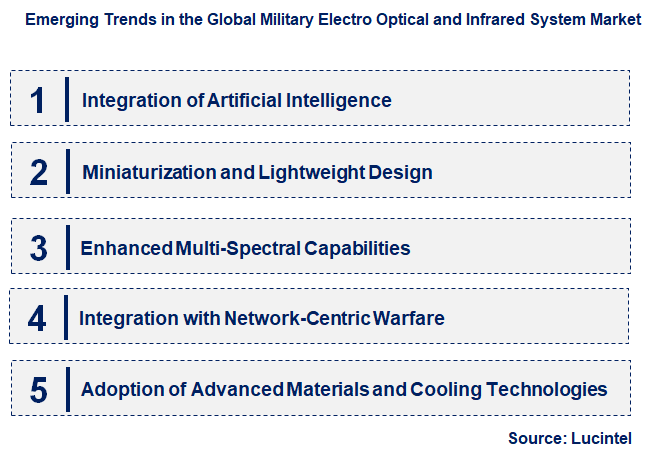
• Integration of Artificial Intelligence: AI is increasingly embedded in EO/IR systems to enhance target detection, classification, and tracking. AI algorithms enable real-time data analysis, reducing response times and improving decision-making accuracy. This integration allows for autonomous operation and reduces the cognitive load on operators, making systems more efficient and reliable in complex combat environments. The adoption of AI is expected to significantly boost the capabilities of military EO/IR systems, leading to smarter, more adaptive battlefield solutions.
• Miniaturization and Lightweight Design: Advances in materials and engineering are leading to smaller, lighter EO/IR components. This trend facilitates the development of portable, drone-mounted, and wearable systems, expanding their operational versatility. Miniaturization allows for easier integration into various platforms such as UAVs, handheld devices, and small-scale surveillance units, without compromising performance. The impact is a broader deployment scope, increased mobility, and enhanced tactical flexibility for military forces operating in diverse environments.
• Enhanced Multi-Spectral Capabilities: Modern EO/IR systems are increasingly capable of operating across multiple spectral bands, including visible, near-infrared, and thermal infrared. This multi-spectral approach improves target detection in challenging conditions such as fog, smoke, or nighttime scenarios. It also enables better differentiation of objects and targets, reducing false alarms. The enhanced spectral capabilities are crucial for comprehensive battlefield awareness, providing military personnel with detailed, reliable intelligence regardless of environmental conditions.
• Integration with Network-Centric Warfare: EO/IR systems are becoming integral components of network-centric military operations. They are interconnected with other sensors, command centers, and communication networks to facilitate seamless data sharing and coordinated responses. This integration enhances situational awareness, accelerates decision-making, and supports real-time operational adjustments. As network-centric warfare gains prominence, EO/IR systems are evolving into vital nodes within a broader, interconnected defense ecosystem, improving overall mission effectiveness.
• Adoption of Advanced Materials and Cooling Technologies: The development of new materials and cooling solutions is improving the performance and durability of EO/IR systems. Advanced materials offer better thermal management, resistance to harsh environmental conditions, and longer operational lifespans. Innovative cooling technologies enable systems to operate efficiently in extreme temperatures, ensuring consistent performance in diverse climates. These advancements extend the operational capabilities of EO/IR systems, making them more reliable and suitable for prolonged military missions in challenging environments. These emerging trends are fundamentally transforming the Military Electro-Optical and Infrared System Market by enhancing system capabilities, operational flexibility, and integration within modern warfare frameworks. They are driving innovation, increasing efficiency, and expanding the scope of military surveillance and targeting solutions, ultimately reshaping how defense forces approach battlefield intelligence and combat readiness.
• Growing Demand for Advanced Surveillance Systems: The increasing need for real-time battlefield intelligence is fueling demand for high-resolution EO/IR systems. These systems enable precise target detection, tracking, and identification in diverse operational environments. Enhanced capabilities such as night vision, thermal imaging, and long-range detection are critical for modern military operations. As threats become more complex, the market is expanding to include integrated, multi-spectral EO/IR solutions that improve situational awareness and operational effectiveness, driving substantial market growth.
• Integration of AI and Machine Learning Technologies: The incorporation of AI and machine learning into EO/IR systems is revolutionizing military applications. These technologies enable autonomous target recognition, predictive analytics, and enhanced image processing, reducing operator workload and increasing accuracy. AI-driven systems can adapt to changing environments and improve decision-making speed. This integration is creating new opportunities for smarter, more efficient EO/IR solutions, which are increasingly being adopted by defense agencies worldwide, significantly impacting the market’s evolution.
• Rising Investments in Defense Budget Allocations: Governments are increasing defense budgets to modernize their military capabilities, with a focus on EO/IR systems. These investments support the development of next-generation sensors, weapon targeting, and surveillance platforms. Countries prioritize acquiring advanced EO/IR solutions to counter emerging threats and maintain strategic superiority. The sustained financial commitment is propelling market growth, encouraging innovation, and fostering collaborations between defense contractors and technology providers to deliver cutting-edge EO/IR systems.
• Development of Multi-Function and Compact Systems: The demand for versatile, lightweight EO/IR systems is rising, driven by the need for integration into various platforms such as drones, handheld devices, and small vehicles. Multi-function systems combining thermal imaging, night vision, and laser targeting are gaining popularity. Compact designs facilitate deployment in diverse operational scenarios, including urban warfare and special operations. This trend enhances operational flexibility and expands market opportunities, prompting manufacturers to innovate and develop more adaptable EO/IR solutions.
• Expansion of Commercial and Civil Applications: Beyond military use, EO/IR technology is increasingly adopted in civilian sectors such as border security, disaster management, and surveillance. The commercial market’s growth is driven by the need for enhanced security and monitoring solutions. This diversification broadens the market scope, encouraging cross-sector innovation and investment. The expanding application base is fostering competitive advancements, ultimately leading to more affordable, accessible, and sophisticated EO/IR systems, which influence overall market dynamics. These developments are significantly transforming the military electro optical and infrared system market by fostering innovation, increasing adoption, and expanding application areas. Enhanced surveillance capabilities, AI integration, increased defense spending, multi-function compact systems, and civilian applications collectively drive market growth. This evolution is leading to more advanced, versatile, and cost-effective EO/IR solutions, strengthening military readiness and security infrastructure globally. The market’s trajectory indicates sustained expansion and technological leadership in the defense sector.
• Integration of AI and Machine Learning for Enhanced Targeting and Surveillance: Incorporating AI and machine learning into electro-optical and infrared systems enables real-time data analysis, improved target detection, and reduced false alarms. These advancements enhance operational efficiency, accuracy, and decision-making speed in complex combat environments. As defense agencies prioritize autonomous and intelligent systems, this integration offers a competitive edge, driving market growth through the development of smarter, more adaptable electro-optical and infrared solutions.
• Development of Miniaturized and Lightweight Systems for Drones and Small Platforms: The trend toward miniaturization allows electro-optical and infrared systems to be mounted on smaller platforms like drones, UAVs, and portable devices. These lightweight systems provide high-resolution imaging, long-range detection, and real-time data transmission without compromising mobility. This opportunity caters to modern warfares need for versatile, deployable, and cost-effective surveillance tools, expanding market reach into new applications and increasing demand across military and homeland security sectors.
• Expansion of Surveillance and Border Security Applications: Increasing geopolitical tensions and border disputes drive demand for advanced surveillance systems. Electro-optical and infrared technologies are vital for perimeter security, border patrol, and maritime surveillance, providing day/night operational capabilities. The ability to monitor large areas with high precision and minimal personnel makes these systems indispensable. Growing investments by governments worldwide in border security infrastructure create substantial opportunities for market players to supply integrated, scalable solutions tailored to diverse operational environments.
• Adoption of Network-Centric and Integrated Defense Systems: The shift toward network-centric warfare emphasizes interconnected, interoperable systems that share real-time data across military units. Electro-optical and infrared systems are increasingly integrated with command and control platforms, radar, and other sensors to enhance situational awareness. This integration improves coordination, response times, and mission success rates. The trend offers significant growth potential for vendors capable of delivering seamless, multi-domain solutions that meet modern military operational requirements.
• Increasing Focus on Counter-Drone and Counter-UAV Technologies: The proliferation of small, inexpensive drones has created new security challenges. Electro-optical and infrared systems are crucial for detecting, identifying, and neutralizing hostile UAVs. Developing advanced counter-drone solutions involves high-resolution imaging, rapid tracking, and jamming capabilities. As threats evolve, the market for counter-UAV systems is expected to grow rapidly, prompting investments in innovative detection and mitigation technologies to safeguard military assets, critical infrastructure, and personnel. The overall market is poised for substantial growth as these opportunities drive innovation, enhance operational capabilities, and meet the evolving security landscape. Industry players that capitalize on these trends will strengthen their market positions and contribute to the development of more advanced, versatile military electro-optical and infrared systems.
• Technological Innovation: The continuous evolution of sensor technology, image processing, and data integration enhances system performance. Advanced EO/IR systems offer superior target detection, tracking, and identification capabilities, which are critical for modern warfare. Innovations such as multispectral imaging and artificial intelligence integration improve operational efficiency and situational awareness. As militaries worldwide prioritize modernization, the demand for cutting-edge EO/IR solutions accelerates, fostering market growth and encouraging R&D investments.
• Increasing Defense Budgets: Many countries are increasing their defense spending to modernize armed forces and upgrade surveillance capabilities. Elevated budgets enable procurement of advanced EO/IR systems for aircraft, naval vessels, and ground units. This financial commitment reflects a strategic focus on enhancing national security and technological superiority. As defense budgets grow, so does the procurement and deployment of sophisticated EO/IR systems, fueling market expansion and encouraging industry competition.
• Geopolitical Tensions and Security Threats: Rising regional conflicts, terrorism, and border disputes drive demand for reliable surveillance and reconnaissance systems. EO/IR technology provides real-time intelligence and target acquisition, which are vital for military operations in complex environments. Heightened security concerns compel nations to invest in robust EO/IR solutions to maintain strategic advantages. This persistent threat environment sustains a steady demand, influencing manufacturers to innovate and expand their product offerings.
• Regulatory and Export Control Policies: Stringent export regulations and international treaties impact the transfer and sale of EO/IR technology. Governments impose controls to prevent proliferation and safeguard national security interests, which can restrict market access and complicate international collaborations. While these policies may slow down some transactions, they also encourage domestic R&D and local manufacturing. Navigating regulatory landscapes is essential for market players to sustain growth and expand their global footprint.
• Growing Adoption of Unmanned Systems: The integration of EO/IR sensors into drones and unmanned vehicles enhances surveillance, reconnaissance, and combat capabilities. The proliferation of unmanned systems in military operations is a significant driver for EO/IR market growth. These systems offer cost-effective, versatile, and persistent monitoring solutions, especially in hazardous environments. As militaries seek to leverage unmanned platforms, the demand for lightweight, high-performance EO/IR sensors continues to rise, opening new avenues for market expansion. The challenges facing the military electro optical and infrared system market include:
• High Development and Procurement Costs: Advanced EO/IR systems require significant investment in research, development, and manufacturing. The high costs can limit procurement, especially for smaller or budget-constrained nations. Additionally, maintenance and upgrade expenses add to the financial burden, potentially delaying deployment or limiting system integration. Cost barriers may hinder widespread adoption and slow market growth, necessitating cost-effective innovations and strategic partnerships.
• Rapid Technological Obsolescence: The fast pace of technological change can render existing EO/IR systems obsolete quickly. Military requirements evolve rapidly, demanding continuous upgrades and new developments. This creates pressure on manufacturers to innovate constantly, increasing R&D costs and risking sunk investments. Obsolescence also complicates lifecycle management and can lead to interoperability issues among different systems, challenging long-term procurement strategies.
• Regulatory and Export Restrictions: Stringent export controls and international regulations can restrict the transfer of sensitive EO/IR technology. These restrictions may limit market access for foreign buyers and complicate international collaborations. Compliance with diverse regulatory frameworks increases operational complexity and costs for manufacturers. Such restrictions can slow down market expansion, reduce sales opportunities, and hinder the global dissemination of advanced EO/IR solutions. The military electro optical and infrared system market is shaped by rapid technological advancements, increasing defense investments, and geopolitical tensions, which collectively drive growth. However, high costs, rapid obsolescence, and regulatory restrictions pose significant challenges. Navigating these drivers and challenges requires strategic innovation, cost management, and regulatory compliance. Overall, the markets future depends on balancing technological progress with economic and regulatory considerations, ensuring sustained growth and enhanced military capabilities worldwide.
• Lockheed Martin Corporation
• Northrop Grumman Corporation
• Raytheon Technologies Corporation
• Thales Group
• Leonardo S.p.A.
• L3Harris Technologies, Inc.
• Teledyne FLIR LLC
• BAE Systems Plc
• Leonardo S.p.A.
• Rheinmetall AG
• Airborne
• Land
• Naval
• Staring
• Scanning
• Cooled
• Uncooled
• Surveillance & Reconnaissance
• Target Acquisition & Designation
• Weapon Sighting & Fire Control
• Navigation & Guidance
• North America
• Europe
• Asia Pacific
• The Rest of the World
• United States: The US market is witnessing significant advancements with increased procurement of advanced EO/IR systems for military aircraft, drones, and naval vessels. The Department of Defense is investing in AI-enabled sensors and multi-spectral imaging to improve battlefield awareness. Recent developments include the deployment of next-generation infrared sensors and integration with missile defense systems, enhancing real-time targeting and surveillance capabilities. The US also emphasizes research into miniaturized systems for use on smaller platforms, boosting operational flexibility.
• China: China is rapidly expanding its EO/IR capabilities through substantial investments in indigenous technology development. The country has introduced advanced surveillance systems for border security and naval applications, focusing on high-resolution imaging and long-range detection. Recent innovations include the deployment of multi-spectral sensors on military aircraft and ships, along with increased integration of AI for autonomous targeting. China’s focus on domestic production aims to reduce reliance on foreign technology, positioning it as a formidable player in the global market.
• Germany: Germany is advancing its EO/IR systems primarily for NATO interoperability and modernization of its armed forces. Recent developments include the integration of high-precision sensors into fighter jets and land-based systems, with a focus on enhancing night vision and target acquisition. Germany is also investing in research to improve sensor durability and performance in harsh environments. Collaborations with European defense firms are driving innovation, with a particular emphasis on compact, lightweight systems suitable for various military platforms.
• India: India is rapidly enhancing its EO/IR capabilities to address regional security challenges. Recent developments include the procurement of advanced surveillance sensors for border security and naval applications. The country is also investing in indigenous development of EO/IR systems, with successful trials of multi-spectral sensors on drones and aircraft. Efforts are underway to improve sensor resolution and integrate AI for autonomous operation, aiming to reduce dependency on foreign technology and bolster national defense infrastructure.
• Japan: Japan is focusing on upgrading its EO/IR systems for maritime security and missile defense. Recent advancements include the deployment of high-resolution infrared sensors on coast guard vessels and military aircraft. Japan is also investing in the development of compact, high-performance sensors suitable for space-based applications and unmanned systems. Collaborations with international partners are enhancing technological capabilities, with a focus on improving sensor sensitivity and operational reliability in diverse environmental conditions.


• Lockheed Martin Corporation
• Northrop Grumman Corporation
• Raytheon Technologies Corporation
• Thales Group
• Leonardo S.p.A.
• L3Harris Technologies, Inc.
• Teledyne FLIR LLC
• BAE Systems Plc
• Leonardo S.p.A.
• Rheinmetall AG Q6. Which military electro optical and infrared system market segment will be the largest in future? Answer: Lucintel forecasts that, within the platform category, airborne is expected to witness the highest growth over the forecast period. Q7. In military electro optical and infrared system market, which region is expected to be the largest in next 8 years? Answer: In terms of region, North America is expected to witness the highest growth over the forecast period. Q8. Do we receive customization in this report? Answer: Yes, Lucintel provides 10% customization without any additional cost.


Choose a license that fits your team. Instant PDF delivery.
Prices exclude taxes. Instant delivery. Custom licensing available on request.
Market Report · July 31, 2026
Market Report · July 31, 2026
Market Report · July 31, 2026
Trusted partner for strategic intelligence and business growth


Receive a complimentary market analysis tailored to your industry. Our analysts will identify key growth opportunities and competitive dynamics specific to your business.

Market size, growth rate, and key trend analysis for your specific sector.

Top competitor positioning and market share analysis.

Strategic recommendations backed by data-driven insights.
Get curated market intelligence and competitive moves straight to your inbox.
By subscribing, you agree to receive our monthly insights. Unsubscribe anytime.
Receive a complimentary market analysis tailored to your industry. Our analysts will identify key growth opportunities and competitive dynamics specific to your business.
Market size, growth rate, and key trend analysis for your specific sector.
Top competitor positioning and market share analysis.
Strategic recommendations backed by data-driven insights.
Get curated market intelligence, emerging trends, and competitive moves straight to your inbox each month.
By subscribing, you agree to receive our monthly insights. Unsubscribe anytime.
We'll send your sample report shortly.