
Market Report · July 31, 2026

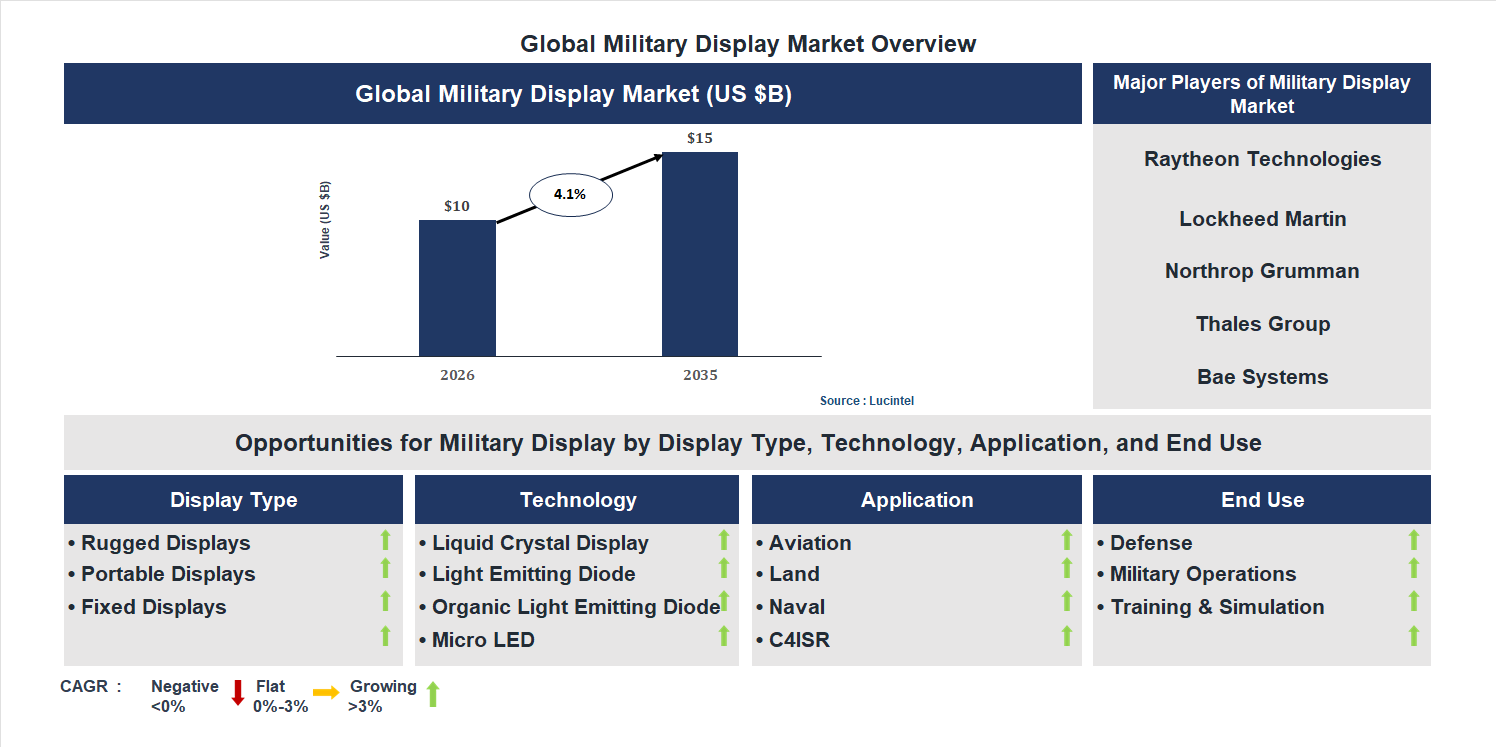
Key data points: The market size in 2035 = $15 billion, growth forecast = 4.1% annually for the next 8 years. Scroll below to get more insights. This market report covers trends, opportunities and forecasts in military display market to 2035 by display type (rugged displays, portable displays, and fixed displays), technology (liquid crystal display, light emitting diode, organic light emitting diode, and micro LED), application (aviation, land, naval, and C4ISR), end use (defense, military operations, and training & simulation), and region (North America, Europe, Asia Pacific, and the Rest of the World)
We'll send your sample report shortly.
• Lucintel forecasts that, within the display type category, rugged display is expected to witness the highest growth over the forecast period.
• Within the end use category, defense is expected to witness the highest growth.
• In terms of region, APAC is expected to witness the highest growth over the forecast period. Gain valuable insights for your business decisions with our comprehensive 150+ page report. Sample figures with some insights are shown below.
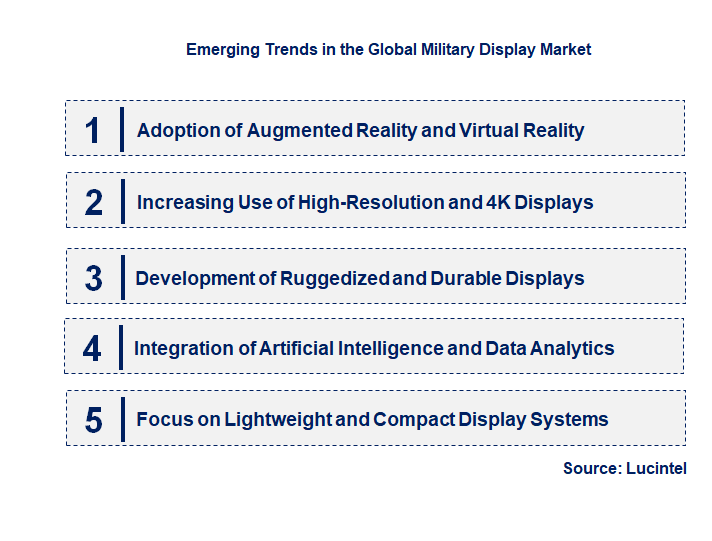
• Adoption of Augmented Reality and Virtual Reality: The integration of AR and VR in military displays is revolutionizing training, mission planning, and battlefield awareness. These immersive technologies enable soldiers to visualize complex scenarios, improve decision-making, and reduce training costs. AR overlays real-time data onto physical environments, enhancing situational awareness during operations. VR provides realistic simulation environments for training without physical risks. This trend is fostering more effective, cost-efficient, and safer training programs, while also improving operational readiness and tactical planning.
• Increasing Use of High-Resolution and 4K Displays: The demand for high-resolution displays, including 4K and beyond, is driven by the need for clearer, more detailed visuals in combat and surveillance systems. These displays improve target identification, threat detection, and data analysis, leading to faster and more accurate decision-making. Enhanced visual clarity is crucial for cockpit displays, head-up displays (HUDs), and command centers. The adoption of ultra-high-definition screens is also enabling better integration of multiple data sources, providing comprehensive situational awareness and reducing cognitive load on operators.
• Development of Ruggedized and Durable Displays: Military displays are increasingly designed to withstand extreme environmental conditions such as high temperatures, humidity, shock, and vibration. Ruggedized displays ensure reliable performance in combat zones, naval ships, and aircraft. These systems feature shock absorption, waterproofing, and anti-glare coatings, making them suitable for field operations. The focus on durability extends the lifespan of equipment and reduces maintenance costs. This trend is critical for ensuring operational continuity and safety in diverse and challenging environments, thereby enhancing overall mission effectiveness.
• Integration of Artificial Intelligence and Data Analytics: AI-powered displays are enabling real-time data processing, predictive analytics, and autonomous decision-making. These systems can analyze vast amounts of sensor data, identify patterns, and provide actionable insights to commanders. AI integration enhances threat detection, target tracking, and resource allocation. It also facilitates autonomous systems such as drones and robotic vehicles. The use of AI in displays is transforming command and control centers into intelligent hubs, improving responsiveness, reducing human error, and enabling more strategic and tactical advantages on the battlefield.
• Focus on Lightweight and Compact Display Systems: The trend toward miniaturization and weight reduction is driven by the need for portable, wearable, and space-efficient display solutions. Lightweight displays improve mobility for soldiers, pilots, and vehicle operators, while compact systems are essential for space-constrained environments. Advances in materials and display technology are enabling thinner, lighter, and more energy-efficient devices. This trend supports the development of head-mounted displays (HMDs), wearable HUDs, and portable command units, thereby enhancing operational flexibility, reducing fatigue, and enabling rapid deployment in diverse scenarios. These emerging trends are collectively transforming the Military Display Market by enhancing operational efficiency, safety, and tactical capabilities. The integration of immersive technologies, high-resolution visuals, rugged durability, AI, and miniaturization is enabling military forces to operate more effectively in complex environments. These developments are not only improving training and battlefield awareness but also paving the way for smarter, more adaptable defense systems, ultimately reshaping the future landscape of military technology and strategy.
• Growing Demand for Rugged Displays: The need for durable, high-performance displays in harsh environments is driving growth. Rugged displays are designed to withstand extreme temperatures, vibrations, and shocks, making them ideal for battlefield conditions. These displays enhance soldier safety and operational efficiency by providing reliable information in challenging environments. The increasing adoption of rugged displays across land, sea, and air platforms is expected to boost market revenue significantly, with applications expanding into portable and vehicle-mounted systems.
• Integration of Augmented Reality (AR) in Military Operations: AR technology is revolutionizing battlefield visualization and training. Military displays equipped with AR enable soldiers to access real-time data, navigation, and target identification directly overlaid on their view. This integration improves situational awareness, reduces cognitive load, and enhances decision-making speed. The growing deployment of AR-enabled displays in combat and training scenarios is expected to create new market opportunities, especially in lightweight, head-up displays and helmet-mounted systems.
• Advancements in High-Resolution and 4K Displays: The demand for high-resolution displays is increasing to support detailed imagery, surveillance, and reconnaissance missions. 4K and ultra-high-definition screens provide clearer visuals, aiding in target identification and data analysis. These displays are crucial for command centers and aircraft cockpits, where precision is vital. The push for better image quality is driving innovation, leading to the development of more sophisticated, energy-efficient, and compact high-resolution displays, thereby expanding their application scope.
• Rising Adoption of Night Vision and Thermal Displays: Night vision and thermal imaging displays are critical for covert operations and night-time missions. These displays enhance visibility in low-light conditions, providing a tactical advantage. The integration of thermal imaging into display systems allows for better target detection and situational assessment. As defense agencies prioritize night operations, the market for night vision and thermal displays is expected to grow rapidly, with innovations focusing on miniaturization and improved sensitivity.
• Increasing Focus on Network-Centric Warfare Displays: Modern military strategies emphasize network-centric warfare, requiring displays that facilitate seamless communication and data sharing across units. Advanced displays enable real-time data visualization, battlefield management, and command coordination. The development of integrated, multi-functional displays supports interoperability among different platforms and systems. This trend is expected to accelerate market growth, especially in integrated command consoles, vehicle displays, and portable tactical units, fostering more synchronized and efficient military operations. The overall impact of these developments is transforming the military display market into a highly innovative and competitive sector. Enhanced display technologies are improving operational efficiency, safety, and battlefield effectiveness. As these advancements continue, the market is expected to see increased adoption, higher revenues, and expanded applications across defense sectors worldwide.
• Enhanced Situational Awareness Through Advanced Display Technologies: The adoption of high-resolution, ruggedized displays, including augmented reality and heads-up displays, improves battlefield awareness for soldiers and commanders. These displays facilitate real-time data visualization, navigation, and target identification, leading to faster decision-making and increased operational efficiency. The integration of AI and sensor data further enhances display capabilities, making them indispensable in modern combat scenarios and boosting demand across military branches.
• Growing Adoption of Augmented Reality (AR) and Heads-Up Displays (HUDs): AR and HUD systems are revolutionizing military communication and targeting. They provide soldiers with critical information directly in their line of sight, reducing cognitive load and response times. These displays are increasingly used in fighter jets, tanks, and ground vehicles for navigation, threat detection, and weapon targeting. The continuous development of lightweight, energy-efficient AR and HUD solutions is expected to expand their deployment, creating significant market opportunities.
• Increasing Deployment of Military Displays in Naval and Airborne Platforms: Naval ships and aircraft are integrating advanced display systems for navigation, surveillance, and combat management. High-definition displays enable real-time monitoring of complex data, enhancing operational coordination. The demand for rugged, weather-resistant displays suitable for harsh environments is rising. As navies and air forces modernize their fleets, the need for sophisticated display solutions will drive market growth, especially in regions investing heavily in defense modernization.
• Rising Demand for Military Display Systems in Ground Vehicles and Drones: Ground vehicles, including tanks and armored personnel carriers, are equipped with advanced displays for situational awareness and command control. The proliferation of military drones also necessitates lightweight, portable display systems for remote operation and data analysis. The integration of these displays enhances battlefield communication, target tracking, and mission planning. The expanding use of autonomous systems and unmanned vehicles is expected to further propel demand for specialized military display solutions.
• Strategic Focus on Customization and Integration of Display Solutions: Military forces require tailored display systems that seamlessly integrate with existing platforms and communication networks. Customization includes size, interface, and environmental resilience to meet specific operational needs. The development of interoperable, multi-functional displays that support various sensors and data sources is a key trend. This strategic focus on integration and adaptability will foster innovation, improve operational efficiency, and open new avenues for market expansion across different military applications. The overall impact of these opportunities is set to significantly enhance military capabilities, foster technological innovation, and expand market size, ensuring that defense forces worldwide are better equipped for modern combat challenges.
• Technological Innovation: The continuous development of advanced display technologies like OLED, AMOLED, and flexible displays enhances military capabilities by providing clearer visuals, durability, and adaptability in harsh environments. These innovations enable real-time data visualization, augmented reality integration, and improved situational awareness, which are critical for modern defense operations. As military forces seek more sophisticated and reliable display solutions, technological progress acts as a primary driver, fostering increased adoption and integration into various defense systems worldwide.
• Increasing Defense Budgets: Governments across the globe are allocating substantial funds toward modernizing their armed forces, including upgrading existing display systems and deploying new ones. Rising defense budgets reflect a focus on enhancing national security and technological superiority, which directly fuels market growth. This financial commitment allows for research, development, and procurement of cutting-edge display technologies, ensuring military forces remain equipped with the latest tools for effective communication, navigation, and combat operations.
• Rising Adoption of Augmented Reality (AR) and Heads-Up Displays (HUDs): The integration of AR and HUDs into military equipment is revolutionizing battlefield management and soldier safety. These displays provide real-time data overlays, target identification, and navigation assistance, significantly improving operational efficiency. The increasing deployment of AR and HUDs in helmets, vehicles, and aircraft enhances situational awareness, reduces cognitive load, and improves decision-making speed, thereby acting as a major growth driver in the military display market.
• Focus on Modernization and Upgradation: Many armed forces are actively modernizing their existing infrastructure by replacing outdated display systems with advanced, high-resolution, and ruggedized displays. This trend is driven by the need for enhanced durability, better image quality, and integration with other digital systems. Modernization efforts ensure compatibility with new weapons, sensors, and communication networks, which in turn stimulates demand for innovative display solutions tailored to military specifications.
• Strategic Collaborations and Partnerships: Collaborations between defense contractors, technology firms, and government agencies facilitate the development of customized display solutions that meet specific military needs. These partnerships accelerate innovation, reduce development costs, and enable faster deployment of advanced display systems. Such strategic alliances are crucial for staying ahead in a competitive market, fostering technological exchange, and ensuring the militarys display systems are aligned with evolving operational requirements. The challenges facing the military display market include:
• High Development and Procurement Costs: Developing advanced military display systems involves significant investment in research, testing, and certification processes. Procurement costs are also high due to the need for ruggedization, reliability, and compliance with strict military standards. These financial barriers can limit adoption, especially for smaller defense budgets, and slow down the deployment of new technologies across armed forces.
• Regulatory and Export Restrictions: Stringent government regulations, export controls, and compliance standards pose substantial hurdles for market players. Restrictions on technology transfer and international sales can limit market expansion, restrict access to global supply chains, and delay the deployment of innovative display solutions. Navigating these regulatory landscapes requires considerable legal expertise and strategic planning, adding complexity to market growth.
• Rapid Technological Obsolescence: The fast-paced evolution of display technologies can render existing systems obsolete quickly, creating challenges for military procurement cycles. Maintaining technological relevance requires continuous innovation and upgrades, which can be costly and time-consuming. This rapid obsolescence risk discourages long-term investments and complicates strategic planning for defense agencies and manufacturers alike. The military display market is shaped by significant technological advancements, increased defense spending, and strategic collaborations, which collectively drive growth. However, high costs, regulatory constraints, and rapid technological changes pose notable challenges. These factors influence the pace and direction of market development, requiring stakeholders to balance innovation with cost-efficiency and regulatory compliance. Overall, the markets future depends on how effectively these drivers are leveraged and challenges mitigated, ensuring the deployment of advanced, reliable, and compliant military display solutions to meet evolving defense needs.
• Raytheon Technologies
• Lockheed Martin
• Northrop Grumman
• Thales Group
• Bae Systems
• Leonardo S.P.A.
• General Dynamics
• Rugged Displays
• Portable Displays
• Fixed Displays
• Liquid Crystal Display
• Light Emitting Diode
• Organic Light Emitting Diode
• Micro LED
• Aviation
• Land
• Naval
• C4ISR
• Defense
• Military Operations
• Training & Simulation
• North America
• Europe
• Asia Pacific
• The Rest of the World
• United States: The US military display market has seen substantial growth with a focus on augmented reality (AR) and heads-up display (HUD) systems for fighter jets and ground vehicles. Major defense contractors are developing high-resolution, durable displays capable of withstanding harsh environments. The US is also investing in integrated command and control systems that enhance real-time decision-making. Additionally, there is a push toward lightweight, energy-efficient displays to improve soldier mobility and operational effectiveness. The adoption of AI-driven interfaces is further enhancing situational awareness and mission planning.
• China: China is rapidly advancing its military display technology, emphasizing the development of large-scale, high-definition screens for command centers and battlefield applications. The country is investing heavily in ruggedized displays suitable for diverse terrains and conditions. Chinese firms are also focusing on integrating AR and VR technologies into training simulators and combat systems. The government’s emphasis on indigenous innovation has led to the domestication of key display components, reducing reliance on foreign technology. These efforts aim to modernize China’s armed forces and enhance their operational capabilities.
• Germany: Germany’s military display market is characterized by a focus on precision, reliability, and integration with existing defense systems. The German armed forces are adopting advanced cockpit displays for aircraft and armored vehicles, emphasizing high contrast and readability in various lighting conditions. There is also a significant push toward developing modular display systems that can be easily upgraded or customized for different missions. Germany is investing in secure, encrypted displays to ensure data integrity and prevent cyber threats. The emphasis remains on interoperability within NATO and European defense frameworks.
• India: India is rapidly expanding its military display capabilities to modernize its armed forces amid regional security challenges. The country is focusing on ruggedized, portable displays for soldiers and command units, suitable for diverse terrains like deserts and jungles. India is also investing in augmented reality systems for training and battlefield management. The government’s "Make in India" initiative is encouraging domestic production of display components, reducing dependency on imports. Collaborations with international defense firms are also facilitating the integration of advanced display technologies into Indian military platforms.
• Japan: Japan’s military display market is driven by advancements in missile defense and naval systems. The country is developing high-resolution, multi-functional displays for its ships and submarines, emphasizing durability and clarity in challenging maritime environments. Japan is also exploring the integration of AI and sensor data to enhance situational awareness. The focus on compact, lightweight displays supports the country’s emphasis on mobility and rapid deployment. Japan’s defense modernization efforts are aligned with its strategic alliance with the US, ensuring compatibility and interoperability of display systems across allied forces.


• Raytheon Technologies
• Lockheed Martin
• Northrop Grumman
• Thales Group
• Bae Systems
• Leonardo S.P.A.
• General Dynamics Q6. Which military display market segment will be the largest in future? Answer: Lucintel forecasts that, within the display type category, rugged display is expected to witness the highest growth over the forecast period. Q7. In military display market, which region is expected to be the largest in next 8 years? Answer: In terms of region, APAC is expected to witness the highest growth over the forecast period. Q8. Do we receive customization in this report? Answer: Yes, Lucintel provides 10% customization without any additional cost.


Choose a license that fits your team. Instant PDF delivery.
Prices exclude taxes. Instant delivery. Custom licensing available on request.
Market Report · July 31, 2026
Market Report · July 31, 2026
Market Report · July 31, 2026
Trusted partner for strategic intelligence and business growth


Receive a complimentary market analysis tailored to your industry. Our analysts will identify key growth opportunities and competitive dynamics specific to your business.

Market size, growth rate, and key trend analysis for your specific sector.

Top competitor positioning and market share analysis.

Strategic recommendations backed by data-driven insights.
Get curated market intelligence and competitive moves straight to your inbox.
By subscribing, you agree to receive our monthly insights. Unsubscribe anytime.
Receive a complimentary market analysis tailored to your industry. Our analysts will identify key growth opportunities and competitive dynamics specific to your business.
Market size, growth rate, and key trend analysis for your specific sector.
Top competitor positioning and market share analysis.
Strategic recommendations backed by data-driven insights.
Get curated market intelligence, emerging trends, and competitive moves straight to your inbox each month.
By subscribing, you agree to receive our monthly insights. Unsubscribe anytime.
We'll send your sample report shortly.