
Market Report · July 17, 2026

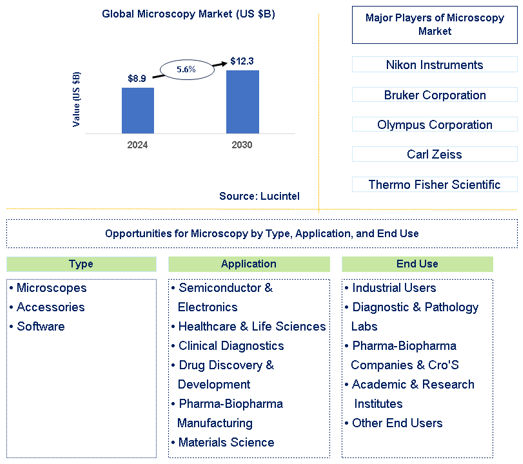
Key data points: The market size in 2030 = $12.3 billion, growth forecast = 5.6% annually for the next 6 years. Scroll below to get more insights. This market report covers trends, opportunities, and forecasts in the global microscopy market to 2030 by type (microscopes, accessories, and software), application (semiconductor & electronics, healthcare & life sciences, clinical diagnostics, drug discovery & development, pharma-biopharma manufacturing, and materials science), end use (industrial users, diagnostic & pathology labs, pharma-biopharma companies & cro's, academic & research institutes, and other end users), and region (North America, Europe, Asia Pacific, and the Rest of the World)
We'll send your sample report shortly.
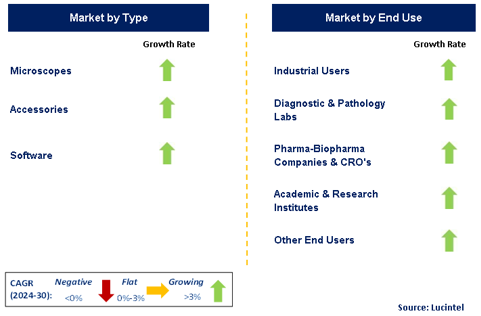
• Lucintel forecasts that, within the type category, microscope is expected to witness the highest growth over the forecast period.
• In terms of region, APAC is expected to witness the highest growth over the forecast period. A more than 150-page report is developed to help in your business decisions.
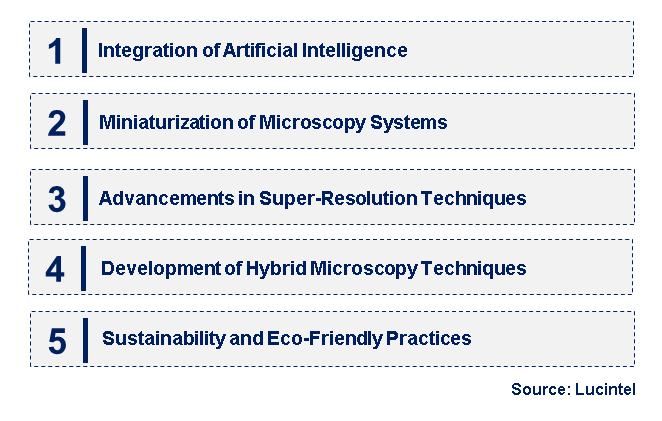
• Integration of Artificial Intelligence: AI is being increasingly integrated into microscopy for automated image analysis and processing. This trend significantly enhances the speed and accuracy of image interpretation, allowing researchers to focus on more complex tasks. AI algorithms can analyze large datasets, enabling the identification of patterns and anomalies that may not be apparent through traditional methods. This not only improves research efficiency but also opens up new avenues for data-driven insights in various fields.
• Miniaturization of Microscopy Systems: There is a growing trend towards miniaturizing microscopy systems, making them more portable and user-friendly. This shift is particularly beneficial for educational purposes and fieldwork, allowing researchers to conduct high-quality imaging outside traditional lab environments. Miniaturized systems also lower costs and improve accessibility for smaller institutions, thus broadening the scope of microscopy applications across various sectors, including biology, materials science, and environmental monitoring.
• Advancements in Super-Resolution Techniques: Super-resolution microscopy techniques are rapidly evolving, enabling scientists to visualize biological structures at unprecedented resolutions. These advancements allow researchers to study cellular processes in real-time, providing insights into disease mechanisms and drug interactions. As super-resolution techniques become more widely adopted, they are revolutionizing fields like molecular biology and neuroscience, leading to more targeted and effective therapies.
• Development of Hybrid Microscopy Techniques: Hybrid microscopy, which combines multiple imaging modalities, is gaining traction. Techniques like correlative light and electron microscopy (CLEM) enable comprehensive analysis of samples by integrating different imaging methods. This trend enhances the depth of information obtained from samples, leading to more holistic understanding in research. Hybrid approaches are particularly beneficial in studying complex biological systems, where multiple imaging perspectives are essential for accurate analysis.
• Sustainability and Eco-Friendly Practices: Sustainability is becoming a key consideration in the microscopy market. Manufacturers are increasingly focusing on eco-friendly materials and energy-efficient technologies. This trend is driven by the growing awareness of environmental issues and regulatory pressures. By adopting sustainable practices, companies not only reduce their environmental footprint but also appeal to a broader base of environmentally conscious customers, thereby enhancing their market position. These emerging trends are significantly reshaping the microscopy market by enhancing capabilities, improving accessibility, and promoting sustainability. As technology continues to advance, the impact of these trends will likely lead to broader applications and increased demand across various sectors.
• Advancements in Electron Microscopy: The development of next-generation electron microscopes has improved imaging resolution and speed. These tools enable researchers to observe materials at the atomic level, providing critical insights into material properties and behaviors. Enhanced electron microscopy is proving invaluable in fields like nanotechnology and materials science, facilitating the design of novel materials and components.
• Rise of Multiphoton Microscopy: Multiphoton microscopy is gaining traction, especially in biological research. This technique allows for deeper tissue imaging with minimal damage, making it ideal for in vivo studies. Recent advancements have improved its applicability, enabling researchers to observe cellular processes in real time. This development is particularly beneficial in neuroscience and developmental biology.
• Increased Focus on User-Friendly Interfaces: The trend towards more intuitive and user-friendly interfaces in microscopy software is on the rise. Companies are prioritizing ease of use to accommodate a broader range of users, including those without specialized training. Enhanced interfaces streamline workflows, making advanced microscopy techniques more accessible and fostering greater innovation in research and education.
• Expansion of 3D Imaging Capabilities: Recent innovations in 3D imaging techniques, such as light-sheet microscopy, are revolutionizing the way researchers visualize complex biological systems. These advancements allow for high-resolution, three-dimensional reconstructions of samples, enabling more comprehensive analyses of structural and functional relationships in tissues and organisms. This development is particularly impactful in developmental biology and regenerative medicine.
• Collaborative Research Initiatives: Collaborative initiatives between academia and industry are driving rapid advancements in microscopy technology. Partnerships are fostering innovation by combining expertise from various fields, resulting in the development of cutting-edge imaging techniques and tools. These collaborations are essential for addressing complex scientific challenges and advancing the application of microscopy in diverse sectors. These recent developments are significantly impacting the microscopy market by enhancing imaging capabilities, improving accessibility, and fostering collaboration. As the field continues to evolve, these changes are paving the way for new applications and research opportunities across various disciplines.
• Life Sciences and Biomedical Research: The life sciences sector is one of the largest consumers of microscopy technology. The demand for advanced imaging solutions, such as super-resolution microscopy and live-cell imaging, is growing rapidly. As researchers seek to understand complex biological processes, opportunities for innovation in microscopy tools and techniques are expanding, leading to more effective diagnostics and treatments.
• Materials Science and Nanotechnology: The materials science and nanotechnology sectors are experiencing significant growth, driven by the need for precise characterization of materials at the nanoscale. Advanced microscopy techniques, including atomic force microscopy (AFM) and scanning electron microscopy (SEM), are crucial for developing new materials. This trend presents opportunities for companies to develop specialized microscopy solutions tailored to these fields.
• Education and Training: There is a growing demand for microscopy in educational institutions, particularly in STEM programs. The development of affordable, user-friendly microscopy systems enhances accessibility for students and educators. As educational programs increasingly incorporate advanced imaging techniques, opportunities arise for companies to offer training and support services, driving market growth.
• Environmental Monitoring: Environmental monitoring is an emerging application area for microscopy, as researchers require precise imaging techniques to study pollutants and environmental changes. The development of portable and field-ready microscopy solutions enables real-time analysis of environmental samples. This trend presents growth opportunities for companies focused on sustainability and environmental research.
• Semiconductor Industry: The semiconductor industry relies heavily on advanced microscopy techniques for process control and failure analysis. As technology progresses, the demand for high-resolution imaging tools is increasing. Companies that develop innovative microscopy solutions for this sector can capitalize on growth opportunities and establish themselves as leaders in the market. These strategic growth opportunities are shaping the microscopy market by expanding applications and enhancing technological capabilities. As demand for high-quality imaging solutions continues to rise, these opportunities will drive innovation and growth across various sectors.
• Technological Advancements: Continuous advancements in microscopy technology, such as super-resolution imaging and automated systems, are driving market growth. These innovations enhance imaging quality and expand the range of applications, making microscopy indispensable in research and industry.
• Increased Research Funding: Growing investments in research and development, particularly in the life sciences and materials science sectors, are boosting demand for advanced microscopy tools. Funding from both government and private sectors is facilitating innovation and improving access to cutting-edge imaging technologies.
• Rising Demand in Healthcare: The healthcare sector’s increasing focus on precision medicine and advanced diagnostics is driving demand for sophisticated microscopy solutions. Techniques like digital pathology and live-cell imaging are becoming essential for understanding diseases and developing targeted therapies.
• Expansion of Biotechnology and Nanotechnology: The rapid growth of the biotechnology and nanotechnology industries is creating a strong demand for high-resolution microscopy. As these fields advance, the need for precise characterization and imaging of materials and biological samples becomes critical.
• Globalization of Research: The globalization of research and collaboration across borders is leading to increased demand for microscopy solutions. International partnerships are fostering knowledge exchange and driving innovation, thereby enhancing the market’s growth potential. Challenges in the microscopy market include:
• High Costs of Advanced Systems: The high cost of advanced microscopy systems can be a barrier to entry for smaller institutions and laboratories. This challenge limits access to cutting-edge technology, particularly in developing regions where budgets may be constrained.
• Complexity of Equipment: The increasing complexity of microscopy equipment requires specialized training for effective use. This need for skilled personnel can hinder adoption, particularly in sectors with limited access to trained professionals.
• Regulatory Compliance: Stringent regulatory requirements for medical and research applications can pose challenges for microscopy manufacturers. Compliance with these regulations may increase development times and costs, impacting market entry and growth. These drivers and challenges play a crucial role in shaping the microscopy market landscape. While technological advancements and increasing demand present significant growth opportunities, barriers such as high costs and regulatory compliance require strategic navigation. Understanding these dynamics will be essential for stakeholders aiming to thrive in the evolving microscopy market.
• Nikon Instruments
• Bruker Corporation
• Olympus Corporation
• Carl Zeiss
• Thermo Fisher Scientific
• Microscopes
• Accessories
• Software
• Semiconductor & Electronics
• Healthcare & Life Sciences
• Clinical Diagnostics
• Drug Discovery & Development
• Pharma-biopharma Manufacturing
• Materials Science
• Industrial Users
• Diagnostic & Pathology Labs
• Pharma-Biopharma Companies & CRO's
• Academic & Research Institutes
• Other End Users
• North America
• Europe
• Asia Pacific
• The Rest of the World
• United States: In the U.S., the microscopy market has seen a surge in the adoption of advanced imaging techniques, particularly in life sciences and materials research. Companies are increasingly investing in digital and high-resolution microscopy systems, enabling researchers to obtain more detailed images. Additionally, there’s a growing emphasis on integrating artificial intelligence to enhance image analysis and processing capabilities, making microscopy more efficient and user-friendly.
• China: China continues to expand its microscopy capabilities, with significant investments in both public and private sectors. The country is focusing on developing state-of-the-art electron microscopes and super-resolution technologies. Chinese manufacturers are also working on making these advanced tools more affordable, which is enhancing accessibility for academic institutions and laboratories. The rapid growth of biotechnology and nanotechnology industries is further propelling the demand for advanced microscopy solutions.
• Germany: Germany remains a leader in the microscopy market, particularly in precision engineering and industrial applications. The country is known for its high-quality instruments and innovative imaging solutions. Recent developments include the introduction of next-generation scanning probe microscopes, which provide unprecedented resolution for materials science applications. Collaborative efforts between academia and industry are fostering breakthroughs in microscopy, particularly in biomedical research and nanotechnology.
• India: India's microscopy market is experiencing growth driven by the expanding research infrastructure and increasing funding for scientific studies. The focus is on making microscopy more accessible through cost-effective solutions. Recent developments include the introduction of portable and user-friendly microscopy systems designed for educational institutions and smaller laboratories. The rising demand for quality imaging in life sciences, agriculture, and environmental monitoring is also contributing to market growth.
• Japan: Japan continues to innovate in microscopy, with a focus on advancing imaging techniques in both biological and material sciences. Recent developments include improvements in atomic force microscopy and scanning electron microscopy, enabling higher-resolution imaging and analysis. The country’s robust semiconductor and electronics industries drive demand for precision microscopy tools. Additionally, Japan is enhancing collaboration between industries and research institutions to foster innovative applications in microscopy.


• Nikon Instruments
• Bruker Corporation
• Olympus Corporation
• Carl Zeiss
• Thermo Fisher Scientific Q6. Which microscopy market segment will be the largest in future? Answer: Lucintel forecasts that microscope is expected to witness the highest growth over the forecast period. Q7. In microscopy market, which region is expected to be the largest in next 5 years? Answer: APAC is expected to witness the highest growth over the forecast period. Q.8 Do we receive customization in this report? Answer: Yes, Lucintel provides 10% customization without any additional cost.


Choose a license that fits your team. Instant PDF delivery.
Prices exclude taxes. Instant delivery. Custom licensing available on request.
Market Report · July 17, 2026
Trusted partner for strategic intelligence and business growth


Receive a complimentary market analysis tailored to your industry. Our analysts will identify key growth opportunities and competitive dynamics specific to your business.

Market size, growth rate, and key trend analysis for your specific sector.

Top competitor positioning and market share analysis.

Strategic recommendations backed by data-driven insights.
Get curated market intelligence and competitive moves straight to your inbox.
By subscribing, you agree to receive our monthly insights. Unsubscribe anytime.
Receive a complimentary market analysis tailored to your industry. Our analysts will identify key growth opportunities and competitive dynamics specific to your business.
Market size, growth rate, and key trend analysis for your specific sector.
Top competitor positioning and market share analysis.
Strategic recommendations backed by data-driven insights.
Get curated market intelligence, emerging trends, and competitive moves straight to your inbox each month.
By subscribing, you agree to receive our monthly insights. Unsubscribe anytime.
We'll send your sample report shortly.