
'
...

The Impact of COVID-19 is included in Electron Microscopy Market Report. Buy it today to get an advantage.

Request the impact of COVID-19 on your product or industry


Electron Microscopy Market Trends and Forecast

The future of the global electron microscopy market looks promising with opportunities in the industry, healthcare, and research institute markets. The global electron microscopy market is expected to reach an estimated $8,840 million by 2035 with a CAGR of 7.4% from 2026 to 2035. The major drivers for this market are the increasing demand for nanotechnology research across industries, the rising demand for cancer & virus structure studies, and the growing demand for advancements in microscope resolution & automation.

• Lucintel forecasts that, within the type category, scanning electron microscope (sem) is expected to witness higher growth over the forecast period.
• Within the end use category, research institute is expected to witness the highest growth.
• In terms of region, APAC is expected to witness the highest growth over the forecast period.
Gain valuable insights for your business decisions with our comprehensive 150+ page report. Sample figures with some insights are shown below.
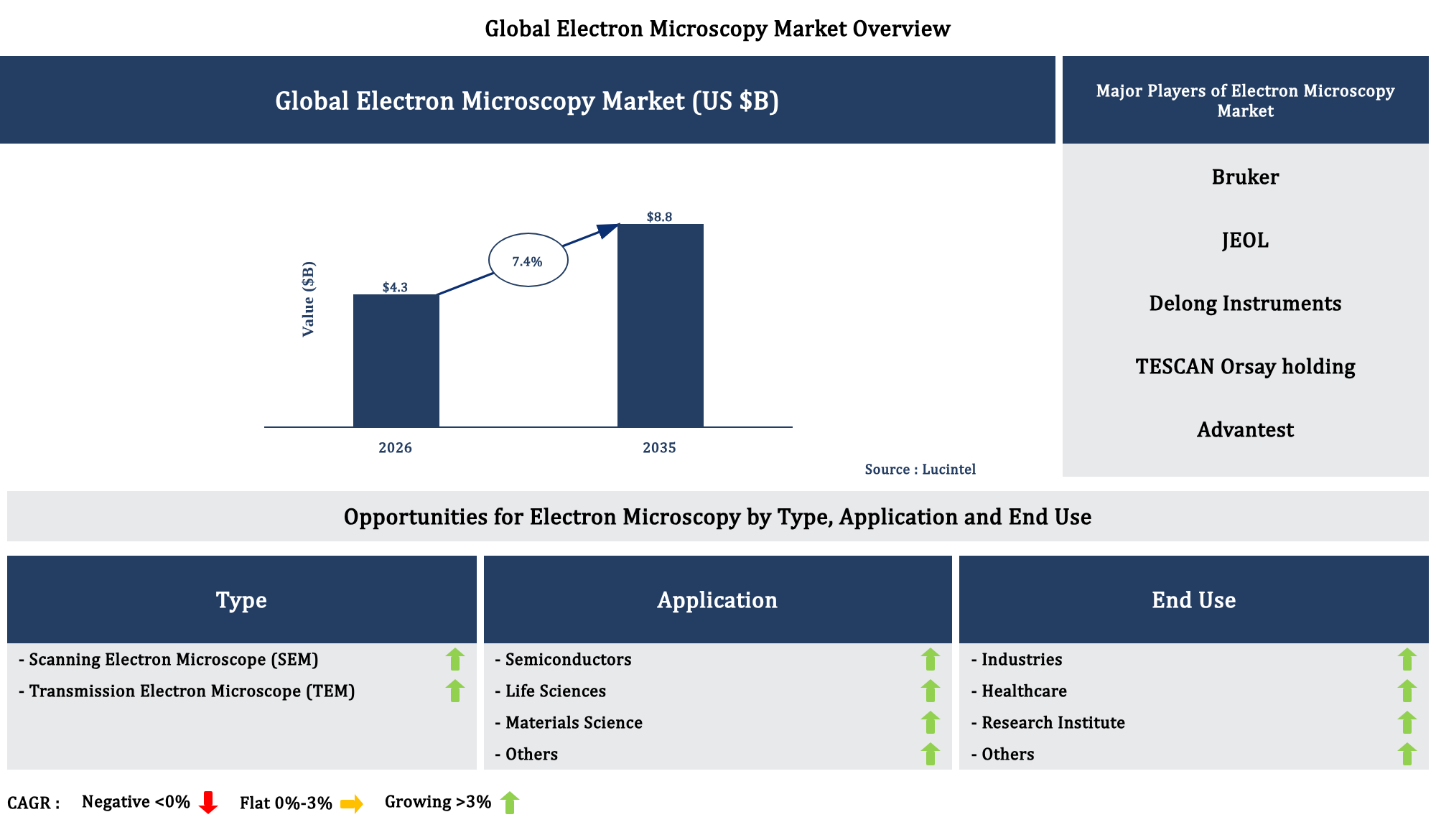
Electron Microscopy Market Trends and Forecast

Emerging Trends in the Electron Microscopy Market

The electron microscopy market is evolving rapidly due to growing demand for ultra-high resolution imaging, nanoscale research, and advanced material characterization across industries such as semiconductors, healthcare, pharmaceuticals, and energy. Emerging technologies like artificial intelligence, automation, cryo-electron microscopy, and 3D imaging are transforming traditional microscopy systems into highly advanced analytical platforms. Increasing research investments from governments and private organizations are accelerating innovation in imaging speed, accuracy, and data processing. The market is also benefiting from the integration of cloud computing and remote access systems, enabling global collaboration. These developments are reshaping how scientists and industries analyze materials at atomic and molecular levels.

• Artificial Intelligence Integration: Artificial Intelligence Integration: AI is becoming a major trend in the electron microscopy market by improving image analysis, defect detection, and data interpretation. AI-based systems are helping researchers process large volumes of microscopic data faster and more accurately. Machine learning algorithms are increasingly used to automate image classification and reduce human error in nanoscale analysis. This trend is especially important in semiconductor manufacturing, where precision and speed are critical. AI integration also enables predictive maintenance of microscopy equipment, reducing downtime. As imaging datasets grow more complex, AI is playing a key role in improving efficiency, productivity, and decision-making in research and industrial applications.
• Croy Electron Microscopy Growth: Croy Electron Microscopy Growth: Cryo-electron microscopy is gaining strong momentum due to rising demand in structural biology and drug discovery. It allows researchers to observe biological molecules at near-atomic resolution without damaging samples. This technology is widely used in pharmaceutical research for protein structure analysis and vaccine development. Recent advancements have improved imaging speed, resolution, and sample preparation techniques. Growing investments in biomedical research institutions are accelerating adoption. Cryo-EM is also being used to study viruses and complex biomolecular structures. Its ability to provide detailed insights into biological systems is making it one of the fastest-growing segments in the electron microscopy market.
• Semiconductor Industry Expansion: Semiconductor Industry Expansion: The expanding semiconductor industry is a major driver for electron microscopy adoption. As chip designs become smaller and more complex, high-resolution imaging is essential for defect detection and quality control. Electron microscopes are widely used in wafer inspection, failure analysis, and nanofabrication research. Increasing demand for advanced electronics such as smartphones, AI processors, and IoT devices is fueling growth. Manufacturers are investing in multi-beam SEM systems to improve production efficiency. The trend toward miniaturization and advanced chip architecture is increasing reliance on electron microscopy for precision manufacturing and ensuring high-performance semiconductor device production.
• Automation and High Throughput Systems: Automation And High Throughput Systems: Automation is transforming electron microscopy by enabling faster imaging, reduced manual intervention, and improved accuracy. High-throughput systems allow researchers to analyze large sample volumes efficiently, which is critical in materials science and life sciences research. Automated SEM and TEM systems are increasingly integrated with robotics and software for sample handling and imaging. This trend is helping laboratories improve productivity while reducing operational costs. It also supports remote operation and data sharing across global research networks. As demand for large-scale analysis grows, automation is becoming essential for improving efficiency and consistency in electron microscopy workflows.
• 3D and Correlative Imaging Techniques: 3D And Correlative Imaging Techniques: The adoption of 3D and correlative imaging is enhancing the capabilities of electron microscopy by combining multiple imaging methods for deeper insights. These techniques integrate electron microscopy with light microscopy and other analytical tools to provide comprehensive structural and functional information. 3D reconstruction allows researchers to visualize nanoscale structures in greater detail. This trend is widely used in materials science, biology, and nanotechnology research. It helps in understanding complex structures and improving product design. Increasing demand for advanced visualization techniques is driving innovation in multi-modal imaging systems and expanding the application scope of electron microscopy.

These emerging trends are significantly transforming the electron microscopy market by improving imaging precision, speed, and analytical capabilities. The integration of AI, automation, cryo-EM, and advanced imaging techniques is making microscopy systems more efficient and intelligent. Growing semiconductor demand and expanding biomedical research are further accelerating technological advancements. Overall, these trends are shifting the market toward highly automated, data-driven, and high-resolution imaging solutions that support innovation across scientific and industrial applications worldwide.
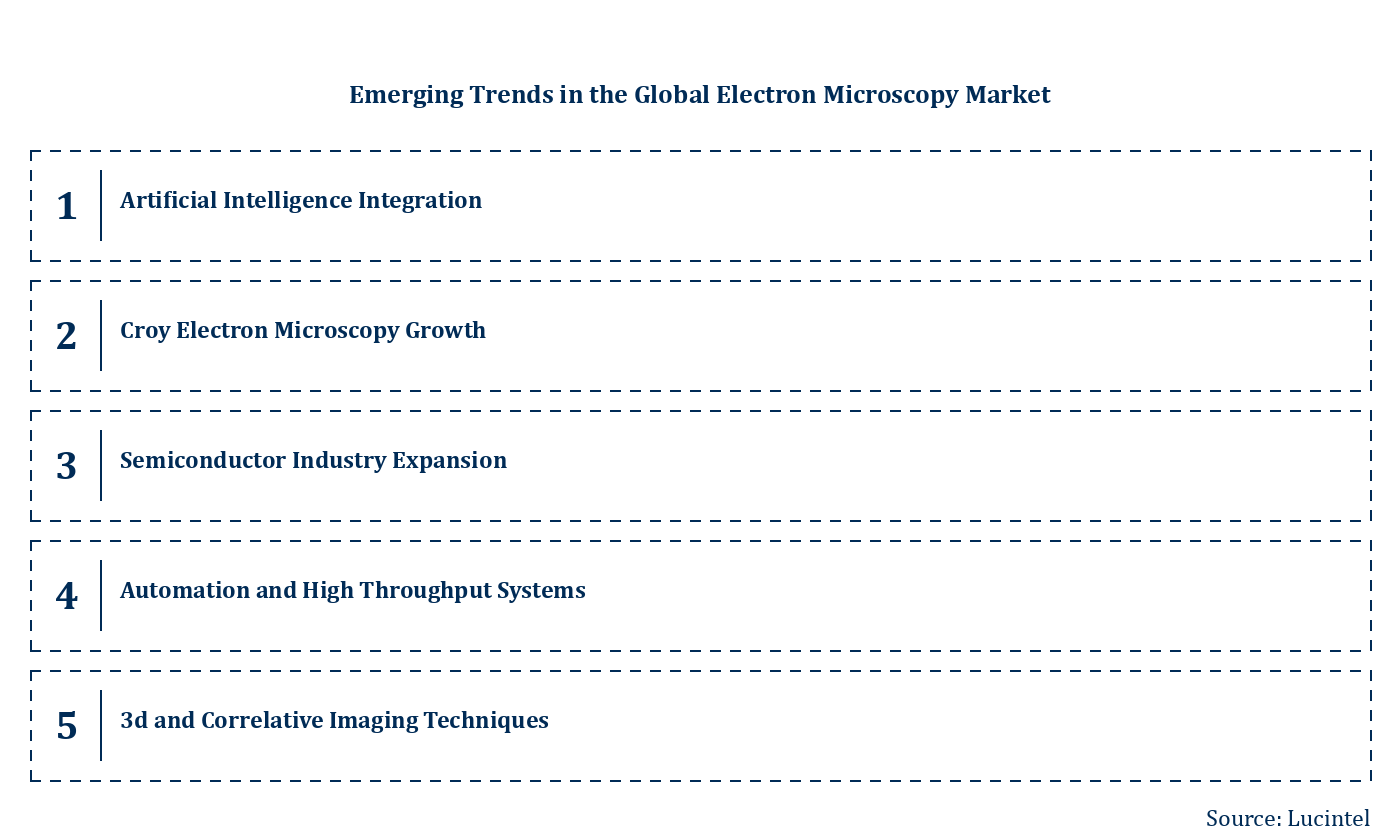
Emerging Trends in the Electron Microscopy Market

Recent Developments in the Electron Microscopy Market

The electron microscopy market is experiencing significant transformation driven by continuous technological advancements and increasing demand for high-resolution imaging across scientific, industrial, and healthcare applications. Rapid progress in nanotechnology, semiconductor manufacturing, and biomedical research is fueling the adoption of advanced microscopy systems. Innovations such as artificial intelligence integration, cryo-electron microscopy, automation, and 3D imaging are reshaping research capabilities. Growing investments from governments and private organizations are further strengthening infrastructure and expanding applications. These developments are enabling faster, more accurate, and highly detailed analysis at atomic and molecular levels across multiple industries worldwide.

• Artificial Intelligence Integration in Electron Microscopy: Artificial intelligence integration in electron microscopy is improving image processing, defect detection, and data interpretation across research and industrial applications. AI algorithms are enabling faster analysis of large datasets generated by high-resolution microscopes, reducing manual effort and increasing accuracy. Machine learning models are being used for automated pattern recognition in semiconductor inspection and materials science. This development is enhancing productivity in laboratories and manufacturing facilities while minimizing errors. AI-driven predictive maintenance is also improving equipment performance and reducing downtime. Overall, AI integration is making electron microscopy more efficient, intelligent, and suitable for complex nanoscale research applications globally.
• Expansion of Croy Electron Microscopy Applications: Expansion of cry electron microscopy applications is transforming structural biology and pharmaceutical research by enabling near atomic level imaging of biological molecules. This technology is widely used in drug discovery, vaccine development, and protein structure analysis. Recent improvements in sample preparation and imaging resolution have increased its accuracy and reliability. Research institutions are increasingly adopting Croy electron microscopy for studying viruses and complex biological systems. Government and private funding are supporting infrastructure expansion. This development is accelerating breakthroughs in life sciences and enhancing understanding of molecular interactions, significantly impacting healthcare research and biopharmaceutical innovation worldwide.
• Growth in Semiconductor Inspection Demand: Growth in semiconductor inspection demand is driving increased adoption of electron microscopy for wafer analysis, defect detection, and nanofabrication research. As semiconductor devices become smaller and more complex, high precision imaging is essential for ensuring product quality and performance. Electron microscopes are widely used in advanced chip manufacturing to identify structural flaws and improve production efficiency. Rising demand for smartphones, artificial intelligence processors, and IoT devices is further boosting this trend. Manufacturers are investing in advanced multi beam SEM systems. This development is strengthening the role of electron microscopy in supporting next generation semiconductor technology innovation.
• Rising Adoption of Automated Microscopy Systems: Rising adoption of automated microscopy systems is improving efficiency, reducing manual intervention, and enabling high throughput analysis in research laboratories. Automation allows for faster imaging, consistent results, and reduced operational costs. Integrated robotics and software solutions are streamlining sample handling and data acquisition processes. This is particularly important in materials science and biomedical research where large sample volumes are analyzed. Remote operation capabilities are also enabling global collaboration among researchers. This development is increasing productivity and scalability of microscopy workflows, making advanced electron microscopy more accessible and efficient for both academic and industrial applications across global markets.
• Advancements in Multi Modal and 3D Imaging: Advancements in multi modal and 3D imaging are enhancing electron microscopy by combining different imaging techniques for comprehensive structural analysis. These systems integrate electron microscopy with optical and analytical methods to provide detailed spatial and functional information. 3D reconstruction techniques allow researchers to visualize complex nanoscale structures with higher accuracy. This is widely used in materials science, nanotechnology, and biological research. Improved visualization capabilities are helping in better product design and scientific discovery. Increasing demand for advanced imaging solutions is driving innovation in this area, significantly expanding the application scope and analytical power of electron microscopy technologies.

These developments are significantly transforming the electron microscopy market by enhancing imaging accuracy, automation, and analytical capabilities across multiple industries. Innovations such as artificial intelligence, Croy electron microscopy, semiconductor inspection technologies, automated systems, and advanced 3D imaging are improving research efficiency and expanding application areas. Growing investments in nanotechnology, healthcare, and electronics are further accelerating adoption. Overall, these advancements are making electron microscopy more intelligent, efficient, and versatile, supporting faster scientific discovery and industrial innovation while strengthening its role as a critical tool for nanoscale analysis globally.

Strategic Growth Opportunities in the Electron Microscopy Market

The electron microscopy market is expanding due to rising demand for nanoscale imaging across healthcare, semiconductor, materials science, and industrial research applications. Advancements in scanning and transmission electron microscopy are enabling higher resolution, faster imaging, and improved analytical accuracy. Increasing investments in nanotechnology, biotechnology, and advanced manufacturing are creating opportunities for market expansion. Rising adoption in drug discovery, failure analysis, and quality inspection is strengthening demand. Integration with artificial intelligence and automation is enhancing efficiency and supporting broader research applications.

• Semiconductor Failure Analysis and Inspection: Electron microscopy is increasingly used for defect detection and failure analysis in advanced semiconductor manufacturing. As chip architectures shrink, demand for high resolution imaging continues to rise. SEM and TEM systems help identify structural defects, contamination, and circuit failures at nanoscale levels. This application supports quality assurance and process optimization in fabrication plants. Growing demand for AI chips, smartphones, and IoT devices is driving investment in advanced inspection tools. Electron microscopy ensures reliability and performance in next generation semiconductor production.
• Drug Discovery and Croy Electron Microscopy Applications: Croy electron microscopy is becoming essential in drug discovery and structural biology research. It enables high resolution imaging of proteins, viruses, and biomolecules without damaging samples. Pharmaceutical companies are using this technology to accelerate vaccine development and targeted therapy design. Increasing investment in life sciences research is driving adoption in research institutes and biotech firms. Croy EM provides detailed molecular insights that support drug design and disease understanding. Growing demand for precision medicine is boosting its use in biomedical applications.
• Materials Science and Nanostructure Analysis Applications: Electron microscopy plays a key role in materials science by enabling nanoscale characterization of metals, polymers, and composites. Researchers use SEM and TEM systems to study material properties, defects, and crystal structures. This application supports innovation in aerospace, automotive, and energy industries. Growing demand for lightweight and high strength materials is driving adoption. Advanced imaging helps improve product durability and performance. Increasing investment in nanotechnology research is further expanding the use of electron microscopy in developing next generation materials globally.
• Industrial Quality Control and Failure Inspection Applications: Electron microscopy is widely used in industrial quality control to ensure product reliability and performance. It helps detect micro defects, contamination, and structural inconsistencies in manufactured components. Industries such as aerospace, automotive, and electronics rely on electron microscopy for precise inspection. Increasing demand for high quality products is driving adoption of advanced imaging systems. Automation and digital analysis are improving inspection speed and accuracy. Growing emphasis on safety and compliance standards is strengthening use of electron microscopy in manufacturing environments.
• Artificial Intelligence and Automated Imaging Systems Applications: Artificial intelligence and automation are transforming electron microscopy by improving image analysis, data processing, and operational efficiency. AI based systems enable faster identification of patterns, defects, and anomalies in nanoscale images. Automation reduces manual intervention and increases throughput in research and industrial laboratories. These technologies are widely used in semiconductor inspection and materials research. Integration of AI with electron microscopy enhances accuracy and reproducibility. Growing demand for smart laboratory solutions is driving innovation and expanding adoption across industrial applications globally.

These strategic growth opportunities are significantly transforming the electron microscopy market by expanding its application scope across semiconductor, healthcare, materials science, and industrial sectors. Advancements in Croy electron microscopy, artificial intelligence, and automation are improving imaging accuracy, efficiency, and scalability. Increasing demand for nanoscale analysis is driving adoption across research and manufacturing environments. Continuous innovation is enabling faster decision making and better product development. Overall, these developments are strengthening market growth, enhancing technological capabilities adoption of electron microscopy solutions globally.

Electron Microscopy Market Driver and Challenges

The electron microscopy market is evolving rapidly due to a combination of technological, economic, and regulatory factors that are shaping its global adoption across multiple industries. Increasing demand for nanoscale imaging in semiconductor manufacturing, healthcare research, and materials science is driving technological advancements in scanning and transmission electron microscopy systems. Economic factors such as rising investments in research infrastructure and industrial innovation are further supporting market expansion. At the same time, regulatory requirements related to quality control, safety standards, and scientific validation are influencing equipment adoption. However, high costs, technical complexity, and skilled workforce shortages continue to create challenges for widespread market growth globally.

The factors responsible for driving the Electron Microscopy Market include:-
• Increasing Demand for High Resolution Imaging in Research and Industry: Increasing demand for high resolution imaging is a major driver of the electron microscopy market as industries and research institutions require detailed nanoscale analysis. Electron microscopes provide superior resolution compared to optical microscopes, enabling precise visualization of materials, biological samples, and semiconductor structures. This demand is growing in pharmaceuticals, biotechnology, and nanotechnology research. Semiconductor manufacturers rely heavily on electron microscopy for defect detection and process optimization. Advancements in imaging speed and resolution are further increasing adoption. Growing investment in scientific research and innovation is also expanding the use of electron microscopy across academic and industrial applications globally.
• Rising Adoption in Semiconductor Manufacturing and Electronics Industry: Rising adoption in semiconductor manufacturing is significantly driving market growth as chip designs become smaller and more complex. Electron microscopy is essential for wafer inspection, failure analysis, and nanofabrication research. It ensures high precision in detecting defects that impact device performance. The growing demand for advanced electronics such as smartphones, AI processors, and IoT devices is fueling this trend. Manufacturers are increasingly investing in multi beam SEM systems to improve efficiency. Continuous technological advancements in semiconductor architecture are further increasing reliance on electron microscopy for quality control and production optimization in the global electronics industry.
• Growing Applications in Life Sciences and Drug Discovery: Growing applications in life sciences and drug discovery are driving the electron microscopy market, especially through Croy electron microscopy techniques. Researchers use these systems to study proteins, viruses, and biomolecular structures at near atomic resolution. This capability is critical for vaccine development, disease research, and targeted drug design. Increasing investment in pharmaceutical and biotechnology sectors is boosting adoption. Electron microscopy helps accelerate drug discovery by providing detailed structural insights. Rising focus on precision medicine and biologics is further expanding demand. Academic and research institutions are increasingly integrating advanced microscopy systems into biomedical research workflows worldwide.
• Increasing Government Funding and Research Investments: Increasing government funding and research investments are supporting the expansion of electron microscopy infrastructure across academic and industrial sectors. Governments are funding nanotechnology, materials science, and biomedical research projects that rely heavily on high resolution imaging. Research institutions are upgrading facilities with advanced SEM and TEM systems. Public private partnerships are also contributing to technology development and adoption. This financial support is enabling innovation in microscopy technologies and expanding access to advanced instruments. Growing focus on scientific innovation and technological leadership is strengthening long term demand for electron microscopy systems globally.

The challenges facing this Market include:
• High Cost of Equipment and Maintenance: High cost of electron microscopy systems is a major challenge limiting widespread adoption, especially in developing regions. Advanced SEM and TEM instruments require significant capital investment along with high maintenance and operational costs. Consumables, training, and infrastructure requirements further increase total expenditure. Small and medium research institutions often face budget constraints that restrict access to advanced imaging technologies. Regular calibration and technical servicing add to ongoing costs. Although technological advancements are improving performance, affordability remains a key barrier, slowing market penetration in cost sensitive regions and limiting broader adoption across smaller laboratories and industries globally.
• Requirement for Highly Skilled Workforce: Requirement for highly skilled professionals is another major challenge in the electron microscopy market. Operating and interpreting electron microscopy data requires specialized training in physics, materials science, and image analysis. There is a shortage of trained technicians and researchers capable of handling advanced SEM and TEM systems. This limits efficient utilization of equipment in many laboratories. Continuous technological advancements further increase the complexity of systems. Training programs and educational infrastructure are still developing in several regions. The lack of skilled workforce slows adoption and reduces operational efficiency in both academic and industrial research environments worldwide.
• Complex Sample Preparation and Operational Limitations: Complex sample preparation and operational limitations present significant challenges for electron microscopy usage. Preparing samples for SEM and TEM analysis requires precise techniques that can be time consuming and technically demanding. Biological and material samples often need specialized processing to prevent damage during imaging. Vacuum requirements and environmental constraints also limit sample types. Operational complexity increases training requirements and reduces workflow efficiency. These limitations can delay research processes and increase costs. Despite advancements in automation, sample preparation remains a critical bottleneck, restricting faster adoption and efficient use of electron microscopy systems across various applications.

The electron microscopy market is strongly influenced by rising demand for high resolution imaging, expanding semiconductor manufacturing, and growing applications in life sciences and advanced research. Technological advancements and increased government funding are further accelerating market growth. However, challenges such as high equipment costs, skilled workforce shortages, and complex sample preparation continue to limit widespread adoption. Despite these barriers, continuous innovation in automation, artificial intelligence, and imaging technologies is improving efficiency and accessibility. Overall, the market is expected to grow steadily as industries increasingly rely on nanoscale analysis for innovation, quality control, and scientific discovery worldwide.

List of Electron Microscopy Companies

Companies in the market compete on the basis of product quality offered. Major players in this market focus on expanding their manufacturing facilities, R&D investments, infrastructural development, and leverage integration opportunities across the value chain. With these strategies electron microscopy companies cater increasing demand, ensure competitive effectiveness, develop innovative products & technologies, reduce production costs, and expand their customer base. Some of the electron microscopy companies profiled in this report include-
• Bruker
• JEOL
• Delong Instruments
• TESCAN Orsay holding
• Advantest
• Hitachi High-Technologies
• Oxford Instruments
• Thermo Fisher Scientific
• Carl Zeiss
• Leica Microsystems

Electron Microscopy Market by Segment

The study includes a forecast for the global electron microscopy market by type, application, end use, and region.

Electron Microscopy Market by Type [Value from 2019 to 2035]:


• Scanning Electron Microscope (SEM)
• Transmission Electron Microscope (TEM)

Electron Microscopy Market by Application [Value from 2019 to 2035]:


• Semiconductors
• Life Sciences
• Materials Science
• Others

Electron Microscopy Market by End Use [Value from 2019 to 2035]:


• Industries
• Healthcare
• Research Institute
• Others

Electron Microscopy Market by Region [Value from 2019 to 2035]:


• North America
• Europe
• Asia Pacific
• The Rest of the World

Country Wise Outlook for the Electron Microscopy Market

The electron microscopy market is witnessing rapid technological advancement driven by increasing demand for nanoscale imaging, automation, and high-resolution analysis across semiconductor, healthcare, and materials science sectors. Recent developments are strongly influenced by innovations in scanning electron microscopy (SEM), transmission electron microscopy (TEM), cryo-electron microscopy, AI-based image analysis, and multi-beam systems. Countries such as the United States, China, Germany, India, and Japan are playing a major role in shaping global growth through strong research infrastructure, government funding, and industrial applications. The focus is shifting toward faster imaging, improved resolution, remote operation capabilities, and integration of artificial intelligence for automated defect detection and data interpretation in advanced research and industrial environments.

• United States:
The United States is leading advancements in electron microscopy through strong investment in semiconductor R&D, biomedical research, and national laboratory infrastructure. Recent developments include increased adoption of automated SEM systems and AI-powered imaging platforms for faster defect detection and materials analysis. Institutions like national labs and universities are expanding cryo-EM capabilities for drug discovery and structural biology research. Companies are focusing on high-throughput multi-beam SEM and hybrid TEM systems to support advanced nanotechnology applications. The rise of remote-access microscopy platforms and cloud-based data analysis is improving collaboration across research centers. Growing federal funding for nanoscience and life sciences continues to strengthen the country’s leadership in high-resolution imaging innovation.

• China:
China is experiencing rapid expansion in electron microscopy due to strong government support for semiconductor manufacturing, nanotechnology, and advanced materials research. Recent developments include large-scale installation of high-end SEM and TEM systems in research institutes and industrial labs. Domestic manufacturers are improving instrument precision and resolution while reducing dependency on imports. AI-integrated microscopy systems are increasingly used for automated defect detection in semiconductor fabrication. Universities and national research centers are investing heavily in cryo-EM for biomedical research and protein structure analysis. The country is also focusing on building advanced microscopy infrastructure under national innovation programs, strengthening its position in both industrial and academic electron microscopy applications.

• Germany:
Germany is advancing electron microscopy through strong contributions from precision engineering, automotive materials research, and life sciences. Recent developments include enhanced integration of electron microscopy with AI-based analytics and correlative imaging techniques combining optical and electron systems. Leading companies are introducing high-resolution TEM and SEM systems with improved automation and faster imaging workflows. Research institutes are expanding applications in nanomaterials, battery research, and structural biology. Germany is also focusing on sustainable manufacturing and advanced quality control using electron microscopy in industrial production. Strong collaboration between academia and industry is accelerating innovation in imaging resolution, detector technology, and nanoscale analytical capabilities.

• India:
India is rapidly strengthening its electron microscopy ecosystem through increased government funding in scientific research, semiconductor development, and biotechnology. Recent developments include expansion of electron microscopy facilities in IITs, national laboratories, and medical research institutes. Adoption of advanced SEM and TEM systems is increasing for materials science, pharmaceuticals, and nanotechnology studies. India is also focusing on building domestic expertise in cryo-EM for biological and medical research applications. Collaborative projects with global companies are improving access to high-end imaging systems. Growth in semiconductor initiatives and academic research funding is further accelerating the adoption of electron microscopy technologies across research and industrial sectors.

• Japan:
Japan remains a global leader in electron microscopy innovation, supported by strong contributions from major manufacturers and advanced research institutions. Recent developments include next-generation TEM and SEM systems with ultra-high resolution, improved electron beam stability, and compact instrument designs. Japanese companies are introducing automated imaging platforms and multi-modal systems for materials science and semiconductor inspection. Research collaborations between universities and industry are advancing atomic-level imaging and in-situ analysis technologies. Japan is also focusing on cryo-EM advancements for life sciences and protein research. Continuous innovation in detector technology, robotics integration, and precision engineering is reinforcing Japan’s leadership in the global electron microscopy market.
Lucintel Analytics Dashboard

Features of the Global Electron Microscopy Market

Market Size Estimates: Electron microscopy market size estimation in terms of value ($M).
Trend and Forecast Analysis: Market trends (2019 to 2025) and forecast (2026 to 2035) by various segments and regions.
Segmentation Analysis: Electron microscopy market size by type, application, end use, and region in terms of value ($M).
Regional Analysis: Electron microscopy market breakdown by North America, Europe, Asia Pacific, and Rest of the World.
Growth Opportunities: Analysis of growth opportunities in different type, application, end use, and regions for the electron microscopy market.
Strategic Analysis: This includes M&A, new product development, and competitive landscape of the electron microscopy market.
Analysis of competitive intensity of the industry based on Porter’s Five Forces model.

Lucintel Consulting Services

FAQ

Q1. What is the electron microscopy market size?
Answer: The global electron microscopy market is expected to reach an estimated $8,840 million by 2035.
Q2. What is the growth forecast for electron microscopy market?
Answer: The global electron microscopy market is expected to grow with a CAGR of 7.4% from 2026 to 2035.
Q3. What are the major drivers influencing the growth of the electron microscopy market?
Answer: The major drivers for this market are the increasing demand for nanotechnology research across industries, the rising demand for cancer & virus structure studies, and the growing demand for advancements in microscope resolution & automation.
Q4. What are the major segments for electron microscopy market?
Answer: The future of the electron microscopy market looks promising with opportunities in the industry, healthcare, and research institute markets.
Q5. Who are the key electron microscopy market companies?
Answer: Some of the key electron microscopy companies are as follows:
• Bruker
• JEOL
• Delong Instruments
• TESCAN Orsay holding
• Advantest
• Hitachi High-Technologies
• Oxford Instruments
• Thermo Fisher Scientific
• Carl Zeiss
• Leica Microsystems
Q6. Which electron microscopy market segment will be the largest in future?
Answer: Lucintel forecasts that, within the type category, scanning electron microscope (sem) is expected to witness higher growth over the forecast period.
Q7. In electron microscopy market, which region is expected to be the largest in next 8 years?
Answer: In terms of region, APAC is expected to witness the highest growth over the forecast period.
Q8. Do we receive customization in this report?
Answer: Yes, Lucintel provides 10% customization without any additional cost.

This report answers following 11 key questions:

Q.1. What are some of the most promising, high-growth opportunities for the electron microscopy market by type (scanning electron microscope (SEM) and transmission electron microscope (TEM)), application (semiconductors, life sciences, materials science, and others), end use (industries, healthcare, research institute, and others), and region (North America, Europe, Asia Pacific, and the Rest of the World)?
Q.2. Which segments will grow at a faster pace and why?
Q.3. Which region will grow at a faster pace and why?
Q.4. What are the key factors affecting market dynamics? What are the key challenges and business risks in this market?
Q.5. What are the business risks and competitive threats in this market?
Q.6. What are the emerging trends in this market and the reasons behind them?
Q.7. What are some of the changing demands of customers in the market?
Q.8. What are the new developments in the market? Which companies are leading these developments?
Q.9. Who are the major players in this market? What strategic initiatives are key players pursuing for business growth?
Q.10. What are some of the competing products in this market and how big of a threat do they pose for loss of market share by material or product substitution?
Q.11. What M&A activity has occurred in the last 5 years and what has its impact been on the industry?

For any questions related to Electron Microscopy Market, Electron Microscopy Market Size, Electron Microscopy Market Growth, Electron Microscopy Market Analysis, Electron Microscopy Market Report, Electron Microscopy Market Share, Electron Microscopy Market Trends, Electron Microscopy Market Forecast, Electron Microscopy Companies, write Lucintel analyst at email: helpdesk@lucintel.com. We will be glad to get back to you soon.
                                           Table of Contents

            1. Executive Summary

            2. Market Overview

                        2.1 Background and Classifications
                        2.2 Supply Chain

            3. Market Trends & Forecast Analysis

                        3.1 Macroeconomic Trends and Forecasts
                        3.2 Industry Drivers and Challenges
                        3.3 PESTLE Analysis
                        3.4 Patent Analysis
                        3.5 Regulatory Environment
                        3.6 Global Electron Microscopy Market Trends and Forecast

            4. Global Electron Microscopy Market by Type

                        4.1 Overview
                        4.2 Attractiveness Analysis by Type
                        4.3 Scanning Electron Microscope (SEM) : Trends and Forecast (2019 to 2035)
                        4.4 Transmission Electron Microscope (TEM) : Trends and Forecast (2019 to 2035)

            5. Global Electron Microscopy Market by Application

                        5.1 Overview
                        5.2 Attractiveness Analysis by Application
                        5.3 Semiconductors : Trends and Forecast (2019 to 2035)
                        5.4 Life Sciences : Trends and Forecast (2019 to 2035)
                        5.5 Materials Science : Trends and Forecast (2019 to 2035)
                        5.6 Others : Trends and Forecast (2019 to 2035)

            6. Global Electron Microscopy Market by End Use

                        6.1 Overview
                        6.2 Attractiveness Analysis by End Use
                        6.3 Industries : Trends and Forecast (2019 to 2035)
                        6.4 Healthcare : Trends and Forecast (2019 to 2035)
                        6.5 Research Institute : Trends and Forecast (2019 to 2035)
                        6.6 Others : Trends and Forecast (2019 to 2035)

            7. Regional Analysis

                        7.1 Overview
                        7.2 Global Electron Microscopy Market by Region

            8. North American Electron Microscopy Market

                        8.1 Overview
                        8.2 North American Electron Microscopy Market by Type
                        8.3 North American Electron Microscopy Market by Application
                        8.4 The United States Electron Microscopy Market
                        8.5 Canadian Electron Microscopy Market
                        8.6 Mexican Electron Microscopy Market

            9. European Electron Microscopy Market

                        9.1 Overview
                        9.2 European Electron Microscopy Market by Type
                        9.3 European Electron Microscopy Market by Application
                        9.4 German Electron Microscopy Market
                        9.5 French Electron Microscopy Market
                        9.6 Italian Electron Microscopy Market
                        9.7 Spanish Electron Microscopy Market
                        9.8 The United Kingdom Electron Microscopy Market

            10. APAC Electron Microscopy Market

                        10.1 Overview
                        10.2 APAC Electron Microscopy Market by Type
                        10.3 APAC Electron Microscopy Market by Application
                        10.4 Chinese Electron Microscopy Market
                        10.5 Indian Electron Microscopy Market
                        10.6 Japanese Electron Microscopy Market
                        10.7 South Korean Electron Microscopy Market
                        10.8 Indonesian Electron Microscopy Market

            11. ROW Electron Microscopy Market

                        11.1 Overview
                        11.2 ROW Electron Microscopy Market by Type
                        11.3 ROW Electron Microscopy Market by Application
                        11.4 Middle Eastern Electron Microscopy Market
                        11.5 South American Electron Microscopy Market
                        11.6 African Electron Microscopy Market

            12. Competitor Analysis

                        12.1 Product Portfolio Analysis
                        12.2 Operational Integration
                        12.3 Porter’s Five Forces Analysis
                                    • Competitive Rivalry
                                    • Bargaining Power of Buyers
                                    • Bargaining Power of Suppliers
                                    • Threat of Substitutes
                                    • Threat of New Entrants
                        12.4 Market Share Analysis

            13. Opportunities & Strategic Analysis

                        13.1 Value Chain Analysis
                        13.2 Growth Opportunity Analysis
                                    13.2.1 Growth Opportunity by Type
                                    13.2.2 Growth Opportunity by Application
                                    13.2.3 Growth Opportunity by End Use
                                    13.2.4 Growth Opportunity by Region
                        13.3 Emerging Trends in the Global Electron Microscopy Market
                        13.4 Strategic Analysis
                                    13.4.1 New Product Development
                                    13.4.2 Certification and Licensing
                                    13.4.3 Mergers, Acquisitions, Agreements, Collaborations, and Joint Ventures

            14. Company Profiles of the Leading Players Across the Value Chain

                        14.1 Competitive Analysis Overview
                        14.2 Bruker
                                    • Company Overview
                                    • Electron Microscopy Market Business Overview
                                    • New Product Development
                                    • Merger, Acquisition, and Collaboration
                                    • Certification and Licensing
                        14.3 JEOL
                                    • Company Overview
                                    • Electron Microscopy Market Business Overview
                                    • New Product Development
                                    • Merger, Acquisition, and Collaboration
                                    • Certification and Licensing
                        14.4 Delong Instruments
                                    • Company Overview
                                    • Electron Microscopy Market Business Overview
                                    • New Product Development
                                    • Merger, Acquisition, and Collaboration
                                    • Certification and Licensing
                        14.5 TESCAN Orsay holding
                                    • Company Overview
                                    • Electron Microscopy Market Business Overview
                                    • New Product Development
                                    • Merger, Acquisition, and Collaboration
                                    • Certification and Licensing
                        14.6 Advantest
                                    • Company Overview
                                    • Electron Microscopy Market Business Overview
                                    • New Product Development
                                    • Merger, Acquisition, and Collaboration
                                    • Certification and Licensing
                        14.7 Hitachi High-Technologies
                                    • Company Overview
                                    • Electron Microscopy Market Business Overview
                                    • New Product Development
                                    • Merger, Acquisition, and Collaboration
                                    • Certification and Licensing
                        14.8 Oxford Instruments
                                    • Company Overview
                                    • Electron Microscopy Market Business Overview
                                    • New Product Development
                                    • Merger, Acquisition, and Collaboration
                                    • Certification and Licensing
                        14.9 Thermo Fisher Scientific
                                    • Company Overview
                                    • Electron Microscopy Market Business Overview
                                    • New Product Development
                                    • Merger, Acquisition, and Collaboration
                                    • Certification and Licensing
                        14.10 Carl Zeiss
                                    • Company Overview
                                    • Electron Microscopy Market Business Overview
                                    • New Product Development
                                    • Merger, Acquisition, and Collaboration
                                    • Certification and Licensing
                        14.11 Leica Microsystems
                                    • Company Overview
                                    • Electron Microscopy Market Business Overview
                                    • New Product Development
                                    • Merger, Acquisition, and Collaboration
                                    • Certification and Licensing

            15. Appendix

                        15.1 List of Figures
                        15.2 List of Tables
                        15.3 Research Methodology
                        15.4 Disclaimer
                        15.5 Copyright
                        15.6 Abbreviations and Technical Units
                        15.7 About Us
                        15.8 Contact Us

                                               List of Figures


            Chapter 1

                        Figure 1.1: Trends and Forecast for the Global Electron Microscopy Market

            Chapter 2

                        Figure 2.1: Usage of Electron Microscopy Market
                        Figure 2.2: Classification of the Global Electron Microscopy Market
                        Figure 2.3: Supply Chain of the Global Electron Microscopy Market

            Chapter 3

                        Figure 3.1: Trends of the Global GDP Growth Rate
                        Figure 3.2: Trends of the Global Population Growth Rate
                        Figure 3.3: Trends of the Global Inflation Rate
                        Figure 3.4: Trends of the Global Unemployment Rate
                        Figure 3.5: Trends of the Regional GDP Growth Rate
                        Figure 3.6: Trends of the Regional Population Growth Rate
                        Figure 3.7: Trends of the Regional Inflation Rate
                        Figure 3.8: Trends of the Regional Unemployment Rate
                        Figure 3.9: Trends of Regional Per Capita Income
                        Figure 3.10: Forecast for the Global GDP Growth Rate
                        Figure 3.11: Forecast for the Global Population Growth Rate
                        Figure 3.12: Forecast for the Global Inflation Rate
                        Figure 3.13: Forecast for the Global Unemployment Rate
                        Figure 3.14: Forecast for the Regional GDP Growth Rate
                        Figure 3.15: Forecast for the Regional Population Growth Rate
                        Figure 3.16: Forecast for the Regional Inflation Rate
                        Figure 3.17: Forecast for the Regional Unemployment Rate
                        Figure 3.18: Forecast for Regional Per Capita Income
                        Figure 3.19: Driver and Challenges of the Electron Microscopy Market

            Chapter 4

                        Figure 4.1: Global Electron Microscopy Market by Type in 2019, 2025, and 2035
                        Figure 4.2: Trends of the Global Electron Microscopy Market ($M) by Type
                        Figure 4.3: Forecast for the Global Electron Microscopy Market ($M) by Type
                        Figure 4.4: Trends and Forecast for Scanning Electron Microscope (SEM) in the Global Electron Microscopy Market (2019-2035)
                        Figure 4.5: Trends and Forecast for Transmission Electron Microscope (TEM) in the Global Electron Microscopy Market (2019-2035)

            Chapter 5

                        Figure 5.1: Global Electron Microscopy Market by Application in 2019, 2025, and 2035
                        Figure 5.2: Trends of the Global Electron Microscopy Market ($M) by Application
                        Figure 5.3: Forecast for the Global Electron Microscopy Market ($M) by Application
                        Figure 5.4: Trends and Forecast for Semiconductors in the Global Electron Microscopy Market (2019-2035)
                        Figure 5.5: Trends and Forecast for Life Sciences in the Global Electron Microscopy Market (2019-2035)
                        Figure 5.6: Trends and Forecast for Materials Science in the Global Electron Microscopy Market (2019-2035)
                        Figure 5.7: Trends and Forecast for Others in the Global Electron Microscopy Market (2019-2035)

            Chapter 6

                        Figure 6.1: Global Electron Microscopy Market by End Use in 2019, 2025, and 2035
                        Figure 6.2: Trends of the Global Electron Microscopy Market ($M) by End Use
                        Figure 6.3: Forecast for the Global Electron Microscopy Market ($M) by End Use
                        Figure 6.4: Trends and Forecast for Industries in the Global Electron Microscopy Market (2019-2035)
                        Figure 6.5: Trends and Forecast for Healthcare in the Global Electron Microscopy Market (2019-2035)
                        Figure 6.6: Trends and Forecast for Research Institute in the Global Electron Microscopy Market (2019-2035)
                        Figure 6.7: Trends and Forecast for Others in the Global Electron Microscopy Market (2019-2035)

            Chapter 7

                        Figure 7.1: Trends of the Global Electron Microscopy Market ($M) by Region (2019-2025)
                        Figure 7.2: Forecast for the Global Electron Microscopy Market ($M) by Region (2026-2035)

            Chapter 8

                        Figure 8.1: Trends and Forecast for the North American Electron Microscopy Market (2019-2035)
                        Figure 8.2: North American Electron Microscopy Market by Type in 2019, 2025, and 2035
                        Figure 8.3: Trends of the North American Electron Microscopy Market ($M) by Type (2019-2025)
                        Figure 8.4: Forecast for the North American Electron Microscopy Market ($M) by Type (2026-2035)
                        Figure 8.5: North American Electron Microscopy Market by Application in 2019, 2025, and 2035
                        Figure 8.6: Trends of the North American Electron Microscopy Market ($M) by Application (2019-2025)
                        Figure 8.7: Forecast for the North American Electron Microscopy Market ($M) by Application (2026-2035)
                        Figure 8.8: Trends and Forecast for the United States Electron Microscopy Market ($M) (2019-2035)
                        Figure 8.9: Trends and Forecast for the Mexican Electron Microscopy Market ($M) (2019-2035)
                        Figure 8.10: Trends and Forecast for the Canadian Electron Microscopy Market ($M) (2019-2035)

            Chapter 9

                        Figure 9.1: Trends and Forecast for the European Electron Microscopy Market (2019-2035)
                        Figure 9.2: European Electron Microscopy Market by Type in 2019, 2025, and 2035
                        Figure 9.3: Trends of the European Electron Microscopy Market ($M) by Type (2019-2025)
                        Figure 9.4: Forecast for the European Electron Microscopy Market ($M) by Type (2026-2035)
                        Figure 9.5: European Electron Microscopy Market by Application in 2019, 2025, and 2035
                        Figure 9.6: Trends of the European Electron Microscopy Market ($M) by Application (2019-2025)
                        Figure 9.7: Forecast for the European Electron Microscopy Market ($M) by Application (2026-2035)
                        Figure 9.8: Trends and Forecast for the German Electron Microscopy Market ($M) (2019-2035)
                        Figure 9.9: Trends and Forecast for the French Electron Microscopy Market ($M) (2019-2035)
                        Figure 9.10: Trends and Forecast for the Spanish Electron Microscopy Market ($M) (2019-2035)
                        Figure 9.11: Trends and Forecast for the Italian Electron Microscopy Market ($M) (2019-2035)
                        Figure 9.12: Trends and Forecast for the United Kingdom Electron Microscopy Market ($M) (2019-2035)

            Chapter 10

                        Figure 10.1: Trends and Forecast for the APAC Electron Microscopy Market (2019-2035)
                        Figure 10.2: APAC Electron Microscopy Market by Type in 2019, 2025, and 2035
                        Figure 10.3: Trends of the APAC Electron Microscopy Market ($M) by Type (2019-2025)
                        Figure 10.4: Forecast for the APAC Electron Microscopy Market ($M) by Type (2026-2035)
                        Figure 10.5: APAC Electron Microscopy Market by Application in 2019, 2025, and 2035
                        Figure 10.6: Trends of the APAC Electron Microscopy Market ($M) by Application (2019-2025)
                        Figure 10.7: Forecast for the APAC Electron Microscopy Market ($M) by Application (2026-2035)
                        Figure 10.8: Trends and Forecast for the Japanese Electron Microscopy Market ($M) (2019-2035)
                        Figure 10.9: Trends and Forecast for the Indian Electron Microscopy Market ($M) (2019-2035)
                        Figure 10.10: Trends and Forecast for the Chinese Electron Microscopy Market ($M) (2019-2035)
                        Figure 10.11: Trends and Forecast for the South Korean Electron Microscopy Market ($M) (2019-2035)
                        Figure 10.12: Trends and Forecast for the Indonesian Electron Microscopy Market ($M) (2019-2035)

            Chapter 11

                        Figure 11.1: Trends and Forecast for the ROW Electron Microscopy Market (2019-2035)
                        Figure 11.2: ROW Electron Microscopy Market by Type in 2019, 2025, and 2035
                        Figure 11.3: Trends of the ROW Electron Microscopy Market ($M) by Type (2019-2025)
                        Figure 11.4: Forecast for the ROW Electron Microscopy Market ($M) by Type (2026-2035)
                        Figure 11.5: ROW Electron Microscopy Market by Application in 2019, 2025, and 2035
                        Figure 11.6: Trends of the ROW Electron Microscopy Market ($M) by Application (2019-2025)
                        Figure 11.7: Forecast for the ROW Electron Microscopy Market ($M) by Application (2026-2035)
                        Figure 11.8: Trends and Forecast for the Middle Eastern Electron Microscopy Market ($M) (2019-2035)
                        Figure 11.9: Trends and Forecast for the South American Electron Microscopy Market ($M) (2019-2035)
                        Figure 11.10: Trends and Forecast for the African Electron Microscopy Market ($M) (2019-2035)

            Chapter 12

                        Figure 12.1: Porter’s Five Forces Analysis of the Global Electron Microscopy Market
                        Figure 12.2: Market Share (%) of Top Players in the Global Electron Microscopy Market (2025)

            Chapter 13

                        Figure 13.1: Growth Opportunities for the Global Electron Microscopy Market by Type
                        Figure 13.2: Growth Opportunities for the Global Electron Microscopy Market by Application
                        Figure 13.3: Growth Opportunities for the Global Electron Microscopy Market by End Use
                        Figure 13.4: Growth Opportunities for the Global Electron Microscopy Market by Region
                        Figure 13.5: Emerging Trends in the Global Electron Microscopy Market

                                               List of Tables


            Chapter 1

                        Table 1.1: Growth Rate (%, 2024-2025) and CAGR (%, 2026-2035) of the Electron Microscopy Market by Type, Application, and End Use
                        Table 1.2: Attractiveness Analysis for the Electron Microscopy Market by Region
                        Table 1.3: Global Electron Microscopy Market Parameters and Attributes

            Chapter 3

                        Table 3.1: Trends of the Global Electron Microscopy Market (2019-2025)
                        Table 3.2: Forecast for the Global Electron Microscopy Market (2026-2035)

            Chapter 4

                        Table 4.1: Attractiveness Analysis for the Global Electron Microscopy Market by Type
                        Table 4.2: Market Size and CAGR of Various Type in the Global Electron Microscopy Market (2019-2025)
                        Table 4.3: Market Size and CAGR of Various Type in the Global Electron Microscopy Market (2026-2035)
                        Table 4.4: Trends of Scanning Electron Microscope (SEM) in the Global Electron Microscopy Market (2019-2025)
                        Table 4.5: Forecast for Scanning Electron Microscope (SEM) in the Global Electron Microscopy Market (2026-2035)
                        Table 4.6: Trends of Transmission Electron Microscope (TEM) in the Global Electron Microscopy Market (2019-2025)
                        Table 4.7: Forecast for Transmission Electron Microscope (TEM) in the Global Electron Microscopy Market (2026-2035)

            Chapter 5

                        Table 5.1: Attractiveness Analysis for the Global Electron Microscopy Market by Application
                        Table 5.2: Market Size and CAGR of Various Application in the Global Electron Microscopy Market (2019-2025)
                        Table 5.3: Market Size and CAGR of Various Application in the Global Electron Microscopy Market (2026-2035)
                        Table 5.4: Trends of Semiconductors in the Global Electron Microscopy Market (2019-2025)
                        Table 5.5: Forecast for Semiconductors in the Global Electron Microscopy Market (2026-2035)
                        Table 5.6: Trends of Life Sciences in the Global Electron Microscopy Market (2019-2025)
                        Table 5.7: Forecast for Life Sciences in the Global Electron Microscopy Market (2026-2035)
                        Table 5.8: Trends of Materials Science in the Global Electron Microscopy Market (2019-2025)
                        Table 5.9: Forecast for Materials Science in the Global Electron Microscopy Market (2026-2035)
                        Table 5.10: Trends of Others in the Global Electron Microscopy Market (2019-2025)
                        Table 5.11: Forecast for Others in the Global Electron Microscopy Market (2026-2035)

            Chapter 6

                        Table 6.1: Attractiveness Analysis for the Global Electron Microscopy Market by End Use
                        Table 6.2: Market Size and CAGR of Various End Use in the Global Electron Microscopy Market (2019-2025)
                        Table 6.3: Market Size and CAGR of Various End Use in the Global Electron Microscopy Market (2026-2035)
                        Table 6.4: Trends of Industries in the Global Electron Microscopy Market (2019-2025)
                        Table 6.5: Forecast for Industries in the Global Electron Microscopy Market (2026-2035)
                        Table 6.6: Trends of Healthcare in the Global Electron Microscopy Market (2019-2025)
                        Table 6.7: Forecast for Healthcare in the Global Electron Microscopy Market (2026-2035)
                        Table 6.8: Trends of Research Institute in the Global Electron Microscopy Market (2019-2025)
                        Table 6.9: Forecast for Research Institute in the Global Electron Microscopy Market (2026-2035)
                        Table 6.10: Trends of Others in the Global Electron Microscopy Market (2019-2025)
                        Table 6.11: Forecast for Others in the Global Electron Microscopy Market (2026-2035)

            Chapter 7

                        Table 7.1: Market Size and CAGR of Various Regions in the Global Electron Microscopy Market (2019-2025)
                        Table 7.2: Market Size and CAGR of Various Regions in the Global Electron Microscopy Market (2026-2035)

            Chapter 8

                        Table 8.1: Trends of the North American Electron Microscopy Market (2019-2025)
                        Table 8.2: Forecast for the North American Electron Microscopy Market (2026-2035)
                        Table 8.3: Market Size and CAGR of Various Type in the North American Electron Microscopy Market (2019-2025)
                        Table 8.4: Market Size and CAGR of Various Type in the North American Electron Microscopy Market (2026-2035)
                        Table 8.5: Market Size and CAGR of Various Application in the North American Electron Microscopy Market (2019-2025)
                        Table 8.6: Market Size and CAGR of Various Application in the North American Electron Microscopy Market (2026-2035)
                        Table 8.7: Trends and Forecast for the United States Electron Microscopy Market (2019-2035)
                        Table 8.8: Trends and Forecast for the Mexican Electron Microscopy Market (2019-2035)
                        Table 8.9: Trends and Forecast for the Canadian Electron Microscopy Market (2019-2035)

            Chapter 9

                        Table 9.1: Trends of the European Electron Microscopy Market (2019-2025)
                        Table 9.2: Forecast for the European Electron Microscopy Market (2026-2035)
                        Table 9.3: Market Size and CAGR of Various Type in the European Electron Microscopy Market (2019-2025)
                        Table 9.4: Market Size and CAGR of Various Type in the European Electron Microscopy Market (2026-2035)
                        Table 9.5: Market Size and CAGR of Various Application in the European Electron Microscopy Market (2019-2025)
                        Table 9.6: Market Size and CAGR of Various Application in the European Electron Microscopy Market (2026-2035)
                        Table 9.7: Trends and Forecast for the German Electron Microscopy Market (2019-2035)
                        Table 9.8: Trends and Forecast for the French Electron Microscopy Market (2019-2035)
                        Table 9.9: Trends and Forecast for the Spanish Electron Microscopy Market (2019-2035)
                        Table 9.10: Trends and Forecast for the Italian Electron Microscopy Market (2019-2035)
                        Table 9.11: Trends and Forecast for the United Kingdom Electron Microscopy Market (2019-2035)

            Chapter 10

                        Table 10.1: Trends of the APAC Electron Microscopy Market (2019-2025)
                        Table 10.2: Forecast for the APAC Electron Microscopy Market (2026-2035)
                        Table 10.3: Market Size and CAGR of Various Type in the APAC Electron Microscopy Market (2019-2025)
                        Table 10.4: Market Size and CAGR of Various Type in the APAC Electron Microscopy Market (2026-2035)
                        Table 10.5: Market Size and CAGR of Various Application in the APAC Electron Microscopy Market (2019-2025)
                        Table 10.6: Market Size and CAGR of Various Application in the APAC Electron Microscopy Market (2026-2035)
                        Table 10.7: Trends and Forecast for the Japanese Electron Microscopy Market (2019-2035)
                        Table 10.8: Trends and Forecast for the Indian Electron Microscopy Market (2019-2035)
                        Table 10.9: Trends and Forecast for the Chinese Electron Microscopy Market (2019-2035)
                        Table 10.10: Trends and Forecast for the South Korean Electron Microscopy Market (2019-2035)
                        Table 10.11: Trends and Forecast for the Indonesian Electron Microscopy Market (2019-2035)

            Chapter 11

                        Table 11.1: Trends of the ROW Electron Microscopy Market (2019-2025)
                        Table 11.2: Forecast for the ROW Electron Microscopy Market (2026-2035)
                        Table 11.3: Market Size and CAGR of Various Type in the ROW Electron Microscopy Market (2019-2025)
                        Table 11.4: Market Size and CAGR of Various Type in the ROW Electron Microscopy Market (2026-2035)
                        Table 11.5: Market Size and CAGR of Various Application in the ROW Electron Microscopy Market (2019-2025)
                        Table 11.6: Market Size and CAGR of Various Application in the ROW Electron Microscopy Market (2026-2035)
                        Table 11.7: Trends and Forecast for the Middle Eastern Electron Microscopy Market (2019-2035)
                        Table 11.8: Trends and Forecast for the South American Electron Microscopy Market (2019-2035)
                        Table 11.9: Trends and Forecast for the African Electron Microscopy Market (2019-2035)

            Chapter 12

                        Table 12.1: Product Mapping of Electron Microscopy Suppliers Based on Segments
                        Table 12.2: Operational Integration of Electron Microscopy Manufacturers
                        Table 12.3: Rankings of Suppliers Based on Electron Microscopy Revenue

            Chapter 13

                        Table 13.1: New Product Launches by Major Electron Microscopy Producers (2019-2025)
                        Table 13.2: Certification Acquired by Major Competitor in the Global Electron Microscopy Market
 
.

Buy full report or by chapter as follows

Price by License Type:
[-] Hide Chapter Details
[Chapter Number] [Chapter Name] [Chapter Number Of Pages] [Chapter Price]
Title/Chapter Name Pages Price
Full Report: Electron Microscopy Market Report: Trends, Forecast and Competitive Analysis to 2035 Full Report $ 4,850
A 150 Page Report
Lucintel has been in the business of market research and management consulting since 2000 and has published over 1000 market intelligence reports in various markets / applications and served over 1,000 clients worldwide. This study is a culmination of four months of full-time effort performed by Lucintel's analyst team. The analysts used the following sources for the creation and completion of this valuable report:
  • In-depth interviews of the major players in this market
  • Detailed secondary research from competitors’ financial statements and published data 
  • Extensive searches of published works, market, and database information pertaining to industry news, company press releases, and customer intentions
  • A compilation of the experiences, judgments, and insights of Lucintel’s professionals, who have analyzed and tracked this market over the years.
Extensive research and interviews are conducted across the supply chain of this market to estimate market share, market size, trends, drivers, challenges, and forecasts. Below is a brief summary of the primary interviews that were conducted by job function for this report.
 
Thus, Lucintel compiles vast amounts of data from numerous sources, validates the integrity of that data, and performs a comprehensive analysis. Lucintel then organizes the data, its findings, and insights into a concise report designed to support the strategic decision-making process. The figure below is a graphical representation of Lucintel’s research process. 
 

Please sign in below to get report brochure - Electron Microscopy Market Report.

At Lucintel, we respect your privacy and maintain the confidentiality of information / data provided by you
(Please enter your corporate email. * These fields are mandatory )

Follow us on
