
Report Feature
Micro LED Market Trends and Forecast
The future of the global micro LED market looks promising with opportunities in the consumer electronic, automotive, advertisement, and aerospace & defense markets. The global micro LED market is expected to reach an estimated $113433 million by 2035 with a CAGR of 45.1% from 2026 to 2035. The major drivers for this market are the rising adoption in smartphones & wearable devices, the growing demand for thinner & flexible displays, and the increasing demand for energy-efficient display solutions.• Lucintel forecasts that, within the panel size category, large panel is expected to witness the highest growth over the forecast period.
• Within the application category, consumer electronic is expected to witness the highest growth.
• In terms of region, APAC is expected to witness the highest growth over the forecast period.
Gain valuable insights for your business decisions with our comprehensive 150+ page report. Sample figures with some insights are shown below.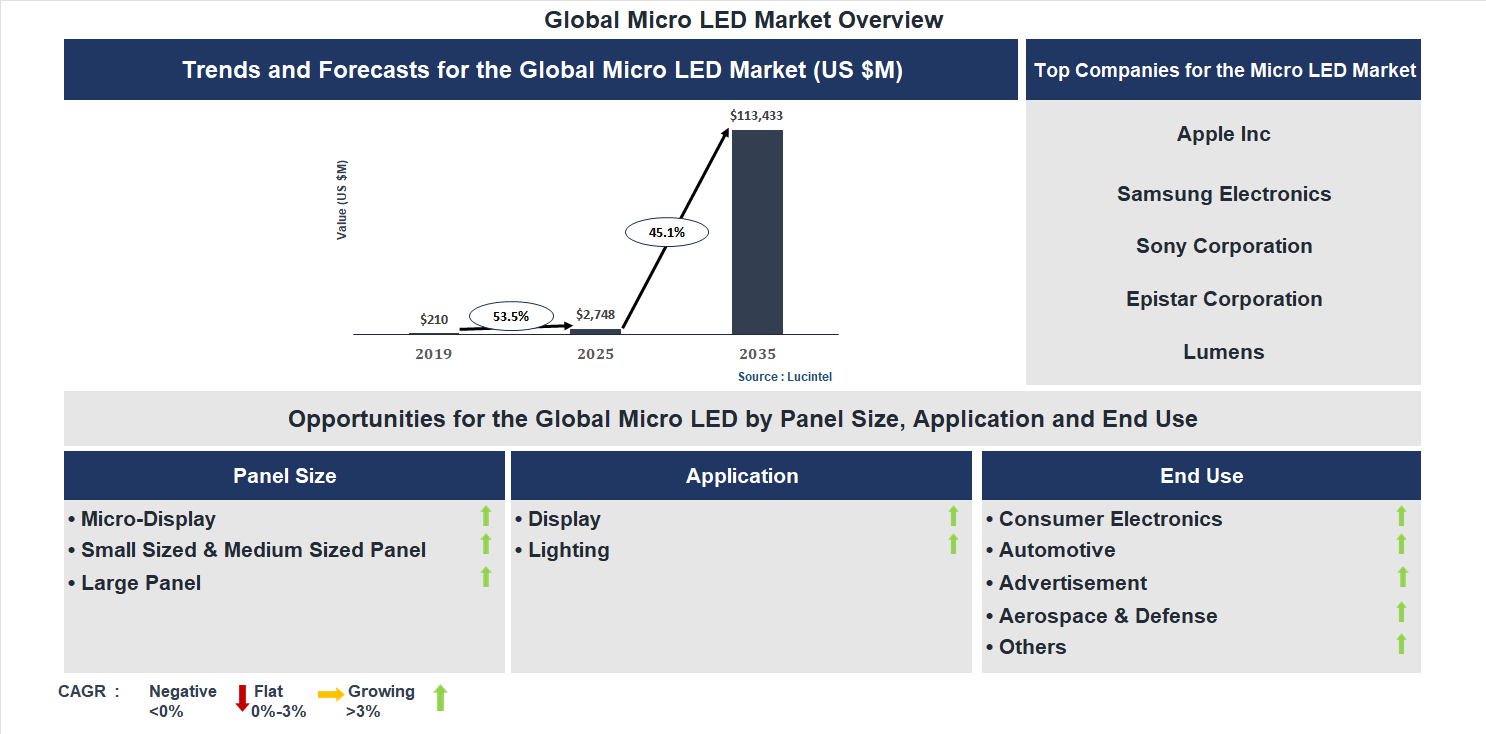
Emerging Trends in the Micro LED Market
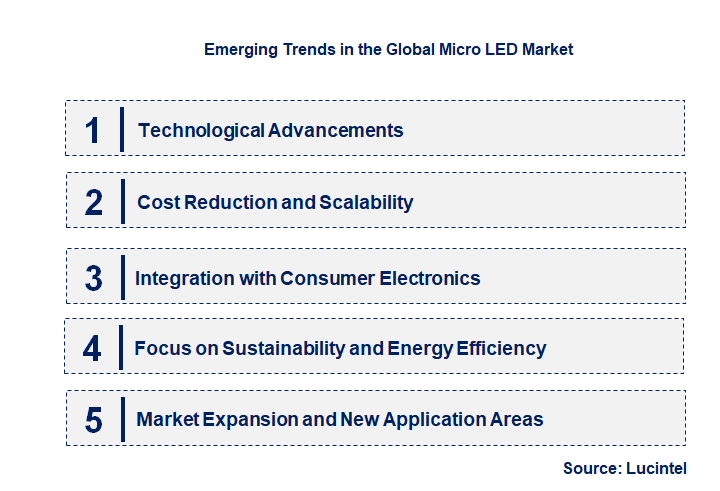
The micro LED market is experiencing rapid growth driven by technological advancements and increasing demand for high-performance display solutions across various industries. As consumer electronics, automotive, and healthcare sectors seek more efficient, brighter, and more durable displays, the market is evolving swiftly. Innovations in manufacturing processes, material science, and integration techniques are fueling this expansion. Additionally, the push for sustainability and energy efficiency is encouraging the adoption of Micro LED technology over traditional display options. These developments are not only transforming product offerings but also redefining industry standards, creating new opportunities and challenges for manufacturers, developers, and consumers alike.• Technological Advancements: The development of more efficient manufacturing techniques, such as transfer and assembly processes, is reducing costs and improving yield rates. Innovations in micro-scale materials and pixel design are enhancing display brightness, contrast, and color accuracy. These improvements are making Micro LED displays more viable for mainstream applications, including large-scale signage and consumer electronics. As technology matures, the market is expected to see increased adoption driven by better performance and affordability, ultimately expanding the reach of Micro LED displays across various sectors.
• Cost Reduction and Scalability: As manufacturing processes become more refined, costs associated with producing Micro LED displays are decreasing. Techniques like mass transfer and automation are enabling higher scalability, making it feasible to produce larger displays at competitive prices. This trend is crucial for penetrating markets such as televisions, smartphones, and wearable devices, where cost sensitivity is high. Lower costs will accelerate adoption, allowing Micro LED technology to compete more effectively with OLED and LCD displays, and fostering broader market penetration.
• Integration with Consumer Electronics: The integration of Micro LED displays into smartphones, tablets, and wearable devices is gaining momentum. These displays offer superior brightness, energy efficiency, and durability, which are highly desirable for portable electronics. Manufacturers are focusing on developing flexible and transparent Micro LED panels to enable innovative form factors and designs. This trend is transforming consumer electronics by providing more immersive and vibrant visual experiences, thereby driving demand and encouraging further innovation in device form factors and functionalities.
• Focus on Sustainability and Energy Efficiency: Micro LED technology is inherently more energy-efficient than traditional display options, leading to lower power consumption and longer device battery life. As environmental concerns grow, manufacturers are emphasizing sustainable production methods and eco-friendly materials. The market is witnessing a shift towards greener displays, which appeal to environmentally conscious consumers and regulatory bodies. This focus on sustainability is not only reducing the environmental footprint but also adding value to Micro LED products, making them more attractive in a competitive landscape.
• Market Expansion and New Application Areas: The versatility of Micro LED displays is opening up new markets beyond consumer electronics, including automotive, healthcare, and industrial sectors. In automotive, Micro LEDs are used for heads-up displays and dashboards due to their brightness and durability. In healthcare, they enable high-resolution, compact displays for medical imaging. Industrial applications benefit from rugged, high-performance screens suitable for harsh environments. This diversification is expanding the market scope, creating new revenue streams, and encouraging cross-industry collaborations, which are vital for sustained growth.
These emerging trends are collectively reshaping the micro LED market by making displays more affordable, efficient, and versatile. Technological innovations, cost reductions, and expanding application areas are driving widespread adoption. As sustainability becomes a priority, the market is aligning with eco-friendly practices. Overall, these developments are positioning Micro LED technology as a key player in the future of high-performance display solutions, transforming industries and consumer experiences alike.
Recent Development in the Micro LED Market
The micro LED market is experiencing rapid advancements driven by technological innovations and increasing demand for high-performance displays. These developments are transforming the industry landscape, offering new opportunities for manufacturers and consumers alike. As the technology matures, key growth areas are emerging, promising to enhance display quality, reduce costs, and expand application scopes. Stakeholders are closely monitoring these trends to capitalize on emerging market potentials and stay competitive in a dynamic environment.• Growth in Consumer Electronics: The integration of Micro LED displays in smartphones, wearables, and TVs is accelerating, driven by demand for superior brightness, contrast, and energy efficiency. This trend is expanding market reach and encouraging manufacturers to develop more affordable, scalable solutions. As consumer preferences shift towards premium display experiences, Micro LED technology is poised to replace traditional LCD and OLED screens, creating significant growth opportunities and reshaping the electronics landscape.
• Advancements in Manufacturing Processes: Innovations such as mass transfer techniques and automation are reducing production costs and improving yield rates. These technological improvements are enabling large-scale manufacturing of Micro LEDs, making the technology more commercially viable. Enhanced manufacturing efficiency is expected to lower prices, increase supply, and facilitate broader adoption across various sectors, including automotive and signage, thereby expanding the market footprint and encouraging new entrants.
• Expansion into Automotive Displays: Micro LED displays are increasingly being adopted in automotive applications due to their durability, high brightness, and excellent visibility under various lighting conditions. This development opens new revenue streams for manufacturers and enhances in-car entertainment and information systems. The automotive sector‘s demand for rugged, high-performance displays is expected to drive significant growth, positioning Micro LED as a key technology in next-generation vehicle interfaces.
• Growing Investment and Strategic Partnerships: Major tech companies and startups are investing heavily in Micro LED research and development, forming strategic alliances to accelerate commercialization. These collaborations are fostering innovation, sharing expertise, and reducing time-to-market for new products. Increased funding and partnerships are vital for overcoming technical challenges, scaling production, and expanding application areas, ultimately fueling market growth and competitive positioning.
• Rising Adoption in Commercial and Architectural Displays: Micro LED technology is gaining traction in large-format signage, retail displays, and architectural installations due to its brightness, longevity, and design flexibility. This trend is opening new markets beyond consumer electronics, offering immersive visual experiences and energy-efficient solutions. The expanding use in commercial spaces is expected to boost demand, diversify revenue streams, and establish Micro LED as a preferred display technology in various professional sectors.
The overall impact of these developments is significantly transforming the micro LED market by enhancing product capabilities, reducing costs, and broadening application scopes. These trends are fostering innovation, attracting investments, and accelerating commercialization, which collectively are driving robust market growth and establishing Micro LED as a dominant display technology across multiple industries.
Strategic Growth Opportunities in the Micro LED Market
The micro LED market is poised for significant expansion driven by technological advancements, increasing demand for high-resolution displays, and the need for energy-efficient solutions across various industries. As consumer electronics, automotive, and healthcare sectors seek innovative display technologies, opportunities for growth are emerging rapidly. Companies investing in research and development, strategic partnerships, and manufacturing scalability will shape the competitive landscape. This dynamic environment offers numerous avenues for market players to capitalize on emerging applications and evolving consumer preferences, ultimately fueling the market’s overall growth trajectory.• Growing Adoption of Micro LED in Consumer Electronics: Micro LED technology offers superior brightness, contrast, and energy efficiency, making it ideal for smartphones, tablets, and TVs. As consumers demand higher quality displays with lower power consumption, manufacturers are integrating Micro LED into premium devices. The technology’s scalability and durability further enhance its appeal, encouraging brands to replace traditional OLED and LCD screens. This trend is expected to accelerate, expanding the market and driving innovation in display manufacturing.
• Expansion of Micro LED Applications in Automotive Displays: The automotive industry is increasingly adopting Micro LED for dashboards, head-up displays, and infotainment systems due to its high brightness, fast response time, and durability under harsh conditions. As vehicles become more connected and autonomous, the demand for advanced, reliable displays grows. Micro LED’s ability to deliver vibrant visuals in various lighting environments makes it a preferred choice, opening new revenue streams for manufacturers and fostering industry-wide technological advancements.
• Rising Use of Micro LED in Healthcare Imaging and Wearables: Micro LED’s high resolution, low power consumption, and biocompatibility make it suitable for medical imaging devices, portable diagnostics, and wearable health monitors. The technology enables clearer visuals and real-time data display, improving diagnostic accuracy and patient monitoring. As healthcare providers seek innovative solutions for remote and personalized care, Micro LED’s integration into medical devices is expected to increase, creating significant growth opportunities in the healthcare sector.
• Increasing Investments in Micro LED Manufacturing Infrastructure: To meet rising demand, companies are investing heavily in establishing dedicated Micro LED fabrication facilities. Advances in mass transfer techniques and chip production are critical for scalability and cost reduction. Strategic partnerships and government initiatives are also supporting manufacturing expansion. These investments will enhance supply chain capabilities, reduce production costs, and accelerate commercialization, thereby strengthening the overall market position and enabling broader adoption across various applications.
• Development of Flexible and Transparent Micro LED Displays: The demand for flexible, foldable, and transparent displays is driving innovation in Micro LED technology. These displays are ideal for wearable devices, augmented reality, and smart windows, offering high resolution and durability. Advances in substrate materials and transfer processes are enabling the production of such innovative displays. As consumer and industrial markets seek versatile display solutions, the development of flexible and transparent Micro LED displays will open new application avenues and stimulate market growth.
The overall impact of these opportunities is set to significantly accelerate the micro LED market’s growth, fostering innovation, expanding application areas, and enhancing competitive dynamics. Companies that strategically leverage these opportunities will be well-positioned to lead in this rapidly evolving landscape, ultimately transforming display technology across multiple industries.
Micro LED Market Driver and Challenges
The micro LED market is influenced by a variety of technological, economic, and regulatory factors that shape its growth trajectory. Rapid advancements in display technology, increasing consumer demand for high-quality visual experiences, and the push for energy-efficient solutions are key drivers. Additionally, regulatory standards related to sustainability and product safety impact market dynamics. Economic factors such as rising disposable incomes and the decreasing cost of manufacturing components further propel market expansion. However, the market also faces challenges including high production costs, technological complexities, and regulatory hurdles that could impede growth. Understanding these drivers and challenges is essential for stakeholders to navigate the evolving landscape effectively.The factors responsible for driving the micro LED market include:
• Technological Innovation: The continuous development of Micro LED technology enhances display quality, offering superior brightness, contrast, and energy efficiency. Innovations in manufacturing processes, such as transfer and assembly techniques, are reducing costs and improving scalability. These advancements enable the production of flexible, transparent, and high-resolution displays, attracting consumer electronics, automotive, and advertising sectors. As technology matures, it opens new application avenues, fostering market growth and encouraging investments from key players seeking competitive advantages.
• Rising Consumer Demand for Premium Displays: Consumers increasingly seek high-definition, immersive visual experiences in devices like smartphones, TVs, and wearables. Micro LED displays meet these demands by providing vibrant colors, high contrast ratios, and energy efficiency. The growing adoption of 8K and 4K resolutions further fuels demand for Micro LED screens in premium products. This trend is driven by a desire for enhanced entertainment, gaming, and professional applications, prompting manufacturers to incorporate Micro LED technology to differentiate their offerings and capture market share.
• Economic Growth and Disposable Income: As economies expand, consumers and businesses have higher disposable incomes, enabling increased spending on advanced electronic devices. This economic upliftment boosts demand for premium display solutions, including Micro LED panels. Moreover, increased investment in smart city projects, digital signage, and automotive displays contributes to market expansion. The economic environment also encourages research and development investments, accelerating technological breakthroughs and reducing costs over time, thus making Micro LED displays more accessible.
• Strategic Collaborations and Investments: Major industry players are forming strategic alliances, joint ventures, and investing heavily in Micro LED technology development. These collaborations facilitate knowledge sharing, reduce R&D costs, and accelerate commercialization. For instance, partnerships between display manufacturers and material suppliers are improving production efficiency and quality. Such investments also attract venture capital funding, fostering innovation and scaling production capabilities, which collectively drive market growth and help overcome technological barriers.
• Regulatory and Sustainability Initiatives: Governments and regulatory bodies are implementing standards related to energy efficiency, environmental impact, and product safety. These regulations encourage the adoption of eco-friendly display technologies like Micro LED, which consume less power and use sustainable materials. Compliance with such standards can be a competitive advantage, prompting manufacturers to innovate accordingly. Additionally, policies promoting digital infrastructure and smart city initiatives support the deployment of Micro LED displays in public spaces, further expanding market opportunities.
The challenges facing the micro LED market include:
• High Production Costs: Manufacturing Micro LED displays involves complex processes such as precise chip transfer, assembly, and encapsulation, which are currently expensive and time-consuming. The need for high-precision equipment and materials increases overall costs, making products less affordable and limiting mass-market adoption. Overcoming these cost barriers requires technological breakthroughs and economies of scale, which are still in development stages, thus hindering rapid market penetration.
• Technological Complexities: The fabrication of Micro LED displays involves intricate processes like precise placement of millions of tiny LEDs onto substrates. Achieving uniformity, reliability, and scalability remains challenging. Issues such as pixel defects, brightness uniformity, and longevity need to be addressed to meet industry standards. These technological hurdles slow down commercialization and increase R&D expenses, posing significant barriers for new entrants and existing players aiming for widespread adoption.
• Regulatory and Standardization Challenges: The lack of unified standards for Micro LED technology creates uncertainty in the market. Regulatory frameworks related to safety, environmental impact, and intellectual property rights are still evolving, which can delay product launches and increase compliance costs. Additionally, differing regional regulations may complicate global deployment strategies. Navigating these regulatory landscapes requires significant resources and expertise, potentially slowing down innovation and market expansion.
The micro LED market is driven by technological advancements, rising consumer demand, economic growth, strategic collaborations, and regulatory support. However, high production costs, technological complexities, and regulatory uncertainties pose substantial challenges. These factors collectively influence the pace and scope of market growth. While opportunities for innovation and expansion are significant, addressing the challenges is crucial for sustainable development. The market‘s future will depend on how effectively stakeholders can leverage drivers while mitigating obstacles, ultimately shaping a competitive and innovative display technology landscape.
List of Micro LED Companies
Companies in the market compete on the basis of product quality offered. Major players in this market focus on expanding their manufacturing facilities, R&D investments, infrastructural development, and leverage integration opportunities across the value chain. With these strategies micro LED companies cater increasing demand, ensure competitive effectiveness, develop innovative products & technologies, reduce production costs, and expand their customer base. Some of the micro LED companies profiled in this report include-• Apple Inc
• Samsung Electronics
• Sony Corporation
• Epistar Corporation
• Lumens
• Plessy Semiconductor
• X-Celeprint
• PlayNitride
• VerLASE Technologies LLC
• Plessey Semiconductor Ltd..
Micro LED Market by Segment
The study includes a forecast for the global micro LED market by panel size, application, end use, and region.Micro LED Market by Panel Size [Value from 2019 to 2035]:
• Micro-Display
• Small Sized & Medium Sized Panel
• Large Panel
Micro LED Market by Application [Value from 2019 to 2035]:
• Display
• Lighting
Micro LED Market by End Use [Value from 2019 to 2035]:
• Consumer Electronics
• Automotive
• Advertisement
• Aerospace & Defense
• Others
Micro LED Market by Region [Value from 2019 to 2035]:
• North America
• Europe
• Asia Pacific
• The Rest of the World
Country Wise Outlook for the Micro LED Market
The micro LED market has experienced rapid growth driven by technological advancements, increasing demand for high-quality displays, and expanding applications across various industries. As companies innovate and invest heavily in research and development, the landscape is shifting significantly in key regions. The United States, China, Germany, India, and Japan are at the forefront of this evolution, each contributing unique developments that shape the global trajectory of Micro LED technology. These countries are leveraging their technological strengths and market dynamics to push the boundaries of display performance, manufacturing processes, and commercial adoption.• United States: The US has seen significant investments from tech giants like Apple and Google, focusing on integrating Micro LED into consumer electronics and wearable devices. Leading research institutions are pioneering new fabrication techniques, reducing costs, and improving efficiency. The US market is also witnessing increased collaborations between startups and established firms to accelerate commercialization and scale production capabilities.
• China: China is rapidly advancing in Micro LED manufacturing, with major companies such as BOE and TCL investing heavily in R&D. The country is focusing on developing large-scale production facilities and improving yield rates. Government support and strategic initiatives are fostering innovation, making China a key player in the global supply chain and pushing for mass-market adoption of Micro LED displays.
• Germany: Germany‘s strength in precision engineering and manufacturing is translating into high-quality Micro LED components and display systems. Several research institutes and companies are working on enhancing the durability and brightness of Micro LED displays. Germany is also exploring applications in automotive and industrial sectors, emphasizing reliability and performance standards.
• India: India is emerging as a significant market for Micro LED technology, driven by increasing consumer demand for premium display solutions. The country is witnessing growing investments in R&D and manufacturing capabilities, supported by government initiatives promoting electronics manufacturing. Local startups are exploring innovative applications, including smart signage and consumer electronics.
• Japan: Japan continues to lead in display technology innovation, with companies like Sony and Sharp investing in Micro LED research. The focus is on improving pixel density, color accuracy, and energy efficiency. Japan is also exploring niche applications such as augmented reality and high-end consumer displays, leveraging its expertise in semiconductor and display manufacturing to stay at the forefront of Micro LED development.

Features of the Global Micro LED Market
Market Size Estimates: Micro LED market size estimation in terms of value ($M).Trend and Forecast Analysis: Market trends (2019 to 2025) and forecast (2026 to 2035) by various segments and regions.
Segmentation Analysis: Micro LED market size by panel size, application, end use, and region in terms of value ($M).
Regional Analysis: Micro LED market breakdown by North America, Europe, Asia Pacific, and Rest of the World.
Growth Opportunities: Analysis of growth opportunities in different panel size, application, end use, and regions for the micro LED market.
Strategic Analysis: This includes M&A, new product development, and competitive landscape of the micro LED market.
Analysis of competitive intensity of the industry based on Porter’s Five Forces model.

FAQ
Q1. What is the micro LED market size?Answer: The global micro LED market is expected to reach an estimated $113433 million by 2035.
Q2. What is the growth forecast for micro LED market?
Answer: The global micro LED market is expected to grow with a CAGR of 45.1% from 2026 to 2035.
Q3. What are the major drivers influencing the growth of the micro LED market?
Answer: The major drivers for this market are the rising adoption in smartphones & wearable devices, the growing demand for thinner & flexible displays, and the increasing demand for energy-efficient display solutions.
Q4. What are the major segments for micro LED market?
Answer: The future of the micro LED market looks promising with opportunities in the consumer electronic, automotive, advertisement, and aerospace & defense markets.
Q5. Who are the key micro LED market companies?
Answer: Some of the key micro LED companies are as follows:
• Apple Inc
• Samsung Electronics
• Sony Corporation
• Epistar Corporation
• Lumens
• Plessy Semiconductor
• X-Celeprint
• PlayNitride
• VerLASE Technologies LLC
• Plessey Semiconductor Ltd..
Q6. Which micro LED market segment will be the largest in future?Answer: Lucintel forecasts that, within the panel size category, large panel is expected to witness the highest growth over the forecast period.
Q7. In micro LED market, which region is expected to be the largest in next 8 years?
Answer: In terms of region, APAC is expected to witness the highest growth over the forecast period.
Q8. Do we receive customization in this report?
Answer: Yes, Lucintel provides 10% customization without any additional cost.
Table of Contents
List of Figures
List of Tables
Methodology
- In-depth interviews of the major players in this market
- Detailed secondary research from competitors’ financial statements and published data
- Extensive searches of published works, market, and database information pertaining to industry news, company press releases, and customer intentions
- A compilation of the experiences, judgments, and insights of Lucintel’s professionals, who have analyzed and tracked this market over the years.


Buy Now
Choose a license that fits your team. Instant PDF delivery.
Prices exclude taxes. Instant delivery. Custom licensing available on request.
Key Questions
- • What are some of the most promising, high-growth opportunities for the micro LED market by panel size (micro-display, small sized & medium sized panel, and large panel), application (display and lighting), end use (consumer electronics, automotive, advertisement, aerospace & defense, and others), and region (North America, Europe, Asia Pacific, and the Rest of the World)?
- • Which segments will grow at a faster pace and why?
- • Which region will grow at a faster pace and why?
- • What are the key factors affecting market dynamics? What are the key challenges and business risks in this market?
- • What are the business risks and competitive threats in this market?
- • What are the emerging trends in this market and the reasons behind them?
- • What are some of the changing demands of customers in the market?
- • What are the new developments in the market? Which companies are leading these developments?
- • Who are the major players in this market? What strategic initiatives are key players pursuing for business growth?
- • What are some of the competing products in this market and how big of a threat do they pose for loss of market share by material or product substitution?
- • What M&A activity has occurred in the last 7 years and what has its impact been on the industry? For any questions related to Micro LED Market, Micro LED Market Size, Micro LED Market Growth, Micro LED Market Analysis, Micro LED Market Report, Micro LED Market Share, Micro LED Market Trends, Micro LED Market Forecast, Micro LED Companies, write Lucintel analyst at email: helpdesk@lucintel.com. We will be glad to get back to you soon.


