
Market Report · July 17, 2026

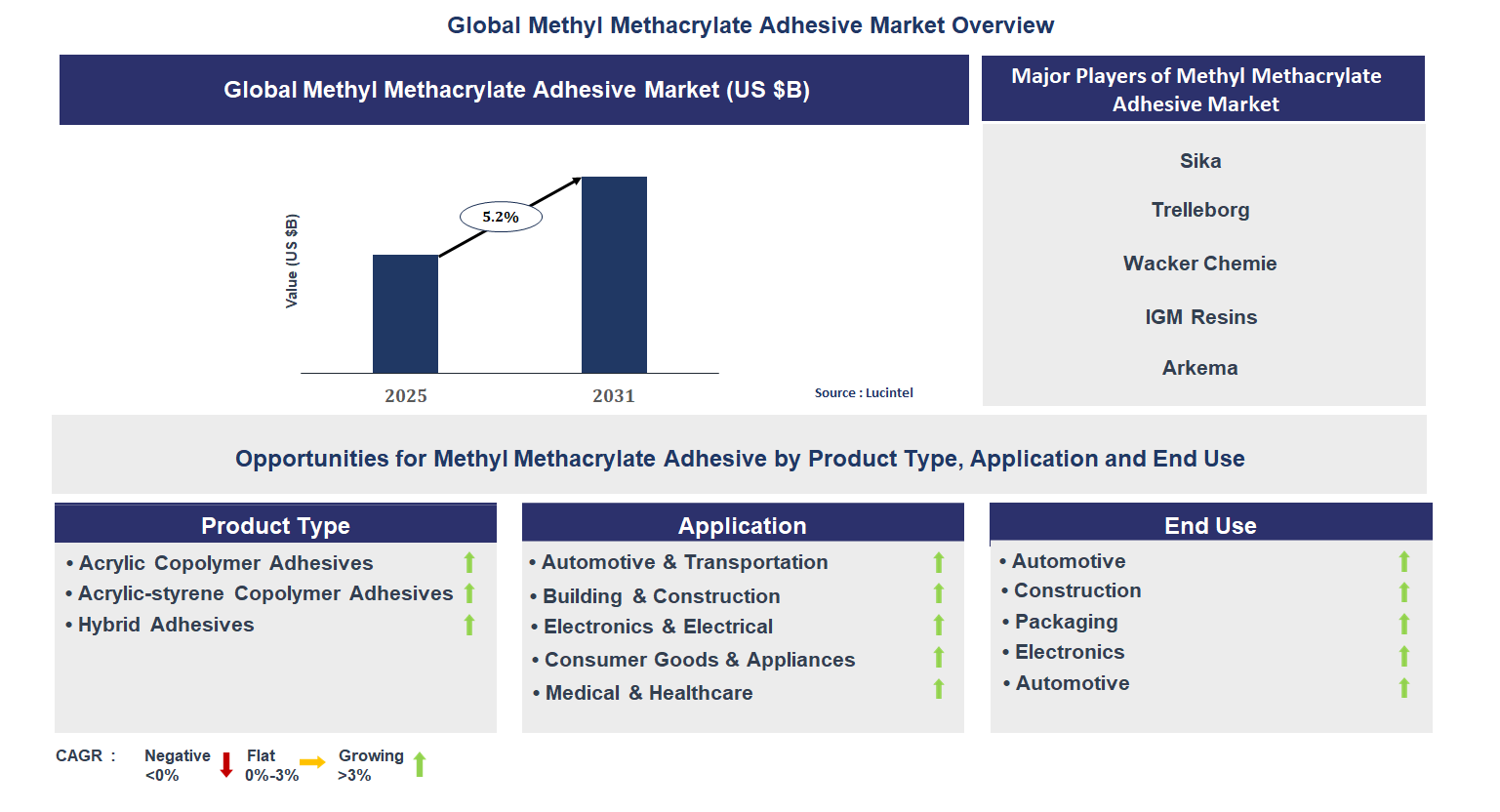
Key data points: The growth forecast = 5.2% annually for the next 7 years. Scroll below to get more insights. This market report covers trends, opportunities and forecasts in methyl methacrylate adhesive market to 2031 by product type (acrylic copolymer adhesives, acrylic-styrene copolymer adhesives, and hybrid adhesives), application (automotive & transportation, building & construction, electronics & electrical, consumer goods & appliances, and medical & healthcare), end use (automotive, construction, packaging, electronics, and automotive), and region (North America, Europe, Asia Pacific, and the Rest of the World)
We'll send your sample report shortly.
• Lucintel forecasts that, within the product type category, acrylic copolymer adhesive is expected to witness higher growth over the forecast period.
• Within the end use category, automotive is expected to witness the highest growth.
• In terms of region, APAC is expected to witness the highest growth over the forecast period. Gain valuable insights for your business decisions with our comprehensive 150+ page report. Sample figures with some insights are shown below.
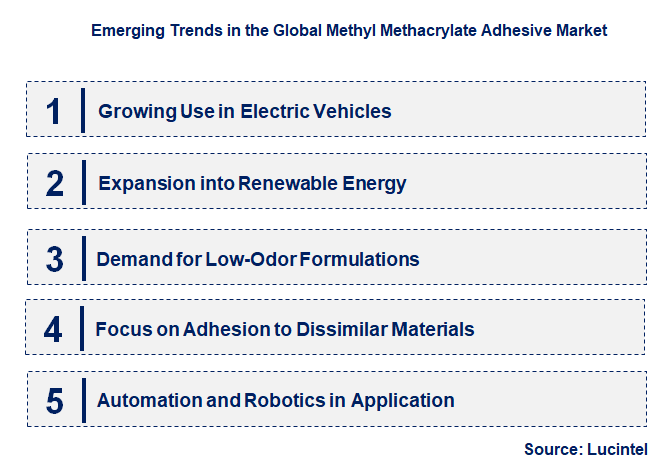
• Growing Use in Electric Vehicles: A key trend is the increasing adoption of MMA adhesives in the manufacturing of electric vehicles (EVs). These adhesives are crucial for bonding lightweight composite and plastic materials to reduce vehicle weight, which in turn improves battery efficiency and range. This trend is a direct response to the global shift toward cleaner, more efficient transportation.
• Expansion into Renewable Energy: The market is seeing a major trend toward using MMA adhesives in the renewable energy sector, particularly for wind turbine blade assembly. The adhesives are used to bond large composite components, providing a strong, durable, and weather-resistant bond. This trend is driven by the global push for clean energy and the rapid growth of the wind energy sector.
• Demand for Low-Odor Formulations: There is a clear trend toward the development of low-odor and low-VOC (volatile organic compounds) MMA adhesive formulations. This is a response to increasing health and safety regulations in the workplace. Manufacturers are innovating to reduce the strong odor associated with traditional MMA adhesives, making them more user-friendly and appealing for a wider range of applications.
• Focus on Adhesion to Dissimilar Materials: The market is trending toward developing specialized MMA adhesives that can effectively bond dissimilar materials, such as metals to plastics and composites. This is driven by the need for lightweighting in industries like automotive and aerospace, where multi-material designs are becoming the norm to improve fuel efficiency and performance.
• Automation and Robotics in Application: A significant emerging trend is the integration of automation and robotics in the application of MMA adhesives. The fast-curing nature of these adhesives makes them ideal for automated assembly lines, where speed and precision are critical. This trend is driven by a need to improve manufacturing efficiency and consistency, particularly in high-volume production environments. These trends are reshaping the methyl methacrylate adhesive market by fostering innovation and pushing the industry toward a more sustainable and high-performance future. By developing more effective, environmentally friendly, and application-specific products, manufacturers are ensuring that MMA adhesives remain an indispensable component in a wide range of industries.
• Increased Production Capacity: A key development is the expansion of manufacturing capabilities by major players, particularly in the Asia-Pacific region. New production facilities are being commissioned to meet the surging demand for MMA adhesives from the automotive and construction sectors, helping to ensure a stable supply and manage global price volatility.
• Launch of New Formulations: There have been notable developments in the launch of new, specialized MMA adhesive formulations. These new products are designed to meet the specific needs of end-use industries, such as high-performance grades for electric vehicle assembly or fast-curing options for general manufacturing, creating new, high-value market segments.
• Strategic Mergers and Acquisitions: The market is witnessing strategic mergers and acquisitions as companies aim to consolidate market share and expand their global footprint. These moves are helping businesses to integrate their supply chains, leverage economies of scale, and gain access to new technologies and end-use markets.
• Focus on Sustainable Practices: A significant development is the increasing focus on sustainable production and product offerings. Manufacturers are investing in technologies that reduce energy consumption and are exploring the use of bio-based feedstocks to create adhesives with a lower carbon footprint, responding to corporate sustainability goals.
• Innovation in Logistics and Delivery: There is a notable development in the adoption of advanced logistics and delivery solutions. Companies are improving their supply chain management to ensure the safe and timely delivery of MMA adhesives, which are often sensitive to temperature and have a limited shelf life, which is crucial for maintaining customer relationships. These developments are collectively impacting the methyl methacrylate adhesive market by creating a more competitive, efficient, and technologically advanced industry. They are enabling manufacturers to meet the complex demands of modern applications and are positioning the market for continued growth and innovation in the future.
• Automotive and Transportation: The automotive and transportation sector presents a major growth opportunity. MMA adhesives are essential for bonding lightweight materials like plastics and composites, which are increasingly used in vehicles to improve fuel efficiency and performance. The growth of electric vehicles is a key driver for this application.
• Renewable Energy and Wind Turbines: The renewable energy market offers a significant growth opportunity. MMA adhesives are used for the structural bonding of composite blades in wind turbines, which require a strong, durable, and weather-resistant bond. This application is driven by the rapid growth of wind energy projects globally.
• Building and Construction: The building and construction market provides a robust growth opportunity. MMA adhesives are used in modular construction, roofing, and flooring applications due to their fast curing time and high bond strength. The increasing trend toward off-site and prefabricated construction is a key driver for this application.
• Medical and Healthcare: The medical and healthcare sector is a niche but high-value growth area. MMA adhesives are used in a variety of medical devices and in orthopedic applications, such as bone cement. This application is driven by the aging population and increasing demand for specialized medical materials.
• General Industrial Assembly: The general industrial assembly market is a key growth area. MMA adhesives are used to bond a wide range of substrates in manufacturing processes. Their ability to bond a variety of materials and their rapid curing time make them ideal for improving efficiency in industrial assembly lines. These opportunities are impacting the methyl methacrylate adhesive market by diversifying its application base and fostering a shift toward high-value, specialized products. By capitalizing on these high-growth sectors, manufacturers can secure a more profitable and sustainable future for the market.
• Sika
• Trelleborg
• Wacker Chemie
• IGM Resins
• Arkema
• Zeus Industrial Products
• WEICON
• Huntsman Corporation
• JSR Corporation
• Permabond
• Acrylic Copolymer Adhesives
• Acrylic-styrene Copolymer Adhesives
• Hybrid Adhesives
• Automotive & Transportation
• Building & Construction
• Electronics & Electrical
• Consumer Goods & Appliances
• Medical & Healthcare
• Automotive
• Construction
• Packaging
• Electronics
• Automotive
• North America
• Europe
• Asia Pacific
• The Rest of the World
• United States: The U.S. market is a leading consumer, propelled by its robust automotive, aerospace, and construction industries. There is a strong demand for MMA adhesives to bond lightweight materials in electric vehicles and aircraft. Recent developments include increased R&D focused on creating low-odor and fast-curing formulations to enhance workplace safety and productivity.
• China: Chinas market is a major growth engine, fueled by its booming manufacturing, construction, and electronics sectors. The country is both a key producer and consumer, with a rising demand for MMA adhesives in vehicle assembly and infrastructure projects. Recent developments are centered on expanding domestic production capacity and a growing focus on meeting international quality and environmental standards.
• Germany: Germanys market is a European leader, known for its high-quality automotive and engineering industries. The demand for MMA adhesives is stable, with a strong focus on their use in high-end structural bonding applications. German companies are at the forefront of developing specialized, high-performance formulations for joining dissimilar materials in advanced manufacturing.
• India: Indias MMA adhesive market is a high-growth region, driven by the rapid expansion of its automotive, construction, and wind energy sectors. There is a rising demand for MMA adhesives to bond composite materials and reduce vehicle weight. Recent developments include increased domestic production and strategic partnerships to improve the supply chain and meet rising demand.
• Japan: Japans market is mature and technology-driven, with a focus on high-purity and specialized MMA adhesives. The demand is steady, particularly in the automotive and electronics sectors. Japanese companies are innovating to create new, high-performance adhesive derivatives that offer unique properties, such as enhanced heat resistance for electronics applications.


• Sika
• Trelleborg
• Wacker Chemie
• IGM Resins
• Arkema
• Zeus Industrial Products
• WEICON
• Huntsman Corporation
• JSR Corporation
• Permabond Q5. Which methyl methacrylate adhesive market segment will be the largest in future? Answer: Lucintel forecasts that, within the product type category, acrylic copolymer adhesive is expected to witness higher growth over the forecast period. Q6. In methyl methacrylate adhesive market, which region is expected to be the largest in next 5 years? Answer: In terms of region, APAC is expected to witness the highest growth over the forecast period. Q7. Do we receive customization in this report? Answer: Yes, Lucintel provides 10% customization without any additional cost.


Choose a license that fits your team. Instant PDF delivery.
Prices exclude taxes. Instant delivery. Custom licensing available on request.
Market Report · July 17, 2026
Market Report · July 17, 2026
Market Report · May 18, 2026
Trusted partner for strategic intelligence and business growth


Receive a complimentary market analysis tailored to your industry. Our analysts will identify key growth opportunities and competitive dynamics specific to your business.

Market size, growth rate, and key trend analysis for your specific sector.

Top competitor positioning and market share analysis.

Strategic recommendations backed by data-driven insights.
Get curated market intelligence and competitive moves straight to your inbox.
By subscribing, you agree to receive our monthly insights. Unsubscribe anytime.
Receive a complimentary market analysis tailored to your industry. Our analysts will identify key growth opportunities and competitive dynamics specific to your business.
Market size, growth rate, and key trend analysis for your specific sector.
Top competitor positioning and market share analysis.
Strategic recommendations backed by data-driven insights.
Get curated market intelligence, emerging trends, and competitive moves straight to your inbox each month.
By subscribing, you agree to receive our monthly insights. Unsubscribe anytime.
We'll send your sample report shortly.