
Report Feature
Metaverse Communication Network Market Trends and Forecast
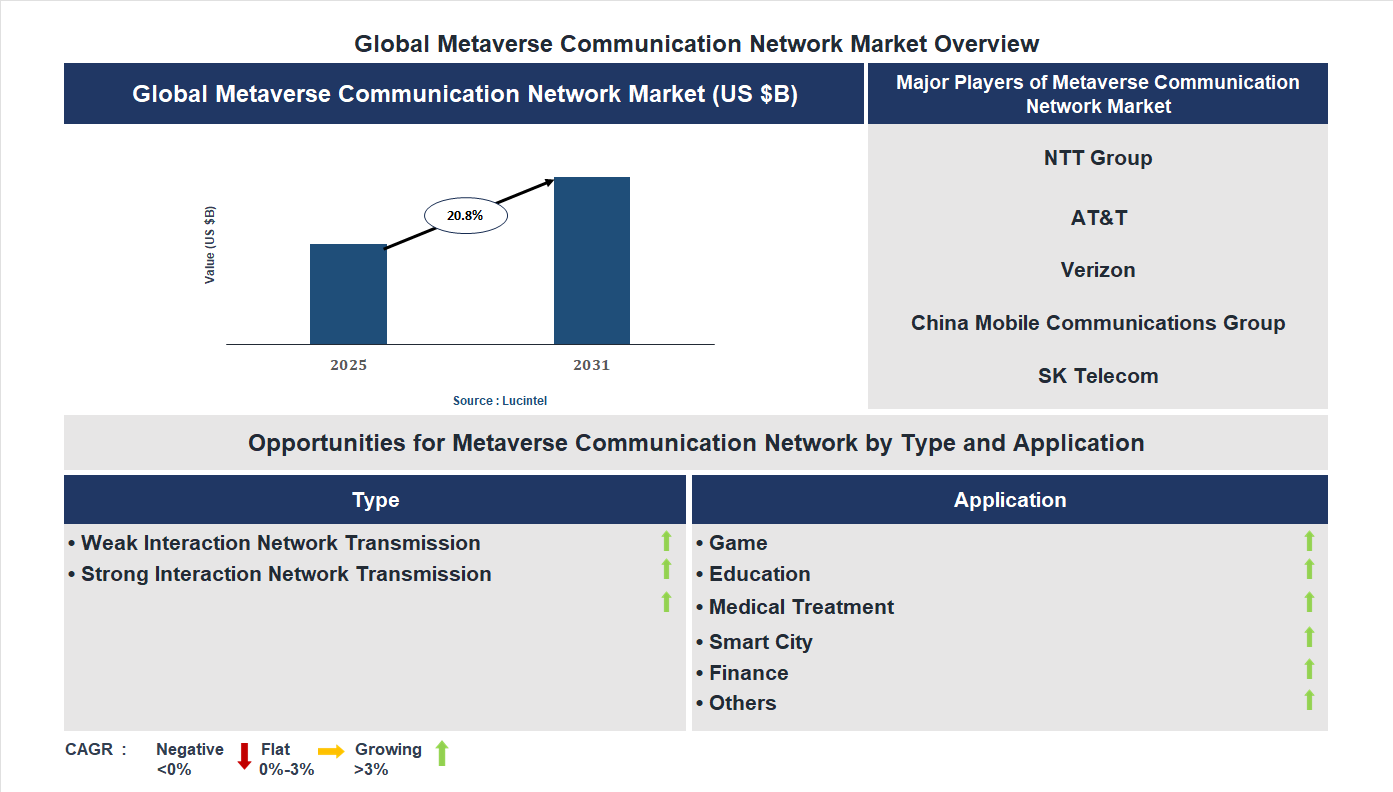
The future of the global metaverse communication network market looks promising with opportunities in the game, education, medical treatment, smart city, and finance markets. The global metaverse communication network market is expected to grow with a CAGR of 20.8% from 2025 to 2031. The major drivers for this market are the increasing need for ultra-low latency connectivity, the rising adoption of immersive digital environments, and the growing demand for high-bandwidth communication systems.• Lucintel forecasts that, within the type category, strong interaction network transmission is expected to witness higher growth over the forecast period.
• Within the application category, game is expected to witness the highest growth.
• In terms of region, APAC is expected to witness the highest growth over the forecast period. Gain valuable insights for your business decisions with our comprehensive 150+ page report. Sample figures with some insights are shown below.
Emerging Trends in the Metaverse Communication Network Market
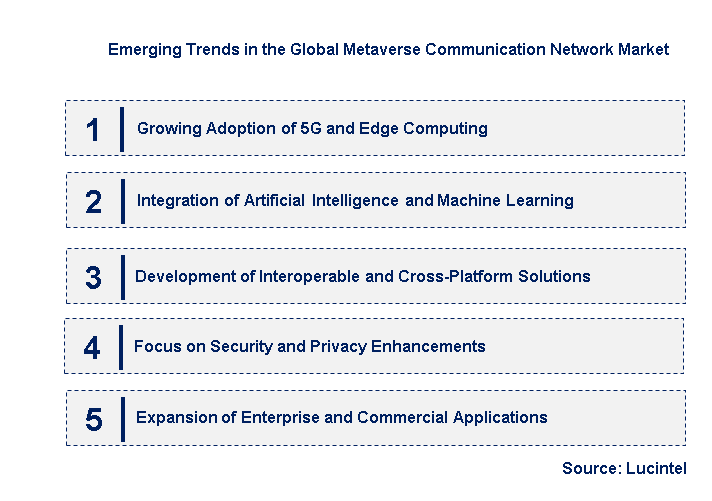
The metaverse communication network market is experiencing rapid evolution driven by technological advancements, increasing user engagement, and the integration of immersive experiences. As digital interactions become more sophisticated, the demand for seamless, high-speed, and secure communication within virtual environments is surging. This market is characterized by innovative infrastructure, enhanced user experiences, and expanding applications across industries such as gaming, education, and enterprise solutions. These developments are not only transforming how users connect and communicate but also redefining the boundaries of digital interaction, creating new opportunities and challenges for stakeholders involved in the metaverse ecosystem.• Growing Adoption of 5G and Edge Computing: The deployment of 5G networks and edge computing is significantly enhancing the connectivity and latency of metaverse communication networks. These technologies enable real-time data transfer and low-latency interactions, which are crucial for immersive experiences. As a result, users experience smoother interactions, and developers can create more complex and responsive virtual environments. This trend is expected to accelerate the adoption of metaverse platforms, making them more accessible and reliable for a broader audience, thereby expanding market reach and user engagement.
• Integration of Artificial Intelligence and Machine Learning: AI and ML are increasingly integrated into metaverse communication networks to personalize user experiences, automate moderation, and enhance security. AI-driven chatbots, virtual assistants, and content moderation tools improve user interaction quality and safety. Additionally, machine learning algorithms optimize network performance by predicting traffic patterns and managing bandwidth efficiently. This integration leads to more intelligent, adaptive, and secure communication environments, fostering user trust and satisfaction, and enabling scalable growth of metaverse applications across various sectors.
• Development of Interoperable and Cross-Platform Solutions: The demand for interoperability among different metaverse platforms is rising, prompting the development of cross-platform communication solutions. These solutions allow users to seamlessly transition between virtual environments without losing data or connectivity. This trend promotes a unified metaverse experience, encouraging user retention and expanding the ecosystem. It also facilitates collaboration across platforms, industries, and geographies, thereby broadening market opportunities and fostering innovation in virtual communication technologies.
• Focus on Security and Privacy Enhancements: As metaverse communication networks handle sensitive user data and facilitate real-time interactions, security and privacy are paramount. Emerging trends include the implementation of advanced encryption, blockchain-based identity verification, and decentralized data management systems. These measures aim to protect user information, prevent cyber threats, and ensure compliance with data regulations. Strengthening security and privacy not only builds user trust but also encourages wider adoption of metaverse platforms, making them safer and more reliable for personal, social, and commercial activities.
• Expansion of Enterprise and Commercial Applications: Businesses are increasingly leveraging metaverse communication networks for remote collaboration, virtual events, training, and customer engagement. This trend is driven by the need for immersive, interactive, and cost-effective solutions that transcend geographical barriers. As enterprises adopt these technologies, the market is witnessing the development of specialized communication tools tailored for corporate use. This expansion is transforming traditional business models, fostering innovation, and creating new revenue streams, ultimately positioning the metaverse as a vital component of future enterprise communication strategies. In summary, these trends are collectively reshaping the metaverse communication network market by enhancing connectivity, security, interoperability, and application scope. They are driving innovation, expanding user engagement, and enabling new business models, thereby positioning the metaverse as a central platform for digital interaction in the future.
Recent Development in the Metaverse Communication Network Market
The metaverse communication network market is experiencing rapid growth driven by technological advancements, increasing adoption of virtual environments, and the rising demand for immersive digital experiences. As businesses and consumers explore new ways to connect, communicate, and collaborate within virtual spaces, the market is evolving swiftly. Innovations in network infrastructure, hardware, and software are shaping the future landscape, making the metaverse more accessible and efficient. These developments are not only expanding market opportunities but also transforming how users interact in digital environments. The following key developments highlight the current trajectory and future potential of this dynamic market.• Enhanced Network Infrastructure: Upgrades in 5G and fiber optic technologies are providing faster, more reliable connectivity, enabling seamless metaverse experiences. This improvement reduces latency and enhances real-time interactions, making virtual environments more immersive and accessible to a broader audience. The impact is significant, as it supports large-scale virtual events and complex simulations, fostering growth in enterprise and entertainment sectors.
• Integration of AI and Machine Learning: The incorporation of AI-driven tools enhances user interaction, personalization, and content creation within the metaverse. AI algorithms facilitate realistic avatars, intelligent NPCs, and adaptive environments, enriching user engagement. This development boosts user retention and attracts new users, thereby expanding market size and opening avenues for innovative applications across industries.
• Development of Interoperable Platforms: Efforts to create interoperable metaverse platforms allow users to move seamlessly between different virtual worlds and services. This interoperability fosters a unified user experience and encourages cross-platform content sharing. It increases user engagement and retention, driving market growth by enabling a more connected and versatile virtual ecosystem.
• Advancements in Hardware Devices: The launch of advanced VR headsets, haptic gloves, and AR glasses enhances sensory immersion and interaction fidelity. These hardware innovations make virtual environments more realistic and comfortable, encouraging longer and more frequent usage. The impact is a broader consumer base and increased enterprise adoption, fueling overall market expansion.
• Regulatory and Privacy Frameworks: Governments and industry bodies are developing policies to address data security, privacy, and ethical concerns in the metaverse. Clear regulations build user trust and facilitate wider adoption by ensuring safe and secure environments. This development helps stabilize the market, attract investment, and promote sustainable growth. In summary, these developments are collectively transforming the metaverse communication network market by improving connectivity, user experience, interoperability, hardware capabilities, and regulatory clarity. As a result, the market is experiencing accelerated growth, increased adoption across sectors, and a broader scope for innovative applications, positioning it as a key component of the future digital economy.
Strategic Growth Opportunities in the Metaverse Communication Network Market
The metaverse communication network market is experiencing rapid evolution driven by technological advancements and increasing demand for immersive digital experiences. As industries explore new ways to connect, collaborate, and entertain within virtual environments, key growth opportunities are emerging across various applications. These developments are shaping the future landscape of the market, offering innovative solutions that enhance user engagement, security, and scalability. Stakeholders are focusing on leveraging these opportunities to gain competitive advantages and meet the rising expectations of consumers and businesses alike. The following are five key growth opportunities across different applications within this dynamic market.• Virtual Events and Conferences: Expansion of immersive virtual events is revolutionizing how organizations conduct meetings, trade shows, and conferences. These platforms offer enhanced engagement, broader reach, and cost savings, making them attractive for global audiences. As remote work persists, the demand for seamless, interactive virtual gatherings will continue to grow, driving market expansion and technological innovation.
• Gaming and Entertainment: The integration of advanced communication networks in gaming and entertainment is creating more realistic, interactive experiences. High-speed, low-latency networks enable real-time multiplayer interactions and immersive content, attracting a larger user base. This growth boosts revenue streams for developers and content creators, fueling further technological advancements in the metaverse.
• Education and Training: The adoption of metaverse communication networks in education offers immersive learning environments that improve engagement and retention. Virtual classrooms and training modules benefit from real-time interaction, enabling remote learners to participate actively. This opportunity enhances educational accessibility and prepares a skilled workforce for future digital economies.
• Healthcare and Telemedicine: Enhanced communication networks facilitate remote diagnostics, virtual consultations, and collaborative medical procedures within the metaverse. These applications improve patient outcomes, reduce costs, and expand access to healthcare services, especially in underserved regions. The growth in this sector is transforming traditional healthcare delivery models.
• Retail and E-commerce: The metaverse enables virtual shopping experiences that are interactive and personalized. Communication networks support real-time customer interactions, virtual try-ons, and seamless transactions, boosting consumer engagement. This trend is reshaping retail strategies and creating new revenue channels for brands seeking innovative ways to connect with customers. In summary, these growth opportunities are significantly impacting the metaverse communication network market by fostering innovation, expanding application scope, and enhancing user experiences. They are driving market growth, attracting investments, and encouraging the development of advanced communication solutions that cater to diverse industry needs. As these opportunities mature, they will continue to shape the future of digital interaction and connectivity within the metaverse.
Metaverse Communication Network Market Driver and Challenges
The metaverse communication network market is influenced by a variety of technological, economic, and regulatory factors that shape its growth trajectory. Rapid advancements in virtual reality (VR), augmented reality (AR), and 5G connectivity are driving innovation and expanding user engagement. Economic factors such as increasing investments from tech giants and startups are fueling infrastructure development and platform expansion. Regulatory considerations, including data privacy and cybersecurity policies, are also impacting market strategies and compliance requirements. Together, these drivers and challenges create a dynamic environment that determines the pace and direction of market development, requiring stakeholders to adapt swiftly to technological breakthroughs and evolving regulatory landscapes. The factors responsible for driving the Metaverse Communication Network include:• Technological Innovation: The continuous evolution of VR, AR, and 5G technologies enhances user experience and network capabilities. These innovations enable more immersive, seamless, and real-time communication within the metaverse, attracting a broader user base and encouraging content creation. As hardware becomes more affordable and software more sophisticated, adoption accelerates, fostering a robust ecosystem for communication networks. This technological progress also supports scalability and interoperability, which are critical for widespread metaverse deployment, ultimately fueling market growth.
• Increasing Investment and Funding: Major technology companies, venture capitalists, and government agencies are investing heavily in metaverse infrastructure and platforms. These investments facilitate the development of advanced communication networks capable of supporting high data volumes and low latency requirements. Funding also accelerates research and development efforts, leading to innovative solutions that improve network reliability and security. The influx of capital signals strong market confidence, encouraging further participation and expansion, which collectively drive market growth and technological adoption.
• Growing User Adoption and Market Demand: The rising popularity of virtual environments for social interaction, gaming, education, and business activities is expanding the user base. As more consumers and enterprises recognize the benefits of immersive communication, demand for reliable and high-speed metaverse networks increases. This growth incentivizes service providers to enhance network infrastructure, develop new features, and expand coverage. The increasing adoption also stimulates content creation and platform development, creating a positive feedback loop that propels the market forward.
• Regulatory and Policy Developments: Governments and regulatory bodies are establishing frameworks related to data privacy, cybersecurity, and digital rights within the metaverse. These policies influence how companies design and deploy communication networks, ensuring user safety and compliance. While regulatory clarity can foster trust and encourage adoption, overly restrictive policies may hinder innovation and slow market growth. Navigating these evolving regulations is crucial for market participants to sustain growth and avoid legal pitfalls, making regulatory developments a significant driver shaping the industry landscape. The challenges facing this metaverse communication network market include:
• Data Privacy and Security Concerns: As metaverse communication networks handle vast amounts of personal and sensitive data, ensuring privacy and security becomes paramount. Cyber threats, data breaches, and misuse of information can undermine user trust and lead to regulatory penalties. Developing robust security protocols and privacy safeguards requires significant investment and technological innovation. Failure to address these concerns can hamper user adoption, restrict market expansion, and damage brand reputation, making data security a critical challenge for industry stakeholders.
• Infrastructure and Connectivity Limitations: The deployment of high-speed, low-latency networks necessary for immersive metaverse experiences faces infrastructural challenges, especially in rural and underdeveloped regions. Limited broadband access and outdated network infrastructure hinder widespread adoption and create digital divides. Upgrading existing networks involves substantial capital expenditure and logistical complexities. Overcoming these limitations is essential for achieving global reach and ensuring consistent user experiences, but it remains a significant obstacle that could slow market growth.
• Regulatory Uncertainty and Compliance: The evolving legal landscape surrounding digital assets, data governance, and user rights introduces uncertainty for market participants. Ambiguous or rapidly changing regulations can delay product launches, increase compliance costs, and restrict certain functionalities. Companies must navigate complex legal frameworks across different jurisdictions, which can be resource-intensive and risky. Regulatory uncertainty may deter investment and innovation, posing a substantial challenge to the sustainable development of the metaverse communication network market. In summary, the metaverse communication network market is driven by technological advancements, substantial investments, increasing user demand, and evolving regulatory frameworks. However, it faces significant challenges related to data security, infrastructural limitations, and regulatory uncertainties. These factors collectively influence the pace of market growth, requiring stakeholders to innovate continuously and adapt to changing conditions. Successful navigation of these drivers and challenges will determine the market’s future trajectory, impacting its ability to deliver immersive, secure, and accessible virtual communication experiences worldwide.
List of Metaverse Communication Network Companies
Companies in the market compete on the basis of product quality offered. Major players in this market focus on expanding their manufacturing facilities, R&D investments, infrastructural development, and leverage integration opportunities across the value chain. With these strategies metaverse communication network companies cater increasing demand, ensure competitive effectiveness, develop innovative products & technologies, reduce production costs, and expand their customer base. Some of the metaverse communication network companies profiled in this report include-• NTT Group
• AT&T
• Verizon
• China Mobile Communications Group
• SK Telecom
• KDDI
• Orange
• China Telecommunications Corporation
• BT Group
• Telefonica
Metaverse Communication Network Market by Segment
The study includes a forecast for the global metaverse communication network market by type, application, and region.Metaverse Communication Network Market by Type [Value from 2019 to 2031]:
• Weak Interaction Network Transmission
• Strong Interaction Network Transmission
Metaverse Communication Network Market by Application [Value from 2019 to 2031]:
• Game
• Education
• Medical Treatment
• Smart City
• Finance
• Others
Metaverse Communication Network Market by Region [Value from 2019 to 2031]:
• North America
• Europe
• Asia Pacific
• The Rest of the World
Country Wise Outlook for the Metaverse Communication Network Market
The metaverse communication network market is rapidly evolving as digital interactions become more immersive and interconnected. Advances in technology, increased investment, and shifting consumer preferences are driving growth across major economies. Countries are focusing on developing infrastructure, enhancing user experience, and establishing regulatory frameworks to support this emerging sector. These developments reflect a global push toward integrating virtual environments into everyday life, fostering new opportunities for businesses and consumers alike. The following summaries highlight recent key advancements in the United States, China, Germany, India, and Japan within this dynamic market.• United States: The US has seen significant investments from tech giants like Meta and Microsoft, focusing on creating more realistic and seamless virtual communication platforms. Innovations include improved VR/AR hardware and the integration of AI to enhance user interaction. Regulatory discussions around data privacy and security are also gaining prominence, shaping future market growth. Additionally, numerous startups are exploring niche applications such as virtual events and remote collaboration tools, fueling market expansion.
• China: China is rapidly advancing its metaverse infrastructure, with government support playing a crucial role. Major companies like Tencent and Alibaba are investing heavily in virtual social platforms and gaming environments. Recent developments include the launch of large-scale virtual worlds and the integration of 5G technology to improve connectivity. The government is also promoting policies to foster innovation while addressing concerns related to content regulation and data security, positioning China as a key player in the global metaverse ecosystem.
• Germany: Germany emphasizes technological innovation and regulatory compliance in the metaverse space. Leading firms are developing enterprise-focused communication networks that facilitate remote work and virtual collaboration. Recent initiatives include partnerships between tech companies and research institutions to explore augmented reality applications. The country’s focus on data protection and privacy aligns with EU regulations, ensuring responsible development of metaverse technologies. Germany is also investing in digital infrastructure to support widespread adoption of immersive communication tools.
• India: India is witnessing a surge in startups and investments aimed at democratizing access to the metaverse. Efforts are underway to develop affordable VR/AR devices and localized content to cater to diverse linguistic and cultural groups. Recent developments include collaborations between telecom providers and tech firms to enhance 5G deployment, enabling smoother virtual experiences. The government is also exploring policies to promote digital literacy and innovation, positioning India as an emerging hub for metaverse communication networks.
• Japan: Japan continues to innovate in virtual communication through advancements in robotics and AI integration. Companies are developing highly realistic avatars and virtual environments for entertainment, education, and business. Recent initiatives include the deployment of virtual conference platforms and virtual reality training programs. Japan’s focus on technological excellence and user experience is complemented by efforts to address privacy concerns and ensure secure data handling. The country’s strong tech ecosystem supports ongoing research and development in metaverse communication technologies.

Features of the Global Metaverse Communication Network Market
Market Size Estimates: Metaverse communication network market size estimation in terms of value ($B). Trend and Forecast Analysis: Market trends (2019 to 2024) and forecast (2025 to 2031) by various segments and regions. Segmentation Analysis: Metaverse communication network market size by type, application, and region in terms of value ($B). Regional Analysis: Metaverse communication network market breakdown by North America, Europe, Asia Pacific, and Rest of the World. Growth Opportunities: Analysis of growth opportunities in different types, applications, and regions for the metaverse communication network market. Strategic Analysis: This includes M&A, new product development, and competitive landscape of the metaverse communication network market. Analysis of competitive intensity of the industry based on Porter’s Five Forces model.
FAQ
Q1. What is the growth forecast for metaverse communication network market? Answer: The global metaverse communication network market is expected to grow with a CAGR of 20.8% from 2025 to 2031. Q2. What are the major drivers influencing the growth of the metaverse communication network market? Answer: The major drivers for this market are the increasing need for ultra-low latency connectivity, the rising adoption of immersive digital environments, and the growing demand for high-bandwidth communication systems. Q3. What are the major segments for metaverse communication network market? Answer: The future of the metaverse communication network market looks promising with opportunities in the game, education, medical treatment, smart city, and finance markets. Q4. Who are the key metaverse communication network market companies? Answer: Some of the key metaverse communication network companies are as follows:• NTT Group
• AT&T
• Verizon
• China Mobile Communications Group
• SK Telecom
• KDDI
• Orange
• China Telecommunications Corporation
• BT Group
• Telefonica Q5. Which metaverse communication network market segment will be the largest in future? Answer: Lucintel forecasts that, within the type category, strong interaction network transmission is expected to witness higher growth over the forecast period. Q6. In metaverse communication network market, which region is expected to be the largest in next 5 years? Answer: In terms of region, APAC is expected to witness the highest growth over the forecast period. Q7. Do we receive customization in this report? Answer: Yes, Lucintel provides 10% customization without any additional cost.
Table of Contents
List of Figures
List of Tables
Methodology
- In-depth interviews of the major players in this market
- Detailed secondary research from competitors’ financial statements and published data
- Extensive searches of published works, market, and database information pertaining to industry news, company press releases, and customer intentions
- A compilation of the experiences, judgments, and insights of Lucintel’s professionals, who have analyzed and tracked this market over the years.


Buy Now
Choose a license that fits your team. Instant PDF delivery.
Prices exclude taxes. Instant delivery. Custom licensing available on request.
Key Questions
- • What are some of the most promising, high-growth opportunities for the metaverse communication network market by type (weak interaction network transmission and strong interaction network transmission), application (game, education, medical treatment, smart city, finance, and others), and region (North America, Europe, Asia Pacific, and the Rest of the World)?
- • Which segments will grow at a faster pace and why?
- • Which region will grow at a faster pace and why?
- • What are the key factors affecting market dynamics? What are the key challenges and business risks in this market?
- • What are the business risks and competitive threats in this market?
- • What are the emerging trends in this market and the reasons behind them?
- • What are some of the changing demands of customers in the market?
- • What are the new developments in the market? Which companies are leading these developments?
- • Who are the major players in this market? What strategic initiatives are key players pursuing for business growth?
- • What are some of the competing products in this market and how big of a threat do they pose for loss of market share by material or product substitution?
- • What M&A activity has occurred in the last 5 years and what has its impact been on the industry? For any questions related to Metaverse Communication Network Market, Metaverse Communication Network Market Size, Metaverse Communication Network Market Growth, Metaverse Communication Network Market Analysis, Metaverse Communication Network Market Report, Metaverse Communication Network Market Share, Metaverse Communication Network Market Trends, Metaverse Communication Network Market Forecast, Metaverse Communication Network Companies, write Lucintel analyst at email: helpdesk@lucintel.com. We will be glad to get back to you soon.


