
Report Feature
Metalworking Tool Holder Market Trends and Forecast
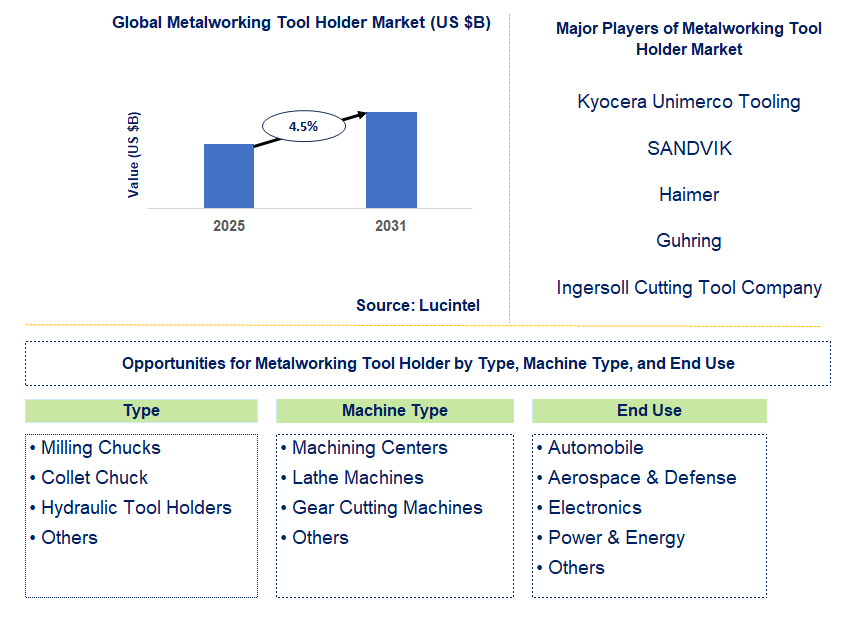
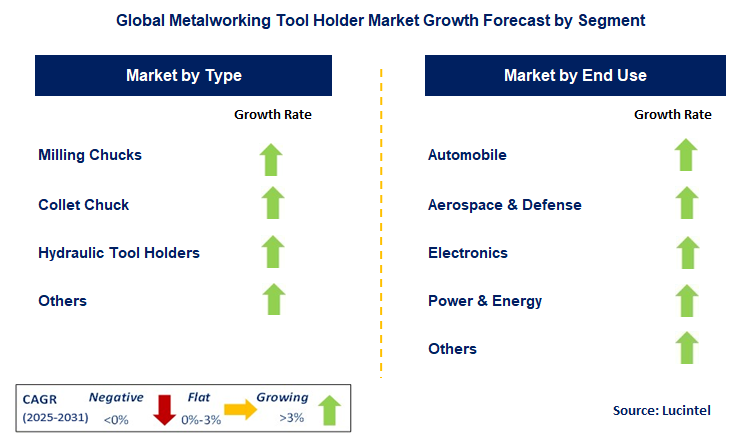
The future of the global metalworking tool holder market looks promising with opportunities in the automobile, aerospace & defense, electronic, and power & energy markets. The global metalworking tool holder market is expected to grow with a CAGR of 4.5% from 2025 to 2031. The major drivers for this market are the increasing demand for precision manufacturing, the rising adoption of automated processes, and the growing need for durable tooling solutions.• Lucintel forecasts that, within the type category, collet chuck is expected to witness the highest growth over the forecast period.
• Within the end use category, automobile is expected to witness the highest growth.
• In terms of region, APAC is expected to witness the highest growth over the forecast period. Gain valuable insights for your business decisions with our comprehensive 150+ page report. Sample figures with some insights are shown below.
Emerging Trends in the Metalworking Tool Holder Market
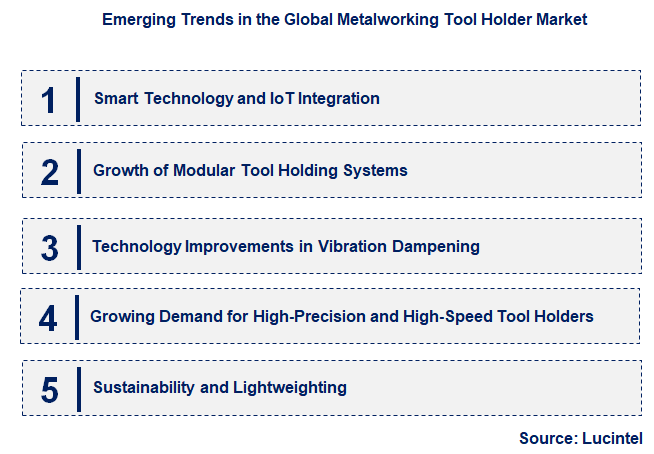
The metalworking tool holder industry is being redefined by a number of prominent new trends that are fundamentally altering product design, manufacturing processes, and customer expectations. They are fueled by an overall need for more efficiency, greater accuracy, and more intelligent manufacturing solutions in the global economy. The market is shifting away from the mere task of holding a tool to an integrated position where the tool holder is a part of a larger, automated system and itself an intelligent component. These trends are not only enhancing product performance but also enabling new innovation and specialization opportunities.• Smart Technology and IoT Integration: Integration of smart technology and Internet of Things (IoT) into tool holders is a dominant trend. Such products have sensors that can track parameters such as vibration, temperature, and wear on tools in real time. The result is a major leap toward predictive maintenance and optimized machining. This technology enables real-time compensation, minimizes unplanned machine downtime, increases tool life, and enhances overall part quality, thus making the manufacturing process more data-driven and efficient.
• Growth of Modular Tool Holding Systems: The industry is witnessing a shift toward modular tool holding systems. These enable one machine spindle to support a vast range of tools and cutting interfaces by using replaceable components. The benefit is increased flexibility and lower setup time. The ability to easily switch between various machining operations without having to recalculate, it suits small lot production and high-mix, low-volume conditions very well, thus improving productivity and operational responsiveness.
• Technology Improvements in Vibration Dampening: One major trend is ongoing improvement in vibration dampening technology. Tool holders are being engineered with intrinsic features and vibration-absorbing, vibration-counteracting materials. The results are improved surface finish and longer tool life. By reducing chatter and vibration, these tool holders avoid premature tool wear and provide a higher-quality finished product, which is essential in demanding applications such as aerospace and medical devices.
• Growing Demand for High-Precision and High-Speed Tool Holders: There is a robust movement towards a growing demand for tool holders suited for high-precision and high-speed applications. These comprise products with better balance, less runout, and innovative clamping systems. The effect is a shift towards higher productivity and more exact tolerances. These tool holders allow manufacturers to boost their cutting speeds and deliver very precise results, which is important for creating complex parts with high-quality requirements and remaining competitive in the international market.
• Sustainability and Lightweighting: One of the major trends is increased emphasis on sustainability and the utilization of light materials in tool holder construction. Producers are creating products that use less energy and are constructed with materials that minimize the tool assembly's total weight. The effect is lower energy usage and enhanced machine dynamics. Less power is needed to accelerate and decelerate the spindle when lighter tool holders are used, potentially resulting in substantial savings and enabling higher cutting speeds, all while helping to promote more environmentally friendly manufacturing procedures. In summary, these new trends are fundamentally transforming the metalworking tool holder industry by making it more efficient, flexible, and intelligent. The use of smart technology, modular design, and sophisticated vibration dampening is resulting in dramatic productivity and part quality gains. The drive for high-speed capabilities and sustainable designs is fueling innovation and the primary needs of the industry. These trends are all together converting the tool holder from a passive component to an active, high-performance member of the contemporary manufacturing world.
Recent Development in the Metalworking Tool Holder Market
Current innovations in metalworking tool holder are mainly centered on performance, reliability, and compatibility with contemporary manufacturing processes. These innovations are necessitated by the requirements for tools that are capable of keeping up with the evolution in CNC machine technology and demands for higher machining speed and accuracy. The industry is drifting toward smarter products that are not only strong but also intelligent and flexible, thus changing the tool holder from a fixture into an indispensable part of a high-performance machining system.• Hydraulic Tool Holders with Improved Clamping Force: One of the main developments is the launch of next-generation hydraulic tool holders with improved clamping force and better vibration dampening. These holders employ hydraulic fluid to generate a strong, consistent clench around the tool shank, the perfect arrangement for high-speed and heavy-duty cutting applications. Impact is a major advancement in rigidity and tool life. This innovation minimizes tool deflection and chatter, resulting in improved surface finish, tighter tolerances, and an extended cutting tool lifespan, a huge cost-saver for manufacturers.
• Introduction of Modular Interface Systems: There has been a major breakthrough in the introduction of modular interface systems, which enable easy and speedy changeover of tools. These systems have a standardized machine-side interface and several adapters for different tools, making a single spindle undertake multiple operations. The effect is a tremendous saving in machine downtime and flexibility. This enables them to produce a greater variety of jobs on a single machine with less setup time, allowing their operation to be more efficient and responsive to shifting production needs.
• Shrink-Fit Holders with Advanced Cooling: The most significant development is the evolution of shrink-fit holders, which today are being combined with advanced cooling systems. These grips heat up and then contract onto the tool for a very secure and precise hold. The newer models have internal cooling tubes that allow heat to dissipate more efficiently. The result is increased tool stability and accuracy in high-temperature machining. This keeps the tool from moving and prevents thermal tool and workpiece damage, allowing for consistent, high-quality production.
• RFID Chip Integration for Tool Management: One of the main developments is the integration of Radio-Frequency Identification (RFID) chips within tool holders. The chips contain important information regarding the tool, including its size, shape, and history of use. This data can be read automatically by a tool management system or a CNC machine. The effect is a revolution in tool data management. It obviates the requirement of manual data entry, minimizes human error, and enables automated tracking of inventory and tool life, thus accelerating the overall manufacturing process and facilitating Industry 4.0 projects.
• Smart and Connected Tool Holders: One of the newer introductions is that of smart and connected tool holders that can interact with the CNC machine control system. These holders feature sensors that give feedback in real time on spindle load and vibration. The payoff is the possibility of cutting parameters being optimized in real time. The machine can adjust feeds and speeds automatically to avoid tool breakage and achieve maximum possible efficiency. This feature is a breakthrough for lights-out manufacturing and high-precision, where real-time control is everything. In summary, all these advances are jointly contributing to the metalworking tool holder industry in that it becomes more technologically superior and an integral part of today's manufacturing environment. The emphasis on better clamping, modularity, and smart properties is resulting in tremendous productivity, precision, and efficiency improvements. These innovations are turning the tool holder from a basic mechanical component into an advanced, networked device, which is critically necessary to accomplish today's most demanding industries' high standards.
Strategic Growth Opportunities in the Metalworking Tool Holder Market
The metalworking tool holder market provides a number of strategic growth opportunities in key applications, with high demand for precision, efficiency, and automation. Focusing on these application-specific segments allows businesses to utilize their expertise and develop customized solutions that meet specific industry needs and establish a competitive edge. The marketplace is transforming away from a one-size-fits-all paradigm to one that focuses on specialized, high-performance solutions that are necessary to the next generation of manufacturing. These opportunities are central to capturing market share and fostering innovation.• Automotive and Electric Vehicle Manufacturing Growth: A major strategic growth opportunity exists in the automotive space, and specifically in the fast-growing electric vehicle (EV) segment. The demand for machining of light metals such as aluminum and composites, as well as the precise manufacture of EV battery parts, establishes the need for high-performance tool holders. The challenge is to manufacture and sell tool holders with better balance and cooling for high-speed machining. The benefit is the capability to address a high-volume, high-growth market, establishing a company as a primary supplier in the shift to electric mobility.
• Aerospace and Defense Manufacturing Expansion: Another important growth potential lies in aerospace and defense manufacturing, where machining demand for superalloys such as titanium and Inconel is increasing. Tool holders for these materials need to have superior rigidity, heat stability, and vibration dampening to provide component integrity. The potential is to develop and sell high-performance tool holders that can handle severe machining conditions. The impact is the ability to serve a high-value, quality-critical market, where performance and reliability are paramount and command premium pricing.
• Targeting the Medical Device Manufacturing Sector: The market presents a significant growth opportunity in the medical device manufacturing sector. This industry requires the machining of small, intricate components from advanced materials, demanding tool holders with very high precision and minimal runout. The opportunity is to develop and offer miniature and custom tool holders that can meet these exacting standards. The impact is the ability to enter a specialized, high-margin market where the need for flawless quality and precision drives demand for premium products.
• Leveraging Automation and Robotic Integration: A strategic opportunity is to leverage the growing trend of automation and robotic integration in manufacturing. With factories becoming automated, there is greater demand for quick-change and reliable clamping tool holders which can be driven by robots. The challenge is to manufacture and sell tool holders which are specifically made for automated tool changers. The effect is the capacity to collaborate with robotics and automation vendors, thus tapping into a rapidly expanding market segment and becoming part of the smart factory ecosphere.
• Targeting Small and Medium-Sized Enterprises: One of the most important opportunities for growth is targeting the huge and heterogeneous segment of small and medium-sized enterprises (SMEs). Numerous SMEs are replacing their outdated machinery and implementing CNC technology, requiring a high level of demand for affordable yet high-quality tool holders. The challenge is to provide a product line that integrates both performance and price, coupled with extensive support and training. The result is wide market penetration and the potential to establish long-term relationships with a large customer base, which can result in stable, consistent revenue. Overall, these strategic growth prospects are transforming the metalworking tool holder market to drive application-specific attention. By aligning with the high-growth aerospace and automotive industries, precision-critical medical device market, and changing automation industry, businesses are shifting towards a more specialized and high-margin paradigm. Attention to the SMEs also provides wide market coverage. These opportunities are all combined to drive the market towards a more mature and segmented solution, where segment-specific solutions are the drivers of long-term growth and success.
Metalworking Tool Holder Market Driver and Challenges
The market of metalworking tool holder is influenced by a sophisticated interrelation of key drivers and major challenges. The growth in the markets is inherently driven by the growing worldwide need for precision production and the constant pressure towards automation. These drivers are generating a robust and persistent demand for sophisticated tool holding solutions. Yet, this development is also moderated by major challenges like economic uncertainty and the expense of sophisticated technology. The balance among these forces must be understood to prevail in the market successfully by companies. The factors responsible for driving the metalworking tool holder market include: 1. Increasing Demand for Automation and CNC Machines: The major driver is the increasing demand for automation and Computer Numerical Control (CNC) machines in production. As companies try to become more efficient and save on labor, they are spending heavily in automated systems. Automated systems need high-precision, robust tool holders that can execute many different functions with little human interaction. This move towards automation provides the core demand for superior tool holders, driving the market. 2. Growth of High-Speed and High-Precise Machining: One of the most significant drivers is the rapid transition of various industries to high-speed and high-precision machining. In order to manufacture complex components with very close tolerances, manufacturers require tool holders that can withstand high spindle speeds without compromising on stability and precision. This requirement for higher performance fuels innovation in tool holder design, materials, and balancing technology, compelling the market to further develop at the pace of current manufacturing needs. 3. Technological Advances in Material Technology: A major stimulus is the ongoing technological advances in material technology. Advances in the development of new materials and coatings for tool holders, such as high-strength alloys and advanced composites, have enabled tools with better rigidity, vibration absorption, and heat resistance. These advances in materials improve tool life and machining performance, stimulating demand as producers want to maximize their production process. 4. Growth in Key End-User Markets: Growth of key end-user markets such as automotive, aerospace, and medical devices is the key driver. Automotive, for instance, needs millions of components to be machined to very high precision. Likewise, aerospace and medical industries have strict quality requirements for components. Expansion and technological development of these industries drive a steady and increasing demand for metalworking tool holders with high sophistication. 5. Prioritize Reducing Downtime and Increasing Productivity: A major driver is the across-the-board emphasis on minimizing machine downtime and overall productivity. In a competitive marketplace, each minute of downtime is an opportunity lost. High-end tool holders with quick-change mechanism features and smart sensors optimize setup time and avoid surprise tool failure. The need for efficiency is a strong driver for demand for advanced tool holding solutions. Challenges in the metalworking tool holder market are: 1. Raw Material Price Fluctuations and Economic Volatility: One of the major challenges is economic volatility and raw material price fluctuations like that of steel and aluminum. The price fluctuations in these materials can cause a significant impact on the cost of producing tool holders, influencing profitability and price strategies. This volatility can also hinder manufacturers from planning and investing in R&D, slowing the innovation pace. 2. Excessive Expense of Advanced Tool Holding Solutions: The industry is hindered by the excessive expense of advanced tool holding solutions, including hydraulic and shrink-fit holders. Although these products provide better performance, their expense can be prohibitive for small and medium-sized businesses (SMEs) with limited finances. This expense limitation may limit the usage of advanced technology and impede market development in some niches. 3. Shortage of Skilled Labor: A very important challenge is the shortage of skilled labor in the manufacturing industry. It takes a highly skilled workforce to operate high-end CNC machines and to maximize the use of advanced tool holders. The shortage of skilled operators and programmers may delay the implementation of new technologies and deny companies full benefits of their investments in high-end tool holders. The market for metalworking tool holders is in a phase of dynamic development, driven by growing demand for automation and precision manufacturing. Ongoing progress in technology and growth in major industries are building a solid foundation for future development. But this drive is countered with the mounting challenges brought on by economic uncertainty and the resultant high expense of complex solutions. The net effect is a technology-driven and highly innovative market that needs to strategically overcome such obstacles to provide more advanced, high-performing tool holders to a broader base of manufacturers and sustain the development of the international manufacturing sector.List of Metalworking Tool Holder Companies
Companies in the market compete on the basis of product quality offered. Major players in this market focus on expanding their manufacturing facilities, R&D investments, infrastructural development, and leverage integration opportunities across the value chain. With these strategies metalworking tool holder companies cater increasing demand, ensure competitive effectiveness, develop innovative products & technologies, reduce production costs, and expand their customer base. Some of the metalworking tool holder companies profiled in this report include-• Kyocera Unimerco Tooling
• SANDVIK
• Haimer
• Guhring
• Ingersoll Cutting Tool Company
• Collis Toolholder Corp
• BIG KAISER Precision Tooling
• Schunk
• Kennametal
• Plansee Group
Metalworking Tool Holder Market by Segment
The study includes a forecast for the global metalworking tool holder market by type, machine type, end use, and region.Metalworking Tool Holder Market by Type [Value from 2019 to 2031]:
• Milling Chucks
• Collet Chuck
• Hydraulic Tool Holders
• Others
Metalworking Tool Holder Market by Machine Type [Value from 2019 to 2031]:
• Machining Centers
• Lathe Machines
• Gear Cutting Machines
• Others
Metalworking Tool Holder Market by End Use [Value from 2019 to 2031]:
• Automobile
• Aerospace & Defense
• Electronics
• Power & Energy
• Others
Metalworking Tool Holder Market by Region [Value from 2019 to 2031]:
• North America
• Europe
• Asia Pacific
• The Rest of the World
Country Wise Outlook for the Metalworking Tool Holder Market
The market for metalworking tool holder is going through a radical shift, propelled by the worldwide drive for increased precision, efficiency, and automation in production. Over recent times, this has been marked by a major emphasis on innovative materials, intelligent technologies, and modular configurations that boost performance and flexibility. This shift is critical for sectors like automotive, aerospace, and MedTech, where the demand for intricate and high-quality components is of prime importance. As companies look to streamline their manufacturing operations and eliminate downtime, the tool holder industry is turning towards next-generation solutions that enable the next phase of CNC machining and Industry 4.0.• United States: The United States market is at the forefront of cutting-edge manufacturing, with recent trends focusing on the aerospace, defense, and medical device sectors. There is great demand for high-performance tool holders that are able to withstand the abuse of machining exotic materials such as titanium and nickel alloys. There is also a huge push for intelligent tool holders with in-tool sensors that enable real-time monitoring of tool wear and vibration, which is a central element of the nation's Industry 4.0 efforts. This emphasis on technology and accuracy places the US at the vanguard of tool holder innovation.
• China: China's metalworking tool holder industry is characterized by its continued growth and a two-track manufacturing approach. Recent trends see a high demand for domestic producers to develop high-quality, affordable tool holders to service its enormous automotive and electronics sectors. Concurrently, premium, imported tool holders from foreign brands are increasingly sought after to cater to its high-technology manufacturing industries. The industry is also being driven by government investments in automation and an increasing number of small and medium-sized enterprises (SMEs) embracing CNC technology.
• Germany: Germany's market is the world standard for precision engineering and quality. New trends feature a dominant presence of modular and hydraulic tool holders with outstanding rigidity and vibration suppression. Such emphasis is essential to meet the tight tolerances demanded by the nation's automotive and industrial machinery markets. The sector is also a hub of R&D, with companies continually working towards optimizing clamping systems and material technology to maximize tool life and overall machining performance.
• India: The metalworking tool holder market in India is a developing market with great growth potential. The recent trends are propelled by the increasing industrialization of the country, especially in the construction and auto industries. Demand for cost-effective and dependable tool holders is high, and hence local manufacturers are growing. Besides, as Indian manufacturing industries shift to higher value-added manufacturing, more sophisticated tool holders are increasingly being adopted and there is also a greater tendency to embrace products that can balance cost with performance.
• Japan: The Japanese market is extremely technologically advanced and concentrates on innovation and painstaking quality. The latest trends consist of a high trend towards ultra-high-speed and balanced tool holders necessary for the electronics and precision machinery industries in the country. Japanese suppliers are leaders in producing tool holders with sophisticated cooling systems and high runout accuracy, essential for high-speed machining and obtaining a perfect surface finish. The industry is also dominated by a strong focus on tool life and long-term reliability.

Features of the Global Metalworking Tool Holder Market
Market Size Estimates: Metalworking tool holder market size estimation in terms of value ($B). Trend and Forecast Analysis: Market trends (2019 to 2024) and forecast (2025 to 2031) by various segments and regions. Segmentation Analysis: Metalworking tool holder market size by type, machine type, end use, and region in terms of value ($B). Regional Analysis: Metalworking tool holder market breakdown by North America, Europe, Asia Pacific, and Rest of the World. Growth Opportunities: Analysis of growth opportunities in different types, machine types, end uses, and regions for the metalworking tool holder market. Strategic Analysis: This includes M&A, new product development, and competitive landscape of the metalworking tool holder market. Analysis of competitive intensity of the industry based on Porter’s Five Forces model.
FAQ
Q1. What is the growth forecast for metalworking tool holder market? Answer: The global metalworking tool holder market is expected to grow with a CAGR of 4.5% from 2025 to 2031. Q2. What are the major drivers influencing the growth of the metalworking tool holder market? Answer: The major drivers for this market are the increasing demand for precision manufacturing, the rising adoption of automated processes, and the growing need for durable tooling solutions. Q3. What are the major segments for metalworking tool holder market? Answer: The future of the metalworking tool holder market looks promising with opportunities in the automobile, aerospace & defense, electronic, and power & energy markets. Q4. Who are the key metalworking tool holder market companies? Answer: Some of the key metalworking tool holder companies are as follows:• Kyocera Unimerco Tooling
• SANDVIK
• Haimer
• Guhring
• Ingersoll Cutting Tool Company
• Collis Toolholder Corp
• BIG KAISER Precision Tooling
• Schunk
• Kennametal
• Plansee Group Q5. Which metalworking tool holder market segment will be the largest in future? Answer: Lucintel forecasts that, within the type category, collet chuck is expected to witness the highest growth over the forecast period. Q6. In metalworking tool holder market, which region is expected to be the largest in next 5 years? Answer: In terms of region, APAC is expected to witness the highest growth over the forecast period. Q7. Do we receive customization in this report? Answer: Yes, Lucintel provides 10% customization without any additional cost.
Table of Contents
Methodology
- In-depth interviews of the major players in this market
- Detailed secondary research from competitors’ financial statements and published data
- Extensive searches of published works, market, and database information pertaining to industry news, company press releases, and customer intentions
- A compilation of the experiences, judgments, and insights of Lucintel’s professionals, who have analyzed and tracked this market over the years.


Buy Now
Choose a license that fits your team. Instant PDF delivery.
Prices exclude taxes. Instant delivery. Custom licensing available on request.
Key Questions
- • What are some of the most promising, high-growth opportunities for the metalworking tool holder market by type (milling chucks, collet chuck, hydraulic tool holders, and others), machine type (machining centers, lathe machines, gear cutting machines, and others), end use (automobile, aerospace & defense, electronics, power & energy, and others), and region (North America, Europe, Asia Pacific, and the Rest of the World)?
- • Which segments will grow at a faster pace and why?
- • Which region will grow at a faster pace and why?
- • What are the key factors affecting market dynamics? What are the key challenges and business risks in this market?
- • What are the business risks and competitive threats in this market?
- • What are the emerging trends in this market and the reasons behind them?
- • What are some of the changing demands of customers in the market?
- • What are the new developments in the market? Which companies are leading these developments?
- • Who are the major players in this market? What strategic initiatives are key players pursuing for business growth?
- • What are some of the competing products in this market and how big of a threat do they pose for loss of market share by material or product substitution?
- • What M&A activity has occurred in the last 5 years and what has its impact been on the industry? For any questions related to Metalworking Tool Holder Market, Metalworking Tool Holder Market Size, Metalworking Tool Holder Market Growth, Metalworking Tool Holder Market Analysis, Metalworking Tool Holder Market Report, Metalworking Tool Holder Market Share, Metalworking Tool Holder Market Trends, Metalworking Tool Holder Market Forecast, Metalworking Tool Holder Companies, write Lucintel analyst at email: helpdesk@lucintel.com. We will be glad to get back to you soon.


