
Market Report · July 22, 2026

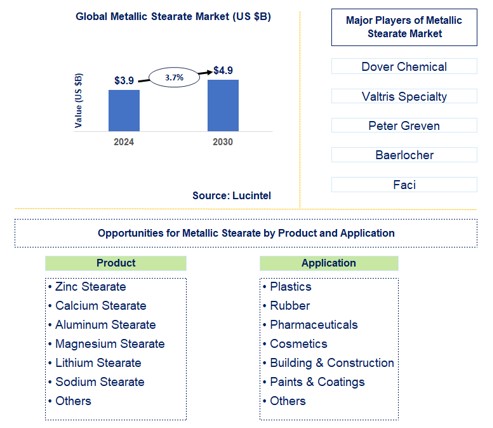
Key data points: The market size in 2030 = $4.9 billion, growth forecast = 3.7% annually for the next 6 years. Scroll below to get more insights. This market report covers trends, opportunities, and forecasts in the global metallic stearate market to 2030 by product (zinc stearate, calcium stearate, aluminum stearate, magnesium stearate, lithium stearate, sodium stearate, and others), application (plastics, rubber, pharmaceuticals, cosmetics, building & construction, paints & coatings, and others), and region (North America, Europe, Asia Pacific, and the Rest of the World)
We'll send your sample report shortly.
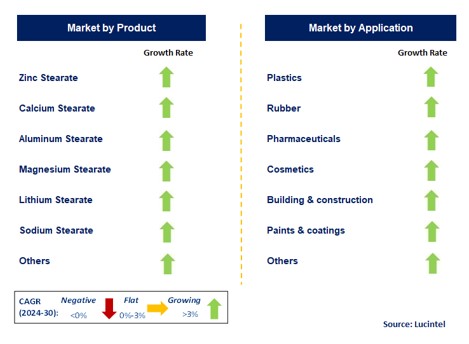
• Lucintel forecasts that, within the product category, zinc stearate will remain the largest segment over the forecast period because it is regarded as the most effective mold release agent and used as release agents and lubricants in the rubber and plastic industries.
• Within the application category, plastic will remain the largest segment because the metallic stearates are primarily utilized as lubricants, acid scavengers, and releasing agents in the plastics sector, and they play an important role in the melting process.
• In terms of regions, APAC will remain the largest region over the forecast period due to increased building activities and automobile manufacturing have boosted the product demand for paints and coatings, rubber, and plastics. Gain valuable insights for your business decisions with our comprehensive 150+ page report.
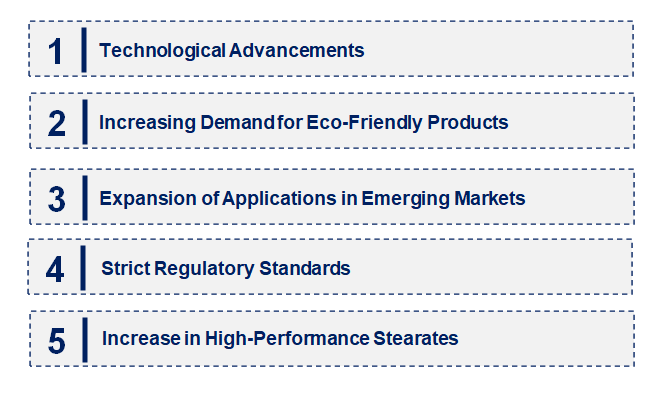
• Technological Advancements: Technological progress has revolutionized the metallic stearate market by improving production efficiency and product quality. Innovations in manufacturing processes, such as high-precision tools and advanced formulations, improve the functional properties of metallic stearates. As a result, specialty stearates are developed with increased functionality and endurance. Industries such as automotive, plastics, and coatings have benefited from higher-quality materials that meet specific application requirements. Additionally, the adoption of sophisticated technologies reduces production costs while simultaneously aligning with sustainability goals by reducing environmental impact.
• Increasing Demand for Eco-Friendly Products: Regulatory pressures and consumer demand for ecological products are driving a shift towards sustainable practices in the metallic stearate market. A major focus for firms is the development and adoption of environmentally friendly production processes. This includes reducing the use of hazardous materials and maximizing the use of biological feedstocks as alternatives. This move toward greener practices not only helps organizations meet strict regulations but also enhances their appeal in the market. In conclusion, environmental concerns are expected to result in increased demand for sustainable metallic stearates.
• Expansion of Applications in Emerging Markets: Metallic stearates are witnessing significant growth in several applications within emerging markets. With industrialization and infrastructure development progressing, the demand for stearates is increasing in industries such as construction, automotive, and consumer goods. The need to improve material performance and functionality has driven this expansion. The increasing presence of metallic stearate manufacturers in the Asia-Pacific and Latin American regions has created new opportunities and requires local adaptation of their product offerings. These companies have entered these markets, driven by industrial activities and other factors, leading to the expansion of their product lines.
• Strict Regulatory Standards: Many aspects of the metallic stearate market are heavily influenced by regulatory standards governing product safety, quality, and environmental impact. Recent regulatory reforms require manufacturers to adopt more stringent measures to improve compliance and increase investment in research and development to meet emerging requirements. This has led to the production of products that are both safer and more sustainable. Organizations must understand complex regulatory regimes to ensure their products conform with the latest standards, thereby maintaining their competitiveness. Consistency with regulatory policies builds trust among consumers and enhances credibility within the market.
• Increase in High-Performance Stearates: The demand for high-performance metallic stearates is increasing due to advancements in industries' requirements for materials that offer better functionality and durability. These high-performance stearates are used in specialized applications that require technical improvements, such as better thermal stability, resistance to corrosion, and lubrication. Precision engineering and reliability have driven trends in industries like automotive, aerospace, and electronics. This shift toward improved performance stearates is fostering innovation and increasing R&D spending, leading to market expansion and product differentiation. The metallic stearate market is experiencing significant changes due to these emerging trends, which are expected to drive technological innovation, sustainability, and the development of new application areas. Companies that respond favorably to these changes are likely to increase their growth opportunities and improve their market positioning. Stakeholders must be aware of these changes in order to navigate the shifting market and capitalize on new possibilities in the metallic stearate sector.
• Technological Advancement in Production: The production of metallic stearates has been revolutionized by technological advancements that have enhanced efficiency and product quality. For example, automation, high-precision equipment, and advanced formulations have enabled the production of high-purity and specialty stearates. Manufacturers can meet specific performance requirements for industries such as plastics, automotive, and coatings due to these developments. Improved production technologies also contribute to cost reduction and sustainability through waste minimization and reduced energy consumption. This has resulted in a shift in the market toward higher-quality products and greater manufacturing efficiency.
• Focus on Environmental Sustainability: There is an increasing focus on environmental sustainability in the metallic stearate market. To comply with regulations and meet consumer demand for greener products, companies are embracing environmentally friendly materials and processes. This includes reducing the use of harmful chemicals and using renewable resources wherever possible. This shift helps companies comply with stringent environmental legislation while making their products more attractive to consumers. As green metallic stearates gain popularity, it is expected that there will be a surge in demand for environmentally friendly products.
• Expansion to Developing Markets: The metallic stearate market is gaining ground in emerging markets, especially in regions like Asia-Pacific and Latin America. The demand for metallic stearates is increasing due to the rapid pace of industrialization and infrastructure development in these regions. Companies are establishing local manufacturing plants and distribution systems to serve the growing industrial and consumer demands. This expansion presents new growth opportunities and will increase the global market size. The demand for metallic stearates will continue to grow as these regions continue to develop.
• Regulatory Changes and Compliance: The metallic stearate industry is facing stricter standards on product safety, quality, and environmental issues due to recent regulatory changes. Manufacturers are required to invest in research and development to meet these new guidelines. Market trustworthiness depends on compliance with regulatory requirements, ensuring that products meet updated standards. Companies must adapt to these regulations to maintain competitiveness and address concerns such as environmental conservation and safety.
• Increase in the Demand for Specialty Stearates: The growing demand for materials with improved performance properties is driving the market for specialty metallic stearates. High-performance stearates are used in applications requiring enhanced lubricity, thermal stability, and corrosion resistance. Sectors such as automotive, aerospace, and electronics are driving this trend. Ongoing research and development activities have led to the creation of superior materials that meet specific industry requirements. These recent advancements are shaping the metallic stearate market by promoting technological change, sustainability practices, market expansion, and improved product performance. Over time, these factors will shape future trends and offer new opportunities for growth and development.
• Rubber Industry: The rubber compounding process greatly benefits from the role of metallic stearates in improving product properties and increasing processing efficiency. High-performance elastomers are required for automotive, industrial, and consumer applications, leading to increased demand for effective stearate solutions. Stearate additives aid in filler dispersion, thereby improving overall rubber quality. Companies can capitalize on this by developing specialty stearates that meet specific requirements for various rubber applications, thereby increasing their market share.
• Coatings and Paints: The metallic stearate industry is witnessing a significant rise in demand for stearates used as stabilizers and flow agents in paints and coatings. The need for advanced stearates is also growing with the increasing demand for quality coatings, particularly in automotive, industrial, and architectural sectors. Stearates improve coating performance, including longevity, which is critical in achieving desired product characteristics. Companies can seize this opportunity by developing innovative stearate solutions that enhance the environmental compliance and performance of paints and coatings.
• Pharmaceuticals and Personal Care: The pharmaceutical and personal care industries are increasingly using metallic stearates as excipients and stabilizers in drug formulations. High-quality stearates are required to improve the stability and bioavailability of active ingredients. By focusing on quality, safety, and regulatory compliance, businesses can develop targeted stearate solutions for these industries and capitalize on this growing demand.
• Electronics Industry: The electronics industry offers considerable potential for metallic stearates, particularly in the manufacture of high-performance electronic components. Stearates serve as lubricants and stabilizers in the production of materials such as capacitors and insulators. The growing popularity of high-tech electronic equipment and consumer appliances is driving demand for quality stearates. Companies can capitalize on this opportunity by developing stearates that meet the stringent performance needs of the electronics industry, thereby driving innovation and expanding the market. These growth opportunities in the plastics, rubber, coatings, pharmaceuticals, and electronics markets present significant potential for the metallic stearate market. By focusing on these areas, companies can strengthen their position in specific market segments and drive growth by addressing emerging industry needs and trends.
• Technological Advancements: In the metallic stearate market, technology progression stands out as one of the most prominent forces driving this industry forward. To improve efficiency as well as product quality in their production processes, such innovations like automation and high precision equipment have been employed. This creates a room for advanced formulations and manufacturing processes leading to the development of high-performance specialty stearates that address variable industrial needs. These developments provide cost reduction opportunities, increased performance capabilities together with sustainability thereby promoting the expansion of the market and creation of new prospects for manufacturers.
• Increasing Demand for High-Performance Materials: A growing demand for high-performance materials across different industries is propelling developments in metal stearate markets. For instance, automobile industry requires better performing additives to increase thermal stability, lubrication properties or corrosion protection because of extreme operating conditions while other sectors are emerging with more complex requirements that need special stearates along with it. Therefore innovation and R&D investments including additional capitalization in these areas are helping drive continued expansion in this business field over time
• Growth of Economy and Industrialization: Economic growth and industrialization, especially in the emerging countries, are the main drivers of metal stearates demand. The rapid development of industries as well as infrastructure projects in regions like Latin America and Asia Pacific creates the necessity for stearates of high quality to be used in various applications. As a result, expansion of manufacturing activities and consumer markets in these areas lead to an escalated cry for metallic stearates hence there is room for growth by players of this market hence providing impetus for global market extension.
• Regulatory Changes and Compliance: Regulatory changes and compliance requirements are pushing the market towards higher levels of product safety, environmental impact, and product quality. Companies invest in research to meet new regulations and ensure their products conform with updated standards. This regulatory push towards safer and more sustainable products builds market credibility as well as consumer trust. Adaptation to regulatory changes is key to survival in any industry or business sector due to its role in maintaining competitiveness and alliance with the prevailing market forces driving change. Challenges in the metallic stearate market are:
• Environmental Concerns: As regulations tighten, environmental concerns present a significant challenge to the metallic stearate market. Manufacturers must adopt sustainable practices and technologies to minimize the environmental impact of their products and production processes. This may require significant investment in new technologies and green manufacturing methods.
• Regulatory Compliance: Compliance with increasingly complex and diverse regulations is a challenge for the metallic stearate market. Different regions have different standards, and staying compliant can be costly in terms of time, resources, and R&D investments. This may discourage new entrants from joining the market, especially in regions with stringent regulatory frameworks. The metallic stearate market is shaped by various drivers, including technological advancements, economic growth, regulatory changes, and market competition. Understanding these factors is critical for companies looking to navigate the market and capitalize on its growth potential.
• Dover Chemical
• Valtris Specialty Chemicals
• Peter Greven
• Baerlocher
• FACI
• Norac Additives
• Sun Ace Kakoh
• PMC Biogenix
• James M. Brown
• Nimbasia Stabilizers
• Zinc Stearate
• Calcium Stearate
• Aluminum Stearate
• Magnesium Stearate
• Lithium Stearate
• Sodium Stearate
• Others
• Plastics
• Rubber
• Pharmaceuticals
• Cosmetics
• Building & Construction
• Paints & Coatings
• Others
• North America
• Europe
• Asia Pacific
• The Rest of the World
• United States: The U.S. metallic stearate market has seen steady growth, driven by increased demand from the automotive and construction sectors. Technological advancements have improved manufacturing efficiency, while regulatory shifts have pushed companies toward greener practices.
• China: China remains a major player in the metallic stearate market, driven by rapid industrialization. The country’s expanding manufacturing base and infrastructure development continue to support high demand for metallic stearates, although there is also a shift toward higher-quality products and improved regulatory compliance.
• Germany: Germany’s metallic stearate industry is characterized by technological innovation and strict regulatory frameworks. As a global leader in chemical manufacturing, the country focuses on developing advanced, high-performance stearates for industries like automotive and industrial applications.
• India: India's metallic stearate market is expanding rapidly due to increasing industrial activity and demand for plastics and rubber. Recent developments include investments in local production capabilities and technology upgrades to enhance product quality and cost efficiency.
• Japan: Japan's metallic stearate market is influenced by high levels of industrial performance and technological innovation. The country’s focus on advanced manufacturing processes and the production of high-quality goods has resulted in strong demand for specialized stearates across various sectors.


• Dover Chemical
• Valtris Specialty Chemicals
• Peter Greven
• Baerlocher
• FACI
• Norac Additives
• Sun Ace Kakoh
• PMC Biogenix
• James M. Brown
• Nimbasia Stabilizers Q6. Which metallic stearate market segment will be the largest in future? Answer: Lucintel forecasts that zinc stearate will remain the largest segment over the forecast period because it is regarded as the most effective mold release agent and used as release agents and lubricants in the rubber and plastic industries. Q7. In metallic stearate market, which region is expected to be the largest in next 5 years? Answer: APAC will remain the largest region over the forecast period due to increased building activities and automobile manufacturing have boosted the product demand for paints and coatings, rubber, and plastics. Q.8 Do we receive customization in this report? Answer: Yes, Lucintel provides 10% customization without any additional cost.


Choose a license that fits your team. Instant PDF delivery.
Prices exclude taxes. Instant delivery. Custom licensing available on request.
Market Report · July 22, 2026
Market Report · July 22, 2026
Market Report · July 22, 2026
Trusted partner for strategic intelligence and business growth


Receive a complimentary market analysis tailored to your industry. Our analysts will identify key growth opportunities and competitive dynamics specific to your business.

Market size, growth rate, and key trend analysis for your specific sector.

Top competitor positioning and market share analysis.

Strategic recommendations backed by data-driven insights.
Get curated market intelligence and competitive moves straight to your inbox.
By subscribing, you agree to receive our monthly insights. Unsubscribe anytime.
Receive a complimentary market analysis tailored to your industry. Our analysts will identify key growth opportunities and competitive dynamics specific to your business.
Market size, growth rate, and key trend analysis for your specific sector.
Top competitor positioning and market share analysis.
Strategic recommendations backed by data-driven insights.
Get curated market intelligence, emerging trends, and competitive moves straight to your inbox each month.
By subscribing, you agree to receive our monthly insights. Unsubscribe anytime.
We'll send your sample report shortly.