
Market Report · July 22, 2026

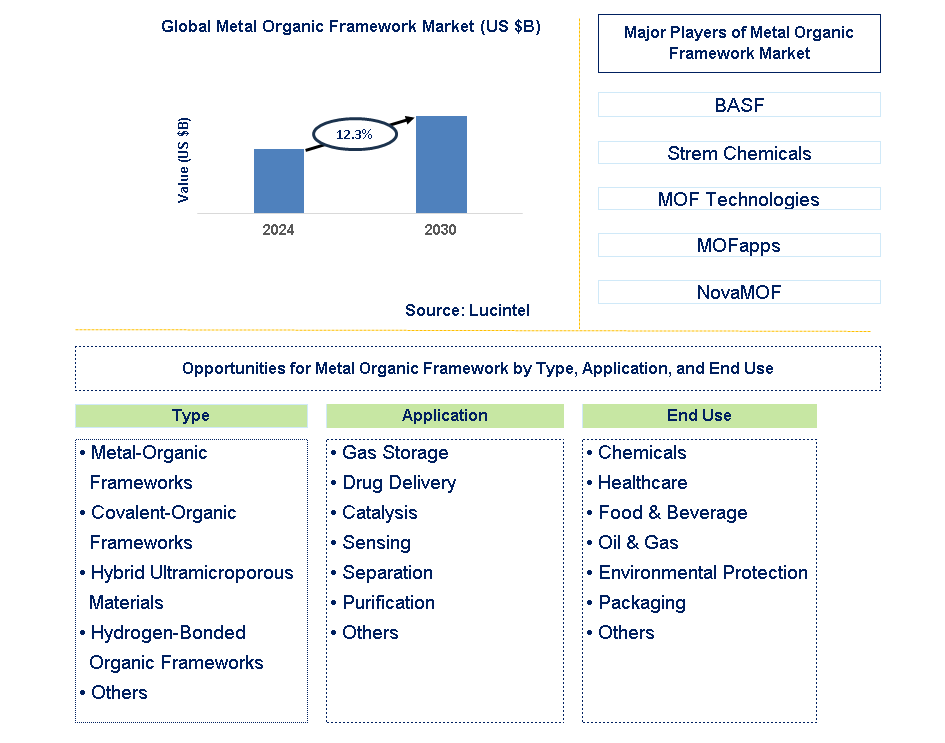
Key data points: The growth forecast = 12.3% annually next 6 years. Scroll below to get more insights. This market report covers trends, opportunities, and forecast in the global metal organic framework market to 2030 by type (metal-organic frameworks, covalent-organic frameworks, hybrid ultramicroporous materials, hydrogen-bonded organic frameworks, and others), application (gas storage, drug delivery, catalysis, sensing, separation, purification, and others), end use (chemicals, healthcare, food & beverage, oil & gas, environmental protection, packaging, and others), and region (North America, Europe, Asia Pacific, and the Rest of the World)
We'll send your sample report shortly.
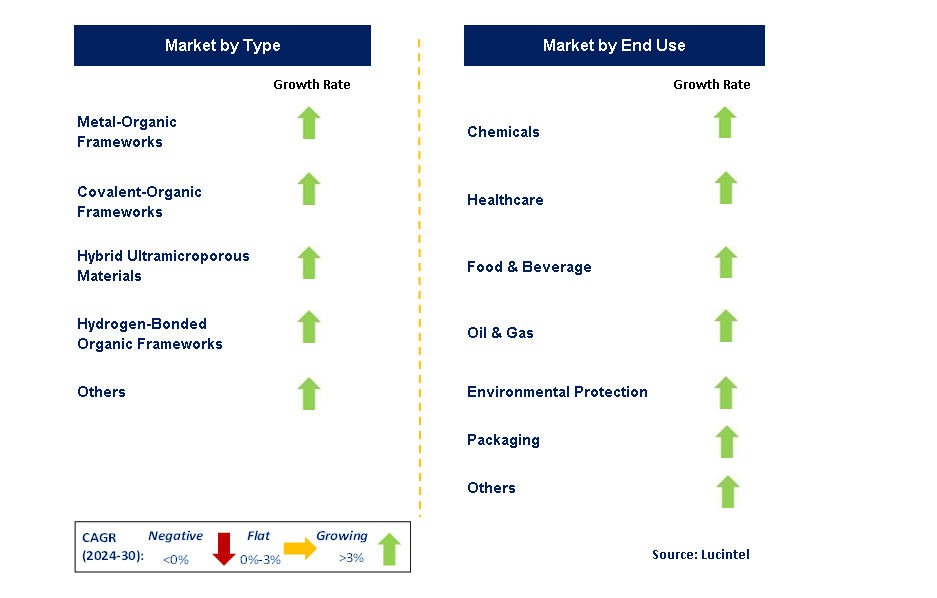
• Lucintel forecasts that, within the type category, the metal-organic frameworks is expected to witness the highest growth over the forecast period.
• Within the end use category, the gas storage is expected to witness the highest growth over the forecast period.
• In terms of region, North America is expected to witness the highest growth over the forecast period. A more than 150-page report is developed to help in your business decisions.
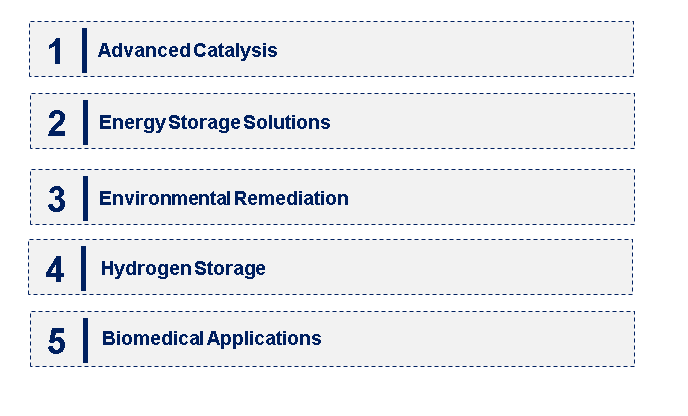
• Advanced Catalysis: Due to their adjustable properties and large surface area, MOFs are widely employed in catalysis. This trend has improved chemical reaction efficiencies, particularly in the production of fine chemicals, including pharmaceuticals.
• Energy Storage Solutions: The development of MOFs for energy storage applications, such as batteries and supercapacitors, is gaining momentum. The engineering of MOFs aims to enhance energy density and charge/discharge rates.
• Environmental Remediation: Exploration of MOFs' potential in environmental cleanup, such as purification of air or water, is ongoing. This trend has been driven by their ability to adsorb pollutants and contaminants.
• Hydrogen Storage: The development of MOFs for hydrogen storage addresses issues like storage density and safety controls. This is a key application essential for advancing hydrogen-based clean energy sources.
• Biomedical Applications: Increasingly, MOFs are being used in the biomedical field, including drug delivery systems and imaging techniques. In this way, they can be used to achieve targeted therapy or provide enhanced imaging due to their modifiable architecture. These emerging trends expand the scope of MOFs' applications across various industries, resulting in marketable innovations. Therefore, continuous growth opportunities will arise as the more segmented MOF market continues to develop within its niche, expanding its overall influence over time.
• High-Performance MOFs for Gas Storage: Some recent advances include the development of MOFs with exceptional gas storage capacities, particularly for CO2 and H2. These materials are being investigated to help reduce greenhouse gas emissions and support clean energy initiatives.
• Commercialization of MOF-Based Products: Research on moving from concept to commercial production of MOF-based products has led several companies to explore areas like water purification and air filtration, demonstrating their usefulness for addressing environmental challenges.
• Enhanced Synthesis Techniques: The use of solvent-free, scalable methods for synthesis, employed by a few new companies, has made it easier and cheaper to produce MOFs. These innovations enable manufacturers to reach a larger audience, including other businesses.
• Integration with Nanotechnology: By integrating with nanotech systems, MOF frameworks can be implemented using associated materials with minimal waste. Electronics, materials science, and other fields would greatly benefit from composites based on nanomolecular units.
• Collaborative Research Initiatives: There is an increasing trend toward university-industry collaboration aimed at boosting MOF R&D efforts. Collaborative work is enabling novel designs and practices for MOFs, leading to groundbreaking discoveries and eventual commercialization. Material performance improvements and a wider range of application possibilities have changed the face of the MOF market recently. The focus is now on advanced synthesis technologies, which drive growth, adoption, and innovation.
• Energy Storage: MOFs are poised to play a key role in energy storage applications, including batteries and supercapacitors. Their high surface area and tailorable properties improve energy density and performance, meeting the increasing demand for efficient storage systems.
• Environmental Cleanup: A significant growth opportunity exists in using MOFs for environmental remediation, such as water and air purification. They provide an invaluable solution to environmental problems by adsorbing pollutants from air or water bodies suffering from pollution.
• Medical Applications: Drug delivery systems and medical imaging are fields where MOFs have been applied recently. Due to their customizable nature, MOFs are being used for targeted drug delivery and enhanced imaging capabilities, increasing their presence in the medical field and boosting market development.
• Catalysis: Catalytic systems continue to gain interest and are widely used across manufacturing processes and industrial chemical production lines. MOFs are especially interesting for various industries because their high surface areas enhance catalytic properties, improving reaction efficiency.
• Hydrogen Storage: Recent research has shown considerable promise in employing MOFs for hydrogen storage technologies. These frameworks address concerns about storage density and safety, aligning with the growing interest in hydrogen as a clean source of energy. These strategic growth opportunities reflect the broad potential of MOFs across different sectors. Stakeholders who focus on this space will be able to leverage the unique features of MOFs to solve key challenges while expanding the market.
• Technological Advancements: Innovations in the synthesis and use of MOFs are driving the market. Advances in materials science enable the development of high-performance MOFs with diverse applications, improving their commercial potential.
• Growing Demand for Sustainable Solutions: Environmental concerns have led to the adoption of MOFs in areas like environmental cleanup and energy storage, which are driving market demand.
• Investment and Funding: Increased public-private investment, as well as government funding, has accelerated MOF R&D activities. Financing facilitates the invention, commercialization, and scale-up of MOF-based products.
• Collaborations and Partnerships: Strategic collaborations between academic institutions, industry players, and research centers are fueling innovation and speeding up technology transfer for MOFs. This broadens their marketing potential.
• Emerging Economies Opening New Markets: Expansion into emerging economies has opened up opportunities for new MOF applications. Industrial growth and research activities in these regions contribute to overall market expansion. Challenges in the metal-organic framework market include:
• High Production Costs: The synthesis of high-quality MOFs remains an expensive challenge. Expensive raw materials and complex production processes hinder the affordability and scalability of MOF technologies.
• Regulatory Hurdles: Strict environmental safety regulations can adversely impact the development and marketing of products made from MOFs. These regulations pose challenges for businesses in this sector.
• Limited Awareness and Adoption: Despite their potential benefits, some sectors have low awareness of MOFs, leading to slow adoption. Educating stakeholders and demonstrating the value and use of MOFs can overcome this challenge. MOF market drivers and challenges demonstrate a changing landscape influenced by technology, economic conditions, and government regulations. Addressing these elements is crucial for market expansion and the successful development of MOF technologies.
• BASF
• Strem Chemicals
• MOF Technologies
• MOFapps
• NovaMOF
• ACYSNAM
• Framergy
• Metal-Organic Frameworks
• Covalent-Organic Frameworks
• Hybrid Ultramicroporous Materials
• Hydrogen-Bonded Organic Frameworks
• Others
• Gas Storage
• Drug Delivery
• Catalysis
• Sensing
• Separation
• Purification
• Others
• Chemicals
• Healthcare
• Food & Beverage
• Oil & Gas
• Environmental Protection
• Packaging
• North America
• Europe
• Asia Pacific
• The Rest of the World
• United States: Noteworthy recent developments in the US MOF sector include substantial research investments and commercial applications of these materials in energy storage and environmental remediation. For instance, there has been notable progress with MOFs used for carbon capture technologies, with several start-ups receiving funding to scale up their production capacity.
• China: China has rapidly expanded its MOF research and applications, focusing on energy-efficient materials and advanced catalysis. The country has seen increased investment in MOF-based hydrogen storage solutions and has established several research centers dedicated to developing high-performance MOF materials for industrial use.
• Germany: A strong industrial and research base drives Germany's MOF market. Recent advances include innovative applications in the wastewater treatment and air purification sectors. German scientists are also pioneering the development of enhanced stability for MOFs designed to withstand high-temperature environments.
• India: Recently, India initiated a number of research projects aimed at utilizing MOFs for clean energy solutions as well as agricultural purposes. Indian universities and research institutions are concentrating on cost-effective synthesis methods and exploring water purification systems based on MOFs, as well as drug delivery systems using MOF-based materials.
• Japan: Japanese MOF market is focused on advancing technologies related to environmental monitoring and energy storage using MOFs. Notable developments include industry-academic collaborations to design MOFs with tailored properties suited to specific needs, such as sensors or batteries.


• BASF
• Strem Chemicals
• MOF Technologies
• MOFapps
• NovaMOF
• ACYSNAM
• Framergy Q5. Which metal organic framework market segment will be the largest in the future? Answer: Lucintel forecasts that metal-organic frameworks is expected to witness the highest growth over the forecast period. Q6. In the metal organic framework market, which region is expected to be the largest in the next 5 years? Answer: North America is expected to witness the highest growth over the forecast period. Q7. Do we receive customization in this report? Answer: Yes, Lucintel provides 10% customization without any additional cost.


Choose a license that fits your team. Instant PDF delivery.
Prices exclude taxes. Instant delivery. Custom licensing available on request.
Market Report · July 22, 2026
Market Report · July 17, 2026
Market Report · July 17, 2026
Trusted partner for strategic intelligence and business growth


Receive a complimentary market analysis tailored to your industry. Our analysts will identify key growth opportunities and competitive dynamics specific to your business.

Market size, growth rate, and key trend analysis for your specific sector.

Top competitor positioning and market share analysis.

Strategic recommendations backed by data-driven insights.
Get curated market intelligence and competitive moves straight to your inbox.
By subscribing, you agree to receive our monthly insights. Unsubscribe anytime.
Receive a complimentary market analysis tailored to your industry. Our analysts will identify key growth opportunities and competitive dynamics specific to your business.
Market size, growth rate, and key trend analysis for your specific sector.
Top competitor positioning and market share analysis.
Strategic recommendations backed by data-driven insights.
Get curated market intelligence, emerging trends, and competitive moves straight to your inbox each month.
By subscribing, you agree to receive our monthly insights. Unsubscribe anytime.
We'll send your sample report shortly.