
Metal Detector Market Trends and Forecast
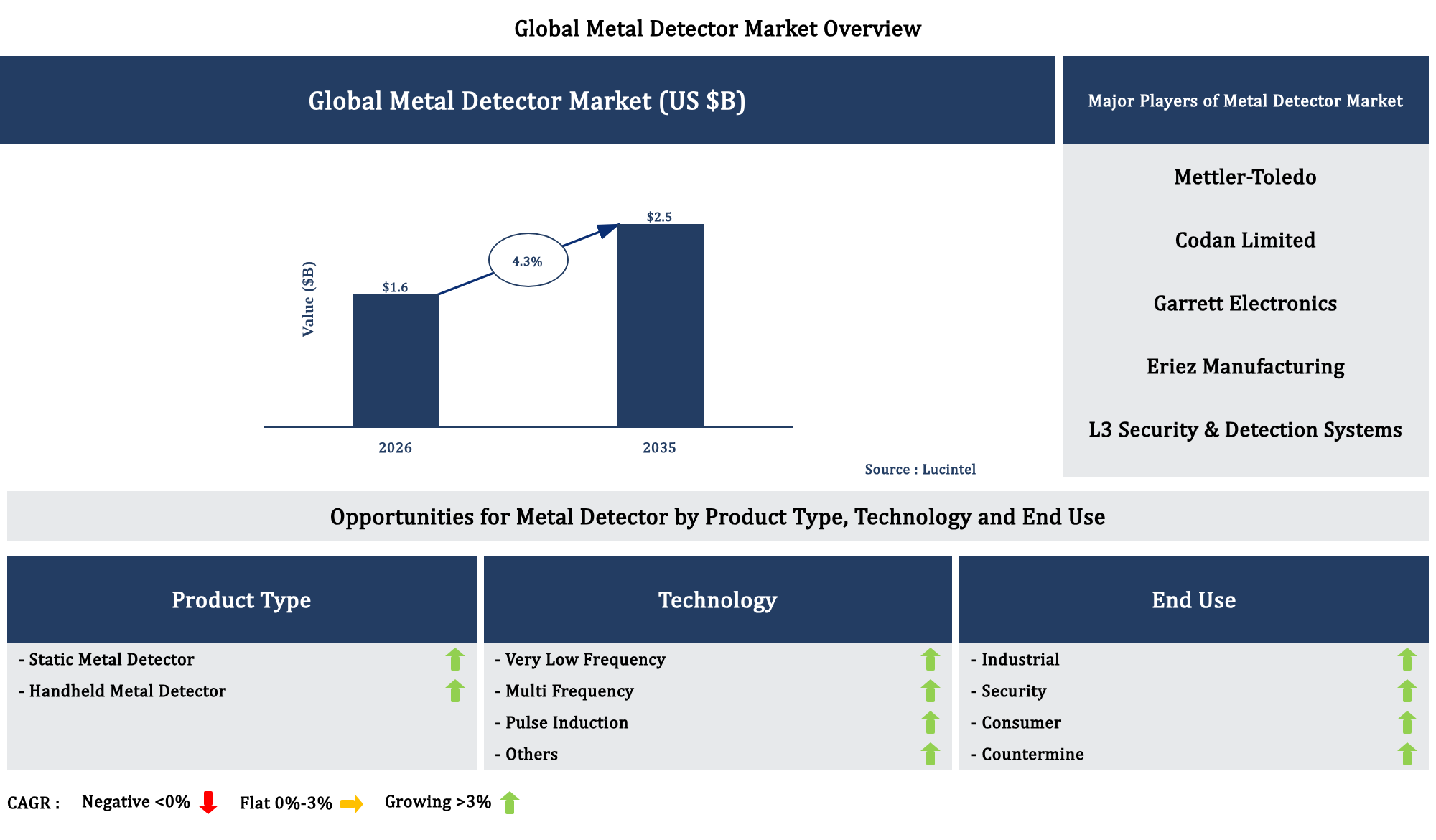
The future of the global metal detector market looks promising with opportunities in the industrial, security, consumer, and countermine markets. The global metal detector market is expected to reach an estimated $2,513 million by 2035 with a CAGR of 4.3% from 2026 to 2035. The major drivers for this market are the increasing use in mining & treasure hunting activities, the growing adoption in food & pharmaceutical industry, and the rising government regulations for security compliance.
• Lucintel forecasts that, within the product type category, static metal detector is expected to witness higher growth over the forecast period.
• Within the end use category, security is expected to witness the highest growth.
• In terms of region, APAC is expected to witness the highest growth over the forecast period.
Gain valuable insights for your business decisions with our comprehensive 150+ page report. Sample figures with some insights are shown below.
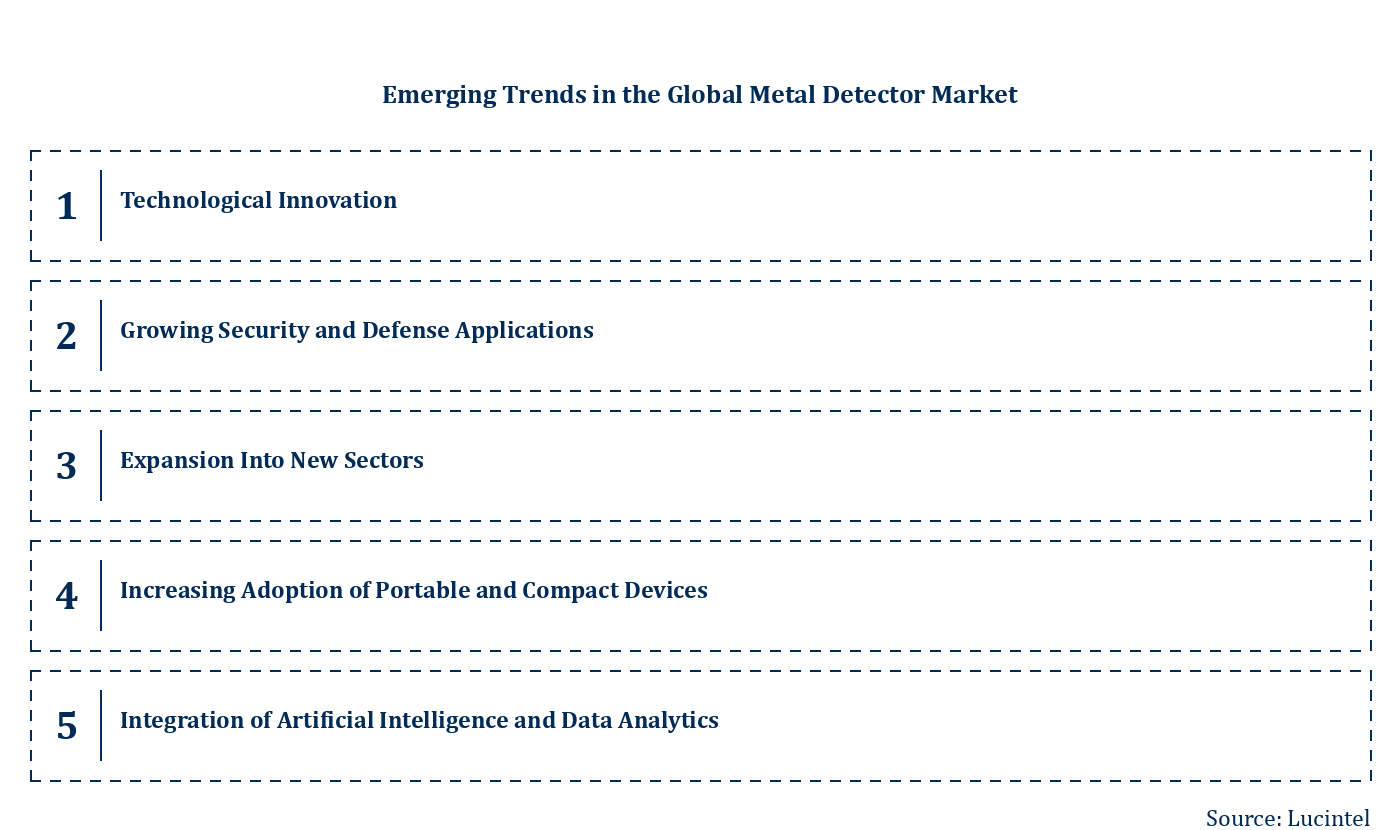
Emerging Trends in the Metal Detector Market
The metal detector market is experiencing rapid evolution driven by technological advancements, increasing security concerns, and expanding applications across various industries. As consumer demand grows for more accurate, efficient, and user-friendly devices, manufacturers are innovating to meet these needs. Additionally, the integration of digital technologies and the rise of specialized detectors are shaping the competitive landscape. These developments are not only enhancing product performance but also broadening market reach into new sectors such as construction, archaeology, and food safety. Understanding these emerging trends is crucial for stakeholders aiming to capitalize on the market‘s growth potential and adapt to changing consumer and industry requirements.
• Technological Innovation: The market is witnessing significant advancements in detection capabilities, including multi-frequency systems, improved sensitivity, and enhanced discrimination features. These innovations enable more precise identification of metals, reducing false alarms and increasing efficiency. Digital integration, such as Bluetooth connectivity and smartphone compatibility, is also becoming prevalent, offering users real-time data and customizable settings. This trend improves user experience and broadens application possibilities, making detectors more versatile and accessible across different user segments.
• Growing Security and Defense Applications: Increasing security concerns worldwide are driving demand for metal detectors in airports, public events, and military installations. Enhanced security protocols require more reliable and faster detection systems, prompting manufacturers to develop high-performance models with advanced features like rapid target identification and increased detection depth. This trend is expanding the market beyond traditional recreational use, positioning security as a key growth driver and opening new revenue streams for industry players.
• Expansion into New Sectors: Beyond traditional uses, metal detectors are gaining traction in sectors such as construction, archaeology, and food safety. In construction, they help locate underground utilities and prevent accidents. Archaeologists use advanced detectors for artifact discovery, while food industry applications involve detecting metal contaminants to ensure safety. This diversification is broadening the market scope, encouraging innovation tailored to specific industry needs, and creating new opportunities for manufacturers to develop specialized products.
• Increasing Adoption of Portable and Compact Devices: The demand for lightweight, portable, and easy-to-use metal detectors is rising, especially among hobbyists and amateur treasure hunters. Compact designs with ergonomic features and longer battery life enhance user convenience and accessibility. This trend is driven by the desire for mobility and ease of operation, making metal detectors suitable for a wider audience. Manufacturers are focusing on miniaturization and user-friendly interfaces, which are expanding market penetration and encouraging recreational use in diverse environments.
• Integration of Artificial Intelligence and Data Analytics: The incorporation of AI and data analytics is transforming the metal detector market by enabling smarter detection systems. AI algorithms improve target discrimination, reduce false signals, and adapt to different soil conditions. Data analytics provide insights into usage patterns and detection success rates, aiding users in decision-making. This trend enhances device accuracy, efficiency, and user experience, positioning AI-powered detectors as the future of the industry. It also opens avenues for connected devices and cloud-based data sharing, fostering innovation and competitive advantage.
These emerging trends are reshaping the metal detector market by driving technological innovation, expanding application areas, and enhancing user experience. They are fostering a more versatile, efficient, and security-focused industry landscape, ultimately broadening market reach and accelerating growth prospects.
Recent Developments in the Metal Detector Market
The metal detector market has experienced significant advancements driven by technological innovations, increasing security concerns, and expanding applications across various industries. These developments are shaping the future landscape, offering new opportunities for manufacturers and users alike. As demand grows in sectors such as security, construction, and healthcare, understanding these key growth areas is essential for stakeholders aiming to capitalize on emerging trends and stay competitive in a dynamic market environment.
• Growth in Security Sector: The rising need for security screening at airports, public events, and government facilities has propelled the demand for advanced metal detectors. Enhanced sensitivity, faster detection capabilities, and portability are key features driving adoption. This growth not only boosts market revenue but also encourages innovation in detector design, ensuring better threat detection and safety. As security concerns escalate globally, the market is poised for sustained expansion, creating opportunities for manufacturers to develop more sophisticated and user-friendly devices.
• Technological Innovations in Detection: Recent developments include the integration of AI, IoT, and advanced sensor technologies into metal detectors. These innovations improve accuracy, reduce false alarms, and enable remote monitoring. Such technological progress enhances user experience and operational efficiency across industries like mining, construction, and healthcare. The adoption of smart detectors is expected to revolutionize the market by providing real-time data analytics, predictive maintenance, and seamless connectivity, thereby expanding application scope and market size.
• Growing Construction and Infrastructure Projects: The surge in construction activities worldwide, especially in urban development and infrastructure projects, has increased the need for metal detection in construction sites. These detectors help locate underground utilities, prevent accidents, and ensure safety compliance. The market benefits from the demand for rugged, high-performance detectors capable of operating in challenging environments. This trend supports market growth by opening new avenues in civil engineering, tunneling, and archaeological explorations, fostering innovation and product diversification.
• Expansion in Healthcare and Food Industry Applications: Metal detectors are increasingly vital in healthcare for detecting metal fragments in medical devices and implants, ensuring patient safety. Similarly, the food industry relies on metal detection for quality control and contamination prevention. These applications demand high sensitivity and reliability, prompting manufacturers to develop specialized detectors. The expanding use in these sectors not only broadens market reach but also encourages technological advancements tailored to specific industry needs, contributing to overall market growth.
• Increasing Focus on Portable and Handheld Devices: The demand for portable, lightweight, and easy-to-use metal detectors is rising across recreational, security, and industrial sectors. Innovations in battery technology and ergonomic design have made handheld detectors more efficient and accessible. This trend enhances operational flexibility, allowing quick deployment in various environments. The market benefits from increased adoption in outdoor activities, security patrols, and emergency response, driving product innovation and expanding market penetration into new customer segments.
The overall impact of these developments is a robust, innovative market characterized by increased safety, efficiency, and application diversity. These opportunities are fueling growth, attracting investments, and fostering technological progress, which collectively strengthen the market’s future outlook and global competitiveness.
Strategic Growth Opportunities in the Metal Detector Market
The metal detector market is experiencing rapid expansion driven by diverse applications across security, industrial, and recreational sectors. Increasing safety regulations, technological advancements, and rising demand for quality control are fueling growth opportunities. Companies are investing in innovative solutions to meet evolving customer needs, expanding market reach globally. This dynamic environment presents numerous avenues for strategic development, enabling stakeholders to capitalize on emerging trends and enhance their competitive edge in the industry.
• Expansion into Security Screening Applications: The growing need for enhanced security at airports, public events, and government facilities is driving the adoption of advanced metal detectors. Innovations in detection sensitivity and false alarm reduction are making these devices more reliable and efficient. As security concerns escalate worldwide, investments in high-performance metal detection systems are expected to surge, creating significant growth opportunities for manufacturers and service providers.
• Adoption of Wireless and Portable Metal Detectors: The demand for portable, wireless metal detectors is increasing among hobbyists, archaeologists, and security personnel. These devices offer greater mobility, ease of use, and real-time data transmission, improving operational efficiency. Technological advancements in battery life, signal processing, and ergonomic design are making portable detectors more attractive, expanding their market share across various end-user segments.
• Integration of AI and IoT Technologies for Enhanced Detection: Incorporating artificial intelligence and Internet of Things (IoT) capabilities into metal detectors is revolutionizing the industry. AI algorithms improve detection accuracy and reduce false positives, while IoT connectivity enables remote monitoring and data analytics. These innovations facilitate smarter security systems and industrial inspections, opening new avenues for product differentiation and value-added services, thus accelerating market growth.
• Growing Demand in Industrial Metal Detection for Quality Control: Industries such as food, pharmaceuticals, and manufacturing are increasingly relying on metal detectors for quality assurance. Ensuring product safety and compliance with regulatory standards is critical, prompting investments in high-precision detection systems. The need to prevent metal contamination and product recalls is fueling market expansion, with ongoing innovations enhancing sensitivity, speed, and integration capabilities.
• Rising Popularity of Recreational Metal Detecting and Treasure Hunting: The hobbyist segment is witnessing significant growth due to increased leisure activities and interest in archaeology. Advances in detector technology, affordability, and user-friendly features are attracting more enthusiasts. This trend is expanding the consumer base and encouraging product innovation tailored to recreational use, thereby boosting overall market revenue and encouraging new entrants to develop specialized equipment.
The overall market outlook is positively influenced by these growth opportunities, promising increased innovation, broader application scope, and heightened competition. Stakeholders who strategically leverage these trends can capitalize on emerging demand, enhance product offerings, and secure a competitive advantage in the expanding metal detector industry.
Metal Detector Market Driver and Challenges
The metal detector market is influenced by a variety of technological, economic, and regulatory factors that shape its growth and development. Advances in detection technology, increasing demand from various sectors such as security, archaeology, and industrial applications, along with evolving regulatory standards, are key drivers. Conversely, challenges such as high costs, technological limitations, and regulatory restrictions pose hurdles to market expansion. Understanding these drivers and challenges is essential for stakeholders to navigate the market landscape effectively and capitalize on emerging opportunities while addressing potential risks.
The factors responsible for driving the metal detector market include:-
• Technological Innovation: The continuous development of more sensitive, accurate, and user-friendly metal detection technologies has expanded applications across security, mining, and hobbyist sectors. Innovations such as digital signal processing and multi-frequency systems enhance detection capabilities, making devices more reliable and versatile. This technological progress attracts new users and encourages existing users to upgrade, fueling market growth.
• Growing Security Concerns: Increasing security threats worldwide have led to heightened demand for metal detectors in airports, public events, and border control. Governments and private organizations invest heavily in security infrastructure, driving demand for advanced detection systems. This trend is expected to continue as security remains a top priority, supporting sustained market expansion.
• Expansion in Archaeology and Heritage Preservation: The rising interest in archaeological exploration and heritage conservation has boosted demand for metal detectors among researchers and hobbyists. Improved detection accuracy helps locate buried artifacts and relics, contributing to cultural preservation efforts. This niche market segment is expanding, providing additional growth opportunities for manufacturers.
• Industrial and Construction Applications: Metal detectors are increasingly used in construction, manufacturing, and recycling industries to identify metal contaminants and ensure safety standards. The need for quality control and safety compliance drives demand for reliable detection equipment, supporting market growth across diverse industrial sectors.
The challenges in the metal detector market are:
• High Cost of Advanced Devices: Cutting-edge metal detectors with sophisticated features tend to be expensive, limiting accessibility for small-scale users and hobbyists. The high initial investment can restrict market penetration, especially in developing regions, and slow down overall growth.
• Technological Limitations: Despite advancements, some detection scenarios remain challenging, such as distinguishing between different metal types or detecting deeply buried objects. These limitations can reduce user confidence and restrict application scope, hindering market expansion.
• Regulatory and Environmental Restrictions: Stringent regulations regarding the use of metal detectors in certain areas, such as protected archaeological sites or sensitive environments, pose compliance challenges. These restrictions can limit operational areas and impact market growth, especially in regions with strict environmental policies.
The metal detector market is driven by technological advancements, increasing security needs, and expanding applications in archaeology and industry. However, high costs, technological limitations, and regulatory restrictions present significant challenges. These factors collectively influence market dynamics, requiring stakeholders to innovate and adapt to sustain growth. Overall, the market‘s future hinges on balancing technological progress with regulatory compliance and cost management to unlock its full potential.
List of Metal Detector Companies
Companies in the market compete on the basis of product quality offered. Major players in this market focus on expanding their manufacturing facilities, R&D investments, infrastructural development, and leverage integration opportunities across the value chain. With these strategies metal detector companies cater increasing demand, ensure competitive effectiveness, develop innovative products & technologies, reduce production costs, and expand their customer base. Some of the metal detector companies profiled in this report include-
• Mettler-Toledo
• Codan Limited
• Garrett Electronics
• Eriez Manufacturing
• L3 Security & Detection Systems
• Smiths Detection
• XP Metal Detectors
• Thermo Fisher Scientific
• Fisher Research Labs
• Lock Inspection Systems
Metal Detector Market by Segment
The study includes a forecast for the global metal detector market by product type, technology, end use, and region.
Metal Detector Market by Product Type [Value from 2019 to 2035]:
• Static Metal Detector
• Handheld Metal Detector
Metal Detector Market by Technology [Value from 2019 to 2035]:
• Very Low Frequency
• Multi Frequency
• Pulse Induction
• Others
Metal Detector Market by End Use [Value from 2019 to 2035]:
• Industrial
• Security
• Consumer
• Countermine
Metal Detector Market by Region [Value from 2019 to 2035]:
• North America
• Europe
• Asia Pacific
• The Rest of the World
Country Wise Outlook for the Metal Detector Market
The metal detector market has experienced significant growth driven by technological advancements, increasing security concerns, and expanding applications across various sectors such as security, construction, and archaeology. As countries adapt to evolving safety standards and technological innovations, regional developments reflect diverse priorities and investment levels. The United States, China, Germany, India, and Japan are key players, each contributing uniquely to the market‘s evolution through policy changes, technological adoption, and industry expansion.
• United States: The US market has seen increased adoption of advanced metal detectors with enhanced sensitivity and discrimination capabilities. Security applications, especially in airports and public events, drive demand. Innovations in portable and handheld devices are prominent, supported by government investments in security infrastructure and private sector growth. The focus on improving detection accuracy and reducing false alarms remains a priority.
• China: China’s metal detector market is rapidly expanding, fueled by infrastructure development, manufacturing, and security needs. The government’s emphasis on technological innovation has led to the integration of AI and IoT in metal detection systems. Domestic manufacturers are gaining ground by offering cost-effective, high-performance products, and the market is witnessing increased exports and international collaborations.
• Germany: Germany’s market is characterized by high-quality, precision metal detectors used mainly in industrial and security sectors. The country emphasizes research and development, leading to sophisticated detection systems with enhanced durability and accuracy. The adoption of automation and integration with other security systems is growing, supported by stringent safety standards and technological expertise.
• India: The Indian market is experiencing rapid growth due to increased security concerns, infrastructure projects, and urbanization. There is a rising demand for portable and affordable metal detectors, especially in security and archaeological applications. Government initiatives to improve security infrastructure and the expansion of manufacturing capabilities are key drivers. The market is also witnessing technological upgrades to meet international standards.
• Japan: Japan’s metal detector market focuses on advanced security solutions and industrial applications. The country invests heavily in R&D, resulting in highly reliable and innovative detection systems. The integration of AI and robotics in metal detection enhances efficiency and accuracy. Japan’s emphasis on quality and technological excellence sustains its position as a leader in specialized metal detection equipment.
Features of the Global Metal Detector Market
Market Size Estimates: Metal detector market size estimation in terms of value ($M).
Trend and Forecast Analysis: Market trends (2019 to 2025) and forecast (2026 to 2035) by various segments and regions.
Segmentation Analysis: Metal detector market size by product type, technology, end use, and region in terms of value ($M).
Regional Analysis: Metal detector market breakdown by North America, Europe, Asia Pacific, and Rest of the World.
Growth Opportunities: Analysis of growth opportunities in different product type, technology, end use, and regions for the metal detector market.
Strategic Analysis: This includes M&A, new product development, and competitive landscape of the metal detector market.
Analysis of competitive intensity of the industry based on Porter’s Five Forces model.
FAQ
Q1. What is the metal detector market size?
Answer: The global metal detector market is expected to reach an estimated $2,513 million by 2035.
Q2. What is the growth forecast for metal detector market?
Answer: The global metal detector market is expected to grow with a CAGR of 4.3% from 2026 to 2035.
Q3. What are the major drivers influencing the growth of the metal detector market?
Answer: The major drivers for this market are the increasing use in mining & treasure hunting activities, the growing adoption in food & pharmaceutical industry, and the rising government regulations for security compliance.
Q4. What are the major segments for metal detector market?
Answer: The future of the metal detector market looks promising with opportunities in the industrial, security, consumer, and countermine markets.
Q5. Who are the key metal detector market companies?
Answer: Some of the key metal detector companies are as follows:
• Mettler-Toledo
• Codan Limited
• Garrett Electronics
• Eriez Manufacturing
• L3 Security & Detection Systems
• Smiths Detection
• XP Metal Detectors
• Thermo Fisher Scientific
• Fisher Research Labs
• Lock Inspection Systems
Q6. Which metal detector market segment will be the largest in future?
Answer: Lucintel forecasts that, within the product type category, static metal detector is expected to witness higher growth over the forecast period.
Q7. In metal detector market, which region is expected to be the largest in next 8 years?
Answer: In terms of region, APAC is expected to witness the highest growth over the forecast period.
Q8. Do we receive customization in this report?
Answer: Yes, Lucintel provides 10% customization without any additional cost.
This report answers following 11 key questions:
Q.1. What are some of the most promising, high-growth opportunities for the metal detector market by product type (static metal detector and handheld metal detector), technology (very low frequency, multi frequency, pulse induction, and others), end use (industrial, security, consumer, and countermine), and region (North America, Europe, Asia Pacific, and the Rest of the World)?
Q.2. Which segments will grow at a faster pace and why?
Q.3. Which region will grow at a faster pace and why?
Q.4. What are the key factors affecting market dynamics? What are the key challenges and business risks in this market?
Q.5. What are the business risks and competitive threats in this market?
Q.6. What are the emerging trends in this market and the reasons behind them?
Q.7. What are some of the changing demands of customers in the market?
Q.8. What are the new developments in the market? Which companies are leading these developments?
Q.9. Who are the major players in this market? What strategic initiatives are key players pursuing for business growth?
Q.10. What are some of the competing products in this market and how big of a threat do they pose for loss of market share by material or product substitution?
Q.11. What M&A activity has occurred in the last 5 years and what has its impact been on the industry?
For any questions related to Metal Detector Market, Metal Detector Market Size, Metal Detector Market Growth, Metal Detector Market Analysis, Metal Detector Market Report, Metal Detector Market Share, Metal Detector Market Trends, Metal Detector Market Forecast, Metal Detector Companies, write Lucintel analyst at email: helpdesk@lucintel.com. We will be glad to get back to you soon.