
Report Feature
Mechanical Vapor Recompression Evaporator Market Trends and Forecast
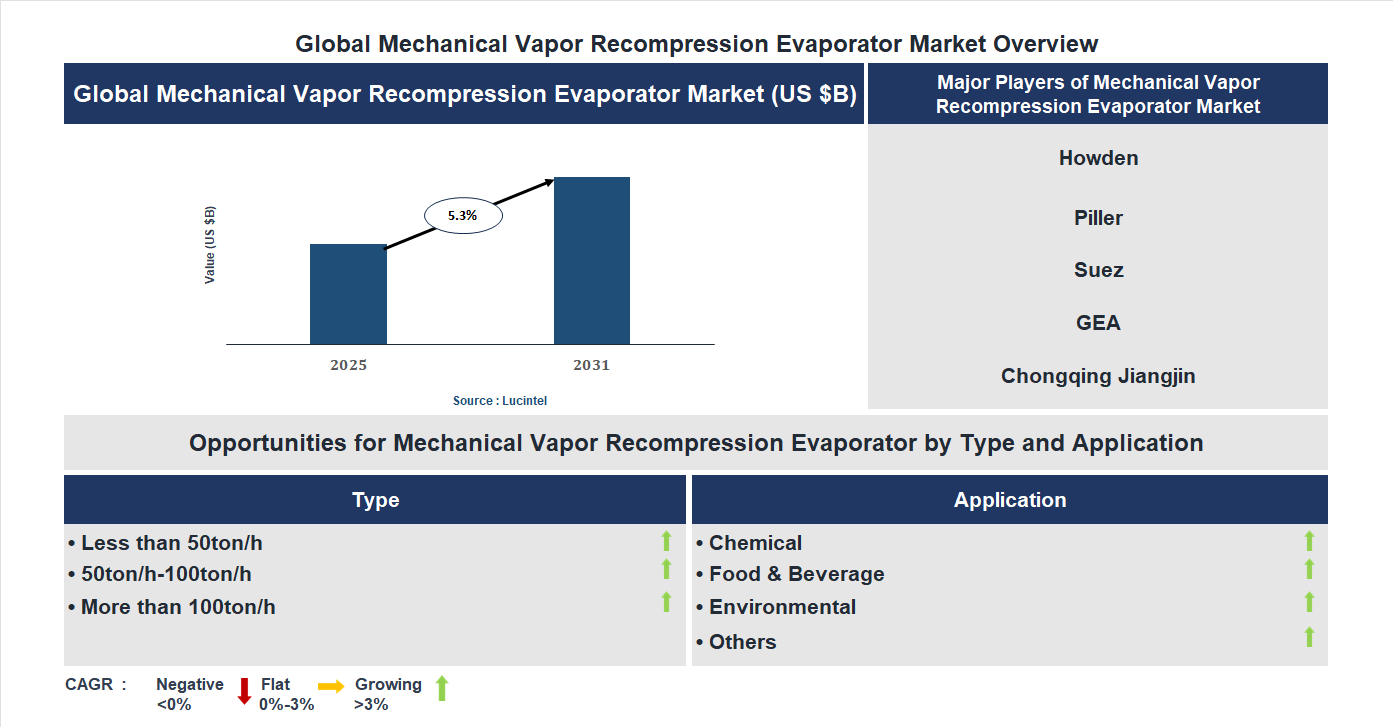
The future of the global mechanical vapor recompression evaporator market looks promising with opportunities in the chemical, food & beverage, and environmental markets. The global mechanical vapor recompression evaporator market is expected to grow with a CAGR of 5.3% from 2025 to 2031. The major drivers for this market are the increasing demand for energy-efficient wastewater treatment, the rising focus on industrial effluent recycling, and the growing adoption of zero liquid discharge systems.• Lucintel forecasts that, within the type category, more than 100ton/h is expected to witness the highest growth over the forecast period.
• Within the application category, environmental is expected to witness the highest growth.
• In terms of region, APAC is expected to witness the highest growth over the forecast period. Gain valuable insights for your business decisions with our comprehensive 150+ page report. Sample figures with some insights are shown below.
Emerging Trends in the Mechanical Vapor Recompression Evaporator Market
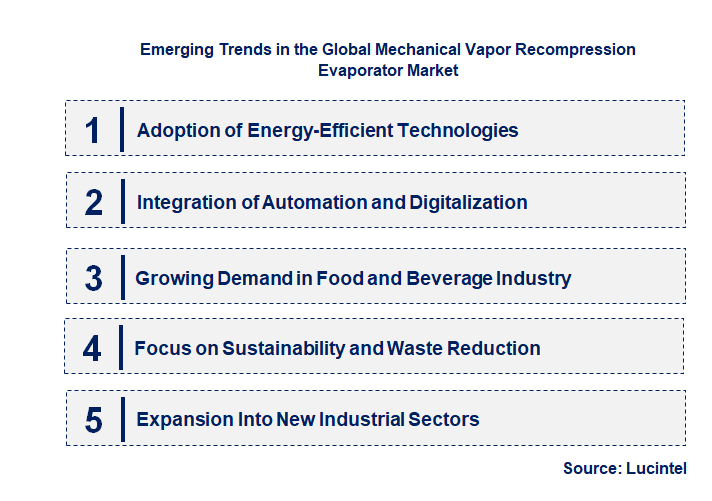
The mechanical vapor recompression evaporator market is experiencing rapid growth driven by technological advancements, increasing environmental concerns, and the demand for energy-efficient solutions across various industries. As industries seek sustainable and cost-effective methods for liquid concentration and waste management, the market is evolving with innovative designs and applications. These developments are not only enhancing operational efficiency but also reducing environmental impact, making MVR evaporators a preferred choice globally. The following key trends highlight the major shifts shaping this market, reflecting its dynamic nature and future potential.• Adoption of Energy-Efficient Technologies: The market is witnessing a surge in the adoption of energy-efficient MVR systems. These systems utilize less power by recycling vapor, significantly reducing operational costs and carbon footprint. Innovations such as variable frequency drives and advanced heat recovery techniques are enhancing efficiency. This trend is driven by increasing environmental regulations and the need for sustainable industrial processes, making energy-efficient MVR evaporators a critical component for industries aiming to lower energy consumption and operational expenses.
• Integration of Automation and Digitalization: Automation and digital technologies are increasingly integrated into MVR evaporator systems. Smart sensors, IoT connectivity, and real-time monitoring enable precise control and predictive maintenance, minimizing downtime and optimizing performance. This trend improves operational reliability and reduces maintenance costs, appealing to industries seeking to enhance productivity. The digital transformation also facilitates data-driven decision-making, leading to more efficient process management and customization of evaporator systems to specific industrial needs.
• Growing Demand in Food and Beverage Industry: The food and beverage sector is a significant driver of market growth, utilizing MVR evaporators for concentration, dehydration, and waste management. The trend towards natural, preservative-free products increases the need for efficient liquid concentration methods. MVR systems offer rapid, energy-efficient processing that preserves product quality while reducing costs. As consumer preferences shift towards healthier and organic products, the demand for advanced evaporation solutions like MVR is expected to rise, further expanding market opportunities within this industry.
• Focus on Sustainability and Waste Reduction: Environmental concerns are prompting industries to adopt sustainable practices, including waste minimization and water recycling. MVR evaporators contribute by reducing energy consumption and enabling the reuse of process water, aligning with green manufacturing initiatives. This trend is supported by stricter environmental regulations and corporate social responsibility commitments. The ability of MVR systems to operate with minimal environmental impact makes them increasingly attractive, encouraging industries to invest in sustainable evaporation technologies to meet regulatory standards and improve their ecological footprint.
• Expansion into New Industrial Sectors: Beyond traditional applications, MVR evaporators are expanding into new sectors such as pharmaceuticals, chemicals, and textiles. These industries require efficient solvent recovery, concentration, and waste treatment solutions. The trend is driven by the need for cost-effective, scalable, and environmentally friendly processes. Innovations in design and customization are enabling MVR systems to meet diverse industrial requirements, opening new markets and increasing overall adoption. This diversification is expected to sustain market growth and foster technological advancements tailored to specific industry needs. In summary, these emerging trends are transforming the mechanical vapor recompression evaporator market by enhancing energy efficiency, integrating digital technologies, expanding application areas, and emphasizing sustainability. These developments are not only improving operational performance but also aligning the market with global environmental and economic goals, ensuring its continued growth and relevance in various industrial sectors.
Recent Development in the Mechanical Vapor Recompression Evaporator Market
The mechanical vapor recompression evaporator market has experienced significant growth driven by increasing demand for energy-efficient and sustainable evaporation solutions across various industries such as food processing, pharmaceuticals, and chemicals. Technological advancements, environmental regulations, and the need for cost reduction are fueling innovation and adoption in this sector. Companies are investing in research to improve efficiency, reduce operational costs, and minimize environmental impact. The markets evolution reflects a shift towards greener, more sustainable processes, aligning with global sustainability goals. These developments are shaping the future landscape of the MVR evaporator industry, making it more competitive and environmentally conscious.• Technological Innovations: Enhanced efficiency and automation are leading to smarter MVR systems, reducing energy consumption and operational costs. These advancements improve process control and reliability, attracting more industrial users seeking sustainable solutions.
• Environmental Regulations: Stricter environmental standards are pushing industries to adopt eco-friendly evaporation technologies. MVR evaporators, with their lower energy consumption and reduced emissions, are increasingly preferred, boosting market growth.
• Cost Reduction Strategies: Manufacturers are focusing on reducing capital and operational costs through design improvements and material innovations. These strategies make MVR evaporators more accessible to small and medium-sized enterprises, expanding market reach.
• Integration with Renewable Energy: The integration of MVR systems with renewable energy sources like solar and wind is gaining traction. This development enhances sustainability and reduces dependence on conventional energy, appealing to environmentally conscious industries.
• Market Expansion in Emerging Economies: Growing industrialization in regions such as Asia-Pacific and Latin America is driving demand for efficient evaporation solutions. Local manufacturers are adopting advanced MVR technologies to meet increasing processing needs. In summary, these recent developments are significantly impacting the mechanical vapor recompression evaporator market by enhancing efficiency, reducing environmental impact, and expanding market reach. The focus on sustainability and cost-effectiveness is fostering innovation and driving growth across various industries, positioning the market for a more sustainable and competitive future.
Strategic Growth Opportunities in the Mechanical Vapor Recompression Evaporator Market
The mechanical vapor recompression evaporator market is experiencing rapid growth driven by increasing demand for energy-efficient and sustainable solutions across various industries. As industries seek to optimize processes and reduce operational costs, MVR technology offers significant advantages in water recovery, waste minimization, and energy savings. Key applications such as food processing, chemical manufacturing, wastewater treatment, pharmaceuticals, and desalination are pivotal in shaping market expansion. These sectors are adopting MVR evaporators to enhance productivity, comply with environmental regulations, and lower energy consumption. The following are five key growth opportunities within these applications that are propelling the market forward.• Food Processing: MVR evaporators enable food processors to efficiently recover water from waste streams, reducing water consumption and costs. They improve product quality by providing consistent and controlled evaporation processes. This technology supports sustainable practices and helps companies meet stringent environmental standards, thereby expanding their market share and operational efficiency.
• Chemical Manufacturing: In chemical industries, MVR systems facilitate the recovery of solvents and other volatile compounds, minimizing raw material wastage. This leads to significant cost savings and reduces environmental impact. The ability to operate at lower energy levels compared to traditional evaporators makes MVR a preferred choice, fostering growth in chemical processing applications.
• Wastewater Treatment: MVR evaporators are increasingly used in wastewater treatment plants to concentrate and recover water from industrial effluents. Their energy-efficient design reduces operational costs and carbon footprint. This application is critical in regions with strict water regulations, driving demand for sustainable and cost-effective treatment solutions.
• Pharmaceuticals: In pharmaceutical manufacturing, MVR evaporators provide high-purity water and concentrate active ingredients without contamination. Their precise control over temperature and pressure ensures product integrity. The growing pharmaceutical sectors need for reliable and clean processing equipment boosts the adoption of MVR technology.
• Desalination: MVR technology offers an energy-efficient alternative for seawater desalination, producing fresh water with lower energy consumption. As freshwater scarcity intensifies globally, the demand for sustainable desalination solutions increases. MVR systems contribute to reducing operational costs and environmental impact, expanding their application in this sector. In summary, these growth opportunities across key applications are significantly impacting the mechanical vapor recompression evaporator market by driving innovation, reducing energy consumption, and promoting sustainable industrial practices. The adoption of MVR technology across diverse sectors is expected to continue expanding, supporting market growth and environmental goals.
Mechanical Vapor Recompression Evaporator Market Driver and Challenges
The mechanical vapor recompression evaporator market is influenced by a variety of technological, economic, and regulatory factors. Advances in energy-efficient technologies and increasing environmental concerns are driving demand for sustainable solutions. Economic growth in emerging markets boosts industrial activities that rely on efficient evaporation systems. Regulatory frameworks aimed at reducing carbon emissions and promoting water conservation further shape market dynamics. Additionally, innovations in automation and process optimization are enhancing operational efficiencies. However, the market also faces challenges such as high initial capital costs, regulatory compliance complexities, and technological limitations. Understanding these drivers and challenges is essential for stakeholders to navigate the evolving landscape effectively. The factors responsible for driving the mechanical vapor recompression evaporator market include:• Technological Advancements: The development of energy-efficient MVR systems has significantly reduced operational costs and environmental impact. Innovations such as improved heat transfer surfaces and automation enhance process efficiency, making MVR evaporators more attractive across industries like food processing, pharmaceuticals, and wastewater treatment. These technological improvements enable companies to meet stringent environmental regulations while optimizing energy consumption, thereby expanding market adoption.
• Rising Environmental Regulations: Governments worldwide are implementing stricter regulations to curb water usage and reduce greenhouse gas emissions. MVR evaporators, being energy-efficient and eco-friendly, align with these policies. Compliance with standards such as the Clean Water Act and international sustainability commitments encourages industries to adopt MVR technology, driving market growth. This regulatory push also incentivizes innovation and investment in advanced evaporation solutions.
• Increasing Industrialization in Emerging Economies: Rapid industrial growth in countries like China, India, and Brazil is fueling demand for efficient water and waste management solutions. Industries such as textiles, chemicals, and food processing require large-scale evaporation systems, creating a substantial market for MVR evaporators. The expanding industrial base and supportive government initiatives in these regions further accelerate market penetration.
• Cost Savings and Operational Efficiency: MVR evaporators offer significant energy savings compared to traditional evaporation methods. By recycling vapor, they reduce energy consumption and operational costs, providing a compelling value proposition for industries seeking cost-effective solutions. These economic benefits encourage widespread adoption, especially in sectors where operational expenses are critical to profitability. The challenges facing this mechanical vapor recompression evaporator market include:
• High Capital Investment: The initial cost of installing MVR evaporators is substantial, which can be a barrier for small and medium-sized enterprises. The expense associated with advanced equipment, infrastructure modifications, and maintenance deters some potential users. This financial hurdle limits market expansion, particularly in price-sensitive regions, and necessitates favorable financing options or government incentives to promote adoption.
• Regulatory Compliance Complexities: Navigating diverse and evolving environmental regulations across different regions poses a challenge. Companies must ensure their systems meet specific standards, which can involve complex certifications and frequent updates. Non-compliance can lead to penalties and operational disruptions, making regulatory adherence a significant concern that may slow down market growth.
• Technological Limitations and Maintenance: Despite advancements, MVR evaporators can face issues such as scaling, corrosion, and equipment fouling, which impact performance and increase maintenance costs. Technological limitations in handling certain feedwaters or waste streams can restrict application scope. Ensuring reliable operation requires skilled personnel and regular maintenance, adding to operational expenses and potentially hindering widespread adoption. In summary, the mechanical vapor recompression evaporator market is shaped by technological innovations, environmental regulations, and rising industrial demand, which collectively promote growth. However, high capital costs, regulatory complexities, and technological challenges pose significant hurdles. Balancing these drivers and challenges will determine the markets trajectory, with ongoing innovations and supportive policies likely to foster sustainable expansion. Stakeholders must strategically address these factors to capitalize on emerging opportunities and mitigate risks in this evolving landscape.
List of Mechanical Vapor Recompression Evaporator Companies
Companies in the market compete on the basis of product quality offered. Major players in this market focus on expanding their manufacturing facilities, R&D investments, infrastructural development, and leverage integration opportunities across the value chain. With these strategies mechanical vapor recompression evaporator companies cater increasing demand, ensure competitive effectiveness, develop innovative products & technologies, reduce production costs, and expand their customer base. Some of the mechanical vapor recompression evaporator companies profiled in this report include-• Howden
• Piller
• Suez
• GEA
• Chongqing Jiangjin
• Leheng
• ANDRITZ
• IDE
• Leke
• Gardner Denver
Mechanical Vapor Recompression Evaporator Market by Segment
The study includes a forecast for the global mechanical vapor recompression evaporator market by type, application, and region.Mechanical Vapor Recompression Evaporator Market by Type [Value from 2019 to 2031]:
• Less than 50ton/h
• 50ton/h-100ton/h
• More than 100ton/h
Mechanical Vapor Recompression Evaporator Market by Application [Value from 2019 to 2031]:
• Chemical
• Food & Beverage
• Environmental
• Others
Mechanical Vapor Recompression Evaporator Market by Region [Value from 2019 to 2031]:
• North America
• Europe
• Asia Pacific
• The Rest of the World
Country Wise Outlook for the Mechanical Vapor Recompression Evaporator Market
The mechanical vapor recompression evaporator market has experienced significant growth driven by increasing demand for energy-efficient and sustainable solutions across various industries. Technological advancements, environmental regulations, and rising awareness of water conservation have propelled market expansion globally. Countries are investing in innovative MVR technologies to optimize operations and reduce costs. The markets evolution reflects a shift towards greener processes, with key players focusing on product development and strategic collaborations. This dynamic landscape varies across regions, influenced by local industrial needs, regulatory frameworks, and economic conditions, shaping the future trajectory of the MVR evaporator industry.• United States: The U.S. market for MVR evaporators has seen rapid adoption in the food and beverage, pharmaceutical, and wastewater treatment sectors. Innovations in energy recovery systems and automation have enhanced efficiency and reduced operational costs. Regulatory pressures for sustainable practices have further accelerated market growth, with key companies investing in R&D to develop eco-friendly solutions. The U.S. also witnesses increased integration of IoT and smart controls in MVR systems, improving monitoring and maintenance. Overall, the market is poised for steady expansion driven by technological advancements and environmental policies.
• China: China remains a dominant player in the MVR evaporator market, fueled by rapid industrialization and urbanization. The country’s focus on water reuse and wastewater treatment has led to increased demand for energy-efficient evaporation technologies. Local manufacturers are expanding their product portfolios, incorporating advanced materials and automation features. Government initiatives promoting sustainable industrial practices and stricter environmental regulations are further boosting market growth. Additionally, China’s investments in green technology research are fostering innovation in MVR systems, making them more cost-effective and reliable for large-scale applications.
• Germany: Germany’s MVR evaporator market is characterized by high technological sophistication and a strong emphasis on sustainability. The country’s robust chemical, pharmaceutical, and food processing industries are primary consumers of advanced MVR systems. German companies are pioneering innovations in energy recovery and system integration, aiming to minimize environmental impact. Strict EU environmental standards and a focus on circular economy principles are driving the adoption of efficient evaporation solutions. The market benefits from Germany’s reputation for engineering excellence and a proactive approach to environmental regulation, ensuring continued growth and technological leadership.
• India: The Indian MVR evaporator market is witnessing rapid growth due to increasing industrialization and water scarcity issues. The agriculture, textile, and chemical sectors are major consumers, seeking energy-efficient and cost-effective solutions. Government initiatives promoting water conservation and pollution control are encouraging adoption of MVR technology. Local manufacturers are expanding their capacities and adopting innovative designs to cater to diverse applications. The market is also supported by rising investments in infrastructure and industrial development, with a focus on sustainable practices. Overall, India’s market is expected to grow significantly as industries prioritize eco-friendly and energy-efficient processes.
• Japan: Japan’s market for MVR evaporators is driven by its advanced manufacturing sector and stringent environmental regulations. The country emphasizes energy conservation and waste minimization, leading to increased adoption of high-performance MVR systems. Innovations in system automation, energy recovery, and maintenance have enhanced operational efficiency. The pharmaceutical, electronics, and food industries are key markets, benefiting from Japan’s focus on sustainability. Government policies promoting green technology and resource efficiency further support market growth. Japan’s reputation for technological innovation ensures ongoing development of sophisticated MVR solutions, maintaining its position as a leader in the industry.

Features of the Global Mechanical Vapor Recompression Evaporator Market
Market Size Estimates: Mechanical vapor recompression evaporator market size estimation in terms of value ($B). Trend and Forecast Analysis: Market trends (2019 to 2024) and forecast (2025 to 2031) by various segments and regions. Segmentation Analysis: Mechanical vapor recompression evaporator market size by type, application, and region in terms of value ($B). Regional Analysis: Mechanical vapor recompression evaporator market breakdown by North America, Europe, Asia Pacific, and Rest of the World. Growth Opportunities: Analysis of growth opportunities in different types, applications, and regions for the mechanical vapor recompression evaporator market. Strategic Analysis: This includes M&A, new product development, and competitive landscape of the mechanical vapor recompression evaporator market. Analysis of competitive intensity of the industry based on Porter’s Five Forces model.
FAQ
Q1. What is the growth forecast for mechanical vapor recompression evaporator market? Answer: The global mechanical vapor recompression evaporator market is expected to grow with a CAGR of 5.3% from 2025 to 2031. Q2. What are the major drivers influencing the growth of the mechanical vapor recompression evaporator market? Answer: The major drivers for this market are the increasing demand for energy-efficient wastewater treatment, the rising focus on industrial effluent recycling, and the growing adoption of zero liquid discharge systems. Q3. What are the major segments for mechanical vapor recompression evaporator market? Answer: The future of the mechanical vapor recompression evaporator market looks promising with opportunities in the chemical, food & beverage, and environmental markets. Q4. Who are the key mechanical vapor recompression evaporator market companies? Answer: Some of the key mechanical vapor recompression evaporator companies are as follows:• Howden
• Piller
• Suez
• GEA
• Chongqing Jiangjin
• Leheng
• ANDRITZ
• IDE
• Leke
• Gardner Denver Q5. Which mechanical vapor recompression evaporator market segment will be the largest in future? Answer: Lucintel forecasts that, within the type category, more than 100ton/h is expected to witness the highest growth over the forecast period. Q6. In mechanical vapor recompression evaporator market, which region is expected to be the largest in next 5 years? Answer: In terms of region, APAC is expected to witness the highest growth over the forecast period. Q7. Do we receive customization in this report? Answer: Yes, Lucintel provides 10% customization without any additional cost.
Table of Contents
List of Figures
List of Tables
Methodology
- In-depth interviews of the major players in this market
- Detailed secondary research from competitors’ financial statements and published data
- Extensive searches of published works, market, and database information pertaining to industry news, company press releases, and customer intentions
- A compilation of the experiences, judgments, and insights of Lucintel’s professionals, who have analyzed and tracked this market over the years.


Buy Now
Choose a license that fits your team. Instant PDF delivery.
Prices exclude taxes. Instant delivery. Custom licensing available on request.
Key Questions
- • What are some of the most promising, high-growth opportunities for the mechanical vapor recompression evaporator market by type (less than 50ton/h, 50ton/h-100ton/h, and more than 100ton/h), application (chemical, food & beverage, environmental, and others), and region (North America, Europe, Asia Pacific, and the Rest of the World)?
- • Which segments will grow at a faster pace and why?
- • Which region will grow at a faster pace and why?
- • What are the key factors affecting market dynamics? What are the key challenges and business risks in this market?
- • What are the business risks and competitive threats in this market?
- • What are the emerging trends in this market and the reasons behind them?
- • What are some of the changing demands of customers in the market?
- • What are the new developments in the market? Which companies are leading these developments?
- • Who are the major players in this market? What strategic initiatives are key players pursuing for business growth?
- • What are some of the competing products in this market and how big of a threat do they pose for loss of market share by material or product substitution?
- • What M&A activity has occurred in the last 5 years and what has its impact been on the industry? For any questions related to Mechanical Vapor Recompression Evaporator Market, Mechanical Vapor Recompression Evaporator Market Size, Mechanical Vapor Recompression Evaporator Market Growth, Mechanical Vapor Recompression Evaporator Market Analysis, Mechanical Vapor Recompression Evaporator Market Report, Mechanical Vapor Recompression Evaporator Market Share, Mechanical Vapor Recompression Evaporator Market Trends, Mechanical Vapor Recompression Evaporator Market Forecast, Mechanical Vapor Recompression Evaporator Companies, write Lucintel analyst at email: helpdesk@lucintel.com. We will be glad to get back to you soon.


