
Report Feature
Mechanical and Electronic Fuze Market Trends and Forecast
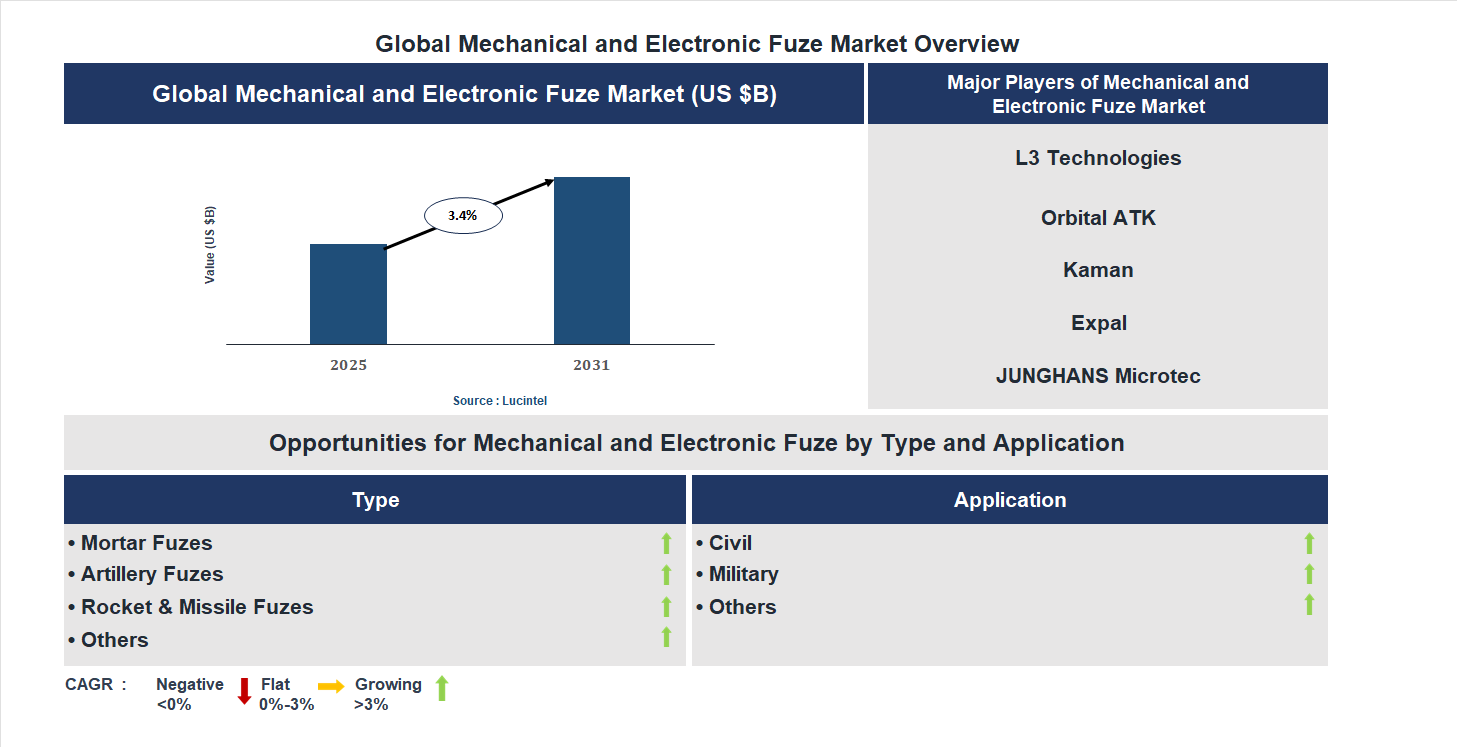
The future of the global mechanical and electronic fuze market looks promising with opportunities in the civil and military markets. The global mechanical and electronic fuze market is expected to grow with a CAGR of 3.4% from 2025 to 2031. The major drivers for this market are the increasing defense modernization & weapon system upgrades, the rising demand for precision-guided munitions technology, and the growing investment in advanced military infrastructure.• Lucintel forecasts that, within the type category, rocket & missile fuze is expected to witness the highest growth over the forecast period.
• Within the application category, military is expected to witness higher growth.
• In terms of region, APAC is expected to witness the highest growth over the forecast period. Gain valuable insights for your business decisions with our comprehensive 150+ page report. Sample figures with some insights are shown below.
Emerging Trends in the Mechanical and Electronic Fuze Market
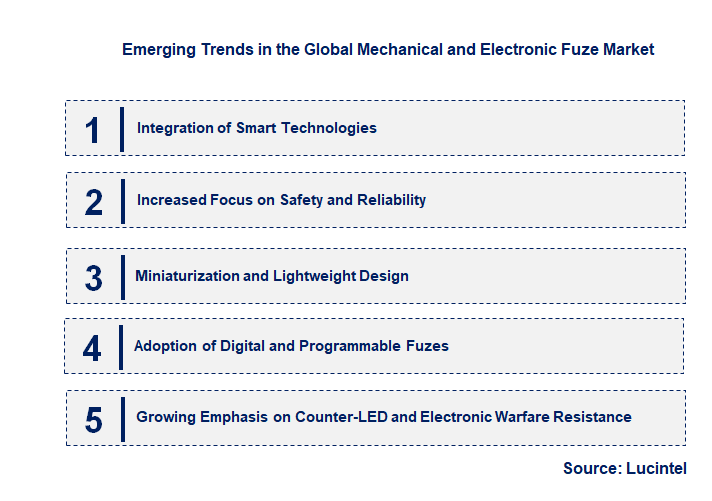
The mechanical and electronic fuze market is experiencing rapid evolution driven by technological advancements, safety requirements, and changing defense strategies. As military and civilian applications demand more reliable, precise, and adaptable fuzes, industry players are innovating to meet these needs. Emerging trends are shaping the future landscape, influencing product development, manufacturing processes, and market dynamics. These developments are not only enhancing operational efficiency but also addressing safety concerns and regulatory standards. Understanding these key trends is essential for stakeholders aiming to stay competitive and leverage new opportunities in this dynamic market environment.• Integration of Smart Technologies: The market is witnessing a shift towards smart fuzes equipped with sensors and microprocessors. These fuzes can adapt to different conditions, provide real-time data, and improve targeting accuracy. Companies like safran and dynamit nobel are developing electronic fuzes with enhanced programmability and safety features. This trend enhances operational flexibility, reduces collateral damage, and improves safety protocols, making military operations more precise and efficient.
• Increased Focus on Safety and Reliability: Safety standards are becoming more stringent, prompting manufacturers to innovate safer fuze designs. Electronic fuzes with fail-safe mechanisms and self-diagnostic capabilities are gaining prominence. firms like moog and general dynamics are investing in research to develop fuzes that minimize accidental detonation risks and ensure reliable performance under extreme conditions. This trend boosts confidence among users and aligns with regulatory requirements, ultimately reducing operational hazards.
• Miniaturization and Lightweight Design: The demand for smaller, lighter fuzes is rising, especially for use in compact munitions and drone applications. Advances in materials and electronic components enable manufacturers like ordnance and lockheed martin to produce miniaturized fuzes without compromising performance. This trend allows for increased payload capacity, longer operational ranges, and enhanced maneuverability, broadening the scope of applications across military and civilian sectors.
• Adoption of Digital and Programmable Fuzes: Digital fuzes with programmable settings are replacing traditional mechanical types. They offer greater flexibility, allowing customization for specific missions and environments. Companies such as raytheon and bae systems are developing digital fuzes that can be reprogrammed in the field, providing tactical advantages. This trend improves mission success rates, reduces logistics complexity, and enables rapid adaptation to changing battlefield conditions.
• Growing Emphasis on Counter-IED and Electronic Warfare Resistance: As threats from improvised explosive devices (IEDs) and electronic warfare increase, fuzes are being designed with enhanced resistance features. Electronic counter-countermeasures (ECCM) and hardened circuits are integrated to prevent jamming and hacking. firms like thales and safran are innovating in this area to ensure fuze functionality in electronic warfare environments. This trend is critical for maintaining operational integrity and survivability in modern combat scenarios. In summary, these trends are fundamentally transforming the mechanical and electronic fuze market by enhancing safety, precision, adaptability, and resistance to emerging threats. They are enabling more sophisticated, reliable, and versatile munitions, which are crucial for modern defense strategies and applications. As these developments continue, the market is poised for significant growth and innovation, driven by technological progress and evolving security needs.
Recent Development in the Mechanical and Electronic Fuze Market
The mechanical and electronic fuze market has experienced significant advancements driven by technological innovation, increasing defense budgets, and evolving military strategies. These developments aim to enhance weapon accuracy, safety, and reliability while addressing emerging threats. As nations invest in modernizing their armed forces, the market is witnessing a surge in new product launches, integration of smart technology, and increased focus on safety features. The following key developments highlight the current trajectory of this market, reflecting its dynamic nature and the growing importance of precision and safety in modern warfare.• technological integration: companies like boeing and lockheed martin are integrating electronic components into traditional fuzes, improving targeting accuracy and enabling remote detonation capabilities, which enhance operational flexibility and reduce collateral damage.
• safety enhancements: firms such as raytheon are developing advanced safety mechanisms in fuzes, including self-destruct and safe-arming features, significantly reducing accidental detonations and increasing user confidence in military operations.
• miniaturization and lightweight design: manufacturers like safran are focusing on reducing the size and weight of fuzes, facilitating their use in smaller munitions and improving overall weapon system efficiency without compromising performance.
• increased use of smart fuzes: companies such as general dynamics are advancing smart fuze technology that incorporates sensors and data processing, allowing for target discrimination, environmental adaptation, and increased mission success rates.
• regional market expansion: emerging markets in asia-pacific and middle east are witnessing increased procurement of advanced fuzes, driven by modernization programs and regional security concerns, expanding the global market footprint. The recent developments in the Mechanical and Electronic Fuze Market are significantly impacting the industry by enhancing weapon safety, precision, and operational efficiency. The integration of smart technology and miniaturization are enabling more versatile and reliable munitions, while safety improvements are reducing risks during handling and deployment. Regional expansion indicates growing global demand, fostering innovation and competition among key players. Overall, these advancements are shaping a more sophisticated, safe, and effective fuze market, aligning with modern military needs and technological progress.
Strategic Growth Opportunities in the Mechanical and Electronic Fuze Market
The mechanical and electronic fuze market is experiencing rapid evolution driven by technological advancements and increasing demand across various industries such as defense, aerospace, and industrial safety. As applications diversify, companies are exploring innovative growth opportunities to enhance performance, reliability, and safety standards. These developments are shaping the future landscape of the market, offering new avenues for expansion and competitive advantage. Key growth opportunities are emerging across different application segments, reflecting the markets dynamic nature and the need for strategic adaptation by industry players.• Defense Applications: Enhanced precision and reliability : The integration of electronic fuzes in defense systems improves targeting accuracy and safety, leading to increased adoption in military munitions. Companies like lockheed martin are investing in advanced electronic fuze technology to meet stringent defense standards, boosting market growth and operational effectiveness.
• Aerospace Industry: Weight reduction and miniaturization : The aerospace sector benefits from compact, lightweight electronic fuzes that contribute to overall aircraft efficiency. firms such as boeing are adopting innovative fuze designs to meet strict weight and safety regulations, expanding market opportunities in commercial and military aviation.
• Industrial Safety: Automation and remote operation : The rise of automated safety systems in industrial settings is driving demand for electronic fuzes capable of remote activation and monitoring. companies like honeywell are developing smart fuze solutions that enhance safety protocols, reducing accidents and downtime.
• Mining and Construction: Durability and environmental resistance : Fuzes designed to withstand harsh conditions are critical in mining and construction applications. firms such as caterpillar are focusing on ruggedized electronic fuzes that ensure operational reliability in extreme environments, opening new market segments.
• Space Exploration: High-performance and reliability : The space industry demands highly reliable fuzes for spacecraft and satellite deployment. companies like northrop grumman are innovating in electronic fuze technology to meet the rigorous standards of space missions, fostering growth in this niche market. In summary, these growth opportunities across defense, aerospace, industrial safety, mining, and space exploration are significantly impacting the mechanical and electronic fuze market. They are driving innovation, expanding application scopes, and enhancing safety and performance standards, ultimately fueling market expansion and competitive differentiation.
Mechanical and Electronic Fuze Market Driver and Challenges
The mechanical and electronic fuze market is influenced by a variety of technological, economic, and regulatory factors. Advances in military and defense technology, increasing security concerns, and evolving regulations around weapon safety and control are shaping the market landscape. Additionally, the integration of electronic components into traditional fuzes offers enhanced precision and reliability, driving innovation. Economic factors such as defense budgets and geopolitical tensions also play a significant role in market growth. However, challenges such as regulatory restrictions, technological complexities, and supply chain disruptions pose hurdles. Understanding these drivers and challenges is essential for stakeholders aiming to capitalize on market opportunities and navigate potential risks effectively. The factors responsible for driving the Mechanical and Electronic Fuze Market include:• Technological Advancements: The continuous development of more sophisticated and reliable fuzes, especially electronic variants, is a key driver. These innovations improve safety, accuracy, and operational efficiency, making them highly desirable for modern defense systems. The integration of sensors, microprocessors, and remote activation capabilities enhances functionality, meeting the demands of contemporary warfare. As military forces seek smarter weapon systems, the market benefits from increased R&D investments and technological breakthroughs, fostering growth and competitiveness.
• Rising Defense Budgets: Governments worldwide are increasing their defense spending to modernize armed forces and enhance national security. This surge in budgets directly correlates with higher procurement of advanced fuzes, including electronic types. Countries are investing in upgrading existing arsenals and developing new weapon systems, which require reliable fuzing solutions. The sustained financial commitment from defense agencies ensures a steady demand, supporting market expansion and innovation.
• Geopolitical Tensions and Conflicts: Ongoing regional conflicts and geopolitical tensions drive the need for advanced weaponry, including sophisticated fuzes. Military forces seek reliable, precise, and adaptable fuzing systems to improve combat effectiveness. These tensions prompt rapid procurement and deployment of new systems, fueling market growth. The demand for electronic fuzes, with their enhanced capabilities, increases as nations aim to maintain strategic superiority and respond swiftly to emerging threats.
• Regulatory and Safety Standards: Stringent regulations governing the safety, testing, and deployment of munitions influence the market. Compliance with international standards ensures operational safety and reduces risks of accidental detonation. These regulations encourage the development of more reliable and safer fuzes, particularly electronic variants with built-in safety features. While compliance can pose challenges for manufacturers, it ultimately promotes innovation and higher quality standards within the industry. The challenges in the mechanical and electronic fuze market are:
• Regulatory Restrictions: Strict international and national regulations on the manufacturing, export, and use of munitions and fuzes can hinder market growth. These restrictions often involve complex approval processes, export controls, and compliance requirements, which can delay product development and deployment. Additionally, geopolitical considerations may restrict access to certain markets, limiting growth opportunities for manufacturers. Navigating these regulatory landscapes requires significant resources and expertise, posing a barrier for smaller players and slowing overall market expansion.
• Technological Complexities: Developing electronic fuzes involves sophisticated technology, including microprocessors, sensors, and communication systems. Ensuring reliability, durability, and safety under extreme conditions is challenging. Technological failures or vulnerabilities can compromise mission success and safety, leading to increased R&D costs and longer development cycles. The rapid pace of technological change also demands continuous innovation, which can strain resources and expertise, potentially hindering market progress.
• Supply Chain Disruptions: The manufacturing of fuzes relies on a complex global supply chain for electronic components, raw materials, and specialized manufacturing equipment. Disruptions caused by geopolitical tensions, trade restrictions, or pandemics can lead to delays, increased costs, and shortages. These supply chain issues impact production schedules and delivery timelines, affecting customer satisfaction and market competitiveness. Ensuring a resilient supply chain is critical but challenging, especially given the sensitive nature of the components involved. In summary, the Mechanical and Electronic Fuze Market is driven by technological innovation, increased defense spending, geopolitical tensions, and regulatory standards. These factors collectively promote growth by fostering advanced, reliable, and safe fuzing solutions. However, challenges such as regulatory restrictions, technological complexities, and supply chain disruptions pose significant hurdles. Overcoming these obstacles requires strategic planning, innovation, and regulatory compliance. The markets future will depend on how effectively stakeholders can leverage drivers while mitigating challenges, ensuring sustained growth and technological advancement in defense applications.
List of Mechanical and Electronic Fuze Companies
Companies in the market compete on the basis of product quality offered. Major players in this market focus on expanding their manufacturing facilities, R&D investments, infrastructural development, and leverage integration opportunities across the value chain. With these strategies mechanical and electronic fuze companies cater increasing demand, ensure competitive effectiveness, develop innovative products & technologies, reduce production costs, and expand their customer base. Some of the mechanical and electronic fuze companies profiled in this report include-• L3 Technologies
• Orbital ATK
• Kaman
• Expal
• JUNGHANS Microtec
• Reutech Fuchs Electronics
• DIXI Microtechniques
• Anhui Great Wall Military Industry
• Sandeep Metalcraft
• Reshef Technologies
Mechanical and Electronic Fuze Market by Segment
The study includes a forecast for the global mechanical and electronic fuze market by type, application, and region.Mechanical and Electronic Fuze Market by Type [Value from 2019 to 2031]:
• Mortar Fuzes
• Artillery Fuzes
• Rocket & Missile Fuzes
• Others
Mechanical and Electronic Fuze Market by Application [Value from 2019 to 2031]:
• Civil
• Military
• Others
Mechanical and Electronic Fuze Market by Region [Value from 2019 to 2031]:
• North America
• Europe
• Asia Pacific
• The Rest of the World
Country Wise Outlook for the Mechanical and Electronic Fuze Market
The mechanical and electronic fuze market has experienced significant shifts driven by technological advancements, regulatory changes, and evolving defense strategies across the globe. Countries are investing heavily in research and development to enhance safety, reliability, and performance of fuzes used in military and aerospace applications. The integration of electronic components has revolutionized traditional mechanical fuzes, offering improved precision and adaptability. As geopolitical tensions rise, nations are prioritizing domestic production and innovation to reduce dependency on imports. These developments reflect a broader trend towards smarter, more reliable, and versatile fuze systems, shaping the future landscape of defense technology worldwide.• United States: The US defense sector, led by companies like raytheon and lockheed martin, has focused on integrating electronic fuzes with advanced sensors and smart technology. Recent innovations include the development of multi-mode fuzes capable of adapting to various target types, enhancing battlefield effectiveness. The US government has increased funding for research into autonomous and networked fuze systems, emphasizing safety and precision. Regulatory standards have also evolved to incorporate electronic safety features, ensuring better performance and reduced accidental detonation risks. Domestic manufacturing initiatives aim to bolster supply chain resilience amid geopolitical uncertainties.
• China: China’s defense industry, with key players such as norinco and china electronics technology group corporation, has made rapid progress in developing electronic and smart fuzes. Recent developments include the deployment of multi-functional fuzes with enhanced sensitivity and remote control capabilities. The country is investing heavily in indigenous technology to reduce reliance on foreign components, focusing on miniaturization and integration of electronic systems. China’s military modernization efforts emphasize the use of electronic fuzes in missile and artillery systems, improving accuracy and operational flexibility. Regulatory frameworks are also evolving to support domestic innovation and export potential.
• Germany: Germany’s defense companies, including Rheinmetall and Krauss-Maffei Wegmann, are advancing in the field of electronic fuzes by incorporating cutting-edge safety and environmental features. Recent developments highlight the integration of electronic fuzes with digital battlefield systems, enabling real-time targeting adjustments. Germany emphasizes compliance with strict safety standards and environmental regulations, leading to innovations in eco-friendly materials and design. The focus remains on enhancing the reliability and precision of fuzes used in land and air defense systems. Collaborative efforts with NATO allies are fostering standardization and joint development projects, strengthening Germany’s position in the global market.
• India: India’s defense sector, with companies like drdo and ordnance factory board, is increasingly adopting electronic and smart fuze technologies. Recent advancements include the development of indigenous electronic fuzes for artillery and missile systems, reducing dependence on foreign imports. The government’s push for self-reliance has accelerated innovation in miniaturization, remote operation, and multi-mode functionality. India is also focusing on upgrading existing systems with electronic fuzes to improve accuracy and safety. Strategic partnerships and technology transfers are facilitating rapid development, with an emphasis on creating cost-effective solutions suitable for diverse operational environments.
• Japan: Japan’s defense industry, led by companies such as mitsubishi and toshiba, is advancing electronic fuze technology with a focus on precision, safety, and environmental sustainability. Recent innovations include the integration of electronic fuzes with advanced sensors and digital control systems for missile and artillery applications. Japan emphasizes high reliability and safety standards, incorporating fail-safe mechanisms and environmental considerations. The country is also investing in research to develop electronic fuzes that can operate effectively in harsh conditions. Collaboration with international partners and adherence to strict regulatory standards are driving the development of sophisticated, eco-friendly fuze systems suitable for Japan’s defense needs.

Features of the Global Mechanical and Electronic Fuze Market
Market Size Estimates: Mechanical and electronic fuze market size estimation in terms of value ($B). Trend and Forecast Analysis: Market trends (2019 to 2024) and forecast (2025 to 2031) by various segments and regions. Segmentation Analysis: Mechanical and electronic fuze market size by type, application, and region in terms of value ($B). Regional Analysis: Mechanical and electronic fuze market breakdown by North America, Europe, Asia Pacific, and Rest of the World. Growth Opportunities: Analysis of growth opportunities in different types, applications, and regions for the mechanical and electronic fuze market. Strategic Analysis: This includes M&A, new product development, and competitive landscape of the mechanical and electronic fuze market. Analysis of competitive intensity of the industry based on Porter’s Five Forces model.
FAQ
Q1. What is the growth forecast for mechanical and electronic fuze market? Answer: The global mechanical and electronic fuze market is expected to grow with a CAGR of 3.4% from 2025 to 2031. Q2. What are the major drivers influencing the growth of the mechanical and electronic fuze market? Answer: The major drivers for this market are the increasing defense modernization & weapon system upgrades, the rising demand for precision-guided munitions technology, and the growing investment in advanced military infrastructure. Q3. What are the major segments for mechanical and electronic fuze market? Answer: The future of the mechanical and electronic fuze market looks promising with opportunities in the civil and military markets. Q4. Who are the key mechanical and electronic fuze market companies? Answer: Some of the key mechanical and electronic fuze companies are as follows:• L3 Technologies
• Orbital ATK
• Kaman
• Expal
• JUNGHANS Microtec
• Reutech Fuchs Electronics
• DIXI Microtechniques
• Anhui Great Wall Military Industry
• Sandeep Metalcraft
• Reshef Technologies Q5. Which mechanical and electronic fuze market segment will be the largest in future? Answer: Lucintel forecasts that, within the type category, rocket & missile fuze is expected to witness the highest growth over the forecast period. Q6. In mechanical and electronic fuze market, which region is expected to be the largest in next 5 years? Answer: In terms of region, APAC is expected to witness the highest growth over the forecast period. Q7. Do we receive customization in this report? Answer: Yes, Lucintel provides 10% customization without any additional cost.
Table of Contents
List of Figures
List of Tables
Methodology
- In-depth interviews of the major players in this market
- Detailed secondary research from competitors’ financial statements and published data
- Extensive searches of published works, market, and database information pertaining to industry news, company press releases, and customer intentions
- A compilation of the experiences, judgments, and insights of Lucintel’s professionals, who have analyzed and tracked this market over the years.


Buy Now
Choose a license that fits your team. Instant PDF delivery.
Prices exclude taxes. Instant delivery. Custom licensing available on request.
Key Questions
- • What are some of the most promising, high-growth opportunities for the mechanical and electronic fuze market by type (mortar fuzes, artillery fuzes, rocket & missile fuzes, and others), application (civil, military, and others), and region (North America, Europe, Asia Pacific, and the Rest of the World)?
- • Which segments will grow at a faster pace and why?
- • Which region will grow at a faster pace and why?
- • What are the key factors affecting market dynamics? What are the key challenges and business risks in this market?
- • What are the business risks and competitive threats in this market?
- • What are the emerging trends in this market and the reasons behind them?
- • What are some of the changing demands of customers in the market?
- • What are the new developments in the market? Which companies are leading these developments?
- • Who are the major players in this market? What strategic initiatives are key players pursuing for business growth?
- • What are some of the competing products in this market and how big of a threat do they pose for loss of market share by material or product substitution?
- • What M&A activity has occurred in the last 5 years and what has its impact been on the industry? For any questions related to Mechanical and Electronic Fuze Market, Mechanical and Electronic Fuze Market Size, Mechanical and Electronic Fuze Market Growth, Mechanical and Electronic Fuze Market Analysis, Mechanical and Electronic Fuze Market Report, Mechanical and Electronic Fuze Market Share, Mechanical and Electronic Fuze Market Trends, Mechanical and Electronic Fuze Market Forecast, Mechanical and Electronic Fuze Companies, write Lucintel analyst at email: helpdesk@lucintel.com. We will be glad to get back to you soon.


