
Report Feature
Mattress Market Trends and Forecast
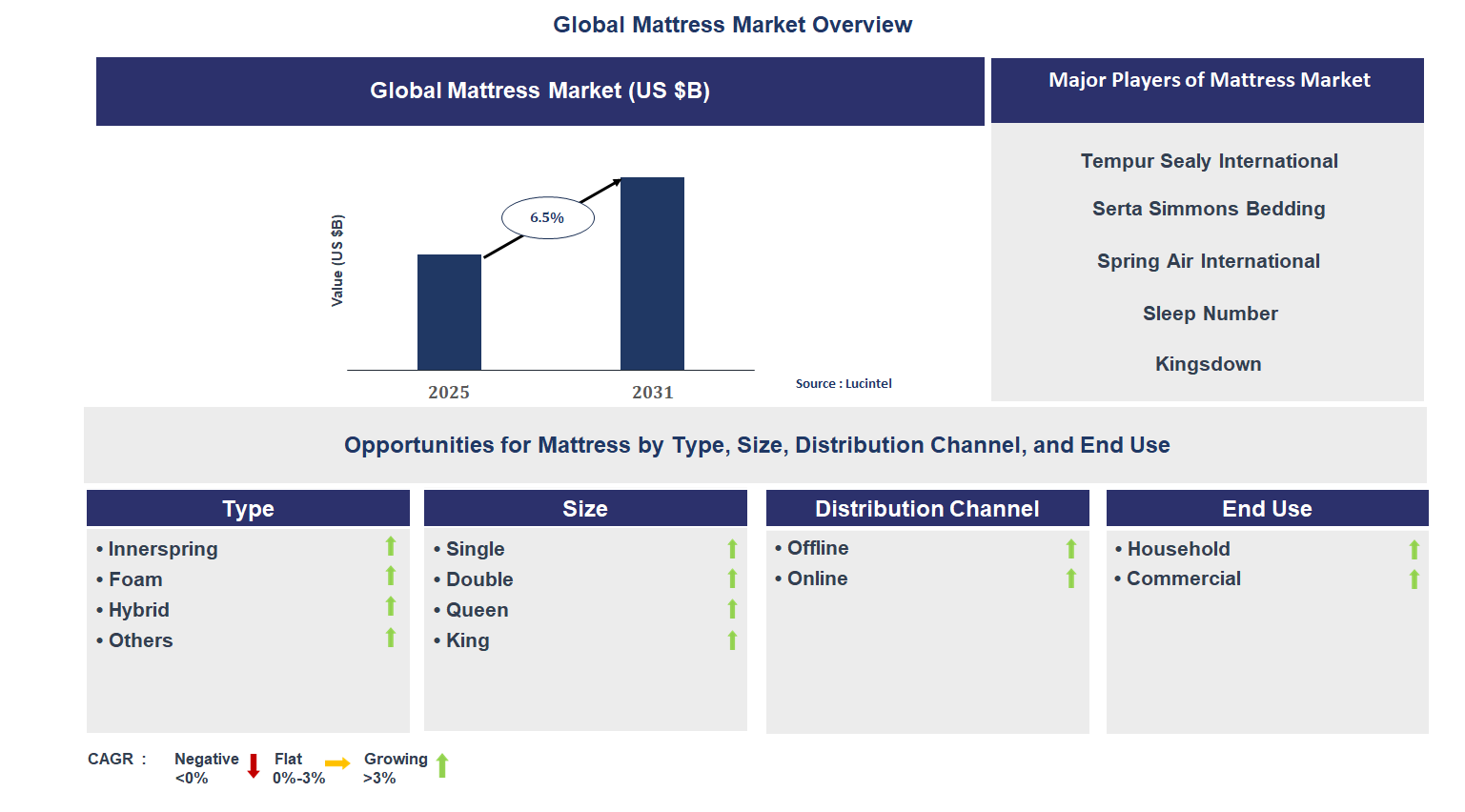
The future of the global mattress market looks promising with opportunities in the household and commercial markets. The global mattress market is expected to grow with a CAGR of 6.5% from 2025 to 2031. The major drivers for this market are the increasing consumer focus on sleep quality, the rising awareness of health benefits of mattresses, and the growing demand for eco-friendly mattress materials.• Lucintel forecasts that, within the type category, foam is expected to witness the highest growth over the forecast period.
• Within the end use category, household is expected to witness higher growth.
• In terms of region, APAC is expected to witness the highest growth over the forecast period. Gain valuable insights for your business decisions with our comprehensive 150+ page report. Sample figures with some insights are shown below.
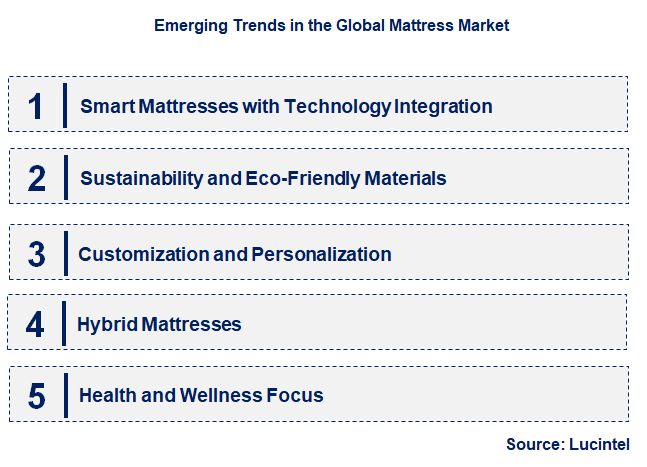
Emerging Trends in the Mattress Market
The mattress industry is rapidly evolving, with emerging trends driven by innovation in materials, sleep technology, and consumer preferences for health and sustainability. These trends reflect a significant shift towards personalized sleep experiences, environmental responsibility, and smart technology integration, reshaping the way consumers approach their sleep and mattress purchases.• Smart Mattresses with Technology Integration: Smart mattresses equipped with sensors to monitor sleep patterns and adjust firmness or temperature are gaining popularity. These mattresses enhance sleep quality by adapting to the user’s needs throughout the night. Features like sleep tracking, automatic adjustments, and integration with smart home systems are increasing consumer interest in high-tech sleep solutions.
• Sustainability and Eco-Friendly Materials: Eco-conscious consumers are increasingly looking for mattresses made from sustainable and non-toxic materials. Brands are focusing on organic fabrics, natural latex, and memory foam alternatives, while reducing carbon footprints. Sustainability is a growing consumer concern, prompting manufacturers to adopt green certifications and eco-friendly practices in production, further influencing market demand.
• Customization and Personalization: Consumers are increasingly seeking personalized mattress solutions that cater to their unique sleep needs. Adjustable firmness levels, temperature control, and customized support features are becoming common in mattress offerings. This trend is enabling manufacturers to differentiate themselves by offering individualized sleep experiences, which can improve customer satisfaction and brand loyalty.
• Hybrid Mattresses: The rise of hybrid mattresses, which combine the benefits of innerspring and memory foam, has been a key trend in the market. These mattresses offer a balance of support and comfort, making them highly attractive to a wide range of consumers. Hybrid models are quickly gaining market share as they cater to diverse sleep preferences and needs.
• Health and Wellness Focus: With growing awareness of the importance of sleep for overall health, consumers are increasingly prioritizing health-centric features in their mattresses. Orthopedic designs, spinal support, and pressure-relieving materials are key considerations. As wellness continues to be a major driver in consumer purchasing decisions, the mattress industry is aligning its products to meet these health-driven demands. These trends reflect a deeper shift in consumer expectations, blending health, sustainability, technology, and convenience. As mattress brands adapt, the industry is becoming more personalized, eco-conscious, and tech-driven, ushering in a new era of sleep innovation.
Recent Development in the Mattress Market
Several recent developments are shaping the global mattress market, including innovations in sleep technology, the adoption of eco-friendly materials, and growing consumer demand for personalization. These developments reflect broader shifts in consumer behavior and the competitive landscape, as companies strive to meet evolving preferences for comfort, sustainability, and advanced features.• Rise of Direct-to-Consumer Models: A significant development in the mattress market is the growth of direct-to-consumer (DTC) brands, especially through online channels. These companies offer competitive pricing, free trials, and home delivery, challenging traditional retail models. The DTC approach has empowered consumers by offering convenience and lower prices while driving market expansion.
• Introduction of Sleep Technology: Many mattress brands are incorporating advanced sleep technologies, such as smart sensors and sleep tracking, into their products. These innovations allow users to monitor their sleep patterns, adjust firmness, and optimize temperature settings for improved rest. The integration of technology into mattresses is appealing to health-conscious consumers seeking enhanced sleep experiences.
• Sustainability and Green Initiatives: Manufacturers are increasingly adopting sustainable practices, such as using organic, biodegradable, and non-toxic materials. As consumer demand for eco-friendly products rises, companies are shifting towards green certifications, reducing their environmental impact. These efforts are appealing to environmentally conscious buyers, which is fueling the demand for eco-friendly mattresses in the market.
• Growth of Hybrid Mattresses: Hybrid mattresses, combining both foam and innerspring technology, are becoming one of the fastest-growing segments in the mattress market. The hybrid design aims to combine the support of coils with the comfort of foam, creating a balanced sleep surface. This trend is especially attractive to consumers seeking a blend of comfort, support, and durability.
• Pressure on Pricing and Market Competition: With increased competition, manufacturers are being pressured to offer more affordable options without compromising quality. Price wars, combined with innovations in direct-to-consumer sales channels, have led to more competitive pricing strategies in the market. Companies are also introducing discounts, promotions, and bundling options to maintain market share. These developments are reshaping the mattress landscape by integrating innovation, sustainability, and user-centric models. They are setting new benchmarks for quality, service, and technology, driving sustained growth and consumer trust in a highly competitive global market.
Strategic Growth Opportunities in the Mattress Market
The mattress market offers various growth opportunities across different segments, from innovations in sleep technology to the demand for sustainable products. These opportunities reflect changing consumer expectations for personalization, health, and eco-conscious solutions. Companies that focus on these key growth areas are well-positioned to capture new market share.• Expansion of Smart Mattress Offerings: As consumers seek more personalized and connected sleep experiences, smart mattresses that integrate with sleep-tracking apps and smart home devices are becoming a prime growth opportunity. These mattresses monitor health metrics like sleep quality, breathing patterns, and body temperature, providing consumers with valuable insights and tailored sleep solutions.
• Eco-Friendly and Sustainable Products: With increasing environmental awareness, the demand for sustainable mattresses made from organic materials, natural latex, and non-toxic foams is growing. Companies that invest in eco-friendly manufacturing processes and materials will benefit from rising consumer demand for green products, helping to capture environmentally conscious market segments.
• Online and Direct-to-Consumer Sales Models: The shift towards online shopping has opened new opportunities for mattress companies to reach consumers directly. Offering competitive pricing, free trials, and delivery services, online brands can attract a broad customer base and disrupt traditional retail models. Investing in digital marketing and e-commerce platforms is key to capturing this growing market.
• Health and Wellness-Oriented Mattresses: As consumers become more health-conscious, mattresses designed for specific health needs, such as orthopedic support, pressure relief, and spinal alignment, are gaining traction. Brands that focus on the wellness aspect of sleep and offer specialized products for conditions like back pain or sleep apnea can tap into a niche but lucrative market.
• Customization and Personalization: Offering customizable mattresses that allow consumers to choose firmness, material, and even adjustable features such as temperature regulation represents a significant growth opportunity. Providing personalized sleep experiences can enhance customer satisfaction and loyalty, leading to increased demand for such products. Strategic growth opportunities in the mattress market span healthcare, luxury, and digital integration. By targeting niche segments and aligning with evolving lifestyles, brands can diversify offerings and solidify their presence across both premium and mass-market categories.
Mattress Market Driver and Challenges
The mattress market is shaped by several technological, economic, and regulatory factors. Key drivers include advancements in sleep technology, consumer demand for customization, and increased focus on sustainability. However, challenges such as rising material costs and intense competition also play a significant role in shaping the market landscape. The factors responsible for driving the mattress market include: 1. Technological Innovations: The introduction of sleep-tracking technologies and smart mattresses is a major driver in the market. Consumers are increasingly seeking products that help optimize their sleep quality, such as adjustable firmness, smart sensors, and temperature regulation features. These advancements are revolutionizing the market, leading to greater demand for high-tech solutions. 2. Consumer Demand for Personalization: The desire for customized sleep experiences is driving the growth of personalized mattresses. Consumers are seeking products that cater to their specific comfort preferences, such as adjustable firmness and customized support. Companies offering customizable mattresses are gaining market share by meeting these consumer demands. 3. Growing Health Consciousness: With increased awareness of the link between sleep and overall health, consumers are prioritizing mattresses that provide enhanced comfort, support, and pain relief. Products that offer orthopedic benefits, pressure relief, and spinal alignment are becoming more popular, as health-conscious consumers focus on improving their sleep quality. 4. Sustainability Focus: The rising demand for sustainable and eco-friendly products is a significant driver in the mattress market. Consumers are becoming more environmentally conscious and are seeking mattresses made from organic, biodegradable, and non-toxic materials. Manufacturers who prioritize sustainability are benefiting from this growing trend. 5. Increase in Disposable Income: As disposable incomes rise in many regions, especially in emerging markets like India and China, consumers are more willing to invest in premium mattresses. This increase in purchasing power is driving demand for high-quality, luxury mattresses, which offer better comfort and advanced features like memory foam and hybrid designs. Challenges in the mattress market are: 1. Rising Material Costs: The cost of raw materials for mattresses, such as foam, fabric, and springs, has increased in recent years. This poses a challenge for manufacturers, who must balance rising production costs with consumer expectations for affordable prices. Companies need to find ways to maintain profit margins while keeping products accessible to consumers. 2. Intense Competition: The mattress market is highly competitive, with numerous brands offering similar products at various price points. This saturation makes it difficult for companies to differentiate themselves and maintain market share. Brands need to focus on innovation, marketing, and customer loyalty to stand out in a crowded market. 3. Regulatory Compliance: The mattress industry is subject to various regulations regarding materials, fire safety, and emissions. Compliance with these standards can be costly and time-consuming for manufacturers. Additionally, stricter regulations on sustainability and environmental impact may further increase operational costs for companies. The mattress market is evolving rapidly, driven by consumer demands for better sleep quality, technological integration, and sustainability. Innovations in smart mattresses, customization, and eco-friendly products are reshaping the market. However, challenges such as rising costs and intense competition require manufacturers to be strategic in their approach. As the market continues to grow, companies that adapt to these drivers and challenges will be well-positioned for success.List of Mattress Companies
Companies in the market compete on the basis of product quality offered. Major players in this market focus on expanding their manufacturing facilities, R&D investments, infrastructural development, and leverage integration opportunities across the value chain. With these strategies mattress companies cater increasing demand, ensure competitive effectiveness, develop innovative products & technologies, reduce production costs, and expand their customer base. Some of the mattress companies profiled in this report include-• Tempur Sealy International
• Serta Simmons Bedding
• Spring Air International
• Sleep Number
• Kingsdown
• Southerland Sleep
• Hästens
• Casper Sleep
• Silentnight Group Limited
• Emma
Mattress Market by Segment
The study includes a forecast for the global mattress market by type, size, distribution channel, end use, and region.Mattress Market by Type [Value from 2019 to 2031]:
• Innerspring
• Foam
• Hybrid
• Others
Mattress Market by Size [Value from 2019 to 2031]:
• Single
• Double
• Queen
• King
Mattress Market by Distribution Channel [Value from 2019 to 2031]:
• Offline
• Online
Mattress Market by End Use [Value from 2019 to 2031]:
• Household
• Commercial
Mattress Market by Region [Value from 2019 to 2031]:
• North America
• Europe
• Asia Pacific
• The Rest of the World
Country Wise Outlook for the Mattress Market
The global mattress market has experienced significant transformations in recent years, driven by consumer demand for comfort, health, and technological innovations. In markets such as the United States, China, Germany, India, and Japan, there has been a rise in preferences for memory foam, hybrid models, and eco-friendly materials. These changes reflect evolving consumer needs and advancements in mattress technology, driving competition and growth in the industry.• United States: The U.S. mattress market is witnessing a shift towards hybrid and memory foam mattresses, driven by increased consumer interest in sleep quality and health. Brands are embracing online sales models, offering customizable mattresses with adjustable firmness and temperature control. Health-conscious consumers are prioritizing mattresses that offer support for pain relief, leading to the popularity of foam and innerspring hybrids.
• China: In China, the mattress market is growing as urbanization and disposable incomes rise. There is a growing demand for premium sleep solutions, particularly memory foam and hybrid mattresses. Chinese consumers are increasingly focused on comfort, quality, and brand reputation, with manufacturers focusing on advanced manufacturing techniques and eco-friendly materials. The market also sees an uptick in demand for online mattress retailing.
• Germany: Germany’s mattress market is characterized by a strong demand for quality, eco-friendly, and health-oriented products. Consumers are increasingly opting for organic and sustainable mattresses, such as those made from natural latex and non-toxic materials. The rise of online retail has led to greater competition, with companies offering customizable mattresses and value-added services, such as free trial periods and delivery options.
• India: In India, the mattress market is expanding rapidly due to rising disposable incomes, urbanization, and changing lifestyles. Consumers are showing greater awareness of the importance of sleep quality and are gravitating towards high-end memory foam and spring mattresses. Manufacturers are introducing more affordable products while focusing on eco-friendly and sustainable options, tapping into the growing demand for health-conscious sleeping solutions.
• Japan: Japan’s mattress market is influenced by the country’s focus on quality, comfort, and innovation. Memory foam and hybrid mattresses are becoming more popular, with Japanese consumers prioritizing comfort for health reasons. There is a growing preference for products that cater to the aging population, such as mattresses designed for better spinal support. Japanese brands are also leading innovation in mattress materials and ergonomic designs.

Features of the Global Mattress Market
Market Size Estimates: Mattress market size estimation in terms of value ($B). Trend and Forecast Analysis: Market trends (2019 to 2024) and forecast (2025 to 2031) by various segments and regions. Segmentation Analysis: Mattress market size by various segments, such as by type, size, distribution channel, end use, and region in terms of value ($B). Regional Analysis: Mattress market breakdown by North America, Europe, Asia Pacific, and Rest of the World. Growth Opportunities: Analysis of growth opportunities in different types, sizes, distribution channels, end uses, and regions for the mattress market. Strategic Analysis: This includes M&A, new product development, and competitive landscape of the mattress market. Analysis of competitive intensity of the industry based on Porter’s Five Forces model.
FAQ
Q1. What is the growth forecast for mattress market? Answer: The global mattress market is expected to grow with a CAGR of 6.5% from 2025 to 2031. Q2. What are the major drivers influencing the growth of the mattress market? Answer: The major drivers for this market are the increasing consumer focus on sleep quality, the rising awareness of health benefits of mattresses, and the growing demand for eco-friendly mattress materials. Q3. What are the major segments for mattress market? Answer: The future of the mattress market looks promising with opportunities in the household and commercial markets. Q4. Who are the key mattress market companies? Answer: Some of the key mattress companies are as follows:• Tempur Sealy International
• Serta Simmons Bedding
• Spring Air International
• Sleep Number
• Kingsdown
• Southerland Sleep
• Hästens
• Casper Sleep
• Silentnight Group Limited
• Emma Q5. Which mattress market segment will be the largest in future? Answer: Lucintel forecasts that, within the type category, foam is expected to witness the highest growth over the forecast period. Q6. In mattress market, which region is expected to be the largest in next 5 years? Answer: In terms of region, APAC is expected to witness the highest growth over the forecast period. Q7. Do we receive customization in this report? Answer: Yes, Lucintel provides 10% customization without any additional cost.
Table of Contents
List of Figures
List of Tables
Methodology
- In-depth interviews of the major players in this market
- Detailed secondary research from competitors’ financial statements and published data
- Extensive searches of published works, market, and database information pertaining to industry news, company press releases, and customer intentions
- A compilation of the experiences, judgments, and insights of Lucintel’s professionals, who have analyzed and tracked this market over the years.


Buy Now
Choose a license that fits your team. Instant PDF delivery.
Prices exclude taxes. Instant delivery. Custom licensing available on request.
Key Questions
- • What are some of the most promising, high-growth opportunities for the mattress market by type (innerspring, foam, hybrid, and others), size (single, double, queen, and king), distribution channel (offline and online), end use (household and commercial), and region (North America, Europe, Asia Pacific, and the Rest of the World)?
- • Which segments will grow at a faster pace and why?
- • Which region will grow at a faster pace and why?
- • What are the key factors affecting market dynamics? What are the key challenges and business risks in this market?
- • What are the business risks and competitive threats in this market?
- • What are the emerging trends in this market and the reasons behind them?
- • What are some of the changing demands of customers in the market?
- • What are the new developments in the market? Which companies are leading these developments?
- • Who are the major players in this market? What strategic initiatives are key players pursuing for business growth?
- • What are some of the competing products in this market and how big of a threat do they pose for loss of market share by material or product substitution?
- • What M&A activity has occurred in the last 5 years and what has its impact been on the industry? For any questions related to Mattress Market, Mattress Market Size, Mattress Market Growth, Mattress Market Analysis, Mattress Market Report, Mattress Market Share, Mattress Market Trends, Mattress Market Forecast, Mattress Companies, write Lucintel analyst at email: helpdesk@lucintel.com. We will be glad to get back to you soon.


