
'
...

The Impact of COVID-19 is included in Maternal and Infant Probiotic Market Report. Buy it today to get an advantage.

Request the impact of COVID-19 on your product or industry


Maternal and Infant Probiotic Market Trends and Forecast

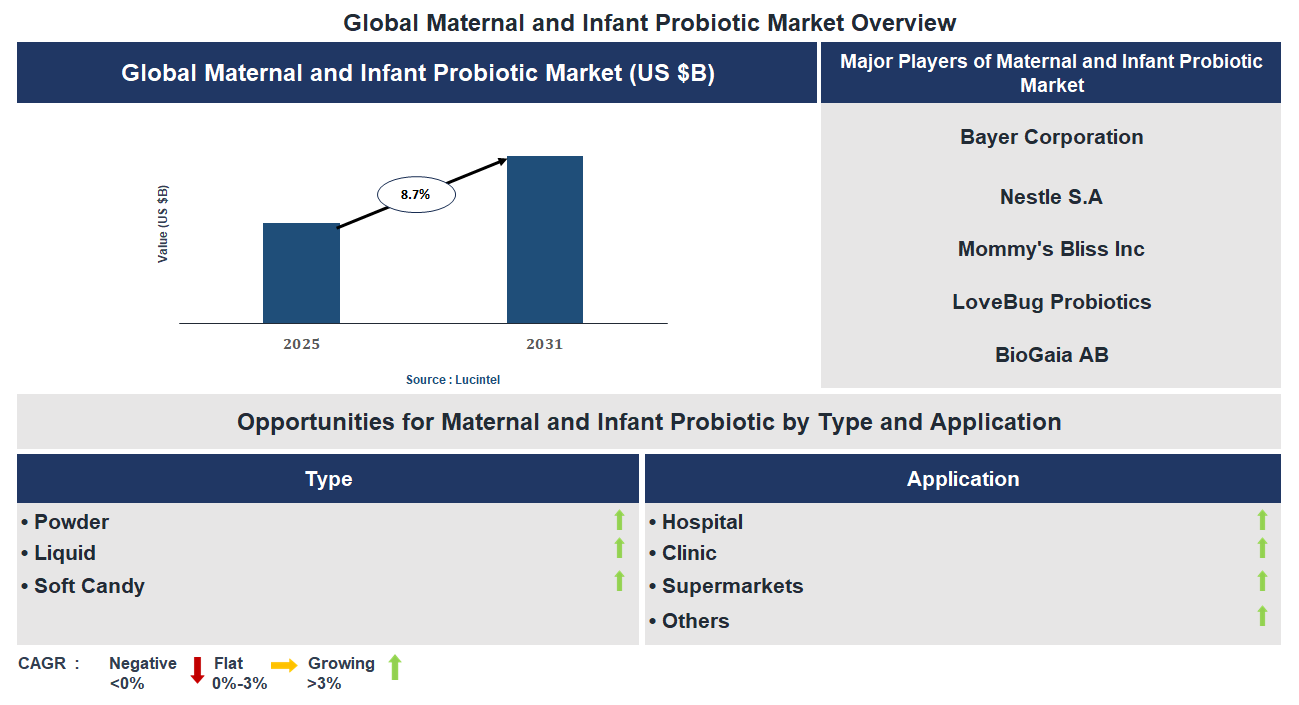
The future of the global maternal and infant probiotic market looks promising with opportunities in the hospital, clinic, and supermarket markets. The global maternal and infant probiotic market is expected to grow with a CAGR of 8.7% from 2025 to 2031. The major drivers for this market are the increasing awareness of gut health, the rising adoption of probiotics in healthcare, and the growing demand for infant digestive support.

• Lucintel forecasts that, within the type category, liquid is expected to witness the highest growth over the forecast period.
• Within the application category, supermarket is expected to witness the highest growth.
• In terms of region, APAC is expected to witness the highest growth over the forecast period.
Gain valuable insights for your business decisions with our comprehensive 150+ page report. Sample figures with some insights are shown below.
Maternal and Infant Probiotic Market Trends and Forecast

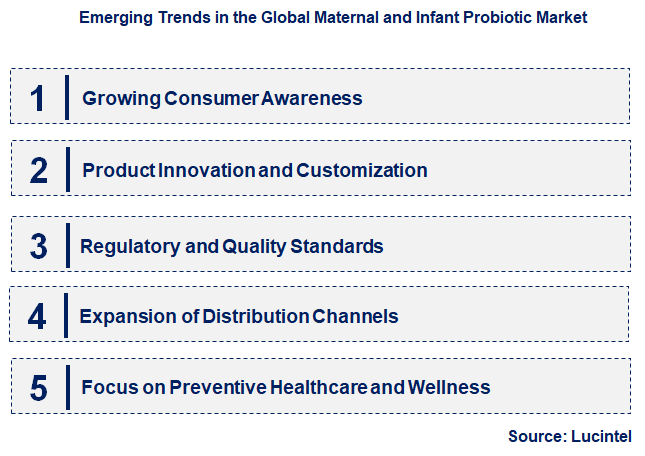
Emerging Trends in the Maternal and Infant Probiotic Market

The maternal and infant probiotic market is experiencing rapid growth driven by increasing awareness of gut health, rising demand for natural health solutions, and a focus on early-life wellness. As consumers become more health-conscious, the market is evolving with innovative products tailored for mothers and infants. Technological advancements, regulatory changes, and a shift towards preventive healthcare are further shaping this landscape. These developments are not only expanding market size but also influencing product formulations, distribution channels, and consumer preferences. Understanding these emerging trends is crucial for stakeholders aiming to capitalize on this burgeoning sector and meet the evolving needs of mothers and infants worldwide.

• Growing Consumer Awareness: Increased knowledge about gut health benefits is driving demand for probiotics among mothers and caregivers. Consumers are more informed about the role of probiotics in supporting immune function, digestion, and overall wellness, leading to a preference for natural and preventive health solutions. This heightened awareness is encouraging brands to educate consumers through marketing campaigns and scientific research, thereby expanding market reach and acceptance.
• Product Innovation and Customization: Companies are developing specialized probiotic formulations tailored for maternal and infant needs. These include age-specific strains, single-serve sachets, and formulations free from allergens or artificial additives. Such innovations enhance product efficacy and safety, catering to the unique health requirements of mothers during pregnancy and infants in their early years. Customization also helps brands differentiate themselves in a competitive market.
• Regulatory and Quality Standards: Increasing regulatory scrutiny is prompting manufacturers to adhere to stricter quality controls and safety standards. Governments and health authorities are establishing guidelines for probiotic products, especially those intended for vulnerable populations like infants. Compliance ensures product safety, boosts consumer confidence, and facilitates market expansion across regions with stringent regulations, ultimately fostering trust and credibility.
• Expansion of Distribution Channels: The rise of e-commerce platforms, specialty health stores, and direct-to-consumer models is broadening access to probiotic products. Digital channels enable brands to reach a wider audience, provide detailed product information, and offer personalized recommendations. This shift is particularly significant for maternal and infant products, where convenience and trust are paramount, thereby accelerating market penetration.
• Focus on Preventive Healthcare and Wellness: There is a growing emphasis on preventive health measures during pregnancy and early childhood. Consumers are increasingly adopting probiotics as part of holistic wellness routines to boost immunity and reduce illness risk. This trend aligns with the broader shift towards proactive healthcare, encouraging brands to develop educational content and integrate probiotics into daily health regimens, ultimately fostering long-term customer loyalty.

In summary, these trends are collectively transforming the maternal and infant probiotic market by enhancing product offerings, improving safety standards, expanding access, and aligning with consumer health priorities. This evolution is driving market growth, fostering innovation, and positioning probiotics as a vital component of maternal and infant healthcare strategies worldwide.
Emerging Trends in the Maternal and Infant Probiotic Market

Recent Development in the Maternal and Infant Probiotic Market

The maternal and infant probiotic market has experienced significant growth driven by increasing awareness of gut health, rising demand for natural health solutions, and advancements in probiotic formulations tailored for mothers and infants. As consumers seek safer, effective options to support early-life health, companies are innovating to meet these needs. Regulatory changes and scientific research are also shaping the market landscape, fostering trust and expanding product offerings. This dynamic environment reflects a broader shift towards preventive healthcare and personalized nutrition, positioning the market for sustained expansion in the coming years.

• Growing consumer awareness: Increased knowledge about the benefits of probiotics for maternal and infant health has led to higher demand for specialized products, encouraging companies to develop targeted formulations and expand their product lines.
• Regulatory advancements: Governments and health authorities are establishing clearer guidelines for probiotic products, improving safety standards and boosting consumer confidence, which in turn accelerates market growth and innovation.
• Product innovation: Companies are introducing novel probiotic strains and delivery formats, such as powders, capsules, and liquids, enhancing ease of use and efficacy, thereby attracting a broader consumer base.
• Scientific research and clinical trials: Ongoing studies validate the health benefits of maternal and infant probiotics, strengthening scientific backing, increasing consumer trust, and encouraging healthcare provider recommendations.
• E-commerce expansion: The rise of online retail channels has increased accessibility and visibility of probiotic products, enabling brands to reach a wider audience and facilitating direct consumer engagement.

In summary, these developments are collectively driving the growth of the maternal and infant probiotic market by enhancing product credibility, expanding consumer access, and fostering innovation. The market is becoming more competitive and sophisticated, with a focus on safety, efficacy, and personalized health solutions, promising continued expansion in the near future.

Strategic Growth Opportunities in the Maternal and Infant Probiotic Market

The maternal and infant probiotic market is experiencing rapid growth driven by increasing awareness of gut health, rising prevalence of digestive and immune-related disorders, and a growing focus on maternal and infant wellness. As consumers seek natural and preventive healthcare options, key applications are emerging as significant growth drivers. These developments are reshaping the market landscape, offering new opportunities for manufacturers and healthcare providers to innovate and expand their offerings. Understanding these growth opportunities is essential for stakeholders aiming to capitalize on the evolving needs of mothers and infants worldwide.

• Expanding Probiotic-infused Formulas and Supplements: This application is witnessing increased demand as parents seek to improve their infantsÄX%$%X digestive health and immunity, leading to innovative product development and market expansion.
• Probiotics for Pregnancy and Postpartum Care: Growing awareness of maternal gut healthÄX%$%Xs role in pregnancy outcomes is driving the adoption of targeted probiotic products, enhancing maternal well-being and reducing complications.
• Probiotics for Immune System Enhancement: With a focus on preventing infections and boosting immunity, probiotic products are increasingly integrated into daily routines for both mothers and infants, expanding market reach.
• Addressing Digestive Disorders in Infants and Mothers: The rising prevalence of gastrointestinal issues is fueling demand for specialized probiotic formulations, fostering research and product innovation.
• Probiotics as a Proactive Health Measure: Consumers are increasingly adopting probiotics as part of preventive health strategies, emphasizing wellness and reducing healthcare costs, thereby broadening market scope.

These growth opportunities are significantly impacting the maternal and infant probiotic market by driving innovation, expanding consumer base, and fostering a focus on preventive and holistic health approaches. As demand continues to rise, the market is poised for sustained growth and diversification.

Maternal and Infant Probiotic Market Driver and Challenges

The maternal and infant probiotic market is influenced by a variety of technological, economic, and regulatory factors. Advances in probiotic research and development have led to innovative formulations tailored for maternal and infant health, boosting market growth. Economic factors such as increasing healthcare expenditure and rising awareness about preventive health contribute to expanding demand. Regulatory frameworks around safety and efficacy standards shape product development and market entry strategies. Additionally, consumer preferences for natural and organic products are driving market expansion. However, challenges such as regulatory hurdles, safety concerns, and market competition also impact growth trajectories. Understanding these drivers and challenges is essential for stakeholders aiming to capitalize on emerging opportunities within this dynamic sector.

The factors responsible for driving the maternal and infant probiotic market include:
• Technological Innovations: The development of advanced probiotic strains and delivery systems has significantly enhanced product efficacy and safety. Breakthroughs in microbiome research enable targeted formulations for maternal and infant health, fostering consumer confidence and expanding market reach. These innovations facilitate personalized nutrition solutions, improve shelf life, and ensure better bioavailability, which collectively boost market growth. Continuous R&D investments are expected to sustain this momentum, attracting new entrants and encouraging product diversification.
• Rising Awareness and Health Consciousness: Increasing awareness among mothers about the benefits of probiotics for digestive health, immunity, and overall well-being is a key driver. Educational campaigns, social media influence, and healthcare provider endorsements have amplified consumer knowledge, leading to higher demand for probiotic supplements and foods. This trend is particularly prominent in developed regions, where health consciousness is on the rise, prompting manufacturers to innovate and expand their product portfolios to meet consumer expectations.
• Growing Preference for Natural and Organic Products: Consumers are increasingly seeking natural, organic, and clean-label products, especially in maternal and infant nutrition. This shift is driven by concerns over synthetic additives and artificial ingredients, prompting brands to develop probiotic products that align with these preferences. The demand for plant-based, non-GMO, and allergen-free probiotics is fueling market growth, encouraging companies to adopt sustainable sourcing and transparent labeling practices to attract health-conscious buyers.
• Increasing Healthcare Expenditure and Prenatal Care: Rising healthcare spending globally, coupled with a focus on prenatal and postnatal care, is propelling the market forward. Pregnant women and new mothers are seeking preventive health solutions, including probiotics, to support maternal health and infant development. Enhanced access to healthcare services and increased screening programs further promote probiotic use, creating a favorable environment for market expansion, especially in emerging economies where healthcare infrastructure is improving.
• Strategic Collaborations and Product Launches: Partnerships between biotech firms, pharmaceutical companies, and consumer health brands are fostering innovation and expanding product offerings. Launching new probiotic formulations tailored for maternal and infant needs helps companies capture market share. These collaborations facilitate research, regulatory approval, and distribution, accelerating market penetration. Additionally, marketing campaigns emphasizing scientific backing and safety profiles bolster consumer trust and drive sales.

The challenges facing this maternal and infant probiotic market include:
• Regulatory and Safety Concerns: The lack of standardized regulations across regions poses significant hurdles. Ensuring product safety, efficacy, and quality remains complex, especially for products intended for vulnerable populations like infants and pregnant women. Regulatory delays and stringent approval processes can hinder product launches and market entry. Moreover, concerns about potential adverse effects and the need for extensive clinical trials add to the complexity, requiring manufacturers to invest heavily in compliance and safety validation.
• Market Competition and Product Differentiation: The increasing number of players entering the market intensifies competition. Differentiating products based on strains, formulations, and health claims becomes challenging, especially with the prevalence of counterfeit or substandard products. Companies must invest in branding, quality assurance, and scientific validation to stand out. Price wars and marketing battles can also impact profit margins, making it essential for firms to develop unique value propositions.
• Safety and Efficacy Concerns: Despite growing acceptance, skepticism remains regarding the safety and long-term effects of probiotics, particularly in infants. Variability in probiotic strains and dosages can lead to inconsistent results, raising concerns among healthcare providers and consumers. Ensuring consistent quality and demonstrating clear health benefits through clinical evidence are critical to overcoming these barriers. Addressing these concerns is vital for building trust and expanding market adoption.

In summary, the maternal and infant probiotic market is driven by technological advancements, increasing health awareness, consumer preferences for natural products, rising healthcare investments, and strategic collaborations. However, regulatory complexities, intense competition, and safety concerns pose significant challenges. These factors collectively shape the market landscape, requiring stakeholders to innovate, ensure safety, and navigate regulatory environments effectively. The overall impact is a dynamic, growing market with substantial opportunities for growth, provided that challenges are managed through rigorous research, compliance, and consumer engagement strategies.

List of Maternal and Infant Probiotic Companies

Companies in the market compete on the basis of product quality offered. Major players in this market focus on expanding their manufacturing facilities, R&D investments, infrastructural development, and leverage integration opportunities across the value chain. With these strategies maternal and infant probiotic companies cater increasing demand, ensure competitive effectiveness, develop innovative products & technologies, reduce production costs, and expand their customer base. Some of the maternal and infant probiotic companies profiled in this report include-
• Bayer Corporation
• Nestle S.A
• MommyÄX%$%Xs Bliss Inc
• LoveBug Probiotics
• BioGaia AB
• MaryRuth Organics
• Infinant Health
• Biomeology
• Nordic Naturals
• Culturelle

Maternal and Infant Probiotic Market by Segment

The study includes a forecast for the global maternal and infant probiotic market by type, application, and region.

Maternal and Infant Probiotic Market by Type [Value from 2019 to 2031]:


• Powder
• Liquid
• Soft Candy

Maternal and Infant Probiotic Market by Application [Value from 2019 to 2031]:


• Hospital
• Clinic
• Supermarkets
• Others

Maternal and Infant Probiotic Market by Region [Value from 2019 to 2031]:


• North America
• Europe
• Asia Pacific
• The Rest of the World

Country Wise Outlook for the Maternal and Infant Probiotic Market

The maternal and infant probiotic market has experienced significant growth driven by increasing awareness of gut health, rising demand for natural and preventive healthcare, and advancements in probiotic formulations. Countries are adopting innovative strategies to enhance product efficacy, safety, and accessibility. Regulatory frameworks are evolving to accommodate new probiotic strains, while consumer preferences shift towards organic and clinically supported options. This dynamic landscape reflects broader trends in health and wellness, with each country contributing uniquely based on its healthcare infrastructure, research capabilities, and consumer behavior. The following summarizes recent developments in the maternal and infant probiotic market across the United States, China, Germany, India, and Japan.

• United States: The US market has seen a surge in research-backed probiotic products tailored for maternal and infant health, with increased FDA oversight ensuring safety and efficacy. Major brands are launching new formulations targeting immune support and digestive health, supported by clinical trials. E-commerce channels are expanding access, and there is a growing trend toward personalized probiotic solutions based on genetic and microbiome testing. Regulatory agencies are working to establish clearer guidelines for infant probiotic products, fostering consumer confidence and innovation.
• China: China’s maternal and infant probiotic market is rapidly expanding due to rising awareness of gut health benefits and government initiatives promoting maternal health. Domestic companies are investing heavily in R&D to develop strains suited for local populations. E-commerce platforms like Alibaba and JD.com are major distribution channels, facilitating widespread access. Regulatory frameworks are evolving to improve product safety standards, and collaborations with international firms are increasing to incorporate advanced probiotic strains. Consumer preferences are shifting toward organic and natural products, boosting market growth.
• Germany: Germany’s market emphasizes high-quality, scientifically validated probiotic products for mothers and infants. Regulatory standards are stringent, ensuring product safety and efficacy. Recent developments include the launch of probiotic strains targeting specific health concerns such as allergies and colic. There is a focus on sustainable and organic ingredients, aligning with European Union regulations. Research institutions are actively involved in clinical studies to substantiate health claims, and healthcare providers increasingly recommend probiotic supplements as part of prenatal and infant care routines.
• India: The Indian market is witnessing rapid growth driven by increasing awareness of maternal and infant health, coupled with rising disposable incomes. Local companies are developing affordable probiotic formulations tailored to regional dietary habits and health issues. E-commerce and pharmacy chains are expanding distribution networks, making products more accessible. Government initiatives promoting maternal health are encouraging probiotic use. Additionally, research collaborations are emerging to develop strains suited for the Indian microbiome, and consumer preference is shifting toward natural and herbal-based probiotic products.
• Japan: Japan’s market is characterized by a focus on scientifically supported probiotic strains and functional foods for maternal and infant health. Regulatory agencies have introduced guidelines to ensure product safety and efficacy. Recent innovations include probiotic formulations targeting infant colic and immune support, often combined with traditional ingredients. The market also emphasizes sustainability and natural sourcing of ingredients. Consumer awareness about gut health is high, and healthcare professionals frequently recommend probiotic products as part of prenatal and pediatric care, fostering steady market growth.

Lucintel Analytics Dashboard

Features of the Global Maternal and Infant Probiotic Market

Market Size Estimates: Maternal and infant probiotic market size estimation in terms of value ($B).
Trend and Forecast Analysis: Market trends (2019 to 2024) and forecast (2025 to 2031) by various segments and regions.
Segmentation Analysis: Maternal and infant probiotic market size by type, application, and region in terms of value ($B).
Regional Analysis: Maternal and infant probiotic market breakdown by North America, Europe, Asia Pacific, and Rest of the World.
Growth Opportunities: Analysis of growth opportunities in different types, applications, and regions for the maternal and infant probiotic market.
Strategic Analysis: This includes M&A, new product development, and competitive landscape of the maternal and infant probiotic market.
Analysis of competitive intensity of the industry based on Porter’s Five Forces model.

Lucintel Consulting Services

FAQ

Q1. What is the growth forecast for maternal and infant probiotic market?
Answer: The global maternal and infant probiotic market is expected to grow with a CAGR of 8.7% from 2025 to 2031.
Q2. What are the major drivers influencing the growth of the maternal and infant probiotic market?
Answer: The major drivers for this market are the increasing awareness of gut health, the rising adoption of probiotics in healthcare, and the growing demand for infant digestive support.
Q3. What are the major segments for maternal and infant probiotic market?
Answer: The future of the maternal and infant probiotic market looks promising with opportunities in the hospital, clinic, and supermarket markets.
Q4. Who are the key maternal and infant probiotic market companies?
Answer: Some of the key maternal and infant probiotic companies are as follows:
• Bayer Corporation
• Nestle S.A
• MommyÄX%$%Xs Bliss Inc
• LoveBug Probiotics
• BioGaia AB
• MaryRuth Organics
• Infinant Health
• Biomeology
• Nordic Naturals
• Culturelle
Q5. Which maternal and infant probiotic market segment will be the largest in future?
Answer: Lucintel forecasts that, within the type category, liquid is expected to witness the highest growth over the forecast period.
Q6. In maternal and infant probiotic market, which region is expected to be the largest in next 5 years?
Answer: In terms of region, APAC is expected to witness the highest growth over the forecast period.
Q7. Do we receive customization in this report?
Answer: Yes, Lucintel provides 10% customization without any additional cost.

This report answers following 11 key questions:

Q.1. What are some of the most promising, high-growth opportunities for the maternal and infant probiotic market by type (powder, liquid, and soft candy), application (hospital, clinic, supermarkets, and others), and region (North America, Europe, Asia Pacific, and the Rest of the World)?
Q.2. Which segments will grow at a faster pace and why?
Q.3. Which region will grow at a faster pace and why?
Q.4. What are the key factors affecting market dynamics? What are the key challenges and business risks in this market?
Q.5. What are the business risks and competitive threats in this market?
Q.6. What are the emerging trends in this market and the reasons behind them?
Q.7. What are some of the changing demands of customers in the market?
Q.8. What are the new developments in the market? Which companies are leading these developments?
Q.9. Who are the major players in this market? What strategic initiatives are key players pursuing for business growth?
Q.10. What are some of the competing products in this market and how big of a threat do they pose for loss of market share by material or product substitution?
Q.11. What M&A activity has occurred in the last 5 years and what has its impact been on the industry?

For any questions related to Maternal and Infant Probiotic Market, Maternal and Infant Probiotic Market Size, Maternal and Infant Probiotic Market Growth, Maternal and Infant Probiotic Market Analysis, Maternal and Infant Probiotic Market Report, Maternal and Infant Probiotic Market Share, Maternal and Infant Probiotic Market Trends, Maternal and Infant Probiotic Market Forecast, Maternal and Infant Probiotic Companies, write Lucintel analyst at email: helpdesk@lucintel.com. We will be glad to get back to you soon.
                                           Table of Contents

            1. Executive Summary

            2. Market Overview

                        2.1 Background and Classifications
                        2.2 Supply Chain

            3. Market Trends & Forecast Analysis

                        3.1 Macroeconomic Trends and Forecasts
                        3.2 Industry Drivers and Challenges
                        3.3 PESTLE Analysis
                        3.4 Patent Analysis
                        3.5 Regulatory Environment
                        3.6 Global Maternal and Infant Probiotic Market Trends and Forecast

            4. Global Maternal and Infant Probiotic Market by Type

                        4.1 Overview
                        4.2 Attractiveness Analysis by Type
                        4.3 Powder : Trends and Forecast 2019 to 2031
                        4.4 Liquid : Trends and Forecast 2019 to 2031
                        4.5 Soft Candy : Trends and Forecast 2019 to 2031

            5. Global Maternal and Infant Probiotic Market by Application

                        5.1 Overview
                        5.2 Attractiveness Analysis by Application
                        5.3 Hospital : Trends and Forecast 2019 to 2031
                        5.4 Clinic : Trends and Forecast 2019 to 2031
                        5.5 Supermarkets : Trends and Forecast 2019 to 2031
                        5.6 Others : Trends and Forecast 2019 to 2031

            6. Regional Analysis

                        6.1 Overview
                        6.2 Global Maternal and Infant Probiotic Market by Region

            7. North American Maternal and Infant Probiotic Market

                        7.1 Overview
                        7.2 North American Maternal and Infant Probiotic Market by Type
                        7.3 North American Maternal and Infant Probiotic Market by Application
                        7.4 The United States Maternal and Infant Probiotic Market
                        7.5 Canadian Maternal and Infant Probiotic Market
                        7.6 Mexican Maternal and Infant Probiotic Market

            8. European Maternal and Infant Probiotic Market

                        8.1 Overview
                        8.2 European Maternal and Infant Probiotic Market by Type
                        8.3 European Maternal and Infant Probiotic Market by Application
                        8.4 German Maternal and Infant Probiotic Market
                        8.5 French Maternal and Infant Probiotic Market
                        8.6 Italian Maternal and Infant Probiotic Market
                        8.7 Spanish Maternal and Infant Probiotic Market
                        8.8 The United Kingdom Maternal and Infant Probiotic Market

            9. APAC Maternal and Infant Probiotic Market

                        9.1 Overview
                        9.2 APAC Maternal and Infant Probiotic Market by Type
                        9.3 APAC Maternal and Infant Probiotic Market by Application
                        9.4 Chinese Maternal and Infant Probiotic Market
                        9.5 Indian Maternal and Infant Probiotic Market
                        9.6 Japanese Maternal and Infant Probiotic Market
                        9.7 South Korean Maternal and Infant Probiotic Market
                        9.8 Indonesian Maternal and Infant Probiotic Market

            10. ROW Maternal and Infant Probiotic Market

                        10.1 Overview
                        10.2 ROW Maternal and Infant Probiotic Market by Type
                        10.3 ROW Maternal and Infant Probiotic Market by Application
                        10.4 Middle Eastern Maternal and Infant Probiotic Market
                        10.5 South American Maternal and Infant Probiotic Market
                        10.6 African Maternal and Infant Probiotic Market

            11. Competitor Analysis

                        11.1 Product Portfolio Analysis
                        11.2 Operational Integration
                        11.3 Porter’s Five Forces Analysis
                                    • Competitive Rivalry
                                    • Bargaining Power of Buyers
                                    • Bargaining Power of Suppliers
                                    • Threat of Substitutes
                                    • Threat of New Entrants
                        11.4 Market Share Analysis

            12. Opportunities & Strategic Analysis

                        12.1 Value Chain Analysis
                        12.2 Growth Opportunity Analysis
                                    12.2.1 Growth Opportunity by Type
                                    12.2.2 Growth Opportunity by Application
                        12.3 Emerging Trends in the Global Maternal and Infant Probiotic Market
                        12.4 Strategic Analysis
                                    12.4.1 New Product Development
                                    12.4.2 Certification and Licensing
                                    12.4.3 Mergers, Acquisitions, Agreements, Collaborations, and Joint Ventures

            13. Company Profiles of the Leading Players Across the Value Chain

                        13.1 Competitive Analysis Overview
                        13.2 Bayer Corporation
                                    • Company Overview
                                    • Maternal and Infant Probiotic Market Business Overview
                                    • New Product Development
                                    • Merger, Acquisition, and Collaboration
                                    • Certification and Licensing
                        13.3 Nestle S.A
                                    • Company Overview
                                    • Maternal and Infant Probiotic Market Business Overview
                                    • New Product Development
                                    • Merger, Acquisition, and Collaboration
                                    • Certification and Licensing
                        13.4 MommyÄX%$%Xs Bliss Inc
                                    • Company Overview
                                    • Maternal and Infant Probiotic Market Business Overview
                                    • New Product Development
                                    • Merger, Acquisition, and Collaboration
                                    • Certification and Licensing
                        13.5 LoveBug Probiotics
                                    • Company Overview
                                    • Maternal and Infant Probiotic Market Business Overview
                                    • New Product Development
                                    • Merger, Acquisition, and Collaboration
                                    • Certification and Licensing
                        13.6 BioGaia AB
                                    • Company Overview
                                    • Maternal and Infant Probiotic Market Business Overview
                                    • New Product Development
                                    • Merger, Acquisition, and Collaboration
                                    • Certification and Licensing
                        13.7 MaryRuth Organics
                                    • Company Overview
                                    • Maternal and Infant Probiotic Market Business Overview
                                    • New Product Development
                                    • Merger, Acquisition, and Collaboration
                                    • Certification and Licensing
                        13.8 Infinant Health
                                    • Company Overview
                                    • Maternal and Infant Probiotic Market Business Overview
                                    • New Product Development
                                    • Merger, Acquisition, and Collaboration
                                    • Certification and Licensing
                        13.9 Biomeology
                                    • Company Overview
                                    • Maternal and Infant Probiotic Market Business Overview
                                    • New Product Development
                                    • Merger, Acquisition, and Collaboration
                                    • Certification and Licensing
                        13.10 Nordic Naturals
                                    • Company Overview
                                    • Maternal and Infant Probiotic Market Business Overview
                                    • New Product Development
                                    • Merger, Acquisition, and Collaboration
                                    • Certification and Licensing
                        13.11 Culturelle
                                    • Company Overview
                                    • Maternal and Infant Probiotic Market Business Overview
                                    • New Product Development
                                    • Merger, Acquisition, and Collaboration
                                    • Certification and Licensing

            14. Appendix

                        14.1 List of Figures
                        14.2 List of Tables
                        14.3 Research Methodology
                        14.4 Disclaimer
                        14.5 Copyright
                        14.6 Abbreviations and Technical Units
                        14.7 About Us
                        14.8 Contact Us

                                               List of Figures


            Chapter 1

                        Figure 1.1: Trends and Forecast for the Global Maternal and Infant Probiotic Market

            Chapter 2

                        Figure 2.1: Usage of Maternal and Infant Probiotic Market
                        Figure 2.2: Classification of the Global Maternal and Infant Probiotic Market
                        Figure 2.3: Supply Chain of the Global Maternal and Infant Probiotic Market

            Chapter 3

                        Figure 3.1: Trends of the Global GDP Growth Rate
                        Figure 3.2: Trends of the Global Population Growth Rate
                        Figure 3.3: Trends of the Global Inflation Rate
                        Figure 3.4: Trends of the Global Unemployment Rate
                        Figure 3.5: Trends of the Regional GDP Growth Rate
                        Figure 3.6: Trends of the Regional Population Growth Rate
                        Figure 3.7: Trends of the Regional Inflation Rate
                        Figure 3.8: Trends of the Regional Unemployment Rate
                        Figure 3.9: Trends of Regional Per Capita Income
                        Figure 3.10: Forecast for the Global GDP Growth Rate
                        Figure 3.11: Forecast for the Global Population Growth Rate
                        Figure 3.12: Forecast for the Global Inflation Rate
                        Figure 3.13: Forecast for the Global Unemployment Rate
                        Figure 3.14: Forecast for the Regional GDP Growth Rate
                        Figure 3.15: Forecast for the Regional Population Growth Rate
                        Figure 3.16: Forecast for the Regional Inflation Rate
                        Figure 3.17: Forecast for the Regional Unemployment Rate
                        Figure 3.18: Forecast for Regional Per Capita Income
                        Figure 3.19: Driver and Challenges of the Maternal and Infant Probiotic Market

            Chapter 4

                        Figure 4.1: Global Maternal and Infant Probiotic Market by Type in 2019, 2024, and 2031
                        Figure 4.2: Trends of the Global Maternal and Infant Probiotic Market ($B) by Type
                        Figure 4.3: Forecast for the Global Maternal and Infant Probiotic Market ($B) by Type
                        Figure 4.4: Trends and Forecast for Powder in the Global Maternal and Infant Probiotic Market (2019-2031)
                        Figure 4.5: Trends and Forecast for Liquid in the Global Maternal and Infant Probiotic Market (2019-2031)
                        Figure 4.6: Trends and Forecast for Soft Candy in the Global Maternal and Infant Probiotic Market (2019-2031)

            Chapter 5

                        Figure 5.1: Global Maternal and Infant Probiotic Market by Application in 2019, 2024, and 2031
                        Figure 5.2: Trends of the Global Maternal and Infant Probiotic Market ($B) by Application
                        Figure 5.3: Forecast for the Global Maternal and Infant Probiotic Market ($B) by Application
                        Figure 5.4: Trends and Forecast for Hospital in the Global Maternal and Infant Probiotic Market (2019-2031)
                        Figure 5.5: Trends and Forecast for Clinic in the Global Maternal and Infant Probiotic Market (2019-2031)
                        Figure 5.6: Trends and Forecast for Supermarkets in the Global Maternal and Infant Probiotic Market (2019-2031)
                        Figure 5.7: Trends and Forecast for Others in the Global Maternal and Infant Probiotic Market (2019-2031)

            Chapter 6

                        Figure 6.1: Trends of the Global Maternal and Infant Probiotic Market ($B) by Region (2019-2024)
                        Figure 6.2: Forecast for the Global Maternal and Infant Probiotic Market ($B) by Region (2025-2031)

            Chapter 7

                        Figure 7.1: Trends and Forecast for the North American Maternal and Infant Probiotic Market (2019-2031)
                        Figure 7.2: North American Maternal and Infant Probiotic Market by Type in 2019, 2024, and 2031
                        Figure 7.3: Trends of the North American Maternal and Infant Probiotic Market ($B) by Type (2019-2024)
                        Figure 7.4: Forecast for the North American Maternal and Infant Probiotic Market ($B) by Type (2025-2031)
                        Figure 7.5: North American Maternal and Infant Probiotic Market by Application in 2019, 2024, and 2031
                        Figure 7.6: Trends of the North American Maternal and Infant Probiotic Market ($B) by Application (2019-2024)
                        Figure 7.7: Forecast for the North American Maternal and Infant Probiotic Market ($B) by Application (2025-2031)
                        Figure 7.8: Trends and Forecast for the United States Maternal and Infant Probiotic Market ($B) (2019-2031)
                        Figure 7.9: Trends and Forecast for the Mexican Maternal and Infant Probiotic Market ($B) (2019-2031)
                        Figure 7.10: Trends and Forecast for the Canadian Maternal and Infant Probiotic Market ($B) (2019-2031)

            Chapter 8

                        Figure 8.1: Trends and Forecast for the European Maternal and Infant Probiotic Market (2019-2031)
                        Figure 8.2: European Maternal and Infant Probiotic Market by Type in 2019, 2024, and 2031
                        Figure 8.3: Trends of the European Maternal and Infant Probiotic Market ($B) by Type (2019-2024)
                        Figure 8.4: Forecast for the European Maternal and Infant Probiotic Market ($B) by Type (2025-2031)
                        Figure 8.5: European Maternal and Infant Probiotic Market by Application in 2019, 2024, and 2031
                        Figure 8.6: Trends of the European Maternal and Infant Probiotic Market ($B) by Application (2019-2024)
                        Figure 8.7: Forecast for the European Maternal and Infant Probiotic Market ($B) by Application (2025-2031)
                        Figure 8.8: Trends and Forecast for the German Maternal and Infant Probiotic Market ($B) (2019-2031)
                        Figure 8.9: Trends and Forecast for the French Maternal and Infant Probiotic Market ($B) (2019-2031)
                        Figure 8.10: Trends and Forecast for the Spanish Maternal and Infant Probiotic Market ($B) (2019-2031)
                        Figure 8.11: Trends and Forecast for the Italian Maternal and Infant Probiotic Market ($B) (2019-2031)
                        Figure 8.12: Trends and Forecast for the United Kingdom Maternal and Infant Probiotic Market ($B) (2019-2031)

            Chapter 9

                        Figure 9.1: Trends and Forecast for the APAC Maternal and Infant Probiotic Market (2019-2031)
                        Figure 9.2: APAC Maternal and Infant Probiotic Market by Type in 2019, 2024, and 2031
                        Figure 9.3: Trends of the APAC Maternal and Infant Probiotic Market ($B) by Type (2019-2024)
                        Figure 9.4: Forecast for the APAC Maternal and Infant Probiotic Market ($B) by Type (2025-2031)
                        Figure 9.5: APAC Maternal and Infant Probiotic Market by Application in 2019, 2024, and 2031
                        Figure 9.6: Trends of the APAC Maternal and Infant Probiotic Market ($B) by Application (2019-2024)
                        Figure 9.7: Forecast for the APAC Maternal and Infant Probiotic Market ($B) by Application (2025-2031)
                        Figure 9.8: Trends and Forecast for the Japanese Maternal and Infant Probiotic Market ($B) (2019-2031)
                        Figure 9.9: Trends and Forecast for the Indian Maternal and Infant Probiotic Market ($B) (2019-2031)
                        Figure 9.10: Trends and Forecast for the Chinese Maternal and Infant Probiotic Market ($B) (2019-2031)
                        Figure 9.11: Trends and Forecast for the South Korean Maternal and Infant Probiotic Market ($B) (2019-2031)
                        Figure 9.12: Trends and Forecast for the Indonesian Maternal and Infant Probiotic Market ($B) (2019-2031)

            Chapter 10

                        Figure 10.1: Trends and Forecast for the ROW Maternal and Infant Probiotic Market (2019-2031)
                        Figure 10.2: ROW Maternal and Infant Probiotic Market by Type in 2019, 2024, and 2031
                        Figure 10.3: Trends of the ROW Maternal and Infant Probiotic Market ($B) by Type (2019-2024)
                        Figure 10.4: Forecast for the ROW Maternal and Infant Probiotic Market ($B) by Type (2025-2031)
                        Figure 10.5: ROW Maternal and Infant Probiotic Market by Application in 2019, 2024, and 2031
                        Figure 10.6: Trends of the ROW Maternal and Infant Probiotic Market ($B) by Application (2019-2024)
                        Figure 10.7: Forecast for the ROW Maternal and Infant Probiotic Market ($B) by Application (2025-2031)
                        Figure 10.8: Trends and Forecast for the Middle Eastern Maternal and Infant Probiotic Market ($B) (2019-2031)
                        Figure 10.9: Trends and Forecast for the South American Maternal and Infant Probiotic Market ($B) (2019-2031)
                        Figure 10.10: Trends and Forecast for the African Maternal and Infant Probiotic Market ($B) (2019-2031)

            Chapter 11

                        Figure 11.1: Porter’s Five Forces Analysis of the Global Maternal and Infant Probiotic Market
                        Figure 11.2: Market Share (%) of Top Players in the Global Maternal and Infant Probiotic Market (2024)

            Chapter 12

                        Figure 12.1: Growth Opportunities for the Global Maternal and Infant Probiotic Market by Type
                        Figure 12.2: Growth Opportunities for the Global Maternal and Infant Probiotic Market by Application
                        Figure 12.3: Growth Opportunities for the Global Maternal and Infant Probiotic Market by Region
                        Figure 12.4: Emerging Trends in the Global Maternal and Infant Probiotic Market

                                               List of Tables


            Chapter 1

                        Table 1.1: Growth Rate (%, 2023-2024) and CAGR (%, 2025-2031) of the Maternal and Infant Probiotic Market by Type and Application
                        Table 1.2: Attractiveness Analysis for the Maternal and Infant Probiotic Market by Region
                        Table 1.3: Global Maternal and Infant Probiotic Market Parameters and Attributes

            Chapter 3

                        Table 3.1: Trends of the Global Maternal and Infant Probiotic Market (2019-2024)
                        Table 3.2: Forecast for the Global Maternal and Infant Probiotic Market (2025-2031)

            Chapter 4

                        Table 4.1: Attractiveness Analysis for the Global Maternal and Infant Probiotic Market by Type
                        Table 4.2: Market Size and CAGR of Various Type in the Global Maternal and Infant Probiotic Market (2019-2024)
                        Table 4.3: Market Size and CAGR of Various Type in the Global Maternal and Infant Probiotic Market (2025-2031)
                        Table 4.4: Trends of Powder in the Global Maternal and Infant Probiotic Market (2019-2024)
                        Table 4.5: Forecast for Powder in the Global Maternal and Infant Probiotic Market (2025-2031)
                        Table 4.6: Trends of Liquid in the Global Maternal and Infant Probiotic Market (2019-2024)
                        Table 4.7: Forecast for Liquid in the Global Maternal and Infant Probiotic Market (2025-2031)
                        Table 4.8: Trends of Soft Candy in the Global Maternal and Infant Probiotic Market (2019-2024)
                        Table 4.9: Forecast for Soft Candy in the Global Maternal and Infant Probiotic Market (2025-2031)

            Chapter 5

                        Table 5.1: Attractiveness Analysis for the Global Maternal and Infant Probiotic Market by Application
                        Table 5.2: Market Size and CAGR of Various Application in the Global Maternal and Infant Probiotic Market (2019-2024)
                        Table 5.3: Market Size and CAGR of Various Application in the Global Maternal and Infant Probiotic Market (2025-2031)
                        Table 5.4: Trends of Hospital in the Global Maternal and Infant Probiotic Market (2019-2024)
                        Table 5.5: Forecast for Hospital in the Global Maternal and Infant Probiotic Market (2025-2031)
                        Table 5.6: Trends of Clinic in the Global Maternal and Infant Probiotic Market (2019-2024)
                        Table 5.7: Forecast for Clinic in the Global Maternal and Infant Probiotic Market (2025-2031)
                        Table 5.8: Trends of Supermarkets in the Global Maternal and Infant Probiotic Market (2019-2024)
                        Table 5.9: Forecast for Supermarkets in the Global Maternal and Infant Probiotic Market (2025-2031)
                        Table 5.10: Trends of Others in the Global Maternal and Infant Probiotic Market (2019-2024)
                        Table 5.11: Forecast for Others in the Global Maternal and Infant Probiotic Market (2025-2031)

            Chapter 6

                        Table 6.1: Market Size and CAGR of Various Regions in the Global Maternal and Infant Probiotic Market (2019-2024)
                        Table 6.2: Market Size and CAGR of Various Regions in the Global Maternal and Infant Probiotic Market (2025-2031)

            Chapter 7

                        Table 7.1: Trends of the North American Maternal and Infant Probiotic Market (2019-2024)
                        Table 7.2: Forecast for the North American Maternal and Infant Probiotic Market (2025-2031)
                        Table 7.3: Market Size and CAGR of Various Type in the North American Maternal and Infant Probiotic Market (2019-2024)
                        Table 7.4: Market Size and CAGR of Various Type in the North American Maternal and Infant Probiotic Market (2025-2031)
                        Table 7.5: Market Size and CAGR of Various Application in the North American Maternal and Infant Probiotic Market (2019-2024)
                        Table 7.6: Market Size and CAGR of Various Application in the North American Maternal and Infant Probiotic Market (2025-2031)
                        Table 7.7: Trends and Forecast for the United States Maternal and Infant Probiotic Market (2019-2031)
                        Table 7.8: Trends and Forecast for the Mexican Maternal and Infant Probiotic Market (2019-2031)
                        Table 7.9: Trends and Forecast for the Canadian Maternal and Infant Probiotic Market (2019-2031)

            Chapter 8

                        Table 8.1: Trends of the European Maternal and Infant Probiotic Market (2019-2024)
                        Table 8.2: Forecast for the European Maternal and Infant Probiotic Market (2025-2031)
                        Table 8.3: Market Size and CAGR of Various Type in the European Maternal and Infant Probiotic Market (2019-2024)
                        Table 8.4: Market Size and CAGR of Various Type in the European Maternal and Infant Probiotic Market (2025-2031)
                        Table 8.5: Market Size and CAGR of Various Application in the European Maternal and Infant Probiotic Market (2019-2024)
                        Table 8.6: Market Size and CAGR of Various Application in the European Maternal and Infant Probiotic Market (2025-2031)
                        Table 8.7: Trends and Forecast for the German Maternal and Infant Probiotic Market (2019-2031)
                        Table 8.8: Trends and Forecast for the French Maternal and Infant Probiotic Market (2019-2031)
                        Table 8.9: Trends and Forecast for the Spanish Maternal and Infant Probiotic Market (2019-2031)
                        Table 8.10: Trends and Forecast for the Italian Maternal and Infant Probiotic Market (2019-2031)
                        Table 8.11: Trends and Forecast for the United Kingdom Maternal and Infant Probiotic Market (2019-2031)

            Chapter 9

                        Table 9.1: Trends of the APAC Maternal and Infant Probiotic Market (2019-2024)
                        Table 9.2: Forecast for the APAC Maternal and Infant Probiotic Market (2025-2031)
                        Table 9.3: Market Size and CAGR of Various Type in the APAC Maternal and Infant Probiotic Market (2019-2024)
                        Table 9.4: Market Size and CAGR of Various Type in the APAC Maternal and Infant Probiotic Market (2025-2031)
                        Table 9.5: Market Size and CAGR of Various Application in the APAC Maternal and Infant Probiotic Market (2019-2024)
                        Table 9.6: Market Size and CAGR of Various Application in the APAC Maternal and Infant Probiotic Market (2025-2031)
                        Table 9.7: Trends and Forecast for the Japanese Maternal and Infant Probiotic Market (2019-2031)
                        Table 9.8: Trends and Forecast for the Indian Maternal and Infant Probiotic Market (2019-2031)
                        Table 9.9: Trends and Forecast for the Chinese Maternal and Infant Probiotic Market (2019-2031)
                        Table 9.10: Trends and Forecast for the South Korean Maternal and Infant Probiotic Market (2019-2031)
                        Table 9.11: Trends and Forecast for the Indonesian Maternal and Infant Probiotic Market (2019-2031)

            Chapter 10

                        Table 10.1: Trends of the ROW Maternal and Infant Probiotic Market (2019-2024)
                        Table 10.2: Forecast for the ROW Maternal and Infant Probiotic Market (2025-2031)
                        Table 10.3: Market Size and CAGR of Various Type in the ROW Maternal and Infant Probiotic Market (2019-2024)
                        Table 10.4: Market Size and CAGR of Various Type in the ROW Maternal and Infant Probiotic Market (2025-2031)
                        Table 10.5: Market Size and CAGR of Various Application in the ROW Maternal and Infant Probiotic Market (2019-2024)
                        Table 10.6: Market Size and CAGR of Various Application in the ROW Maternal and Infant Probiotic Market (2025-2031)
                        Table 10.7: Trends and Forecast for the Middle Eastern Maternal and Infant Probiotic Market (2019-2031)
                        Table 10.8: Trends and Forecast for the South American Maternal and Infant Probiotic Market (2019-2031)
                        Table 10.9: Trends and Forecast for the African Maternal and Infant Probiotic Market (2019-2031)

            Chapter 11

                        Table 11.1: Product Mapping of Maternal and Infant Probiotic Suppliers Based on Segments
                        Table 11.2: Operational Integration of Maternal and Infant Probiotic Manufacturers
                        Table 11.3: Rankings of Suppliers Based on Maternal and Infant Probiotic Revenue

            Chapter 12

                        Table 12.1: New Product Launches by Major Maternal and Infant Probiotic Producers (2019-2024)
                        Table 12.2: Certification Acquired by Major Competitor in the Global Maternal and Infant Probiotic Market

.

Buy full report or by chapter as follows

Limited Time Offer

Price by License Type:
[-] Hide Chapter Details
[Chapter Number] [Chapter Name] [Chapter Number Of Pages] [Chapter Price]
Title/Chapter Name Pages Price
Full Report: Maternal and Infant Probiotic Market Report: Trends, Forecast and Competitive Analysis to 2031 Full Report $ 2,990
A 150 Page Report
Lucintel has been in the business of market research and management consulting since 2000 and has published over 1000 market intelligence reports in various markets / applications and served over 1,000 clients worldwide. This study is a culmination of four months of full-time effort performed by Lucintel's analyst team. The analysts used the following sources for the creation and completion of this valuable report:
  • In-depth interviews of the major players in this market
  • Detailed secondary research from competitors’ financial statements and published data 
  • Extensive searches of published works, market, and database information pertaining to industry news, company press releases, and customer intentions
  • A compilation of the experiences, judgments, and insights of Lucintel’s professionals, who have analyzed and tracked this market over the years.
Extensive research and interviews are conducted across the supply chain of this market to estimate market share, market size, trends, drivers, challenges, and forecasts. Below is a brief summary of the primary interviews that were conducted by job function for this report.
 
Thus, Lucintel compiles vast amounts of data from numerous sources, validates the integrity of that data, and performs a comprehensive analysis. Lucintel then organizes the data, its findings, and insights into a concise report designed to support the strategic decision-making process. The figure below is a graphical representation of Lucintel’s research process. 
 

Please sign in below to get report brochure - Maternal and Infant Probiotic Market Report.

At Lucintel, we respect your privacy and maintain the confidentiality of information / data provided by you
(Please enter your corporate email. * These fields are mandatory )

Follow us on