
Report Feature
Management System Certification Market Trends and Forecast
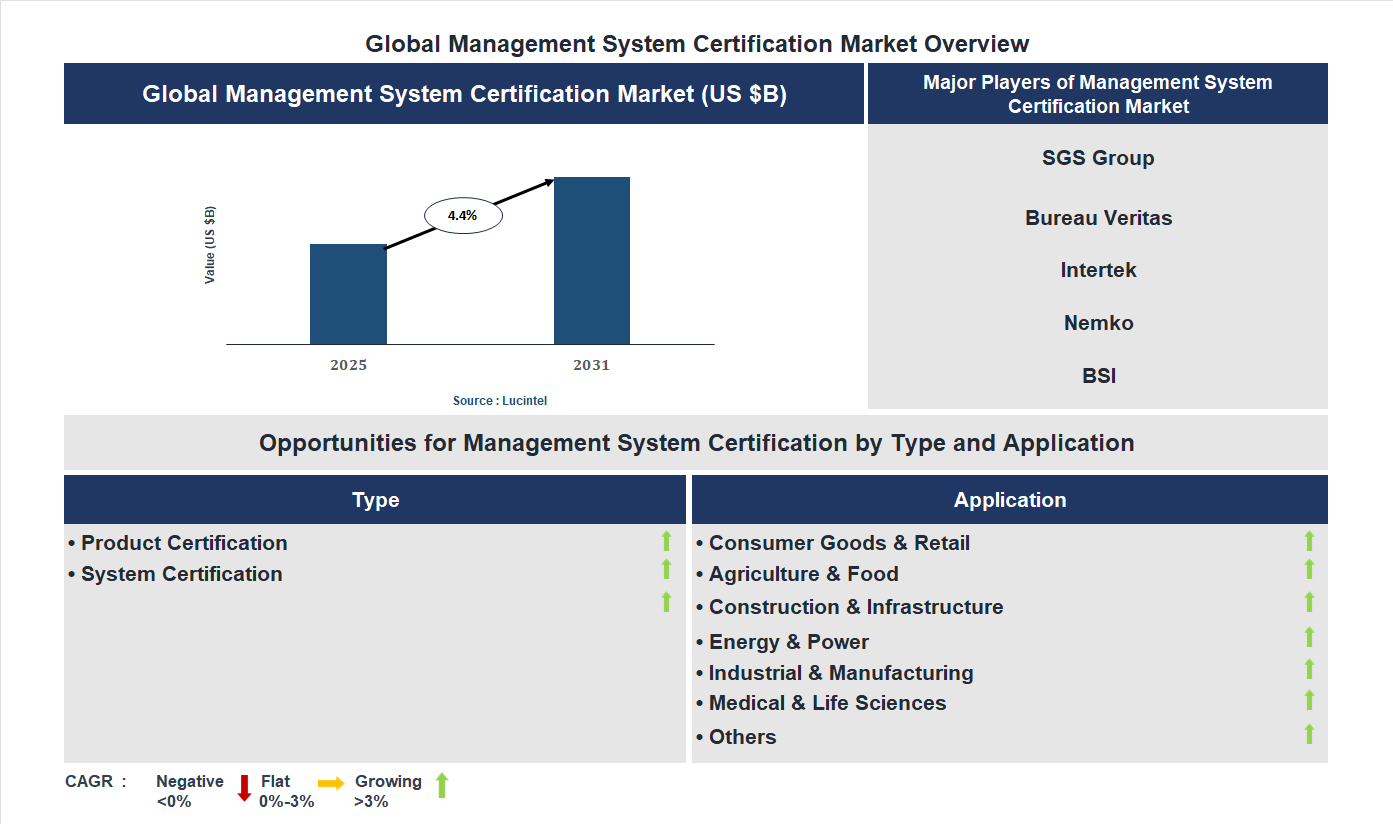
The future of the global management system certification market looks promising with opportunities in the consumer good & retail, agriculture & food, construction & infrastructure, energy & power, industrial & manufacturing, and medical & life science markets. The global management system certification market is expected to grow with a CAGR of 4.4% from 2025 to 2031. The major drivers for this market are the increasing regulatory compliance requirements for industries, the rising need for standardized quality management systems, and the growing focus on operational efficiency & safety.• Lucintel forecasts that, within the type category, system certification is expected to witness higher growth over the forecast period.
• Within the application category, medical & life science is expected to witness the highest growth.
• In terms of region, APAC is expected to witness the highest growth over the forecast period. Gain valuable insights for your business decisions with our comprehensive 150+ page report. Sample figures with some insights are shown below.
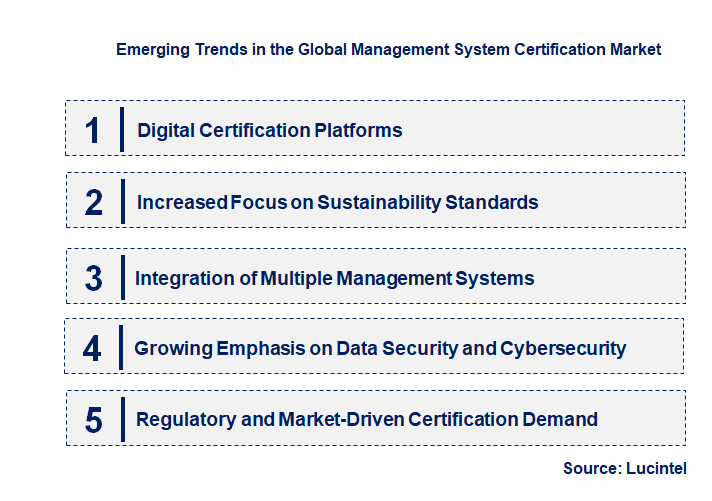
Emerging Trends in the Management System Certification Market
The management system certification market is experiencing rapid evolution driven by technological advancements, increasing regulatory demands, and a growing emphasis on sustainability and quality standards across industries. Organizations are seeking more efficient, transparent, and integrated certification processes to enhance their competitiveness and compliance. These developments are reshaping how companies approach certification, emphasizing innovation, digital transformation, and stakeholder engagement. As the market adapts to these changes, new opportunities and challenges are emerging, influencing global trade, operational efficiency, and corporate responsibility. Understanding these key trends is essential for stakeholders aiming to stay ahead in this dynamic environment.• Digital Certification Platforms: The adoption of digital platforms is transforming certification processes by enabling real-time tracking, automated documentation, and remote audits. This shift enhances efficiency, reduces costs, and accelerates certification timelines. Digital tools also improve transparency and data security, making it easier for organizations to maintain compliance and demonstrate their standards to stakeholders. As technology advances, digital certification is expected to become the norm, facilitating seamless integration with other management systems and fostering global connectivity.
• Increased Focus on Sustainability Standards: Sustainability is becoming a core component of management system certifications, driven by regulatory pressures and consumer demand for responsible business practices. Certifications such as ISO 14001 and ISO 26000 are gaining prominence, encouraging companies to adopt environmentally friendly and socially responsible policies. This trend impacts market dynamics by creating new certification opportunities and pushing organizations to innovate in sustainability initiatives, ultimately enhancing their brand reputation and stakeholder trust.
• Integration of Multiple Management Systems: Organizations are increasingly seeking integrated certification solutions that combine standards like quality (ISO 9001), environmental (ISO 14001), and occupational health and safety (ISO 45001). This integrated approach reduces redundancies, streamlines processes, and provides a comprehensive view of organizational performance. The market is witnessing a rise in multi-standard certifications, which help companies meet diverse regulatory requirements efficiently and improve overall management effectiveness.
• Growing Emphasis on Data Security and Cybersecurity: As certification processes become more digital, data security and cybersecurity are gaining importance. Protecting sensitive information related to organizational compliance and audit results is critical to prevent breaches and maintain stakeholder confidence. Certification bodies are incorporating cybersecurity standards and protocols into their assessments, reflecting the increasing need for organizations to safeguard their digital assets and ensure integrity in their management systems.
• Regulatory and Market-Driven Certification Demand: Evolving regulations and international trade agreements are driving the demand for management system certifications. Governments and industry bodies are mandating certifications to ensure safety, quality, and environmental standards. This trend encourages organizations to proactively pursue certifications to access new markets, comply with legal requirements, and enhance their competitive edge. The market is thus witnessing a surge in certification services tailored to specific industry needs and regional regulations. In summary, these trends are fundamentally reshaping the management system certification market by fostering digital innovation, emphasizing sustainability, promoting integrated management approaches, enhancing data security, and responding to regulatory demands. These developments are enabling organizations to operate more efficiently, responsibly, and competitively in a globalized economy.
Recent Development in the Management System Certification Market
The management system certification market has experienced significant growth driven by increasing global demand for standardized quality, environmental, and safety practices across industries. As organizations strive to enhance operational efficiency, ensure compliance, and build stakeholder trust, the market has seen rapid innovation and expansion. Technological advancements, regulatory changes, and rising awareness about sustainable practices are key factors influencing this evolution. Companies are increasingly seeking certifications such as ISO 9001, ISO 14001, and ISO 45001 to demonstrate their commitment to excellence. These developments are shaping the competitive landscape, fostering innovation, and driving market growth in both developed and emerging economies.• Digital Transformation Adoption: The integration of digital tools and platforms has streamlined certification processes, reducing time and costs. Automated auditing and online documentation have improved accuracy and efficiency, making certifications more accessible for small and medium enterprises. This shift enhances market penetration and accelerates certification cycles, ultimately boosting overall market growth.
• Regulatory Stringency and Compliance: Governments and industry bodies are imposing stricter regulations related to quality, safety, and environmental standards. This increased regulatory pressure compels organizations to seek certifications to ensure compliance, thereby expanding the market. It also encourages continuous improvement and adoption of best practices, fostering a culture of quality and safety.
• Growing Emphasis on Sustainability Certifications: The rising focus on environmental sustainability has led to increased demand for certifications like ISO 14001 and LEED. Organizations aim to demonstrate their commitment to eco-friendly practices, which enhances brand reputation and stakeholder trust. This trend is expanding the scope of the management system certification market into new sectors and regions.
• Industry-Specific Certification Expansion: The market is witnessing the development of industry-specific management system certifications tailored to sectors such as healthcare, IT, and manufacturing. These specialized certifications address unique industry challenges and requirements, providing targeted assurance to clients and regulators. This diversification broadens market opportunities and drives sector-specific growth.
• Impact of Global Supply Chain Dynamics: The globalization of supply chains has heightened the need for consistent management standards across borders. Multinational companies seek certifications to ensure uniform quality and safety standards globally, fostering trust among international partners. This trend promotes cross-border certification services and stimulates market expansion into emerging markets. In summary, these developments are significantly impacting the management system certification market by enhancing efficiency, ensuring compliance, and promoting sustainability. The integration of digital tools, stricter regulations, and industry-specific standards are driving growth and diversification. As organizations increasingly recognize the value of certification for competitive advantage, the market is poised for continued expansion, innovation, and global reach.
Strategic Growth Opportunities in the Management System Certification Market
The management system certification market is experiencing rapid expansion driven by increasing global emphasis on quality, safety, and environmental standards. Organizations across various industries seek certification to enhance credibility, ensure compliance, and gain competitive advantage. As regulatory requirements tighten and customer expectations evolve, the market presents numerous growth opportunities across key applications. These opportunities are shaping the future landscape, fostering innovation, and driving demand for comprehensive certification services. Understanding these growth avenues is essential for stakeholders aiming to capitalize on emerging trends and sustain long-term success in this dynamic environment.• Digital Transformation: Adoption of digital tools and platforms is streamlining certification processes, reducing time and costs, and enabling remote audits. This enhances efficiency and broadens access for organizations worldwide, accelerating certification cycles and expanding market reach.
• Sustainability and Environmental Certification: Growing focus on sustainability practices is increasing demand for environmental management system certifications. This trend helps companies demonstrate eco-friendly operations, meet regulatory standards, and appeal to environmentally conscious consumers.
• Industry-Specific Certifications: Tailored certifications for sectors like healthcare, manufacturing, and IT are gaining prominence. These specialized standards address unique industry needs, improve operational quality, and foster trust among clients and regulators.
• Small and Medium Enterprises (SMEs): Increasing support and simplified certification pathways are enabling SMEs to attain management system certifications. This democratizes access, enhances competitiveness, and promotes widespread adoption across diverse business sizes.
• Regulatory Compliance and Risk Management: Stricter regulations are compelling organizations to seek certifications that ensure compliance and mitigate risks. This reduces legal liabilities, enhances safety, and sustains business continuity in a complex regulatory landscape. In summary, these growth opportunities are significantly impacting the management system certification market by expanding its scope, increasing adoption across industries, and fostering innovation. They are driving market growth, improving operational standards, and enabling organizations to meet evolving regulatory and consumer demands effectively.
Management System Certification Market Driver and Challenges
The management system certification market is influenced by a variety of technological, economic, and regulatory factors that shape its growth and development. Advances in digital technologies and increasing globalization have heightened the demand for standardized management practices across industries. Regulatory frameworks and compliance requirements are becoming more stringent, prompting organizations to seek certification to demonstrate adherence. Economic factors such as rising competition and the need for operational efficiency also drive market expansion. Conversely, challenges like high certification costs, evolving standards, and regional disparities pose obstacles. Understanding these drivers and challenges is essential for stakeholders aiming to capitalize on opportunities and navigate potential risks within this dynamic market. The factors responsible for driving the management system certification market include:-• Increasing Regulatory Compliance and Standards: The growing complexity of regulatory requirements across industries compels organizations to obtain management system certifications such as ISO 9001, ISO 14001, and ISO 45001. These certifications help companies demonstrate compliance, reduce legal risks, and enhance stakeholder trust. As governments and industry bodies tighten regulations, the demand for certified management systems rises, fostering market growth. Additionally, international trade agreements often require certified management practices, further incentivizing organizations to pursue certification to access global markets. This trend underscores the importance of certification as a strategic tool for compliance and competitive advantage.
• Technological Advancements and Digital Transformation: The integration of digital technologies like IoT, AI, and cloud computing has revolutionized management systems. These innovations enable real-time monitoring, data-driven decision-making, and streamlined certification processes. Digital tools facilitate easier audits, continuous improvement, and transparency, making certification more accessible and efficient. As organizations adopt Industry 4.0 practices, the need for updated management systems that leverage these technologies increases. This technological evolution not only accelerates certification processes but also enhances the credibility and robustness of management systems, thereby driving market expansion.
• Growing Awareness and Emphasis on Sustainability: Increasing awareness of environmental and social responsibility has propelled organizations to adopt sustainable management practices. Certifications such as ISO 14001 and ISO 26000 serve as proof of commitment to sustainability, attracting environmentally conscious consumers and investors. Governments and NGOs are promoting sustainable development goals, encouraging companies to integrate sustainability into their management systems. This shift enhances brand reputation, reduces environmental impact, and ensures regulatory compliance, all of which contribute to higher certification adoption. The emphasis on sustainability is thus a significant driver for the growth of the management system certification market.
• Rising Global Trade and Market Expansion: The globalization of markets has intensified competition and created a need for standardized management practices. Companies seeking to enter new markets or expand their global footprint often require management system certifications to meet international standards and customer expectations. Certification acts as a mark of quality and reliability, facilitating smoother entry into diverse markets. Moreover, multinational corporations prefer suppliers with certified management systems, creating a ripple effect across supply chains. This global trade environment fosters increased demand for management system certifications, fueling market growth and encouraging organizations to adopt internationally recognized standards.
• Increasing Focus on Risk Management and Operational Efficiency: Organizations are increasingly prioritizing risk management to mitigate operational, financial, and reputational risks. Management system certifications like ISO 9001 and ISO 45001 emphasize process standardization, continuous improvement, and hazard control, which help organizations identify and manage risks proactively. Additionally, certification promotes operational efficiency by streamlining processes, reducing waste, and enhancing productivity. As businesses face volatile markets and complex regulatory landscapes, the need for robust management systems becomes critical. This focus on risk mitigation and efficiency drives organizations to pursue certification, thereby expanding the market. The challenges facing this management system certification market include:-
• High Certification Costs and Implementation Expenses: Acquiring and maintaining management system certifications involve significant costs, including consultancy fees, training, audits, and ongoing compliance efforts. Small and medium-sized enterprises (SMEs) often find these expenses prohibitive, limiting their ability to participate in the market. Additionally, the costs associated with continuous improvement and recertification can strain organizational resources. This financial barrier hampers widespread adoption, especially in developing regions, and may slow overall market growth. Organizations must carefully evaluate the return on investment to justify certification expenses, which can be a deterrent for some entities.
• Evolving Standards and Regulatory Landscape: The management system standards are continually updated to reflect technological advancements, industry best practices, and regulatory changes. Keeping pace with these evolving standards requires organizations to invest in ongoing training, process adjustments, and system upgrades. Failure to adapt can lead to non-compliance, certification lapses, and reputational damage. The dynamic regulatory environment also creates uncertainty, making it challenging for organizations to plan long-term certification strategies. Navigating these changes demands agility and resources, posing a significant challenge for market participants.
• Regional Disparities and Lack of Awareness: The adoption of management system certification varies significantly across regions due to differences in regulatory frameworks, economic development, and awareness levels. In emerging markets, limited awareness and understanding of certification benefits hinder adoption. Additionally, regional disparities in infrastructure and technical expertise can impede certification processes. This uneven landscape creates barriers for global companies seeking uniform standards and complicates market expansion efforts. Overcoming these disparities requires targeted awareness campaigns, capacity building, and supportive policies, which can be resource-intensive and slow to implement. In summary, the management system certification market is driven by increasing regulatory demands, technological innovations, sustainability initiatives, globalization, and a focus on risk management. However, high costs, evolving standards, and regional disparities present notable challenges. These factors collectively influence market dynamics, with growth prospects hinging on how organizations navigate these drivers and obstacles. The markets future will depend on technological integration, regulatory support, and efforts to enhance awareness and affordability, ensuring broader adoption and sustained expansion.
List of Management System Certification Companies
Companies in the market compete on the basis of product quality offered. Major players in this market focus on expanding their manufacturing facilities, R&D investments, infrastructural development, and leverage integration opportunities across the value chain. With these strategies management system certification companies cater increasing demand, ensure competitive effectiveness, develop innovative products & technologies, reduce production costs, and expand their customer base. Some of the management system certification companies profiled in this report include-• SGS Group
• Bureau Veritas
• Intertek
• Nemko
• BSI
• BRE Group
• IFC Certification
Management System Certification Market by Segment
The study includes a forecast for the global management system certification market by type, application, and region.Management System Certification Market by Type [Value from 2019 to 2031]:
• Product Certification
• System Certification
Management System Certification Market by Application [Value from 2019 to 2031]:
• Consumer Goods & Retail
• Agriculture & Food
• Construction & Infrastructure
• Energy & Power
• Industrial & Manufacturing
• Medical & Life Sciences
• Others
Management System Certification Market by Region [Value from 2019 to 2031]:
• North America
• Europe
• Asia Pacific
• The Rest of the World
Country Wise Outlook for the Management System Certification Market
The management system certification market has experienced significant growth driven by increasing global emphasis on quality, sustainability, and regulatory compliance. As organizations seek to enhance operational efficiency and meet evolving standards, countries are adopting new certifications and updating existing frameworks. Technological advancements and digital transformation are also influencing certification processes, making them more accessible and efficient. Governments and industries worldwide are recognizing the importance of standardized management systems to improve competitiveness and stakeholder trust. This dynamic environment reflects a global shift towards more sustainable and responsible business practices, with each country tailoring its approach to local needs and international standards.• United States: The US market has seen a surge in ISO 9001 and ISO 14001 certifications, driven by increased demand from manufacturing and service sectors. There is a growing focus on integrating digital tools into certification processes, enhancing efficiency. Regulatory bodies are updating standards to align with sustainability goals, encouraging companies to adopt environmentally friendly practices. The adoption of management system certifications is also linked to supply chain transparency and risk management, especially in the wake of recent supply chain disruptions. Overall, the US market emphasizes innovation and compliance to maintain competitive advantage.
• China: China continues to expand its certification landscape, with a strong focus on ISO 9001, ISO 14001, and new standards like ISO 45001 for occupational health and safety. The government actively promotes management system certifications to support industrial upgrading and sustainable development. Digital platforms are increasingly used for certification processes, reducing time and costs. The country is also emphasizing green certifications to meet environmental targets under its national policies. The market is witnessing rapid growth in manufacturing, construction, and technology sectors, with certifications playing a crucial role in global trade and compliance.
• Germany: Germany remains a leader in management system certifications, particularly in quality and environmental standards such as ISO 9001 and ISO 14001. The focus is on integrating Industry 4.0 technologies into certification processes, promoting smart manufacturing. There is a strong emphasis on sustainability and energy efficiency, with certifications supporting Germany’s commitment to the EU Green Deal. The certification market is also evolving to include cybersecurity and data protection standards, reflecting digital transformation. German companies are increasingly adopting integrated management systems to streamline operations and meet international standards.
• India: The Indian market is witnessing rapid growth in management system certifications, driven by government initiatives like Make in India and Digital India. ISO 9001 and ISO 14001 are widely adopted across manufacturing, IT, and service sectors. There is a rising trend of integrating management systems with digital tools for better compliance and monitoring. The government’s focus on sustainability and quality standards is encouraging organizations to pursue certifications. Additionally, new standards related to occupational health and safety are gaining traction, supporting India’s industrial growth and global competitiveness.
• Japan: Japan’s management system certification market is characterized by a focus on quality, safety, and environmental standards such as ISO 9001 and ISO 14001. The country emphasizes continuous improvement and innovation, integrating certifications with lean manufacturing and Kaizen practices. Digitalization is enhancing certification processes, making them more efficient and transparent. Japan is also advancing certifications related to cybersecurity and data protection, aligning with global trends. The market supports industries like automotive, electronics, and manufacturing, with a strong emphasis on sustainability and corporate social responsibility to meet both domestic and international expectations.

Features of the Global Management System Certification Market
Market Size Estimates: Management system certification market size estimation in terms of value ($B). Trend and Forecast Analysis: Market trends (2019 to 2024) and forecast (2025 to 2031) by various segments and regions. Segmentation Analysis: Management system certification market size by type, application, and region in terms of value ($B). Regional Analysis: Management system certification market breakdown by North America, Europe, Asia Pacific, and Rest of the World. Growth Opportunities: Analysis of growth opportunities in different types, applications, and regions for the management system certification market. Strategic Analysis: This includes M&A, new product development, and competitive landscape of the management system certification market. Analysis of competitive intensity of the industry based on Porter’s Five Forces model.
FAQ
Q1. What is the growth forecast for management system certification market? Answer: The global management system certification market is expected to grow with a CAGR of 4.4% from 2025 to 2031. Q2. What are the major drivers influencing the growth of the management system certification market? Answer: The major drivers for this market are the increasing regulatory compliance requirements for industries, the rising need for standardized quality management systems, and the growing focus on operational efficiency & safety. Q3. What are the major segments for management system certification market? Answer: The future of the management system certification market looks promising with opportunities in the consumer good & retail, agriculture & food, construction & infrastructure, energy & power, industrial & manufacturing, and medical & life science markets. Q4. Who are the key management system certification market companies? Answer: Some of the key management system certification companies are as follows:• SGS Group
• Bureau Veritas
• Intertek
• Nemko
• BSI
• BRE Group
• IFC Certification Q5. Which management system certification market segment will be the largest in future? Answer: Lucintel forecasts that, within the type category, system certification is expected to witness higher growth over the forecast period. Q6. In management system certification market, which region is expected to be the largest in next 5 years? Answer: In terms of region, APAC is expected to witness the highest growth over the forecast period. Q7. Do we receive customization in this report? Answer: Yes, Lucintel provides 10% customization without any additional cost.
Table of Contents
List of Figures
List of Tables
Methodology
- In-depth interviews of the major players in this market
- Detailed secondary research from competitors’ financial statements and published data
- Extensive searches of published works, market, and database information pertaining to industry news, company press releases, and customer intentions
- A compilation of the experiences, judgments, and insights of Lucintel’s professionals, who have analyzed and tracked this market over the years.


Buy Now
Choose a license that fits your team. Instant PDF delivery.
Prices exclude taxes. Instant delivery. Custom licensing available on request.
Key Questions
- • What are some of the most promising, high-growth opportunities for the management system certification market by type (product certification and system certification), application (consumer goods & retail, agriculture & food, construction & infrastructure, energy & power, industrial & manufacturing, medical & life sciences, and others), and region (North America, Europe, Asia Pacific, and the Rest of the World)?
- • Which segments will grow at a faster pace and why?
- • Which region will grow at a faster pace and why?
- • What are the key factors affecting market dynamics? What are the key challenges and business risks in this market?
- • What are the business risks and competitive threats in this market?
- • What are the emerging trends in this market and the reasons behind them?
- • What are some of the changing demands of customers in the market?
- • What are the new developments in the market? Which companies are leading these developments?
- • Who are the major players in this market? What strategic initiatives are key players pursuing for business growth?
- • What are some of the competing products in this market and how big of a threat do they pose for loss of market share by material or product substitution?
- • What M&A activity has occurred in the last 5 years and what has its impact been on the industry? For any questions related to Management System Certification Market, Management System Certification Market Size, Management System Certification Market Growth, Management System Certification Market Analysis, Management System Certification Market Report, Management System Certification Market Share, Management System Certification Market Trends, Management System Certification Market Forecast, Management System Certification Companies, write Lucintel analyst at email: helpdesk@lucintel.com. We will be glad to get back to you soon.


