
Report Feature
Mammalian Cell Banking Market Trends and Forecast
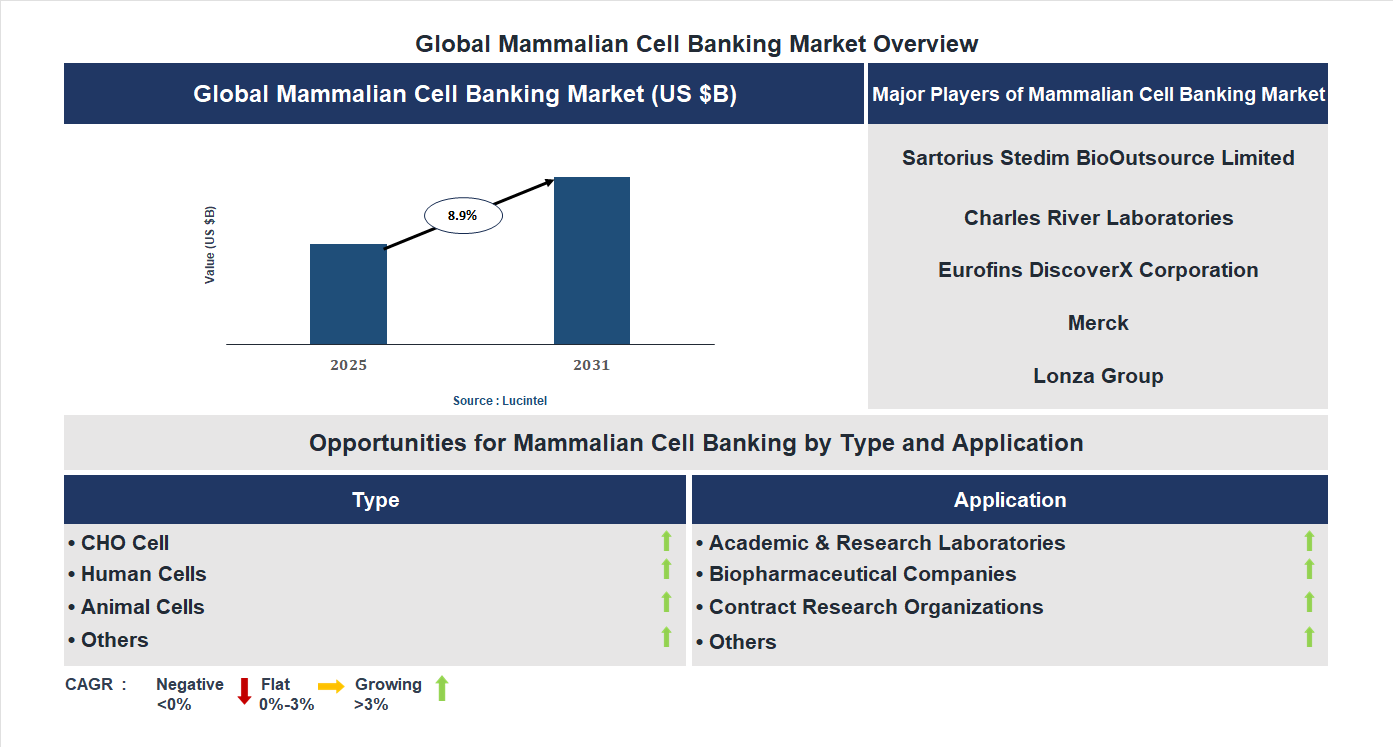
The future of the global mammalian cell banking market looks promising with opportunities in the academic & research laboratory, biopharmaceutical company, and contract research organization markets. The global mammalian cell banking market is expected to grow with a CAGR of 8.9% from 2025 to 2031. The major drivers for this market are the increasing demand for biologics & vaccines, the rising investment in cell therapy research, and the growing focus on personalized medicine solutions.• Lucintel forecasts that, within the type category, CHO cell is expected to witness the highest growth over the forecast period.
• Within the application category, biopharmaceutical company is expected to witness the highest growth.
• In terms of region, APAC is expected to witness the highest growth over the forecast period. Gain valuable insights for your business decisions with our comprehensive 150+ page report. Sample figures with some insights are shown below.
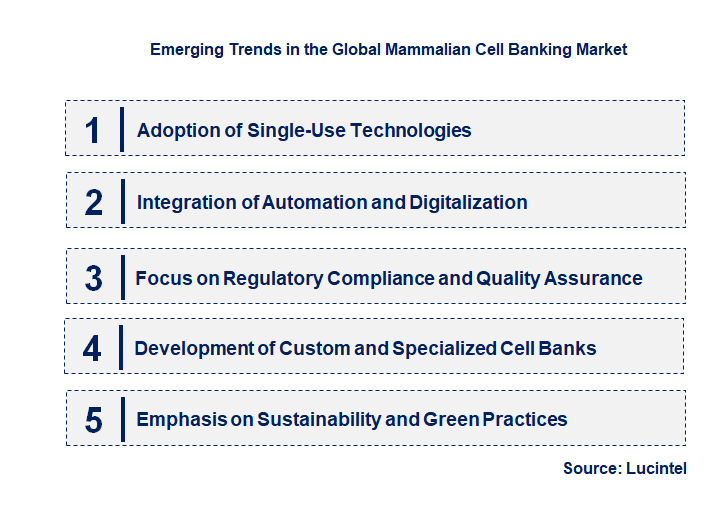
Emerging Trends in the Mammalian Cell Banking Market
The mammalian cell banking market is experiencing rapid evolution driven by advancements in biotechnology, increasing demand for biopharmaceuticals, and the need for reliable cell line preservation. As the industry shifts towards more efficient, scalable, and compliant processes, several emerging trends are shaping its future. These developments are not only enhancing the quality and safety of cell banks but also reducing costs and turnaround times. Companies are investing heavily in innovative technologies and strategic collaborations to stay competitive. Understanding these key trends is essential for stakeholders aiming to capitalize on the markets growth potential and navigate the complex regulatory landscape effectively.• Adoption of Single-Use Technologies: The shift towards single-use bioreactors and containers is transforming cell banking processes by offering greater flexibility, reduced contamination risk, and lower cleaning costs. This trend enables faster scale-up and scale-down operations, making cell banking more adaptable to various production needs. Single-use systems also facilitate easier validation and compliance with regulatory standards, which is crucial for biopharmaceutical companies. As a result, companies like geneart and proliant are increasingly integrating single-use technologies into their cell banking workflows, leading to more efficient and cost-effective operations.
• Integration of Automation and Digitalization: Automation tools and digital platforms are streamlining cell banking procedures, from sample collection to storage management. Automated systems reduce human error, improve reproducibility, and enhance data accuracy, which is vital for regulatory compliance. Digitalization enables real-time monitoring, data analytics, and seamless inventory management, increasing overall operational efficiency. Companies such as bio-rad and milliporeSigma are investing in automation and digital solutions to optimize their cell banking services, which ultimately accelerates development timelines and improves product quality.
• Focus on Regulatory Compliance and Quality Assurance: Stringent regulatory standards are prompting companies to adopt more rigorous quality control measures in cell banking. This includes implementing advanced testing protocols, validation procedures, and documentation practices to ensure cell line integrity and safety. Enhanced compliance reduces the risk of contamination and product recalls, safeguarding brand reputation and market access. Firms like thermo fisher scientific and lonza are emphasizing quality assurance in their cell banking offerings, aligning with evolving regulatory requirements and fostering trust among clients and regulators.
• Development of Custom and Specialized Cell Banks: There is a growing demand for tailored cell banking solutions to meet specific research and production needs. Customized cell banks enable companies to optimize cell line performance, stability, and productivity for particular applications. Specialized banks, such as those for stem cells or genetically modified cells, are gaining prominence. This trend allows for greater flexibility and innovation in biopharmaceutical development. Companies like bio-techne and cellero are expanding their portfolios to include bespoke cell banking services, supporting personalized medicine and niche therapeutic areas.
• Emphasis on Sustainability and Green Practices: Environmental concerns are influencing the market to adopt sustainable practices in cell banking. This includes reducing energy consumption, minimizing waste, and utilizing eco-friendly materials. Green initiatives not only align with corporate social responsibility goals but also help reduce operational costs. Companies are exploring biodegradable containers, energy-efficient storage solutions, and waste management protocols. Firms like bio-rad and milliporeSigma are leading efforts to incorporate sustainability into their cell banking processes, which appeals to environmentally conscious clients and complies with emerging regulations. In summary, these trends are collectively reshaping the mammalian cell banking market by enhancing operational efficiency, ensuring regulatory compliance, fostering innovation, and promoting sustainability. As companies adopt new technologies and strategies, the market is poised for continued growth, driven by the increasing demand for high-quality biopharmaceutical products and personalized therapies. These developments are setting new standards for reliability, safety, and environmental responsibility in cell banking practices worldwide.
Recent Development in the Mammalian Cell Banking Market
The mammalian cell banking market has experienced significant growth driven by advancements in biopharmaceuticals, regenerative medicine, and vaccine development. As the demand for high-quality cell lines increases, companies are investing in innovative banking solutions to ensure cell line stability, safety, and regulatory compliance. Recent developments reflect a focus on automation, quality assurance, and expanding applications across various biotech sectors. These innovations are shaping the future landscape of cell banking, making processes more efficient and reliable. The following key developments highlight the major trends influencing this markets evolution and its overall growth trajectory.• Automation in Cell Banking: The integration of automation technologies has streamlined cell banking processes, reducing manual errors and increasing throughput. Companies like thermo fisher scientific are developing automated systems for cell storage and retrieval, which enhance efficiency and reproducibility. This development minimizes contamination risks and ensures consistent cell quality, ultimately accelerating research and production timelines.
• Advanced Quality Control Measures: Enhanced quality control protocols, including genomic stability testing and pathogen screening, are being adopted to meet stringent regulatory standards. bio-rad laboratories and other players are implementing real-time monitoring tools that improve the safety and reliability of cell banks. These measures boost confidence among biopharma companies and regulatory bodies, facilitating faster approval processes.
• Expansion of Cell Line Repositories: Major companies are expanding their cell line repositories to include a broader range of mammalian cell types, such as stem cells and primary cells. this expansion supports diverse research needs and biomanufacturing applications. Companies like lonza are investing in new storage facilities and partnerships to increase their repository offerings, thereby strengthening their market position.
• Focus on Cryopreservation Techniques: Innovations in cryopreservation, including the development of new cryoprotectants and freezing protocols, are improving cell viability post-thaw. companies like thermo fisher scientific are pioneering these techniques to ensure long-term stability of cell lines. This advancement reduces cell loss during storage and enhances the reliability of cell banks for future use.
• Regulatory and Standardization Initiatives: Efforts to standardize cell banking practices and align with global regulatory frameworks are gaining momentum. organizations such as the international society for cell & gene therapy are establishing guidelines that promote consistency and safety. These initiatives facilitate international collaboration and market expansion, ensuring compliance and fostering trust among stakeholders. In summary, these recent developments are significantly impacting the mammalian cell banking market by improving process efficiency, ensuring higher quality standards, and expanding application scope. Automation and advanced quality controls are reducing costs and turnaround times, while innovations in cryopreservation and repository expansion are enhancing cell line stability and availability. Regulatory standardization efforts are fostering global market growth and confidence, positioning the market for sustained expansion and innovation.
Strategic Growth Opportunities in the Mammalian Cell Banking Market
The mammalian cell banking market is experiencing rapid growth driven by advancements in biotechnology, pharmaceuticals, and regenerative medicine. As industries seek reliable cell sources for research, drug development, and therapeutic applications, the demand for high-quality, scalable cell banking solutions increases. Key applications such as biopharmaceutical production, regenerative medicine, vaccine development, gene therapy, and research are fueling this expansion. Companies like thermo fisher scientific, bio-rad laboratories, and merck are investing heavily in innovative cell banking technologies. These developments are creating new opportunities for market players to enhance product offerings, improve efficiency, and meet the evolving needs of the biotech industry.• Biopharmaceutical Production: Enhanced cell banking techniques improve the consistency and yield of biologic drugs, leading to more efficient manufacturing processes and higher-quality products, which ultimately benefit patients and reduce costs.
• Regenerative Medicine: Advanced cell banking solutions enable the preservation of stem cells and other therapeutic cells, facilitating the development of personalized treatments and tissue engineering applications, thus expanding market reach.
• Vaccine Development: Reliable mammalian cell banks accelerate vaccine research and production, especially for complex viral vaccines, ensuring rapid response to emerging health threats and increasing market competitiveness.
• Gene Therapy: Robust cell banking systems support the development of gene therapies by providing stable, high-quality cell lines, which are crucial for ensuring safety and efficacy in clinical applications.
• Research and Development: Improved cell banking methods enhance the reproducibility and reliability of research experiments, fostering innovation and enabling new discoveries in cell biology and drug development. In summary, these growth opportunities are significantly impacting the mammalian cell banking market by driving innovation, improving product quality, and expanding application areas. As companies like thermo fisher scientific, bio-rad laboratories, and merck continue to develop advanced solutions, the market is poised for sustained growth, meeting the increasing global demand for reliable cell banking in various biomedical fields.
Mammalian Cell Banking Market Driver and Challenges
The mammalian cell banking market is influenced by a variety of technological, economic, and regulatory factors that shape its growth trajectory. Advances in biotechnological research, increasing demand for biopharmaceuticals, and stringent regulatory standards are key drivers. Conversely, challenges such as high operational costs, complex regulatory compliance, and technological limitations pose significant hurdles. Understanding these drivers and challenges is essential for stakeholders aiming to navigate this dynamic landscape effectively. The interplay of these factors determines the pace of innovation, investment, and overall market expansion, impacting companies, researchers, and regulatory bodies involved in mammalian cell banking. The factors responsible for driving the mammalian cell banking market include:• technological advancements: Rapid innovations in cell culture techniques, automation, and bioprocessing technologies have significantly enhanced the efficiency, scalability, and reliability of mammalian cell banking. These advancements enable faster development of biopharmaceuticals, reduce contamination risks, and improve product consistency. As a result, companies can meet increasing demand for personalized medicine and biologics, fueling market growth. Continuous R&D investments further propel this trend, making cell banking more accessible and cost-effective. The integration of AI and machine learning is expected to optimize cell line development, boosting productivity and reducing time-to-market.
• rising demand for biopharmaceuticals: The global surge in chronic diseases, cancer, and rare disorders has driven the need for innovative biologic therapies. Mammalian cell lines are essential for producing complex proteins, monoclonal antibodies, and vaccines. The expanding pipeline of biopharmaceutical products necessitates robust cell banking systems to ensure consistent supply and quality. Additionally, the shift from traditional small-molecule drugs to biologics is creating a substantial market opportunity. This demand is further supported by increasing healthcare expenditure and a growing awareness of personalized medicine, which collectively accelerate market expansion.
• regulatory landscape: Stringent regulatory standards set by agencies like the FDA, EMA, and ICH require comprehensive validation, documentation, and quality control in cell banking processes. These regulations ensure product safety, efficacy, and consistency, compelling companies to adopt advanced, compliant technologies. While compliance can be costly and time-consuming, it ultimately enhances product credibility and market access. Evolving regulatory frameworks also encourage innovation in cell banking practices, fostering the development of standardized protocols and quality assurance measures that benefit the entire industry.
• increasing investments in bioprocessing infrastructure: Governments, private investors, and biotech firms are investing heavily in bioprocessing facilities to support mammalian cell banking. These investments facilitate the development of state-of-the-art laboratories, manufacturing plants, and R&D centers. Enhanced infrastructure improves scalability, reduces production costs, and accelerates product development timelines. Moreover, increased funding supports workforce training and technological upgrades, ensuring the industry remains competitive. This financial backing is crucial for meeting the rising demand for biologics and maintaining a robust supply chain, ultimately driving market growth. The challenges facing this mammalian cell banking market include:
• high operational and development costs: Establishing and maintaining mammalian cell banks require significant capital investment in facilities, equipment, and skilled personnel. The costs associated with cell line development, validation, and ongoing quality control are substantial. These expenses can hinder entry for small and emerging players, limiting market competition. Additionally, the lengthy development timelines and risk of contamination or failure add financial burdens. High operational costs also impact pricing strategies, potentially making biologic products less accessible and affecting overall market growth. Overcoming these financial barriers is essential for broader market expansion.
• complex regulatory compliance: Navigating the complex regulatory environment is a major challenge. Companies must adhere to strict guidelines for cell line characterization, validation, and traceability, which can be time-consuming and costly. Regulatory delays can postpone product launches and increase R&D expenses. Variability in regional regulations further complicates global market access. Ensuring compliance without compromising innovation requires substantial expertise and resources. Failure to meet regulatory standards can result in product recalls, legal penalties, and loss of market credibility, posing significant risks to companies operating in this space.
• technological limitations and standardization issues: Despite advancements, technological limitations such as variability in cell line performance, contamination risks, and scalability issues persist. Standardizing cell banking procedures across different laboratories remains challenging, leading to inconsistencies in product quality. These issues hinder reproducibility and regulatory approval processes. Additionally, emerging bioprocessing technologies may require further validation before widespread adoption. Overcoming these technological hurdles is crucial for ensuring reliable, high-quality biologics and maintaining competitive advantage in the market. In summary, the mammalian cell banking market is driven by technological innovations, increasing demand for biologics, regulatory support, and infrastructure investments. However, high costs, regulatory complexities, and technological challenges pose significant hurdles. These factors collectively influence the pace of market growth, requiring stakeholders to balance innovation with compliance and cost management. Successful navigation of these drivers and challenges will determine the future landscape, shaping the development and accessibility of biopharmaceutical products worldwide.
List of Mammalian Cell Banking Companies
Companies in the market compete on the basis of product quality offered. Major players in this market focus on expanding their manufacturing facilities, R&D investments, infrastructural development, and leverage integration opportunities across the value chain. With these strategies mammalian cell banking companies cater increasing demand, ensure competitive effectiveness, develop innovative products & technologies, reduce production costs, and expand their customer base. Some of the mammalian cell banking companies profiled in this report include-• Sartorius Stedim BioOutsource Limited
• Charles River Laboratories
• Eurofins DiscoverX Corporation
• Merck
• Lonza Group
• ViruSure
• Altogen Labs
• Abzena
• Northway Biotechpharma
• Selexis
Mammalian Cell Banking Market by Segment
The study includes a forecast for the global mammalian cell banking market by type, application, and region.Mammalian Cell Banking Market by Type [Value from 2019 to 2031]:
• CHO Cell
• Human Cells
• Animal Cells
• Others
Mammalian Cell Banking Market by Application [Value from 2019 to 2031]:
• Academic & Research Laboratories
• Biopharmaceutical Companies
• Contract Research Organizations
• Others
Mammalian Cell Banking Market by Region [Value from 2019 to 2031]:
• North America
• Europe
• Asia Pacific
• The Rest of the World
Country Wise Outlook for the Mammalian Cell Banking Market
The mammalian cell banking market is experiencing rapid growth driven by advancements in biopharmaceuticals, regenerative medicine, and personalized therapies. As the demand for biologics increases globally, countries are investing heavily in research, infrastructure, and regulatory frameworks to support innovation. Technological improvements, such as automation and quality control, are enhancing cell bank stability and safety. Additionally, collaborations between biotech firms and academic institutions are accelerating development. These developments reflect a broader trend toward more efficient, scalable, and compliant cell banking solutions, positioning key countries as leaders in this evolving landscape.• United States: The US leads in mammalian cell banking with significant investments from biotech giants like amgen and biogen. Innovations in automation and high-throughput screening are improving cell bank quality and efficiency. Regulatory agencies such as the FDA are updating guidelines to support advanced therapies, fostering a conducive environment for market growth. The US also sees increased collaborations between academia and industry, accelerating research and development efforts.
• China: China is rapidly expanding its mammalian cell banking capabilities, driven by government initiatives to boost biotech innovation. Companies like geneo and innovent are investing in state-of-the-art bioprocessing facilities. The country is focusing on developing indigenous cell lines and improving biomanufacturing standards to meet global quality benchmarks. Strategic partnerships with international firms are also enhancing technological expertise and market competitiveness.
• Germany: Germany remains a key player in the European mammalian cell banking market, with a focus on quality and regulatory compliance. Companies such as bioNTech are advancing cell banking techniques for personalized medicine. The country benefits from a strong biotech ecosystem and supportive regulatory frameworks, which facilitate innovation and commercialization. Investments in automation and quality assurance are driving improvements in cell bank stability and safety.
• India: India is witnessing significant growth in mammalian cell banking, supported by government initiatives like Make in India and increased R&D funding. Local firms such as biocon and serum institute are expanding their bioprocessing capacities. The focus is on developing cost-effective solutions and improving infrastructure to cater to domestic and export markets. Collaborations with international companies are helping transfer technology and enhance expertise.
• Japan: Japan continues to innovate in mammalian cell banking, emphasizing quality control and process optimization. Companies like takeda are adopting advanced bioprocessing techniques to improve cell bank robustness. The country’s strong regulatory environment and focus on regenerative medicine are fostering new developments. Investments in automation and digitalization are enhancing efficiency and product consistency in cell banking processes.

Features of the Global Mammalian Cell Banking Market
Market Size Estimates: Mammalian cell banking market size estimation in terms of value ($B). Trend and Forecast Analysis: Market trends (2019 to 2024) and forecast (2025 to 2031) by various segments and regions. Segmentation Analysis: Mammalian cell banking market size by type, application, and region in terms of value ($B). Regional Analysis: Mammalian cell banking market breakdown by North America, Europe, Asia Pacific, and Rest of the World. Growth Opportunities: Analysis of growth opportunities in different types, applications, and regions for the mammalian cell banking market. Strategic Analysis: This includes M&A, new product development, and competitive landscape of the mammalian cell banking market. Analysis of competitive intensity of the industry based on Porter’s Five Forces model.
FAQ
Q1. What is the growth forecast for mammalian cell banking market? Answer: The global mammalian cell banking market is expected to grow with a CAGR of 8.9% from 2025 to 2031. Q2. What are the major drivers influencing the growth of the mammalian cell banking market? Answer: The major drivers for this market are the increasing demand for biologics & vaccines, the rising investment in cell therapy research, and the growing focus on personalized medicine solutions. Q3. What are the major segments for mammalian cell banking market? Answer: The future of the mammalian cell banking market looks promising with opportunities in the academic & research laboratory, biopharmaceutical company, and contract research organization markets. Q4. Who are the key mammalian cell banking market companies? Answer: Some of the key mammalian cell banking companies are as follows:• Sartorius Stedim BioOutsource Limited
• Charles River Laboratories
• Eurofins DiscoverX Corporation
• Merck
• Lonza Group
• ViruSure
• Altogen Labs
• Abzena
• Northway Biotechpharma
• Selexis Q5. Which mammalian cell banking market segment will be the largest in future? Answer: Lucintel forecasts that, within the type category, CHO cell is expected to witness the highest growth over the forecast period. Q6. In mammalian cell banking market, which region is expected to be the largest in next 5 years? Answer: In terms of region, APAC is expected to witness the highest growth over the forecast period. Q7. Do we receive customization in this report? Answer: Yes, Lucintel provides 10% customization without any additional cost.
Table of Contents
List of Figures
List of Tables
Methodology
- In-depth interviews of the major players in this market
- Detailed secondary research from competitors’ financial statements and published data
- Extensive searches of published works, market, and database information pertaining to industry news, company press releases, and customer intentions
- A compilation of the experiences, judgments, and insights of Lucintel’s professionals, who have analyzed and tracked this market over the years.


Buy Now
Choose a license that fits your team. Instant PDF delivery.
Prices exclude taxes. Instant delivery. Custom licensing available on request.
Key Questions
- • What are some of the most promising, high-growth opportunities for the mammalian cell banking market by type (CHO cell, human cells, animal cells, and others), application (academic & research laboratories, biopharmaceutical companies, contract research organizations, and others), and region (North America, Europe, Asia Pacific, and the Rest of the World)?
- • Which segments will grow at a faster pace and why?
- • Which region will grow at a faster pace and why?
- • What are the key factors affecting market dynamics? What are the key challenges and business risks in this market?
- • What are the business risks and competitive threats in this market?
- • What are the emerging trends in this market and the reasons behind them?
- • What are some of the changing demands of customers in the market?
- • What are the new developments in the market? Which companies are leading these developments?
- • Who are the major players in this market? What strategic initiatives are key players pursuing for business growth?
- • What are some of the competing products in this market and how big of a threat do they pose for loss of market share by material or product substitution?
- • What M&A activity has occurred in the last 5 years and what has its impact been on the industry? For any questions related to Mammalian Cell Banking Market, Mammalian Cell Banking Market Size, Mammalian Cell Banking Market Growth, Mammalian Cell Banking Market Analysis, Mammalian Cell Banking Market Report, Mammalian Cell Banking Market Share, Mammalian Cell Banking Market Trends, Mammalian Cell Banking Market Forecast, Mammalian Cell Banking Companies, write Lucintel analyst at email: helpdesk@lucintel.com. We will be glad to get back to you soon.


