
Report Feature
Male Grooming Product Market Trends and Forecast
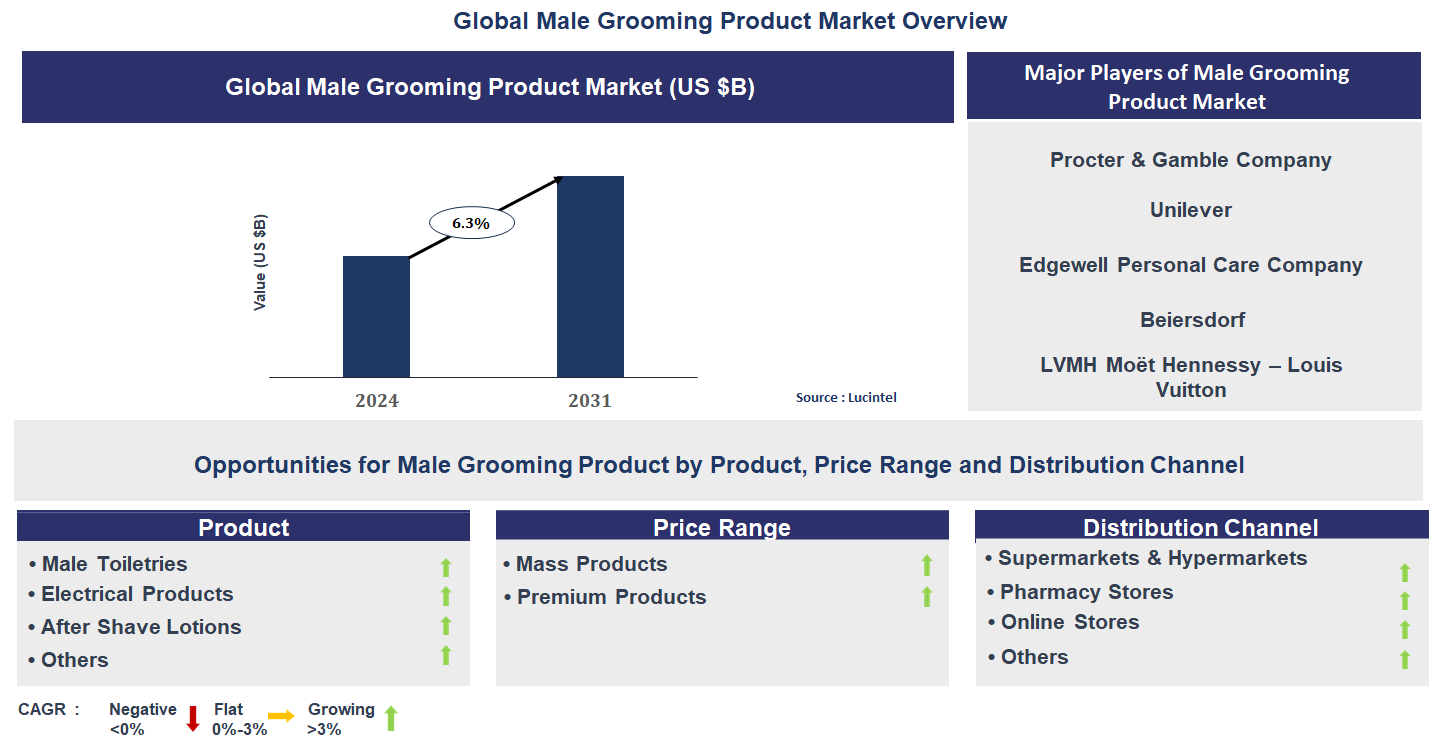
The future of the global male grooming product market looks promising with opportunities in the supermarket & hypermarket, pharmacy store, and online store markets. The global male grooming product market is expected to grow with a CAGR of 6.3% from 2025 to 2031. The major drivers for this market are the increasing focus on personal grooming, the rising acceptance of male beauty products, and the growing trend of self-care for men.• Lucintel forecasts that, within the product category, electrical product is expected to witness the highest growth over the forecast period.
• Within the distribution channel category, online store is expected to witness the highest growth.
• In terms of region, APAC is expected to witness the highest growth over the forecast period. Gain valuable insights for your business decisions with our comprehensive 150+ page report. Sample figures with some insights are shown below.
Emerging Trends in the Male Grooming Product Market
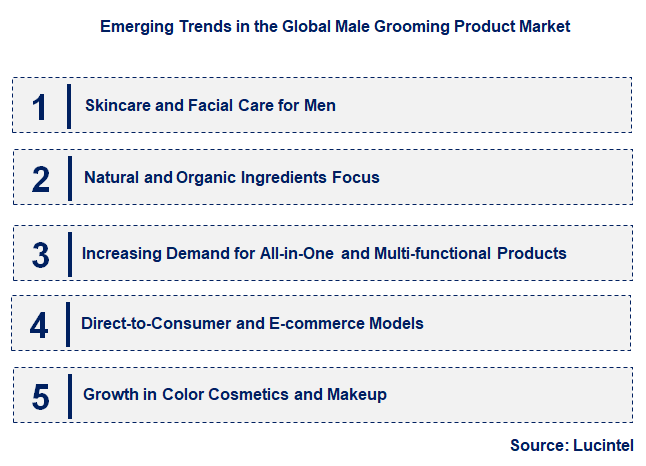
Male grooming product market is being reformed by a new group of emerging trends that are redefining its context. They are showcasing a wider trend in consumer values in which health and wellness are pushing new consumer choices. They are taking the industry from a basic, medicinal product to one that is more specialized, sustainable, and consumer-driven in business models. The five most important trends transforming this market are as follows.• Skincare and Facial Care for Men: One of the key trends is the mass acceptance of mens skincare and facial care products. This is shifting the market beyond their traditional shaving products to offer cleansers, moisturizers, serums, and even anti-aging creams. This trend is forcing brands to reformulate their products and sell them as a fundamental part of a new everyday health regimen. It is making way for new, mission-oriented brands entering the market with a specialty skincare for men.
• Natural and Organic Ingredients Focus: The market is witnessing a strong direction towards the use of natural and organic ingredients. Consumers are paying more attention to product labels and looking for formulations that are without synthetic chemicals. This has created a demand for products that contain ingredients such as tea tree oil, aloe vera, and botanical extracts. This trend is enabling emerging, environmentally friendly brands to enter the marketplace and is forcing legacy companies to re-formulate their product offerings to satisfy the needs of a health-savvy consumer market.
• Increasing Demand for All-in-One and Multi-functional Products: A speeding trend is demand for multi-functional and all-in-one products. Todays male consumers, especially those who lead a hectic lifestyle, are looking for products that provide benefits in one use. It is because of this that products such as a conditioner and shampoo in one, or a moisturizer with sun protection factor, have been developed. This trend is enabling companies to streamline their product lines and reach a new group of consumers who prioritize convenience.
• Direct-to-Consumer and E-commerce Models: There is a robust trend of growth in the direct-to-consumer and e-commerce business models within the market. This business model provides consumers a handy means to buy a plethora of grooming products from home. This model is a reliable source of revenue for firms and helps them establish a direct connection with customers. It also becomes simpler for new companies to enter the market and challenge long-standing giants.
• Growth in Color Cosmetics and Makeup: There is a growing trend of niche male makeup and cosmetics. This is encompassing creation of products for men like foundation, concealer, and eyebrow fillers. Although this trend is only just emerging in most countries, it is spreading quickly, especially in the South Korean and Japanese markets. The trend emphasizes the look of things in a business environment and is generating a new, highly developed niche of the market with tremendous growth prospects. These new trends are all together redefining the market for male grooming products by making it more sensitive to consumer values and requirements. The trend towards multi-functional products and the application of new technology is generating a new segment of value-driven premium products. The development of new business models and growth in the aesthetic and skincare categories are generating new opportunities for growth in the market and in revenue. The future of the industry will be defined by its ability to innovate and adapt to these powerful trends.
Recent Development in the Male Grooming Product Market
The market for male grooming product has seen a succession of fast-paced and meaningful changes in recent years, mainly due to an increased consumer interest in wellness and self-care. These changes are driving the market away from a straightforward, problem-based category and towards a more holistic, consumer-facing industry. Attention is now centered on issues such as sustainability, therapeutics effectiveness, and a broader understanding of health. The below five major developments illustrate how the market is shifting.• Launch of Skincare and Anti-Aging Products: One of the most important trends is the universal launch of skincare and anti-aging products specifically for men. Following demand for natural ingredients, companies are substituting artificial chemicals with botanical alternatives and introducing ingredients such as retinol and hyaluronic acid. This trend is revolutionizing product formulation and a brands public image, establishing a new benchmark for ethical and health-driven production.
• Developments in Electric and Smart Grooming Devices: There has been a significant advancement in electric and smart grooming devices. There are new products with sophisticated features such as AI-based sensors that have the capability to scan skin and hair. The market is also witnessing an increase in intelligent shavers with built-in cleaning functions and multiple settings for diverse skin types.
• E-commerce and Subscription Model Growth: One of the key developments is the growth and mass deployment of the e-commerce and subscription model. This business model provides customers with an easy means to buy a vast range of male grooming items from the comfort of home. It is a steady source of income for firms and enables them to establish a direct relationship with consumers. It also facilitates easier entry of new, niche players in the market to rival behemoths that have been around for long.
• Product Expansion into Beard and Hair Styling: One of the important developments is the extension of the market into beard and hair styling products. Companies are now providing a variety of beard oils, balms, waxes, and specialized shampoos. This trend mirrors a worldwide phenomenon whereby men are focusing on the look of their facial hair and will pay for products that will allow them to achieve a desired style. It is a very lucrative sector that is fueling enormous innovation in formulations and ingredients.
• Focus on Sustainable and Eco-Friendly Products: Another outstanding trend is the increased focus on sustainable and eco-friendly products. This means the use of recyclable packaging and environmentally and ethically responsible ingredient sourcing. Brands now advertise their sustainable practices. This trend appeals to a new generation of environmentally aware consumers and is a major driver of ongoing product innovation within the industry. These recent trends are combined to influence the male grooming product market toward a more specialized, therapeutic, and consumer-driven future. The move toward sustainable ingredients and the emergence of new formulations are aligning with both health and environmental requirements. The push into new segments and the emergence of new business models are opening up new avenues for growth and brand differentiation.
Strategic Growth Opportunities in the Male Grooming Product Market
The male grooming product industry provides several strategic growth opportunities in key applications through a combination of changing consumer values and an inclination towards more specialization. To take advantage of the opportunities, firms need to get beyond the one-size-fits-all strategy and emphasize innovation and segmented marketing. By recognizing and fulfilling particular needs in various market segments, brands are able to build new streams of revenue and develop a solid source of competitive differentiation.• Serves the Professional and Business Segment: One of the largest growth opportunities is in the professional and business segment. It involves creating specialized products for men who have to look good in order to work. Brands can intentionally design high-value, durable products that are simple to use and work well. This offers a secure, high-value revenue source and a building block for brand credibility, since customers in this category tend to be motivated by a desire for efficiency and tried-and-true effectiveness.
• Leverage the Athletic and Sports Segment: Growing opportunity exists within the athletic and sports market. This involves creating products that solve concerns such as sweat, body odor, and skin irritation after a workout. Companies can produce such products as high-performance deodorants, body washes, and fast-absorbing moisturizers designed for performance and recovery. This category provides a high-value consumer base that is willing to pay more for products that enable them to stay healthy and look clean.
• Penetration into the Skincare and Anti-Aging Market: One of the primary growth avenues is to enter into the skincare and anti-aging business. Brands can create a high-end line of products featuring exquisite cleansers, serums, and anti-aging creams with superior ingredients. This approach addresses the expanding population of consumers who want to adopt self-care practices and invest in long-term skin health.
• Taking Advantage of E-commerce and Personalization: The direct-to-consumer and e-commerce model offers a significant growth prospect. Through a direct-to-consumer service, brands can cut down on distribution expenses and establish a direct relationship with customers. A subscription model provides a regular and recurring income stream. Companies are also able to utilize online sales data to learn more about consumer habits and preferences, which can be used to guide future product launches and marketing campaigns.
• Entering Emerging Markets with an Affordable, Quality Line: There is a strategic growth opportunity in entering emerging markets. With increasing disposable incomes and urbanization, demand for affordable but effective male grooming brands will increase. By providing a series of well-produced but reasonably priced products, ranging from simple shaving sets to more sophisticated ones, companies are able to gain a position in these markets before they get saturated, taking advantage of first-mover status and a built-in customer base. These tactical growth possibilities are affecting the market for male grooming products as a whole by driving it toward a future that is increasingly specialized and consumer-driven. Through niching on groups such as athletes and niching on particular applications, businesses are increasing the market coverage. The focus on skincare and new models of business is building new segments of value-based, premium products. The penetration of the industry into new markets strategically also makes sure that the industry will keep changing and responding to worldwide consumer needs.
Male Grooming Product Market Driver and Challenges
The male grooming product industry is influenced by a subtle interplay of primary drivers and challenges that are shaping its development and trajectory. Growth and expansion of the market are mainly driven by an increased worldwide consciousness of personal hygiene and health, combined with a new generation of consumers that emphasizes self-care. But the industry also has major challenges, such as the lack of consumer awareness in a few areas, harsh competition, and a high cost for premium products. The factors responsible for driving the male grooming product market include: 1. Changing Societal Norms and Attitudes: One of the major drivers is the changing societal norms and attitudes towards male grooming. The old image that personal care is only for women is fading. This is being influenced by celebrities, social media, and an increased focus on personal appearance and self-care. Consequently, men are increasingly accepting of using a broader variety of grooming products, ranging from skincare to perfumes, which is driving market expansion. 2. Increasing Disposable Incomes: The increasing disposable incomes, especially in emerging economies, are one of the biggest drivers of the market. With the expansion of the middle class, consumers find that they have more spending money available to spend on discretionary personal care products. They can upgrade from mass market hygiene products to more specialist and higher-end grooming products. This driver is especially high in countries such as China and India, where economic growth is generating a huge new consumer base. 3. Development of Digital Marketing and E-commerce: The development of digital marketing and e-commerce is a key influencer of the market. They are increasing the ease of brands to access a large audience and consumers to access a variety of products. Beauty bloggers and social media influencers are among the leaders in educating men on grooming products and are helping create a new generation of consumers. This has also opened the market to new brands. 4. Social Media and Celebrity Influence: The power of social media and celebrities is a key driver. Social media platforms such as Instagram and YouTube are influencing the trends of male grooming and are propelling product demand. Male celebrities and influencers are turning grooming into the norm and are promoting a broad range of products. This is encouraging a new generation of men to try out their appearance and to spend money on grooming products. 5. Technology and Product Innovation: Ongoing product innovation is a key driver. Companies are continuously upgrading their products by incorporating features such as improved hydration, attention to particular skin issues, and many fragrances. Formulations with new ingredients and technologies are enabling the development of non-greasy, quick-absorbing products that better resonate with consumers. This innovation justifies a premium price and maintains consumers interest in the category. Challenges in the male grooming product market are: 1. Cultural Resistance and Traditional Attitudes: One of the biggest challenges for the market is the cultural resistance and traditional attitudes towards male grooming in certain regions. Personal care is still viewed as feminine by many men, and they view grooming products as something they do not need. This poses a major challenge to brands and necessitates that they spend heavily on large-scale educational campaigns in order to stimulate demand and alter consumer behavior. 2. Absence of Consumer Education and Awareness: The absence of consumer education and awareness is one of the biggest challenges in some markets. Most men do not know the advantages of applying a whole grooming regimen and do not realize the differences between different products. This hinders brands from increasing their market share above straightforward shaving products. The challenge is to inform and to change the way of perceiving the grooming. 3. Market Saturation and Tough Competition: The market is being greatly challenged by market saturation and tough competition. The immense demand saw new manufacturers stream into the market, causing an excess of products. This has resulted in a race to the bottom with regards to pricing, causing pressure on profit margins. The challenge is to have brands differentiate products and be able to charge a premium price. The combined effect of these drivers and challenges is a market that is in a constant state of development. The drivers, particularly the increasing emphasis on health, aging populations, and self-care, are driving the industry towards diversification and innovation. Companies are reacting by developing high-technology, specialist, and organic offerings. Yet the challenges, most notably cultural resistance and intense competition, are making companies more strategic and accountable.List of Male Grooming Product Companies
Companies in the market compete on the basis of product quality offered. Major players in this market focus on expanding their manufacturing facilities, R&D investments, infrastructural development, and leverage integration opportunities across the value chain. With these strategies male grooming product companies cater increasing demand, ensure competitive effectiveness, develop innovative products & technologies, reduce production costs, and expand their customer base. Some of the male grooming product companies profiled in this report include-• Procter & Gamble Company
• Unilever
• Edgewell Personal Care Company
• Beiersdorf
• LVMH Moët Hennessy – Louis Vuitton
• L’Óreal
• Coty
• Natura Cosmeticos
• PUIG
• Koninklijke Philips
Male Grooming Product Market by Segment
The study includes a forecast for the global male grooming product market by product, price range, distribution channel, and region.Male Grooming Product Market by Product [Value from 2019 to 2031]:
• Male Toiletries
• Electrical Products
• After Shave Lotions
• Others
Male Grooming Product Market by Price Range [Value from 2019 to 2031]:
• Mass Products
• Premium Products
Male Grooming Product Market by Distribution Channel [Value from 2019 to 2031]:
• Supermarkets & Hypermarkets
• Pharmacy Stores
• Online Stores
• Others
Male Grooming Product Market by Region [Value from 2019 to 2031]:
• North America
• Europe
• Asia Pacific
• The Rest of the World
Country Wise Outlook for the Male Grooming Product Market
The international market for male grooming product is experiencing a dramatic shift, expanding from a niche category to a sizeable personal care category. This transformation is fueled by an increased consumer consciousness of personal wellness, an expanding focus on self-grooming, and the impact of emerging technologies and social media. Whereas the market has traditionally been a mainstay for meeting fundamental shaving needs, current trends focus on product innovation, a turn towards natural and gender-neutral ingredients, and a more diversified base of uses.• United States: The male grooming market in the United States is trending toward an emphasis on premium and specialty products. Although the core shaving products continue to be a mainstay, there is increasingly a demand for added-value products, including anti-aging benefits, SPF, and naturally derived ingredients. The industry is also experiencing an increase in niche products for beard care and skin care routines. Direct-to-consumer companies and e-commerce sites are taking center stage, offering vast ranges and enabling targeted advertising to sophisticated consumer bases.
• China: Chinas market for male grooming products is undergoing high-speed expansion, driven by the emerging middle class and a growing emphasis on personal hygiene. The market is witnessing an increased demand for products that are both therapeutic as well as aesthetically beneficial, including moisturizers, anti-aging creams, and even cosmetic products for men. Social media and online marketplaces are the main growth drivers, and brands are using influencer marketing to tap a huge consumer base. Demand is also increasing for premium and imported products.
• Germany: The German male grooming market is defined by a rigorous consumer focus on product performance and quality. The market is fueled by an ageing large population and high incidence of dry skin diseases. German consumers are very sensitive to environmentally friendly initiatives and hence have a growing trend toward adopting products with sustainable ingredients and packaging. Innovation in Germany focuses on developing high-performance products that are clinically proven and effective and place great emphasis on dermatological health.
• India: Indias market for male grooming products is growing very fast, fueled by increasing disposable incomes and heightened awareness of personal grooming and hygiene. Although the market is dominated to a considerable extent by value-for-money, traditional remedies, there is a definite trend towards premium and multi-functional products. The demand for beard care products is increasing in the market. The extensive availability of products by a rapidly expanding e-commerce industry is one of the major growth drivers.
• Japan: The Japanese market for male grooming products is mature and characterized by emphasis on cutting-edge technology and high precision. Japanese consumers require products not only to be effective but also gentle and luxurious. Consequently, products with added properties, like mens specialized skincare and grooming high-tech gadgetry, have become popular. Demand exists also for products offering anti-aging for the professional, aging market. Japanese brands are leading the way with innovation in products that present a spa-like, high-quality experience.

Features of the Global Male Grooming Product Market
Market Size Estimates: Male grooming product market size estimation in terms of value ($B). Trend and Forecast Analysis: Market trends (2019 to 2024) and forecast (2025 to 2031) by various segments and regions. Segmentation Analysis: Male grooming product market size by product, price range, distribution channel, and region in terms of value ($B). Regional Analysis: Male grooming product market breakdown by North America, Europe, Asia Pacific, and Rest of the World. Growth Opportunities: Analysis of growth opportunities in different products, price range, distribution channels, and regions for the male grooming product market. Strategic Analysis: This includes M&A, new product development, and competitive landscape of the male grooming product market. Analysis of competitive intensity of the industry based on Porter’s Five Forces model.
FAQ
Q1. What is the growth forecast for male grooming product market? Answer: The global male grooming product market is expected to grow with a CAGR of 6.3% from 2025 to 2031. Q2. What are the major drivers influencing the growth of the male grooming product market? Answer: The major drivers for this market are the increasing focus on personal grooming, the rising acceptance of male beauty products, and the growing trend of self-care for men. Q3. What are the major segments for male grooming product market? Answer: The future of the male grooming product market looks promising with opportunities in the supermarket & hypermarket, pharmacy store, and online store markets. Q4. Who are the key male grooming product market companies? Answer: Some of the key male grooming product companies are as follows:• Procter & Gamble Company
• Unilever
• Edgewell Personal Care Company
• Beiersdorf
• LVMH Moët Hennessy – Louis Vuitton
• L’Óreal
• Coty
• Natura Cosmeticos
• PUIG
• Koninklijke Philips Q5. Which male grooming product market segment will be the largest in future? Answer: Lucintel forecasts that, within the product category, electrical product is expected to witness the highest growth over the forecast period. Q6. In male grooming product market, which region is expected to be the largest in next 5 years? Answer: In terms of region, APAC is expected to witness the highest growth over the forecast period. Q7. Do we receive customization in this report? Answer: Yes, Lucintel provides 10% customization without any additional cost.
Table of Contents
List of Figures
List of Tables
Methodology
- In-depth interviews of the major players in this market
- Detailed secondary research from competitors’ financial statements and published data
- Extensive searches of published works, market, and database information pertaining to industry news, company press releases, and customer intentions
- A compilation of the experiences, judgments, and insights of Lucintel’s professionals, who have analyzed and tracked this market over the years.


Buy Now
Choose a license that fits your team. Instant PDF delivery.
Prices exclude taxes. Instant delivery. Custom licensing available on request.
Key Questions
- • What are some of the most promising, high-growth opportunities for the male grooming product market by product (male toiletries, electrical products, after shave lotions, and others), price range (mass products and premium products), distribution channel (supermarkets & hypermarkets, pharmacy stores, online stores, and others), and region (North America, Europe, Asia Pacific, and the Rest of the World)?
- • Which segments will grow at a faster pace and why?
- • Which region will grow at a faster pace and why?
- • What are the key factors affecting market dynamics? What are the key challenges and business risks in this market?
- • What are the business risks and competitive threats in this market?
- • What are the emerging trends in this market and the reasons behind them?
- • What are some of the changing demands of customers in the market?
- • What are the new developments in the market? Which companies are leading these developments?
- • Who are the major players in this market? What strategic initiatives are key players pursuing for business growth?
- • What are some of the competing products in this market and how big of a threat do they pose for loss of market share by material or product substitution?
- • What M&A activity has occurred in the last 5 years and what has its impact been on the industry? For any questions related to Male Grooming Product Market, Male Grooming Product Market Size, Male Grooming Product Market Growth, Male Grooming Product Market Analysis, Male Grooming Product Market Report, Male Grooming Product Market Share, Male Grooming Product Market Trends, Male Grooming Product Market Forecast, Male Grooming Product Companies, write Lucintel analyst at email: helpdesk@lucintel.com. We will be glad to get back to you soon.


