
Market Report · July 15, 2026

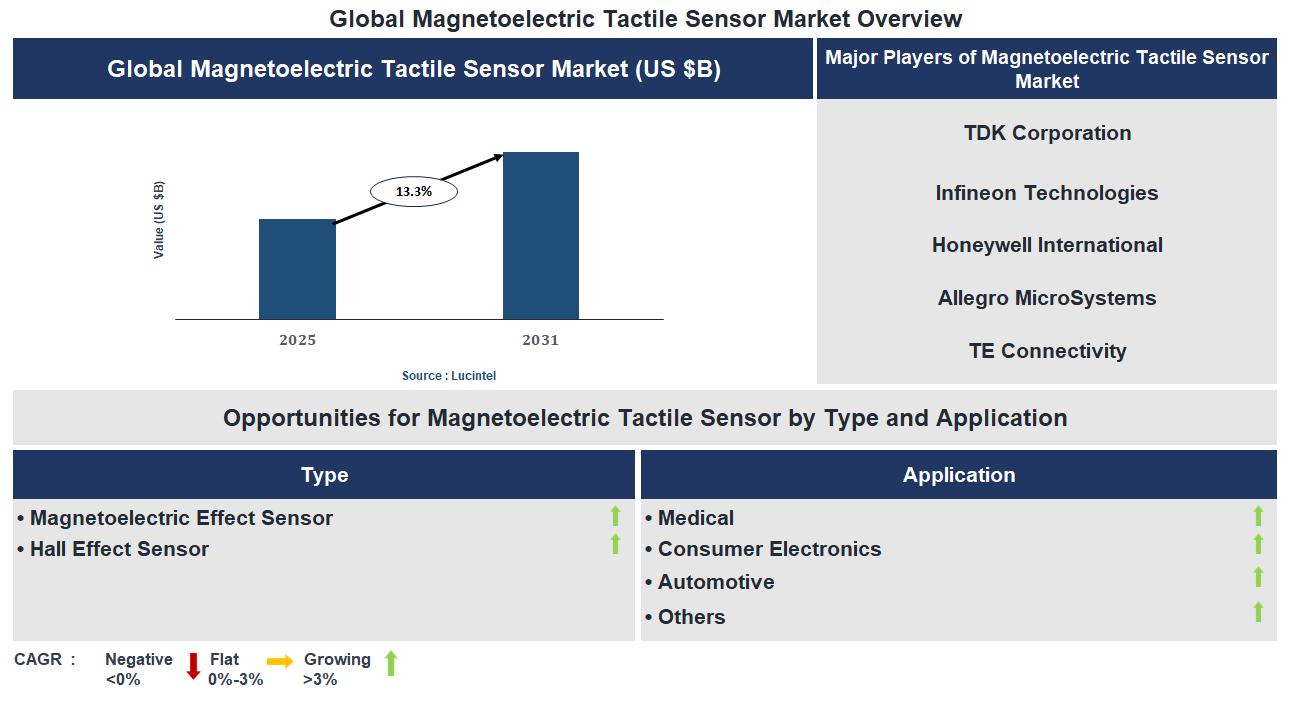
Key data points: The growth forecast = 13.3% annually for the next 6 years. Scroll below to get more insights. This market report covers trends, opportunities and forecasts in magnetoelectric tactile sensor market to 2031 by type (magnetoelectric effect sensor and hall effect sensor), application (medical, consumer electronics, automotive, and others), and region (North America, Europe, Asia Pacific, and the Rest of the World)
We'll send your sample report shortly.
• Lucintel forecasts that, within the type category, magnetoelectric effect sensor is expected to witness higher growth over the forecast period.
• Within the application category, medical is expected to witness the highest growth.
• In terms of region, APAC is expected to witness the highest growth over the forecast period. Gain valuable insights for your business decisions with our comprehensive 150+ page report. Sample figures with some insights are shown below.
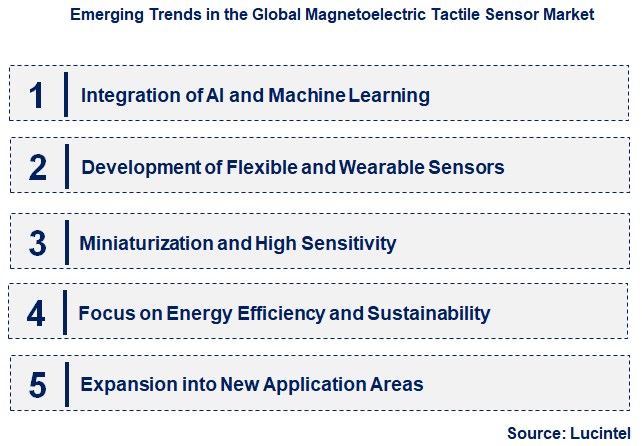
• Integration of AI and Machine Learning: The incorporation of AI and machine learning algorithms enhances sensor data processing, enabling more accurate and real-time tactile feedback. This integration improves the sensors ability to interpret complex stimuli, leading to smarter robotic systems and more responsive devices. It also facilitates predictive maintenance and adaptive responses, expanding the sensors applications across industries. As AI-driven analytics become more sophisticated, the market will see increased adoption of intelligent tactile sensors that can learn and adapt over time, significantly improving performance and user experience.
• Development of Flexible and Wearable Sensors: The shift towards flexible, lightweight, and wearable tactile sensors is driven by the demand for more ergonomic and unobtrusive devices. These sensors are made from advanced materials like flexible polymers and nanomaterials, allowing integration into clothing, prosthetics, and medical devices. Their ability to conform to various surfaces enhances user comfort and expands application possibilities in healthcare, sports, and consumer electronics. This trend is fostering innovation in personalized healthcare and human-machine interfaces, making tactile sensing more accessible and versatile.
• Miniaturization and High Sensitivity: Advances in nanotechnology and material science are enabling the production of smaller, more sensitive magnetoelectric sensors. Miniaturization allows for integration into compact devices, while high sensitivity improves detection accuracy for subtle tactile stimuli. This development is crucial for applications requiring precise manipulation, such as micro-robotics and surgical tools. As sensors become more sensitive and smaller, they open new avenues for detailed tactile feedback in confined spaces, enhancing performance in delicate tasks and complex environments.
• Focus on Energy Efficiency and Sustainability: The market is witnessing a push towards energy-efficient sensor designs that reduce power consumption and extend device lifespan. Sustainable materials and low-power electronics are being developed to meet environmental standards and reduce operational costs. This focus not only benefits consumer electronics and industrial applications but also aligns with global sustainability goals. Energy-efficient tactile sensors are critical for long-term deployment in remote or autonomous systems, ensuring reliable performance while minimizing ecological impact.
• Expansion into New Application Areas: Emerging applications such as virtual reality, augmented reality, and advanced prosthetics are driving demand for magnetoelectric tactile sensors. These sensors provide realistic haptic feedback, improving user immersion and interaction. Additionally, their use in robotics for delicate manipulation and in healthcare for patient monitoring is expanding rapidly. This diversification of applications is broadening the market scope, encouraging innovation, and fostering cross-industry collaborations. As new sectors adopt tactile sensing technology, the market will continue to grow and evolve with novel use cases. In summary, these trends are fundamentally transforming the magnetoelectric tactile sensor market by enhancing sensor capabilities, expanding application horizons, and promoting sustainable development. The integration of AI, flexible designs, miniaturization, energy efficiency, and new application areas is collectively driving innovation, making tactile sensors more intelligent, adaptable, and essential across various industries. This evolution is poised to unlock new opportunities and redefine the future of tactile sensing technology.
• Growing Adoption in Robotics: The integration of magnetoelectric tactile sensors in robotics is expanding, offering enhanced sensitivity and precise feedback for robotic arms and prosthetics. This development improves automation accuracy, safety, and human-machine interaction, leading to broader industrial and medical applications. The increased adoption is also driving demand for miniaturized, energy-efficient sensors, fostering innovation in autonomous systems and wearable devices.
• Advances in Material Science: New composite materials with superior magnetoelectric properties are being developed, resulting in sensors with higher sensitivity and durability. These materials enable sensors to operate effectively in harsh environments, expanding their use in industrial automation, aerospace, and defense. The improved material performance reduces costs and enhances reliability, making magnetoelectric sensors more viable for long-term, high-performance applications.
• Integration with IoT and Smart Devices: The convergence of magnetoelectric tactile sensors with IoT technology is creating smarter, connected systems. These sensors facilitate real-time data collection and remote monitoring in healthcare, smart homes, and industrial automation. The seamless integration enhances system responsiveness, predictive maintenance, and user experience, accelerating the deployment of intelligent environments and expanding market reach across various sectors.
• Miniaturization and Cost Reduction: Efforts to miniaturize magnetoelectric sensors and reduce manufacturing costs are making them more accessible for consumer electronics and wearable devices. Smaller, affordable sensors enable new product designs with enhanced tactile feedback, improving user interaction and device performance. This trend is opening new markets and increasing adoption rates, especially in portable and low-power applications.
• Enhanced Sensitivity and Multi-Functionality: Recent developments focus on increasing sensor sensitivity and enabling multi-functional capabilities, such as combining tactile sensing with temperature or pressure detection. These advancements allow for more comprehensive environmental interaction, benefiting applications in healthcare diagnostics, advanced robotics, and virtual reality. The enhanced performance broadens the scope of applications and drives innovation in high-precision sensing solutions. The overall impact of these developments is significantly transforming the magnetoelectric tactile sensor market by enabling more sophisticated, reliable, and versatile sensors. This progress is fostering new applications, improving existing systems, and expanding market opportunities across multiple industries, ultimately accelerating technological innovation and market growth.
• Expansion into Robotics and Prosthetics: Magnetoelectric tactile sensors are increasingly integrated into robotics and prosthetic devices, providing enhanced tactile feedback for improved manipulation and interaction. This growth is driven by the need for more precise, responsive, and natural-feeling robotic systems, especially in industrial automation and healthcare. The sensors ability to detect subtle forces and textures makes them ideal for advanced prosthetics, enabling users to perform delicate tasks with greater confidence and dexterity, thus opening new markets and applications.
• Advancements in Healthcare Monitoring Devices: The development of wearable and implantable tactile sensors offers promising opportunities in healthcare for real-time patient monitoring and diagnostics. These sensors can detect pressure, touch, and other tactile stimuli, aiding in rehabilitation and chronic disease management. The integration of magnetoelectric sensors with wireless communication enhances remote health monitoring, improving patient outcomes. Growing demand for minimally invasive, high-precision medical devices is expected to drive innovation and commercialization in this sector.
• Integration with Consumer Electronics for Enhanced User Experience: Consumer electronics manufacturers are adopting magnetoelectric tactile sensors to improve device interactivity and user engagement. Applications include touchscreens, gaming controllers, and virtual reality interfaces, where precise haptic feedback enhances immersion. The sensors ability to deliver nuanced tactile sensations at a low power cost makes them attractive for next-generation devices. As consumer demand for more intuitive and immersive experiences grows, this integration is set to expand significantly.
• Miniaturization and Cost-Effective Manufacturing Techniques: Advances in materials science and fabrication processes are enabling the production of smaller, more affordable magnetoelectric sensors. This miniaturization allows for their integration into compact devices and wearables, broadening the application scope. Cost-effective manufacturing techniques such as printed electronics and scalable assembly methods are reducing overall costs, making these sensors accessible for mass-market applications. This trend supports widespread adoption across various industries, including consumer electronics, healthcare, and industrial automation.
• Development of Multi-Functional and Hybrid Sensor Systems: Combining magnetoelectric sensors with other sensing modalities creates multi-functional systems capable of detecting multiple stimuli simultaneously. These hybrid sensors enhance performance in complex environments, such as robotics and smart environments, by providing comprehensive tactile and environmental data. The development of integrated sensor platforms enables smarter, more adaptive systems, fostering innovation in areas like autonomous vehicles, smart homes, and advanced manufacturing. This convergence of technologies is expected to accelerate market growth and application diversity. The overall market outlook indicates that these strategic growth opportunities will significantly influence the evolution of the magnetoelectric tactile sensor market, fostering innovation, expanding application domains, and driving commercial success across multiple industries.
• Technological Innovation: The continuous development of magnetoelectric materials and sensor designs enhances sensitivity, accuracy, and miniaturization, enabling applications in robotics, healthcare, and consumer electronics. These innovations improve tactile sensing capabilities, making devices more responsive and reliable. As research progresses, new materials and fabrication techniques are expected to further expand application possibilities, fostering market growth. The integration of AI and IoT with tactile sensors also opens avenues for smarter, more adaptive systems, increasing demand across industries.
• Growing Adoption in Healthcare: The increasing use of magnetoelectric tactile sensors in prosthetics, rehabilitation devices, and diagnostic tools is a significant growth driver. These sensors provide precise tactile feedback, improving the functionality and user experience of medical devices. The aging population and rising prevalence of chronic conditions necessitate advanced healthcare solutions, boosting demand for such sensors. Additionally, regulatory approvals and technological advancements are making these sensors more accessible and affordable, encouraging widespread adoption in medical applications.
• Expansion in Robotics and Automation: The rise of industrial automation and service robots relies heavily on advanced tactile sensing for safe and efficient operation. Magnetoelectric sensors enable robots to perceive touch, pressure, and texture, facilitating delicate tasks and human-robot interaction. As industries seek to improve automation efficiency and safety standards, the demand for high-performance tactile sensors increases. Innovations in sensor integration and durability further support their deployment in challenging environments, accelerating market growth in robotics.
• Regulatory and Standardization Developments: The establishment of safety standards and regulatory frameworks for tactile sensors influences market dynamics. Clear guidelines ensure product reliability and safety, encouraging manufacturers to invest in compliant solutions. Regulatory support can also facilitate market entry and international trade. Conversely, stringent standards may increase development costs and time-to-market, posing challenges for smaller players. Harmonization of standards across regions is crucial for global market expansion and technological interoperability.
• Rising Investment and Funding: Increased funding from government agencies, private investors, and industry stakeholders accelerates research and development activities. Such investments support the commercialization of advanced magnetoelectric tactile sensors and foster innovation. Funding also enables startups and established companies to scale production, improve quality, and expand applications. This financial backing is vital for overcoming technical barriers and bringing new products to market, ultimately driving overall industry growth. The challenges facing this magnetoelectric tactile sensor market include:
• High Manufacturing Costs: Developing magnetoelectric tactile sensors involves complex materials and fabrication processes, leading to high production costs. These expenses can limit affordability and restrict adoption, especially in cost-sensitive markets like consumer electronics. Additionally, scaling manufacturing while maintaining quality and consistency remains a challenge, potentially hindering widespread deployment. Overcoming cost barriers requires technological advancements and process optimization to make sensors more economically viable.
• Technological Complexity and Integration: Integrating magnetoelectric sensors into existing systems demands sophisticated design and engineering expertise. Compatibility issues with other electronic components and systems can complicate deployment. Moreover, ensuring sensor durability and performance in diverse environments adds to technical challenges. Addressing these complexities requires ongoing research, standardization, and the development of user-friendly integration solutions to facilitate broader adoption.
• Regulatory and Standardization Uncertainties: The evolving regulatory landscape and lack of universally accepted standards can delay product development and market entry. Uncertainty regarding safety, environmental impact, and certification processes increases compliance costs and risks. Companies may face difficulties in navigating different regional requirements, impeding international expansion. Establishing clear, harmonized standards is essential to streamlining development, ensuring safety, and fostering market confidence. In summary, the magnetoelectric tactile sensor market is shaped by rapid technological advancements, expanding applications in healthcare and robotics, and supportive investment trends. However, high manufacturing costs, integration challenges, and regulatory uncertainties pose significant hurdles. These drivers and challenges collectively influence the pace and direction of market growth. While innovation and demand are poised to propel the industry forward, addressing cost, technical, and regulatory issues is crucial for sustainable expansion. Stakeholders must focus on technological improvements, standardization, and cost reduction strategies to capitalize on emerging opportunities and ensure long-term success.
• TDK Corporation
• Infineon Technologies
• Honeywell International
• Allegro MicroSystems
• TE Connectivity
• NXP Semiconductors
• Melexis
• AMS OSRAM
• Pressure Profile Systems
• Sensata Technologies
• Magnetoelectric Effect Sensor
• Hall Effect Sensor
• Medical
• Consumer Electronics
• Automotive
• Others
• North America
• Europe
• Asia Pacific
• The Rest of the World
• United States: The US market has seen significant investments in research institutions and startups focusing on high-sensitivity magnetoelectric sensors. Major tech companies are integrating these sensors into robotics and prosthetics, improving tactile feedback. Government agencies are funding projects to develop energy-efficient, miniaturized sensors for medical devices and consumer electronics. Collaborations between academia and industry are accelerating commercialization, with several prototypes entering early-stage testing. The US also emphasizes standardization and regulatory frameworks to facilitate market growth and ensure safety and reliability.
• China: China is rapidly expanding its magnetoelectric sensor capabilities through government-backed initiatives and private sector investments. The country is focusing on developing cost-effective, scalable manufacturing processes to meet domestic demand and export needs. Chinese research institutions are making breakthroughs in sensor sensitivity and integration with IoT devices, especially for smart manufacturing and healthcare applications. The government’s "Made in China 2025" plan emphasizes advanced sensor technology as a strategic priority, fostering innovation hubs and industrial parks dedicated to magnetoelectric sensor development. This has resulted in increased patent filings and commercial product launches.
• Germany: Germany’s market developments are characterized by a focus on industrial applications and automotive integration. Leading automotive manufacturers are adopting magnetoelectric sensors for enhanced safety systems and autonomous vehicle navigation. German research centers are advancing sensor durability and environmental resistance, making them suitable for harsh industrial environments. The country’s emphasis on Industry 4.0 is driving demand for highly reliable, miniaturized sensors that can be embedded into machinery and robotics. Additionally, Germany’s strong emphasis on sustainability is encouraging the development of energy-efficient sensor solutions, supported by EU funding programs and collaborations with European tech firms.
• India: India is witnessing a surge in magnetoelectric sensor research driven by government initiatives like Make in India and Digital India. Startups and academia are focusing on developing affordable sensors for healthcare, agriculture, and consumer electronics. The country’s expanding manufacturing sector is adopting these sensors for automation and quality control. Investment in R&D is increasing, with several pilot projects demonstrating the potential for low-cost, high-performance sensors. Additionally, India’s growing electronics ecosystem and strategic partnerships with global firms are fostering innovation and commercialization, positioning the country as a key player in the emerging market.
• Japan: Japan continues to lead in sensor technology innovation, with a strong emphasis on precision and miniaturization. Japanese companies are developing magnetoelectric sensors for robotics, medical devices, and industrial automation, emphasizing high sensitivity and low power consumption. The country’s focus on aging population solutions is driving research into sensors for healthcare monitoring and assistive devices. Japan’s collaboration between government agencies and private firms is accelerating the development of next-generation sensors, supported by funding from the Ministry of Economy, Trade, and Industry. The market is also benefiting from Japan’s expertise in materials science, enabling the production of more durable and efficient sensors.


• TDK Corporation
• Infineon Technologies
• Honeywell International
• Allegro MicroSystems
• TE Connectivity
• NXP Semiconductors
• Melexis
• AMS OSRAM
• Pressure Profile Systems
• Sensata Technologies Q5. Which magnetoelectric tactile sensor market segment will be the largest in future? Answer: Lucintel forecasts that, within the type category, magnetoelectric effect sensor is expected to witness higher growth over the forecast period. Q6. In magnetoelectric tactile sensor market, which region is expected to be the largest in next 5 years? Answer: In terms of region, APAC is expected to witness the highest growth over the forecast period. Q7. Do we receive customization in this report? Answer: Yes, Lucintel provides 10% customization without any additional cost.


Choose a license that fits your team. Instant PDF delivery.
Prices exclude taxes. Instant delivery. Custom licensing available on request.
Market Report · July 15, 2026
Market Report · July 13, 2026
Market Report · July 13, 2026
Trusted partner for strategic intelligence and business growth


Receive a complimentary market analysis tailored to your industry. Our analysts will identify key growth opportunities and competitive dynamics specific to your business.

Market size, growth rate, and key trend analysis for your specific sector.

Top competitor positioning and market share analysis.

Strategic recommendations backed by data-driven insights.
Get curated market intelligence and competitive moves straight to your inbox.
By subscribing, you agree to receive our monthly insights. Unsubscribe anytime.
Receive a complimentary market analysis tailored to your industry. Our analysts will identify key growth opportunities and competitive dynamics specific to your business.
Market size, growth rate, and key trend analysis for your specific sector.
Top competitor positioning and market share analysis.
Strategic recommendations backed by data-driven insights.
Get curated market intelligence, emerging trends, and competitive moves straight to your inbox each month.
By subscribing, you agree to receive our monthly insights. Unsubscribe anytime.
We'll send your sample report shortly.