
Report Feature
Machine Vision Market Trends and Forecast
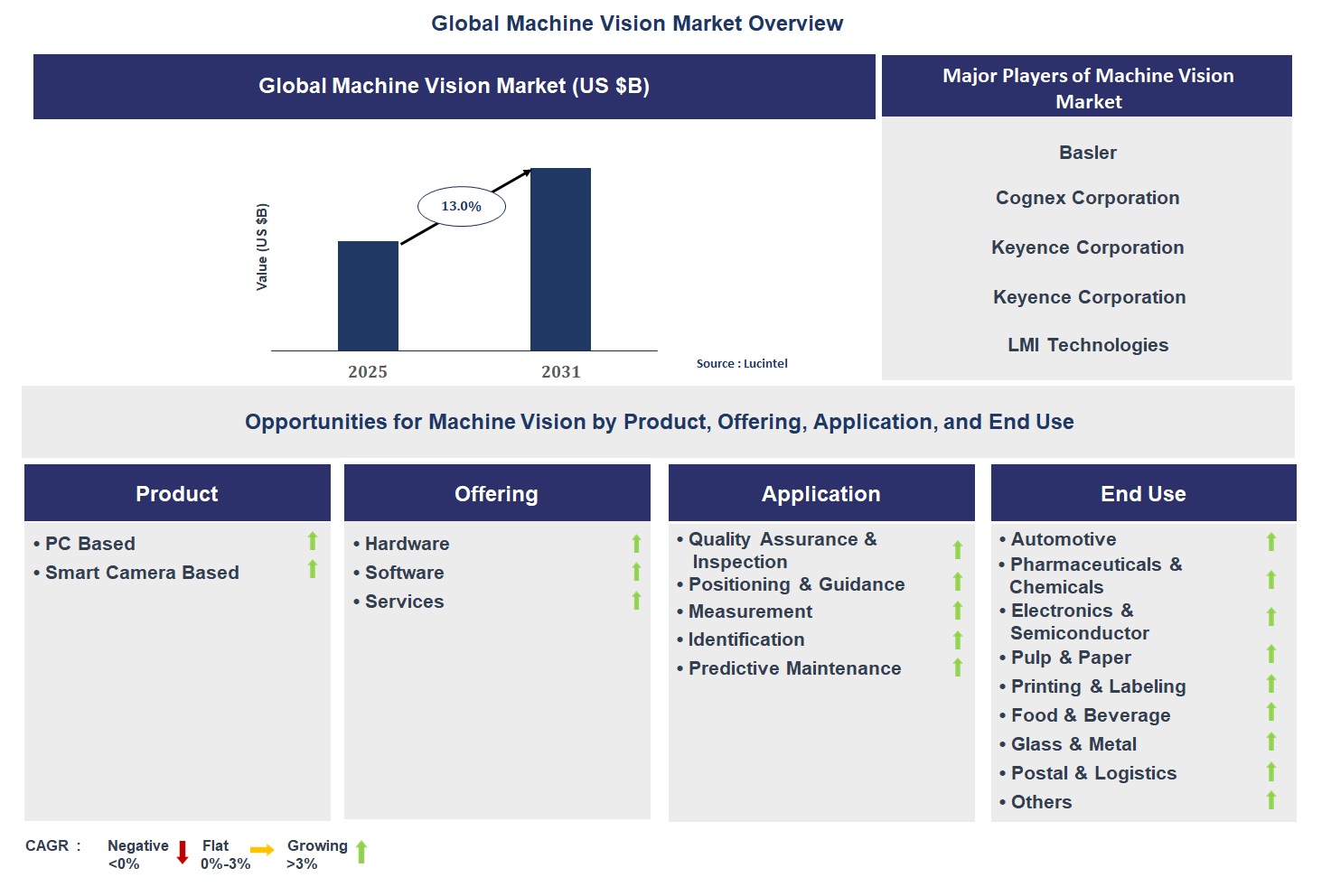
The future of the global machine vision market looks promising with opportunities in the automotive, pharmaceutical & chemical, electronics & semiconductor, pulp & paper, printing & labeling, food & beverage, glass & metal, and postal & logistics markets. The global machine vision market is expected to grow with a CAGR of 13% from 2025 to 2031. The major drivers for this market are the increasing demand for automation in industries, the rising need for quality inspection in manufacturing, and the growing adoption of AI in machine vision systems.• Lucintel forecasts that, within the product category, PC based is expected to witness higher growth over the forecast period.
• Within the end use category, automotive is expected to witness the highest growth.
• In terms of region, APAC is expected to witness the highest growth over the forecast period. Gain valuable insights for your business decisions with our comprehensive 150+ page report. Sample figures with some insights are shown below.
Emerging Trends in the Machine Vision Market
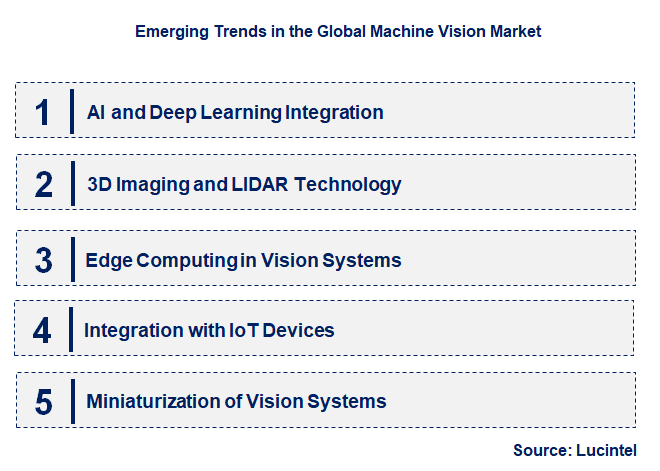
The machine vision market is experiencing significant transformation due to the rise of AI, advancements in sensors, and increased automation. As industries strive for greater efficiency, accuracy, and innovation, several emerging trends are reshaping the landscape, providing both opportunities and challenges for players in this field.• AI and Deep Learning Integration: Machine vision systems are increasingly incorporating AI and deep learning, enhancing their ability to interpret complex visual data. By using neural networks, these systems can perform tasks like object recognition and quality inspection with greater accuracy, revolutionizing industries such as automotive and electronics.
• 3D Imaging and LIDAR Technology: The rise of 3D imaging, particularly in conjunction with LIDAR (Light Detection and Ranging) technology, is driving improvements in precision and depth perception. This is especially important for applications in autonomous vehicles, robotics, and warehouse automation, where accurate spatial understanding is critical for navigation and decision-making.
• Edge Computing in Vision Systems: Edge computing is enabling real-time data processing directly at the source, reducing latency and bandwidth requirements. For industries such as manufacturing, this means faster decision-making and more responsive machine vision systems, which improves efficiency and enhances automation capabilities.
• Integration with IoT Devices: Machine vision is increasingly integrated with the Internet of Things (IoT), creating interconnected systems that enhance automation and data-driven decision-making. This trend enables predictive maintenance, real-time quality monitoring, and smart supply chains, providing a competitive edge to industries in sectors like logistics and pharmaceuticals.
• Miniaturization of Vision Systems: There’s a growing trend toward smaller, more compact machine vision systems that maintain or enhance performance. This miniaturization is enabling their use in smaller, more flexible manufacturing setups, as well as in consumer electronics and wearable devices, expanding their range of applications. These trends demonstrate how machine vision is evolving into a more intelligent, integrated, and versatile technology. The combination of AI, edge computing, and other innovations is not only increasing the accuracy and speed of vision systems but also expanding their potential applications across diverse industries, from autonomous driving to industrial automation.
Recent Development in the Machine Vision Market
Recent developments in the machine vision market reflect the ongoing innovation in technology, with advancements in AI, optics, and sensor technology. These developments are paving the way for machine vision to become an even more integral component of manufacturing, logistics, healthcare, and more.• AI-Powered Quality Control: The integration of AI has revolutionized quality control in manufacturing. AI-enabled machine vision systems can identify defects in real time, reduce errors, and improve production yields. In industries like automotive and semiconductor manufacturing, this advancement leads to higher product quality and faster production cycles.
• Enhanced Sensor Technology: Advances in sensor technology, including high-definition cameras and infrared sensors, are significantly improving the performance of machine vision systems. These sensors enable better detection of minute defects, enabling applications in industries such as pharmaceuticals, food processing, and electronics.
• Cloud Integration for Vision Systems: Machine vision solutions are increasingly being integrated with cloud platforms, allowing for remote monitoring, data analytics, and system optimization. This development enables real-time insights and decision-making across geographically dispersed manufacturing facilities, fostering global production strategies.
• Robotics and Automation Synergy: Machine vision is playing a crucial role in the development of smarter robots. By providing robots with the ability to see and interpret their environment, vision systems are enabling advanced automation solutions in areas such as logistics, manufacturing, and healthcare.
• Industrial 4.0 Integration: Machine vision systems are becoming a cornerstone of the Industry 4.0 revolution. By connecting to enterprise systems, these technologies contribute to real-time monitoring, predictive maintenance, and automated decision-making, transforming traditional manufacturing into smart, connected ecosystems. These recent developments are transforming the machine vision market by introducing smarter, more capable systems that improve efficiency, reduce costs, and enable new applications. The integration of AI, advanced sensors, and cloud technologies is accelerating the adoption of machine vision across various industries.
Strategic Growth Opportunities in the Machine Vision Market
The machine vision market is experiencing growth across various applications, driven by the increasing need for automation, precision, and efficiency. As industries continue to embrace digital transformation, key growth opportunities are emerging that will further advance machine vision technology.• Automotive Manufacturing: The automotive industry is seeing increased adoption of machine vision for quality control, assembly line automation, and autonomous vehicle development. With high demands for precision, machine vision is essential in improving production speed and ensuring safety standards.
• Healthcare and Medical Imaging: Machine vision is gaining traction in healthcare, particularly in medical imaging and diagnostics. By automating image analysis, it enables faster, more accurate diagnoses. The technology is also used in robotic surgeries, enhancing precision and reducing human error.
• Logistics and Supply Chain Management: Machine vision is optimizing warehouse automation and supply chain management by enabling better tracking and sorting of goods. The use of vision systems in autonomous vehicles and drones is also enhancing efficiency in logistics operations.
• Food Processing and Packaging: The food industry is leveraging machine vision to ensure quality control in packaging, sorting, and inspection. Vision systems can identify defects, contamination, or irregularities, improving food safety and reducing waste.
• Electronics and Semiconductor Manufacturing: As demand for smaller, more efficient electronic components rises, machine vision is playing a critical role in quality control and inspection. Vision systems are essential for inspecting microchips and electronic components for defects, ensuring high-quality products. These growth opportunities highlight the expanding role of machine vision across multiple industries. As technologies continue to evolve, machine vision systems will play an increasingly pivotal role in driving efficiency, enhancing quality, and creating new business models in diverse applications.
Machine Vision Market Driver and Challenges
The machine vision market is influenced by several key drivers, including technological advancements and economic shifts, as well as challenges such as integration complexities and regulatory hurdles. Understanding these drivers and challenges is crucial for businesses seeking to leverage machine vision technologies effectively. The factors responsible for driving the machine vision market include: 1. Advancements in AI and Machine Learning: AI is the biggest driver in the machine vision market, improving image recognition, data processing, and automation. This is enabling vision systems to handle increasingly complex tasks with higher accuracy and reliability, boosting adoption across various industries. 2. Industry 4.0 and Automation Demand: As companies embrace smart manufacturing and automation, the demand for machine vision systems has surged. These systems are integral to Industry 4.0 initiatives, enhancing production efficiency, reducing human error, and enabling predictive maintenance. 3. Increasing Use of Robotics: Machine vision is a key enabler of robotics in industries like automotive, logistics, and healthcare. The ability of robots to "see" and make real-time decisions is driving the need for sophisticated vision systems to perform tasks like assembly, inspection, and packaging. 4. Technological Advancements in Sensors and Cameras: With the development of high-definition sensors, infrared cameras, and 3D imaging, machine vision systems can now perform with greater precision and at faster speeds. These advancements are expanding the range of applications for machine vision across industries. 5. Cost Reduction and Accessibility: As the cost of machine vision systems continues to decrease, these technologies are becoming more accessible to a wider range of industries. Small and medium-sized enterprises (SMEs) are increasingly adopting vision systems to improve operational efficiency. Challenges in the machine vision market are: 1. High Integration Costs: While machine vision systems offer significant benefits, the initial costs for implementation, including hardware, software, and training, can be prohibitively high, especially for small manufacturers. 2. Data Security and Privacy Concerns: With the increasing use of cloud-based machine vision systems, data security becomes a major challenge. Ensuring the integrity and privacy of sensitive data is critical as these systems become more interconnected. 3. Skilled Labor Shortage: There is a shortage of professionals skilled in machine vision technology, making it difficult for companies to fully utilize these systems. Training and recruitment efforts are essential to bridge this gap. The drivers and challenges in the machine vision market reflect the growing importance of this technology in industrial automation and beyond. While advancements are pushing the market forward, issues such as high integration costs and the need for skilled labor remain key considerations for companies looking to capitalize on machine vision solutions.List of Machine Vision Companies
Companies in the market compete on the basis of product quality offered. Major players in this market focus on expanding their manufacturing facilities, R&D investments, infrastructural development, and leverage integration opportunities across the value chain. With these strategies machine vision companies cater increasing demand, ensure competitive effectiveness, develop innovative products & technologies, reduce production costs, and expand their customer base. Some of the machine vision companies profiled in this report include-• Basler
• Cognex Corporation
• Keyence Corporation
• Keyence Corporation
• LMI Technologies
• Stemmer Imaging
• National Instruments Corporation
• OMRON Corporation
• Sick AG
• Tordivel
Machine Vision Market by Segment
The study includes a forecast for the global machine vision market by product, offering, application, end use, and region.Machine Vision Market by Product [Value from 2019 to 2031]:
• PC Based
• Smart Camera Based
Machine Vision Market by Offering [Value from 2019 to 2031]:
• Hardware
• Software
• Services
Machine Vision Market by Application [Value from 2019 to 2031]:
• Quality Assurance & Inspection
• Positioning & Guidance
• Measurement
• Identification
• Predictive Maintenance
Machine Vision Market by End Use [Value from 2019 to 2031]:
• Automotive
• Pharmaceuticals & Chemicals
• Electronics & Semiconductor
• Pulp & Paper
• Printing & Labeling
• Food & Beverage
• Glass & Metal
• Postal & Logistics
• Others
Machine Vision Market by Region [Value from 2019 to 2031]:
• North America
• Europe
• Asia Pacific
• The Rest of the World
Country Wise Outlook for the Machine Vision Market
The machine vision market, which encompasses computer vision, image processing, and intelligent automation technologies, is rapidly evolving across various regions. Countries like the U.S., China, Germany, India, and Japan are investing heavily in this space, propelling advancements and driving the integration of machine vision into a range of industries, from manufacturing to healthcare.• United States: The U.S. is seeing strong growth in machine vision due to its focus on automation, robotics, and AI integration. Increased demand in industries like automotive manufacturing, healthcare, and consumer electronics has accelerated the adoption of vision-based solutions. AI-powered image recognition, combined with real-time data processing, is boosting accuracy and operational efficiency.
• China: Chinas machine vision market is expanding rapidly, driven by its booming manufacturing sector and the push for smart factories. Significant investments in AI and 5G are enabling enhanced machine vision systems for industrial automation. The automotive and semiconductor sectors are prime areas of growth, with vision technologies improving quality control and production speeds.
• Germany: Germany remains a leader in machine vision, particularly within its industrial and automotive sectors. With the continued push toward Industry 4.0, advanced vision systems are used for automation, quality inspection, and robotics. The country’s emphasis on precision engineering and high-end manufacturing drives demand for highly accurate vision solutions to optimize processes.
• India: India’s machine vision market is growing as the country shifts toward digitalization in manufacturing. Industrial automation and applications in agriculture, pharmaceuticals, and textiles are key drivers. The push for more efficient production lines and the adoption of AI are aiding the transition toward smart factories. Machine vision is helping to meet growing demand for quality assurance.
• Japan: Japans machine vision market is driven by technological advancements in robotics, AI, and electronics. Vision systems are integral in automating production lines, particularly in the automotive and electronics industries. Japan’s focus on smart manufacturing and robotics innovation is making machine vision a critical component of operational improvements and higher production speeds.

Features of the Global Machine Vision Market
Market Size Estimates: Machine vision market size estimation in terms of value ($B). Trend and Forecast Analysis: Market trends (2019 to 2024) and forecast (2025 to 2031) by various segments and regions. Segmentation Analysis: Machine vision market size by various segments, such as by product, offering, application, end use, and region in terms of value ($B). Regional Analysis: Machine vision market breakdown by North America, Europe, Asia Pacific, and Rest of the World. Growth Opportunities: Analysis of growth opportunities in different products, offerings, applications, end uses, and regions for the machine vision market. Strategic Analysis: This includes M&A, new product development, and competitive landscape of the machine vision market. Analysis of competitive intensity of the industry based on Porter’s Five Forces model.
FAQ
Q1. What is the growth forecast for machine vision market? Answer: The global machine vision market is expected to grow with a CAGR of 13% from 2025 to 2031. Q2. What are the major drivers influencing the growth of the machine vision market? Answer: The major drivers for this market are the increasing demand for automation in industries, the rising need for quality inspection in manufacturing, and the growing adoption of AI in machine vision systems. Q3. What are the major segments for machine vision market? Answer: The future of the machine vision market looks promising with opportunities in the automotive, pharmaceutical & chemical, electronics & semiconductor, pulp & paper, printing & labeling, food & beverage, glass & metal, and postal & logistics markets. Q4. Who are the key machine vision market companies? Answer: Some of the key machine vision companies are as follows:• Basler
• Cognex Corporation
• Keyence Corporation
• Keyence Corporation
• LMI Technologies
• Stemmer Imaging
• National Instruments Corporation
• OMRON Corporation
• Sick AG
• Tordivel Q5. Which machine vision market segment will be the largest in future? Answer: Lucintel forecasts that, within the product category, PC based is expected to witness higher growth over the forecast period. Q6. In machine vision market, which region is expected to be the largest in next 5 years? Answer: In terms of region, APAC is expected to witness the highest growth over the forecast period. Q7. Do we receive customization in this report? Answer: Yes, Lucintel provides 10% customization without any additional cost.
Table of Contents
List of Figures
List of Tables
Methodology
- In-depth interviews of the major players in this market
- Detailed secondary research from competitors’ financial statements and published data
- Extensive searches of published works, market, and database information pertaining to industry news, company press releases, and customer intentions
- A compilation of the experiences, judgments, and insights of Lucintel’s professionals, who have analyzed and tracked this market over the years.


Buy Now
Choose a license that fits your team. Instant PDF delivery.
Prices exclude taxes. Instant delivery. Custom licensing available on request.
Key Questions
- • What are some of the most promising, high-growth opportunities for the machine vision market by product (PC based and smart camera based), offering (hardware, software, and services), application (quality assurance & inspection, positioning & guidance, measurement, identification, and predictive maintenance), end use (automotive, pharmaceuticals & chemicals, electronics & semiconductor, pulp & paper, printing & labeling, food & beverage, glass & metal, postal & logistics, and others), and region (North America, Europe, Asia Pacific, and the Rest of the World)?
- • Which segments will grow at a faster pace and why?
- • Which region will grow at a faster pace and why?
- • What are the key factors affecting market dynamics? What are the key challenges and business risks in this market?
- • What are the business risks and competitive threats in this market?
- • What are the emerging trends in this market and the reasons behind them?
- • What are some of the changing demands of customers in the market?
- • What are the new developments in the market? Which companies are leading these developments?
- • Who are the major players in this market? What strategic initiatives are key players pursuing for business growth?
- • What are some of the competing products in this market and how big of a threat do they pose for loss of market share by material or product substitution?
- • What M&A activity has occurred in the last 5 years and what has its impact been on the industry? For any questions related to Machine Vision Market, Machine Vision Market Size, Machine Vision Market Growth, Machine Vision Market Analysis, Machine Vision Market Report, Machine Vision Market Share, Machine Vision Market Trends, Machine Vision Market Forecast, Machine Vision Companies, write Lucintel analyst at email: helpdesk@lucintel.com. We will be glad to get back to you soon.


