
Market Report · July 16, 2026

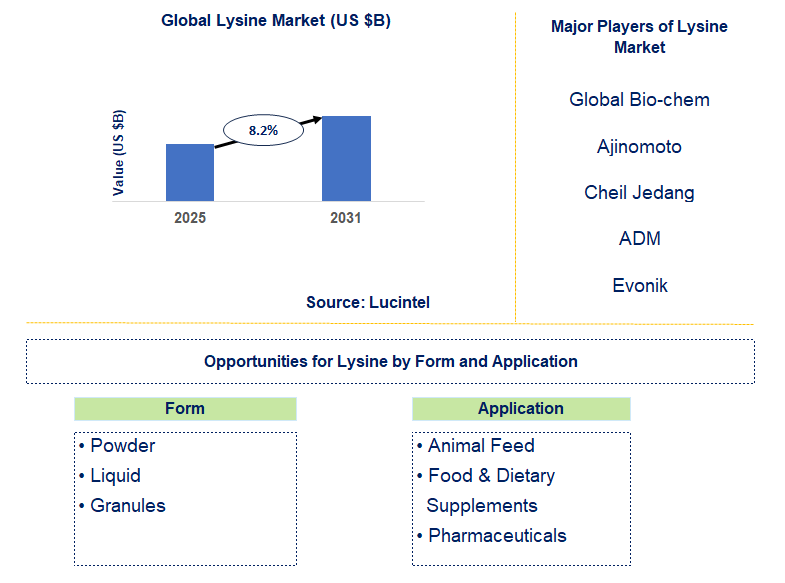
Key data points: The growth forecast = 8.2% annually for the next 7 years. Scroll below to get more insights. This market report covers trends, opportunities and forecasts in lysine market to 2031 by form (powder, liquid, and granules), application (animal feed, food & dietary supplements, and pharmaceuticals), and region (North America, Europe, Asia Pacific, and the Rest of the World)
We'll send your sample report shortly.
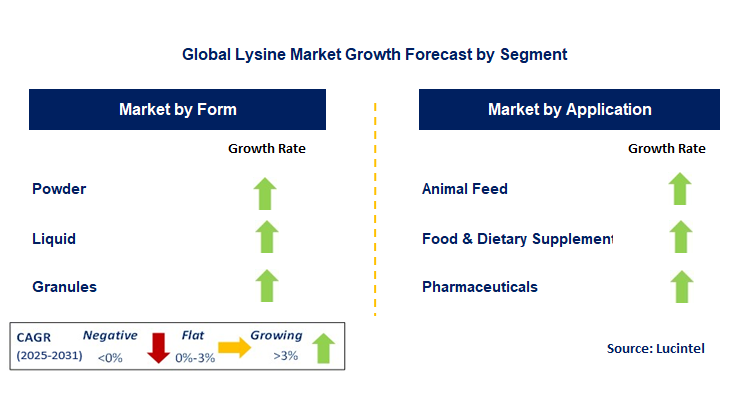
• Lucintel forecasts that, within the form category, powder is expected to witness the highest growth over the forecast period.
• Within the application category, animal feed is expected to witness the highest growth.
• In terms of region, APAC is expected to witness the highest growth over the forecast period. Gain valuable insights for your business decisions with our comprehensive 150+ page report. Sample figures with some insights are shown below.
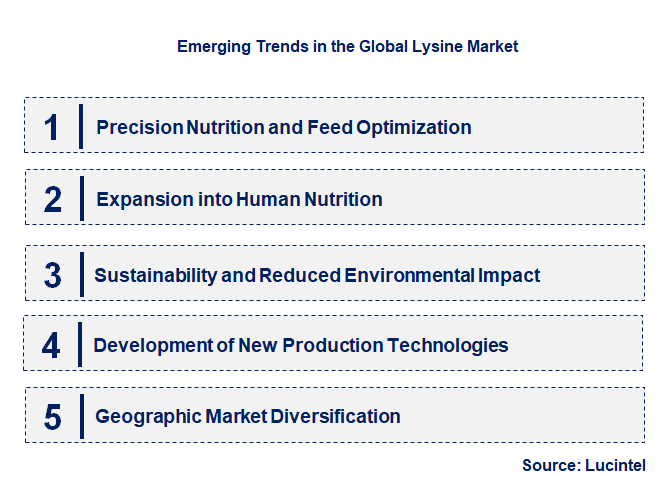
• Precision Nutrition and Feed Optimization: This trend involves using data analytics and AI to precisely determine the optimal lysine inclusion rate in animal feed, minimizing waste. The impact is a more efficient use of resources, which reduces feed costs for farmers and lowers the environmental footprint of livestock farming. This trend is driven by a desire for both economic and environmental sustainability.
• Expansion into Human Nutrition: Lysine's role is expanding beyond animal feed to include human nutritional supplements, fortified foods, and pharmaceuticals. The impact is a diversification of the market into high-value applications. This trend is driven by increasing consumer awareness of lysine's health benefits, such as its role in protein synthesis and calcium absorption.
• Sustainability and Reduced Environmental Impact: A major trend is the development of production methods and product formulations that reduce the environmental impact of livestock farming. The impact is a decrease in nitrogen emissions and pollution from animal waste. This is achieved by using more efficient amino acid supplements, like lysine, which allow for a reduction in crude protein in animal diets.
• Development of New Production Technologies: Companies are investing in research and development to create more efficient and sustainable fermentation methods for producing lysine. The impact is a reduction in reliance on traditional raw materials like corn and a decrease in production costs. This trend helps companies improve their competitive edge and address volatility in commodity prices.
• Geographic Market Diversification: With growing trade tensions and anti-dumping tariffs, companies are increasingly diversifying their supply chains and market presence. The impact is a more resilient and stable global market. This trend involves manufacturers and buyers looking for new production and sourcing partners outside of traditional hubs, reducing concentration risk. These trends are fundamentally reshaping the lysine market, moving it toward greater sustainability, technological sophistication, and application diversity. The focus on precision nutrition and human health applications is creating new value, while efforts to reduce environmental impact and diversify supply chains are making the market more resilient and responsible. This evolution is essential for long-term growth.
• EU Anti-Dumping Tariffs on Chinese Imports: The European Union recently imposed anti-dumping tariffs on lysine imports from China. The impact is a significant disruption in global trade flows, leading to a major price surge in the European market. This development has forced European buyers to seek alternative, more expensive suppliers and has created an opportunity for local producers to regain market share.
• Technological Upgrades in Production: Manufacturers are investing in new fermentation and purification technologies to increase production efficiency and reduce costs. The impact is a more competitive market where companies can offer higher-quality products at lower prices. This development is crucial for maintaining profitability in a market prone to price fluctuations due to raw material costs.
• Product Innovation with Higher Purity: Recent developments include the launch of new lysine formulations with a higher concentration of the amino acid and improved bioavailability. The impact is a more efficient and effective product for end-users, particularly in animal feed. This innovation allows for more precise nutritional formulations, reducing the need for other protein sources and improving animal performance.
• Strategic Business Expansions: Companies are making strategic moves to expand their global footprint, including building new production facilities or acquiring smaller players. The impact is a consolidation of the market, with larger players gaining a competitive advantage. This development allows companies to control more of the supply chain and better manage risks associated with regional market volatility.
• Emergence of Human Nutrition Products: A notable development is the launch of new lysine products specifically for human consumption, such as dietary supplements and functional foods. The impact is a diversification of the market into a high-growth, high-margin segment. This move is driven by the increasing consumer interest in amino acids for health and wellness, providing a new revenue stream. These recent developments are collectively reshaping the lysine market by altering global trade dynamics, fostering technological innovation, and expanding its application scope. The strategic responses to regulatory changes, coupled with a focus on product purity and market expansion, are positioning the industry for a more complex and diversified future.
• Targeting the Aquaculture Sector: The global aquaculture industry is experiencing rapid growth, presenting a key opportunity for lysine. The impact is a rising demand for specialized feed formulations for fish and shrimp. By providing high-quality lysine for aquatic animal feed, companies can tap into this lucrative market, which has a high demand for efficient and sustainable protein sources.
• Expanding into Pet Food Formulations: The premiumization of pet food and the growing focus on pet health offer a significant growth opportunity. The impact is a rising demand for high-quality amino acids like lysine in pet food. Companies can develop specialized, food-grade lysine products for this application, catering to pet owners seeking balanced and nutritious diets for their animals.
• Entering the Human Dietary Supplements Market: As health and wellness trends gain momentum, the market for human dietary supplements is expanding. The impact is a growing opportunity for lysine in products for muscle growth, immune support, and anti-viral applications. This allows companies to move into a high-margin segment, capitalizing on consumer demand for functional ingredients.
• Developing Lysine for Plant-Based Foods: The increasing popularity of plant-based diets creates an opportunity for lysine supplementation. The impact is a rising demand for lysine to improve the amino acid profile of plant-based protein products. Manufacturers can provide food-grade lysine to companies producing vegetarian and vegan foods, ensuring complete protein sources for consumers.
• Serving the Pharmaceutical Industry: The pharmaceutical sector is a high-value application for lysine, which is used in drug development and as a therapeutic agent. The impact is a stable and profitable growth opportunity. By focusing on producing high-purity, pharmaceutical-grade lysine, companies can cater to this niche market with high barriers to entry and strong profit potential. These strategic growth opportunities are critical for the lysine market's future, as they move the industry beyond its reliance on a single application. By targeting emerging sectors like aquaculture and pet food, and by tapping into high-value markets like human nutrition and pharmaceuticals, the market can achieve diversification and sustainable, long-term growth.
• Global Bio-chem Technology Group Company Limited
• Ajinomoto
• Cheil Jedang
• ADM
• Evonik
• COFCO Biochemical
• Juneng Golden Corn
• Changchun Dacheng Industry Group
• KYOWA HAKKO BIO
• Cargill
• Powder
• Liquid
• Granules
• Animal Feed
• Food & Dietary Supplements
• Pharmaceuticals
• North America
• Europe
• Asia Pacific
• The Rest of the World
• United States: The U.S. market has recently faced a historic price collapse for lysine, largely due to a flood of aggressively priced imports from China. This has created oversupply and put significant pressure on domestic producers, who are reassessing production plans. Demand has also been sluggish, with livestock feed formulators switching to cheaper protein alternatives.
• China: China, as the world's largest producer and exporter, is at the center of recent market developments. In anticipation of EU anti-dumping tariffs, Chinese exporters increased shipments to other regions, leading to a global price drop. The domestic market has also seen a softening of prices as downstream users adopt a "just-in-time" purchasing strategy.
• Germany: The German and broader European market has been directly impacted by the EU's recent anti-dumping investigation and tariffs on Chinese lysine. This has led to a surge in local prices due to restricted imports. While demand from the animal nutrition sector remains steady, the market is adjusting to a new competitive landscape and seeking alternative suppliers.
• India: The Indian lysine market is experiencing moderate growth, driven by a rising livestock population and modernizing farming practices. Recent developments include increased collaboration between international manufacturers and local distributors, which is improving market penetration. The country is solidifying its position as a key player in the Asia-Pacific region's feed amino acids market.
• Japan: The Japanese market, while stable, is being affected by global price volatility and supply chain disruptions. Recent developments are focused on securing stable supply channels amid trade tensions. The market is also seeing a growing emphasis on high-quality lysine for pharmaceuticals and dietary supplements, indicating a diversification of applications beyond animal feed.


• Global Bio-chem Technology Group Company Limited
• Ajinomoto
• Cheil Jedang
• ADM
• Evonik
• COFCO Biochemical
• Juneng Golden Corn
• Changchun Dacheng Industry Group
• KYOWA HAKKO BIO
• Cargill Q5. Which lysine market segment will be the largest in future? Answer: Lucintel forecasts that, within the form category, powder is expected to witness the highest growth over the forecast period. Q6. In lysine market, which region is expected to be the largest in next 5 years? Answer: In terms of region, APAC is expected to witness the highest growth over the forecast period. Q7. Do we receive customization in this report? Answer: Yes, Lucintel provides 10% customization without any additional cost.


Choose a license that fits your team. Instant PDF delivery.
Prices exclude taxes. Instant delivery. Custom licensing available on request.
Market Report · July 16, 2026
Market Report · July 15, 2026
Market Report · July 15, 2026
Trusted partner for strategic intelligence and business growth


Receive a complimentary market analysis tailored to your industry. Our analysts will identify key growth opportunities and competitive dynamics specific to your business.

Market size, growth rate, and key trend analysis for your specific sector.

Top competitor positioning and market share analysis.

Strategic recommendations backed by data-driven insights.
Get curated market intelligence and competitive moves straight to your inbox.
By subscribing, you agree to receive our monthly insights. Unsubscribe anytime.
Receive a complimentary market analysis tailored to your industry. Our analysts will identify key growth opportunities and competitive dynamics specific to your business.
Market size, growth rate, and key trend analysis for your specific sector.
Top competitor positioning and market share analysis.
Strategic recommendations backed by data-driven insights.
Get curated market intelligence, emerging trends, and competitive moves straight to your inbox each month.
By subscribing, you agree to receive our monthly insights. Unsubscribe anytime.
We'll send your sample report shortly.