
Report Feature
Luxury Good Market Trends and Forecast
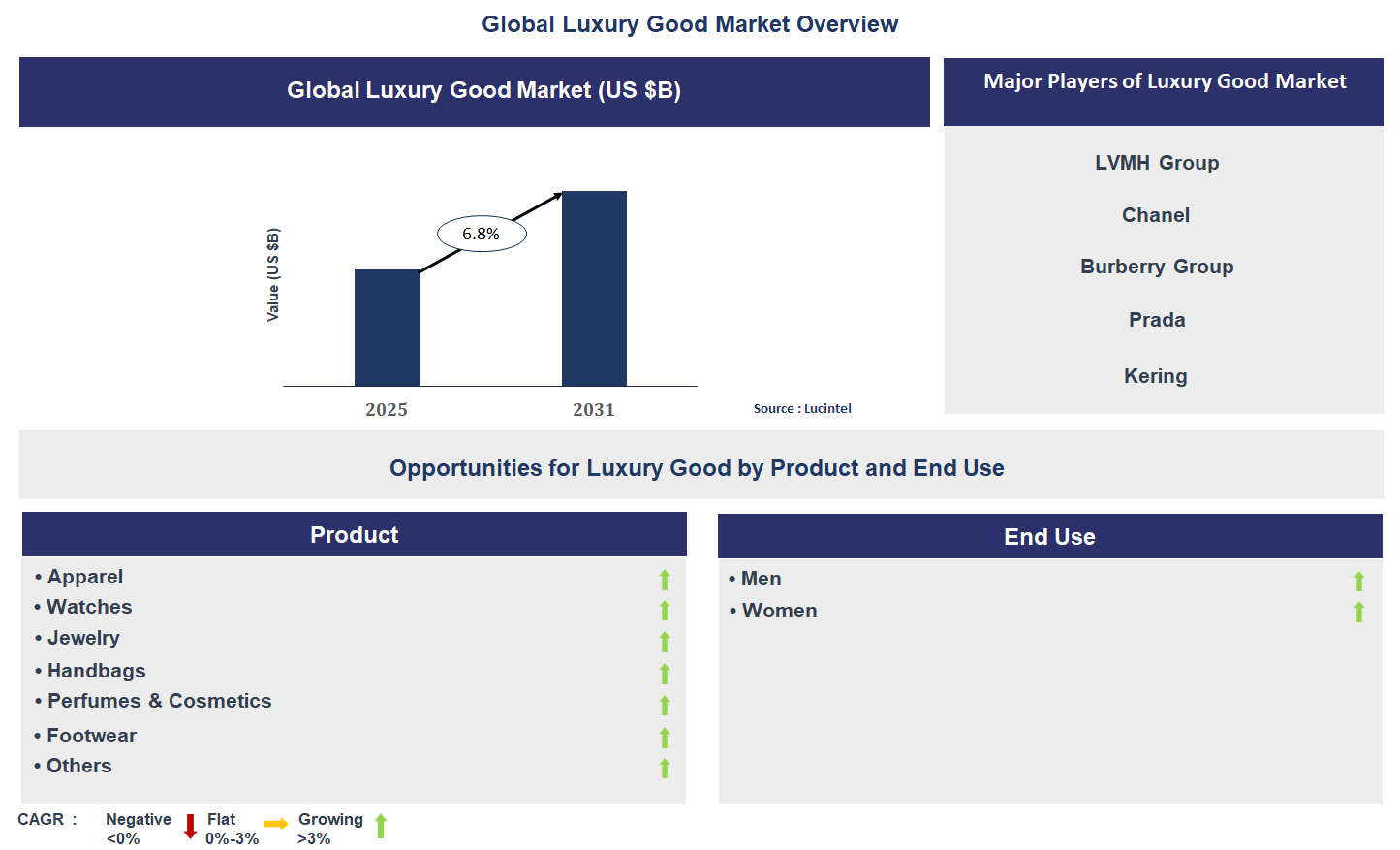
The future of the global luxury good market looks promising with opportunities in the apparel, watch, jewelry, handbag, perfume & cosmetic, and footwear markets. The global luxury good market is expected to grow with a CAGR of 6.8% from 2025 to 2031. The major drivers for this market are the increasing consumer spending on premium products, the rising desire for exclusive luxury brands, and the growing influence of social media trends.• Lucintel forecasts that, within the end use category, women is expected to witness higher growth over the forecast period.
• Within the product category, apparel is expected to witness the highest growth.
• In terms of region, North America is expected to witness the highest growth over the forecast period. Gain valuable insights for your business decisions with our comprehensive 150+ page report. Sample figures with some insights are shown below.
Emerging Trends in the Luxury Good Market
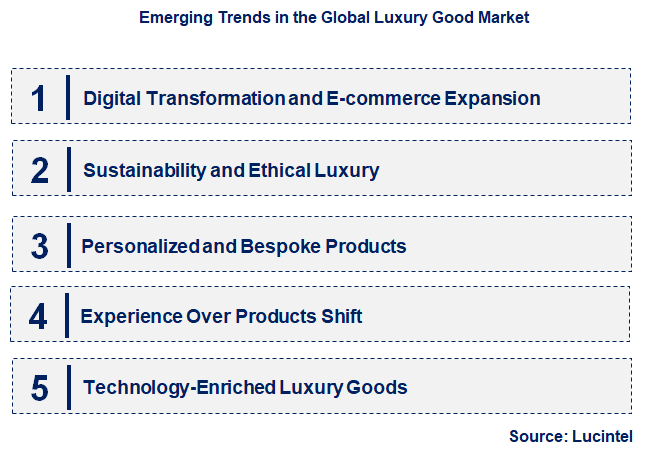
The luxury good industry is experiencing some major changes fueled by changing consumer behavior, technological innovation, and increasing emphasis on sustainability. New trends are reshaping the way luxury brands are doing business and connecting with their customers, propelling the industry into a new era of luxury. Some of the five major trends affecting the market are as follows:• Digital Transformation and E-commerce Expansion: The growth of online shopping has revolutionized the market for luxury goods by expanding high-end products access to customers worldwide. E-commerce sites are playing a growing role in getting luxury brands in front of young, digitally native shoppers. Brands are also spending money on sophisticated digital technology such as virtual try-ons and augmented reality to make online shopping more engaging. Social media too is making its presence felt, with influencer promotion and live-stream selling making inroads into the luxury segment. The online transition is expanding the base of consumers as well as reforming classic bricks-and-mortar retail paradigms.
• Sustainability and Ethical Luxury: As consumers turn green in their thinking, demand for sustainable luxury products is also on the rise. Luxury brands are reacting by embracing green materials, ethical sourcing, and transparent supply chains. There is an increasing demand for products produced using natural materials, organic textiles, and less environmental degradation. High-end brands that focus on sustainability in their business are attractive to a new class of wealthy consumers who would like their consumption choices to reflect their environmental and social conscience.
• Personalized and Bespoke Products: Customization is the increasing trend in the luxury goods sector. Consumers are now more and more looking for personal experiences, ranging from monogrammed luggage to custom-fitted apparel. Luxury brands are using new technologies, including AI and 3D printing, to provide highly customized products. The trend also applies to experiences, with certain brands providing bespoke services, ranging from private shopping experiences to limited-edition products.
• Experience Over Products Shift: Physical products are still key in the luxury space, but there is increasing experience drift. Wealthy consumers are increasingly spending money on high-end experiences like private tours, high-end travel, and custom events. The need for novel and recollective experiences more than material goods is dominating the market, especially among young luxury buyers. Luxury brands are therefore expanding their products to experiential services, including premium concierge services, private gourmet dinners with famous chefs, and invitations to special events. This is opening up new opportunities for expansion in the luxury merchandise market.
• Technology-Enriched Luxury Goods: Luxury items are adding more and more cutting-edge technology, ranging from intelligent watches and smart jewelry to technologically advanced cars and sofas. Technology integration is not just about giving something more features but about refining the luxury experience as a whole. Premium brands are designing products that put together the latest technology with ageless style, providing both exclusiveness and new-age practicality. This trend is redefining consumer expectations, as high-end buyers want more than mere traditional craftsmanship—they demand goods that seamlessly integrate into their high-tech lifestyles. These new trends are redefining the luxury goods industry, prioritizing digital transformation, sustainability, personalization, experience-based consumption, and technological innovation. Brands that find success through these trends will be well on their way to meeting the changing tastes and expectations of todays luxury consumers.
Recent Development in the Luxury Good Market
The luxury good industry has witnessed several major developments that are transforming the landscape of the industry. These developments represent both international and local changes in consumers tastes, changes in technology, and business models. The following are five major developments that are leading to change in the luxury goods industry:• Growth of Luxury Online Platforms: E-commerce has emerged as a key distribution channel for luxury products. Luxury brands are heavily investing in digital platforms, where customers can shop online for luxury products. This transformation has been influenced by increasing demands for convenience, particularly from younger consumers who prioritize online shopping experiences. Luxury e-commerce growth is also promoted by enhanced digital experiences, including virtual try-on and augmented reality tools, that enable consumers to engage with products online.
• Luxury Brand Sustainability Initiatives: Sustainability is high on the list for most luxury brands today. Firms are embracing environmentally friendly practices in their manufacturing, employing green materials, and ensuring fair labor practices. Many premium brands are pledging carbon-free operations and producing goods from recycled or sustainable sources. Emphasis on sustainability is to win over a new generation of environmentally friendly customers who are willing to pay extra for products that share similar values.
• Personalization and Customization of Luxury Products: Personalized products have gained traction in the luxury market. Consumers are increasingly looking for bespoke items that reflect their individual tastes. Luxury brands are responding by offering more customization options, such as bespoke tailoring, personalized engravings, and custom design services. This trend allows brands to cater to the growing demand for exclusive, one-of-a-kind products, enhancing the customer experience and driving brand loyalty.
• Application of High-Tech Features in Luxury Goods: Technology is becoming a part of luxury products, with the brands adding sophisticated features to their offerings. Luxury watches, for instance, include smart features, high-end vehicles are now autonomous driving capable, and high-end fashion products are adding wearable technology. The fusion of these technologies enables the luxury brand to develop products that appease the desires of contemporary tech-oriented consumers without detracting from the brandings hallmark craftsmanship and exclusivity.
• Greater Emphasis on Experiential Luxury: Experiential luxury is becoming more popular, and customers are looking for unique, memorable experiences more than physical products. Luxury companies are extending their range of products to include upscale experiences, such as private events, luxury travel packages, and customized services. This trend is motivated by personalization and exclusivity, as high-end consumers look for experiences beyond physical goods. These latest trends reflect the continued evolution of the luxury goods market, with greater emphasis on digital interaction, sustainability, personalization, technology adoption, and experiential experiences. Those brands that adapt to these shifts are likely to succeed in a more competitive and fast-paced luxury market.
Strategic Growth Opportunities in the Luxury Good Market
The luxury good industry offers many opportunities in key applications, as changes in consumer tastes, technological advancements, and economic expansion open up new possibilities. As luxury brands continue to evolve with changing market conditions, a number of areas offer potential for growth. From digitalization and experiential luxury to sustainability and personalization, companies can ride these growth options to remain competitive. The following are five primary growth opportunities in the luxury goods industry, with an emphasis on applications in various industries.• Expansion of E-commerce and Digitalization: The expansion of digital platforms and e-commerce is a significant growth opportunity for luxury brands. Luxury consumers prefer to shop online for luxury products more and more, led by convenience and increasing acceptance of digital channels. Augmented reality, virtual fitting rooms, and online shopping experiences that are tailored to individual customers boost customer engagement. E-commerce allows brands to expand their reach internationally to a large number of people, especially in emerging economies.
• Sustainability and Ethical Luxury: Sustainability has emerged as a fundamental concern for consumers in the market for luxury goods. With increasing concerns regarding environmental conservation and ethical issues, many consumers now insist on products that are environmentally friendly and socially ethical. Luxury companies are reacting by using sustainable materials, lowering carbon emissions, and practicing ethical production. Not only is this tendency in line with consumer ethic, but it also gives a competitive advantage to brands that practice sustainability.
• Personalization and Product Customization Personalized luxury products are increasingly on the rise as consumers look for exclusive, customized products that speak directly to their personal preferences. These range from custom-designed items such as bespoke clothing, customized accessories, and monogrammed products. New technologies like artificial intelligence and 3D printing are making it possible for brands to provide more customized experiences, allowing for enhanced product differentiation. This movement enables luxury brands to forge deeper relationships with consumers, building customer loyalty and premium pricing.
• Experiential Luxury and High-End Services: People are turning the spotlight away from material goods and onto unique experiences, presenting a growth opportunity for luxury brands that can deliver high-end services. These range from private events, high-end travel packages, and bespoke concierge services. Experiential luxury is the provision of an irreplaceable experience, one linked with status and uniqueness. By providing unique and customized experiences, luxury brands get to connect with customers on a greater level, beyond the usual product-based exchange.
• Technology Integration in Luxury Products: Another important growth opportunity is the integration of technology in luxury products. Right from connected luxury watches and luxury connected devices to high-tech vehicles and appliances, technology is making its mark in the luxury industry. Customers are looking for products that merge innovation and legacy craftsmanship, fusing functionality with exclusivity. Premium brands that integrate high-tech features into their offerings, without compromising the design and quality for which they are recognized, will be attractive to a more technology-conscious clientele. The luxury market is adopting major growth opportunities that revolve around digital transformation, sustainability, personalized products, high-end experiences, and technology. These growth opportunities allow companies to realign with shifting consumer behaviors and produce more compelling, innovative products and services. As these trends unfold, luxury brands will need to purposefully align their businesses and product lines to lead the market and respond to the changing needs of high-net-worth consumers.
Luxury Good Market Driver and Challenges
There are various factors driving the luxury good market, including technological changes, changes in consumer behavior, and changes in the economy. Meanwhile, the industry also encounters a variety of challenges, including economic uncertainty, changes in regulatory landscapes, and increased demands on sustainability. Each driver and challenge is significant for luxury brands seeking to take advantage of market opportunities while overcoming potential hurdles. These are five primary drivers and three primary challenges affecting the luxury goods market. The factors responsible for driving the luxury good market include: 1. Increasing Affluence in Emerging Economies: Emerging market economies, especially in Africa and Asia, have seen rising disposable incomes, which are among the major drivers of luxury consumption. High-end products are being increasingly sought after by affluent consumers in these markets, driving demand in segments such as fashion, accessories, cars, and jewelry. Increasingly rising middle-class purchasing power is creating new avenues for luxury brands. As these markets develop, luxury goods demand is likely to increase hugely, creating huge revenue opportunities for international brands targeting these markets. 2. Digital Transformation and E-Commerce Growth: Digitalization is transforming the luxury goods market. E-commerce provides brands with the chance to access a broader audience and interact with consumers in new ways. Premium brands are now incorporating digital technologies such as virtual try-ons, one-to-one shopping, and influencer marketing to boost their online presence. The comfort of shopping online, coupled with the increased embrace of digital media, is turning into an increase in online luxury sales. As brands build more robust e-commerce strategies, they can connect with new consumer bases and geographies. 3. Trend Towards Sustainability and Ethical Consumption: Customers are valuing sustainability and ethicality more and more, which is having an impact on their shopping habits in the luxury sector. Brands that adopt environmentally friendly materials, ethical manufacturing, and transparent supply chains are winning over eco-aware consumers. The drive for sustainability is compelling brands to get creative with product design, packaging, and supply chains. Luxury brands that focus on environmental and social responsibility are more likely to resonate with a new generation of values-conscious consumers who would like their spending to reflect their values. 4. Innovation and Technological Integration: Technology is changing luxury items, with innovations in product characteristics, design, and manufacturing processes. From intelligent technology incorporated into luxury watches to AI-based personalization platforms, technology is changing the definition of a luxury item. The inclusion of advanced technology not only makes the luxury items more functional but also incorporates a sense of exclusivity. The use of technological innovation by luxury companies helps them stand out in a competitive environment by providing technologically advanced luxury products that attract contemporary, technology-aware consumers. 5. Aging Population and Changing Consumer Demographics: An aging population in the major markets of Europe and Japan is impacting the luxury goods industry. This age group prefers to invest in luxury goods, particularly commodities that provide comfort, quality, and durability. This age trend is generating demand for upscale goods that meet the needs of the older population, including luxury cars, home furnishings, and apparel. Also, younger consumers, particularly Millennials and Gen Z, are now also a prime target audience for luxury brands, with new preferences and values, including greater focus on experiences and sustainability. Challenges in the luxury good market are: 1. Economic Uncertainty and Volatility: Economic downturns and insecurities, including recessions, inflation, and geopolitical conflicts, are a challenge to the luxury goods sector. As the luxury industry has traditionally been resilient during times of economic recession, ongoing economic instability can result in consumers spending less on non-essential products. Brands have to respond to fluctuating economic conditions by diversifying their products and concentrating on value-oriented advertising strategies to keep consumers interested at difficult times. 2. Counterfeit and Brand Protection Issues: Counterfeiting continues to be a serious issue in the luxury goods market. The prevalence of counterfeit luxury items erodes the value of genuine brands and hurts consumer trust. Luxury companies are investing in emerging technologies like blockchain, RFID tags, and AI in order to fight counterfeit products and safeguard intellectual property. Authenticating luxury products is vital in the fight to sustain brand reputation and consumer trust in the market. 3. Greater Regulatory Oversight and Compliance: As the market for luxury goods expands worldwide, brands are increasingly subject to scrutiny by regulatory authorities in different parts of the world. Environmental standards, labor practices, and consumer protection regulations are emerging as concerns. Luxury brands need to keep themselves informed of such regulations to escape judicial action and comply with them. It is not always easy to comply with intricate systems of regulation across divergent jurisdictions, particularly for global luxury brands doing business in several jurisdictions. The luxury retail market is driven by a mixture of drivers, such as expanding prosperity in emerging markets, technological change, sustainability trends, and technological innovation. Nevertheless, brands need to adapt to challenges such as economic uncertainty, counterfeiting, and expanding regulatory control. Meeting these drivers and challenges will be key for luxury brands to sustain their competitive advantage and thrive in a changing market.List of Luxury Good Companies
Companies in the market compete on the basis of product quality offered. Major players in this market focus on expanding their manufacturing facilities, R&D investments, infrastructural development, and leverage integration opportunities across the value chain. With these strategies luxury good companies cater increasing demand, ensure competitive effectiveness, develop innovative products & technologies, reduce production costs, and expand their customer base. Some of the luxury good companies profiled in this report include-• LVMH Group
• Chanel
• Burberry Group
• Prada
• Kering
• Coty
• Estée Lauder Companies
• Shiseido Company, Limited
• LOréal
• Hermès International
Luxury Good Market by Segment
The study includes a forecast for the global luxury good market by product, end use, and region.Luxury Good Market by Product [Value from 2019 to 2031]:
• Apparel
• Watches
• Jewelry
• Handbags
• Perfumes & Cosmetics
• Footwear
• Others
Luxury Good Market by End Use [Value from 2019 to 2031]:
• Men
• Women
Luxury Good Market by Region [Value from 2019 to 2031]:
• North America
• Europe
• Asia Pacific
• The Rest of the World
Country Wise Outlook for the Luxury Good Market
The luxury good market continues to change quickly worldwide. While tastes among consumers and economic conditions shift, regions of the world are experiencing unique trends in the industry. Advances in digital technology, rising disposable incomes, and greater demand for customized products have created changes in the manufacturing, marketing, and distribution of luxury goods. Moreover, the international trend towards sustainability and ethical sourcing has compelled brands to change their ways to suit contemporary consumers. Following are brief accounts of current trends in the luxury goods industry in important geographies: the United States, China, Germany, India, and Japan.• United States: The luxury goods industry in the United States has remained strong despite economic pressures. The industry is experiencing robust growth in the high-fashion, jewelry, and cosmetics markets. Shoppers are seeking more individualized, unique products, driving brands to emphasize custom products and limited-series collections. Moreover, the proliferation of digital platforms and social media has presented luxury companies with new avenues for connecting with younger consumers. The movement towards sustainability is also on the rise, with most U.S. brands embracing ethical sourcing and environmental responsibility.
• China: China continues to be a leading force in the global luxury goods industry. With a rapidly expanding base of affluent consumers, especially among younger generations, demand for luxury goods continues to grow, led by categories such as luxury watches, fashion, and luxury cars. The Chinese governments initiatives to boost domestic consumption have helped fuel the surge. Additionally, Chinese consumers increasingly look for brand heritage and quality, which causes them to demand more European luxury products. The move towards digital platforms is also evident, with e-commerce, livestream shopping, and social media campaigns becoming integral components of luxury marketing strategies in China.
• Germany: Germanys luxury market is marked by a combination of tradition and innovation. There is still strong demand for top-notch craftsmanship in luxury products, especially in sectors like automotive, fashion, and accessories. German customers are very demanding and look for hardy, functional luxury products. Additionally, Germany is experiencing greater interest in sustainable luxury products since consumers are increasingly keen on ethically produced and eco-friendly products. The luxury car industry, particularly with electric cars, is also seeing substantial investments in line with the nations environmental ambitions and scientific breakthroughs.
• India: Indias luxury market for goods is growing on the back of a growing affluent segment. Consumption of luxury goods in fashion, watches, and jewelry has increased among urban richer classes. The market is still in a development phase and international luxury brands are growing in demand. Indian consumers are also accepting a fusion of global and local luxury, looking for items that combine contemporary style with cultural heritage. Online retailers are helping to make luxury products more accessible, and India is seeing more high-end stores opening up in large cities.
• Japan: The Japanese market for luxury goods remains firm, with consistent demand for both foreign and domestic high-end products. There is an importance on quality and design among Japanese consumers, and there is a strong preference for limited-edition items, especially in accessories and fashion. There is also an increasing trend toward sustainability, and luxury brands are reacting by engaging in eco-friendly practices. There is a growing trend towards online shopping as well, with an increasing number of luxury consumers shopping online. Japans aged population is fueling demand for luxury items focusing on comfort and quality, especially in the automotive and home products industries.

Features of the Global Luxury Good Market
Market Size Estimates: Luxury good market size estimation in terms of value ($B). Trend and Forecast Analysis: Market trends (2019 to 2024) and forecast (2025 to 2031) by various segments and regions. Segmentation Analysis: Luxury good market size by product, end use, and region in terms of value ($B). Regional Analysis: Luxury good market breakdown by North America, Europe, Asia Pacific, and Rest of the World. Growth Opportunities: Analysis of growth opportunities in different products, end uses, and regions for the luxury good market. Strategic Analysis: This includes M&A, new product development, and competitive landscape of the luxury good market. Analysis of competitive intensity of the industry based on Porter’s Five Forces model.
FAQ
Q1. What is the growth forecast for luxury good market? Answer: The global luxury good market is expected to grow with a CAGR of 6.8% from 2025 to 2031. Q2. What are the major drivers influencing the growth of the luxury good market? Answer: The major drivers for this market are the increasing consumer spending on premium products, the rising desire for exclusive luxury brands, and the growing influence of social media trends. Q3. What are the major segments for luxury good market? Answer: The future of the luxury good market looks promising with opportunities in the apparel, watch, jewelry, handbag, perfume & cosmetic, and footwear markets. Q4. Who are the key luxury good market companies? Answer: Some of the key luxury good companies are as follows:• LVMH Group
• Chanel
• Burberry Group
• Prada
• Kering
• Coty
• Estée Lauder Companies
• Shiseido Company, Limited
• LOréal
• Hermès International Q5. Which luxury good market segment will be the largest in future? Answer: Lucintel forecasts that, within the end use category, women is expected to witness higher growth over the forecast period. Q6. In luxury good market, which region is expected to be the largest in next 5 years? Answer: In terms of region, North America is expected to witness the highest growth over the forecast period. Q7. Do we receive customization in this report? Answer: Yes, Lucintel provides 10% customization without any additional cost.
Table of Contents
List of Figures
List of Tables
Methodology
- In-depth interviews of the major players in this market
- Detailed secondary research from competitors’ financial statements and published data
- Extensive searches of published works, market, and database information pertaining to industry news, company press releases, and customer intentions
- A compilation of the experiences, judgments, and insights of Lucintel’s professionals, who have analyzed and tracked this market over the years.


Buy Now
Choose a license that fits your team. Instant PDF delivery.
Prices exclude taxes. Instant delivery. Custom licensing available on request.
Key Questions
- • What are some of the most promising, high-growth opportunities for the luxury good market by product (apparel, watches, jewelry, handbags, perfumes & cosmetics, footwear, and others), end use (men and women), and region (North America, Europe, Asia Pacific, and the Rest of the World)?
- • Which segments will grow at a faster pace and why?
- • Which region will grow at a faster pace and why?
- • What are the key factors affecting market dynamics? What are the key challenges and business risks in this market?
- • What are the business risks and competitive threats in this market?
- • What are the emerging trends in this market and the reasons behind them?
- • What are some of the changing demands of customers in the market?
- • What are the new developments in the market? Which companies are leading these developments?
- • Who are the major players in this market? What strategic initiatives are key players pursuing for business growth?
- • What are some of the competing products in this market and how big of a threat do they pose for loss of market share by material or product substitution?
- • What M&A activity has occurred in the last 5 years and what has its impact been on the industry? For any questions related to Luxury Good Market, Luxury Good Market Size, Luxury Good Market Growth, Luxury Good Market Analysis, Luxury Good Market Report, Luxury Good Market Share, Luxury Good Market Trends, Luxury Good Market Forecast, Luxury Good Companies, write Lucintel analyst at email: helpdesk@lucintel.com. We will be glad to get back to you soon.


