
Report Feature
Luxury Furniture Market Trends and Forecast
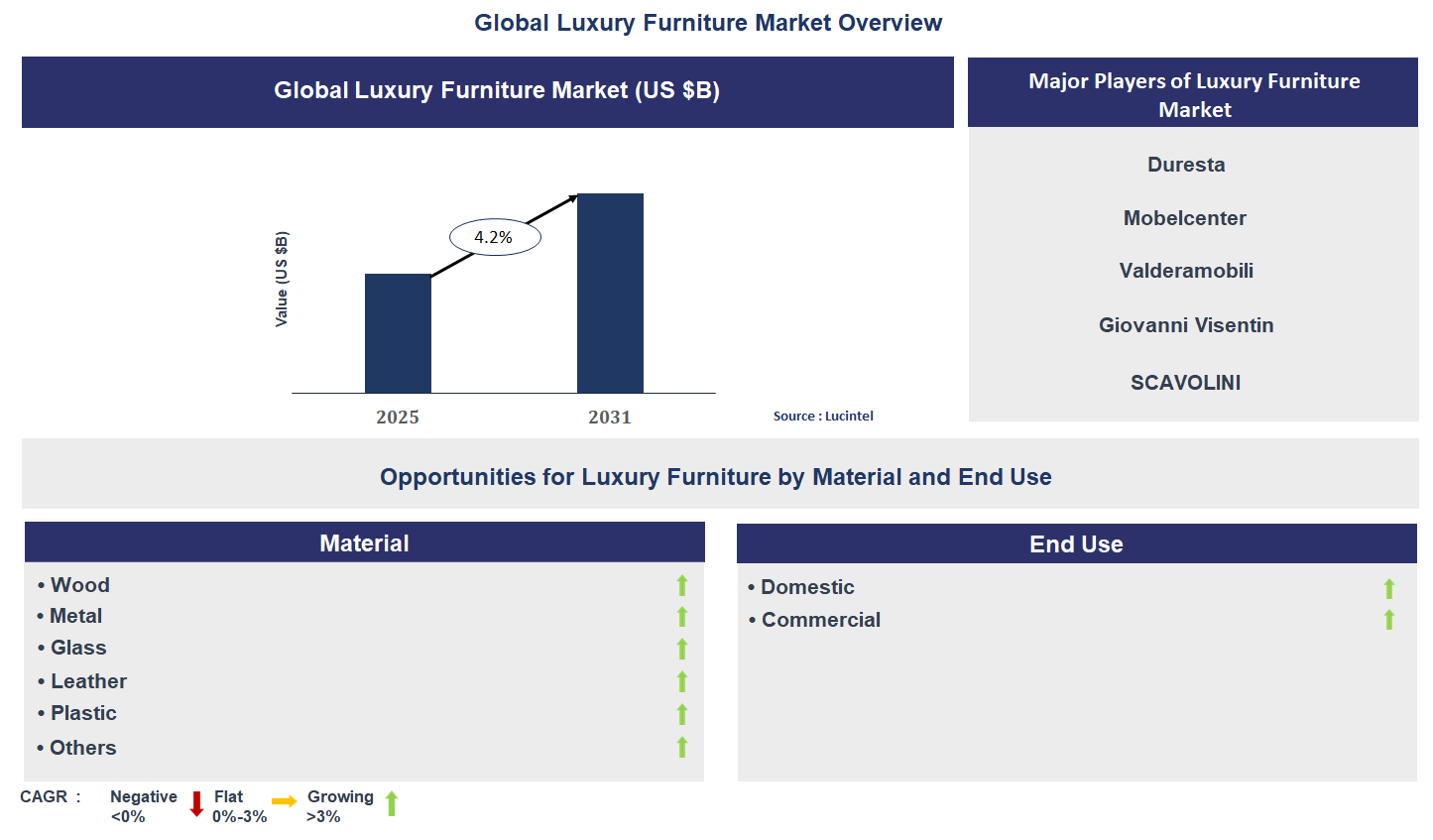
The future of the global luxury furniture market looks promising with opportunities in the domestic and commercial markets. The global luxury furniture market is expected to grow with a CAGR of 4.2% from 2025 to 2031. The major drivers for this market are the increasing demand for high-end designs, the rising focus on personalized home décor, and the growing popularity of luxury home interiors.• Lucintel forecasts that, within the material category, wood will remain the largest segment over the forecast period.
• Within the end use category, domestic will remain a larger segment.
• In terms of region, APAC will remain the largest region over the forecast period. Gain valuable insights for your business decisions with our comprehensive 150+ page report. Sample figures with some insights are shown below.
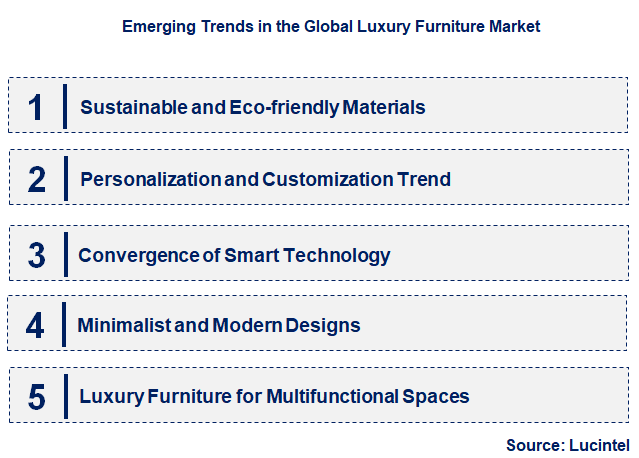
Emerging Trends in the Luxury Furniture Market
The luxury furniture market is transforming, with major trends centered on sustainability, customization, smart technology, and design trends. As people get more discerning and environmentally conscious, furniture companies are moving to address these new needs. The following are five of the major trends transforming the market.• Sustainable and Eco-friendly Materials: Sustainability is emerging as a hallmark characteristic of the luxury furniture market. Consumers are moving more toward organic materials, like recycled wood, natural fibers, and low-VOC finishes. Builders are reacting by using materials that have a smaller carbon footprint and are more durable. It is a trend that is seen in both high-end and middle-range luxury furniture collections, as consumers want furniture that not only is stunning but also reflects their values of environmental stewardship. The drive for sustainability is fueling innovation in materials and manufacturing processes, so eco-luxury is a major market segment.
• Personalization and Customization Trend: Personalization is becoming a popular trend in the luxury furniture industry. Consumers are now expecting furniture that is tailored to their personal tastes, inclinations, and lifestyles. Manufacturers are now providing bespoke options, where the buyer can choose fabrics, colors, sizes, and designs that fit their individual purposes. This is contributing to websites that enable the consumer to customize their furniture, from sofas to tables. This has made bespoke luxury furniture increasingly popular, with an exclusive product that brings a personal touch to interior design, giving it more appeal to high-end buyers.
• Convergence of Smart Technology: Smart furniture, with integrated technology for enhanced comfort and convenience, is popularizing in the high-end furniture industry. From sofas with USB connections to smart beds that change position via apps, technology is becoming a standard feature in high-end furniture products. The inclusion of features like inbuilt speakers, wireless charging pads, and intelligent lighting systems appeals to technology-minded consumers who appreciate innovation in their living spaces. The trend is revolutionizing the luxury furniture industry, opening up new avenues for manufacturers to innovate and diversify their offerings.
• Minimalist and Modern Designs: Minimalism is ruling the luxury furniture space, especially in mature economies such as the U.S., Germany, and Japan. Clean-lined, minimal, and functional designs that focus on neutral color, lightness, and simplicity are sought after. Consumers are shifting away from elaborate, historic-style furniture towards more contemporary, minimalist pieces that seamlessly integrate into modern interiors. This is seen in the increased popularity of Scandinavian and mid-century modern design principles, which prioritize both style and functionality, producing beautiful and functional furniture for luxury homes and workplaces.
• Luxury Furniture for Multifunctional Spaces: With decreasing urban living areas, especially in metropolises such as New York, Tokyo, and Hong Kong, there is growing demand for multifunctional luxury furniture. People are looking for furniture that is both fashionable and functional, with items that can perform more than one purpose, for example, sofas that have a bed function or tables with storage. The trend is addressing smaller homes and apartments where maximizing space is essential. Multifunctional luxury furniture allows consumers to have an elegant and utilitarian living space, a phenomenon that captures the new demands of city dwellers who want luxury and utility in their lives. These new trends are redefining the luxury furniture industry, with more focus on sustainability, customization, smart tech, contemporary designs, and multi-functionality. Companies that transform these trends by providing new, environmentally friendly, and customizable furniture will be in a good position to cater to the needs of consumers in todays high-net-worth space.
Recent Development in the Luxury Furniture Market
Recent trends in the luxury furniture industry are indicative of the sectors reaction to shifting consumer tastes, emerging technologies, and emphasis on sustainability. Companies are investing in new materials, providing customized designs, and using technology to improve both form and function of luxury furniture. Here are five recent developments in the market.• Investment in Sustainable Materials and Processes: As consumers increasingly seek out environmentally friendly products, there is significant investment by luxury furniture companies in sustainable materials like recycled wood, biodegradable textiles, and non-toxic paints. Companies are also turning to sustainable manufacturing processes in order to minimize waste and energy usage. These shifts are propelling the industry towards environmental responsibility, with luxury companies touting their commitment to sustainability as a major differentiator in an increasingly competitive market.
• Development of E-commerce Platforms: E-commerce has become an important platform for luxury furniture sales. Brands are spending more in online channels to address the increase in demand for convenience and ease of access. Customers now buy, customize, and order luxury furniture online, with some brands providing in-home delivery and trial periods. This trend is taking luxury furniture brands to a global level, particularly in markets where there is limited physical retail exposure. The shift to the online platform is likely to persist as more luxury brands advance their virtual presence.
• Emphasis on Smart Furniture: The incorporation of technology in luxury furniture is another significant trend. Smart furniture like beds with variable settings, sofas with charging capabilities, and tables with wireless connectivity are on the rise. The trend addresses the growing demand among consumers for functionality and ease of use, where furniture has multiple functions. With more consumers adopting smart home appliances, high-end furniture makers are integrating advanced technology into their products, enhancing the overall customer experience and establishing a new segment of luxury.
• Customization and Bespoke Offerings: Made-to-measure furniture is becoming more popular among high-end consumers looking to acquire exclusive, one-of-a-kind pieces for the home. Luxury furniture manufacturers are answering by providing high levels of customization, ranging from specially ordered finishes to bespoke designs. With this evolution, clients are able to design furniture that satisfies their individual tastes and particular requirements. Bespoke furniture items are being a major selling feature for luxury brands, fostering customer loyalty and appealing to a market niche that appreciates uniqueness and exclusivity.
• Revival of Traditional Craftsmanship: Aside from minimalist, modern designs, consumers are increasingly interested in traditional craftsmanship. Luxury furniture companies are bringing back hand-crafted furniture, focusing on artisanal skills and superior materials. It is a trend that resonates with customers who value the artistry and heritage of high-quality furniture, wanting pieces that have historical as well as aesthetic appeal. The resurgence of heritage craftsmanship is assisting high-end furniture brands to distinguish themselves in a saturated marketplace and appeal to sophisticated consumers who recognize the exclusivity and authenticity of hand-crafted items. Recent trends in the luxury furniture industry are aimed at responding to consumers shifting needs, including sustainability, technology, customization, and heritage craftsmanship. These trends are setting the course of the industry, with the companies that adopt innovation and customization set to thrive in the new face of luxury furniture.
Strategic Growth Opportunities in the Luxury Furniture Market
The luxury furniture industry offers many growth opportunities in different applications. With changing consumer preferences, companies are shifting their products to align with new needs such as eco-friendly products, customized designs, and multifunctional furniture. The following are some of the most significant growth opportunities in the luxury furniture market.• Expansion into Emerging Markets: The increasing prosperity in developing economies like China, India, and Southeast Asia presents vast growth prospects for luxury furniture brands. As incomes increase, more people are ready to splurge on high-quality furniture to improve the standards of their homes. Luxury brands can gain more traction in these countries by marketing products that meet the local tastes and preferences, as well as riding on the increased demand for Western-style luxury furniture.
• Investment in Smart Furniture Technology: As technologies used in smart homes continue to become more mainstream, there is increased potential for luxury furniture companies to incorporate advanced technologies into their offerings. From intelligent beds with built-in sleep tracking to massage-equipped chairs, the integration of advanced technology into furnishings can provide a substantial amount of value to consumers. This trend provides manufacturers with the potential to stand out by providing high-tech, multifunctional products that provide greater convenience and comfort.
• Sustainable and Eco-Friendly Products: As environmental concerns gain greater awareness among consumers, demand is building for sustainable luxury furniture. Companies that emphasize green production methods, including recycling, organic materials, and non-toxic coatings, can benefit from the growing demand for green luxury goods. The opportunity is strongest in mature markets such as North America and Europe, where consumers are increasingly demanding furniture that supports their sustainability ideals.
• Personalization and Customization Services: Personalization and customization are becoming major drivers in the high-end furniture industry. By giving customers the power to create their own furniture, ranging from choosing materials to picking colors and sizes, manufacturers are able to meet the rising demand for customized products. Not only does this help brands stand out but also boosts customer satisfaction and loyalty. With growing demand for personalized items, this offers luxury furniture brands a major growth opportunity.
• Expansion of Online Retailing Channels: E-commerce is becoming a bigger factor in the luxury furniture industry, giving brands access to a worldwide market. Because customers are using online stores more and more for ease of use, luxury furniture companies can increase their market reach by building strong e-commerce platforms. This growth potential enables brands to eliminate existing retail channels and address customers directly, along with the opportunity to provide virtual consultations and customization to improve the customer experience. Strategic opportunities for growth in the luxury furniture industry are focused on emerging markets expansion, technology innovation, sustainability, and customization. Companies that are able to take advantage of these opportunities will be well-placed to address changing needs among luxury customers and propel additional growth in the sector.
Luxury Furniture Market Driver and Challenges
The market for luxury furniture is driven by numerous technological, economic, and regulatory factors. The drivers and challenges determine the dynamics of the market and affect manufacturers and consumers. The following is a description of the main drivers and challenges in the business. The factors responsible for driving the luxury furniture market include: 1. Increasing Disposable Income in Emerging Economies: As incomes in emerging economies increase, demand for luxury furniture is on the rise. Consumers in these emerging economies, especially in the Middle East and Asia, are growing in wealth and are happy to invest in luxurious furniture to make their homes more beautiful. The growth can be harnessed by the manufacturers through targeting these markets with offerings that suit local preferences and tastes. 2. Rising Emphasis on Sustainability: Customers are increasingly concerned with sustainability, forcing luxury furniture companies to implement green materials and manufacturing processes. Consequently, companies that specialize in green practices, i.e., the use of recycled products and non-toxic coatings, are fulfilling the increased demand for eco-friendly products. This trend is transforming the luxury furniture industry, with sustainability becoming an important sales point for luxury brands. 3. Technological Advances in Furniture Design: Technological advancements are fueling innovation in the world of luxury furniture. From adding smart features in furniture to 3D printing for customized designs, technology is helping manufacturers develop products with both functional and aesthetic value. This technological advancement is drawing high-tech consumers who desire modern, multi-functional furniture. 4. Demand for Personalization and Customization: The market for luxury furniture is being pushed more and more by consumers desire for custom and bespoke products. Consumers are looking for furniture that suits their personal taste and fits their individual requirements. Manufacturers are taking heed by providing personalization alternatives, like bespoke material, colors, and dimensions, allowing consumers to design one-of-a-kind pieces. This trend is fueling the growth in the luxury furniture market. 5. Growth of E-Commerce Platforms: Online shopping is becoming a significant contributor to the luxury furniture market. Online websites enable people to view, tailor, and buy luxury furniture across the globe. Online shopping has made luxury furniture easily accessible and is propelling the growth of the market. Companies that make investments in strong online selling platforms can reach more consumers. Challenges in the luxury furniture market are: 1. High Production Costs: Production of luxury furniture requires top-quality materials, skilled labor, and complex designs, hence increased costs of production. Such high costs act as a deterrent to consumers, particularly in cost-sensitive markets. The producers need to balance price and quality to stay competitive within the market. 2. Global Brands Fierce Competition: Luxury furniture is a competitive market where both international established brands and new local designers compete for market share. Competition is forcing manufacturers to keep innovating and creating distinctive designs to appeal to discerning consumers. Price is also a threat, as there are consumers who will look for cheap luxury. 3. Supply Chain Disruptions: Disruptions to global supply chains, like raw material shortages and transport delays, can have a significant effect on the luxury furniture industry. These disruptions can result in increased costs, longer lead times, and challenges to keeping inventory up. Companies need to create strategies for managing these risks and insuring that materials and products flow consistently and reliably. The luxury furniture industry is fueled by increasing disposable incomes, technological innovation, and a rising trend towards sustainability. But manufacturers have to overcome barriers like high costs of manufacturing, stiff competition, and supply chain shocks. Manufacturers who can take advantage of the drivers while overcoming the hurdles will stand to benefit in the changing luxury furniture industry.List of Luxury Furniture Companies
Companies in the market compete on the basis of product quality offered. Major players in this market focus on expanding their manufacturing facilities, R&D investments, infrastructural development, and leverage integration opportunities across the value chain. With these strategies luxury furniture companies cater increasing demand, ensure competitive effectiveness, develop innovative products & technologies, reduce production costs, and expand their customer base. Some of the luxury furniture companies profiled in this report include-• Duresta
• Mobelcenter
• Valderamobili
• Giovanni Visentin
• SCAVOLINI
• LAURA ASHLEY HOLDINGS
• Iola Modern
Luxury Furniture Market by Segment
The study includes a forecast for the global luxury furniture market by material, end use, and region.Luxury Furniture Market by Material [Value from 2019 to 2031]:
• Wood
• Metal
• Glass
• Leather
• Plastic
• Others
Luxury Furniture Market by End Use [Value from 2019 to 2031]:
• Domestic
• Commercial
Luxury Furniture Market by Region [Value from 2019 to 2031]:
• North America
• Europe
• Asia Pacific
• The Rest of the World
Country Wise Outlook for the Luxury Furniture Market
The luxury furniture industry has undergone tremendous changes based on changing consumer behavior, advancements in technology, and an increased emphasis on sustainability. There has been a rise in disposable income, especially in emerging economies such as China and India, which has resulted in greater demand for luxury furniture. Concurrently, there has been a move towards online purchases and e-commerce websites, which have increased access to luxury furniture for a global customer base.• United States: In the United States, the luxury furniture sector is on the rise as consumers increasingly demand good quality, bespoke, and designer pieces. The market is being fueled by a growing interest in home furnishings and a desire for sustainable, environmentally friendly materials. Brands are also enriching customer experience by way of personalization and high-tech products, like intelligent furniture that communicates with home automation systems. Online retailing platforms have extended the reach of the market, enabling consumers to buy luxury furniture from established and new designers, thus adding to the growth of the market.
• China: Chinas luxury furniture market has expanded at a fast pace as a result of increasing incomes, urbanization, and an expanding middle class. Demand for modern and traditional luxury furniture is growing, with consumers looking for bespoke, premium-quality products. Local manufacturers are pushing to provide what Chinese consumers want, while also luring international brands to take advantage of Chinas market. Online platforms are driving sales significantly, with greater demand for online shopping. The Chinese market for luxury furniture is likely to maintain its growth trend with wealthy consumers seeking more technologically advanced, design-focused pieces.
• Germany: Germanys luxury furniture industry is reputed for its focus on the craftsmanship, quality materials, and practical designs. The minimalist style and clean modern looks are still reigning supreme in the market, with German consumers opting for longevity and sustainability in their buying decisions. Manufacturers are adopting eco-friendly materials, including recycled timber and natural fibers, to keep up with emerging sustainability trends. Also, Germanys affluent interior design culture is driving demand for luxury furniture, especially high-end office furniture and living room furnishings, which have recorded rising demand both domestically and globally.
• India: Indias luxury furniture market is nascent but expanding significantly, particularly in urban cities. As the upper-middle class continues to grow and disposable incomes continue to rise, demand for upscale, imported, and designer furniture grows. Consumers are getting more design-driven and seeking high-quality individual pieces of furniture that denote status. International luxury brands as well as local producers are vying to meet this new demand, emphasizing traditional craftsmanship with a contemporary aesthetic. While Indias high-income consumer segment increases, the luxury furniture industry will witness considerable growth.
• Japan: Japans luxury furniture industry is based on a combination of traditional skills and the latest innovation. The industry is defined by the high regard for quality, design, and functionality. Japanese consumers prefer minimalist, timeless designs that focus both on form and function. As a response, manufacturers are increasingly using natural materials, including wood and leather, in order to satisfy the markets desire for sustainable luxury. Demand for luxury furniture has also been boosted by an aging Japanese population, where high-quality, comfortable furniture is being sought after for home and retirement home usage.

Features of the Global Luxury Furniture Market
Market Size Estimates: Luxury furniture market size estimation in terms of value ($B). Trend and Forecast Analysis: Market trends (2019 to 2024) and forecast (2025 to 2031) by various segments and regions. Segmentation Analysis: Luxury furniture market size by material, end use, and region in terms of value ($B). Regional Analysis: Luxury furniture market breakdown by North America, Europe, Asia Pacific, and Rest of the World. Growth Opportunities: Analysis of growth opportunities in different materials, end uses, and regions for the luxury furniture market. Strategic Analysis: This includes M&A, new product development, and competitive landscape of the luxury furniture market. Analysis of competitive intensity of the industry based on Porter’s Five Forces model.
FAQ
Q1. What is the growth forecast for luxury furniture market? Answer: The global luxury furniture market is expected to grow with a CAGR of 4.2% from 2025 to 2031. Q2. What are the major drivers influencing the growth of the luxury furniture market? Answer: The major drivers for this market are the increasing demand for high-end designs, the rising focus on personalized home décor, and the growing popularity of luxury home interiors. Q3. What are the major segments for luxury furniture market? Answer: The future of the luxury furniture market looks promising with opportunities in the domestic and commercial markets. Q4. Who are the key luxury furniture market companies? Answer: Some of the key luxury furniture companies are as follows:• Duresta
• Mobelcenter
• Valderamobili
• Giovanni Visentin
• SCAVOLINI
• LAURA ASHLEY HOLDINGS
• Iola Modern Q5. Which luxury furniture market segment will be the largest in future? Answer: Lucintel forecasts that, within the material category, wood will remain the largest segment over the forecast period. Q6. In luxury furniture market, which region is expected to be the largest in next 5 years? Answer: In terms of region, APAC will remain the largest region over the forecast period. Q7. Do we receive customization in this report? Answer: Yes, Lucintel provides 10% customization without any additional cost.
Table of Contents
List of Figures
List of Tables
Methodology
- In-depth interviews of the major players in this market
- Detailed secondary research from competitors’ financial statements and published data
- Extensive searches of published works, market, and database information pertaining to industry news, company press releases, and customer intentions
- A compilation of the experiences, judgments, and insights of Lucintel’s professionals, who have analyzed and tracked this market over the years.


Buy Now
Choose a license that fits your team. Instant PDF delivery.
Prices exclude taxes. Instant delivery. Custom licensing available on request.
Key Questions
- • What are some of the most promising, high-growth opportunities for the luxury furniture market by material (wood, metal, glass, leather, plastic, and others), end use (domestic and commercial), and region (North America, Europe, Asia Pacific, and the Rest of the World)?
- • Which segments will grow at a faster pace and why?
- • Which region will grow at a faster pace and why?
- • What are the key factors affecting market dynamics? What are the key challenges and business risks in this market?
- • What are the business risks and competitive threats in this market?
- • What are the emerging trends in this market and the reasons behind them?
- • What are some of the changing demands of customers in the market?
- • What are the new developments in the market? Which companies are leading these developments?
- • Who are the major players in this market? What strategic initiatives are key players pursuing for business growth?
- • What are some of the competing products in this market and how big of a threat do they pose for loss of market share by material or product substitution?
- • What M&A activity has occurred in the last 5 years and what has its impact been on the industry? For any questions related to Luxury Furniture Market, Luxury Furniture Market Size, Luxury Furniture Market Growth, Luxury Furniture Market Analysis, Luxury Furniture Market Report, Luxury Furniture Market Share, Luxury Furniture Market Trends, Luxury Furniture Market Forecast, Luxury Furniture Companies, write Lucintel analyst at email: helpdesk@lucintel.com. We will be glad to get back to you soon.


