
Close Lucintel Chat
Didn't Find What You're Looking for?
Call us at +1972 636 5056 or write at helpdesk@Lucintel.com
Ask an Expert Provide Custom Requirements Download Sample Report Search Available Reports
  • helpdesk@Lucintel.com
  • |
  • Call Lucintel +1 972 636 5056
  • |
  • Login
  • |
  • Register
  • |
  • Search
  • |
'
...

The Impact of COVID-19 is included in Luxury Apparel Market Report. Buy it today to get an advantage.

Request the impact of COVID-19 on your product or industry


Luxury Apparel Market Trends and Forecast

The future of the global luxury apparel market looks promising with opportunities in the cotton, leather & wool, silk & viscose, and denim markets. The global luxury apparel market is expected to grow with a CAGR of 5.7% from 2025 to 2031. The major drivers for this market are the increasing demand for premium fashion products, the rising popularity of high-end fashion brands, and the growing influence of social media influencers.

• Lucintel forecasts that, within the application category, women is expected to witness higher growth over the forecast period.
• Within the type category, silk & viscose is expected to witness the highest growth.
• In terms of region, APAC is expected to witness the highest growth over the forecast period.
Gain valuable insights for your business decisions with our comprehensive 150+ page report. Sample figures with some insights are shown below.
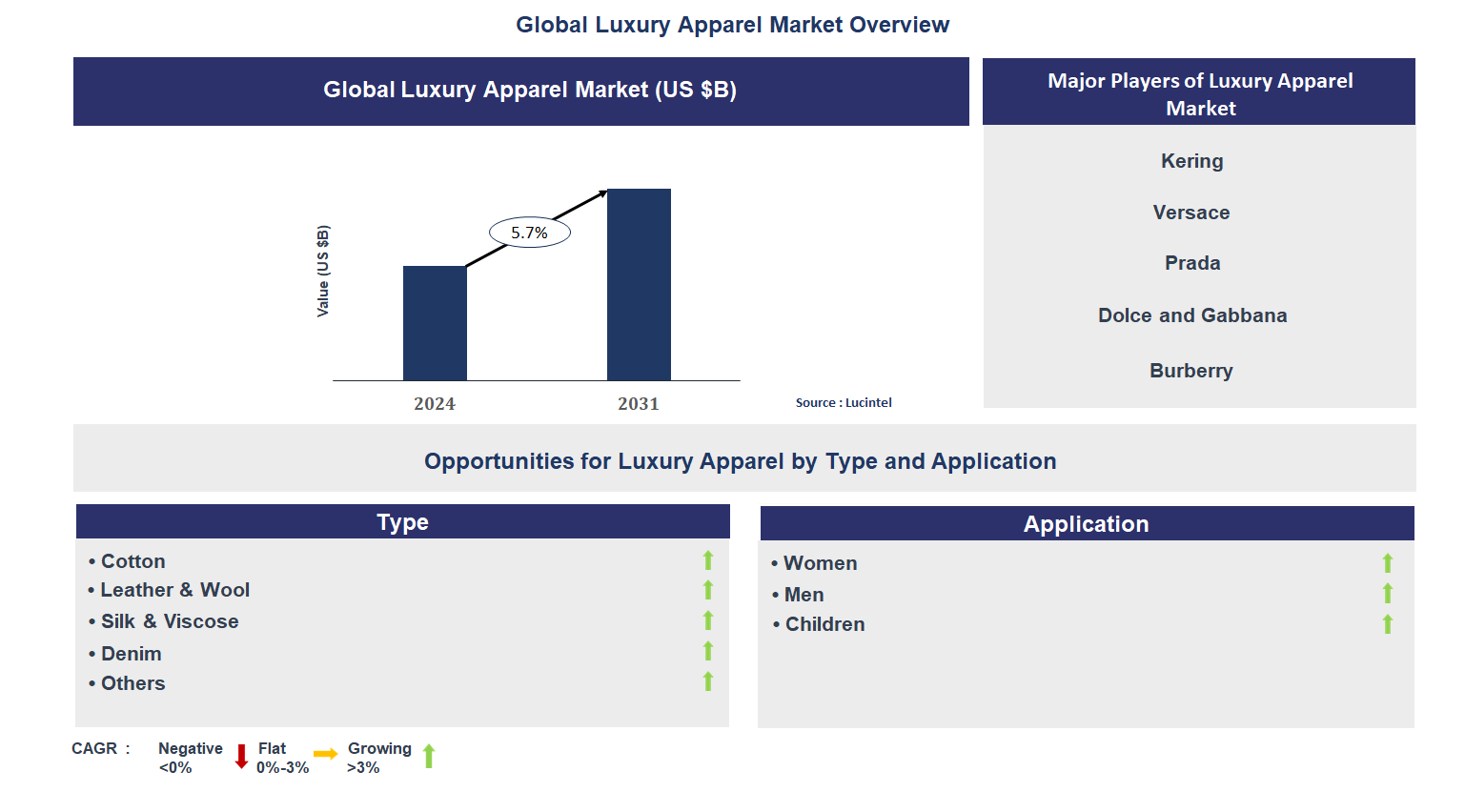
Luxury Apparel Market Trends and Forecast

Emerging Trends in the Luxury Apparel Market

The luxury apparel market is being reshaped by a series of emerging trends that reflect a fundamental shift in consumer values. These trends are moving the industry beyond traditional exclusivity and towards a model that emphasizes ethical sourcing, digital-first experiences, and a deeper connection with a diverse, globally conscious consumer base.
• Sustainability and Ethical Sourcing: Consumers, particularly millennials and Gen Z, are demanding transparency and ethical practices from luxury brands. This trend involves using eco-friendly materials, reducing waste, and ensuring fair labor practices throughout the supply chain. Brands are adopting circular fashion models, like rental and resale, to build a more responsible and appealing brand image.
• Personalization and Customization: The desire for unique, one-of-a-kind products is a major trend. Luxury brands are offering bespoke services, from custom-fit garments to personalized accessories. This not only enhances the customer experience but also reinforces the sense of exclusivity. Technology, such as AI-driven recommendations and virtual try-ons, is making personalization more accessible.
• The Rise of Digital-First Luxury: E-commerce and digital platforms are now central to the luxury market. Brands are creating immersive online experiences, utilizing augmented reality (AR) and virtual reality (VR) to showcase products in new ways. The use of social media influencers and live-stream shopping is also a key strategy to engage younger, digitally native consumers.
• Crossover with Streetwear and Casual Wear: The traditional boundary between luxury and streetwear is dissolving. High-end brands are collaborating with streetwear designers and incorporating casual elements into their collections. This trend is attracting a new, younger demographic and making luxury apparel more versatile and suitable for everyday life, expanding its market and cultural relevance.
• The Second-Hand Luxury Market: The market for pre-owned luxury goods is growing rapidly, driven by both sustainability concerns and the desire for affordability. Brands are recognizing this trend and are either entering the resale market themselves or partnering with established platforms. This circular economy model is democratizing luxury and providing new revenue streams.
These emerging trends are collectively reshaping the luxury apparel market by broadening its appeal and purpose. By embracing sustainability, technological innovation, and new business models, the industry is not only meeting the demands of modern consumers but also ensuring its long-term viability in a changing climate.
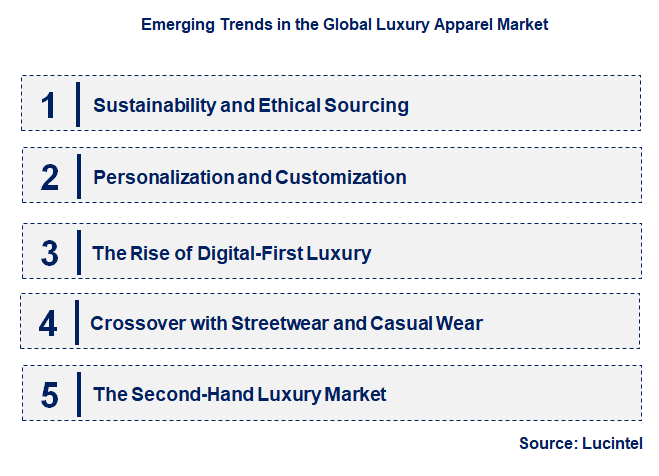
Emerging Trends in the Luxury Apparel Market

Recent Development in the Luxury Apparel Market

The luxury apparel market is experiencing significant evolution, driven by shifts in consumer preferences, technological advancements, and a growing emphasis on ethical consumption. These recent developments are transforming a once-simple product category into a diverse and innovative segment of the global apparel industry, impacting everything from product design to distribution strategies.
• Advanced Material Innovation: Recent developments include the use of advanced, performance-driven materials that are also sustainable. Brands are investing in research to create luxurious fabrics from recycled ocean plastics, plant-based materials like mushroom leather, and other bio-engineered textiles. This innovation meets the dual demand for high quality and environmental responsibility.
• Omnichannel Retail Strategies: Brands are no longer focused on just physical or online stores. A key development is the creation of a seamless omnichannel experience that integrates physical boutiques with digital platforms. This includes using in-store technology to connect with online profiles, offering "click and collect" services, and providing personalized digital styling consultations.
• Data-Driven Personalization: Luxury brands are leveraging big data and AI to understand consumer behavior and provide highly personalized experiences. This development allows for targeted marketing, curated product recommendations, and bespoke clienteling services both online and in-person. This approach deepens customer relationships and drives repeat business.
• Experiential Retail: Another significant development is the shift towards experiential retail. Brands are transforming their physical stores into immersive environments that offer more than just a place to shop. This includes hosting private events, fashion shows, and artistic installations to create a memorable brand experience that reinforces the luxury lifestyle.
• Strategic Acquisitions and Collaborations: The market is witnessing a flurry of strategic acquisitions and high-profile collaborations. Larger luxury groups are acquiring smaller, innovative brands to diversify their portfolios and appeal to niche markets. Additionally, collaborations between luxury houses and artists, musicians, or even tech companies are generating significant media buzz and reaching new audiences.
These developments are collectively impacting the luxury apparel market by expanding its potential applications and consumer segments. By focusing on innovation in materials, technology, and distribution, brands are successfully transforming the product from a simple commodity into a dynamic and highly differentiated footwear category.

Strategic Growth Opportunities in the Luxury Apparel Market

The luxury apparel market, once defined by functionality, now presents significant strategic growth opportunities driven by evolving consumer lifestyles and technological integration. These opportunities extend beyond traditional applications, allowing companies to innovate and capture new market segments by focusing on specific consumer needs and behaviors.
• Expansion into Emerging Markets: Countries like India and China, with their growing affluent populations, represent a major growth opportunity. By establishing a strong presence in these markets through flagship stores and strategic partnerships, brands can tap into a new generation of luxury consumers. Localized marketing and product offerings can significantly enhance their success.
• Customization as a Core Business Model: The desire for uniqueness presents an opportunity to integrate customization into the core business model. Brands can offer bespoke services, allowing customers to design their own garments or accessories. This not only commands a premium price but also creates a unique selling proposition and strengthens brand loyalty.
• Leveraging the Rental and Resale Economy: A strategic opportunity exists in embracing the circular economy. By creating their own certified pre-owned marketplaces or partnering with existing resale platforms, brands can tap into a new revenue stream. This also addresses sustainability concerns and makes luxury more accessible to a broader, more conscious audience.
• Technological Integration into Retail: The future of luxury retail is highly technological. Brands can invest in AR and VR to create virtual showrooms and interactive shopping experiences. This offers a convenient and engaging way for consumers to explore collections from anywhere in the world, breaking down geographical barriers and reaching a global audience.
• Building a Lifestyle Ecosystem: Luxury brands can expand their product offerings beyond apparel to create a complete lifestyle ecosystem. This includes launching products in adjacent categories like home goods, furniture, and experiential services like travel or fine dining. This strategy strengthens brand identity and creates multiple touchpoints for consumer engagement.
These strategic growth opportunities are impacting the luxury apparel market by encouraging diversification and innovation. By moving beyond a single-use product, companies can build more robust and resilient business models that cater to a wider range of consumer needs and market conditions, leading to sustainable long-term growth.

Luxury Apparel Market Driver and Challenges

The luxury apparel market is a dynamic industry shaped by a combination of major drivers and challenges that influence its growth trajectory. The major drivers include various technological, economic, and cultural factors, such as the rising affluence of consumers and the influence of social media. Conversely, key challenges such as economic downturns and the threat of counterfeiting can hinder market growth.
The factors responsible for driving the luxury apparel market include:
1. Rising Global Affluence: A primary driver is the growth of the high-net-worth and ultra-high-net-worth individual populations, particularly in emerging markets like China and India. As disposable incomes rise, a larger consumer base can afford luxury goods, driving a consistent increase in sales. This demographic shift is crucial for market expansion.
2. Influence of Social Media and Digitalization: Social media platforms have become a powerful tool for brand discovery and marketing. Influencers and celebrities showcase luxury products, creating aspirational appeal and a sense of urgency. Brands are leveraging these platforms and investing in e-commerce to reach a younger, digitally native consumer, which is expanding their market reach.
3. Growth of the Experiential Economy: Modern luxury consumers are increasingly valuing experiences over material possessions. This trend drives the market as brands create unique, high-touch experiences, such as exclusive events, personalized services, and private store access. These experiences help to build brand loyalty and justify premium price points.
4. Shift Towards Quiet Luxury: A recent driver is the "quiet luxury" trend, which emphasizes quality, craftsmanship, and understated elegance over overt branding. This shift appeals to discerning consumers who value substance and long-term investment pieces. Brands that focus on heritage and superior materials are benefiting from this change.
5. Sustainability and Ethical Consumption: Growing consumer awareness of environmental and social issues is a key driver. Consumers are willing to pay a premium for luxury goods that are ethically sourced and sustainably produced. This trend is pushing brands to adopt transparent supply chains and use eco-friendly materials, enhancing their brand image and attracting a new market segment.
Challenges in the luxury apparel market are:
1. Economic Volatility and Downturns: The luxury market is highly sensitive to economic conditions. In times of recession or economic uncertainty, consumer spending on non-essential, high-priced items often declines significantly. This volatility poses a major challenge for brands, which must manage inventory and marketing budgets in a rapidly changing economic climate.
2. Threat of Counterfeit Products: The proliferation of high-quality counterfeit products poses a significant challenge to luxury brands. These fakes can devalue brand prestige, erode consumer trust, and lead to substantial revenue losses. The ease of access to counterfeit goods through online channels makes it difficult for brands to protect their intellectual property.
3. Maintaining Exclusivity in a Digital Age: As luxury brands embrace e-commerce and social media to reach a wider audience, they face the challenge of maintaining their exclusive and aspirational image. Over-exposure can dilute a brands prestige. Brands must carefully balance accessibility with exclusivity to avoid alienating their core, high-value consumer base.
The luxury apparel markets growth is propelled by powerful drivers like rising global affluence and the strategic use of social media, which are expanding the markets reach. However, it must contend with significant challenges, including economic volatility and the persistent threat of counterfeiting. Navigating these forces requires a careful balance between embracing modern trends and preserving the core values of exclusivity and quality.

List of Luxury Apparel Companies

Companies in the market compete on the basis of product quality offered. Major players in this market focus on expanding their manufacturing facilities, R&D investments, infrastructural development, and leverage integration opportunities across the value chain. With these strategies luxury apparel companies cater increasing demand, ensure competitive effectiveness, develop innovative products & technologies, reduce production costs, and expand their customer base. Some of the luxury apparel companies profiled in this report include-
• Kering
• Versace
• Prada
• Dolce and Gabbana
• Burberry
• LVMH
• Giorgio Armani
• Ralph Lauren
• Hugo Boss
• Chanel

Luxury Apparel Market by Segment

The study includes a forecast for the global luxury apparel market by type, application, and region.

Luxury Apparel Market by Type [Value from 2019 to 2031]:


• Cotton
• Leather & Wool
• Silk & Viscose
• Denim
• Others

Luxury Apparel Market by Application [Value from 2019 to 2031]:


• Women
• Men
• Children

Luxury Apparel Market by Region [Value from 2019 to 2031]:


• North America
• Europe
• Asia Pacific
• The Rest of the World

Country Wise Outlook for the Luxury Apparel Market

The global luxury apparel market is undergoing a significant transformation, driven by shifts in consumer values, technological integration, and evolving retail landscapes. Brands are moving beyond traditional status symbols to focus on sustainability, digital engagement, and personalized experiences. This new approach is helping luxury brands appeal to younger, more ethically conscious consumers and navigate an increasingly complex global market.
• United States: The U.S. luxury apparel market is experiencing robust growth, fueled by high consumer spending and a strong influence of celebrity and influencer marketing. Brands are heavily investing in e-commerce and digital platforms, with a notable trend towards "quiet luxury"—an emphasis on craftsmanship and understated elegance. Sustainability and personalization are also becoming key purchase drivers.
• China: China’s luxury apparel market is marked by a rapid rebound in sales post-pandemic, though with some near-term uncertainties. The market is increasingly driven by a digitally savvy Gen Z population. Brands are leveraging social media and livestreaming to engage consumers, while also facing a new challenge: the rising popularity of local luxury brands that are gaining traction.
• Germany: Germany’s luxury apparel market is strong, with a consumer base that values high quality and durability. There is a growing focus on sustainability and ethical consumerism, with German consumers actively seeking eco-friendly materials and transparent supply chains. The market is also seeing a rise in online retail and the popularity of pre-owned luxury goods.
• India: Indias luxury apparel market is expanding, driven by a growing affluent population and a deep cultural appreciation for high-end textiles. The market is witnessing a surge in international brands establishing a presence, often through partnerships with local retailers. E-commerce is a major growth driver, bridging the gap between global brands and Indian consumers.
• Japan: Japans luxury apparel market is characterized by a blend of traditional aesthetics and modern trends. The market is driven by a strong local fashion culture and a high demand for premium, high-quality products. Recent developments include the rise of domestic luxury designers and a growing interest in technology-driven retail experiences like virtual try-ons.

Lucintel Analytics Dashboard

Features of the Global Luxury Apparel Market

Market Size Estimates: Luxury apparel market size estimation in terms of value ($B).
Trend and Forecast Analysis: Market trends (2019 to 2024) and forecast (2025 to 2031) by various segments and regions.
Segmentation Analysis: Luxury apparel market size by type, application, and region in terms of value ($B).
Regional Analysis: Luxury apparel market breakdown by North America, Europe, Asia Pacific, and Rest of the World.
Growth Opportunities: Analysis of growth opportunities in different types, applications, and regions for the luxury apparel market.
Strategic Analysis: This includes M&A, new product development, and competitive landscape of the luxury apparel market.
Analysis of competitive intensity of the industry based on Porter’s Five Forces model.

Lucintel Consulting Services

FAQ

Q1. What is the growth forecast for luxury apparel market?
Answer: The global luxury apparel market is expected to grow with a CAGR of 5.7% from 2025 to 2031.
Q2. What are the major drivers influencing the growth of the luxury apparel market?
Answer: The major drivers for this market are the increasing demand for premium fashion products, the rising popularity of high-end fashion brands, and the growing influence of social media influencers.
Q3. What are the major segments for luxury apparel market?
Answer: The future of the luxury apparel market looks promising with opportunities in the cotton, leather & wool, silk & viscose, and denim markets.
Q4. Who are the key luxury apparel market companies?
Answer: Some of the key luxury apparel companies are as follows:
• Kering
• Versace
• Prada
• Dolce and Gabbana
• Burberry
• LVMH
• Giorgio Armani
• Ralph Lauren
• Hugo Boss
• Chanel
Q5. Which luxury apparel market segment will be the largest in future?
Answer: Lucintel forecasts that, within the application category, women is expected to witness higher growth over the forecast period.
Q6. In luxury apparel market, which region is expected to be the largest in next 5 years?
Answer: In terms of region, APAC is expected to witness the highest growth over the forecast period.
Q7. Do we receive customization in this report?
Answer: Yes, Lucintel provides 10% customization without any additional cost.

This report answers following 11 key questions:

Q.1. What are some of the most promising, high-growth opportunities for the luxury apparel market by type (cotton, leather & wool, silk & viscose, denim, and others), application (women, men, and children), and region (North America, Europe, Asia Pacific, and the Rest of the World)?
Q.2. Which segments will grow at a faster pace and why?
Q.3. Which region will grow at a faster pace and why?
Q.4. What are the key factors affecting market dynamics? What are the key challenges and business risks in this market?
Q.5. What are the business risks and competitive threats in this market?
Q.6. What are the emerging trends in this market and the reasons behind them?
Q.7. What are some of the changing demands of customers in the market?
Q.8. What are the new developments in the market? Which companies are leading these developments?
Q.9. Who are the major players in this market? What strategic initiatives are key players pursuing for business growth?
Q.10. What are some of the competing products in this market and how big of a threat do they pose for loss of market share by material or product substitution?
Q.11. What M&A activity has occurred in the last 5 years and what has its impact been on the industry?

For any questions related to Luxury Apparel Market, Luxury Apparel Market Size, Luxury Apparel Market Growth, Luxury Apparel Market Analysis, Luxury Apparel Market Report, Luxury Apparel Market Share, Luxury Apparel Market Trends, Luxury Apparel Market Forecast, Luxury Apparel Companies, write Lucintel analyst at email: helpdesk@lucintel.com. We will be glad to get back to you soon.
                                           Table of Contents

            1. Executive Summary

            2. Market Overview

                        2.1 Background and Classifications
                        2.2 Supply Chain

            3. Market Trends & Forecast Analysis

                        3.1 Macroeconomic Trends and Forecasts
                        3.2 Industry Drivers and Challenges
                        3.3 PESTLE Analysis
                        3.4 Patent Analysis
                        3.5 Regulatory Environment
                        3.6 Global Luxury Apparel Market Trends and Forecast Market Trends and Forecast

            4. Global Luxury Apparel Market by Type

                        4.1 Overview
                        4.2 Attractiveness Analysis by Type
                        4.3 Cotton : Trends and Forecast 2025 to 2031
                        4.4 Leather & Wool : Trends and Forecast 2025 to 2031
                        4.5 Silk & Viscose : Trends and Forecast 2025 to 2031
                        4.6 Denim : Trends and Forecast 2025 to 2031
                        4.7 Others : Trends and Forecast 2025 to 2031

            5. Global Luxury Apparel Market by Application

                        5.1 Overview
                        5.2 Attractiveness Analysis by Application
                        5.3 Women : Trends and Forecast 2025 to 2031
                        5.4 Men : Trends and Forecast 2025 to 2031
                        5.5 Children : Trends and Forecast 2025 to 2031

            6. Regional Analysis

                        6.1 Overview
                        6.2 Global Luxury Apparel Market by Region

            7. North American Luxury Apparel Market

                        7.1 Overview
                        7.2 North American Luxury Apparel Market by Type
                        7.3 North American Luxury Apparel Market by Application
                        7.4 The United States Luxury Apparel Market
                        7.5 Canadian Luxury Apparel Market
                        7.6 Mexican Luxury Apparel Market

            8. European Luxury Apparel Market

                        8.1 Overview
                        8.2 European Luxury Apparel Market by Type
                        8.3 European Luxury Apparel Market by Application
                        8.4 German Luxury Apparel Market
                        8.5 French Luxury Apparel Market
                        8.6 Italian Luxury Apparel Market
                        8.7 Spanish Luxury Apparel Market
                        8.8 The United Kingdom Luxury Apparel Market

            9. APAC Luxury Apparel Market

                        9.1 Overview Overview
                        9.2 APAC Luxury Apparel Market by Type Overview
                        9.3 APAC Luxury Apparel Market by Application Overview
                        9.4 Chinese Luxury Apparel Market Overview
                        9.5 Indian Luxury Apparel Market Overview
                        9.6 Japanese Luxury Apparel Market Overview
                        9.7 South Korean Luxury Apparel Market Overview
                        9.8 Indonesian Luxury Apparel Market Overview

            10. ROW Luxury Apparel Market

                        10.1 Overview Overview
                        10.2 ROW Luxury Apparel Market by Type Overview
                        10.3 ROW Luxury Apparel Market by Application Overview
                        10.4 Middle Eastern Luxury Apparel Market Overview
                        10.5 South American Luxury Apparel Market Overview
                        10.6 African Luxury Apparel Market Overview

            11. Competitor Analysis

                        11.1 Product Portfolio Analysis Overview
                        11.2 Operational Integration Overview
                        11.3 Porter’s Five Forces Analysis Overview
                                    • Competitive Rivalry
                                    • Bargaining Power of Buyers
                                    • Bargaining Power of Suppliers
                                    • Threat of Substitutes
                                    • Threat of New Entrants
                        11.4 Market Share Analysis Overview

            12. Opportunities & Strategic Analysis

                        12.1 Value Chain Analysis Overview
                        12.2 Growth Opportunity Analysis Overview
                                    12.2.1 Growth Opportunity by Type
                                    12.2.2 Growth Opportunity by Application
                        12.3 Emerging Trends in the Global Luxury Apparel Market Overview
                        12.4 Strategic Analysis Overview
                                    12.4.1 New Product Development
                                    12.4.2 Certification and Licensing
                                    12.4.3 Mergers, Acquisitions, Agreements, Collaborations, and Joint Ventures

            13. Company Profiles of the Leading Players Across the Value Chain

                        13.1 Competitive Analysis Overview
                        13.2 Kering Overview
                                    • Company Overview
                                    • Luxury Apparel Market Business Overview
                                    • New Product Development
                                    • Merger, Acquisition, and Collaboration
                                    • Certification and Licensing
                        13.3 Versace Overview
                                    • Company Overview
                                    • Luxury Apparel Market Business Overview
                                    • New Product Development
                                    • Merger, Acquisition, and Collaboration
                                    • Certification and Licensing
                        13.4 Prada Overview
                                    • Company Overview
                                    • Luxury Apparel Market Business Overview
                                    • New Product Development
                                    • Merger, Acquisition, and Collaboration
                                    • Certification and Licensing
                        13.5 Dolce and Gabbana Overview
                                    • Company Overview
                                    • Luxury Apparel Market Business Overview
                                    • New Product Development
                                    • Merger, Acquisition, and Collaboration
                                    • Certification and Licensing
                        13.6 Burberry Overview
                                    • Company Overview
                                    • Luxury Apparel Market Business Overview
                                    • New Product Development
                                    • Merger, Acquisition, and Collaboration
                                    • Certification and Licensing
                        13.7 LVMH Overview
                                    • Company Overview
                                    • Luxury Apparel Market Business Overview
                                    • New Product Development
                                    • Merger, Acquisition, and Collaboration
                                    • Certification and Licensing
                        13.8 Giorgio Armani Overview
                                    • Company Overview
                                    • Luxury Apparel Market Business Overview
                                    • New Product Development
                                    • Merger, Acquisition, and Collaboration
                                    • Certification and Licensing
                        13.9 Ralph Lauren Overview
                                    • Company Overview
                                    • Luxury Apparel Market Business Overview
                                    • New Product Development
                                    • Merger, Acquisition, and Collaboration
                                    • Certification and Licensing
                        13.10 Hugo Boss Overview
                                    • Company Overview
                                    • Luxury Apparel Market Business Overview
                                    • New Product Development
                                    • Merger, Acquisition, and Collaboration
                                    • Certification and Licensing
                        13.11 Chanel Overview
                                    • Company Overview
                                    • Luxury Apparel Market Business Overview
                                    • New Product Development
                                    • Merger, Acquisition, and Collaboration
                                    • Certification and Licensing

            14. Appendix

                        14.1 List of Figures Overview
                        14.2 List of Tables Overview
                        14.3 Research Methodology Overview
                        14.4 Disclaimer Overview
                        14.5 Copyright Overview
                        14.6 Abbreviations and Technical Units Overview
                        14.7 About Us Overview
                        14.8 Contact Us Overview

                                               List of Figures


            Chapter 1

                        Figure 1.1: Trends and Forecast for the Global Luxury Apparel Market

            Chapter 2

                        Figure 2.1: Usage of Luxury Apparel Market
                        Figure 2.2: Classification of the Global Luxury Apparel Market
                        Figure 2.3: Supply Chain of the Global Luxury Apparel Market

            Chapter 3

                        Figure 3.1: Trends of the Global GDP Growth Rate
                        Figure 3.2: Trends of the Global Population Growth Rate
                        Figure 3.3: Trends of the Global Inflation Rate
                        Figure 3.4: Trends of the Global Unemployment Rate
                        Figure 3.5: Trends of the Regional GDP Growth Rate
                        Figure 3.6: Trends of the Regional Population Growth Rate
                        Figure 3.7: Trends of the Regional Inflation Rate
                        Figure 3.8: Trends of the Regional Unemployment Rate
                        Figure 3.9: Trends of Regional Per Capita Income
                        Figure 3.10: Forecast for the Global GDP Growth Rate
                        Figure 3.11: Forecast for the Global Population Growth Rate
                        Figure 3.12: Forecast for the Global Inflation Rate
                        Figure 3.13: Forecast for the Global Unemployment Rate
                        Figure 3.14: Forecast for the Regional GDP Growth Rate
                        Figure 3.15: Forecast for the Regional Population Growth Rate
                        Figure 3.16: Forecast for the Regional Inflation Rate
                        Figure 3.17: Forecast for the Regional Unemployment Rate
                        Figure 3.18: Forecast for Regional Per Capita Income
                        Figure 3.19: Driver and Challenges of the Luxury Apparel Market

            Chapter 4

                        Figure 4.1: Global Luxury Apparel Market by Type in 2019, 2024, and 2031
                        Figure 4.2: Trends of the Global Luxury Apparel Market ($B) by Type
                        Figure 4.3: Forecast for the Global Luxury Apparel Market ($B) by Type
                        Figure 4.4: Trends and Forecast for Cotton in the Global Luxury Apparel Market (2019-2031)
                        Figure 4.5: Trends and Forecast for Leather & Wool in the Global Luxury Apparel Market (2019-2031)
                        Figure 4.6: Trends and Forecast for Silk & Viscose in the Global Luxury Apparel Market (2019-2031)
                        Figure 4.7: Trends and Forecast for Denim in the Global Luxury Apparel Market (2019-2031)
                        Figure 4.8: Trends and Forecast for Others in the Global Luxury Apparel Market (2019-2031)

            Chapter 5

                        Figure 5.1: Global Luxury Apparel Market by Application in 2019, 2024, and 2031
                        Figure 5.2: Trends of the Global Luxury Apparel Market ($B) by Application
                        Figure 5.3: Forecast for the Global Luxury Apparel Market ($B) by Application
                        Figure 5.4: Trends and Forecast for Women in the Global Luxury Apparel Market (2019-2031)
                        Figure 5.5: Trends and Forecast for Men in the Global Luxury Apparel Market (2019-2031)
                        Figure 5.6: Trends and Forecast for Children in the Global Luxury Apparel Market (2019-2031)

            Chapter 6

                        Figure 6.1: Trends of the Global Luxury Apparel Market ($B) by Region (2019-2024)
                        Figure 6.2: Forecast for the Global Luxury Apparel Market ($B) by Region (2025-2031)

            Chapter 7

                        Figure 7.1: Trends and Forecast for the North American Luxury Apparel Market (2019-2031)
                        Figure 7.2: North American Luxury Apparel Market by Type in 2019, 2024, and 2031
                        Figure 7.3: Trends of the North American Luxury Apparel Market ($B) by Type (2019-2024)
                        Figure 7.4: Forecast for the North American Luxury Apparel Market ($B) by Type (2025-2031)
                        Figure 7.5: North American Luxury Apparel Market by Application in 2019, 2024, and 2031
                        Figure 7.6: Trends of the North American Luxury Apparel Market ($B) by Application (2019-2024)
                        Figure 7.7: Forecast for the North American Luxury Apparel Market ($B) by Application (2025-2031)
                        Figure 7.8: Trends and Forecast for the United States Luxury Apparel Market ($B) (2019-2031)
                        Figure 7.9: Trends and Forecast for the Mexican Luxury Apparel Market ($B) (2019-2031)
                        Figure 7.10: Trends and Forecast for the Canadian Luxury Apparel Market ($B) (2019-2031)

            Chapter 8

                        Figure 8.1: Trends and Forecast for the European Luxury Apparel Market (2019-2031)
                        Figure 8.2: European Luxury Apparel Market by Type in 2019, 2024, and 2031
                        Figure 8.3: Trends of the European Luxury Apparel Market ($B) by Type (2019-2024)
                        Figure 8.4: Forecast for the European Luxury Apparel Market ($B) by Type (2025-2031)
                        Figure 8.5: European Luxury Apparel Market by Application in 2019, 2024, and 2031
                        Figure 8.6: Trends of the European Luxury Apparel Market ($B) by Application (2019-2024)
                        Figure 8.7: Forecast for the European Luxury Apparel Market ($B) by Application (2025-2031)
                        Figure 8.8: Trends and Forecast for the German Luxury Apparel Market ($B) (2019-2031)
                        Figure 8.9: Trends and Forecast for the French Luxury Apparel Market ($B) (2019-2031)
                        Figure 8.10: Trends and Forecast for the Spanish Luxury Apparel Market ($B) (2019-2031)
                        Figure 8.11: Trends and Forecast for the Italian Luxury Apparel Market ($B) (2019-2031)
                        Figure 8.12: Trends and Forecast for the United Kingdom Luxury Apparel Market ($B) (2019-2031)

            Chapter 9

                        Figure 9.1: Trends and Forecast for the APAC Luxury Apparel Market (2019-2031)
                        Figure 9.2: APAC Luxury Apparel Market by Type in 2019, 2024, and 2031
                        Figure 9.3: Trends of the APAC Luxury Apparel Market ($B) by Type (2019-2024)
                        Figure 9.4: Forecast for the APAC Luxury Apparel Market ($B) by Type (2025-2031)
                        Figure 9.5: APAC Luxury Apparel Market by Application in 2019, 2024, and 2031
                        Figure 9.6: Trends of the APAC Luxury Apparel Market ($B) by Application (2019-2024)
                        Figure 9.7: Forecast for the APAC Luxury Apparel Market ($B) by Application (2025-2031)
                        Figure 9.8: Trends and Forecast for the Japanese Luxury Apparel Market ($B) (2019-2031)
                        Figure 9.9: Trends and Forecast for the Indian Luxury Apparel Market ($B) (2019-2031)
                        Figure 9.10: Trends and Forecast for the Chinese Luxury Apparel Market ($B) (2019-2031)
                        Figure 9.11: Trends and Forecast for the South Korean Luxury Apparel Market ($B) (2019-2031)
                        Figure 9.12: Trends and Forecast for the Indonesian Luxury Apparel Market ($B) (2019-2031)

            Chapter 10

                        Figure 10.1: Trends and Forecast for the ROW Luxury Apparel Market (2019-2031)
                        Figure 10.2: ROW Luxury Apparel Market by Type in 2019, 2024, and 2031
                        Figure 10.3: Trends of the ROW Luxury Apparel Market ($B) by Type (2019-2024)
                        Figure 10.4: Forecast for the ROW Luxury Apparel Market ($B) by Type (2025-2031)
                        Figure 10.5: ROW Luxury Apparel Market by Application in 2019, 2024, and 2031
                        Figure 10.6: Trends of the ROW Luxury Apparel Market ($B) by Application (2019-2024)
                        Figure 10.7: Forecast for the ROW Luxury Apparel Market ($B) by Application (2025-2031)
                        Figure 10.8: Trends and Forecast for the Middle Eastern Luxury Apparel Market ($B) (2019-2031)
                        Figure 10.9: Trends and Forecast for the South American Luxury Apparel Market ($B) (2019-2031)
                        Figure 10.10: Trends and Forecast for the African Luxury Apparel Market ($B) (2019-2031)

            Chapter 11

                        Figure 11.1: Porter’s Five Forces Analysis of the Global Luxury Apparel Market
                        Figure 11.2: Market Share (%) of Top Players in the Global Luxury Apparel Market (2024)

            Chapter 12

                        Figure 12.1: Growth Opportunities for the Global Luxury Apparel Market by Type
                        Figure 12.2: Growth Opportunities for the Global Luxury Apparel Market by Application
                        Figure 12.3: Growth Opportunities for the Global Luxury Apparel Market by Region
                        Figure 12.4: Emerging Trends in the Global Luxury Apparel Market

                                               List of Tables


            Chapter 1

                        Table 1.1: Growth Rate (%, 2023-2024) and CAGR (%, 2025-2031) of the Luxury Apparel Market by Type and Application
                        Table 1.2: Attractiveness Analysis for the Luxury Apparel Market by Region
                        Table 1.3: Global Luxury Apparel Market Parameters and Attributes

            Chapter 3

                        Table 3.1: Trends of the Global Luxury Apparel Market (2019-2024)
                        Table 3.2: Forecast for the Global Luxury Apparel Market (2025-2031)

            Chapter 4

                        Table 4.1: Attractiveness Analysis for the Global Luxury Apparel Market by Type
                        Table 4.2: Market Size and CAGR of Various Type in the Global Luxury Apparel Market (2019-2024)
                        Table 4.3: Market Size and CAGR of Various Type in the Global Luxury Apparel Market (2025-2031)
                        Table 4.4: Trends of Cotton in the Global Luxury Apparel Market (2019-2024)
                        Table 4.5: Forecast for Cotton in the Global Luxury Apparel Market (2025-2031)
                        Table 4.6: Trends of Leather & Wool in the Global Luxury Apparel Market (2019-2024)
                        Table 4.7: Forecast for Leather & Wool in the Global Luxury Apparel Market (2025-2031)
                        Table 4.8: Trends of Silk & Viscose in the Global Luxury Apparel Market (2019-2024)
                        Table 4.9: Forecast for Silk & Viscose in the Global Luxury Apparel Market (2025-2031)
                        Table 4.10: Trends of Denim in the Global Luxury Apparel Market (2019-2024)
                        Table 4.11: Forecast for Denim in the Global Luxury Apparel Market (2025-2031)
                        Table 4.12: Trends of Others in the Global Luxury Apparel Market (2019-2024)
                        Table 4.13: Forecast for Others in the Global Luxury Apparel Market (2025-2031)

            Chapter 5

                        Table 5.1: Attractiveness Analysis for the Global Luxury Apparel Market by Application
                        Table 5.2: Market Size and CAGR of Various Application in the Global Luxury Apparel Market (2019-2024)
                        Table 5.3: Market Size and CAGR of Various Application in the Global Luxury Apparel Market (2025-2031)
                        Table 5.4: Trends of Women in the Global Luxury Apparel Market (2019-2024)
                        Table 5.5: Forecast for Women in the Global Luxury Apparel Market (2025-2031)
                        Table 5.6: Trends of Men in the Global Luxury Apparel Market (2019-2024)
                        Table 5.7: Forecast for Men in the Global Luxury Apparel Market (2025-2031)
                        Table 5.8: Trends of Children in the Global Luxury Apparel Market (2019-2024)
                        Table 5.9: Forecast for Children in the Global Luxury Apparel Market (2025-2031)

            Chapter 6

                        Table 6.1: Market Size and CAGR of Various Regions in the Global Luxury Apparel Market (2019-2024)
                        Table 6.2: Market Size and CAGR of Various Regions in the Global Luxury Apparel Market (2025-2031)

            Chapter 7

                        Table 7.1: Trends of the North American Luxury Apparel Market (2019-2024)
                        Table 7.2: Forecast for the North American Luxury Apparel Market (2025-2031)
                        Table 7.3: Market Size and CAGR of Various Type in the North American Luxury Apparel Market (2019-2024)
                        Table 7.4: Market Size and CAGR of Various Type in the North American Luxury Apparel Market (2025-2031)
                        Table 7.5: Market Size and CAGR of Various Application in the North American Luxury Apparel Market (2019-2024)
                        Table 7.6: Market Size and CAGR of Various Application in the North American Luxury Apparel Market (2025-2031)
                        Table 7.7: Trends and Forecast for the United States Luxury Apparel Market (2019-2031)
                        Table 7.8: Trends and Forecast for the Mexican Luxury Apparel Market (2019-2031)
                        Table 7.9: Trends and Forecast for the Canadian Luxury Apparel Market (2019-2031)

            Chapter 8

                        Table 8.1: Trends of the European Luxury Apparel Market (2019-2024)
                        Table 8.2: Forecast for the European Luxury Apparel Market (2025-2031)
                        Table 8.3: Market Size and CAGR of Various Type in the European Luxury Apparel Market (2019-2024)
                        Table 8.4: Market Size and CAGR of Various Type in the European Luxury Apparel Market (2025-2031)
                        Table 8.5: Market Size and CAGR of Various Application in the European Luxury Apparel Market (2019-2024)
                        Table 8.6: Market Size and CAGR of Various Application in the European Luxury Apparel Market (2025-2031)
                        Table 8.7: Trends and Forecast for the German Luxury Apparel Market (2019-2031)
                        Table 8.8: Trends and Forecast for the French Luxury Apparel Market (2019-2031)
                        Table 8.9: Trends and Forecast for the Spanish Luxury Apparel Market (2019-2031)
                        Table 8.10: Trends and Forecast for the Italian Luxury Apparel Market (2019-2031)
                        Table 8.11: Trends and Forecast for the United Kingdom Luxury Apparel Market (2019-2031)

            Chapter 9

                        Table 9.1: Trends of the APAC Luxury Apparel Market (2019-2024)
                        Table 9.2: Forecast for the APAC Luxury Apparel Market (2025-2031)
                        Table 9.3: Market Size and CAGR of Various Type in the APAC Luxury Apparel Market (2019-2024)
                        Table 9.4: Market Size and CAGR of Various Type in the APAC Luxury Apparel Market (2025-2031)
                        Table 9.5: Market Size and CAGR of Various Application in the APAC Luxury Apparel Market (2019-2024)
                        Table 9.6: Market Size and CAGR of Various Application in the APAC Luxury Apparel Market (2025-2031)
                        Table 9.7: Trends and Forecast for the Japanese Luxury Apparel Market (2019-2031)
                        Table 9.8: Trends and Forecast for the Indian Luxury Apparel Market (2019-2031)
                        Table 9.9: Trends and Forecast for the Chinese Luxury Apparel Market (2019-2031)
                        Table 9.10: Trends and Forecast for the South Korean Luxury Apparel Market (2019-2031)
                        Table 9.11: Trends and Forecast for the Indonesian Luxury Apparel Market (2019-2031)

            Chapter 10

                        Table 10.1: Trends of the ROW Luxury Apparel Market (2019-2024)
                        Table 10.2: Forecast for the ROW Luxury Apparel Market (2025-2031)
                        Table 10.3: Market Size and CAGR of Various Type in the ROW Luxury Apparel Market (2019-2024)
                        Table 10.4: Market Size and CAGR of Various Type in the ROW Luxury Apparel Market (2025-2031)
                        Table 10.5: Market Size and CAGR of Various Application in the ROW Luxury Apparel Market (2019-2024)
                        Table 10.6: Market Size and CAGR of Various Application in the ROW Luxury Apparel Market (2025-2031)
                        Table 10.7: Trends and Forecast for the Middle Eastern Luxury Apparel Market (2019-2031)
                        Table 10.8: Trends and Forecast for the South American Luxury Apparel Market (2019-2031)
                        Table 10.9: Trends and Forecast for the African Luxury Apparel Market (2019-2031)

            Chapter 11

                        Table 11.1: Product Mapping of Luxury Apparel Suppliers Based on Segments
                        Table 11.2: Operational Integration of Luxury Apparel Manufacturers
                        Table 11.3: Rankings of Suppliers Based on Luxury Apparel Revenue

            Chapter 12

                        Table 12.1: New Product Launches by Major Luxury Apparel Producers (2019-2024)
                        Table 12.2: Certification Acquired by Major Competitor in the Global Luxury Apparel Market

.

Buy full report or by chapter as follows

Limited Time Offer

Price by License Type:
[-] Hide Chapter Details
[Chapter Number] [Chapter Name] [Chapter Number Of Pages] [Chapter Price]
Title/Chapter Name Pages Price
Full Report: Luxury Apparel Market Report: Trends, Forecast and Competitive Analysis to 2031 Full Report $ 2,990
A 150 Page Report
Lucintel has been in the business of market research and management consulting since 2000 and has published over 1000 market intelligence reports in various markets / applications and served over 1,000 clients worldwide. This study is a culmination of four months of full-time effort performed by Lucintel's analyst team. The analysts used the following sources for the creation and completion of this valuable report:
  • In-depth interviews of the major players in this market
  • Detailed secondary research from competitors’ financial statements and published data 
  • Extensive searches of published works, market, and database information pertaining to industry news, company press releases, and customer intentions
  • A compilation of the experiences, judgments, and insights of Lucintel’s professionals, who have analyzed and tracked this market over the years.
Extensive research and interviews are conducted across the supply chain of this market to estimate market share, market size, trends, drivers, challenges, and forecasts. Below is a brief summary of the primary interviews that were conducted by job function for this report.
 
Thus, Lucintel compiles vast amounts of data from numerous sources, validates the integrity of that data, and performs a comprehensive analysis. Lucintel then organizes the data, its findings, and insights into a concise report designed to support the strategic decision-making process. The figure below is a graphical representation of Lucintel’s research process. 
 

Please sign in below to get report brochure - Luxury Apparel Market Report.

At Lucintel, we respect your privacy and maintain the confidentiality of information / data provided by you
(Please enter your corporate email. * These fields are mandatory )

Follow us on

