
Market Report · July 29, 2026

Key data points: The market size in 2030 = $2.9 billion, growth forecast = 6.5% annually next 6 years. Scroll below to get more insights. This market report covers trends, opportunities, and forecast in the global low dielectric materials market to 2030 by type (thermoplastic, thermoset, and ceramics), material (fluoropolymer, modified polyphenylene ether, polyimide, cyclic olefin copolymer, cyanate ester, liquid crystal polymer, and others), application (PCBs, antenna, microelectronics, wire & cable, radome, and others), and region (North America, Europe, Asia Pacific, and the Rest of the World)
We'll send your sample report shortly.
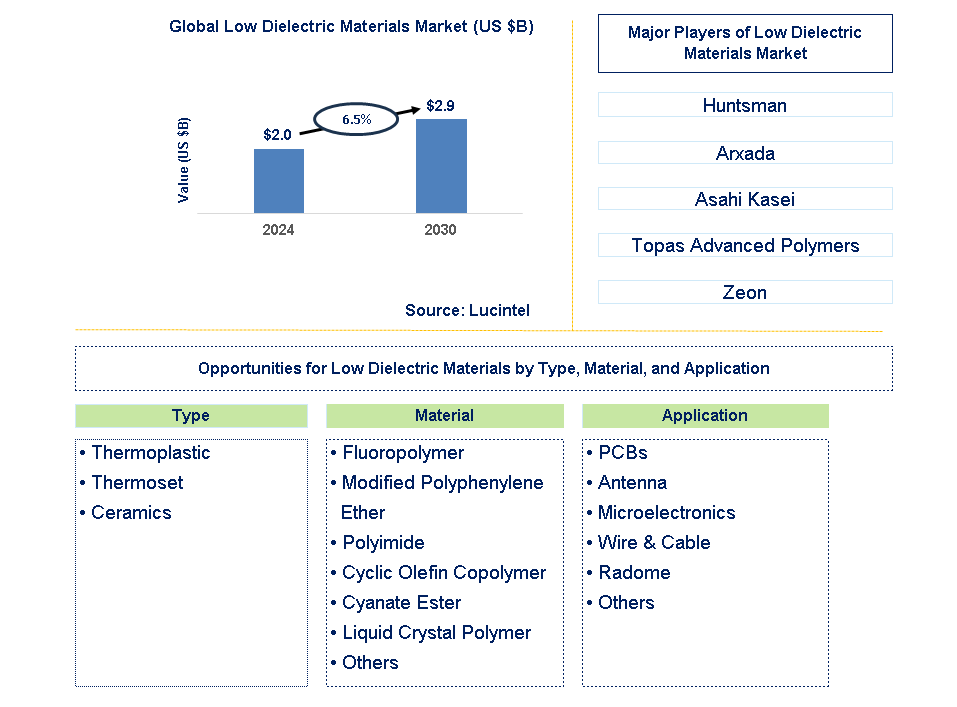
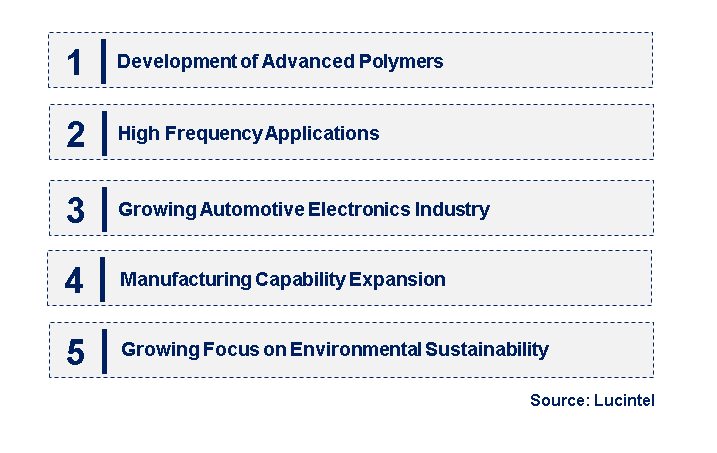
• Development of Advanced Polymers: Advances in chemical polymer are yielding low dielectric polymers with superior performance. The materials have lower signal loss, improved performance at high frequency, and will play a vital role in telecommunications and high-speed electronics.
• High Frequency Applications: There is a growing development of low dielectric materials for high-frequency applications such as the latest 5G technology and advanced semiconductor devices. Low dielectric constant materials are key to maintaining minimal signal loss, which in turn helps to improve the overall system performance.
• Growing Automotive Electronics Industry: Automotive electronics are increasingly finding applications in low dielectric materials for better performance and reliability. Demand growth for ADAS and autonomous vehicles is basically putting pressure on the development of those materials with harsh operating conditions and, at the same time, high performance.
• Manufacturing Capability Expansion: The low dielectric materials thus act as manufacturing capability extenders for higher production volumes and better scalability. According increase investment on meeting the production demand for the materials from all industrial sector through advance in the production techniques and also in the manufacturing infrastructure.
• Growing Focus on Environmental Sustainability: Besides, the development of low dielectric materials with ecological sustainability is an emerging trend. With this, companies seek and work toward such materials that are conducive to being friendly to the environment while sustaining high performance and reliability. These trends in innovation, expansion of applications, and sustainability drive the Low Dielectric Materials market. Emphasis on advanced materials, high-frequency applications, and environmental considerations shows the direction of further growth and evolution in this sector.
• Introduction of High-Performance Polymers: It represents part of the new development of high-performance polymers with low dielectric constant, improved thermal stability, allowing better signal integrity, and minimum power loss which can be experienced in electronic devices and telecommunication systems.
• Ceramic Material Advances: Recent innovations in ceramic low dielectric materials are targeted at dielectric performance improvement and reliability. Improved ceramics find applications in high-frequency applications and automotive electronics where precision and durability are of essence.
• Ramping of Manufacturing Facilities: Manufacturing of low dielectric materials is presenting increasing demand to manufacturers. Additional manufacturing plants and upgraded facilities enable higher production volumes along with more efficient processes to support broader availability and better economics.
• Eco-Friendly Materials Development: There is a growing emphasis in the development of environment-friendly low dielectric materials. Innovation in green materials and their processing methods lessens environmental impact but with high performance, in line with the global trend towards greener technologies.
• More Investment in R&D: The increased investment in research and development propels the growth of low dielectric materials forward. Companies and research institutions are working on finding new materials, perfecting the existing technologies, and broadening their areas of use. Thus, innovation and growth have been established in the market. These developments are driving the Low Dielectric Materials market by improving material functionalities, increasing production output, and facilitating sustainability. In short, such continuous innovations and venture investments set up the stage for future growth and technological advancements in the sector.
• Telecommunication Infrastructure: The world of telecommunication infrastructure poses great scope for growth. With growing demands and necessities, the networks should need to be upgraded; hence, 5G technologies will be developed. Low dielectric material shows better signal integrity and high data transmission rates; hence, will play a vital role in communication systems of the next generation.
• Consumer Electronics: These materials have great scope in the consumer electronics market for smartphone, tablet, and wearable applications. Innovation in material properties improves performances that allow device miniaturization and better efficiency.
• Automotive Electronics: Low dielectric materials find a growing use in automotive electronics, especially for ADAS/autonomous vehicles. It is used to enhance the accuracy and reliability of sensors, thus making the automotive technologies even safer and more advanced.
• Industrial Sensors: In industrial applications, the use of low dielectric material enhances sensor performance in manufacturing and automation. Enhanced performance related to the accuracy and durability of sensors encourages further adoption for a variety of industrial applications.
• Medical Devices: The medical device industry is another sector that may offer opportunities for growth in low dielectric materials. Diagnostic and imaging equipment are just some of the areas where advancements in material characteristics promote high-level performance and precision, enabling medical outcomes and securing market opportunities. Growth prospects in telecommunication, consumer electronics, automotives, industrial sensors, and medical devices are propelling the market for Low Dielectric Materials. Harnessing the potential of such opportunities is imperative for the growth and sustenance of innovations in the sector.
• Huntsman
• Arxada
• Asahi Kasei
• Topas Advanced Polymers
• Zeon
• Chemours
• Arkema
• Mitsubishi
• Dow
• Showa Denko
• Thermoplastic
• Thermoset
• Ceramics
• Fluoropolymer
• Modified Polyphenylene Ether
• Polyimide
• Cyclic Olefin Copolymer
• Cyanate Ester
• Liquid Crystal Polymer
• Others
• PCBs
• Antenna
• Microelectronics
• Wire & Cable
• Radome
• Others
• North America
• Europe
• Asia Pacific
• The Rest of the World
• United States: In the U.S., recent years have seen new developments of low-dielectric materials focusing on performance improvement for high-speed electronics and telecommunications. Advantages have been realized in developing new polymer-based materials with superior dielectric performances and lower loss tangents. Further research investment and development continue to explore applications in 5G technology and advanced semiconductor devices, among others. US firms also focus on scalability in the production process to ensure that supply meets demand.
• China: with its current massive momentum in developing semiconductors and electronics manufacturing, has also shown great leaps in the field of low dielectric material development. It includes introducing new materials into high-frequency applications and furthering its domestic capacity. Support from the government for the technological development towards self-sufficiency in electronics has resulted in heavy investments in R&D and manufacturing infrastructure for low dielectric materials.
• Germany: The German market for low-dielectric materials places high demands on precision and quality. Within the past few years, for instance, a good number of advanced ceramic and polymer materials have been developed possessing improved dielectric properties. Currently, companies in Germany look at finding new uses in automotive electronics and industrial sensors to effectively apply the materials so that performance and reliability under harsh and extreme conditions can be improved. Joint work between academia and industry still provides the motive force in this sector.
• India: India is emerging as one of the substantial player for low dielectric materials, with recent developments could be witnessed about increasing local manufacturing capabilities and technology integration. Companies in India are putting money into the research to bring down the cost of materials which would contribute to meeting the demand of the growing electronics and telecommunication industries. Meanwhile, they are also slowly encouraging alliances with international technology providers to mature material science and production techniques.
• Japan: Japan continues to carry the torch as far as innovations regarding low dielectric materials are concerned. Recent changes in technological features of this nature have resulted in the establishment of high-performance materials in consumer electronics and telecommunications. Japanese companies are focusing on enhancing the dielectric constant and loss tangent of materials to support next-generation devices and high-speed communication systems. The market is also witnessing an increase in the integration of low dielectric materials in advanced manufacturing processes and electronic applications.


• Huntsman
• Arxada
• Asahi Kasei
• Topas Advanced Polymers
• Zeon
• Chemours
• Arkema
• Mitsubishi
• Dow
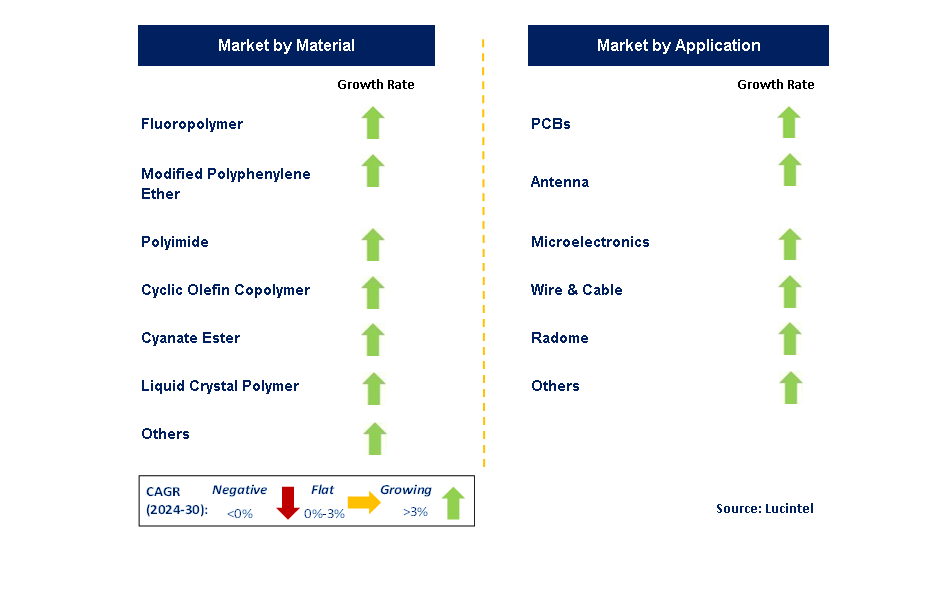
• Showa Denko Q6. Which low dielectric materials market segment will be the largest in future? Answer: Lucintel forecast that fluoropolymer is expected to witness highest growth over the forecast period because it proves to be an excellent material for manufacturing the component sowing to their low cost, excellent resistance to heat and low dielectric constants. Q7. In low dielectric materials market, which region is expected to be the largest in next 5 years? Answer: APAC is expected to witness highest growth over the forecast period due to growing need for the production of microelectronics and PCBs, two types of electronic components, as well as, the region's need for antennas has increased due to an increase in air traffic. Q.8 Do we receive customization in this report? Answer: Yes, Lucintel provides 10% customization without any additional cost.


Choose a license that fits your team. Instant PDF delivery.
Prices exclude taxes. Instant delivery. Custom licensing available on request.
Market Report · July 29, 2026
Market Report · July 15, 2026
Market Report · July 13, 2026
Trusted partner for strategic intelligence and business growth


Receive a complimentary market analysis tailored to your industry. Our analysts will identify key growth opportunities and competitive dynamics specific to your business.

Market size, growth rate, and key trend analysis for your specific sector.

Top competitor positioning and market share analysis.

Strategic recommendations backed by data-driven insights.
Get curated market intelligence and competitive moves straight to your inbox.
By subscribing, you agree to receive our monthly insights. Unsubscribe anytime.
Receive a complimentary market analysis tailored to your industry. Our analysts will identify key growth opportunities and competitive dynamics specific to your business.
Market size, growth rate, and key trend analysis for your specific sector.
Top competitor positioning and market share analysis.
Strategic recommendations backed by data-driven insights.
Get curated market intelligence, emerging trends, and competitive moves straight to your inbox each month.
By subscribing, you agree to receive our monthly insights. Unsubscribe anytime.
We'll send your sample report shortly.