
Report Feature
Long-Read Sequencing Market Trends and Forecast
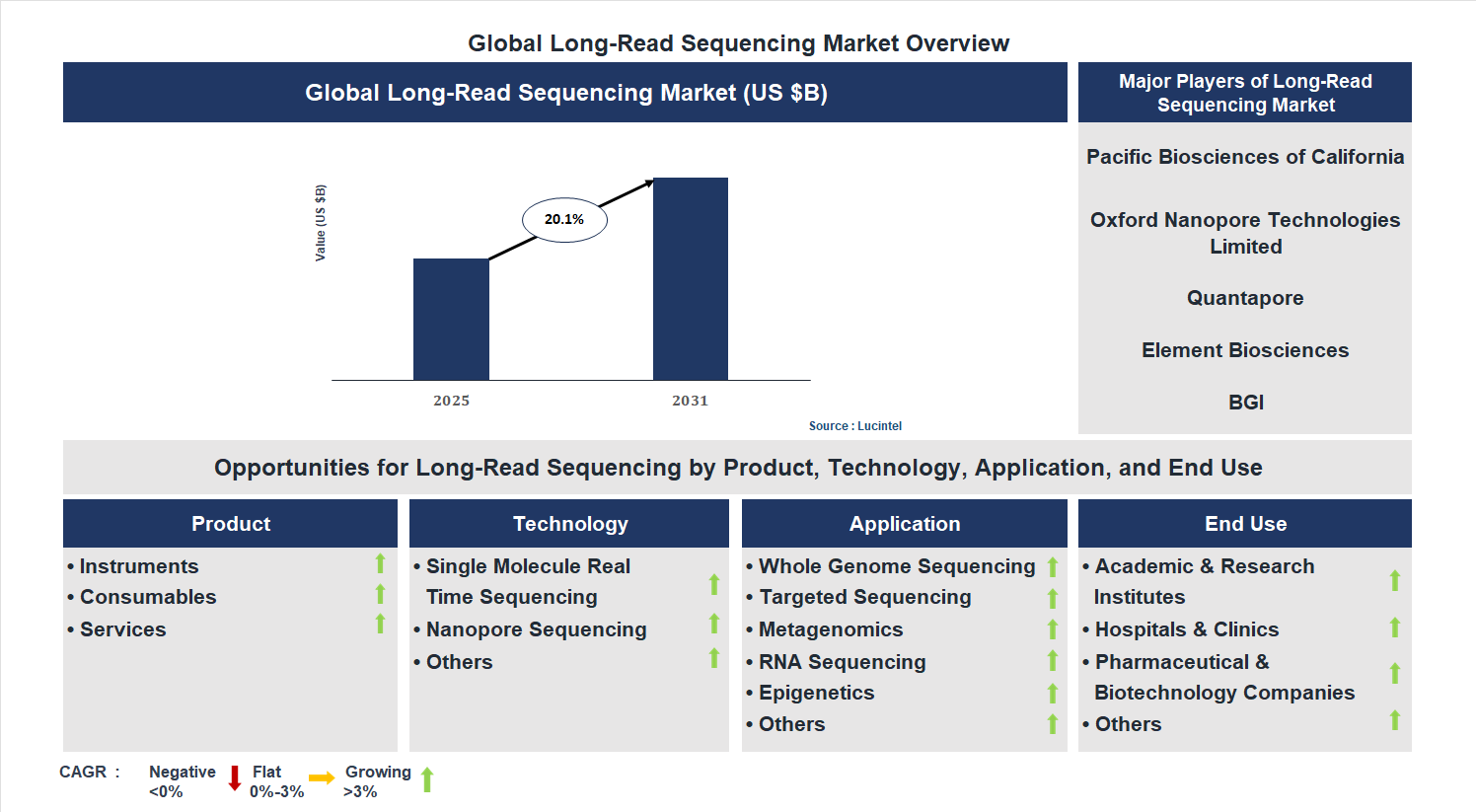
The future of the global long-read sequencing market looks promising with opportunities in the academic & research institute, hospital & clinic, and pharmaceutical & biotechnology company markets. The global long-read sequencing market is expected to grow with a CAGR of 20.1% from 2025 to 2031. The major drivers for this market are the increasing demand for high-accuracy genomic data, the rising adoption of long-read sequencing technologies, and the growing need for complex genome analysis solutions.• Lucintel forecasts that, within the product category, consumable is expected to witness the highest growth over the forecast period.
• Within the end use category, academic & research institute is expected to witness the highest growth.
• In terms of region, APAC is expected to witness the highest growth over the forecast period. Gain valuable insights for your business decisions with our comprehensive 150+ page report. Sample figures with some insights are shown below.
Emerging Trends in the Long-Read Sequencing Market
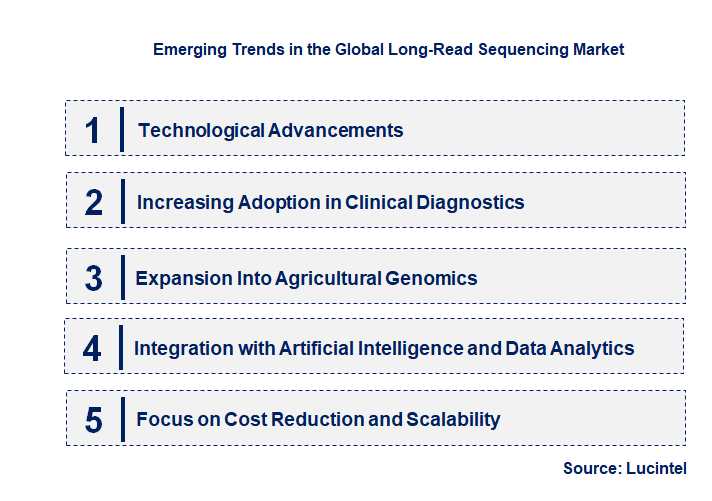
The long-read sequencing market is experiencing rapid growth driven by technological advancements, increasing demand for comprehensive genomic analysis, and expanding applications across healthcare, agriculture, and research. As sequencing technologies evolve, they are enabling more accurate, faster, and cost-effective solutions, which are transforming how scientists and clinicians approach genetic research and diagnostics. The markets trajectory is shaped by innovations that improve read lengths, accuracy, and data processing capabilities, making long-read sequencing more accessible and versatile. These developments are not only expanding existing applications but also opening new avenues for personalized medicine, agricultural improvements, and complex disease research, fundamentally reshaping the genomics landscape.• Technological Advancements: The development of new sequencing platforms with longer read lengths and higher accuracy is a key trend. Innovations such as nanopore and single-molecule real-time (SMRT) sequencing are enabling more detailed and comprehensive genome assemblies. These improvements reduce the need for complex data analysis and enable the detection of structural variants and epigenetic modifications more effectively. As technology continues to evolve, costs are decreasing, making long-read sequencing more accessible to a broader range of users, from research institutions to clinical laboratories.
• Increasing Adoption in Clinical Diagnostics: Long-read sequencing is increasingly being integrated into clinical settings for diagnosing genetic disorders, cancers, and infectious diseases. Its ability to detect structural variants, complex rearrangements, and epigenetic changes enhances diagnostic accuracy. This trend is driven by the need for more precise and comprehensive genetic information to guide personalized treatment plans. As regulatory approvals and clinical validation increase, the market for long-read sequencing in healthcare is expected to expand significantly, improving patient outcomes and enabling earlier, more accurate diagnoses.
• Expansion into Agricultural Genomics: The agricultural sector is adopting long-read sequencing to improve crop and livestock breeding programs. Its capacity to resolve complex genomes and identify structural variations helps in developing genetically superior strains with desirable traits such as disease resistance and higher yield. This trend is driven by the need for sustainable agriculture solutions amid climate change and food security concerns. The ability to generate high-quality genomic data accelerates breeding cycles and enhances genetic diversity, making long-read sequencing a vital tool in modern agriculture.
• Integration with Artificial Intelligence and Data Analytics: The combination of long-read sequencing data with advanced AI and machine learning algorithms is transforming data analysis. These technologies enable faster, more accurate interpretation of complex genomic information, identifying patterns and variants that might be missed otherwise. This integration enhances research capabilities, accelerates discovery, and improves clinical decision-making. As AI tools become more sophisticated, they will further streamline workflows, reduce analysis time, and increase the utility of long-read sequencing data across various applications.
• Focus on Cost Reduction and Scalability: Efforts to reduce the costs associated with long-read sequencing are a significant market trend. Innovations in reagent chemistry, automation, and data processing are making large-scale sequencing projects more feasible financially. Scalability solutions, such as high-throughput platforms, are enabling laboratories to process more samples simultaneously, increasing efficiency. Cost reduction and scalability are critical for widespread adoption, especially in resource-limited settings, and are expected to drive market growth by making long-read sequencing accessible to a broader user base. In summary, these emerging trends are collectively reshaping the long-read sequencing market by enhancing technological capabilities, expanding application areas, and improving affordability. This evolution is fostering a more comprehensive understanding of genomes, accelerating research, and enabling personalized medicine, ultimately transforming the landscape of genomics and molecular diagnostics.
Recent Development in the Long-Read Sequencing Market
The long-read sequencing market has experienced significant growth driven by technological advancements, increasing applications in genomics, and rising demand for precise genetic analysis. As researchers and healthcare providers seek more comprehensive genetic insights, innovations in sequencing technologies are transforming the landscape. These developments are enabling more accurate disease diagnosis, personalized medicine, and advanced research capabilities. The markets evolution reflects a shift towards more efficient, cost-effective, and high-throughput sequencing solutions. This dynamic environment is attracting investments and fostering collaborations across biotech and healthcare sectors, ultimately accelerating the adoption of long-read sequencing technologies worldwide.• Technological Advancements: New sequencing platforms with higher accuracy and longer read lengths are emerging, improving data quality and reducing costs. These innovations enable more detailed genome assemblies and structural variation detection, expanding research and clinical applications.
• Increased Adoption in Clinical Diagnostics: Long-read sequencing is increasingly used for diagnosing genetic disorders, cancer, and infectious diseases. Its ability to detect complex variants enhances diagnostic accuracy, leading to better patient outcomes and personalized treatment plans.
• Expansion in Agricultural Genomics: The technology is being adopted for crop and livestock improvement by identifying genetic traits linked to yield, disease resistance, and climate adaptability. This development supports sustainable agriculture and food security initiatives.
• Rising Investments and Collaborations: Major biotech firms and research institutions are investing heavily in long-read sequencing R&D. Strategic collaborations are fostering innovation, expanding product portfolios, and accelerating market penetration.
• Regulatory Approvals and Reimbursement Policies: Increasing regulatory approvals for clinical applications and evolving reimbursement frameworks are facilitating market growth. These policies are making long-read sequencing more accessible and affordable for healthcare providers. In summary, these developments are significantly impacting the long-read sequencing market by enhancing technological capabilities, broadening application areas, attracting investments, and improving regulatory support. Consequently, the market is poised for rapid growth, with long-read sequencing becoming integral to genomics research, clinical diagnostics, and agricultural innovation.
Strategic Growth Opportunities in the Long-Read Sequencing Market
The long-read sequencing market is experiencing rapid growth driven by technological advancements and increasing demand across various industries. As the need for more accurate and comprehensive genetic analysis rises, key applications are emerging as significant growth drivers. These applications are transforming research, diagnostics, and personalized medicine, creating new opportunities for market expansion. Companies are investing heavily in innovation to capitalize on these trends, making the market highly dynamic. Understanding these growth opportunities is essential for stakeholders aiming to leverage the full potential of long-read sequencing technologies and stay competitive in this evolving landscape.• Genomics Research: Enhanced accuracy and longer read lengths improve genome assembly and structural variation detection, accelerating discoveries in fundamental research and enabling more detailed genetic insights.
• Clinical Diagnostics: Increased precision in identifying genetic mutations supports early diagnosis and personalized treatment plans, improving patient outcomes and reducing healthcare costs.
• Agricultural Biotechnology: Long-read sequencing enables detailed plant and animal genome analysis, leading to the development of resilient crops and improved livestock breeds, boosting food security.
• Rare Disease Identification: The ability to detect complex genetic variations facilitates diagnosis of rare and inherited diseases, providing critical insights for targeted therapies and patient management.
• Pharmacogenomics: Better understanding of genetic factors influencing drug response enhances personalized medicine approaches, optimizing drug efficacy and minimizing adverse effects. These growth opportunities are significantly impacting the market by expanding its applications, increasing adoption rates, and fostering innovation. As these key areas develop, the market is poised for substantial growth, driven by the demand for more precise, comprehensive genetic information. This evolution is also encouraging collaborations between biotech firms, healthcare providers, and research institutions, further propelling market expansion and technological advancements.
Long-Read Sequencing Market Driver and Challenges
The long-read sequencing market is influenced by a variety of technological, economic, and regulatory factors that shape its growth trajectory. Advances in sequencing technology have significantly improved accuracy and read lengths, enabling more comprehensive genomic analysis. Economic factors such as decreasing costs of sequencing and increasing funding for genomic research further propel market expansion. Regulatory frameworks and approvals also play a crucial role in facilitating market entry and adoption. However, challenges such as high costs, technical limitations, and regulatory hurdles can impede growth. Understanding these drivers and challenges is essential for stakeholders to navigate the evolving landscape effectively and capitalize on emerging opportunities. The factors responsible for driving the long-read sequencing market include:-• Technological Advancements: The continuous development of more accurate, faster, and cost-effective long-read sequencing technologies has expanded the scope of genomic research. Innovations like nanopore and single-molecule real-time (SMRT) sequencing enable detailed analysis of complex genomic regions, structural variations, and epigenetic modifications. These technological improvements have increased adoption across research, clinical, and agricultural sectors, fostering market growth. As technology evolves, it reduces barriers related to data quality and throughput, making long-read sequencing more accessible and practical for diverse applications.
• Increasing Funding and Investment: Growing investments from government agencies, private organizations, and biotech companies are fueling the market. Funding initiatives aimed at personalized medicine, rare disease research, and agricultural genomics have accelerated the development and deployment of long-read sequencing platforms. This influx of capital supports research and development activities, infrastructure expansion, and commercialization efforts, thereby expanding market reach. The trend indicates a strong future pipeline of innovations and increased adoption across various sectors.
• Rising Applications in Clinical Diagnostics: The expanding use of long-read sequencing in clinical diagnostics is a major driver. Its ability to detect structural variants, complex mutations, and epigenetic changes with high accuracy makes it invaluable for diagnosing genetic disorders, cancers, and infectious diseases. As regulatory approvals increase and clinical validation studies demonstrate reliability, healthcare providers are more inclined to adopt these technologies. This growth in clinical applications is expected to significantly boost market revenues and establish long-read sequencing as a standard diagnostic tool.
• Growing Demand for Personalized Medicine: The shift towards personalized medicine is a key factor driving market growth. Long-read sequencing provides comprehensive genomic data essential for tailoring treatments to individual genetic profiles. This capability enhances disease diagnosis, prognosis, and therapy selection, especially in oncology and rare genetic disorders. As healthcare systems worldwide emphasize precision medicine, demand for advanced sequencing solutions like long-read platforms is expected to rise, further expanding the market. The challenges facing this long-read sequencing market include:-
• High Cost of Sequencing Platforms and Operations: Despite technological advancements, long-read sequencing remains expensive compared to short-read alternatives. The high costs associated with equipment, reagents, and data analysis limit accessibility, especially for smaller research institutions and developing regions. This financial barrier hampers widespread adoption and slows market growth. Additionally, operational costs related to data storage and computational requirements further contribute to the overall expense, making cost reduction a critical challenge for market expansion.
• Technical Limitations and Data Accuracy: Although improvements have been made, long-read sequencing still faces issues related to error rates and data accuracy. Errors in base calling and difficulties in sequencing highly repetitive or GC-rich regions can compromise data quality. These technical limitations restrict the reliability of results, particularly in clinical settings where precision is paramount. Overcoming these challenges requires ongoing innovation and validation, which can delay adoption and increase costs.
• Regulatory and Ethical Challenges: The evolving regulatory landscape presents hurdles for market growth. Gaining approval for clinical applications involves rigorous validation and compliance with standards, which can be time-consuming and costly. Ethical concerns related to data privacy, consent, and potential misuse of genomic information also pose challenges. Navigating these regulatory and ethical issues is essential for market players to ensure compliance and build trust, but it can slow down product development and deployment. In summary, the long-read sequencing market is driven by technological innovations, increased funding, expanding clinical applications, and the rise of personalized medicine. However, high costs, technical limitations, and regulatory challenges pose significant hurdles. These factors collectively influence the pace and scope of market growth. While opportunities for innovation and expansion are substantial, addressing the challenges is crucial for sustainable development. Overall, the market is poised for growth, provided stakeholders effectively navigate the complex landscape of technological, economic, and regulatory factors.
List of Long-Read Sequencing Companies
Companies in the market compete on the basis of product quality offered. Major players in this market focus on expanding their manufacturing facilities, R&D investments, infrastructural development, and leverage integration opportunities across the value chain. With these strategies long-read sequencing companies cater increasing demand, ensure competitive effectiveness, develop innovative products & technologies, reduce production costs, and expand their customer base. Some of the long-read sequencing companies profiled in this report include-• Pacific Biosciences of California
• Oxford Nanopore Technologies Limited
• Quantapore
• Element Biosciences
• BGI
• Eurofins Genomics
• F. Hoffmann-La Roche
• Microbes
• Takara Bio
• New England Biolabs
Long-Read Sequencing Market by Segment
The study includes a forecast for the global long-read sequencing market by product, technology, application, end use, and region.Long-Read Sequencing Market by Product [Value from 2019 to 2031]:
• Instruments
• Consumables
• Services
Long-Read Sequencing Market by Technology [Value from 2019 to 2031]:
• Single Molecule Real Time Sequencing
• Nanopore Sequencing
• Others
Long-Read Sequencing Market by Application [Value from 2019 to 2031]:
• Whole Genome Sequencing
• Targeted Sequencing
• Metagenomics
• RNA Sequencing
• Epigenetics
• Others
Long-Read Sequencing Market by End Use [Value from 2019 to 2031]:
• Academic & Research Institutes
• Hospitals & Clinics
• Pharmaceutical & Biotechnology Companies
• Others
Long-Read Sequencing Market by Region [Value from 2019 to 2031]:
• North America
• Europe
• Asia Pacific
• The Rest of the World
Country Wise Outlook for the Long-Read Sequencing Market
The long-read sequencing market has experienced significant growth driven by technological advancements, increasing applications in genomics, and expanding research funding. As the demand for more accurate and comprehensive genetic analysis rises, countries are investing heavily in developing and adopting long-read sequencing technologies. These developments are shaping the future of personalized medicine, agricultural biotechnology, and disease research. Each country’s strategic initiatives reflect their focus on innovation, healthcare, and scientific research, contributing to the global expansion of this market. Below is a summary of recent developments in the United States, China, Germany, India, and Japan.• United States: The US continues to lead in long-read sequencing innovation with major investments from biotech firms and government agencies like NIH. Recent advancements include the launch of new high-throughput platforms and increased adoption in clinical diagnostics and personalized medicine. Collaborations between academia and industry are accelerating research, and regulatory frameworks are evolving to support clinical applications.
• China: China has made substantial progress by expanding its genomic research infrastructure and increasing funding for biotech startups focused on long-read sequencing. The country is developing cost-effective sequencing solutions and establishing large-scale projects for agricultural and medical research. Government policies aim to boost domestic innovation and reduce reliance on foreign technology.
• Germany: Germany is emphasizing the integration of long-read sequencing into healthcare and research institutions. Recent developments include the deployment of advanced sequencing platforms in hospitals and research centers, along with initiatives to improve data analysis and storage capabilities. The country is also fostering collaborations between academia and industry to enhance technological capabilities.
• India: India is witnessing rapid growth in the adoption of long-read sequencing for disease research and agricultural genomics. Government programs and private investments are supporting the development of affordable sequencing solutions. Efforts are underway to build local expertise and infrastructure, aiming to make sequencing technologies accessible across the country.
• Japan: Japan is focusing on precision medicine and aging research through long-read sequencing technologies. Recent advancements include the integration of sequencing data into clinical workflows and the development of novel bioinformatics tools. The government is promoting innovation through funding initiatives and partnerships with global biotech firms to strengthen its position in the market.

Features of the Global Long-Read Sequencing Market
Market Size Estimates: Long-read sequencing market size estimation in terms of value ($B). Trend and Forecast Analysis: Market trends (2019 to 2024) and forecast (2025 to 2031) by various segments and regions. Segmentation Analysis: Long-read sequencing market size by various segments, such as by product, technology, application, end use, and region in terms of value ($B). Regional Analysis: Long-read sequencing market breakdown by North America, Europe, Asia Pacific, and Rest of the World. Growth Opportunities: Analysis of growth opportunities in different products, technologies, applications, end uses, and regions for the long-read sequencing market. Strategic Analysis: This includes M&A, new product development, and competitive landscape of the long-read sequencing market. Analysis of competitive intensity of the industry based on Porter’s Five Forces model.
FAQ
Q1. What is the growth forecast for long-read sequencing market? Answer: The global long-read sequencing market is expected to grow with a CAGR of 20.1% from 2025 to 2031. Q2. What are the major drivers influencing the growth of the long-read sequencing market? Answer: The major drivers for this market are the increasing demand for high-accuracy genomic data, the rising adoption of long-read sequencing technologies, and the growing need for complex genome analysis solutions. Q3. What are the major segments for long-read sequencing market? Answer: The future of the long-read sequencing market looks promising with opportunities in the academic & research institute, hospital & clinic, and pharmaceutical & biotechnology company markets. Q4. Who are the key long-read sequencing market companies? Answer: Some of the key long-read sequencing companies are as follows:• Pacific Biosciences of California
• Oxford Nanopore Technologies Limited
• Quantapore
• Element Biosciences
• BGI
• Eurofins Genomics
• F. Hoffmann-La Roche
• Microbes
• Takara Bio
• New England Biolabs Q5. Which long-read sequencing market segment will be the largest in future? Answer: Lucintel forecasts that, within the product category, consumable is expected to witness the highest growth over the forecast period. Q6. In long-read sequencing market, which region is expected to be the largest in next 5 years? Answer: In terms of region, APAC is expected to witness the highest growth over the forecast period. Q7. Do we receive customization in this report? Answer: Yes, Lucintel provides 10% customization without any additional cost.
Table of Contents
List of Figures
List of Tables
Methodology
- In-depth interviews of the major players in this market
- Detailed secondary research from competitors’ financial statements and published data
- Extensive searches of published works, market, and database information pertaining to industry news, company press releases, and customer intentions
- A compilation of the experiences, judgments, and insights of Lucintel’s professionals, who have analyzed and tracked this market over the years.


Buy Now
Choose a license that fits your team. Instant PDF delivery.
Prices exclude taxes. Instant delivery. Custom licensing available on request.
Key Questions
- • What are some of the most promising, high-growth opportunities for the long-read sequencing market by product (instruments, consumables, and services), technology (single molecule real time sequencing, nanopore sequencing, and others), application (whole genome sequencing, targeted sequencing, metagenomics, RNA sequencing, epigenetics, and others), end use (academic & research institutes, hospitals & clinics, pharmaceutical & biotechnology companies, and others), and region (North America, Europe, Asia Pacific, and the Rest of the World)?
- • Which segments will grow at a faster pace and why?
- • Which region will grow at a faster pace and why?
- • What are the key factors affecting market dynamics? What are the key challenges and business risks in this market?
- • What are the business risks and competitive threats in this market?
- • What are the emerging trends in this market and the reasons behind them?
- • What are some of the changing demands of customers in the market?
- • What are the new developments in the market? Which companies are leading these developments?
- • Who are the major players in this market? What strategic initiatives are key players pursuing for business growth?
- • What are some of the competing products in this market and how big of a threat do they pose for loss of market share by material or product substitution?
- • What M&A activity has occurred in the last 5 years and what has its impact been on the industry? For any questions related to Long-Read Sequencing Market, Long-Read Sequencing Market Size, Long-Read Sequencing Market Growth, Long-Read Sequencing Market Analysis, Long-Read Sequencing Market Report, Long-Read Sequencing Market Share, Long-Read Sequencing Market Trends, Long-Read Sequencing Market Forecast, Long-Read Sequencing Companies, write Lucintel analyst at email: helpdesk@lucintel.com. We will be glad to get back to you soon.


