
Market Report · July 22, 2026

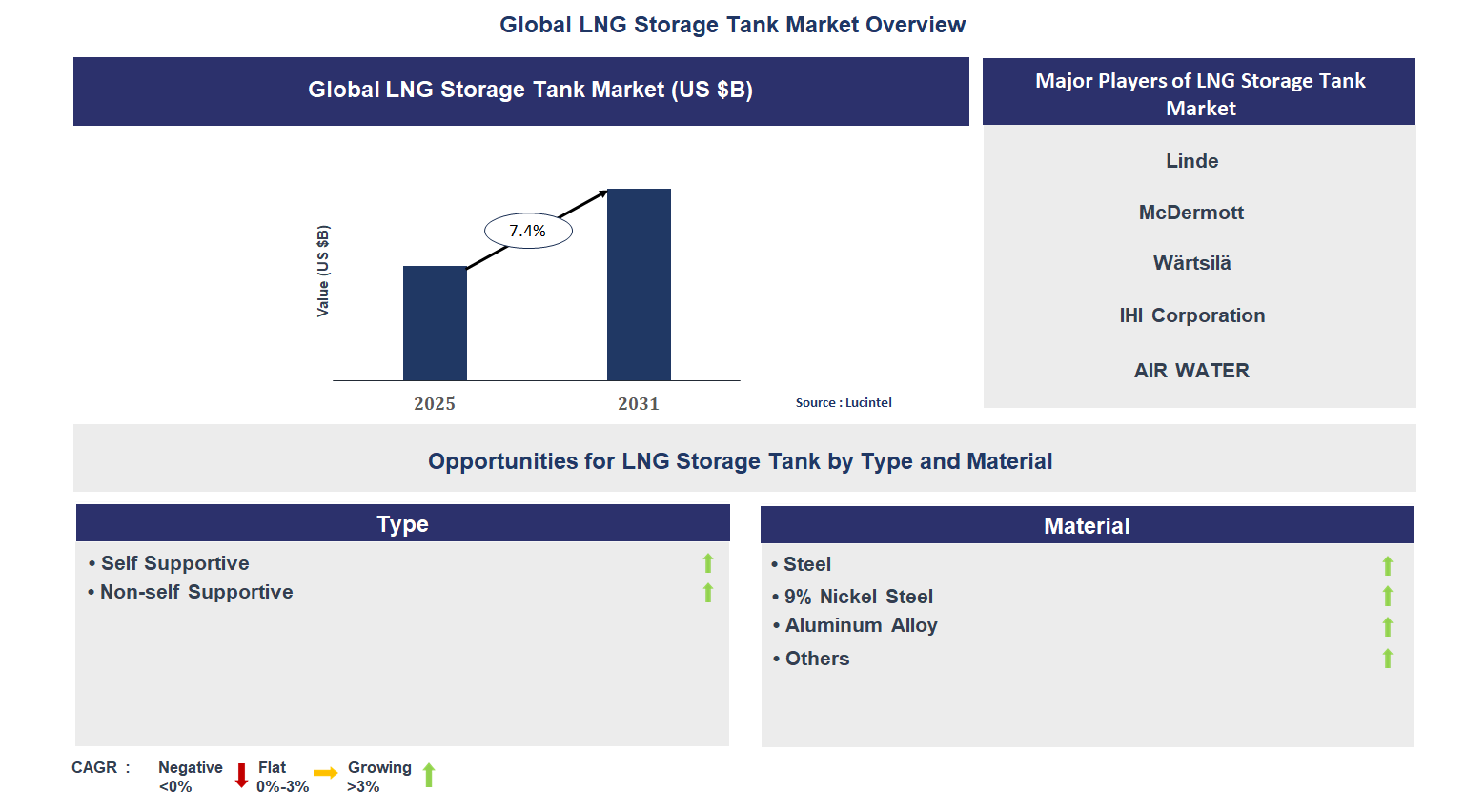
Key data points: The growth forecast = 7.4% annually for the next 7 years. Scroll below to get more insights. This market report covers trends, opportunities and forecasts in LNG storage tank market to 2031 by type (self supportive and non-self supportive), material (steel, 9% nickel steel , aluminum alloy, and others), and region (North America, Europe, Asia Pacific, and the Rest of the World)
We'll send your sample report shortly.
• Lucintel forecasts that, within the type category, self supportive is expected to witness higher growth over the forecast period.
• Within the material category, steel is expected to witness the highest growth.
• In terms of region, APAC is expected to witness the highest growth over the forecast period. Gain valuable insights for your business decisions with our comprehensive 150+ page report. Sample figures with some insights are shown below.
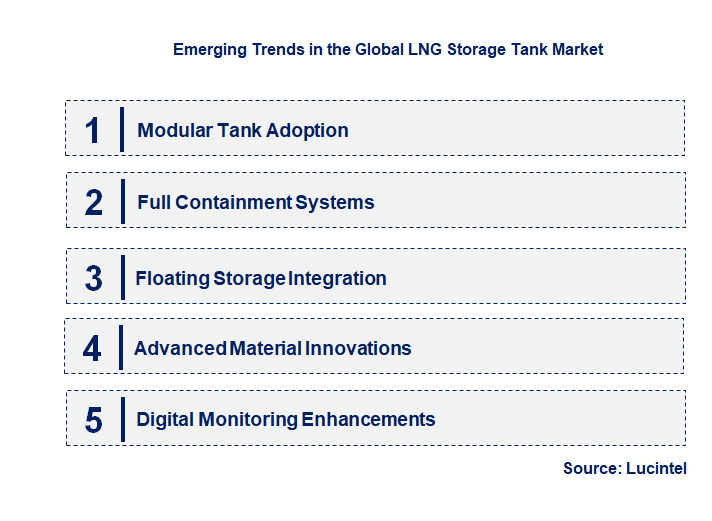
• Modular Tank Adoption: Prefabricated units enable quick deployments in remote sites, reducing construction timelines. Versatile for small-scale ops, they lower costs via scalability. Impact includes faster market entry, minimized downtime, and expanded access in emerging regions for equitable energy distribution.
• Full Containment Systems: Double-walled designs enhance safety against leaks in high-risk zones. Preferred for large terminals, they meet stringent codes. This trend cuts environmental risks, boosts investor confidence, and supports larger capacities for stable supply chains.
• Floating Storage Integration: FSRUs offer flexible regasification without fixed infrastructure. Ideal for coastal imports, they adapt to demand fluctuations. Impact accelerates deployments, enhances security in import-heavy nations, and enables hybrid uses like bunkering.
• Advanced Material Innovations: Nickel steels and composites improve cryogenic durability, slashing boil-off rates. Lighter alloys aid offshore apps. This drives efficiency, reduces operational losses, and aligns with emission goals through durable, low-maintenance solutions.
• Digital Monitoring Enhancements: IoT sensors enable real-time integrity checks, predictive maintenance. AI optimizes boil-off management. Impact elevates safety, cuts failures, and informs scaling, fostering smarter grids for sustainable LNG handling. These trends reshape the LNG storage tank market by prioritizing agility, safety, and green tech. They unlock diverse applications, mitigate risks, and drive inclusive growth, cementing LNG‘s role in resilient energy transitions.
• Binhai Terminal Completion: CNOOC finishes six large tanks, enhancing China‘s import hub with superior insulation. This sets benchmarks for efficiency in high-volume storage. Impact bolsters regional security, cuts transit losses, and stimulates local manufacturing ecosystems.
• Dahej Expansion Initiative: India‘s key facility adds tanks for regasification surges, supporting industrial demands. Modular integrations speed rollout. This expands access, fuels economic hubs, and promotes cleaner transport via pilot integrations.
• Hibiki Third Tank Build: Japan‘s upgrade ensures reserve stability against disruptions. Seismic designs prioritize durability. Impact strengthens import reliability, aids recovery efforts, and diversifies energy mixes for long-term resilience.
• Wilhelmshaven FSRU Launch: Germany‘s floating unit diversifies supplies with adaptable containment. It enables quick scaling. This reduces fossil dependencies, aligns with EU goals, and creates multi-fuel pathways for future-proofing.
• CB&I Oman Contract: Full-containment tank EPC for Sohar port advances Middle East exports. Advanced concrete boosts integrity. Impact heightens trade volumes, optimizes logistics, and fosters cross-border energy collaborations. These developments impact the LNG storage tank market by scaling capacities, enhancing safety, and bridging supply needs. They catalyze investments, innovation, and sustainability, fortifying global chains for equitable energy access.
• Power Generation Facilities: Baseload plants demand robust tanks for steady supplies, integrating with grids. Subsidies spur retrofits. Impact scales renewables hybrids, cuts outages, and supports peak shaving for reliable, low-emission energy.
• Industrial Process Integration: Steel and chemical sectors require on-site storage for heat-intensive ops. Custom containment fits harsh environments. This boosts productivity, reduces transport emissions, and enables localized clean fuel adoption.
• Marine Bunkering Hubs: Port terminals need compact tanks for ship refueling, complying with IMO norms. Floating options enhance reach. Impact grows blue corridors, lowers maritime carbon, and stimulates trade via efficient logistics.
• Transportation Fuel Stations: Heavy-duty vehicles and buses drive small-scale tanks for urban fleets. Pilot programs accelerate uptake. This cuts urban pollution, fosters EV-LNG blends, and expands retail networks for mobility transitions.
• Export Terminal Expansions: Gulf and Asian hubs seek large-scale storage for liquefaction ramps. EPC partnerships speed builds. Impact heightens global trade, optimizes cargoes, and positions regions as supply leaders. These opportunities impact the LNG storage tank market by diversifying uses and embedding adaptability. They spur collaborations, tech uptake, and investments, propelling resilient, low-carbon infrastructure worldwide.
• Linde
• McDermott
• Wärtsilä
• IHI Corporation
• AIR WATER
• CIMC Enric Holdings Limited
• Chart Industries
• ISISAN
• Cryolor
• Inox India Limited
• Self Supportive
• Non-self Supportive
• Steel
• 9% Nickel Steel
• Aluminum Alloy
• Others
• North America
• Europe
• Asia Pacific
• The Rest of the World
• United States: Gulf Coast export terminals drive demand through shale gas booms and new projects like Golden Pass and Plaquemines LNG. Refinery integrations bolster onshore storage, while floating units address flexibility needs. These efforts solidify U.S. leadership in exports, optimizing logistics and fostering domestic energy resilience.
• China: CNOOC‘s Binhai terminal completion marks the largest domestic storage base, featuring multiple high-capacity tanks for import surges. Shale expansions and offshore tie-ins amplify needs, with local manufacturing cutting costs. This enhances energy security, scales consumption, and positions China as Asia‘s import powerhouse.
• Germany: Wilhelmshaven and Brunsbüttel terminals integrate LNG for diversification, with designs adaptable to future hydrogen. EU policies spur FSRU deployments for rapid regasification. These initiatives cut coal reliance, ensure winter supplies, and align with green transitions via multi-fuel compatibility.
• India: Dahej terminal expansions add storage and regasification units to meet rising imports. Pilot LNG bus programs highlight transport applications, while subsidies boost infrastructure. This supports industrial growth, reduces urban pollution, and accelerates clean fuel adoption nationwide.
• Japan: Hibiki terminal‘s third tank addition bolsters reserves amid import dependencies. IHI‘s EPC wins for regional projects emphasize seismic resilience. These advancements secure supply chains, aid disaster recovery, and integrate LNG into hybrid energy systems for stability.


• Linde
• McDermott
• Wärtsilä
• IHI Corporation
• AIR WATER
• CIMC Enric Holdings Limited
• Chart Industries
• ISISAN
• Cryolor
• Inox India Limited Q5. Which LNG storage tank market segment will be the largest in future? Answer: Lucintel forecasts that, within the type category, self supportive is expected to witness higher growth over the forecast period. Q6. In LNG storage tank market, which region is expected to be the largest in next 5 years? Answer: In terms of region, APAC is expected to witness the highest growth over the forecast period. Q7. Do we receive customization in this report? Answer: Yes, Lucintel provides 10% customization without any additional cost.


Choose a license that fits your team. Instant PDF delivery.
Prices exclude taxes. Instant delivery. Custom licensing available on request.
Market Report · July 22, 2026
Market Report · July 22, 2026
Market Report · July 17, 2026
Trusted partner for strategic intelligence and business growth


Receive a complimentary market analysis tailored to your industry. Our analysts will identify key growth opportunities and competitive dynamics specific to your business.

Market size, growth rate, and key trend analysis for your specific sector.

Top competitor positioning and market share analysis.

Strategic recommendations backed by data-driven insights.
Get curated market intelligence and competitive moves straight to your inbox.
By subscribing, you agree to receive our monthly insights. Unsubscribe anytime.
Receive a complimentary market analysis tailored to your industry. Our analysts will identify key growth opportunities and competitive dynamics specific to your business.
Market size, growth rate, and key trend analysis for your specific sector.
Top competitor positioning and market share analysis.
Strategic recommendations backed by data-driven insights.
Get curated market intelligence, emerging trends, and competitive moves straight to your inbox each month.
By subscribing, you agree to receive our monthly insights. Unsubscribe anytime.
We'll send your sample report shortly.