
Report Feature
LEO PNT Market Trends and Forecast
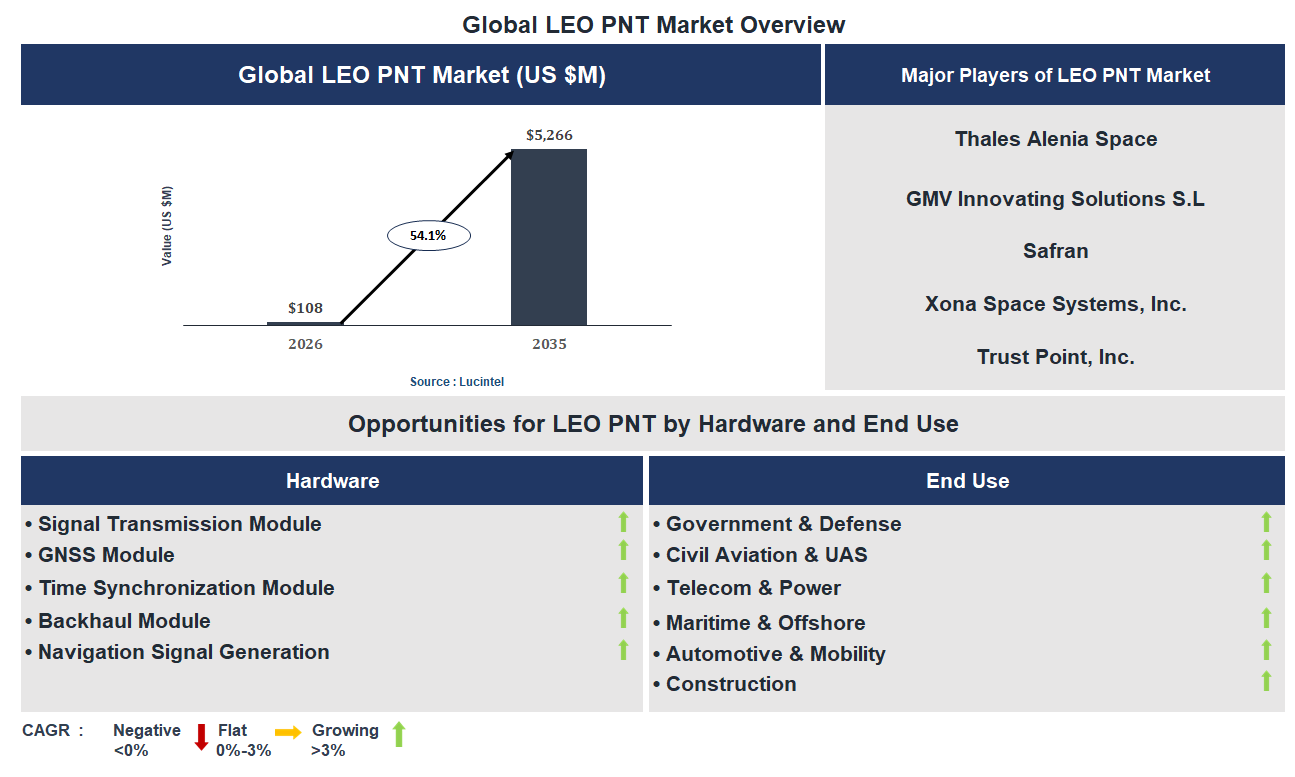
The future of the global LEO PNT market looks promising with opportunities in the government & defense, civil aviation & UAS, telecom & power, maritime & offshore, automotive & mobility, and construction markets. The global LEO PNT market is expected to reach an estimated $5,266 million by 2035 with a CAGR of 54.1% from 2026 to 2035. The major drivers for this market are the increasing demand for precise navigation services, the rising deployment of LEO satellite constellations, and the growing need for resilient positioning solutions.• Lucintel forecasts that, within the hardware category, signal transmission module is expected to witness the highest growth over the forecast period.
• Within the end use category, government & defense is expected to witness the highest growth.
• In terms of region, North America is expected to witness the highest growth over the forecast period. Gain valuable insights for your business decisions with our comprehensive 150+ page report. Sample figures with some insights are shown below.
Emerging Trends in the LEO PNT Market
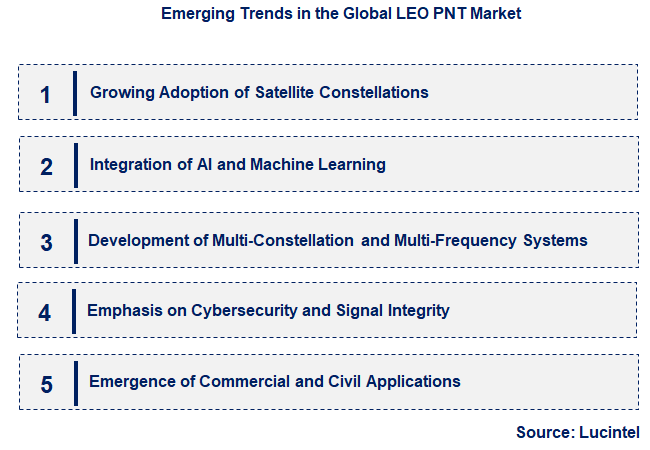
The LEO PNT market is experiencing rapid growth driven by technological advancements, increasing demand for precise location data, and the proliferation of connected devices. As satellite constellations expand and new applications emerge, the market is evolving to meet diverse needs across industries such as telecommunications, defense, and autonomous systems. These developments are transforming how positioning and timing services are delivered, making them more accurate, reliable, and accessible worldwide. The following key trends highlight the major shifts shaping the future of the LEO PNT market and its broader implications.• Growing Adoption of Satellite Constellations: Expansion of LEO satellite networks is enhancing global coverage and reducing latency. Companies like SpaceX and OneWeb are deploying large constellations to provide high-precision PNT services, especially in remote or underserved areas. This trend improves service reliability, supports real-time applications, and fosters new business models in navigation, IoT, and emergency response sectors.
• Integration of AI and Machine Learning: AI-driven algorithms are increasingly used to process vast amounts of satellite data for improved accuracy and resilience. Machine learning models help in anomaly detection, signal correction, and predictive maintenance, thereby enhancing system robustness. This integration enables more adaptive and intelligent PNT solutions, crucial for autonomous vehicles, military operations, and critical infrastructure.
• Development of Multi-Constellation and Multi-Frequency Systems: Combining signals from various satellite systems (GPS, GLONASS, Galileo, BeiDou) and multiple frequency bands improves positioning accuracy and signal integrity. This multi-constellation approach reduces vulnerabilities to jamming and spoofing, ensuring more secure and dependable PNT services, especially in challenging environments like urban canyons or dense forests.
• Emphasis on Cybersecurity and Signal Integrity: As reliance on PNT services increases, protecting these systems from cyber threats becomes paramount. Advanced encryption, authentication protocols, and anti-spoofing measures are being integrated to safeguard data integrity. Strengthening cybersecurity ensures the reliability of critical applications such as defense, aviation, and financial transactions, fostering trust in LEO PNT solutions.
• Emergence of Commercial and Civil Applications: Beyond traditional military uses, commercial sectors are adopting LEO PNT for logistics, agriculture, and consumer navigation. The affordability and scalability of LEO-based services are democratizing access to high-precision positioning, enabling innovative applications like drone delivery, precision farming, and augmented reality. This diversification broadens market opportunities and accelerates technological innovation. These trends are collectively reshaping the LEO PNT market by enhancing coverage, accuracy, security, and accessibility. They are driving a shift toward more resilient, intelligent, and versatile positioning solutions that support a wide array of industries and applications, ultimately transforming how location-based services are delivered and utilized worldwide.
Recent Development in the LEO PNT Market
The LEO PNT market is experiencing rapid growth driven by technological advancements and increasing demand for precise location services. As satellite constellations expand and integration with existing systems improves, the market is poised for significant transformation. These developments are opening new opportunities across various sectors, including telecommunications, defense, and commercial applications. The evolving landscape underscores the importance of innovation and strategic investments to capitalize on emerging trends and maintain competitive advantage.• Growing Satellite Constellations: Expansion of LEO satellite networks enhances global coverage and accuracy, enabling real-time, high-precision positioning services. This growth improves navigation in remote areas, supports autonomous vehicles, and boosts military capabilities. The increased satellite count reduces latency and enhances system resilience, making LEO PNT solutions more reliable and accessible worldwide. As satellite deployment accelerates, the market will see increased competition and innovation, driving down costs and expanding application scope.
• Integration with 5G Networks: The convergence of LEO PNT with 5G infrastructure offers significant benefits, including improved network synchronization and enhanced location-based services. This integration supports the development of smart cities, IoT devices, and autonomous systems by providing precise timing and positioning data. It also enables seamless connectivity and real-time data exchange, fostering new business models. The synergy between LEO PNT and 5G is expected to accelerate digital transformation and create new revenue streams for telecom providers and technology firms.
• Advancements in Signal Technology: Innovations in signal processing and transmission improve the accuracy, robustness, and security of PNT services. Enhanced algorithms and encryption techniques protect against jamming and spoofing, ensuring reliable operation in critical applications. These technological improvements enable LEO PNT to serve sectors like defense, aviation, and maritime with higher precision and security. As signal technology advances, the market will benefit from increased trust, wider adoption, and the ability to support complex, mission-critical operations.
• Regulatory and Standardization Developments: Establishing global standards and regulatory frameworks facilitates interoperability and market growth. Governments and industry bodies are working to create policies that support satellite deployment, spectrum allocation, and data sharing. Clear regulations reduce barriers to entry and foster innovation, attracting investments and encouraging collaboration among stakeholders. These developments ensure a cohesive ecosystem, promote fair competition, and accelerate the deployment of LEO PNT solutions across various sectors.
• Commercialization and New Business Models: The commercialization of LEO PNT services opens avenues for innovative business models, including subscription-based, pay-per-use, and integrated service offerings. Companies are developing tailored solutions for sectors like agriculture, logistics, and consumer electronics. This diversification enhances revenue streams and broadens market reach. As commercialization progresses, the market will see increased competition, lower prices, and expanded access, driving widespread adoption and supporting economic growth. These recent developments are significantly transforming the LEO PNT market by enhancing coverage, accuracy, and security. Integration with emerging technologies like 5G and advancements in signal processing are expanding application possibilities across industries. Regulatory progress and innovative business models are fostering a more competitive and accessible environment. Collectively, these trends are driving market growth, encouraging investment, and positioning LEO PNT as a critical enabler for future digital and connected ecosystems.
Strategic Growth Opportunities in the LEO PNT Market
The LEO PNT market is experiencing rapid growth driven by increasing demand for precise location services, advancements in satellite technology, and expanding applications across various industries. As satellite constellations become more sophisticated and accessible, opportunities for enhanced accuracy, reliability, and global coverage are emerging. This evolving landscape presents significant potential for market players to innovate, collaborate, and capture new revenue streams, ultimately transforming how positioning and timing services are delivered worldwide.• Expanding Global Coverage Through Satellite Constellations: Deploying larger, more comprehensive LEO satellite networks can provide near-instantaneous, high-precision positioning services globally. This expansion addresses coverage gaps in remote and underserved regions, enabling industries like agriculture, maritime, and disaster management to benefit from reliable PNT data. Increased satellite deployment also enhances system resilience against signal disruptions, ensuring continuous service in critical applications.
• Integration of AI and Machine Learning for Enhanced Accuracy: Incorporating AI and machine learning algorithms into LEO PNT systems can significantly improve positioning accuracy, signal processing, and error correction. These technologies enable real-time data analysis, anomaly detection, and adaptive signal management, which are crucial for autonomous vehicles, drones, and precision agriculture. As AI integration advances, the market will see smarter, more reliable PNT solutions that meet the growing demand for precision.
• Development of Multi-Constellation and Interoperable Systems: Creating interoperable systems that combine LEO, MEO, and GEO satellite signals offers enhanced robustness and accuracy. Multi-constellation approaches reduce dependency on a single satellite network, improve signal availability, and mitigate interference issues. This integration supports diverse applications, from military to commercial, and fosters a more resilient PNT infrastructure capable of serving complex, multi-layered operational needs.
• Growing Demand for Secure and Anti-Jamming PNT Solutions: As reliance on satellite-based PNT increases, so does vulnerability to jamming, spoofing, and cyber threats. Developing secure, anti-jamming, and anti-spoofing technologies is critical for safeguarding critical infrastructure, defense, and financial systems. Market opportunities lie in advanced encryption, signal authentication, and resilient system architectures that ensure uninterrupted, trustworthy positioning and timing data.
• Increasing Adoption of Commercial and Consumer Applications: The proliferation of smartphones, autonomous vehicles, and IoT devices drives demand for affordable, high-precision PNT services. Commercial applications such as navigation, asset tracking, and location-based services are expanding rapidly. Market players are focusing on miniaturization, cost reduction, and user-friendly interfaces to capture this growing consumer segment, fueling overall market growth and innovation. The overall impact of these opportunities will accelerate the evolution of the LEO PNT market, fostering technological innovation, expanding application scope, and enhancing service reliability. This growth will enable new business models, improve existing services, and support the development of a more connected, precise, and resilient global positioning ecosystem.
LEO PNT Market Driver and Challenges
The LEO PNT market is influenced by a variety of technological, economic, and regulatory factors. Rapid advancements in satellite technology, increasing demand for precise positioning services across industries, and supportive government policies are key drivers. However, the market also faces challenges such as high deployment costs, regulatory complexities, and concerns over space debris. These factors collectively shape the growth trajectory of the LEO PNT market, impacting stakeholders from satellite manufacturers to end-users. Understanding these drivers and challenges is essential for strategic planning and sustainable development in this dynamic sector. The factors responsible for driving the LEO PNT market include:• Technological Advancements: The continuous evolution of satellite technology, miniaturization, and improved signal accuracy are propelling the market forward. Innovations such as inter-satellite communication and AI integration enhance system reliability and performance, making LEO PNT solutions more attractive for applications like autonomous vehicles, military, and commercial navigation. These advancements reduce costs and improve service quality, encouraging widespread adoption and fostering a competitive environment that accelerates market growth.
• Growing Demand for Precise Navigation: The increasing need for high-accuracy positioning in sectors such as transportation, agriculture, and defense is a significant driver. Industries are shifting towards real-time, reliable location data to optimize operations, improve safety, and enable new services like drone delivery and autonomous vehicles. The limitations of traditional GNSS systems in urban canyons and remote areas further boost the demand for LEO-based PNT solutions, which offer enhanced accuracy and resilience.
• Rising Investment and Strategic Collaborations: Governments, private companies, and international organizations are investing heavily in LEO PNT infrastructure. Strategic partnerships and collaborations facilitate technology sharing, reduce costs, and accelerate deployment. Funding initiatives and public-private partnerships are fostering innovation and expanding market reach, especially in emerging economies, thus fueling overall market growth.
• Regulatory Support and Policy Frameworks: Favorable regulatory environments and policies promoting satellite deployment and space-based services are crucial drivers. Governments are establishing guidelines for spectrum allocation, orbital slots, and space traffic management, which streamline operations and reduce legal uncertainties. Such supportive frameworks encourage investment and innovation, ensuring the markets sustainable expansion. The challenges facing the LEO PNT market include:
• High Deployment and Maintenance Costs: Establishing and maintaining a constellation of LEO satellites require substantial capital investment. Launch costs, satellite manufacturing, and ongoing maintenance pose financial barriers, especially for smaller players. These expenses can limit market entry and slow down the pace of deployment, impacting the overall growth potential of the sector.
• Regulatory and Spectrum Management Complexities: Navigating the complex regulatory landscape across different countries presents significant hurdles. Issues related to spectrum allocation, orbital slot rights, and space traffic management can delay deployment and increase costs. Inconsistent policies and international coordination challenges hinder seamless operation and expansion of LEO PNT services.
• Space Debris and Sustainability Concerns: The proliferation of LEO satellites raises environmental concerns, particularly space debris accumulation. Collisions and debris can threaten satellite operations and pose risks to other space assets. Addressing these sustainability issues requires robust space traffic management and debris mitigation strategies, which are still evolving and can impede rapid deployment and scaling of LEO PNT systems. The LEO PNT market is driven by technological innovations, increasing demand for precise navigation, strategic investments, and supportive policies. However, high costs, regulatory complexities, and environmental concerns pose significant challenges. These factors collectively influence the markets growth trajectory, requiring stakeholders to navigate a complex landscape of opportunities and risks. Successful market development will depend on technological progress, regulatory harmonization, and sustainable practices, ensuring long-term viability and innovation in the LEO PNT sector.
List of LEO PNT Companies
Companies in the market compete on the basis of product quality offered. Major players in this market focus on expanding their manufacturing facilities, R&D investments, infrastructural development, and leverage integration opportunities across the value chain. With these strategies LEO PNT companies cater increasing demand, ensure competitive effectiveness, develop innovative products & technologies, reduce production costs, and expand their customer base. Some of the LEO PNT companies profiled in this report include-• Thales Alenia Space
• GMV Innovating Solutions S.L
• Safran
• Xona Space Systems, Inc.
• Trust Point, Inc.
• Airbus
• Boeing
• ESA
• Iridium
• Lockheed Martin
LEO PNT Market by Segment
The study includes a forecast for the global LEO PNT market by hardware, end use, and region.LEO PNT Market by Hardware [Value from 2019 to 2035]:
• Signal Transmission Module
• GNSS Module
• Time Synchronization Module
• Backhaul Module
• Navigation Signal Generation
LEO PNT Market by End Use [Value from 2019 to 2035]:
• Government & Defense
• Civil Aviation & UAS
• Telecom & Power
• Maritime & Offshore
• Automotive & Mobility
• Construction
LEO PNT Market by Region [Value from 2019 to 2035]:
• North America
• Europe
• Asia Pacific
• The Rest of the World
Country Wise Outlook for the LEO PNT Market
The LEO PNT market is experiencing rapid growth driven by technological advancements, increased demand for precise location services, and expanding applications across various sectors. As satellite constellations become more sophisticated and accessible, countries are investing heavily to enhance their capabilities and secure strategic advantages. The United States, China, Germany, India, and Japan are at the forefront of these developments, each focusing on unique strategies to strengthen their LEO PNT infrastructure and services. These efforts are shaping the future landscape of global navigation and positioning systems, fostering innovation and competition.• United States: The US has made significant progress in expanding its LEO PNT capabilities through initiatives like the Space Development Agencys efforts to deploy resilient satellite networks. The integration of commercial satellite constellations with government systems is a key focus, aiming to improve accuracy and security. The US also continues to innovate with advanced algorithms and ground infrastructure to support military and civilian applications, ensuring leadership in global navigation technology.
• China: China has rapidly advanced its LEO PNT market by deploying multiple satellite constellations, such as the BeiDou systems expansion into LEO. The country emphasizes autonomous navigation solutions and integration with its broader satellite network. Chinese firms are also developing innovative applications for transportation, agriculture, and urban planning, leveraging LEO PNT for enhanced precision and reliability. Strategic investments aim to reduce dependence on foreign systems and bolster national security.
• Germany: Germany is focusing on integrating LEO PNT services within its existing satellite infrastructure, emphasizing interoperability and security. The country is investing in research collaborations with European partners to develop resilient and precise navigation solutions. German companies are also exploring applications in autonomous vehicles, maritime navigation, and environmental monitoring, aiming to position Europe as a key player in the evolving LEO PNT ecosystem.
• India: India has accelerated its LEO PNT development with the launch of regional satellite constellations aimed at improving navigation accuracy across South Asia. The Indian Space Research Organization (ISRO) is working on integrating LEO satellites with existing systems like Navi to enhance coverage and reliability. The government is promoting the use of LEO PNT in sectors such as agriculture, defense, and disaster management, seeking self-reliance and strategic independence.
• Japan: Japan is investing in advanced LEO satellite technologies to complement its existing Quasi-Zenith Satellite System (QZSS). The focus is on improving positioning accuracy in urban and challenging environments. Japanese agencies are also exploring applications in disaster response, transportation, and smart city initiatives. Collaborations with international partners aim to develop resilient and innovative LEO PNT solutions, reinforcing Japans position in global space technology.

Features of the Global LEO PNT Market
Market Size Estimates: LEO PNT market size estimation in terms of value ($M). Trend and Forecast Analysis: Market trends (2019 to 2025) and forecast (2026 to 2035) by various segments and regions. Segmentation Analysis: LEO PNT market size by hardware, end use, and region in terms of value ($M). Regional Analysis: LEO PNT market breakdown by North America, Europe, Asia Pacific, and Rest of the World. Growth Opportunities: Analysis of growth opportunities in different hardware, end uses, and regions for the LEO PNT market. Strategic Analysis: This includes M&A, new product development, and competitive landscape of the LEO PNT market. Analysis of competitive intensity of the industry based on Porter’s Five Forces model.
FAQ
Q1. What is the LEO PNT market size? Answer: The global LEO PNT market is expected to reach an estimated $5,266 million by 2035. Q2. What is the growth forecast for LEO PNT market? Answer: The global LEO PNT market is expected to grow with a CAGR of 54.1% from 2026 to 2035. Q3. What are the major drivers influencing the growth of the LEO PNT market? Answer: The major drivers for this market are the increasing demand for precise navigation services, the rising deployment of leo satellite constellations, and the growing need for resilient positioning solutions. Q4. What are the major segments for LEO PNT market? Answer: The future of the LEO PNT market looks promising with opportunities in the government & defense, civil aviation & UAS, telecom & power, maritime & offshore, automotive & mobility, and construction markets. Q5. Who are the key LEO PNT market companies? Answer: Some of the key LEO PNT companies are as follows:• Thales Alenia Space
• GMV Innovating Solutions S.L
• Safran
• Xona Space Systems, Inc.
• Trust Point, Inc.
• Airbus
• Boeing
• ESA
• Iridium
• Lockheed Martin Q6. Which LEO PNT market segment will be the largest in future? Answer: Lucintel forecasts that, within the hardware category, signal transmission module is expected to witness the highest growth over the forecast period. Q7. In LEO PNT market, which region is expected to be the largest in next 8 years? Answer: In terms of region, North America is expected to witness the highest growth over the forecast period. Q8. Do we receive customization in this report? Answer: Yes, Lucintel provides 10% customization without any additional cost.
Table of Contents
List of Figures
List of Tables
Methodology
- In-depth interviews of the major players in this market
- Detailed secondary research from competitors’ financial statements and published data
- Extensive searches of published works, market, and database information pertaining to industry news, company press releases, and customer intentions
- A compilation of the experiences, judgments, and insights of Lucintel’s professionals, who have analyzed and tracked this market over the years.


Buy Now
Choose a license that fits your team. Instant PDF delivery.
Prices exclude taxes. Instant delivery. Custom licensing available on request.
Key Questions
- • What are some of the most promising, high-growth opportunities for the LEO PNT market by hardware (signal transmission module, GNSS module, time synchronization module, backhaul module, and navigation signal generation), end use (government & defense, civil aviation & UAS, telecom & power, maritime & offshore, automotive & mobility, and construction), and region (North America, Europe, Asia Pacific, and the Rest of the World)?
- • Which segments will grow at a faster pace and why?
- • Which region will grow at a faster pace and why?
- • What are the key factors affecting market dynamics? What are the key challenges and business risks in this market?
- • What are the business risks and competitive threats in this market?
- • What are the emerging trends in this market and the reasons behind them?
- • What are some of the changing demands of customers in the market?
- • What are the new developments in the market? Which companies are leading these developments?
- • Who are the major players in this market? What strategic initiatives are key players pursuing for business growth?
- • What are some of the competing products in this market and how big of a threat do they pose for loss of market share by material or product substitution?
- • What M&A activity has occurred in the last 5 years and what has its impact been on the industry? For any questions related to LEO PNT Market, LEO PNT Market Size, LEO PNT Market Growth, LEO PNT Market Analysis, LEO PNT Market Report, LEO PNT Market Share, LEO PNT Market Trends, LEO PNT Market Forecast, LEO PNT Companies, write Lucintel analyst at email: helpdesk@lucintel.com. We will be glad to get back to you soon.


