
Report Feature
LED Lighting Supply Market Trends and Forecast
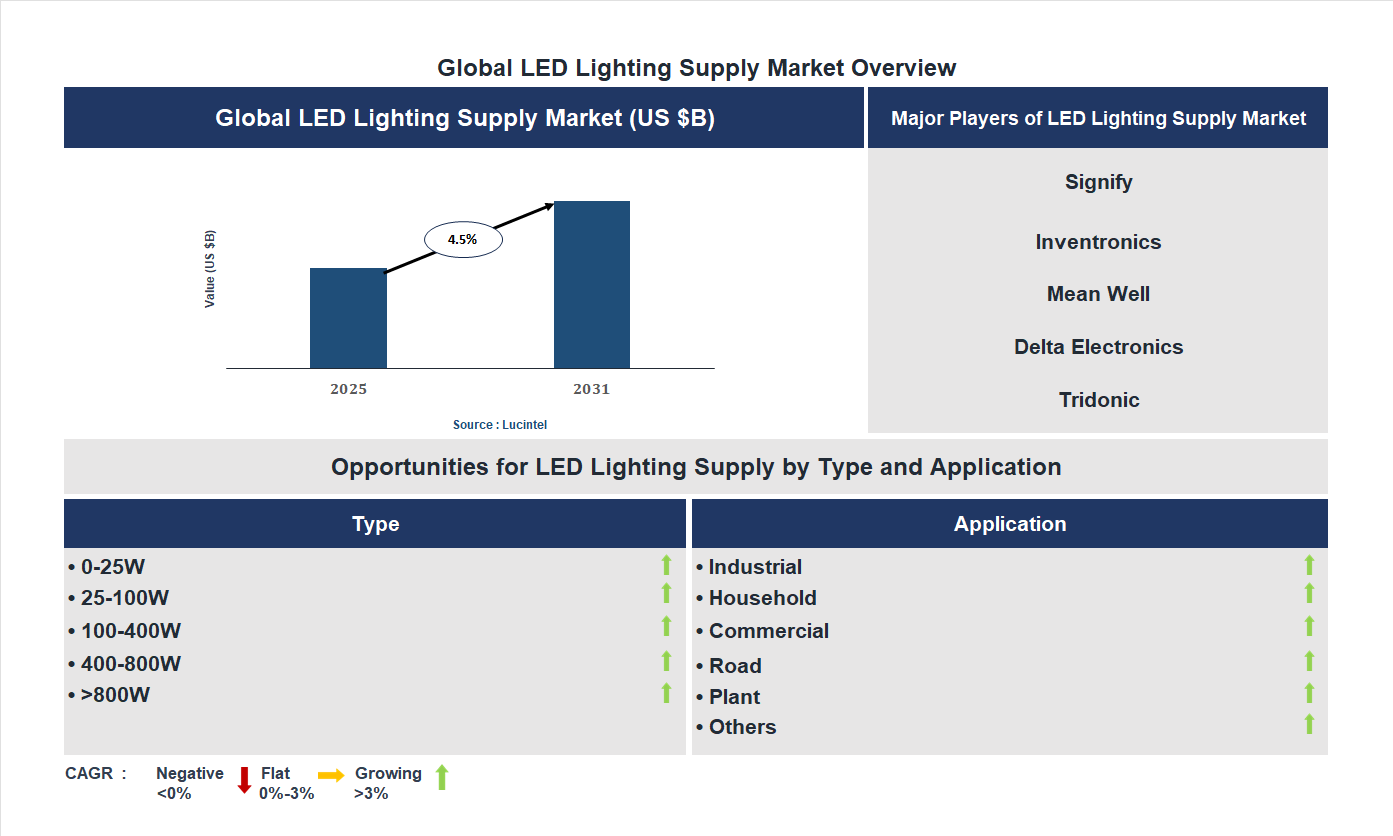
The future of the global LED lighting supply market looks promising with opportunities in the industrial, household, commercial, road, and plant markets. The global LED lighting supply market is expected to grow with a CAGR of 4.5% from 2025 to 2031. The major drivers for this market are the increasing adoption of energy efficient lighting, the rising replacement of traditional lighting systems, and the growing demand for smart lighting solutions.• Lucintel forecasts that, within the type category, 100-400W is expected to witness the highest growth over the forecast period.
• Within the application category, commercial is expected to witness the highest growth.
• In terms of region, APAC is expected to witness the highest growth over the forecast period. Gain valuable insights for your business decisions with our comprehensive 150+ page report. Sample figures with some insights are shown below.
Emerging Trends in the LED Lighting Supply Market
The LED lighting supply market is experiencing rapid transformation driven by technological advancements, shifting consumer preferences, and increasing environmental concerns. As the demand for energy-efficient, sustainable, and cost-effective lighting solutions grows, manufacturers are innovating to meet these needs. The market is also influenced by regulatory changes, urbanization, and the integration of smart technology. These factors are collectively shaping a dynamic landscape where innovation and sustainability are paramount. Understanding the emerging trends is crucial for stakeholders to capitalize on opportunities and navigate challenges effectively. The following five key trends highlight the current trajectory of the LED lighting supply market.• Adoption of Smart LED Lighting: The integration of IoT technology into LED lighting systems is revolutionizing the market. Smart LEDs enable remote control, automation, and customization through mobile apps and voice commands, enhancing user convenience and energy management. This trend is driven by the rise of smart homes and buildings, where intelligent lighting systems contribute to energy savings and improved user experience. Manufacturers are investing in developing connected lighting solutions that can be integrated with other smart devices, creating a seamless and efficient ecosystem. The impact is a shift towards more sophisticated, user-centric lighting options that offer greater control and efficiency.
• Focus on Energy Efficiency and Sustainability: Increasing environmental awareness and stricter regulations are pushing the market towards more energy-efficient LED solutions. Innovations in phosphor technology, heat dissipation, and luminaire design are improving LED performance while reducing power consumption. Additionally, eco-friendly manufacturing processes and recyclable materials are gaining prominence. This trend not only helps reduce carbon footprints but also aligns with corporate social responsibility goals. As a result, consumers and businesses are more inclined to adopt sustainable lighting options, driving demand for high-efficiency LEDs and supporting global sustainability initiatives.
• Miniaturization and Design Flexibility: Advances in LED chip technology and manufacturing processes are enabling smaller, more versatile lighting products. This miniaturization allows for innovative design applications, including embedded lighting, flexible strips, and decorative fixtures. The trend enhances aesthetic appeal and functional versatility, catering to diverse architectural and interior design needs. It also facilitates integration into compact spaces and complex structures, expanding market opportunities. The impact is a broader adoption of LED lighting in various sectors, from retail to healthcare, where customized and unobtrusive lighting solutions are increasingly valued.
• Growing Demand for Commercial and Industrial Applications: The commercial and industrial sectors are experiencing heightened demand for LED lighting due to its durability, energy savings, and low maintenance. Warehouses, factories, offices, and retail outlets are adopting LED solutions to improve operational efficiency and reduce costs. Innovations such as high-bay LEDs and intelligent lighting controls are tailored to large-scale applications. This trend is driven by corporate sustainability commitments and the need for reliable, high-performance lighting. The market expansion in these sectors is significant, contributing to overall growth and encouraging manufacturers to develop specialized products for large-scale use.
• Price Reduction and Market Penetration: As manufacturing technologies advance and economies of scale are achieved, the cost of LED components continues to decline. This price reduction makes LED lighting more accessible to a broader consumer base, including residential markets and small businesses. Increased competition among manufacturers further drives down prices, fostering wider adoption. The trend accelerates market penetration, especially in developing regions where cost is a critical factor. The impact is a democratization of LED lighting, leading to increased global adoption, enhanced energy efficiency, and a shift away from traditional lighting sources. In summary, these emerging trends are fundamentally reshaping the LED lighting supply market by fostering innovation, enhancing sustainability, and expanding market reach. The integration of smart technology, focus on eco-friendly solutions, design flexibility, sector-specific applications, and decreasing costs are collectively driving growth and transforming how lighting solutions are developed, marketed, and utilized worldwide.

Recent Development in the LED Lighting Supply Market
The LED lighting supply market has experienced rapid growth driven by technological advancements, increasing environmental awareness, and government initiatives promoting energy efficiency. As consumers and industries shift towards sustainable solutions, the market landscape is evolving with new innovations, expanding applications, and competitive dynamics. Recent developments reflect a focus on improving product performance, reducing costs, and expanding market reach. These changes are shaping the future of LED lighting, making it more accessible, efficient, and environmentally friendly. Stakeholders must stay informed about these trends to capitalize on emerging opportunities and navigate challenges effectively.• Technological Innovations: Advancements in LED chip efficiency and design have significantly improved lighting performance, durability, and energy savings. These innovations enable manufacturers to produce more versatile and high-quality products, expanding applications in commercial, residential, and industrial sectors. The enhanced performance also reduces maintenance costs and extends product lifespan, boosting consumer confidence and adoption rates.
• Cost Reduction Strategies: Manufacturers are adopting new manufacturing techniques and sourcing cheaper materials, leading to a decline in LED lighting costs. This reduction makes LED products more competitive against traditional lighting options, increasing market penetration across price-sensitive segments. Lower costs also encourage retrofitting projects and new installations, further driving market growth.
• Expansion of Smart Lighting Solutions: Integration of LED lighting with IoT and smart home systems has gained momentum. Smart LED products offer remote control, automation, and energy management features, appealing to tech-savvy consumers and commercial users. This development enhances user experience, promotes energy efficiency, and opens new revenue streams for suppliers.
• Regulatory and Policy Support: Governments worldwide are implementing policies and incentives to promote energy-efficient lighting solutions. These include subsidies, tax benefits, and stricter efficiency standards, which accelerate market adoption. Regulatory support not only boosts demand but also encourages innovation and standardization within the industry.
• Growing Market for Specialty Applications: The demand for LED lighting in specialized sectors such as horticulture, UV sterilization, and automotive lighting is increasing. These niche markets require tailored solutions, prompting manufacturers to develop customized products. The expansion into specialty applications diversifies revenue sources and stimulates further technological development. In summary, recent developments in the LED lighting supply market—spanning technological innovations, cost reductions, smart solutions, regulatory support, and niche applications—are collectively driving robust growth. These trends are making LED lighting more efficient, affordable, and versatile, thereby expanding its market reach and solidifying its role as a sustainable lighting solution for diverse sectors.
Strategic Growth Opportunities in the LED Lighting Supply Market
The LED lighting supply market is experiencing rapid expansion driven by technological advancements, increasing energy efficiency standards, and growing environmental awareness. As industries and consumers shift towards sustainable solutions, the demand for innovative LED lighting products continues to rise across various applications. Key growth opportunities are emerging in sectors such as commercial, residential, industrial, outdoor, and automotive lighting. These opportunities are shaping the future landscape of the market, offering significant potential for manufacturers and stakeholders to capitalize on. Understanding these growth avenues is essential for strategic planning and investment in this dynamic industry.• Commercial Lighting: Enhanced energy efficiency and smart lighting integration are driving growth. Businesses seek cost-effective, sustainable solutions, leading to increased adoption of LED fixtures in offices, retail, and hospitality sectors. This shift reduces operational costs and supports corporate sustainability goals, boosting market demand.
• Residential Lighting: Rising consumer awareness and affordability of LED products are fueling residential adoption. Smart home integration and aesthetic appeal further enhance growth, making LED lighting a preferred choice for homeowners seeking energy savings and modern design.
• Industrial Applications: The need for durable, high-performance lighting in manufacturing and warehousing is expanding. LED solutions offer longevity and low maintenance, improving safety and operational efficiency, which propels market growth in industrial sectors.
• Outdoor and Street Lighting: Governments and municipalities are transitioning to LED street lighting to reduce energy consumption and maintenance costs. This shift supports urban sustainability initiatives and enhances public safety, creating substantial growth opportunities.
• Automotive Lighting: The automotive industry is adopting LED lighting for headlights, interior, and signal lights due to their durability, brightness, and design flexibility. This trend enhances vehicle aesthetics and safety, contributing significantly to market expansion. In summary, these growth opportunities across key applications are significantly impacting the LED lighting supply market by driving innovation, reducing costs, and promoting sustainability. As demand continues to rise, stakeholders are positioned to benefit from increased market share and technological advancements, shaping a more efficient and eco-friendly lighting future.
LED Lighting Supply Market Driver and Challenges
The LED lighting supply market is influenced by a variety of technological, economic, and regulatory factors that shape its growth trajectory. Rapid advancements in LED technology, increasing environmental awareness, and supportive government policies are key drivers propelling market expansion. Conversely, challenges such as high initial costs, technological limitations, and regulatory uncertainties pose hurdles to sustained growth. Understanding these drivers and challenges is essential for stakeholders to navigate the evolving landscape effectively and capitalize on emerging opportunities. The factors responsible for driving the LED lighting supply market include:-• Technological Innovation: The continuous development of energy-efficient LED technologies has significantly enhanced product performance, lifespan, and cost-effectiveness. Innovations such as smart LED systems and integration with IoT have expanded application possibilities across commercial, residential, and industrial sectors. These advancements attract consumers and businesses seeking sustainable lighting solutions, thereby fueling market growth. Moreover, decreasing manufacturing costs due to technological improvements make LED lighting more accessible, further boosting adoption rates globally.
• Environmental Regulations and Policies: Governments worldwide are implementing strict environmental standards and policies aimed at reducing carbon emissions and promoting energy efficiency. Incentives, subsidies, and mandates for the adoption of LED lighting in public infrastructure, commercial buildings, and residential areas have accelerated market demand. These regulatory frameworks not only encourage manufacturers to innovate but also compel consumers and organizations to transition from traditional lighting sources to LEDs, creating a favorable environment for market expansion.
• Rising Urbanization and Infrastructure Development: Rapid urbanization and infrastructure projects across emerging and developed economies are driving the demand for energy-efficient lighting solutions. LED lighting is preferred for street lighting, commercial complexes, and residential developments due to its durability and low maintenance. As urban areas expand, the need for sustainable and cost-effective lighting solutions increases, contributing significantly to market growth. Additionally, the shift towards smart cities further amplifies the demand for integrated LED lighting systems.
• Growing Awareness of Energy Conservation: Increasing awareness about energy conservation and environmental sustainability among consumers and businesses is a major driver. LED lighting consumes significantly less energy compared to traditional incandescent and fluorescent lights, leading to reduced utility bills and carbon footprint. Educational campaigns and corporate social responsibility initiatives have enhanced consumer preferences for eco-friendly lighting options, thereby expanding the market. This trend is expected to continue as environmental concerns become more prominent globally.
• Cost Reduction and Technological Maturity: The declining costs of LED components and manufacturing processes have made LED lighting more affordable for a broad consumer base. As the technology matures, economies of scale and improved supply chains further reduce prices, making LED products competitive with traditional lighting options. This cost advantage encourages widespread adoption across various sectors, including residential, commercial, and industrial, thus driving market growth. Additionally, the availability of a wide range of LED products caters to diverse customer needs, supporting market expansion. The challenges facing this LED Lighting Supply Market include:-
• High Initial Investment Costs: Despite decreasing prices, the upfront costs of LED lighting systems remain relatively high compared to traditional lighting options. This can deter small and medium-sized enterprises or residential consumers from transitioning to LED solutions, especially in regions with limited financial resources. The cost barrier slows down the adoption rate and hampers market penetration in price-sensitive markets, requiring manufacturers and policymakers to develop financing options or incentives to overcome this challenge.
• Technological Limitations and Compatibility Issues: Although LED technology has advanced considerably, certain limitations persist, such as color rendering issues, heat management, and compatibility with existing electrical systems. These technical challenges can affect product performance and reliability, leading to consumer hesitation. Additionally, integrating LED lighting with smart systems requires compatibility with various protocols and standards, which can complicate deployment and maintenance, thereby impeding widespread adoption.
• Regulatory Uncertainties and Standards: The LED lighting market faces evolving regulatory landscapes and standards that can create uncertainty for manufacturers and consumers. Variations in energy efficiency standards, safety regulations, and certification processes across regions can delay product launches and increase compliance costs. Unclear or inconsistent regulations may also hinder innovation and market entry, posing risks for stakeholders and potentially slowing overall market growth. In summary, the LED lighting supply market is driven by technological advancements, supportive policies, urbanization, environmental awareness, and cost reductions. However, high initial costs, technological challenges, and regulatory uncertainties present significant hurdles. These factors collectively influence the pace and direction of market development. While opportunities for growth are substantial, addressing these challenges is crucial for sustainable expansion. Stakeholders must focus on innovation, cost management, and regulatory clarity to capitalize on the market’s full potential and ensure long-term success.
List of LED Lighting Supply Companies
Companies in the market compete on the basis of product quality offered. Major players in this market focus on expanding their manufacturing facilities, R&D investments, infrastructural development, and leverage integration opportunities across the value chain. With these strategies LED lighting supply companies cater increasing demand, ensure competitive effectiveness, develop innovative products & technologies, reduce production costs, and expand their customer base. Some of the LED lighting supply companies profiLED in this report include-• Signify
• Inventronics
• Mean Well
• Delta Electronics
• Tridonic
• Shenzhen Sosen Electronics
• Eaglerise Electric & Electronic
• TCI
• Lifud Technology
• Moso Power Supply Technology
LED Lighting Supply Market by Segment
The study includes a forecast for the global LED lighting supply market by type, application, and region.LED Lighting Supply Market by Type [Value from 2019 to 2031]:
• 0-25W
• 25-100W
• 100-400W
• 400-800W
• >800W
LED Lighting Supply Market by Application [Value from 2019 to 2031]:
• Industrial
• Household
• Commercial
• Road
• Plant
• Others
LED Lighting Supply Market by Region [Value from 2019 to 2031]:
• North America
• Europe
• Asia Pacific
• The Rest of the World
Country Wise Outlook for the LED Lighting Supply Market
The LED lighting supply market has experienced rapid growth driven by technological advancements, increasing energy efficiency concerns, and global sustainability initiatives. As countries adopt stricter regulations and seek cost-effective lighting solutions, the market dynamics are shifting significantly. Innovations in LED technology, such as smart lighting and improved luminaire designs, are expanding applications across residential, commercial, and industrial sectors. Additionally, supply chain adjustments and increased investments in manufacturing capacity are shaping the competitive landscape. These developments reflect a broader trend toward sustainable and energy-efficient lighting solutions worldwide, with each country contributing uniquely based on its economic priorities and technological capabilities.• United States: The US market has seen significant growth in smart LED lighting systems, driven by consumer demand for energy efficiency and automation. Major players are investing in R&D to develop more advanced, connected lighting solutions. Regulatory standards are tightening, encouraging manufacturers to innovate and improve product efficiency. The adoption of IoT-enabled LED lighting in commercial and industrial sectors is expanding rapidly, supported by government incentives for energy conservation. Additionally, the US is witnessing increased integration of LED lighting with renewable energy sources, further promoting sustainability initiatives.
• China: China remains the largest producer and consumer of LED lighting, with substantial investments in manufacturing capacity and technological innovation. The government’s policies favor energy-efficient lighting solutions, leading to rapid market expansion. Chinese companies are focusing on developing cost-effective, high-performance LED products for both domestic and export markets. The country is also advancing in smart LED lighting technology, integrating IoT features for enhanced control and energy management. Moreover, China’s emphasis on green energy policies is boosting demand for LED lighting in urban infrastructure and public projects.
• Germany: Germany’s LED lighting market is characterized by high-quality, energy-efficient products aligned with strict EU regulations. The country is a leader in sustainable lighting solutions, with a focus on reducing carbon emissions. Innovations in smart lighting and human-centric lighting are gaining traction, supported by government and EU funding. German companies are also investing in research to improve LED lifespan and reduce manufacturing costs. The market is witnessing a shift toward retrofit solutions for existing infrastructure, alongside new installations in commercial and public spaces, emphasizing energy savings and environmental impact.
• India: The Indian LED lighting market is experiencing rapid growth due to government initiatives like the UJALA scheme, which promotes affordable LED adoption. The market is driven by urbanization, infrastructure development, and increasing awareness of energy conservation. Local manufacturers are expanding their product portfolios to include smart and solar-powered LED lighting solutions. The government’s focus on rural electrification and sustainable development is further boosting demand. Additionally, falling prices and technological improvements are making LED lighting more accessible to a broader population, fostering widespread adoption across residential, commercial, and public sectors.
• Japan: Japan’s LED lighting market is characterized by high technological innovation and a focus on energy efficiency. The country is investing heavily in smart lighting systems that integrate with home automation and IoT platforms. Japanese firms are leading in developing long-lasting, environmentally friendly LED products with advanced features. The government’s energy conservation policies and aging population are driving demand for retrofit solutions and energy-saving lighting in healthcare and public infrastructure. The market also emphasizes sustainability, with companies exploring recyclable materials and eco-friendly manufacturing processes to meet strict environmental standards.

Features of the Global LED Lighting Supply Market
Market Size Estimates: Led lighting supply market size estimation in terms of value ($B). Trend and Forecast Analysis: Market trends (2019 to 2024) and forecast (2025 to 2031) by various segments and regions. Segmentation Analysis: Led lighting supply market size by type, application, and region in terms of value ($B). Regional Analysis: Led lighting supply market breakdown by North America, Europe, Asia Pacific, and Rest of the World. Growth Opportunities: Analysis of growth opportunities in different types, applications, and regions for the LED lighting supply market. Strategic Analysis: This includes M&A, new product development, and competitive landscape of the LED lighting supply market. Analysis of competitive intensity of the industry based on Porter’s Five Forces model.
FAQ
Q1. What is the growth forecast for LED lighting supply market? Answer: The global LED lighting supply market is expected to grow with a CAGR of 4.5% from 2025 to 2031. Q2. What are the major drivers influencing the growth of the LED lighting supply market? Answer: The major drivers for this market are the increasing adoption of energy efficient lighting, the rising replacement of traditional lighting systems, and the growing demand for smart lighting solutions. Q3. What are the major segments for LED lighting supply market? Answer: The future of the LED lighting supply market looks promising with opportunities in the industrial, household, commercial, road, and plant markets. Q4. Who are the key LED lighting supply market companies? Answer: Some of the key LED lighting supply companies are as follows:• Signify
• Inventronics
• Mean Well
• Delta Electronics
• Tridonic
• Shenzhen Sosen Electronics
• Eaglerise Electric & Electronic
• TCI
• Lifud Technology
• Moso Power Supply Technology Q5. Which LED lighting supply market segment will be the largest in future? Answer: Lucintel forecasts that, within the type category, 100-400W is expected to witness the highest growth over the forecast period. Q6. In LED lighting supply market, which region is expected to be the largest in next 5 years? Answer: In terms of region, APAC is expected to witness the highest growth over the forecast period. Q7. Do we receive customization in this report? Answer: Yes, Lucintel provides 10% customization without any additional cost.
Table of Contents
List of Figures
List of Tables
Methodology
- In-depth interviews of the major players in this market
- Detailed secondary research from competitors’ financial statements and published data
- Extensive searches of published works, market, and database information pertaining to industry news, company press releases, and customer intentions
- A compilation of the experiences, judgments, and insights of Lucintel’s professionals, who have analyzed and tracked this market over the years.


Buy Now
Choose a license that fits your team. Instant PDF delivery.
Prices exclude taxes. Instant delivery. Custom licensing available on request.
Key Questions
- • What are some of the most promising, high-growth opportunities for the LED lighting supply market by type (0-25W, 25-100W, 100-400W, 400-800W, and >800W), application (industrial, household, commercial, road, plant, and others), and region (North America, Europe, Asia Pacific, and the Rest of the World)?
- • Which segments will grow at a faster pace and why?
- • Which region will grow at a faster pace and why?
- • What are the key factors affecting market dynamics? What are the key challenges and business risks in this market?
- • What are the business risks and competitive threats in this market?
- • What are the emerging trends in this market and the reasons behind them?
- • What are some of the changing demands of customers in the market?
- • What are the new developments in the market? Which companies are leading these developments?
- • Who are the major players in this market? What strategic initiatives are key players pursuing for business growth?
- • What are some of the competing products in this market and how big of a threat do they pose for loss of market share by material or product substitution?
- • What M&A activity has occurred in the last 5 years and what has its impact been on the industry? For any questions related to LED Lighting Supply Market, LED Lighting Supply Market Size, LED Lighting Supply Market Growth, LED Lighting Supply Market Analysis, LED Lighting Supply Market Report, LED Lighting Supply Market Share, LED Lighting Supply Market Trends, LED Lighting Supply Market Forecast, LED Lighting Supply Companies, write Lucintel analyst at email: helpdesk@lucintel.com. We will be glad to get back to you soon.


