
Market Report · July 29, 2026

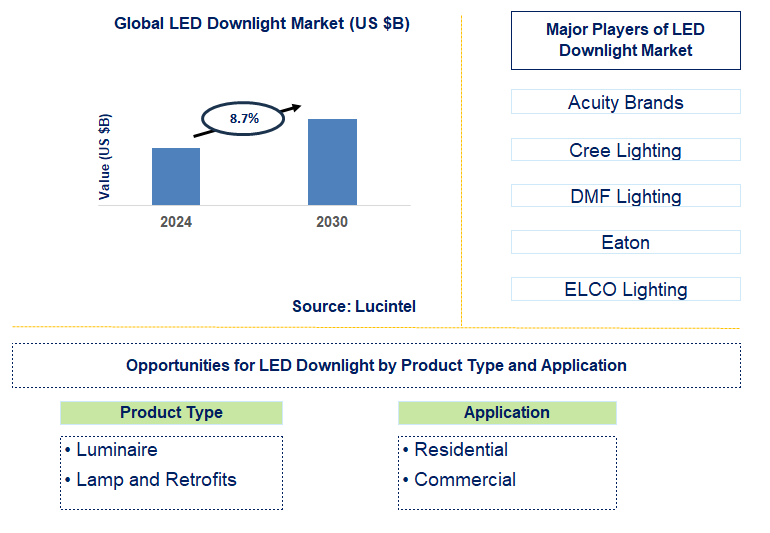
Key data points: The market growth forecast = 8.7% annually next 6 years. Scroll below to get more insights. This market report covers trends, opportunities, and forecasts in the global led downlight market to 2030 by product type (luminaire and lamp and retrofits), application (residential and commercial), and region (North America, Europe, Asia Pacific, and the Rest of the World)
We'll send your sample report shortly.
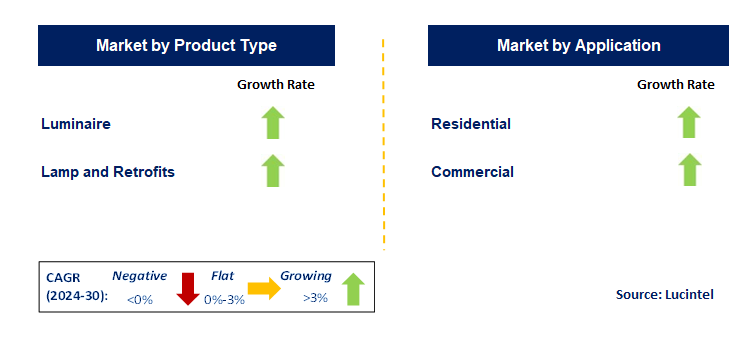
• Lucintel forecasts that, within the type category, lamp and retrofits is expected to witness highest growth over the forecast period due to preferred choice for retrofitting existing lamps and fixtures, as well as for new lighting installations.
• Within the application category, commercial will remain the largest segment due to high deployment in art galleries, offices, museums, restaurants, hotels, retail stores, and theaters.
• In terms of regions, APAC is expected to witness highest growth over the forecast period due to government initiatives, including substantial subsidies for the installation of LED lights, along with a growing awareness among consumers, have contributed to the favorable environment for LED lighting adoption. Gain valuable insights for your business decisions with our comprehensive 150+ page report.
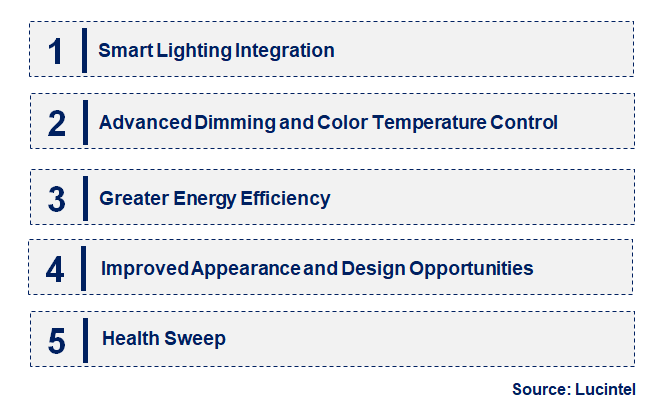
• Smart Lighting Integration: A dominant trend is the incorporation of smart technologies into LED downlights, enabling compatibility with Internet-of-Things (IoT) and home automation systems. These features allow users to control lighting remotely, adjusting parameters such as standby time from anywhere in the room.
• Advanced Dimming and Color Temperature Control: Manufacturers are offering advanced dimmable functions and adjustable color temperature (CCT). This trend caters to varying user preferences based on mood, time of day, or specific activities requiring different lighting conditions.
• Greater Energy Efficiency: There is a continuous push for improved energy efficiency, with ongoing research and development focused on achieving higher efficacy and lower power ratings. This trend promotes sustainable development and reduces operating costs, making LED downlights attractive to both consumers and businesses.
• Improved Appearance and Design Opportunities: Manufacturers are increasingly offering LED downlights in diverse styles and finishes, meeting the demand for decorative lighting solutions that do not require extensive luminaires.
• Health-Centric Features: New LED downlight models prioritize human health by incorporating systems like circadian lighting, which gradually adjusts light intensity to mimic natural daylight patterns. This trend reflects a growing emphasis on enhancing mood and productivity through lighting. These trends are reshaping the LED downlight market, setting new benchmarks for smart technology, energy efficiency, and design versatility.
• Innovative Technology Integration: The technology behind LED downlights is advancing, incorporating smart features such as IoT connectivity, allowing for remote control, automation, and integration with building management systems for improved functionality and energy management.
• Light Quality Improvement: New trends focus on enhancing light output quality, such as improving the color rendering index (CRI) and color temperatures. This enhances color accuracy in various settings, allowing for specific lighting tailored to the purpose of different areas.
• Operational Cost Reduction: Emphasis on energy efficiency has led to innovations that increase lumens per watt and improve thermal management, resulting in reduced energy consumption and lower operational costs.
• Design and Aesthetic Innovations: The market has seen the emergence of LED downlights tailored for diverse aesthetic preferences and practical installation needs, meeting consumer demands for stylish yet functional fixtures that complement modern interiors.
• Enhanced Durability and Longevity: Advances in materials and technology have improved the durability of LED downlights. Enhanced cooling features and high-quality construction contribute to longer lifespans and lower repair costs. These developments are driving innovation and efficiency in the LED downlight market, with a focus on intelligent technology, light quality, and design flexibility.
• Residential Applications: There is significant potential for growth in residential LED downlight use due to increasing consumer demand for energy-efficient and stylish lighting options. Smart lighting advancements and modern designs cater to the growing needs of home automation.
• Commercial Spaces: The use of LED downlights in public spaces such as museums, galleries, and commercial venues is expanding. Sophisticated lighting control systems and energy-saving fixtures can enhance productivity and reduce operational costs.
• Industrial Applications: LED downlights are favored in industrial settings due to their efficiency and reliability. Opportunities exist for developing rugged lighting systems that can withstand harsh environmental conditions.
• Healthcare Facilities: LED downlights present opportunities for improving user interfaces and patient management in healthcare. Specific lighting conditions can enhance surgical assistance and patient care in operating rooms.
• Public Infrastructure: Transportation hubs and civic amenities, including parking and street lighting, present markets for LED downlights. Improved safety and environmental benefits can be achieved through smart, energy-efficient lighting solutions. These growth opportunities are redefining the LED downlight market by addressing unmet needs across various applications.
• Technological Advancements: New products, which improve the light quality or increase the versatility of the LED technology, will propel the growth of the market. Increased performance, color rendition and connectivity options render LED downlights attractive for a wider range of uses.
• Energy Efficiency Regulations: Stringent energy efficiency policies and guidelines are now pushing the implementation of LED downlights. Adhering to such regulations helps improve energy efficiency and minimizes lighting operational expenses thereby increasing the need for high technology lighting products.
• Consumer Demand for Smart Solutions: Consumers are more interested in smart home and building automation, this is therefore supporting the demands for LED downlights with integrated smart features. Consumer requirements such as connectivity, remote control, and automation help in convenience and energy utilization.
• Increased Focus on Sustainability: There is erosion of focus on the principles of energy efficiency and environmental responsibility when it comes to lighting solutions. The best known lighting products are the led downlights since they consume the least amount of power and last longer in the ideal market therefore fit the sustainability agenda and the consumers and companies that are eco-friendly.
• Technological Innovations in Design: New treatments in designs have royalties extended the market of LED downlights. Flexible application, adjustable features and multiple designs meet the modern design market creating a bigger demand. Challenges in the led downlight market are:
• High Initial Costs: Initial costs associated with advanced LED downlights are generally the adoption barrier, however they help in saving costs in the long run. High capital expenditure may hinder such consumers and businesses from adopting led technology.
• Market Saturation: The market for led down light too is fast becoming changing dynamics with all producers producing similar goods. *Competition in the marketplace will be very keen since improvement will be sought by adoption and effective marketing.
• Technical Complexity: Integrating advanced LED downlights into the existing framework may be warring. Integration, Installation and Support are Integration related barriers towards successful adoption and usage. The factors and dynamics that influence the LED downlight industry demonstrate the necessity for innovativeness and strategic approaches. Even though technological advancement and regulatory forestry stimulate the growth, there are issues like excessive pricing and market over-saturation that need to be tackled to keep the market on the growth path.
• Acuity Brands
• Cree Lighting
• DMF Lighting
• Eaton
• ELCO Lighting
• General Electric
• Havells India
• Hubbell
• JESCO Lighting
• Nora Lighting
• Luminaire
• Lamp and Retrofits
• Residential
• Commercial
• North America
• Europe
• Asia Pacific
• The Rest of the World
• United States: In this mature market, there is a trend towards integrating smart downlights with IoT features, aligning with the growth of smart home and energy management systems. Enhanced dimming and color tuning capabilities are also emerging.
• China: Rapid growth in the LED downlight market is driven by urbanization and extensive construction. Chinese manufacturers focus on cost-competitive, energy-efficient products, aggressively developing smart features to compete globally.
• Germany: In Germany, competition is increasingly driven by demand for energy-efficient and eco-friendly products. New fixtures aim to not only provide lighting but also regulate energy use, adhering to strict environmental standards.
• India: Rapid urbanization and infrastructure development are fueling demand for LED downlights in India. Focus is on cost-effective options with enhanced energy performance, supported by government policies promoting energy conservation.
• Japan: In the Japanese market, LED downlights are viewed as advanced technological solutions that minimize power consumption. There have also been developments whereby the newly introduced LED downlights have an additional high CRI and adjustable wattage settings. Some manufacturers in Japan also deal with smart lights that can connect to home devices, showing the advanced orientation of the Japanese market.


• Acuity Brands
• Cree Lighting
• DMF Lighting
• Eaton
• ELCO Lighting
• General Electric
• Havells India
• Hubbell
• JESCO Lighting
• Nora Lighting Q6. Which LED downlight market segment will be the largest in future? Answer: Lucintel forecasts that lamp and retrofits is expected to witness highest growth over the forecast period due to preferred choice for retrofitting existing lamps and fixtures, as well as for new lighting installations. Q7. In LED downlight market, which region is expected to be the largest in next 5 years? Answer: APAC is expected to witness highest growth over the forecast period due to government initiatives, including substantial subsidies for the installation of LED lights, along with a growing awareness among consumers, have contributed to the favorable environment for LED lighting adoption. Q.8 Do we receive customization in this report? Answer: Yes, Lucintel provides 10% customization without any additional cost.


Choose a license that fits your team. Instant PDF delivery.
Prices exclude taxes. Instant delivery. Custom licensing available on request.
Market Report · July 29, 2026
Market Report · July 15, 2026
Market Report · July 13, 2026
Trusted partner for strategic intelligence and business growth


Receive a complimentary market analysis tailored to your industry. Our analysts will identify key growth opportunities and competitive dynamics specific to your business.

Market size, growth rate, and key trend analysis for your specific sector.

Top competitor positioning and market share analysis.

Strategic recommendations backed by data-driven insights.
Get curated market intelligence and competitive moves straight to your inbox.
By subscribing, you agree to receive our monthly insights. Unsubscribe anytime.
Receive a complimentary market analysis tailored to your industry. Our analysts will identify key growth opportunities and competitive dynamics specific to your business.
Market size, growth rate, and key trend analysis for your specific sector.
Top competitor positioning and market share analysis.
Strategic recommendations backed by data-driven insights.
Get curated market intelligence, emerging trends, and competitive moves straight to your inbox each month.
By subscribing, you agree to receive our monthly insights. Unsubscribe anytime.
We'll send your sample report shortly.