
Close Lucintel Chat
Didn't Find What You're Looking for?
Call us at +1972 636 5056 or write at helpdesk@Lucintel.com
Ask an Expert Provide Custom Requirements Download Sample Report Search Available Reports
  • helpdesk@Lucintel.com
  • |
  • Call Lucintel +1 972 636 5056
  • |
  • Login
  • |
  • Register
  • |
  • Search
  • |
'
...

The Impact of COVID-19 is included in Laundry Appliance Market Report. Buy it today to get an advantage.

Request the impact of COVID-19 on your product or industry


Laundry Appliance Market Trends and Forecast

The future of the global laundry appliance market looks promising with opportunities in the residential and commercial markets. The global laundry appliance market is expected to grow with a CAGR of 3.5% from 2025 to 2031. The major drivers for this market are the increasing adoption of smart home technology, the rising disposable incomes & urbanization, and the growing demand for energy-efficient appliances.

• Lucintel forecasts that, within the product type category, combined washer-dryer is expected to witness the highest growth over the forecast period.
• Within the usage category, commercial is expected to witness higher growth.
• In terms of region, APAC is expected to witness the highest growth over the forecast period.
Gain valuable insights for your business decisions with our comprehensive 150+ page report. Sample figures with some insights are shown below.
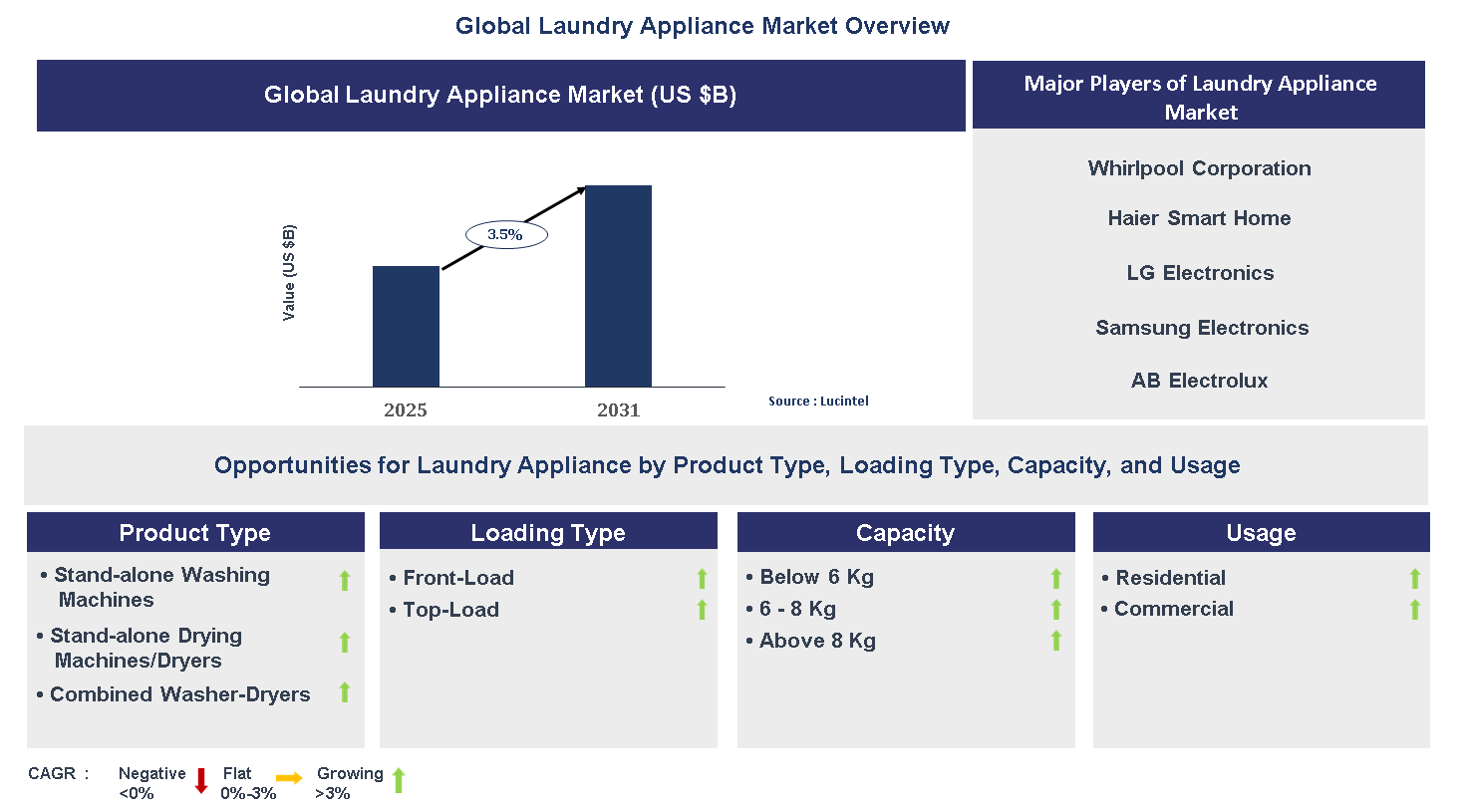
Laundry Appliance Market Trends and Forecast

Emerging Trends in the Laundry Appliance Market

The laundry appliance industry is in the midst of great change, leaving behind basic wash and dry cycles to move toward a future of intelligence, resource savings, and greater user convenience. It is driven by global environmental regulations, the growth of smart home technology, and shifting lifestyles that require appliances that save time, save resources, and make cleaning easier. The developing trends are guiding producers towards a next-generation of products that seamlessly fit into the contemporary, networked home while meeting essential international concerns such as water conservation and energy usage.
• Smart Connectivity and Internet of Things Integration: This trend entails the integration of Wi-Fi and intelligent sensors into laundry appliances, enabling remote control, tracking, and software updates through smartphone apps. This integration enables capabilities such as automatic cycle selection, predictive maintenance notifications, and easy integration into larger smart-home systems. The effect is profound, transforming laundry from a fixed task to an automated, remotely controlled activity, radically enhancing user convenience and providing custom wash programs based on garment type and soil condition, thus maximizing outcomes and machine life.
• Emphasis on Water and Energy Conservation: Fueled by rising utility expenses and more stringent government regulations around the world, companies are making significant investments in technologies to cut down on resource usage. These include the global use of heat pump dryer technology, which employs a closed loop to reclaim heat, and advanced inverter motor technology in washing machines to maximize water and power consumption. The effect is reduced environmental impact for families, long-term cost savings for customers when in operation, and energy labeling and codesign compliance with ever-tougher regulations, allowing sustainability to become a key product differentiator.
• Next-generation Hygiene and Fabric Care Technologies: Pandemic-driven consumer consciousness has fast-forwarded the need for best-in-class hygiene solutions. These features include steam cleaning cycles that sanitize clothing, automatic detergent dosing systems that avoid overuse, and specialized cycles for delicate products. Technologies including built-in water softeners or anti-microbial treatments are not unheard of. The effect is a higher level of cleanliness and preservation of fabrics, appealing to health-conscious consumers as well as the life of clothing, providing a premium value proposition above simple cleaning.
• Product Diversification for Space-Constrained Living: Increasing global urbanization is fueling the need for compact, flexible, and multi-functional washing machines. This involves the trend for all-in-one washer-dryer combinations and stackable machines, as well as dedicated lower-capacity machines for single or apartment dwelling. The trend addresses a huge, underserved urban demographic with little or no space. The effect is extension of product line into niche markets so that consumers in urban crowded places can have automated washing facilities without losing precious floor space.
• Artificial Intelligence and Machine Learning for Optimization: AI and machine learning are used to look at user behavior, type of fabric, water hardness, and load size to determine automatically the best wash cycle, water temperature, and amount of detergent. This is more than mere smart connectivity, though, with true self-optimization. The result is a maximally customized and highly effective cleaning process, precluding user guesswork, producing the best possible outcomes, and reducing wastage of resources even further by fitting input exactly to requirement, greatly enhancing overall appliance performance.
These five trends are basically redefining the laundry appliance market from a conventional manufacturing business to a high-tech ecosystem. The transition to Smart Connectivity and AI integration turns appliances into interactive, self-adjusting home assistants. The prime emphasis on Water and Energy Efficiency turns sustainability into a market imperative, while Advanced Hygiene functionalities address todays health issues. Lastly, Product Diversification guarantees the markets applicability in more urbanized settings.
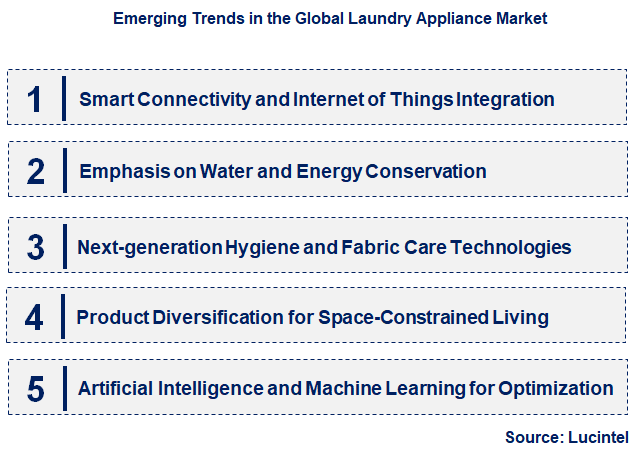
Emerging Trends in the Laundry Appliance Market

Recent Development in the Laundry Appliance Market

The latest trends in the laundry appliance sector are revolutionizing the way consumers think about fabric care, with an emphasis on the combination of technology, efficiency, and personalized solutions. The industry has transcended incremental updates to bring breakthrough innovations that address contemporary lifestyles, the environment, and the need for added convenience. These are prompted by high competition, tighter global policies on energy usage, and the widespread application of digital and smart household technologies, which require a quick product creation cycle among major worldwide makers.
• Widespread Use of Heat Pump Dryer Technology: Technology for heat pumps, predominantly available in Europe, is now experiencing rapid deployment around the world, particularly in North America and Asia. In contrast to traditional vented or condenser dryers, heat pump versions reuse air, employing a refrigerant system to dry clothing at lower temperatures, resulting in large energy savings of between 50 percent or more. Its effect is substantial: although the unit price is more expensive, long-term energy savings and lower environmental footprint have made this the high-end standard in dryer technology, keeping manufacturers aligned with key energy efficiency regulations.
• Artificial Intelligence and Machine Learning Integration: Next-gen appliances use AI to optimize wash cycles in real time. Sensors measure load weight, fabric type, and soil level, and onboard AI in the machine automatically optimizes water usage, wash time, and spin speed, and even recommends the right dose of detergent through integrated dispensing systems. Manual configuration is eliminated. The result is better cleaning performance with lower wastage of water and energy, providing an unparalleled level of convenience to users and transforming the product into a smart, self-sufficient home system.
• All-in-One Washer-Dryer Combo Unit Renaissance: Spurred by market demand in high-density cities, the all-in-one washer-dryer unit has experienced a renaissance with significantly enhanced drying efficiency, especially with the addition of ventless heat pump technology. These machines execute a complete wash and dry cycle within one machine, sometimes needing no venting whatsoever outside the machine. The effect is addressing head-on the space limitations of apartment dwelling, providing full laundry capability in one footprint and thus unlocking major sales potential in densely urbanized countries such as Japan, China, and large European and US metropolitan centers.
• Emphasis on Advanced Fabric Protection and Hygiene Features: Manufacturers are introducing specialized cycles targeting specific fabric requirements and hygiene. New developments include steam sanitizing cycles, which kill germs and allergens safely without using harsh chemicals, and optimizing drum motions to delicately treat sensitive fabrics such as wool and silk. Liquid detergent and fabric conditioner dispensing is automated, ensuring optimal use. The effect is double: responding to increasing consumer health interests and prolonging the life of high-value garments, further supporting the value proposition of the appliance as a high-tech garment care product, rather than simply a laundry machine.
• Growth of Direct-to-Consumer and Online Channels: The buying paradigm for laundry appliances has changed, with significant growth in sales from online sites and manufacturer-owned direct-to-consumer websites. These consist of virtual product showrooms, augmented reality placement solutions, and emphasis on efficient delivery and installation services. The effect is wide market reach, particularly in growing economies and Tier-II/III cities, without the need to operate through conventional retail restrictions. It also provides manufacturers with complete control over customer experience and data, enabling quick response to consumer comments and market trends.
These five new trends—Heat Pump Dryer adoption, AI integration, Washer-Dryer Combo phenomenon, Advanced Fabric Care, and E-commerce growth—are all converging to make laundry appliances smarter, greener, and more affordable. They have driven the market into a high-tech maturity phase where energy efficiency and convenience are no longer niceties but essential consumer expectations. This evolution dictates that the key to future success in the laundry appliance market rests in perpetually fusing digital smarts with increased mechanical prowess.

Strategic Growth Opportunities in the Laundry Appliance Market

Opportunities for strategic growth in the laundry appliance market are aligned across different application segments, fueled by demographic shifts, economic expansion, and technological innovations. The future of the market resides in addressing specific, changing requirements in residential and commercial environments. Critical areas of growth are all about providing higher value through efficiency, convenience, and specialized performance, rather than a one-size-fits-all product strategy. To seize these opportunities, manufacturers need to formulate their innovation, distribution, and marketing strategies to suit the unique needs of each application segment.
• Smart Laundry Solutions in Multi-Family Residential Buildings: Expansion opportunity lies in outfitting new MFR developments, student apartments, and co-living units with coinless, app-operated laundry equipment. Such smart laundries provide tenants with payment convenience, cycle reminders, and machine status checks through a mobile app, a high-end amenity.
• High-Capacity Appliances for Commercial Laundromats: Upgrading conventional laundromats with high-capacity, professional-quality, and ultra-efficient equipment is a main growth opportunity. New equipment saves operators money on water and electricity consumption while providing customers with quicker cycle times and better cleaning. This category demands rugged, heavy-commercial-duty machines. The effect is higher profit for laundromat owners and improved customer satisfaction, generating replacement demand for old, less efficient industrial-grade units, especially in heavily populated urban areas.
• Integrated Combos for Small City Apartments and Miniature Homes: Riding on the quick worldwide increase in urban, space-saving living, the potential is selling high-tech, combo washer-dryer and stack units. These devices need to provide high performance in low space, with low noise and ventless operations. The effect is unlocking a huge consuming customer base in high-density, high-cost cities. Manufacturers gain market strength by dominating miniaturization and efficiency, enabling automated laundry where traditional standalone units are not feasible.
• Sanitizing and Hygiene Solutions for Hospitality and Healthcare: Specialist laundry equipment for utmost hygiene and heat disinfection is a key growth segment in commercial usage such as hospitals, care facilities, and upscale hotels. Such machines need to pass rigorous regulatory requirements for the elimination of pathogens and provide sophisticated wash cycles for linen and uniforms. The effect is the establishment of a high-margin, specialist commercial market where health and compliance standards dictate purchasing behavior.
• Customized Fabric Care Systems for Luxury Homes: A high-potential area is the high-end residential market with fully customized, high-end laundry systems, and not merely machines. This comprises twin washers (concurrent two-load capacity), steam cabinets for wrinkle and deodorization removal, and built-in connectivity to smart wardrobes. The effect is increasing the average selling price of appliances by marketing them as high-end, customizable fabric-care centers, targeting upscale customers who are interested in garment longevity and high-technology styling as part of their contemporary home decor.
These strategic opportunities for growth, ranging from MFR, Laundromats, Urban Homes, Commercial Hygiene, to Premium Residential, demonstrate that the future of the laundry appliance market is one of specialization and segmentation. Achievement will be a function of manufacturers success in shifting from mass-market output to the design of high-brow, application-focused solutions. Targeting these individual segments with customized smart, efficient, and hygienic solutions, the industry can capture enduring growth and dramatically expand the total addressable market by delivering purpose-designed value across the entire range of home and commercial laundry requirements.

Laundry Appliance Market Driver and Challenges

The laundry appliance industry is charting a complicated course influenced by strong technological and economic forces, changing consumer and regulatory requirements. The primary drivers are all largely favorable, propelling the sector toward an efficient, intelligent, and more convenient future. In contrast, major barriers, including cost, supply chain volatility, and infrastructure constraints, continue to generate resistance and hold back market potential, most notably in price-conscious markets.
The factors responsible for driving the laundry appliance market include:
1. Increasing Disposable Incomes and Global Urbanization: The growing middle class, especially among leading emerging economies such as China and India, is translating directly into increased consumer expenditure on convenience-enhancing appliances. Urbanization at a fast pace results in smaller homes, which in turn generates demand for automated, space-saving, and energy-efficient laundry solutions. The result is a never-ending stream of first-time customers and upgrade purchases, more than doubling the market base and driving the sale of more expensive, feature-loaded, full-automatic models over plain semi-automatic ones.
2. Technological Inventions and Smart Home Integration: The convergence of IoT, Wi-Fi, and Artificial Intelligence has transformed washing machines. Remote control, self-diagnosis, auto-dose detergent dispensers, and customized cycles are effective market differentiators. Such technological advancement is attractive to digitally born consumers and extreme convenience seekers. The inference is that innovation yields a strong upgrade cycle, with older, non-smart devices being replaced by networked models, which provide huge time and resource benefits.
3. Aggressive Energy Efficiency Policies and Sustainability Emphasis: Governments globally, especially in the European Union, the United States, and Asia, are enacting more stringent energy efficiency requirements (e.g., improved efficiency ratings, elimination of non-heat-pump dryers). This green initiative is having its leg up strengthened by increasing consumer sensitivity to climate change and power expenses. The implication is that obligatory compliance forces manufacturers to make significant investments in R and D for technologies such as inverter motors and heat pump systems, making sustainability a central competitive criterion and propelling the shift towards high-efficiency models.
4. Changing Consumer Lifestyles and Desire for Convenience: The increase in dual-income households, increased working hours, and the move toward smaller, nuclear families enhances the value proposition of time-saving, automated home appliances. The consumer wishes to spend less time on household work and demands appliances that are easy to use and deliver high performance. The implication is solid market demand for fully automatic machines, all-in-one washer-dryers, and user experience-enhancing features like larger capacity and quietness.
5. Replacement and Upgrade Cycle Growth in Mature Markets: In developed economies such as the United States and Germany, much of the sales are from consumers replacing aged, old appliances. This replacement demand is usually motivated by a need to replace with new models that have better energy efficiency, smart capabilities, or greater capacity. The implication is a reliable, consistent volume of sales in developed economies. Producers tactically employ technologically advanced, feature-rich models to motivate customers to replace before their existing appliance breaks down, thereby reducing the normal replacement cycle.
Challenges in the laundry appliance market are:
1. Elevated Initial Cost of High-Tech and Smart Appliances: The most advanced appliances, with the most recent technology, including AI, heat pump dryers, and state-of-the-art inverter technology, have a much higher initial cost. This high price point can scare off price-sensitive buyers, particularly in developing markets where the middle class is still price-aware. The implication is a possible limitation to universal adoption of the most innovative and efficient products, slowing the markets technological advancement and compelling producers to find cost-saving means to include advanced features.
2. Uncertain Raw Material Prices and Supply Chain Interruptions: The production of laundry equipment is, to a large extent, dependent on raw materials such as steel, aluminum, plastics, and electronics (semiconductors). Volatility in the prices of these commodities and chronic global supply chain uncertainty can critically affect production costs and, in turn, result in price hikes for the end-user. The consequence is smaller profit margins for manufacturers and possible deceleration in production, compromising product availability and eventually inhibiting market growth.
3. Unreliable Infrastructure and Electricity Supply in Emerging Markets: Unreliable power grids and limited access to clean water or consistent water pressure are a major operational limitation for modern, water- and power-dependent laundry machines in most developing countries. Intermittent power restricts the functionality of automatic and smart equipment. The consequence is that manufacturers need to keep developing rugged, usually less-automated, machines that can operate under difficult conditions, which restricts the market potential of high-tech, high-efficiency models in these rapidly growing markets.
The overall impact on the laundry appliance market is one of fast but uneven development. Key drivers such as income expansion and intelligent technology are driving strong demand for high-end, effective products, propelling the industry ahead at an accelerating rate, particularly in urban areas. But difficulties in financing innovation and supply chain uncertainty are a perpetual dampener on growth, while infrastructural constraints limit the take-up of high-value products in high-growth emerging markets.

List of Laundry Appliance Companies

Companies in the market compete on the basis of product quality offered. Major players in this market focus on expanding their manufacturing facilities, R&D investments, infrastructural development, and leverage integration opportunities across the value chain. With these strategies laundry appliance companies cater increasing demand, ensure competitive effectiveness, develop innovative products & technologies, reduce production costs, and expand their customer base. Some of the laundry appliance companies profiled in this report include-
• Whirlpool Corporation
• Haier Smart Home
• LG Electronics
• Samsung Electronics
• AB Electrolux
• Panasonic Corporation
• BSH Hausgeräte
• Midea Group
• Alliance Laundry Systems
• Arçelik

Laundry Appliance Market by Segment

The study includes a forecast for the global laundry appliance market by product type, loading type, capacity, usage, and region.

Laundry Appliance Market by Product Type [Value from 2019 to 2031]:


• Stand-alone Washing Machines
• Stand-alone Drying Machines/Dryers
• Combined Washer-Dryers

Laundry Appliance Market by Loading Type [Value from 2019 to 2031]:


• Front-Load
• Top-Load

Laundry Appliance Market by Capacity [Value from 2019 to 2031]:


• Below 6 Kg
• 6 - 8 Kg
• Above 8 Kg

Laundry Appliance Market by Usage [Value from 2019 to 2031]:


• Residential
• Commercial

Laundry Appliance Market by Region [Value from 2019 to 2031]:


• North America
• Europe
• Asia Pacific
• The Rest of the World

Country Wise Outlook for the Laundry Appliance Market

The international market for laundry appliance is being transformed through a combination of technological advancements, changing consumer behavior, and growing interest in sustainability. Internationally, producers are adding smart technologies, including Wi-Fi connectivity and artificial intelligence, to make their appliances more convenient and efficient. In addition, there is a strong emphasis on creating water- and energy-saving versions, which corresponds to international concerns about the environment and more stringent regulatory requirements. Market expansion is also driven by increasing disposable incomes, increased urbanization, particularly among emerging economies, and accelerating replacement demand in developed markets.
• United States: Demand in the US market is robust for smart and high-efficiency laundry equipment. Latest trends target high-capacity models and advanced features such as in-built Wi-Fi for mobile apps-based remote control and diagnosis. Heat pump dryers, while being more expensive upfront, are picking up pace through enhanced energy efficiency, which attunes to consumer and government pressures for sustainability. Growth in multi-housing units and a strong housing market also drives demand, with brands touting streamlined designs and integrated smart-home systems.
• China: The Chinese market for laundry appliances is marked by quick uptake of smart, technologically advanced, and AI-equipped washing machines. Fueled by rapid urbanization and a rising middle class, consumers prefer full-automatic, high-capacity appliances promising higher convenience and a premium experience. Domestic producers like Haier and Xiaomi lead the way, introducing models with innovations such as auto-dosing detergent dispensers and tailored wash cycles, indicating a dynamic market where innovation and home high-tech integration are valued.
• Germany: Germany, a mature EU market, emphasizes energy efficiency and longevity, driven by strict European Union eco design laws. Innovations focus on sophisticated heat pump technology in dryers and extremely efficient washing machines with extended lifecycles. Consumers are prepared to pay a premium for the highest energy-rated appliances (e.g., A-rated) and for features that provide hygienic cleaning, including steam programs. Premium European brands with a strong emphasis on engineering excellence and resource saving are well represented in the market.
• India: The Indian market is witnessing healthy growth driven by swelling urbanization and growing disposable incomes, especially of the growing middle class. Though the low-cost semi-automatic and mid-capacity (5–7 kg) segments continue to be in favor, there is a clear migration towards fully automatic, water, and energy-saving models in urban India. Companies are launching cost-effective, yet technologically enhanced, appliances, frequently with features to manage local water conditions and power fluctuations, while online channels heavily increase market penetration.
• Japan: The Japanese market for laundry appliances focuses on compact, space-efficient designs, multifunction washer-dryers, and high-tech hygiene technologies. High urbanization and limited living spaces call for size- and function-efficient appliances. Innovations cover advanced inverter motor technology for quiet running and efficiency and high-tech features such as ozone or ion sterilization for increased hygiene, indicating a consumer culture interested in silent performance, technologically advanced features, and space management.

Lucintel Analytics Dashboard

Features of the Global Laundry Appliance Market

Market Size Estimates: Laundry appliance market size estimation in terms of value ($B).
Trend and Forecast Analysis: Market trends (2019 to 2024) and forecast (2025 to 2031) by various segments and regions.
Segmentation Analysis: Laundry appliance market size by various segments, such as by product type, loading type, capacity, usage, and region in terms of value ($B).
Regional Analysis: Laundry appliance market breakdown by North America, Europe, Asia Pacific, and Rest of the World.
Growth Opportunities: Analysis of growth opportunities in different product types, loading types, capacity, usage, and regions for the laundry appliance market.
Strategic Analysis: This includes M&A, new product development, and competitive landscape of the laundry appliance market.
Analysis of competitive intensity of the industry based on Porter’s Five Forces model.

Lucintel Consulting Services

FAQ

Q1. What is the growth forecast for laundry appliance market?
Answer: The global laundry appliance market is expected to grow with a CAGR of 3.5% from 2025 to 2031.
Q2. What are the major drivers influencing the growth of the laundry appliance market?
Answer: The major drivers for this market are the increasing adoption of smart home technology, the rising disposable incomes & urbanization, and the growing demand for energy-efficient appliances.
Q3. What are the major segments for laundry appliance market?
Answer: The future of the laundry appliance market looks promising with opportunities in the residential and commercial markets.
Q4. Who are the key laundry appliance market companies?
Answer: Some of the key laundry appliance companies are as follows:
• Whirlpool Corporation
• Haier Smart Home
• LG Electronics
• Samsung Electronics
• AB Electrolux
• Panasonic Corporation
• BSH Hausgeräte
• Midea Group
• Alliance Laundry Systems
• Arçelik
Q5. Which laundry appliance market segment will be the largest in future?
Answer: Lucintel forecasts that, within the product type category, combined washer-dryer is expected to witness the highest growth over the forecast period.
Q6. In laundry appliance market, which region is expected to be the largest in next 5 years?
Answer: In terms of region, APAC is expected to witness the highest growth over the forecast period.
Q7. Do we receive customization in this report?
Answer: Yes, Lucintel provides 10% customization without any additional cost.

This report answers following 11 key questions:

Q.1. What are some of the most promising, high-growth opportunities for the laundry appliance market by product type (stand-alone washing machines, stand-alone drying machines/dryers, and combined washer-dryers), loading type (front-load and top-load), capacity (below 6 kg, 6 - 8 kg, and above 8 kg), usage (residential and commercial), and region (North America, Europe, Asia Pacific, and the Rest of the World)?
Q.2. Which segments will grow at a faster pace and why?
Q.3. Which region will grow at a faster pace and why?
Q.4. What are the key factors affecting market dynamics? What are the key challenges and business risks in this market?
Q.5. What are the business risks and competitive threats in this market?
Q.6. What are the emerging trends in this market and the reasons behind them?
Q.7. What are some of the changing demands of customers in the market?
Q.8. What are the new developments in the market? Which companies are leading these developments?
Q.9. Who are the major players in this market? What strategic initiatives are key players pursuing for business growth?
Q.10. What are some of the competing products in this market and how big of a threat do they pose for loss of market share by material or product substitution?
Q.11. What M&A activity has occurred in the last 5 years and what has its impact been on the industry?

For any questions related to Laundry Appliance Market, Laundry Appliance Market Size, Laundry Appliance Market Growth, Laundry Appliance Market Analysis, Laundry Appliance Market Report, Laundry Appliance Market Share, Laundry Appliance Market Trends, Laundry Appliance Market Forecast, Laundry Appliance Companies, write Lucintel analyst at email: helpdesk@lucintel.com. We will be glad to get back to you soon.
                                           Table of Contents

            1. Executive Summary

            2. Market Overview

                        2.1 Background and Classifications
                        2.2 Supply Chain

            3. Market Trends & Forecast Analysis

                        3.1 Macroeconomic Trends and Forecasts
                        3.2 Industry Drivers and Challenges
                        3.3 PESTLE Analysis
                        3.4 Patent Analysis
                        3.5 Regulatory Environment
                        3.6 Global Laundry Appliance Market Trends and Forecast Market Trends and Forecast

            4. Global Laundry Appliance Market by Product Type

                        4.1 Overview
                        4.2 Attractiveness Analysis by Product Type
                        4.3 Stand-alone Washing Machines : Trends and Forecast 2025 to 2031
                        4.4 Stand-alone Drying Machines/Dryers : Trends and Forecast 2025 to 2031
                        4.5 Combined Washer-Dryers : Trends and Forecast 2025 to 2031

            5. Global Laundry Appliance Market by Loading Type

                        5.1 Overview
                        5.2 Attractiveness Analysis by Loading Type
                        5.3 Front-Load : Trends and Forecast 2025 to 2031
                        5.4 Top-Load : Trends and Forecast 2025 to 2031

            6. Global Laundry Appliance Market by Capacity

                        6.1 Overview
                        6.2 Attractiveness Analysis by Capacity
                        6.3 Below 6 Kg : Trends and Forecast 2025 to 2031
                        6.4 6 - 8 Kg : Trends and Forecast 2025 to 2031
                        6.5 Above 8 Kg : Trends and Forecast 2025 to 2031

            7. Global Laundry Appliance Market by Usage

                        7.1 Overview
                        7.2 Attractiveness Analysis by Usage
                        7.3 Residential : Trends and Forecast 2025 to 2031
                        7.4 Commercial : Trends and Forecast 2025 to 2031

            8. Regional Analysis

                        8.1 Overview
                        8.2 Global Laundry Appliance Market by Region

            9. North American Laundry Appliance Market

                        9.1 Overview
                        9.2 North American Laundry Appliance Market by Product Type
                        9.3 North American Laundry Appliance Market by Usage
                        9.4 The United States Laundry Appliance Market
                        9.5 Canadian Laundry Appliance Market
                        9.6 Mexican Laundry Appliance Market

            10. European Laundry Appliance Market

                        10.1 Overview
                        10.2 European Laundry Appliance Market by Product Type
                        10.3 European Laundry Appliance Market by Usage
                        10.4 German Laundry Appliance Market
                        10.5 French Laundry Appliance Market
                        10.6 Italian Laundry Appliance Market
                        10.7 Spanish Laundry Appliance Market
                        10.8 The United Kingdom Laundry Appliance Market

            11. APAC Laundry Appliance Market

                        11.1 Overview
                        11.2 APAC Laundry Appliance Market by Product Type
                        11.3 APAC Laundry Appliance Market by Usage
                        11.4 Chinese Laundry Appliance Market
                        11.5 Indian Laundry Appliance Market
                        11.6 Japanese Laundry Appliance Market
                        11.7 South Korean Laundry Appliance Market
                        11.8 Indonesian Laundry Appliance Market

            12. ROW Laundry Appliance Market

                        12.1 Overview
                        12.2 ROW Laundry Appliance Market by Product Type
                        12.3 ROW Laundry Appliance Market by Usage
                        12.4 Middle Eastern Laundry Appliance Market
                        12.5 South American Laundry Appliance Market
                        12.6 African Laundry Appliance Market

            13. Competitor Analysis

                        13.1 Product Portfolio Analysis
                        13.2 Operational Integration
                        13.3 Porter’s Five Forces Analysis
                                    • Competitive Rivalry
                                    • Bargaining Power of Buyers
                                    • Bargaining Power of Suppliers
                                    • Threat of Substitutes
                                    • Threat of New Entrants
                        13.4 Market Share Analysis

            14. Opportunities & Strategic Analysis

                        14.1 Value Chain Analysis
                        14.2 Growth Opportunity Analysis
                                    14.2.1 Growth Opportunity by Product Type
                                    14.2.2 Growth Opportunity by Loading Type
                                    14.2.3 Growth Opportunity by Capacity
                                    14.2.4 Growth Opportunity by Usage
                        14.3 Emerging Trends in the Global Laundry Appliance Market
                        14.4 Strategic Analysis
                                    14.4.1 New Product Development
                                    14.4.2 Certification and Licensing
                                    14.4.3 Mergers, Acquisitions, Agreements, Collaborations, and Joint Ventures

            15. Company Profiles of the Leading Players Across the Value Chain

                        15.1 Competitive Analysis Overview
                        15.2 Whirlpool Corporation
                                    • Company Overview
                                    • Laundry Appliance Market Business Overview
                                    • New Product Development
                                    • Merger, Acquisition, and Collaboration
                                    • Certification and Licensing
                        15.3 Haier Smart Home
                                    • Company Overview
                                    • Laundry Appliance Market Business Overview
                                    • New Product Development
                                    • Merger, Acquisition, and Collaboration
                                    • Certification and Licensing
                        15.4 LG Electronics
                                    • Company Overview
                                    • Laundry Appliance Market Business Overview
                                    • New Product Development
                                    • Merger, Acquisition, and Collaboration
                                    • Certification and Licensing
                        15.5 Samsung Electronics
                                    • Company Overview
                                    • Laundry Appliance Market Business Overview
                                    • New Product Development
                                    • Merger, Acquisition, and Collaboration
                                    • Certification and Licensing
                        15.6 AB Electrolux
                                    • Company Overview
                                    • Laundry Appliance Market Business Overview
                                    • New Product Development
                                    • Merger, Acquisition, and Collaboration
                                    • Certification and Licensing
                        15.7 Panasonic Corporation
                                    • Company Overview
                                    • Laundry Appliance Market Business Overview
                                    • New Product Development
                                    • Merger, Acquisition, and Collaboration
                                    • Certification and Licensing
                        15.8 BSH Hausgeräte
                                    • Company Overview
                                    • Laundry Appliance Market Business Overview
                                    • New Product Development
                                    • Merger, Acquisition, and Collaboration
                                    • Certification and Licensing
                        15.9 Midea Group
                                    • Company Overview
                                    • Laundry Appliance Market Business Overview
                                    • New Product Development
                                    • Merger, Acquisition, and Collaboration
                                    • Certification and Licensing
                        15.10 Alliance Laundry Systems
                                    • Company Overview
                                    • Laundry Appliance Market Business Overview
                                    • New Product Development
                                    • Merger, Acquisition, and Collaboration
                                    • Certification and Licensing
                        15.11 Arçelik
                                    • Company Overview
                                    • Laundry Appliance Market Business Overview
                                    • New Product Development
                                    • Merger, Acquisition, and Collaboration
                                    • Certification and Licensing

            16. Appendix

                        16.1 List of Figures
                        16.2 List of Tables
                        16.3 Research Methodology
                        16.4 Disclaimer
                        16.5 Copyright
                        16.6 Abbreviations and Technical Units
                        16.7 About Us
                        16.8 Contact Us

                                               List of Figures


            Chapter 1

                        Figure 1.1: Trends and Forecast for the Global Laundry Appliance Market

            Chapter 2

                        Figure 2.1: Usage of Laundry Appliance Market
                        Figure 2.2: Classification of the Global Laundry Appliance Market
                        Figure 2.3: Supply Chain of the Global Laundry Appliance Market

            Chapter 3

                        Figure 3.1: Trends of the Global GDP Growth Rate
                        Figure 3.2: Trends of the Global Population Growth Rate
                        Figure 3.3: Trends of the Global Inflation Rate
                        Figure 3.4: Trends of the Global Unemployment Rate
                        Figure 3.5: Trends of the Regional GDP Growth Rate
                        Figure 3.6: Trends of the Regional Population Growth Rate
                        Figure 3.7: Trends of the Regional Inflation Rate
                        Figure 3.8: Trends of the Regional Unemployment Rate
                        Figure 3.9: Trends of Regional Per Capita Income
                        Figure 3.10: Forecast for the Global GDP Growth Rate
                        Figure 3.11: Forecast for the Global Population Growth Rate
                        Figure 3.12: Forecast for the Global Inflation Rate
                        Figure 3.13: Forecast for the Global Unemployment Rate
                        Figure 3.14: Forecast for the Regional GDP Growth Rate
                        Figure 3.15: Forecast for the Regional Population Growth Rate
                        Figure 3.16: Forecast for the Regional Inflation Rate
                        Figure 3.17: Forecast for the Regional Unemployment Rate
                        Figure 3.18: Forecast for Regional Per Capita Income
                        Figure 3.19: Driver and Challenges of the Laundry Appliance Market

            Chapter 4

                        Figure 4.1: Global Laundry Appliance Market by Product Type in 2019, 2024, and 2031
                        Figure 4.2: Trends of the Global Laundry Appliance Market ($B) by Product Type
                        Figure 4.3: Forecast for the Global Laundry Appliance Market ($B) by Product Type
                        Figure 4.4: Trends and Forecast for Stand-alone Washing Machines in the Global Laundry Appliance Market (2019-2031)
                        Figure 4.5: Trends and Forecast for Stand-alone Drying Machines/Dryers in the Global Laundry Appliance Market (2019-2031)
                        Figure 4.6: Trends and Forecast for Combined Washer-Dryers in the Global Laundry Appliance Market (2019-2031)

            Chapter 5

                        Figure 5.1: Global Laundry Appliance Market by Loading Type in 2019, 2024, and 2031
                        Figure 5.2: Trends of the Global Laundry Appliance Market ($B) by Loading Type
                        Figure 5.3: Forecast for the Global Laundry Appliance Market ($B) by Loading Type
                        Figure 5.4: Trends and Forecast for Front-Load in the Global Laundry Appliance Market (2019-2031)
                        Figure 5.5: Trends and Forecast for Top-Load in the Global Laundry Appliance Market (2019-2031)

            Chapter 6

                        Figure 6.1: Global Laundry Appliance Market by Capacity in 2019, 2024, and 2031
                        Figure 6.2: Trends of the Global Laundry Appliance Market ($B) by Capacity
                        Figure 6.3: Forecast for the Global Laundry Appliance Market ($B) by Capacity
                        Figure 6.4: Trends and Forecast for Below 6 Kg in the Global Laundry Appliance Market (2019-2031)
                        Figure 6.5: Trends and Forecast for 6 - 8 Kg in the Global Laundry Appliance Market (2019-2031)
                        Figure 6.6: Trends and Forecast for Above 8 Kg in the Global Laundry Appliance Market (2019-2031)

            Chapter 7

                        Figure 7.1: Global Laundry Appliance Market by Usage in 2019, 2024, and 2031
                        Figure 7.2: Trends of the Global Laundry Appliance Market ($B) by Usage
                        Figure 7.3: Forecast for the Global Laundry Appliance Market ($B) by Usage
                        Figure 7.4: Trends and Forecast for Residential in the Global Laundry Appliance Market (2019-2031)
                        Figure 7.5: Trends and Forecast for Commercial in the Global Laundry Appliance Market (2019-2031)

            Chapter 8

                        Figure 8.1: Trends of the Global Laundry Appliance Market ($B) by Region (2019-2024)
                        Figure 8.2: Forecast for the Global Laundry Appliance Market ($B) by Region (2025-2031)

            Chapter 9

                        Figure 9.1: Trends and Forecast for the North American Laundry Appliance Market (2019-2031)
                        Figure 9.2: North American Laundry Appliance Market by Product Type in 2019, 2024, and 2031
                        Figure 9.3: Trends of the North American Laundry Appliance Market ($B) by Product Type (2019-2024)
                        Figure 9.4: Forecast for the North American Laundry Appliance Market ($B) by Product Type (2025-2031)
                        Figure 9.5: North American Laundry Appliance Market by Loading Type in 2019, 2024, and 2031
                        Figure 9.6: Trends of the North American Laundry Appliance Market ($B) by Loading Type (2019-2024)
                        Figure 9.7: Forecast for the North American Laundry Appliance Market ($B) by Loading Type (2025-2031)
                        Figure 9.8: North American Laundry Appliance Market by Capacity in 2019, 2024, and 2031
                        Figure 9.9: Trends of the North American Laundry Appliance Market ($B) by Capacity (2019-2024)
                        Figure 9.10: Forecast for the North American Laundry Appliance Market ($B) by Capacity (2025-2031)
                        Figure 9.11: North American Laundry Appliance Market by Usage in 2019, 2024, and 2031
                        Figure 9.12: Trends of the North American Laundry Appliance Market ($B) by Usage (2019-2024)
                        Figure 9.13: Forecast for the North American Laundry Appliance Market ($B) by Usage (2025-2031)
                        Figure 9.14: Trends and Forecast for the United States Laundry Appliance Market ($B) (2019-2031)
                        Figure 9.15: Trends and Forecast for the Mexican Laundry Appliance Market ($B) (2019-2031)
                        Figure 9.16: Trends and Forecast for the Canadian Laundry Appliance Market ($B) (2019-2031)

            Chapter 10

                        Figure 10.1: Trends and Forecast for the European Laundry Appliance Market (2019-2031)
                        Figure 10.2: European Laundry Appliance Market by Product Type in 2019, 2024, and 2031
                        Figure 10.3: Trends of the European Laundry Appliance Market ($B) by Product Type (2019-2024)
                        Figure 10.4: Forecast for the European Laundry Appliance Market ($B) by Product Type (2025-2031)
                        Figure 10.5: European Laundry Appliance Market by Loading Type in 2019, 2024, and 2031
                        Figure 10.6: Trends of the European Laundry Appliance Market ($B) by Loading Type (2019-2024)
                        Figure 10.7: Forecast for the European Laundry Appliance Market ($B) by Loading Type (2025-2031)
                        Figure 10.8: European Laundry Appliance Market by Capacity in 2019, 2024, and 2031
                        Figure 10.9: Trends of the European Laundry Appliance Market ($B) by Capacity (2019-2024)
                        Figure 10.10: Forecast for the European Laundry Appliance Market ($B) by Capacity (2025-2031)
                        Figure 10.11: European Laundry Appliance Market by Usage in 2019, 2024, and 2031
                        Figure 10.12: Trends of the European Laundry Appliance Market ($B) by Usage (2019-2024)
                        Figure 10.13: Forecast for the European Laundry Appliance Market ($B) by Usage (2025-2031)
                        Figure 10.14: Trends and Forecast for the German Laundry Appliance Market ($B) (2019-2031)
                        Figure 10.15: Trends and Forecast for the French Laundry Appliance Market ($B) (2019-2031)
                        Figure 10.16: Trends and Forecast for the Spanish Laundry Appliance Market ($B) (2019-2031)
                        Figure 10.17: Trends and Forecast for the Italian Laundry Appliance Market ($B) (2019-2031)
                        Figure 10.18: Trends and Forecast for the United Kingdom Laundry Appliance Market ($B) (2019-2031)

            Chapter 11

                        Figure 11.1: Trends and Forecast for the APAC Laundry Appliance Market (2019-2031)
                        Figure 11.2: APAC Laundry Appliance Market by Product Type in 2019, 2024, and 2031
                        Figure 11.3: Trends of the APAC Laundry Appliance Market ($B) by Product Type (2019-2024)
                        Figure 11.4: Forecast for the APAC Laundry Appliance Market ($B) by Product Type (2025-2031)
                        Figure 11.5: APAC Laundry Appliance Market by Loading Type in 2019, 2024, and 2031
                        Figure 11.6: Trends of the APAC Laundry Appliance Market ($B) by Loading Type (2019-2024)
                        Figure 11.7: Forecast for the APAC Laundry Appliance Market ($B) by Loading Type (2025-2031)
                        Figure 11.8: APAC Laundry Appliance Market by Capacity in 2019, 2024, and 2031
                        Figure 11.9: Trends of the APAC Laundry Appliance Market ($B) by Capacity (2019-2024)
                        Figure 11.10: Forecast for the APAC Laundry Appliance Market ($B) by Capacity (2025-2031)
                        Figure 11.11: APAC Laundry Appliance Market by Usage in 2019, 2024, and 2031
                        Figure 11.12: Trends of the APAC Laundry Appliance Market ($B) by Usage (2019-2024)
                        Figure 11.13: Forecast for the APAC Laundry Appliance Market ($B) by Usage (2025-2031)
                        Figure 11.14: Trends and Forecast for the Japanese Laundry Appliance Market ($B) (2019-2031)
                        Figure 11.15: Trends and Forecast for the Indian Laundry Appliance Market ($B) (2019-2031)
                        Figure 11.16: Trends and Forecast for the Chinese Laundry Appliance Market ($B) (2019-2031)
                        Figure 11.17: Trends and Forecast for the South Korean Laundry Appliance Market ($B) (2019-2031)
                        Figure 11.18: Trends and Forecast for the Indonesian Laundry Appliance Market ($B) (2019-2031)

            Chapter 12

                        Figure 12.1: Trends and Forecast for the ROW Laundry Appliance Market (2019-2031)
                        Figure 12.2: ROW Laundry Appliance Market by Product Type in 2019, 2024, and 2031
                        Figure 12.3: Trends of the ROW Laundry Appliance Market ($B) by Product Type (2019-2024)
                        Figure 12.4: Forecast for the ROW Laundry Appliance Market ($B) by Product Type (2025-2031)
                        Figure 12.5: ROW Laundry Appliance Market by Loading Type in 2019, 2024, and 2031
                        Figure 12.6: Trends of the ROW Laundry Appliance Market ($B) by Loading Type (2019-2024)
                        Figure 12.7: Forecast for the ROW Laundry Appliance Market ($B) by Loading Type (2025-2031)
                        Figure 12.8: ROW Laundry Appliance Market by Capacity in 2019, 2024, and 2031
                        Figure 12.9: Trends of the ROW Laundry Appliance Market ($B) by Capacity (2019-2024)
                        Figure 12.10: Forecast for the ROW Laundry Appliance Market ($B) by Capacity (2025-2031)
                        Figure 12.11: ROW Laundry Appliance Market by Usage in 2019, 2024, and 2031
                        Figure 12.12: Trends of the ROW Laundry Appliance Market ($B) by Usage (2019-2024)
                        Figure 12.13: Forecast for the ROW Laundry Appliance Market ($B) by Usage (2025-2031)
                        Figure 12.14: Trends and Forecast for the Middle Eastern Laundry Appliance Market ($B) (2019-2031)
                        Figure 12.15: Trends and Forecast for the South American Laundry Appliance Market ($B) (2019-2031)
                        Figure 12.16: Trends and Forecast for the African Laundry Appliance Market ($B) (2019-2031)

            Chapter 13

                        Figure 13.1: Porter’s Five Forces Analysis of the Global Laundry Appliance Market
                        Figure 13.2: Market Share (%) of Top Players in the Global Laundry Appliance Market (2024)

            Chapter 14

                        Figure 14.1: Growth Opportunities for the Global Laundry Appliance Market by Product Type
                        Figure 14.2: Growth Opportunities for the Global Laundry Appliance Market by Loading Type
                        Figure 14.3: Growth Opportunities for the Global Laundry Appliance Market by Capacity
                        Figure 14.4: Growth Opportunities for the Global Laundry Appliance Market by Usage
                        Figure 14.5: Growth Opportunities for the Global Laundry Appliance Market by Region
                        Figure 14.6: Emerging Trends in the Global Laundry Appliance Market

                                               List of Tables


            Chapter 1

                        Table 1.1: Growth Rate (%, 2023-2024) and CAGR (%, 2025-2031) of the Laundry Appliance Market by Product Type, Loading Type, Capacity, and Usage
                        Table 1.2: Attractiveness Analysis for the Laundry Appliance Market by Region
                        Table 1.3: Global Laundry Appliance Market Parameters and Attributes

            Chapter 3

                        Table 3.1: Trends of the Global Laundry Appliance Market (2019-2024)
                        Table 3.2: Forecast for the Global Laundry Appliance Market (2025-2031)

            Chapter 4

                        Table 4.1: Attractiveness Analysis for the Global Laundry Appliance Market by Product Type
                        Table 4.2: Market Size and CAGR of Various Product Type in the Global Laundry Appliance Market (2019-2024)
                        Table 4.3: Market Size and CAGR of Various Product Type in the Global Laundry Appliance Market (2025-2031)
                        Table 4.4: Trends of Stand-alone Washing Machines in the Global Laundry Appliance Market (2019-2024)
                        Table 4.5: Forecast for Stand-alone Washing Machines in the Global Laundry Appliance Market (2025-2031)
                        Table 4.6: Trends of Stand-alone Drying Machines/Dryers in the Global Laundry Appliance Market (2019-2024)
                        Table 4.7: Forecast for Stand-alone Drying Machines/Dryers in the Global Laundry Appliance Market (2025-2031)
                        Table 4.8: Trends of Combined Washer-Dryers in the Global Laundry Appliance Market (2019-2024)
                        Table 4.9: Forecast for Combined Washer-Dryers in the Global Laundry Appliance Market (2025-2031)

            Chapter 5

                        Table 5.1: Attractiveness Analysis for the Global Laundry Appliance Market by Loading Type
                        Table 5.2: Market Size and CAGR of Various Loading Type in the Global Laundry Appliance Market (2019-2024)
                        Table 5.3: Market Size and CAGR of Various Loading Type in the Global Laundry Appliance Market (2025-2031)
                        Table 5.4: Trends of Front-Load in the Global Laundry Appliance Market (2019-2024)
                        Table 5.5: Forecast for Front-Load in the Global Laundry Appliance Market (2025-2031)
                        Table 5.6: Trends of Top-Load in the Global Laundry Appliance Market (2019-2024)
                        Table 5.7: Forecast for Top-Load in the Global Laundry Appliance Market (2025-2031)

            Chapter 6

                        Table 6.1: Attractiveness Analysis for the Global Laundry Appliance Market by Capacity
                        Table 6.2: Market Size and CAGR of Various Capacity in the Global Laundry Appliance Market (2019-2024)
                        Table 6.3: Market Size and CAGR of Various Capacity in the Global Laundry Appliance Market (2025-2031)
                        Table 6.4: Trends of Below 6 Kg in the Global Laundry Appliance Market (2019-2024)
                        Table 6.5: Forecast for Below 6 Kg in the Global Laundry Appliance Market (2025-2031)
                        Table 6.6: Trends of 6 - 8 Kg in the Global Laundry Appliance Market (2019-2024)
                        Table 6.7: Forecast for 6 - 8 Kg in the Global Laundry Appliance Market (2025-2031)
                        Table 6.8: Trends of Above 8 Kg in the Global Laundry Appliance Market (2019-2024)
                        Table 6.9: Forecast for Above 8 Kg in the Global Laundry Appliance Market (2025-2031)

            Chapter 7

                        Table 7.1: Attractiveness Analysis for the Global Laundry Appliance Market by Usage
                        Table 7.2: Market Size and CAGR of Various Usage in the Global Laundry Appliance Market (2019-2024)
                        Table 7.3: Market Size and CAGR of Various Usage in the Global Laundry Appliance Market (2025-2031)
                        Table 7.4: Trends of Residential in the Global Laundry Appliance Market (2019-2024)
                        Table 7.5: Forecast for Residential in the Global Laundry Appliance Market (2025-2031)
                        Table 7.6: Trends of Commercial in the Global Laundry Appliance Market (2019-2024)
                        Table 7.7: Forecast for Commercial in the Global Laundry Appliance Market (2025-2031)

            Chapter 8

                        Table 8.1: Market Size and CAGR of Various Regions in the Global Laundry Appliance Market (2019-2024)
                        Table 8.2: Market Size and CAGR of Various Regions in the Global Laundry Appliance Market (2025-2031)

            Chapter 9

                        Table 9.1: Trends of the North American Laundry Appliance Market (2019-2024)
                        Table 9.2: Forecast for the North American Laundry Appliance Market (2025-2031)
                        Table 9.3: Market Size and CAGR of Various Product Type in the North American Laundry Appliance Market (2019-2024)
                        Table 9.4: Market Size and CAGR of Various Product Type in the North American Laundry Appliance Market (2025-2031)
                        Table 9.5: Market Size and CAGR of Various Loading Type in the North American Laundry Appliance Market (2019-2024)
                        Table 9.6: Market Size and CAGR of Various Loading Type in the North American Laundry Appliance Market (2025-2031)
                        Table 9.7: Market Size and CAGR of Various Capacity in the North American Laundry Appliance Market (2019-2024)
                        Table 9.8: Market Size and CAGR of Various Capacity in the North American Laundry Appliance Market (2025-2031)
                        Table 9.9: Market Size and CAGR of Various Usage in the North American Laundry Appliance Market (2019-2024)
                        Table 9.10: Market Size and CAGR of Various Usage in the North American Laundry Appliance Market (2025-2031)
                        Table 9.11: Trends and Forecast for the United States Laundry Appliance Market (2019-2031)
                        Table 9.12: Trends and Forecast for the Mexican Laundry Appliance Market (2019-2031)
                        Table 9.13: Trends and Forecast for the Canadian Laundry Appliance Market (2019-2031)

            Chapter 10

                        Table 10.1: Trends of the European Laundry Appliance Market (2019-2024)
                        Table 10.2: Forecast for the European Laundry Appliance Market (2025-2031)
                        Table 10.3: Market Size and CAGR of Various Product Type in the European Laundry Appliance Market (2019-2024)
                        Table 10.4: Market Size and CAGR of Various Product Type in the European Laundry Appliance Market (2025-2031)
                        Table 10.5: Market Size and CAGR of Various Loading Type in the European Laundry Appliance Market (2019-2024)
                        Table 10.6: Market Size and CAGR of Various Loading Type in the European Laundry Appliance Market (2025-2031)
                        Table 10.7: Market Size and CAGR of Various Capacity in the European Laundry Appliance Market (2019-2024)
                        Table 10.8: Market Size and CAGR of Various Capacity in the European Laundry Appliance Market (2025-2031)
                        Table 10.9: Market Size and CAGR of Various Usage in the European Laundry Appliance Market (2019-2024)
                        Table 10.10: Market Size and CAGR of Various Usage in the European Laundry Appliance Market (2025-2031,)
                        Table 10.11: Trends and Forecast for the German Laundry Appliance Market (2019-2031)
                        Table 10.12: Trends and Forecast for the French Laundry Appliance Market (2019-2031)
                        Table 10.13: Trends and Forecast for the Spanish Laundry Appliance Market (2019-2031)
                        Table 10.14: Trends and Forecast for the Italian Laundry Appliance Market (2019-2031)
                        Table 10.15: Trends and Forecast for the United Kingdom Laundry Appliance Market (2019-2031)

            Chapter 11

                        Table 11.1: Trends of the APAC Laundry Appliance Market (2019-2024)
                        Table 11.2: Forecast for the APAC Laundry Appliance Market (2025-2031)
                        Table 11.3: Market Size and CAGR of Various Product Type in the APAC Laundry Appliance Market (2019-2024)
                        Table 11.4: Market Size and CAGR of Various Product Type in the APAC Laundry Appliance Market (2025-2031)
                        Table 11.5: Market Size and CAGR of Various Loading Type in the APAC Laundry Appliance Market (2019-2024)
                        Table 11.6: Market Size and CAGR of Various Loading Type in the APAC Laundry Appliance Market (2025-2031)
                        Table 11.7: Market Size and CAGR of Various Capacity in the APAC Laundry Appliance Market (2019-2024)
                        Table 11.8: Market Size and CAGR of Various Capacity in the APAC Laundry Appliance Market (2025-2031)
                        Table 11.9: Market Size and CAGR of Various Usage in the APAC Laundry Appliance Market (2019-2024)
                        Table 11.10: Market Size and CAGR of Various Usage in the APAC Laundry Appliance Market (2025-2031)
                        Table 11.11: Trends and Forecast for the Japanese Laundry Appliance Market (2019-2031)
                        Table 11.12: Trends and Forecast for the Indian Laundry Appliance Market (2019-2031)
                        Table 11.13: Trends and Forecast for the Chinese Laundry Appliance Market (2019-2031)
                        Table 11.14: Trends and Forecast for the South Korean Laundry Appliance Market (2019-2031)
                        Table 11.15: Trends and Forecast for the Indonesian Laundry Appliance Market (2019-2031)

            Chapter 12

                        Table 12.1: Trends of the ROW Laundry Appliance Market (2019-2024)
                        Table 12.2: Forecast for the ROW Laundry Appliance Market (2025-2031)
                        Table 12.3: Market Size and CAGR of Various Product Type in the ROW Laundry Appliance Market (2019-2024)
                        Table 12.4: Market Size and CAGR of Various Product Type in the ROW Laundry Appliance Market (2025-2031)
                        Table 12.5: Market Size and CAGR of Various Loading Type in the ROW Laundry Appliance Market (2019-2024)
                        Table 12.6: Market Size and CAGR of Various Loading Type in the ROW Laundry Appliance Market (2025-2031)
                        Table 12.7: Market Size and CAGR of Various Capacity in the ROW Laundry Appliance Market (2019-2024)
                        Table 12.8: Market Size and CAGR of Various Capacity in the ROW Laundry Appliance Market (2025-2031)
                        Table 12.9: Market Size and CAGR of Various Usage in the ROW Laundry Appliance Market (2019-2024)
                        Table 12.10: Market Size and CAGR of Various Usage in the ROW Laundry Appliance Market (2025-2031)
                        Table 12.11: Trends and Forecast for the Middle Eastern Laundry Appliance Market (2019-2031)
                        Table 12.12: Trends and Forecast for the South American Laundry Appliance Market (2019-2031)
                        Table 12.13: Trends and Forecast for the African Laundry Appliance Market (2019-2031)

            Chapter 13

                        Table 13.1: Product Mapping of Laundry Appliance Suppliers Based on Segments
                        Table 13.2: Operational Integration of Laundry Appliance Manufacturers
                        Table 13.3: Rankings of Suppliers Based on Laundry Appliance Revenue

            Chapter 14

                        Table 14.1: New Product Launches by Major Laundry Appliance Producers (2019-2024)
                        Table 14.2: Certification Acquired by Major Competitor in the Global Laundry Appliance Market

.

Buy full report or by chapter as follows

Limited Time Offer

Price by License Type:
[-] Hide Chapter Details
[Chapter Number] [Chapter Name] [Chapter Number Of Pages] [Chapter Price]
Title/Chapter Name Pages Price
Full Report: Laundry Appliance Market Report: Trends, Forecast and Competitive Analysis to 2031 Full Report $ 2,990
A 150 Page Report
Lucintel has been in the business of market research and management consulting since 2000 and has published over 1000 market intelligence reports in various markets / applications and served over 1,000 clients worldwide. This study is a culmination of four months of full-time effort performed by Lucintel's analyst team. The analysts used the following sources for the creation and completion of this valuable report:
  • In-depth interviews of the major players in this market
  • Detailed secondary research from competitors’ financial statements and published data 
  • Extensive searches of published works, market, and database information pertaining to industry news, company press releases, and customer intentions
  • A compilation of the experiences, judgments, and insights of Lucintel’s professionals, who have analyzed and tracked this market over the years.
Extensive research and interviews are conducted across the supply chain of this market to estimate market share, market size, trends, drivers, challenges, and forecasts. Below is a brief summary of the primary interviews that were conducted by job function for this report.
 
Thus, Lucintel compiles vast amounts of data from numerous sources, validates the integrity of that data, and performs a comprehensive analysis. Lucintel then organizes the data, its findings, and insights into a concise report designed to support the strategic decision-making process. The figure below is a graphical representation of Lucintel’s research process. 
 

Please sign in below to get report brochure - Laundry Appliance Market Report.

At Lucintel, we respect your privacy and maintain the confidentiality of information / data provided by you
(Please enter your corporate email. * These fields are mandatory )

Follow us on