
Report Feature
Laser Processing Market Trends and Forecast
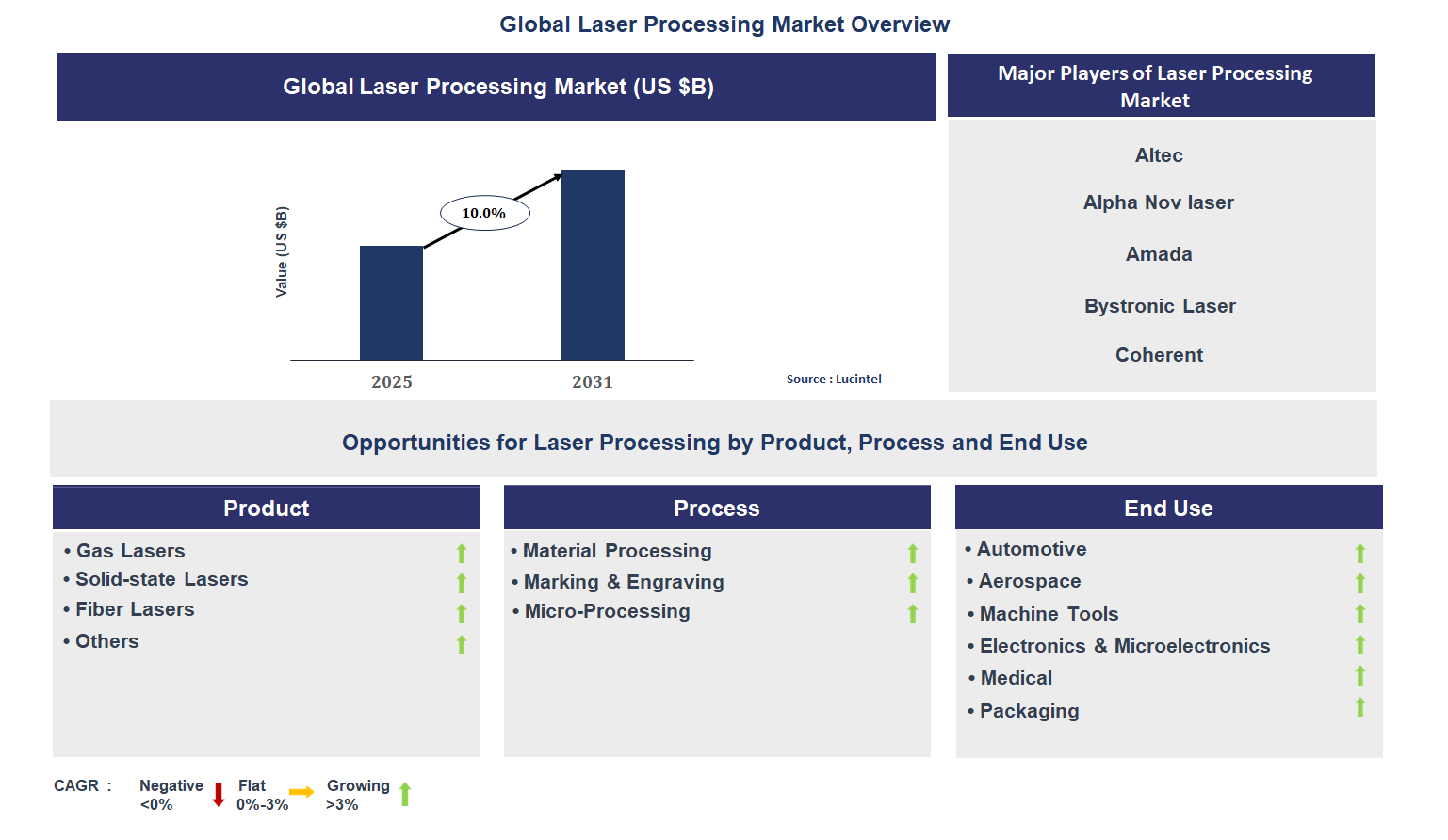
The future of the global laser processing market looks promising with opportunities in the automotive, aerospace, machine tool, electronics & microelectronics, medical, and packaging markets. The global laser processing market is expected to grow with a CAGR of 10% from 2025 to 2031. The major drivers for this market are the increasing demand for precise material processing, the rising adoption of automation in manufacturing, and the growing need for efficient production techniques.• Lucintel forecasts that, within the product category, gas laser is expected to witness the highest growth over the forecast period.
• Within the end use category, machine tool is expected to witness the highest growth.
• In terms of region, APAC is expected to witness the highest growth over the forecast period. Gain valuable insights for your business decisions with our comprehensive 150+ page report. Sample figures with some insights are shown below.
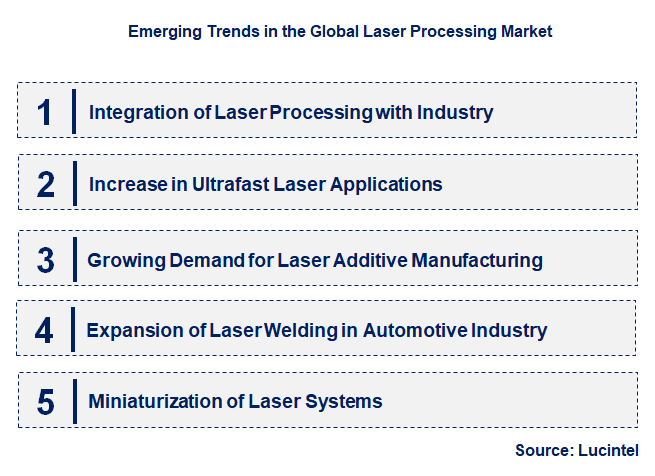
Emerging Trends in the Laser Processing Market
The laser processing market is evolving rapidly with technological advancements, higher precision demands, and increasing automation. Emerging trends reflect a shift toward more efficient, versatile, and high-quality laser technologies that cater to new industrial needs. Below are five key trends that are shaping the future of laser processing across industries.• Integration of Laser Processing with Industry: As industries embrace digitalization, laser processing is increasingly integrated with Industry 4.0 technologies, including IoT and AI. This integration enables real-time monitoring, predictive maintenance, and automated production systems. The convergence of lasers with smart factories is driving higher productivity, reduced downtime, and cost-effective manufacturing.
• Increase in Ultrafast Laser Applications: Ultrafast lasers, including femtosecond and picosecond lasers, are gaining traction in industries like electronics and medical devices. These lasers provide highly precise machining without damaging the surrounding material, making them ideal for micro-machining and complex material processing. This trend is expected to grow as the demand for miniaturized components increases.
• Growing Demand for Laser Additive Manufacturing: Laser additive manufacturing, or 3D printing, is seeing wider adoption in industries like aerospace, automotive, and healthcare. Laser-based 3D printing enables high-precision, customizable parts with reduced material waste. The technology is opening up new opportunities for on-demand manufacturing and product innovation, particularly in highly regulated sectors.
• Expansion of Laser Welding in Automotive Industry: Laser welding is increasingly replacing traditional welding methods in automotive manufacturing due to its precision, speed, and ability to weld complex materials. The trend toward lightweight materials in vehicle production, including aluminum and high-strength steel, is boosting the demand for laser welding, as it allows for faster, more reliable joints.
• Miniaturization of Laser Systems: As industries demand smaller, more powerful laser systems, manufacturers are developing compact and portable laser solutions. These miniaturized systems are increasingly used in sectors like medical device manufacturing, where space and precision are critical. The trend towards smaller laser systems is also enabling cost-effective entry for smaller enterprises. These emerging trends—Industry 4.0 integration, ultrafast lasers, additive manufacturing, laser welding, and miniaturization—are reshaping the laser processing market. These developments are pushing the boundaries of laser technology, making it more versatile and accessible, and enabling new applications across industries like automotive, aerospace, and healthcare.
Recent Development in the Laser Processing Market
The laser processing market is evolving with significant technological and industrial developments. These key advancements are driving the growth of laser systems across diverse sectors, enhancing precision, efficiency, and automation. Below are five recent developments in the laser processing market that are making a major impact on industrial applications worldwide.• High-Power Fiber Lasers: The development of high-power fiber lasers has revolutionized laser cutting, welding, and engraving applications. These lasers offer increased power density, efficiency, and precision, making them ideal for heavy-duty industrial applications. High-power fiber lasers are also more energy-efficient and cost-effective, making them attractive to a wide range of industries.
• Laser Welding Innovations: Laser welding technology has seen remarkable advancements, particularly in its application for joining lightweight materials such as aluminum in the automotive sector. Laser welding enables faster, more precise welds with minimal heat distortion, improving product quality and production speed. Innovations like hybrid laser welding are also gaining traction for their ability to combine laser welding with traditional welding methods for improved results.
• Rise of Laser Additive Manufacturing: Laser-based 3D printing or additive manufacturing is expanding in industries such as aerospace, medical, and automotive. New developments in laser sintering and fusion techniques are improving the accuracy and efficiency of 3D printing, enabling complex part designs with less material waste. Laser additive manufacturing is quickly becoming an essential tool for prototyping and low-volume production.
• Miniaturized and Portable Laser Systems: Advances in miniaturized laser technology are making laser processing equipment smaller, lighter, and more portable. This is especially beneficial in industries like medical devices, electronics, and precision machining, where space constraints and portability are essential. Compact laser systems are increasing accessibility for small and medium-sized enterprises to adopt advanced laser processing.
• Artificial Intelligence in Laser Processing: The integration of AI with laser systems is enhancing process optimization and automation. AI-powered systems are capable of adjusting laser parameters in real-time based on feedback from sensors and cameras, optimizing cutting speeds, and improving product quality. This development is pushing the capabilities of laser systems in highly automated and precision-demanding industries. Developments like high-power fiber lasers, laser welding innovations, laser additive manufacturing, miniaturized systems, and AI integration are transforming the laser processing market. These advancements are making laser processing more efficient, accessible, and versatile, opening up new opportunities across various industries, including automotive, aerospace, healthcare, and electronics.
Strategic Growth Opportunities in the Laser Processing Market
The laser processing market offers a wealth of strategic growth opportunities across diverse applications, driven by the need for more efficient, precise, and automated manufacturing. Below are five key areas where laser technology is gaining significant traction and enabling growth in various industries.• Automotive Industry: Laser processing is increasingly used in automotive manufacturing for applications such as cutting, welding, and marking. The rise of electric vehicles and the need for lightweight materials offer growth opportunities for laser technology, particularly in laser welding for joining aluminum and high-strength steels used in vehicle bodies. Additionally, laser systems for precision marking are expanding in vehicle identification.
• Medical Device Manufacturing: Lasers are vital in the production of medical devices due to their precision and ability to work with delicate materials. With the rise of minimally invasive surgeries and advanced diagnostic tools, the demand for high-precision laser systems in medical device manufacturing is expected to grow. Laser cutting and engraving systems are being used for devices like catheters and implants, driving market expansion.
• Aerospace Manufacturing: In aerospace, laser cutting and welding systems are used for manufacturing lightweight, high-strength parts. With the growing demand for advanced aircraft materials like composites and titanium alloys, laser technology is well-positioned to meet these needs. Additionally, the development of laser-based additive manufacturing solutions for aerospace applications is opening new growth avenues in this sector.
• Electronics Industry: The electronics industry is driving demand for laser processing in the production of components like semiconductors, microelectronics, and flat-panel displays. Laser systems are used for micro-machining and precision cutting of components that require high accuracy. The increasing miniaturization of electronic devices is creating growth opportunities for laser technologies in precision manufacturing.
• Energy and Renewable Sector: Laser systems are being used to manufacture components for the energy and renewable energy sectors, such as solar panels, wind turbines, and battery systems. The increasing adoption of clean energy technologies presents opportunities for lasers in manufacturing efficient energy systems. Laser processing helps improve precision in producing energy-efficient products and components. The laser processing market presents strategic growth opportunities in industries such as automotive, medical devices, aerospace, electronics, and renewable energy. These applications benefit from the precision, efficiency, and versatility that laser technology offers, enabling manufacturers to improve product quality and streamline production processes.
Laser Processing Market Driver and Challenges
The laser processing market is driven by various technological advancements, economic factors, and evolving customer demands. However, it also faces challenges related to cost, complexity, and regulatory considerations. Understanding the key drivers and challenges can help organizations navigate this rapidly growing market. Below are the main drivers and challenges shaping the market. The factors responsible for driving the laser processing market include: 1. Technological Advancements: Innovations in laser sources, beam delivery systems, and software are enhancing the capabilities of laser processing equipment. This enables manufacturers to achieve greater precision, efficiency, and versatility in production. 2. Demand for Automation: The increasing shift toward automation in manufacturing is driving the demand for laser systems. Laser processing offers high-speed, non-contact methods for cutting, welding, and marking, which aligns with the industrys push toward more automated production processes. 3. Rise of Smart Manufacturing: As industries embrace Industry 4.0, smart factories that incorporate AI, IoT, and robotics are driving the adoption of laser processing systems. These systems enable real-time data analysis and process optimization, increasing production efficiency. 4. Cost-Effectiveness of Laser Technology: Laser systems, particularly fiber lasers, offer lower operational costs compared to traditional machining methods. Their ability to work with a wide range of materials and reduce material waste makes them cost-effective, appealing to manufacturers seeking to improve profitability. 5. Increased Precision Demands: As industries demand higher precision in manufacturing processes, laser technology is increasingly used for tasks like micro-machining, which require extreme accuracy. This is particularly important in sectors like medical devices, aerospace, and electronics. Challenges in the laser processing market are: 1. High Initial Investment Costs: The cost of acquiring and maintaining laser processing equipment can be prohibitively high, especially for small and medium-sized enterprises. This is a major barrier to entry for some organizations seeking to adopt laser technology. 2. Complexity of Integration: Integrating laser systems into existing production lines can be complex and may require significant modification of infrastructure. This can be challenging for companies with legacy systems and limited technical expertise. 3. Skilled Labor Shortage: The demand for highly skilled technicians to operate and maintain laser systems is growing. A shortage of qualified professionals in this field could limit the growth potential of the market, particularly in regions where vocational training programs are insufficient. The laser processing market is driven by technological advancements, automation trends, cost-effectiveness, and precision demands. However, challenges like high investment costs, integration complexities, and skilled labor shortages must be addressed to fully realize the potential of laser technology in various industries. As these challenges are overcome, the laser processing market is expected to experience continued growth.List of Laser Processing Companies
Companies in the market compete on the basis of product quality offered. Major players in this market focus on expanding their manufacturing facilities, R&D investments, infrastructural development, and leverage integration opportunities across the value chain. With these strategies laser processing companies cater increasing demand, ensure competitive effectiveness, develop innovative products & technologies, reduce production costs, and expand their customer base. Some of the laser processing companies profiled in this report include-• Altec
• Alpha Nov laser
• Amada
• Bystronic Laser
• Coherent
• Epilog Laser
• Eurolaser
• Hans Laser Technology Industry Group
• IPG Photonics Corporation
• Newport Corporation
Laser Processing Market by Segment
The study includes a forecast for the global laser processing market by product, process, end use, and region.Laser Processing Market by Product [Value from 2019 to 2031]:
• Gas Lasers
• Solid-state Lasers
• Fiber Lasers
• Others
Laser Processing Market by Process [Value from 2019 to 2031]:
• Material Processing
• Marking & Engraving
• Micro-Processing
Laser Processing Market by End Use [Value from 2019 to 2031]:
• Automotive
• Aerospace
• Machine Tools
• Electronics & Microelectronics
• Medical
• Packaging
Laser Processing Market by Region [Value from 2019 to 2031]:
• North America
• Europe
• Asia Pacific
• The Rest of the World
Country Wise Outlook for the Laser Processing Market
The global laser processing market has seen significant growth due to advances in technology, the increasing demand for automation, and the adoption of laser systems across diverse industries such as automotive, aerospace, and electronics. Countries like the United States, China, Germany, India, and Japan have played pivotal roles in pushing the boundaries of laser technology for industrial applications.• United States: The U.S. has witnessed a surge in the adoption of laser processing systems, driven by industries such as aerospace, automotive, and electronics. Companies like Coherent and IPG Photonics are leading the charge in developing high-power fiber lasers and ultrafast laser systems. Additionally, the U.S. is focusing on advanced laser welding and additive manufacturing applications, boosting the demand for precision manufacturing solutions.
• China: China remains a dominant player in the laser processing market, with an increasing shift towards high-precision laser cutting, engraving, and welding. The country has significantly invested in laser technology as part of its "Made in China 2025" initiative. Chinese companies such as Hans Laser and Bystronic are leading innovations in laser processing, aiming to enhance manufacturing efficiency and automation across sectors like electronics, automotive, and textiles.
• Germany: Known for its precision engineering, Germany continues to be a key leader in the laser processing market, especially in industries such as automotive and industrial manufacturing. The country has made substantial investments in laser welding, cutting, and additive manufacturing technologies. German companies like Trumpf and Laserline are at the forefront of developing high-efficiency lasers and integrating them into smart factories for Industry 4.0.
• India: India’s laser processing market is gaining momentum, driven by the demand for advanced manufacturing solutions in sectors like automotive, aerospace, and electronics. Companies such as Laser Technologies India are embracing laser cutting, marking, and engraving technologies. India’s manufacturing industry is also increasingly integrating laser systems for automation, leading to higher productivity and precision in production lines.
• Japan: Japan is renowned for its cutting-edge technology in robotics, automation, and laser processing. Japanese manufacturers like Panasonic and Mitsubishi Electric are innovating in laser welding, cutting, and engraving. The country is also leading the way in developing lasers for micro-machining, which are vital for industries like electronics and semiconductors. Japan’s laser processing market is poised to grow with continued emphasis on automation and industrial efficiency.

Features of the Global Laser Processing Market
Market Size Estimates: Laser processing market size estimation in terms of value ($B). Trend and Forecast Analysis: Market trends (2019 to 2024) and forecast (2025 to 2031) by various segments and regions. Segmentation Analysis: Laser processing market size by product, process, end use, and region in terms of value ($B). Regional Analysis: Laser processing market breakdown by North America, Europe, Asia Pacific, and Rest of the World. Growth Opportunities: Analysis of growth opportunities in different products, processes, end uses, and regions for the laser processing market. Strategic Analysis: This includes M&A, new product development, and competitive landscape of the laser processing market. Analysis of competitive intensity of the industry based on Porter’s Five Forces model.
FAQ
Q1. What is the growth forecast for laser processing market? Answer: The global laser processing market is expected to grow with a CAGR of 10% from 2025 to 2031. Q2. What are the major drivers influencing the growth of the laser processing market? Answer: The major drivers for this market are the increasing demand for precise material processing, the rising adoption of automation in manufacturing, and the growing need for efficient production techniques. Q3. What are the major segments for laser processing market? Answer: The future of the laser processing market looks promising with opportunities in the automotive, aerospace, machine tool, electronics & microelectronics, medical, and packaging markets. Q4. Who are the key laser processing market companies? Answer: Some of the key laser processing companies are as follows:• Altec
• Alpha Nov laser
• Amada
• Bystronic Laser
• Coherent
• Epilog Laser
• Eurolaser
• Hans Laser Technology Industry Group
• IPG Photonics Corporation
• Newport Corporation Q5. Which laser processing market segment will be the largest in future? Answer: Lucintel forecasts that, within the product category, gas laser is expected to witness the highest growth over the forecast period. Q6. In laser processing market, which region is expected to be the largest in next 5 years? Answer: In terms of region, APAC is expected to witness the highest growth over the forecast period. Q7. Do we receive customization in this report? Answer: Yes, Lucintel provides 10% customization without any additional cost.
Table of Contents
List of Figures
List of Tables
Methodology
- In-depth interviews of the major players in this market
- Detailed secondary research from competitors’ financial statements and published data
- Extensive searches of published works, market, and database information pertaining to industry news, company press releases, and customer intentions
- A compilation of the experiences, judgments, and insights of Lucintel’s professionals, who have analyzed and tracked this market over the years.


Buy Now
Choose a license that fits your team. Instant PDF delivery.
Prices exclude taxes. Instant delivery. Custom licensing available on request.
Key Questions
- • What are some of the most promising, high-growth opportunities for the laser processing market by product (gas lasers, solid-state lasers, fiber lasers, and others), process (material processing, marking & engraving, and micro-processing), end use (automotive, aerospace, machine tools, electronics & microelectronics, medical, and packaging), and region (North America, Europe, Asia Pacific, and the Rest of the World)?
- • Which segments will grow at a faster pace and why?
- • Which region will grow at a faster pace and why?
- • What are the key factors affecting market dynamics? What are the key challenges and business risks in this market?
- • What are the business risks and competitive threats in this market?
- • What are the emerging trends in this market and the reasons behind them?
- • What are some of the changing demands of customers in the market?
- • What are the new developments in the market? Which companies are leading these developments?
- • Who are the major players in this market? What strategic initiatives are key players pursuing for business growth?
- • What are some of the competing products in this market and how big of a threat do they pose for loss of market share by material or product substitution?
- • What M&A activity has occurred in the last 5 years and what has its impact been on the industry? For any questions related to Laser Processing Market, Laser Processing Market Size, Laser Processing Market Growth, Laser Processing Market Analysis, Laser Processing Market Report, Laser Processing Market Share, Laser Processing Market Trends, Laser Processing Market Forecast, Laser Processing Companies, write Lucintel analyst at email: helpdesk@lucintel.com. We will be glad to get back to you soon.


