
Report Feature
Laser Cladding Equipment Market Trends and Forecast
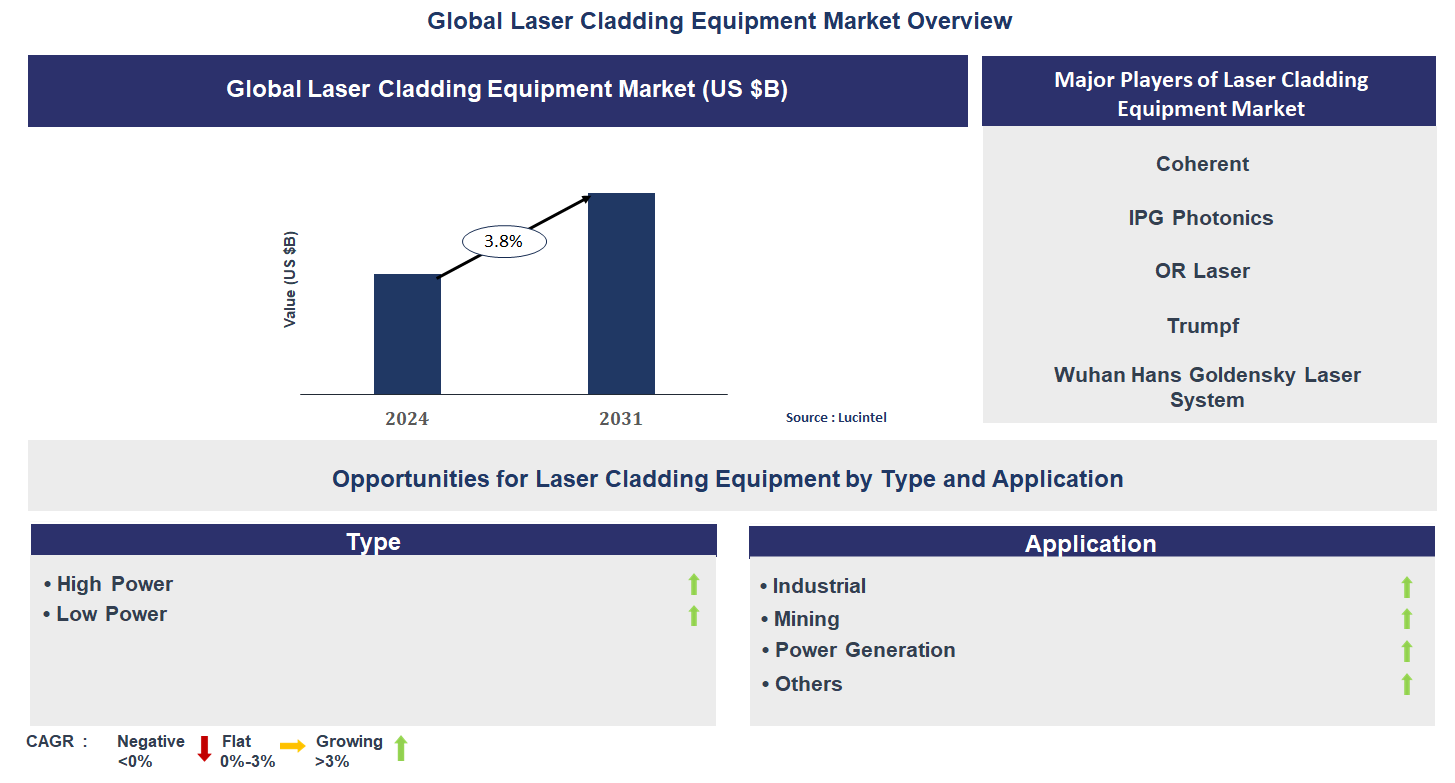
The future of the global laser cladding equipment market looks promising with opportunities in the industrial, mining, and power generation markets. The global laser cladding equipment market is expected to grow with a CAGR of 3.8% from 2025 to 2031. The major drivers for this market are the increasing demand for surface protection, the rising adoption in aerospace industry, and the growing need for efficient manufacturing processes.• Lucintel forecasts that, within the type category, high power is expected to witness higher growth over the forecast period.
• Within the application category, power generation is expected to witness the highest growth.
• In terms of region, APAC is expected to witness the highest growth over the forecast period. Gain valuable insights for your business decisions with our comprehensive 150+ page report. Sample figures with some insights are shown below.
Emerging Trends in the Laser Cladding Equipment Market
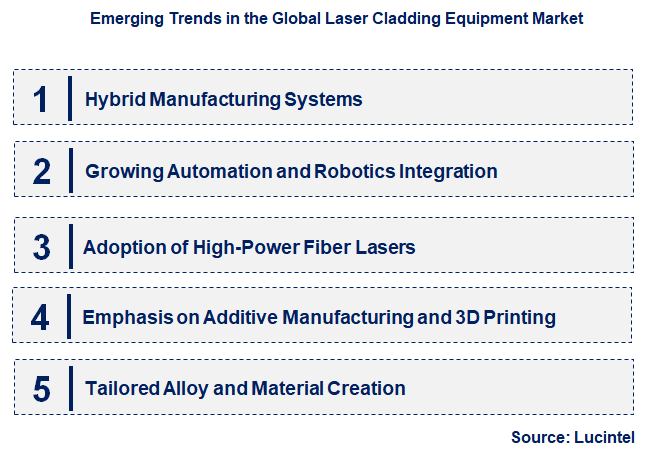
The laser cladding equipment market is in the midst of a revolutionary transformation, driven by technological advancements, changing industrial requirements, and worldwide emphasis on sustainability and efficiency. These novel trends are shifting the market from one with emphasis on rudimentary functionality to one that is focused on smart, integrated, and highly specialized solutions. With industries wanting to extend the life of high-value parts and lower waste, the need for the equipment that can perform these duties safely and effectively is increasing.• Hybrid Manufacturing Systems: The main trend is the creation of hybrid manufacturing systems that integrate laser cladding with other production processes such as milling or turning. They enable the entire "repair and restore" procedure on a single machine, with less downtime and increased efficiency. This trend is affecting the market by presenting an even more diverse and integrated solution for industrial customers. It allows manufacturers not only to replace worn components but also to redesign them with added functionality.
• Growing Automation and Robotics Integration: One of the primary trends is the growing automation and robotics integration. Companies are creating automated laser cladding cells that involve little manual intervention. The systems employ robotic arms to carefully control the laser and powder supply, which is a primary competitive advantage. The trend is affecting the market by profoundly enhancing operational efficiency, lowering labor expenses, and raising the quality and uniformity of the cladded component.
• Adoption of High-Power Fiber Lasers: A strong new trend towards the use of high-power fiber lasers can be seen. Fiber lasers provide higher efficiency, lower maintenance, and improved beam quality than traditional laser technology. They are particularly suited to all types of laser cladding applications. This phenomenon is affecting the market by reducing the total cost of ownership for customers and enhancing the efficiency of the cladding process, a key concern of most businesses and consumers.
• Emphasis on Additive Manufacturing and 3D Printing: The industry is experiencing a robust trend in applications of laser cladding for additive manufacturing and 3D printing. Laser cladding is utilized to layer up complicated parts, which is an essential success factor for a broad range of projects, ranging from prototyping through large-scale production. The trend influences the market by introducing a new and profitable application aside from the conventional repair and refurbishment.
• Tailored Alloy and Material Creation: One of the most important trends is tailored alloy and material creation for laser cladding. Companies are making new powder blends that are tailored specifically to offer improved properties such as wear resistance, corrosion resistance, and hardness for all types of specific end uses. This is influencing the market by offering a more diversified product range and addressing a broader base of industrial requirements. These new trends are together remaking the laser cladding equipment market by converting it into a high-tech industry based on intelligence, efficiency, and material innovation. The integration of hardware innovation with material science and data analytics is making the value chain more integrated and advanced.
Recent Development in the Laser Cladding Equipment Market
The laser cladding equipment market is undergoing dynamic innovation with rising demand for high-performance parts and a worldwide emphasis on sustainable manufacturing. These new developments are shaping the design of products, manufacturing techniques, and end-use applications. The market is seeing a trend towards sophisticated process control and the incorporation of smart technologies to optimize performance. These trends together indicate a shifting market, adjusting to emerging economic and industrial realities.• Introduction of Integrated Systems: A major innovation is the introduction of integrated systems which integrate laser cladding with other manufacturing processes like machining and heat treatment. These single-source systems minimize the use of multiple machines and manual handling of parts, which can have a notable impact on production efficiency. This is having an impact on the market by providing a comprehensive and automated solution for manufacturers and thus becoming a primary competitive distinction.
• Advanced Process Monitoring Software Development: One major development is the creation of advanced process monitoring software. Advanced software enables operators to control and monitor the laser cladding process in real time, ensuring the final product’s quality and consistency. It involves monitoring such parameters as laser power, powder flow, and temperature. It is affecting the market by enhancing the reliability of products, minimizing waste, and ensuring quality standards compliance.
• Aftermarket Service Growth: Recent events indicate a significant emphasis on aftermarket service growth. With the increasing installed base of laser cladding equipment, there’s a growing demand for qualified maintenance, repair, and training services. Companies are providing full service contracts and predictive maintenance programs to guarantee the long-term reliability of their equipment. This is having an impact by generating a high-margin, repeat-service revenue stream.
• Strategic Collaborations and Partnerships: The industry is witnessing a major evolution in strategic collaborations and partnerships. Large corporations are collaboratively working with research institutions and material suppliers in order to create new materials and processes for laser cladding. This enables firms to exchange knowledge and resources, which can accelerate the rate of innovation. This is influencing the market by making the value chain more integrated.
• New Material Development: New material development is one of the biggest developments with very fast growth. Manufacturers are creating numerous new metal powders and alloys optimized for the laser cladding process. New materials are being developed that provide improved corrosion resistance, wear resistance, and hardness. This is having an influence on the market by creating a new and high-value segment for many industries. These major developments are all collectively shaping the laser cladding equipment market by forcing a shift to a more advanced, competitive, and customer-focused industry. The need for technological advancement and digitalization is opening up new growth opportunities, while emphasis on after-sales support is redefining the market fundamentally.
Strategic Growth Opportunities in the Laser Cladding Equipment Market
The laser cladding equipment industry offers compelling strategic opportunities for growth based on changing industrial requirements, international pressure for sustainability, and increasing demand for sophisticated surface engineering solutions. Such opportunities go beyond the conventional repair and lie in niche, high-margin applications in diverse industries. Market participants need to concentrate on innovation, product differentiation, and strategic alliances to leverage these opportunities. By targeting these specific growth areas, companies can secure a competitive edge and ensure long-term profitability.• Growing in the Aerospace and Defense Market: The aerospace and defense market is a major strategic growth area. These markets demand high-performance, lightweight parts that can survive extreme environments. Laser cladding is used to repair and refurbish costly aircraft components, which can be a cost-saver and help to extend the life of a fleet. This affects the market by generating a high-margin application that is less vulnerable to conventional economic cycles.
• Targeting the Energy and Oil and Gas Industry: The energy and oil and gas industry represents a major growth opportunity. Equipment in these industries is subjected to corrosive environments that lead to fast wear and corrosion. Laser cladding applies protective coatings to parts, which can help prolong their lifespan and cut maintenance downtime. This has an effect on the market by giving a steady supply of demand from a crucial sector.
• Capitalizing on the Healthcare and Medical Market: The healthcare and medical market is an immense growth opportunity. Laser cladding is being applied to develop high-quality, biocompatible coatings on medical instruments and implants. This technology provides a method for enhancing the durability and performance of these devices. This influences the market by establishing a high-value opportunity that is less vulnerable to volatility in conventional manufacturing cycles.
• Solutions for the Automotive Sector: A strategic direction is to target the automotive sector. Laser cladding is applied to produce wear-resistant coatings on engine parts, including valves and cylinders, and can contribute to better fuel efficiency and lower emissions. The technology is utilized to restore and repair parts in the aftermarket as well. This influences the market by producing a high-volume, continuous stream of revenues.
• Targeting Aftermarket Services and Remanufacturing: One strategic opportunity is to target aftermarket services and remanufacturing. With the installed base of industrial machinery, there is a growing demand for economical repair and rebuilding solutions. Laser cladding is a prime technology for remanufacturing damaged or worn-out parts, which can reduce waste and extend the life of a machine. This affects the market by establishing a high-margin, recurring revenue stream. These strategic development prospects are transforming the laser cladding equipment market by promoting a change from a bulk commodity company to one based on niche, high-value products and services. By focusing on high-growing industries and capitalizing on the trend towards sustainability, firms can tap new revenue, differentiate themselves from others, and gain a more robust market position for the future.
Laser Cladding Equipment Market Driver and Challenges
The laser cladding equipment market is influenced by a multifaceted interplay of principal drivers and challenges, including different technological, economic, and regulatory aspects. The growth of the market is driven by increasing demand from principal industries and a shift towards greener practice, which encourages innovation. But the growth is moderated by intense competition, high cost of production, and the intricacy of the value chain. The factors responsible for driving the laser cladding equipment market include: 1. Surging Demand for Surface Engineering: The major growth driver for the laser cladding equipment market is the increasing demand for sophisticated surface engineering solutions. Aerospace, oil and gas, and power generation industries need parts that are resistant to severe wear, corrosion, and heat. Laser cladding presents an even better alternative to conventional methods, which can enhance the performance and longevity of key components. 2. Technological Advances in Lasers: Demand is fueled by ongoing technological improvements in lasers, including the creation of high-power fiber and diode lasers. The lasers provide greater efficiency, improved beam quality, and less operating expense than conventional technologies. This renders laser cladding more cost-effective and appealing for an increasing number of industrial processes. 3. Sustainable Manufacturing Push: The worldwide push for sustainable manufacturing is one of the most significant drivers. Laser cladding is a green process that minimizes waste and energy usage. It also facilitates remanufacturing and repair of worn components, which can contribute to cutting down on new part requirements. This fits into an expanding industry emphasis on green and circular economy approaches. 4. Growing Demand for Additive Manufacturing: The market is fueled by the growing demand for additive manufacturing. Laser cladding is utilized as a principal technology to build up and restore sophisticated components layer upon layer. This is a key driver of growth in the market since it promotes a new and more effective means of fabricating and restoring parts with sophisticated geometries. 5. Cost-Effective Replacement for Conventional Techniques: The industry is motivated by the fact that it can provide a cost-effective replacement for conventional techniques like thermal spray and hard chrome plating. Laser cladding generates a better metallurgical bond with the base material, hence giving a more durable and longer-lasting coating. This can assist in the low-level maintenance over the long term of equipment. Challenges in the laser cladding equipment market are: 1. High Upfront Investment: The market has an enormous challenge from the high upfront investment in laser cladding machinery. The technology is sophisticated and calls for specialized parts, which makes it a major investment for small firms. This may present an entry barrier for such firms and may restrict the growth of the market. 2. Need for Skilled Labor: The market is greatly challenged by the demand for skilled and specialized labor. The maintenance and operation of laser cladding machinery involve a high level of technical knowledge. A lack of skilled personnel can affect the timeline of projects and raise labor costs, which can slow down the growth of the market, especially in certain areas. 3. Competition from Alternative Technologies: The industry is confronted with the biggest challenge of stiff competition from other technologies. Although laser cladding has numerous benefits, other processes such as thermal spray, plasma welding, and hard chrome plating continue to enjoy wide applications. It becomes challenging for manufacturers of laser cladding to compete with these other products and processes. In summary, the laser cladding equipment industry is at a crossroads, with strong drivers to move it ahead while major obstacles require adaptive strategy. Increasing demand for sophisticated surface engineering combined with increased emphasis on sustainability and technological advancement is driving new opportunities for profitability and growth. Yet the industry has to face high capital expenses, the necessity for specialized workforce, and aggressive competition from emerging technologies. The capacity of firms to innovate and offer high-value, low-cost solutions will be key for survival in this changing and complex market.List of Laser Cladding Equipment Companies
Companies in the market compete on the basis of product quality offered. Major players in this market focus on expanding their manufacturing facilities, R&D investments, infrastructural development, and leverage integration opportunities across the value chain. With these strategies laser cladding equipment companies cater increasing demand, ensure competitive effectiveness, develop innovative products & technologies, reduce production costs, and expand their customer base. Some of the laser cladding equipment companies profiled in this report include-• Coherent
• IPG Photonics
• OR Laser
• Trumpf
• Wuhan Hans Goldensky Laser System
• Flame Spray Technologies
• Efesto
Laser Cladding Equipment Market by Segment
The study includes a forecast for the global laser cladding equipment market by type, application, and region.Laser Cladding Equipment Market by Type [Value from 2019 to 2031]:
• High Power
• Low Power
Laser Cladding Equipment Market by Application [Value from 2019 to 2031]:
• Industrial
• Mining
• Power Generation
• Others
Laser Cladding Equipment Market by Region [Value from 2019 to 2031]:
• North America
• Europe
• Asia Pacific
• The Rest of the World
Country Wise Outlook for the Laser Cladding Equipment Market
Laser cladding equipment market is growing at a very rapid rate due to the growing demand for sophisticated surface engineering solutions across different industries. Laser cladding, which involves melting and fusing a powdered material onto a surface with the help of a laser, is becoming an increasingly popular method for refurbishing and strengthening components. Recent innovations are focused on enhancing the efficiency, accuracy, and automation of this technology. There is a strong worldwide trend towards applying laser cladding to increase the life of high-value components, minimize material loss, and enhance operational efficiency. This trend mirrors a wider industry move towards more efficient and cost-effective manufacturing methodologies.• United States: In the United States, the market for laser cladding equipment is developing rapidly due to robust demand from aerospace, defense, and power generation industries. An important trend is the rise in adoption of high-power diode and fiber lasers for cladding, which are more efficient and cost-effective to operate than previous technologies. There is a trend toward increased R and D to create new additive manufacturing and repair processes for complex parts. It is also being influenced by government policies that encourage the utilization of new manufacturing methods in order to enhance country competitiveness.
• China: China’s market for laser cladding equipment is the biggest and highest-growing in the world, driven by fast industrialization and official encouragement of high-tech manufacturing in campaigns such as "Made in China 2025." One notable trend is the large-scale production of numerous types of laser cladding systems to serve a surging industrial economy. Emphasis is placed on incorporating robots and automation into the process to increase production efficiency and accuracy. Market is also experiencing increased demand for laser cladding services from small and medium-sized businesses (SMEs) in automotive, mining, and oil and gas segments.
• Germany: German market for laser cladding equipment is dominated by a culture of engineering excellence, innovation, and strict adherence to quality standards. The major developments involve design and manufacturing of extremely specialized equipment developed specifically for niche applications in the automotive and aerospace industries. German producers are at the forefront of combined laser cladding with other technologies like Computer Numerical Control (CNC) machines to develop hybrid manufacturing systems. There is also an increasing trend towards making more energy-efficient and sustainable systems to minimize the environmental footprint of manufacturing.
• India: India’s market for laser cladding machinery is in its nascent stage but with high growth, spurred by an increased need for sophisticated surface engineering solutions in the automotive, power, and oil and gas sectors. The most notable development is the increasing awareness and adoption of laser cladding as a cost-efficient option to the conventional technique for repairing and refurbishing parts. The market is witnessing an arrival of high-quality equipment from domestic as well as overseas players. The urge to improve infrastructure and increase local manufacturing is one of the key drivers of market expansion.
• Japan: Japan’s laser cladding equipment market is mature and characterized by a high focus on precision, reliability, and automation. Recent trends are aimed at developing highly sophisticated, automated systems that can undertake complex cladding tasks with minimal manual interference. The market is witnessing a shift towards the application of laser cladding as a leading technology for remanufacturing and restoration of parts in the automotive as well as heavy machinery sectors. There is also a considerable emphasis on R and D to create new materials and techniques that are able to meet the country’s specific industrial demands.

Features of the Global Laser Cladding Equipment Market
Market Size Estimates: Laser cladding equipment market size estimation in terms of value ($B). Trend and Forecast Analysis: Market trends (2019 to 2024) and forecast (2025 to 2031) by various segments and regions. Segmentation Analysis: Laser cladding equipment market size by type, application, and region in terms of value ($B). Regional Analysis: Laser cladding equipment market breakdown by North America, Europe, Asia Pacific, and Rest of the World. Growth Opportunities: Analysis of growth opportunities in different types, applications, and regions for the laser cladding equipment market. Strategic Analysis: This includes M&A, new product development, and competitive landscape of the laser cladding equipment market. Analysis of competitive intensity of the industry based on Porter’s Five Forces model.
FAQ
Q1. What is the growth forecast for laser cladding equipment market? Answer: The global laser cladding equipment market is expected to grow with a CAGR of 3.8% from 2025 to 2031. Q2. What are the major drivers influencing the growth of the laser cladding equipment market? Answer: The major drivers for this market are the increasing demand for surface protection, the rising adoption in aerospace industry, and the growing need for efficient manufacturing processes. Q3. What are the major segments for laser cladding equipment market? Answer: The future of the laser cladding equipment market looks promising with opportunities in the industrial, mining, and power generation markets. Q4. Who are the key laser cladding equipment market companies? Answer: Some of the key laser cladding equipment companies are as follows:• Coherent
• IPG Photonics
• OR Laser
• Trumpf
• Wuhan Hans Goldensky Laser System
• Flame Spray Technologies
• Efesto Q5. Which laser cladding equipment market segment will be the largest in future? Answer: Lucintel forecasts that, within the type category, high power is expected to witness higher growth over the forecast period. Q6. In laser cladding equipment market, which region is expected to be the largest in next 5 years? Answer: In terms of region, APAC is expected to witness the highest growth over the forecast period. Q7. Do we receive customization in this report? Answer: Yes, Lucintel provides 10% customization without any additional cost.
Table of Contents
List of Figures
List of Tables
Methodology
- In-depth interviews of the major players in this market
- Detailed secondary research from competitors’ financial statements and published data
- Extensive searches of published works, market, and database information pertaining to industry news, company press releases, and customer intentions
- A compilation of the experiences, judgments, and insights of Lucintel’s professionals, who have analyzed and tracked this market over the years.


Buy Now
Choose a license that fits your team. Instant PDF delivery.
Prices exclude taxes. Instant delivery. Custom licensing available on request.
Key Questions
- • What are some of the most promising, high-growth opportunities for the laser cladding equipment market by type (high power and low power), application (industrial, mining, power generation, and others), and region (North America, Europe, Asia Pacific, and the Rest of the World)?
- • Which segments will grow at a faster pace and why?
- • Which region will grow at a faster pace and why?
- • What are the key factors affecting market dynamics? What are the key challenges and business risks in this market?
- • What are the business risks and competitive threats in this market?
- • What are the emerging trends in this market and the reasons behind them?
- • What are some of the changing demands of customers in the market?
- • What are the new developments in the market? Which companies are leading these developments?
- • Who are the major players in this market? What strategic initiatives are key players pursuing for business growth?
- • What are some of the competing products in this market and how big of a threat do they pose for loss of market share by material or product substitution?
- • What M&A activity has occurred in the last 5 years and what has its impact been on the industry? For any questions related to Laser Cladding Equipment Market, Laser Cladding Equipment Market Size, Laser Cladding Equipment Market Growth, Laser Cladding Equipment Market Analysis, Laser Cladding Equipment Market Report, Laser Cladding Equipment Market Share, Laser Cladding Equipment Market Trends, Laser Cladding Equipment Market Forecast, Laser Cladding Equipment Companies, write Lucintel analyst at email: helpdesk@lucintel.com. We will be glad to get back to you soon.


