
Report Feature
Large Exhibition Market Trends and Forecast
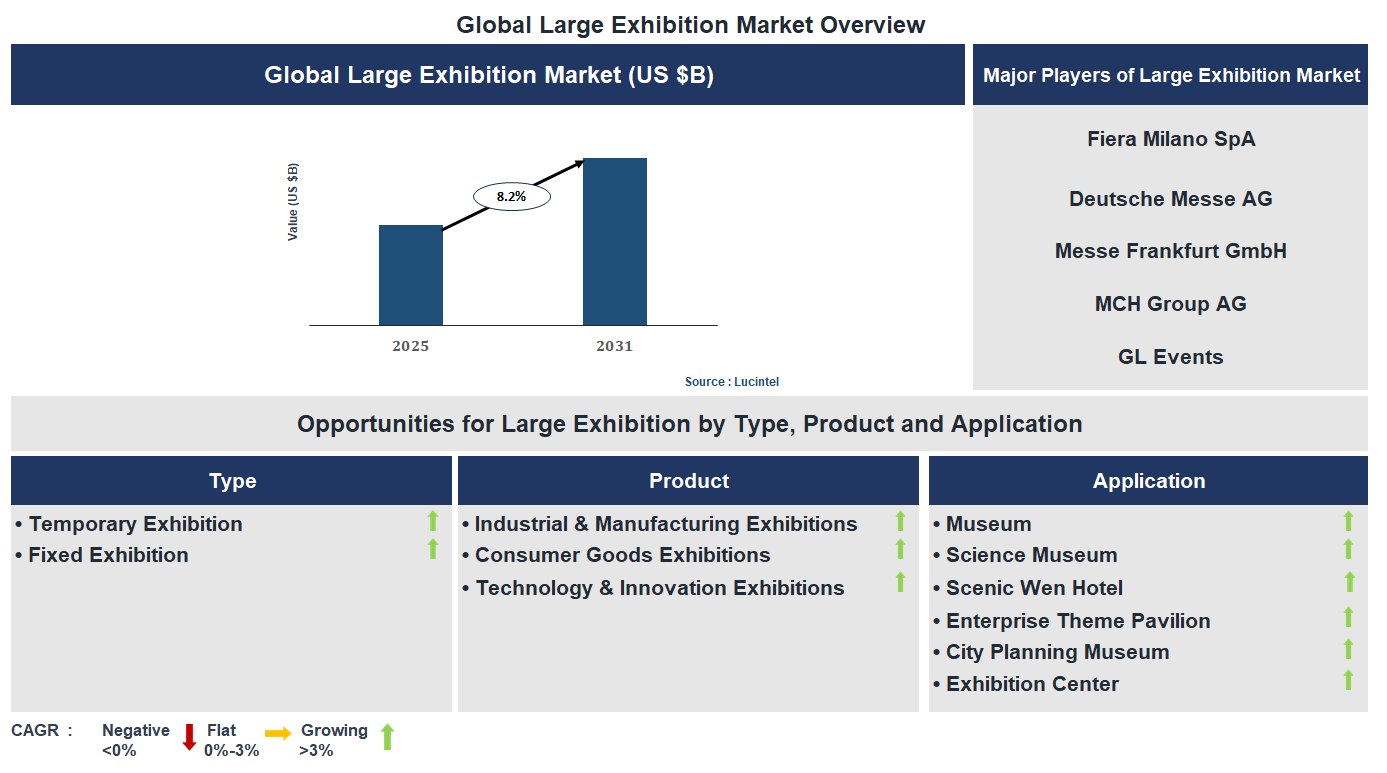
The future of the global large exhibition market looks promising with opportunities in the industrial & manufacturing exhibition, consumer good exhibition, and technology & innovation exhibition markets. The global large exhibition market is expected to grow with a CAGR of 8.2% from 2025 to 2031. The major drivers for this market are the increasing demand for interactive exhibitions, the rising adoption of digital event technologies, and the growing need for networking opportunities.• Lucintel forecasts that, within the type category, temporary exhibition is expected to witness higher growth over the forecast period.
• Within the product category, technology & innovation exhibition is expected to witness the highest growth.
• In terms of region, APAC is expected to witness the highest growth over the forecast period. Gain valuable insights for your business decisions with our comprehensive 150+ page report. Sample figures with some insights are shown below.
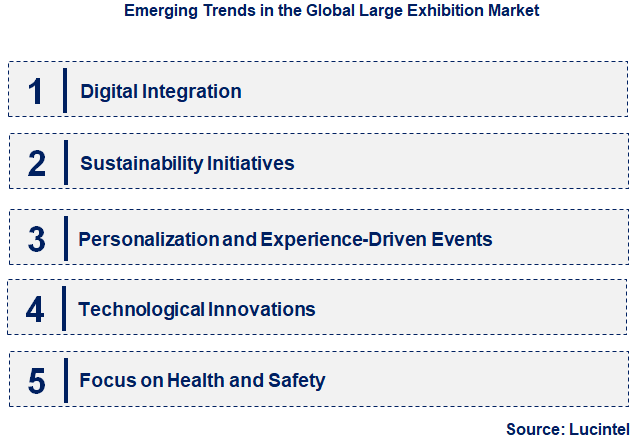
Emerging Trends in the Large Exhibition Market
The large exhibition market is experiencing rapid transformation driven by technological advancements, changing consumer preferences, and global economic shifts. As industries seek innovative ways to engage audiences and showcase products, new trends are emerging that redefine how exhibitions are organized, attended, and experienced. These developments are not only enhancing the overall visitor experience but also expanding market reach and operational efficiency. Stakeholders must adapt to these evolving dynamics to stay competitive and capitalize on new opportunities. The following five key trends highlight the major shifts shaping the future of the large exhibition market.• Digital Integration: The adoption of virtual and hybrid exhibition formats is revolutionizing the market by enabling global participation. Digital platforms allow organizers to reach wider audiences beyond physical constraints, providing interactive features such as live streaming, virtual booths, and networking tools. This trend increases accessibility, reduces costs, and offers data-driven insights into attendee behavior, ultimately broadening market reach and enhancing engagement.
• Sustainability Initiatives: Environmental consciousness is becoming central to exhibition planning. Organizers are implementing eco-friendly practices such as reducing waste, using sustainable materials, and promoting energy efficiency. These initiatives appeal to environmentally conscious attendees and exhibitors, helping brands demonstrate corporate responsibility. Sustainability efforts also align with regulatory requirements and can lead to cost savings, positioning the market as more responsible and future-ready.
• Personalization and Experience-Driven Events: Customization is gaining importance as attendees seek more meaningful experiences. Exhibitors are leveraging data analytics to tailor content, product displays, and interactions to individual preferences. This trend enhances attendee satisfaction, increases engagement, and fosters stronger brand connections. Experience-driven events, including live demonstrations and immersive environments, are becoming key differentiators in a competitive market.
• Technological Innovations: The integration of advanced technologies such as augmented reality (AR), virtual reality (VR), artificial intelligence (AI), and 5G connectivity is transforming exhibition experiences. These innovations enable interactive displays, real-time data processing, and seamless communication, making exhibitions more dynamic and engaging. They also facilitate better logistics management and security, improving overall operational efficiency and attendee satisfaction.
• Focus on Health and Safety: The COVID-19 pandemic has heightened awareness of health protocols, prompting a focus on safety measures. Contactless registration, digital ticketing, social distancing arrangements, and enhanced sanitation are now standard practices. These measures reassure attendees, ensure compliance with regulations, and enable the market to operate sustainably amid ongoing health concerns. The emphasis on safety is reshaping event planning and attendee expectations. In summary, these emerging trends are collectively reshaping the large exhibition market by fostering greater inclusivity, sustainability, personalization, technological integration, and safety. They are driving innovation, expanding market reach, and enhancing the overall attendee experience, positioning the industry for sustainable growth in a rapidly evolving landscape.
Recent Development in the Large Exhibition Market
The large exhibition market is experiencing rapid transformation driven by technological advancements, changing consumer preferences, and global economic shifts. These developments are creating new opportunities for exhibitors, organizers, and stakeholders to innovate and expand their reach. As the industry adapts to these changes, it is poised for significant growth, offering enhanced experiences and increased revenue streams. Understanding these key developments is essential for market participants aiming to capitalize on emerging trends and maintain a competitive advantage.• Expanding Virtual and Hybrid Events: The integration of digital technology has revolutionized the exhibition industry by enabling virtual and hybrid events. This development allows global participation without geographical constraints, broadening audience reach and reducing costs. It also offers interactive features, data analytics, and on-demand content, enhancing attendee engagement. As a result, organizers can attract diverse demographics, increase revenue streams, and create more flexible, scalable event formats that adapt to evolving consumer preferences.
• Emphasizing Eco-Friendly Practices: Sustainability has become a core focus, with exhibitors and organizers adopting eco-friendly practices. These include reducing waste, using sustainable materials, and implementing energy-efficient solutions. Such initiatives appeal to environmentally conscious consumers and stakeholders, enhancing brand reputation. They also align with regulatory requirements and corporate social responsibility goals. This shift encourages innovation in event design and operations, fostering a more sustainable industry that attracts eco-minded clients and audiences.
• Adoption of AI and Data Analytics: The deployment of artificial intelligence (AI) and data analytics is transforming how exhibitions are planned and executed. AI-driven tools optimize logistics, personalize attendee experiences, and improve matchmaking between exhibitors and visitors. Data analytics provide insights into attendee behavior, preferences, and engagement levels, enabling targeted marketing and improved ROI. This technological evolution enhances operational efficiency, attendee satisfaction, and overall event success, positioning the industry for smarter, more data-driven growth.
• Expanding into New Sectors and Regions: The exhibition market is diversifying by entering new sectors such as technology, healthcare, and renewable energy, alongside expanding into emerging markets. This diversification opens up fresh revenue streams and reduces dependency on traditional industries. It also fosters innovation through cross-sector collaborations and attracts a broader audience base. Regional expansion into developing economies offers growth opportunities driven by rising industrialization and increasing demand for trade shows, strengthening the global footprint of the industry.
• Focus on Personalization and Engagement: Improving attendee experience through personalized content, interactive displays, and networking opportunities is a key development. Technologies like mobile apps, augmented reality, and live streaming facilitate real-time engagement and tailored experiences. This focus increases attendee satisfaction, loyalty, and repeat participation. Enhanced engagement strategies also provide valuable data for future event planning, ensuring that exhibitions remain relevant and compelling in a competitive market landscape. The overall impact of these developments is a more dynamic, sustainable, and technologically advanced exhibition market. These opportunities enable industry stakeholders to expand their reach, improve operational efficiency, and deliver superior experiences. As a result, the market is poised for sustained growth, increased profitability, and greater global influence, shaping the future of large exhibitions worldwide.
Strategic Growth Opportunities in the Large Exhibition Market
The large exhibition market is experiencing significant growth driven by globalization, technological advancements, and increasing demand for immersive experiences. As industries seek innovative ways to showcase products and connect with audiences, opportunities arise across various sectors. Companies that leverage emerging technologies and strategic partnerships can capitalize on expanding markets, enhancing engagement, and revenue streams. This dynamic environment offers numerous avenues for growth, requiring a focus on innovation, sustainability, and customer experience to stay competitive and meet evolving client needs.• Expanding Digital and Hybrid Exhibition Platforms: The integration of digital and hybrid formats offers broader reach and accessibility, enabling organizers to attract global audiences beyond physical constraints. Virtual booths, live streaming, and interactive online experiences enhance engagement and reduce costs. As technology advances, these platforms will become more sophisticated, providing immersive environments that complement physical exhibitions. This growth opportunity allows organizers to diversify revenue streams, gather valuable data, and adapt to changing attendee preferences, ensuring resilience in a competitive market.
• Adoption of Sustainable and Eco-Friendly Exhibition Practices: Sustainability is increasingly vital in the exhibition industry, driven by environmental concerns and regulatory pressures. Implementing eco-friendly materials, reducing waste, and promoting energy-efficient solutions can enhance brand reputation and attract environmentally conscious clients. Green certifications and sustainable logistics also appeal to corporate clients aiming to meet ESG goals. This opportunity encourages innovation in sustainable design and operations, positioning companies as responsible industry leaders while reducing costs and environmental impact.
• Leveraging Augmented Reality (AR) and Virtual Reality (VR) Technologies: AR and VR technologies create immersive, interactive experiences that captivate audiences and differentiate exhibitions. These tools enable virtual product demonstrations, interactive displays, and remote participation, expanding reach and engagement. As hardware becomes more affordable and user-friendly, adoption will accelerate across industries such as automotive, real estate, and consumer electronics. This growth opportunity enhances attendee experience, provides valuable data insights, and opens new revenue channels through premium virtual content and sponsorships.
• Developing Niche and Industry-Specific Exhibitions: Specialized exhibitions tailored to specific industries or niche markets can attract targeted audiences and high-value exhibitors. These events foster deeper networking, knowledge sharing, and business opportunities within focused sectors such as healthcare, technology, or luxury goods. By addressing unique industry needs, organizers can command premium pricing and build loyal communities. This approach also encourages innovation and collaboration, positioning the exhibition as a vital platform for industry advancement and long-term growth.
• Enhancing Data Analytics and Personalization Capabilities: Advanced data analytics enable organizers to understand attendee preferences, behavior, and engagement patterns. Personalization of content, networking opportunities, and marketing efforts improves attendee satisfaction and retention. Data-driven insights also inform strategic decisions, optimize event layouts, and enhance ROI for exhibitors. As data collection and analysis tools become more sophisticated, this opportunity allows for highly tailored experiences, increased sponsorship value, and stronger relationships with clients, ultimately driving growth and competitiveness in the market. The overall impact of these opportunities will significantly shape the future of the large exhibition market, fostering innovation, sustainability, and customer-centric approaches. Companies that effectively leverage these growth avenues can expand their market share, improve operational efficiency, and deliver more engaging, impactful experiences. Embracing technological advancements and industry-specific strategies will be crucial for sustained success in this evolving landscape.
Large Exhibition Market Driver and Challenges
The large exhibition market is influenced by a variety of technological, economic, and regulatory factors that shape its growth and sustainability. Technological advancements such as digital platforms and virtual reality are transforming how exhibitions are organized and attended, expanding reach and engagement. Economic factors, including global economic stability and disposable income levels, directly impact attendance and sponsorship opportunities. Regulatory frameworks concerning safety, health, and environmental standards also play a crucial role in shaping operational practices. Additionally, evolving consumer preferences and technological innovations are driving market adaptation. Understanding these drivers and challenges is essential for stakeholders aiming to capitalize on opportunities and mitigate risks within this dynamic industry. The factors responsible for driving the large exhibition market include:• Technological Innovation: The integration of digital technologies such as virtual reality, augmented reality, and online platforms has revolutionized the exhibition landscape. These innovations enable virtual attendance, remote participation, and enhanced engagement, broadening audience reach beyond geographical limitations. They also facilitate data collection and analytics, allowing organizers to tailor experiences and improve marketing strategies. As technology continues to evolve rapidly, exhibitors and organizers are investing heavily to stay competitive, which accelerates market growth and diversification.
• Increasing Global Trade and Business Expansion: The globalization of industries has led to a surge in international trade fairs and exhibitions. Companies seek to showcase their products and services to a broader audience, fostering networking and partnership opportunities. Governments and trade organizations actively promote exhibitions to boost economic development and attract foreign investment. This trend results in higher participation rates, larger venues, and more diverse offerings, fueling market expansion and creating new revenue streams.
• Economic Growth and Disposable Income: Economic stability and growth in key regions increase corporate budgets for marketing and brand visibility through exhibitions. Higher disposable incomes enable consumers and businesses to participate more actively, attend premium events, and invest in innovative exhibition experiences. As economies expand, the demand for large-scale exhibitions rises, supporting infrastructure development and attracting international exhibitors, which further stimulates market growth.
• Regulatory and Safety Standards: Stringent safety, health, and environmental regulations influence how exhibitions are planned and executed. Compliance with these standards ensures attendee safety and environmental sustainability, but also increases operational costs and complexity. Regulatory frameworks can act as barriers for new entrants but also promote higher quality and professionalism within the industry. Adapting to evolving regulations is crucial for market players to maintain credibility and avoid legal issues.
• Growing Use of Data Analytics and AI: The adoption of data analytics and artificial intelligence enhances decision-making, personalization, and operational efficiency in the exhibition industry. Organizers utilize data to optimize layouts, target marketing efforts, and improve attendee experiences. AI-driven tools facilitate virtual matchmaking, lead generation, and post-event analysis, providing a competitive edge. This technological integration drives innovation, improves ROI for exhibitors, and attracts more participants, thereby fueling market growth. The challenges in the large exhibition market are:
• High Operational and Infrastructure Costs: Organizing large-scale exhibitions requires significant investment in infrastructure, technology, and logistics. Venue rentals, security, staffing, and marketing expenses contribute to high operational costs, which can limit profitability, especially for smaller organizers. Additionally, maintaining state-of-the-art facilities to meet evolving standards demands continuous capital expenditure, posing financial challenges and potentially restricting market entry for new players.
• Impact of Global Economic Fluctuations: Economic downturns, geopolitical tensions, and pandemics can severely disrupt the exhibition industry. Reduced corporate budgets, travel restrictions, and decreased consumer spending led to lower participation and attendance. These fluctuations create uncertainty, delay investments, and can cause cancellations, impacting revenue streams. The industry’s dependence on economic stability makes it vulnerable to external shocks, requiring strategic resilience planning.
• Regulatory and Environmental Challenges: Increasing regulatory requirements related to safety, health, and environmental sustainability impose additional compliance burdens. These regulations can lead to delays in planning, increased costs, and operational constraints. Environmental concerns also demand sustainable practices, which may involve significant changes in logistics and materials used. Navigating complex regulatory landscapes requires expertise and resources, posing challenges for market players aiming to expand or innovate. In summary, the large exhibition market is driven by technological advancements, globalization, economic growth, and data-driven innovations, which collectively foster expansion and diversification. However, high operational costs, economic volatility, and regulatory complexities present significant hurdles. The interplay of these drivers and challenges shapes the market’s trajectory, demanding strategic agility from stakeholders. Embracing technological innovation and regulatory compliance while managing costs and economic risks will be crucial for sustained growth and competitiveness in this evolving industry.
List of Large Exhibition Companies
Companies in the market compete on the basis of product quality offered. Major players in this market focus on expanding their manufacturing facilities, R&D investments, infrastructural development, and leverage integration opportunities across the value chain. With these strategies large exhibition companies cater increasing demand, ensure competitive effectiveness, develop innovative products & technologies, reduce production costs, and expand their customer base. Some of the large exhibition companies profiled in this report include-• Fiera Milano SpA
• Deutsche Messe AG
• Messe Frankfurt GmbH
• MCH Group AG
• GL Events
• Shanghai Fengyuzhu Culture Technology
• Silkroad Visual Technology
• Shenzhen ESUN Display
• Broad Messe
• Hefei and Exhibition Technology
Large Exhibition Market by Segment
The study includes a forecast for the global large exhibition market by type, product, application, and region.Large Exhibition Market by Type [Value from 2019 to 2031]:
• Temporary Exhibition
• Fixed Exhibition
Large Exhibition Market by Product [Value from 2019 to 2031]:
• Industrial & Manufacturing Exhibitions
• Consumer Goods Exhibitions
• Technology & Innovation Exhibitions
Large Exhibition Market by Application [Value from 2019 to 2031]:
• Museum
• Science Museum
• Scenic Wen Hotel
• Enterprise Theme Pavilion
• City Planning Museum
• Exhibition Center
Large Exhibition Market by Region [Value from 2019 to 2031]:
• North America
• Europe
• Asia Pacific
• The Rest of the World
Country Wise Outlook for the Large Exhibition Market
The large exhibition market has experienced significant shifts driven by technological advancements, changing consumer preferences, and global economic factors. Countries are increasingly investing in innovative exhibition formats, digital integration, and sustainable practices to attract international visitors and exhibitors. The COVID-19 pandemic accelerated digital transformation, prompting a surge in virtual and hybrid exhibitions. Governments and the private sector are collaborating to enhance infrastructure and promote local industries through large-scale events. These developments reflect a strategic focus on economic growth, international collaboration, and adapting to new norms in the exhibition industry.• United States: The US exhibition market has seen a rise in hybrid events combining physical and virtual formats, driven by technological innovation and pandemic adaptations. Major cities like Las Vegas and New York continue to host large-scale international expos, with increased emphasis on sustainability and digital engagement. Investment in advanced infrastructure and virtual reality experiences has enhanced attendee participation. The US also focuses on niche markets such as technology, healthcare, and entertainment, expanding global reach and attracting diverse exhibitors. Government support and private sector investments are fueling growth, positioning the US as a leader in innovative exhibition solutions.
• China: China’s large exhibition market has rapidly expanded, becoming one of the worlds largest. The country emphasizes integrating digital technology, with many events adopting virtual components to reach wider audiences. Major cities like Shanghai and Beijing host mega-events that showcase manufacturing, technology, and consumer goods. The government actively promotes international cooperation through large exhibitions, boosting trade and economic development. Investments in infrastructure, smart venues, and eco-friendly practices are prominent. China’s focus on innovation and digital transformation has made its exhibition industry more competitive globally, attracting international exhibitors and visitors seeking new business opportunities.
• Germany: Germany remains a key player in the global exhibition market, known for its high-quality trade fairs and industry-specific expos. The country has enhanced its digital offerings, including virtual and hybrid formats, to adapt to post-pandemic realities. Focus areas include automotive, machinery, and renewable energy sectors. Germany’s strong infrastructure, strategic location in Europe, and emphasis on sustainability have contributed to its continued success. The industry is also investing in smart venues and innovative event formats to attract international participants. Government and industry collaborations aim to promote Germany as a leading hub for large exhibitions and trade shows.
• India: India’s exhibition market is experiencing rapid growth, driven by economic expansion and increasing domestic and international trade. The country is investing heavily in infrastructure, including new convention centers and smart venues, to host large-scale events. Focus sectors include textiles, technology, and pharmaceuticals. Digital integration is gaining importance, with many events adopting virtual components to expand reach. The government’s initiatives to promote “Make in India” and ease of doing business are reflected in the growing number of international exhibitions. India aims to position itself as a major global exhibition hub, leveraging its large domestic market and strategic location.
• Japan: Japan’s large exhibition market is characterized by innovation and technological integration. The country hosts numerous international trade fairs, especially in electronics, robotics, and the automotive industries. Recent developments include the adoption of virtual and hybrid formats to accommodate global participants. Japan emphasizes sustainability and smart venue technologies to enhance event experiences. The government supports the industry through policies promoting international collaboration and digital transformation. Japan’s focus on high-quality, specialized exhibitions continues to attract global exhibitors and visitors, reinforcing its reputation as a leading hub for advanced technology and industrial innovation.

Features of the Global Large Exhibition Market
Market Size Estimates: Large exhibition market size estimation in terms of value ($B). Trend and Forecast Analysis: Market trends (2019 to 2024) and forecast (2025 to 2031) by various segments and regions. Segmentation Analysis: Large exhibition market size by type, product, application, and region in terms of value ($B). Regional Analysis: Large exhibition market breakdown by North America, Europe, Asia Pacific, and Rest of the World. Growth Opportunities: Analysis of growth opportunities in different types, products, applications, and regions for the large exhibition market. Strategic Analysis: This includes M&A, new product development, and competitive landscape of the large exhibition market. Analysis of competitive intensity of the industry based on Porter’s Five Forces model.
FAQ
Q1. What is the growth forecast for large exhibition market? Answer: The global large exhibition market is expected to grow with a CAGR of 8.2% from 2025 to 2031. Q2. What are the major drivers influencing the growth of the large exhibition market? Answer: The major drivers for this market are the increasing demand for interactive exhibitions, the rising adoption of digital event technologies, and the growing need for networking opportunities. Q3. What are the major segments for large exhibition market? Answer: The future of the large exhibition market looks promising with opportunities in the industrial & manufacturing exhibition, consumer good exhibition, and technology & innovation exhibition markets. Q4. Who are the key large exhibition market companies? Answer: Some of the key large exhibition companies are as follows:• Fiera Milano SpA
• Deutsche Messe AG
• Messe Frankfurt GmbH
• MCH Group AG
• GL Events
• Shanghai Fengyuzhu Culture Technology
• Silkroad Visual Technology
• Shenzhen ESUN Display
• Broad Messe
• Hefei and Exhibition Technology Q5. Which large exhibition market segment will be the largest in future? Answer: Lucintel forecasts that, within the type category, temporary exhibition is expected to witness higher growth over the forecast period. Q6. In large exhibition market, which region is expected to be the largest in next 5 years? Answer: In terms of region, APAC is expected to witness the highest growth over the forecast period. Q7. Do we receive customization in this report? Answer: Yes, Lucintel provides 10% customization without any additional cost.
Table of Contents
List of Figures
List of Tables
Methodology
- In-depth interviews of the major players in this market
- Detailed secondary research from competitors’ financial statements and published data
- Extensive searches of published works, market, and database information pertaining to industry news, company press releases, and customer intentions
- A compilation of the experiences, judgments, and insights of Lucintel’s professionals, who have analyzed and tracked this market over the years.


Buy Now
Choose a license that fits your team. Instant PDF delivery.
Prices exclude taxes. Instant delivery. Custom licensing available on request.
Key Questions
- • What are some of the most promising, high-growth opportunities for the large exhibition market by type (temporary exhibition and fixed exhibition), product (industrial & manufacturing exhibitions, consumer goods exhibitions, and technology & innovation exhibitions), application (museum, science museum, scenic wen hotel, enterprise theme pavilion, city planning museum, and exhibition center), and region (North America, Europe, Asia Pacific, and the Rest of the World)?
- • Which segments will grow at a faster pace and why?
- • Which region will grow at a faster pace and why?
- • What are the key factors affecting market dynamics? What are the key challenges and business risks in this market?
- • What are the business risks and competitive threats in this market?
- • What are the emerging trends in this market and the reasons behind them?
- • What are some of the changing demands of customers in the market?
- • What are the new developments in the market? Which companies are leading these developments?
- • Who are the major players in this market? What strategic initiatives are key players pursuing for business growth?
- • What are some of the competing products in this market and how big of a threat do they pose for loss of market share by material or product substitution?
- • What M&A activity has occurred in the last 6 years and what has its impact been on the industry? For any questions related to Large Exhibition Market, Large Exhibition Market Size, Large Exhibition Market Growth, Large Exhibition Market Analysis, Large Exhibition Market Report, Large Exhibition Market Share, Large Exhibition Market Trends, Large Exhibition Market Forecast, Large Exhibition Companies, write Lucintel analyst at email: helpdesk@lucintel.com. We will be glad to get back to you soon.


