
Market Report · July 17, 2026

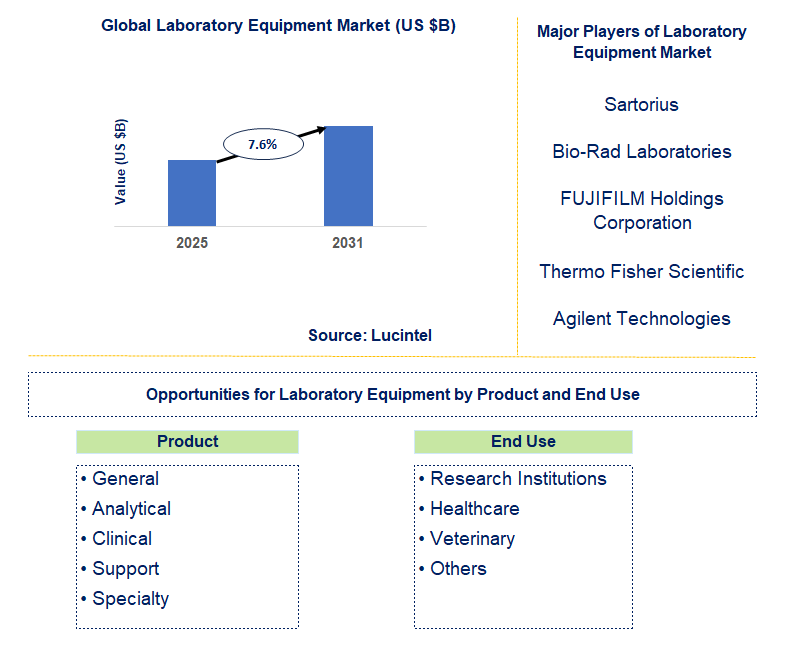
Key data points: The growth forecast = 7.6% annually for the next 7 years. Scroll below to get more insights. This market report covers trends, opportunities and forecasts in laboratory equipment market to 2031 by product (general, analytical, clinical, support, and specialty), end use (research institutions, healthcare, veterinary, and others), and region (North America, Europe, Asia Pacific, and the Rest of the World)
We'll send your sample report shortly.
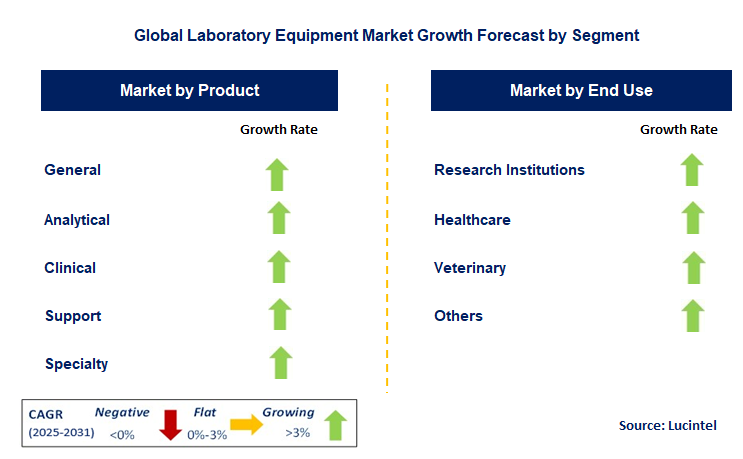
• Lucintel forecasts that, within the product category, analytical is expected to witness the highest growth over the forecast period.
• Within the end use category, healthcare is expected to witness the highest growth.
• In terms of region, APAC is expected to witness the highest growth over the forecast period. Gain valuable insights for your business decisions with our comprehensive 150+ page report. Sample figures with some insights are shown below.
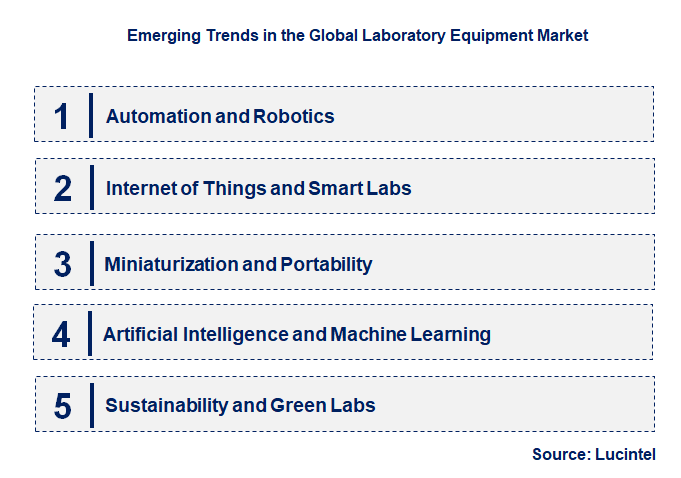
• Automation and Robotics: This trend involves using robotic systems and automated instruments to perform repetitive tasks like sample handling, pipetting, and data collection. The impact is significant: it reduces human error, increases throughput, and frees up scientists to focus on complex analysis and research design. This is especially crucial in high-volume fields like drug discovery and genomics.
• Internet of Things and Smart Labs: This trend involves connecting laboratory equipment to a centralized network, enabling real-time monitoring and control. The impact is enhanced operational efficiency, as lab managers can remotely monitor experiments, receive real-time alerts on critical parameters, and perform predictive maintenance. This ensures optimal conditions for experiments and minimizes downtime.
• Miniaturization and Portability: This trend focuses on creating smaller, more compact, and portable laboratory devices and "lab-on-a-chip" technologies. The impact is a shift towards point-of-care testing and on-site analysis, especially in remote or resource-limited settings. It also reduces the need for large lab spaces, making complex diagnostics and research more accessible.
• Artificial Intelligence and Machine Learning: This trend involves integrating AI and ML algorithms for advanced data analysis and predictive modeling. The impact is a revolution in data interpretation, as these technologies can analyze vast datasets quickly and accurately, identifying patterns and correlations that might be missed by human researchers. This accelerates discovery and improves decision-making.
• Sustainability and Green Labs: This trend involves developing energy-efficient equipment, minimizing waste, and using recyclable materials in lab supplies. The impact is a reduction in the environmental footprint of research facilities. Laboratories are adopting practices and equipment that consume less energy, generate less waste, and are more resource-efficient, aligning with global sustainability goals. These trends are collectively reshaping the market by prioritizing efficiency, connectivity, and intelligence. The shift toward automated, smart, and miniaturized equipment, coupled with a focus on data-driven insights and sustainability, is making scientific research more productive, accurate, and accessible than ever before.
• Advanced Analytical Instruments: New analytical instruments, such as high-resolution mass spectrometers and next-generation sequencers, are being developed. The impact is a significant increase in the precision and sensitivity of analyses, which is crucial for complex research in proteomics, metabolomics, and genomics. These tools allow for deeper insights into biological systems and disease mechanisms.
• Rise of Digital Solutions: There’s a growing adoption of digital solutions, including cloud-based Laboratory Information Management Systems (LIMS). The impact is improved data management, collaboration, and remote access. Cloud-based platforms allow researchers to store, share, and analyze data from anywhere, enhancing global collaboration and streamlining workflows while ensuring data integrity.
• Focus on Point-of-Care Testing: This development involves the creation of portable, user-friendly diagnostic devices for use outside traditional laboratories. The impact is faster and more accessible diagnostics, particularly for infectious diseases and chronic conditions. POCT devices reduce turnaround times for results, enabling quicker medical decisions and improving patient outcomes in various healthcare settings.
• Integration of AI in Diagnostics: AI is being integrated into diagnostic platforms to automate image analysis and pattern recognition. The impact is enhanced diagnostic accuracy and speed. AI-powered systems can analyze complex medical images and genetic data to assist clinicians in identifying diseases more accurately and efficiently, especially in fields like pathology and radiology.
• Expansion of Bioprocessing Equipment: The market is seeing a surge in demand for bioprocessing equipment due to the growth of the biopharmaceutical industry. The impact is the facilitation of large-scale production of biologics, such as monoclonal antibodies and vaccines. This is critical for meeting the increasing demand for advanced therapies and for rapid response to public health crises. These developments are collectively enhancing the capabilities of laboratories, making them more automated, precise, and data-centric. They are enabling faster research cycles, improving diagnostic accuracy, and expanding access to advanced scientific and medical technologies, ultimately driving progress in both basic science and clinical practice.
• Pharmaceutical and Biopharma R&D: The pharmaceutical and biopharmaceutical sectors are the largest consumers of advanced laboratory equipment. The impact is a massive opportunity for manufacturers of analytical instruments, high-throughput screening systems, and bioprocessing equipment. As drug discovery and development pipelines expand, so does the demand for sophisticated tools to accelerate research and ensure quality control.
• Clinical Diagnostics and Pathology: The growing prevalence of chronic diseases and the push for personalized medicine are driving demand for advanced diagnostic equipment. The impact is a major opportunity in areas like molecular diagnostics, immunoassay analyzers, and automated pathology systems. These applications require high accuracy, fast turnaround times, and the ability to handle a high volume of samples efficiently.
• Academic and Government Research: Increased funding for scientific research by governments and academic institutions worldwide is a key growth driver. The impact is a continuous and stable demand for a broad range of laboratory equipment, from basic general-purpose tools to highly specialized research instruments. This sector provides a foundational market for new technologies and innovations.
• Food and Beverage Testing: With increasing concerns about food safety and quality, there’s a growing need for analytical equipment in this sector. The impact is an opportunity in areas like chromatography, mass spectrometry, and spectroscopy for detecting contaminants, allergens, and adulteration. This application ensures product quality and compliance with stringent regulatory standards.
• Forensics and Environmental Testing: The need for accurate and sensitive analysis in forensic and environmental applications presents a unique growth opportunity. The impact is demand for specialized instruments like gas chromatography and mass spectrometry. These tools are essential for analyzing trace evidence in criminal investigations and for monitoring pollutants in air, water, and soil samples. These growth opportunities are fueling innovation and market expansion by aligning with critical societal needs in health, safety, and research. By focusing on these applications, companies can leverage trends like personalized medicine and biomanufacturing, while also meeting the foundational needs of academic and industrial research, ensuring sustained market growth.
• Sartorius
• Bio-Rad Laboratories
• FUJIFILM Holdings Corporation
• Thermo Fisher Scientific
• Agilent Technologies
• General
• Analytical
• Clinical
• Support
• Specialty
• Research Institutions
• Healthcare
• Veterinary
• Others
• North America
• Europe
• Asia Pacific
• The Rest of the World
• United States: The U.S. market is a leader in technological adoption, driven by strong R&D funding and a robust biotech and pharmaceutical industry. Developments are focused on automation, high-throughput systems, and integrating AI and machine learning for advanced data analysis. The market also sees a trend toward cloud-based solutions to facilitate remote work and collaboration.
• China: China’s market is rapidly expanding, fueled by increasing government investment in scientific research and a growing healthcare sector. Key advancements include a significant increase in local manufacturing capabilities and the adoption of high-tech instruments. The country is focusing on becoming a key player in the global market, with a strong emphasis on automation and digital transformation.
• Germany: Germany is a hub for high-quality, precision-engineered laboratory equipment. The market is characterized by a strong emphasis on sophisticated analytical instruments and specialized equipment for fields like life sciences. There’s a growing trend toward green and sustainable laboratory solutions, with companies focusing on energy-efficient and eco-friendly products.
• India: India’s market is one of the fastest-growing due to expanding healthcare infrastructure and rising R&D activities, particularly in pharmaceuticals and biotechnology. Developments are focused on adopting cost-effective, yet technologically advanced, solutions. The country is seeing a rise in local manufacturing and a growing demand for both analytical and general-purpose laboratory equipment.
• Japan: Japan’s laboratory equipment market is known for its strong focus on innovation and high-quality standards. Developments are concentrated on robotics and advanced materials science, with a growing emphasis on miniaturization and creating portable devices. The market is also seeing a shift toward equipment that supports regenerative medicine and personalized diagnostics.


• Sartorius
• Bio-Rad Laboratories
• FUJIFILM Holdings Corporation
• Thermo Fisher Scientific
• Agilent Technologies Q5. Which laboratory equipment market segment will be the largest in future? Answer: Lucintel forecasts that, within the product category, analytical is expected to witness the highest growth over the forecast period. Q6. In laboratory equipment market, which region is expected to be the largest in next 5 years? Answer: In terms of region, APAC is expected to witness the highest growth over the forecast period. Q7. Do we receive customization in this report? Answer: Yes, Lucintel provides 10% customization without any additional cost.


Choose a license that fits your team. Instant PDF delivery.
Prices exclude taxes. Instant delivery. Custom licensing available on request.
Market Report · July 17, 2026
Market Report · July 16, 2026
Market Report · July 10, 2026
Trusted partner for strategic intelligence and business growth


Receive a complimentary market analysis tailored to your industry. Our analysts will identify key growth opportunities and competitive dynamics specific to your business.

Market size, growth rate, and key trend analysis for your specific sector.

Top competitor positioning and market share analysis.

Strategic recommendations backed by data-driven insights.
Get curated market intelligence and competitive moves straight to your inbox.
By subscribing, you agree to receive our monthly insights. Unsubscribe anytime.
Receive a complimentary market analysis tailored to your industry. Our analysts will identify key growth opportunities and competitive dynamics specific to your business.
Market size, growth rate, and key trend analysis for your specific sector.
Top competitor positioning and market share analysis.
Strategic recommendations backed by data-driven insights.
Get curated market intelligence, emerging trends, and competitive moves straight to your inbox each month.
By subscribing, you agree to receive our monthly insights. Unsubscribe anytime.
We'll send your sample report shortly.