
Market Report · July 17, 2026

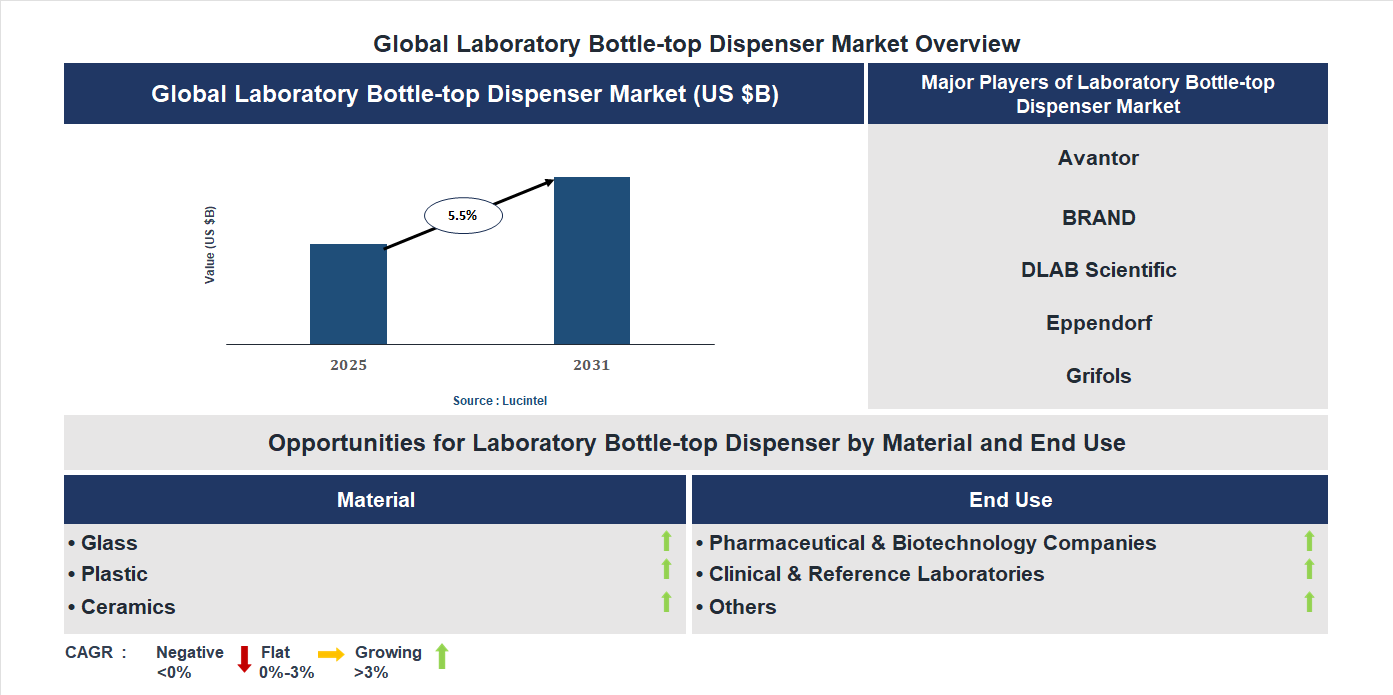
Key data points: The growth forecast = 5.5% annually for the next 7 years. Scroll below to get more insights. This market report covers trends, opportunities and forecasts in laboratory bottle-top dispenser market to 2031 by material (glass, plastic, and ceramics), end use (pharmaceutical & biotechnology companies, clinical & reference laboratories, and others), and region (North America, Europe, Asia Pacific, and the Rest of the World)
We'll send your sample report shortly.
• Lucintel forecasts that, within the material category, plastic is expected to witness the highest growth over the forecast period.
• Within the end use category, pharmaceutical & biotechnology company is expected to witness higher growth.
• In terms of region, APAC is expected to witness the highest growth over the forecast period. Gain valuable insights for your business decisions with our comprehensive 150+ page report. Sample figures with some insights are shown below.
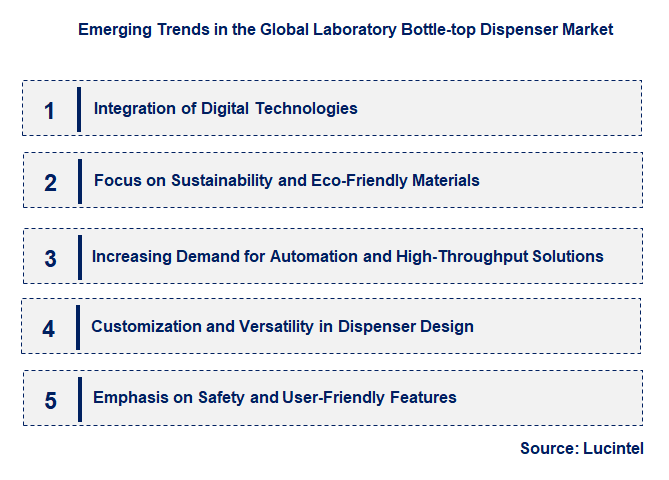
• Integration of Digital Technologies: The adoption of digital and smart dispensing systems is on the rise, enabling precise control and data logging. These advanced dispensers incorporate features like touchscreen interfaces, connectivity with laboratory information management systems (LIMS), and automation capabilities. This trend enhances accuracy, reduces human error, and streamlines workflow, making laboratory processes more efficient. The integration of digital technologies also facilitates real-time monitoring and data analysis, which is crucial for research reproducibility and compliance with regulatory standards.
• Focus on Sustainability and Eco-friendly Materials: Environmental concerns are prompting manufacturers to develop dispensers with eco-friendly materials and energy-efficient designs. Innovations include the use of recyclable plastics, reduced plastic waste, and energy-saving features such as low-power consumption modes. This trend aligns with the global push towards sustainability, helping laboratories reduce their carbon footprint. Additionally, eco-friendly dispensers often feature improved durability and longer lifespan, which further supports sustainable practices and cost savings for end-users.
• Increasing Demand for Automation and High-throughput Solutions: The market is witnessing a shift towards automated liquid handling systems that support high-throughput screening and large-volume dispensing. Automated bottle-top dispensers and integrated systems reduce manual labor, minimize errors, and increase throughput, especially in pharmaceutical and biotech research. This trend is driven by the need for faster, more reliable results in drug discovery, clinical diagnostics, and environmental testing. Automation also enhances safety by reducing exposure to hazardous chemicals, making it a critical development in modern laboratories.
• Customization and Versatility in Dispenser Design: Manufacturers are offering customizable dispensers tailored to specific laboratory needs, including variable volume ranges, specialized materials for corrosive chemicals, and ergonomic designs for user comfort. Versatility in design allows laboratories to optimize workflows and handle a broader range of liquids with precision. This trend supports diverse applications across industries, from chemical handling to biological research, and helps laboratories improve efficiency and safety by providing tailored solutions that meet unique operational requirements.
• Emphasis on Safety and User-friendly Features: Safety features such as spill-proof designs, ergonomic handles, and easy-to-clean components are increasingly incorporated into dispenser models. User-friendly interfaces and maintenance procedures reduce training time and operational errors. This trend is driven by the need to protect laboratory personnel from chemical exposure and ensure compliance with safety regulations. Enhanced safety features also contribute to overall operational efficiency by minimizing accidents and downtime, making these dispensers more attractive to laboratories prioritizing safety and ease of use. In summary, these emerging trends—digital integration, sustainability, automation, customization, and safety—are collectively transforming the laboratory bottle-top dispenser market. They are driving innovations that improve accuracy, efficiency, safety, and environmental responsibility, ultimately reshaping how laboratories operate and advancing scientific research capabilities.
• Technological Innovation: Integration of Digital Controls and Automation The adoption of digital controls and automation in bottle-top dispensers has improved precision and ease of use. Automated features enable consistent dispensing, reduce human error, and enhance laboratory productivity. This innovation attracts research institutions and pharmaceutical companies seeking high accuracy, thereby expanding market reach. The integration of smart technology also facilitates data logging and remote operation, aligning with modern laboratory needs. Overall, this development boosts product competitiveness and market growth by meeting the demand for advanced, user-friendly dispensing solutions.
• Regulatory and Safety Standards Enhancement Stringent regulatory standards for laboratory equipment, especially in pharmaceuticals and biotech sectors, have prompted manufacturers to upgrade their products. Dispensers now incorporate safety features such as leak-proof designs, chemical resistance, and ergonomic handling. Compliance with these standards ensures market acceptance and broadens application scope. Enhanced safety features reduce laboratory accidents and contamination risks, increasing user confidence. This development ensures that products meet evolving legal and safety requirements, fostering trust and expanding market penetration across regulated industries.
• Rising Adoption in Pharmaceutical and Biotech Industries The pharmaceutical and biotech sectors are increasingly adopting bottle-top dispensers for drug formulation, quality control, and research activities. The demand for high-precision liquid handling in these industries has driven innovation and sales. Market players are developing specialized dispensers tailored to these sectors’ needs, such as sterile and chemical-resistant models. This trend significantly boosts market growth, as these industries prioritize accuracy, safety, and compliance, making them key drivers of recent market expansion.
• Expansion of Product Portfolios and Customization Manufacturers are diversifying their product offerings to include various sizes, materials, and features tailored to specific laboratory applications. Customization options, such as adjustable flow rates and ergonomic designs, cater to diverse user preferences. This expansion enhances customer satisfaction and broadens market appeal. The ability to offer tailored solutions helps companies differentiate themselves and capture niche markets, thereby accelerating overall market development and increasing competitiveness.
• Impact of Sustainability and Eco-Friendly Materials Growing environmental awareness has led to the adoption of sustainable materials and eco-friendly manufacturing practices in the production of bottle-top dispensers. Recyclable plastics, reduced chemical waste, and energy-efficient manufacturing processes are gaining prominence. These initiatives appeal to environmentally conscious laboratories and institutions, influencing purchasing decisions. The shift towards sustainability not only aligns with global environmental goals but also enhances brand reputation and market positioning, fostering long-term growth in the market. In summary, recent developments in the laboratory bottle-top dispenser market—ranging from technological innovations and regulatory compliance to industry-specific adoption, product diversification, and sustainability efforts—are collectively driving market expansion. These advancements improve product performance, safety, and environmental impact, making the market more dynamic and aligned with modern laboratory needs. As a result, the market is poised for continued growth, driven by innovation and increasing demand across various scientific and industrial sectors.
• Pharmaceutical Research and Development: Enhanced precision in drug formulation and testing drives demand for advanced bottle-top dispensers, improving accuracy and reproducibility in pharmaceutical experiments. This growth accelerates drug discovery processes and ensures compliance with regulatory standards, ultimately reducing time-to-market for new medications.
• Clinical Diagnostics: The need for reliable sample preparation and reagent dispensing in clinical diagnostics fuels market expansion. Improved dispenser technology enhances workflow efficiency, reduces contamination risks, and ensures consistent results, which are critical for accurate diagnostics and patient care.
• Biotechnology and Life Sciences: Increasing research activities in genomics, proteomics, and cell culture require precise liquid handling. Bottle-top dispensers with automation compatibility support high-throughput screening and complex experiments, boosting productivity and data reliability in biotech labs.
• Food and Beverage Testing: Growing food safety regulations and quality control measures necessitate accurate sample and reagent dispensing. Advanced dispensers facilitate efficient testing processes, ensuring compliance and enhancing product safety standards across the industry.
• Environmental Testing: Rising environmental concerns and regulatory requirements demand precise sampling and analysis. Bottle-top dispensers improve sample handling accuracy, enabling more reliable environmental monitoring and pollution assessment, thus supporting sustainable practices. In summary, these growth opportunities across key applications are significantly impacting the laboratory bottle-top dispenser market by driving innovation, improving operational efficiency, and expanding application scopes. As demand for precision and automation increases, market players are poised to benefit from these developments, fostering sustained growth and technological advancement in the industry.
• Technological Innovation: The continuous development of advanced dispensing technologies, such as digital controls and automation, enhances accuracy, efficiency, and user safety. These innovations meet the increasing demand for precision in laboratories, especially in pharmaceuticals, biotech, and chemical research. Companies investing in R&D are launching smarter, more reliable products, which attract a broader customer base. The integration of IoT and data management features further boosts market appeal, enabling real-time monitoring and improved workflow management. As technology evolves, the market is expected to see increased adoption of high-tech dispensers, driving overall growth.
• Growing Research and Development Activities: Rising investments in scientific research across academia, pharmaceuticals, and industrial sectors are significantly contributing to market growth. Laboratories require reliable dispensing equipment to ensure experimental accuracy and reproducibility. Governments and private organizations are increasing funding for R&D, leading to higher procurement of laboratory equipment, including bottle-top dispensers. This trend supports innovation and expands the customer base, especially in emerging markets where scientific infrastructure is developing rapidly. The demand for high-quality, compliant, and efficient dispensers is thus a key driver fueling market expansion.
• Regulatory and Safety Standards: Stringent safety and environmental regulations are compelling laboratories to adopt safer and more compliant dispensing solutions. Regulatory bodies mandate standards for chemical handling, waste management, and user safety, prompting manufacturers to innovate and improve product standards. Bottle-top dispensers with features like leak-proof designs, chemical resistance, and ergonomic operation are increasingly in demand. Compliance with these standards not only ensures safety but also enhances product credibility and marketability. As regulations become more rigorous globally, the market is driven toward developing safer, environmentally friendly, and compliant dispensing equipment.
• Increasing Adoption in Pharmaceutical and Biotech Sectors: The expanding pharmaceutical and biotech industries are major consumers of laboratory dispensing equipment. Precise liquid handling is critical in drug formulation, testing, and research, making bottle-top dispensers indispensable. The demand for high-throughput screening, quality control, and formulation development is fueling market growth. Additionally, the rise of personalized medicine and biopharmaceuticals necessitates accurate and sterile dispensing solutions, further boosting demand. As these sectors continue to grow, the need for reliable, efficient, and compliant dispensers will remain a significant market driver.
• Expansion in Emerging Markets: Rapid industrialization and increased investment in scientific infrastructure in emerging economies such as China, India, and Brazil are opening new opportunities. Growing research activities, government initiatives, and the establishment of new laboratories are expanding the customer base. Local manufacturers are also entering the market, offering cost-effective solutions that appeal to budget-conscious laboratories. This regional growth contributes to global market expansion, diversifies supply chains, and fosters innovation tailored to local needs. As emerging markets continue to develop their scientific capabilities, the demand for laboratory bottle-top dispensers is expected to rise substantially. The challenges facing this laboratory bottle-top dispenser market include:
• Technological Limitations: Despite advancements, some bottle-top dispensers still face issues related to accuracy, durability, and ease of use. Mechanical wear and tear, calibration errors, and chemical compatibility issues can compromise performance. Developing dispensers that meet the high standards of precision and safety across diverse laboratory conditions remains challenging. Additionally, integrating advanced features like IoT and automation increases complexity and costs, which may deter adoption in budget-sensitive markets. Overcoming these technological limitations is crucial for sustained growth, but it requires significant R&D investment and innovation.
• Regulatory Hurdles: Navigating complex and varying regulatory landscapes across different regions poses a significant challenge. Compliance with safety, environmental, and quality standards involves rigorous testing, documentation, and certification processes, which can delay product launches and increase costs. Manufacturers must continuously update products to meet evolving regulations, adding to R&D expenses. Non-compliance risks legal penalties and damage to reputation, making regulatory adherence a critical but challenging aspect of market operations. Harmonizing standards globally remains difficult, impacting market expansion and product standardization.
• Economic Fluctuations: Economic instability, such as recessions, inflation, and fluctuating research budgets, can adversely affect market growth. Reduced funding for scientific research and laboratory upgrades leads to decreased procurement of laboratory equipment, including bottle-top dispensers. Price sensitivity among end-users may result in preference for cheaper, lower-quality alternatives, impacting premium product sales. Additionally, supply chain disruptions and currency fluctuations can increase manufacturing costs and reduce profit margins. These economic uncertainties create an unpredictable environment, complicating strategic planning and investment decisions for market players. In summary, the laboratory bottle-top dispenser market is driven by technological advancements, increased research activities, regulatory compliance, sector-specific demand, and regional growth in emerging markets. However, technological constraints, regulatory complexities, and economic fluctuations pose significant challenges. These factors collectively influence market dynamics, requiring stakeholders to innovate continuously, adapt to regulatory changes, and navigate economic uncertainties. Overall, the markets future growth hinges on balancing these drivers and challenges through strategic investments, innovation, and compliance, ensuring sustainable development and competitive advantage.
• Avantor
• BRAND
• DLAB Scientific
• Eppendorf
• Grifols
• Hamilton
• Hirschmann Laborgerate
• Kartell
• LabSciences
• Merck
• Glass
• Plastic
• Ceramics
• Pharmaceutical & Biotechnology Companies
• Clinical & Reference Laboratories
• Others
• North America
• Europe
• Asia Pacific
• The Rest of the World
• United States: The US market has seen rapid adoption of automated bottle-top dispensers, driven by increased funding for biomedical research and pharmaceutical development. Innovations focus on digital controls, enhanced accuracy, and ergonomic designs. Regulatory agencies are emphasizing safety and environmental standards, prompting manufacturers to develop eco-friendly models. The rise of biotech startups and research institutions has further fueled demand, with a notable shift towards smart dispensers integrated with laboratory information management systems (LIMS). Market players are also investing in R&D to improve product durability and user interface, maintaining the US as a leading market globally.
• China: China’s laboratory bottle-top dispenser market is expanding due to government initiatives supporting scientific research and industrial growth. The focus is on cost-effective, durable, and easy-to-use dispensers suitable for large-scale manufacturing and research labs. Local manufacturers are increasing their R&D efforts to develop innovative products that meet international standards. The adoption of automation and digital solutions is rising, driven by the increasing number of research institutions and pharmaceutical companies. Additionally, China’s emphasis on environmental sustainability is encouraging the development of eco-friendly dispensers with reduced plastic waste and energy consumption.
• Germany: Germany remains a key player in the European market, with a strong emphasis on precision, quality, and safety standards. The market has seen a surge in demand for high-accuracy dispensers used in chemical, pharmaceutical, and academic research. German companies are focusing on integrating advanced features such as digital calibration and user-friendly interfaces. Sustainability initiatives are also prominent, with manufacturers developing energy-efficient and recyclable products. The country’s strict regulatory environment ensures high product standards, fostering innovation in materials and design. Collaborations between academia and industry are further driving technological advancements in this region.
• India: The Indian market is witnessing rapid growth due to increased investments in healthcare, pharmaceuticals, and research infrastructure. The demand for affordable, reliable, and easy-to-operate dispensers is high among government and private laboratories. Local manufacturers are expanding their product portfolios with innovative, cost-effective solutions tailored to regional needs. The government’s focus on promoting scientific research and manufacturing capabilities is boosting market growth. Additionally, the adoption of digital and automated dispensers is gradually increasing, supported by rising awareness of laboratory safety and efficiency. This growth is expected to continue as India advances its research and development landscape.
• Japan: Japan’s market is characterized by a focus on technological innovation and high-quality standards. The country is investing in smart dispenser technologies that offer enhanced precision and automation capabilities. Japanese manufacturers emphasize durability, safety, and environmental sustainability, aligning with national regulations. The market is driven by the pharmaceutical, chemical, and academic sectors, with a growing trend toward integrating IoT-enabled devices for real-time monitoring and data collection. Japan’s strong R&D infrastructure supports continuous product innovation, and collaborations with global firms are common to incorporate cutting-edge features. Overall, Japan remains a leader in high-end laboratory equipment, including bottle-top dispensers.


• Avantor
• BRAND
• DLAB Scientific
• Eppendorf
• Grifols
• Hamilton
• Hirschmann Laborgerate
• Kartell
• LabSciences
• Merck Q5. Which laboratory bottle-top dispenser market segment will be the largest in future? Answer: Lucintel forecasts that, within the material category, plastic is expected to witness the highest growth over the forecast period. Q6. In laboratory bottle-top dispenser market, which region is expected to be the largest in next 5 years? Answer: In terms of region, APAC is expected to witness the highest growth over the forecast period. Q7. Do we receive customization in this report? Answer: Yes, Lucintel provides 10% customization without any additional cost.


Choose a license that fits your team. Instant PDF delivery.
Prices exclude taxes. Instant delivery. Custom licensing available on request.
Market Report · July 17, 2026
Market Report · July 16, 2026
Market Report · July 10, 2026
Trusted partner for strategic intelligence and business growth


Receive a complimentary market analysis tailored to your industry. Our analysts will identify key growth opportunities and competitive dynamics specific to your business.

Market size, growth rate, and key trend analysis for your specific sector.

Top competitor positioning and market share analysis.

Strategic recommendations backed by data-driven insights.
Get curated market intelligence and competitive moves straight to your inbox.
By subscribing, you agree to receive our monthly insights. Unsubscribe anytime.
Receive a complimentary market analysis tailored to your industry. Our analysts will identify key growth opportunities and competitive dynamics specific to your business.
Market size, growth rate, and key trend analysis for your specific sector.
Top competitor positioning and market share analysis.
Strategic recommendations backed by data-driven insights.
Get curated market intelligence, emerging trends, and competitive moves straight to your inbox each month.
By subscribing, you agree to receive our monthly insights. Unsubscribe anytime.
We'll send your sample report shortly.