
Report Feature
Label-free Array System Market Trends and Forecast
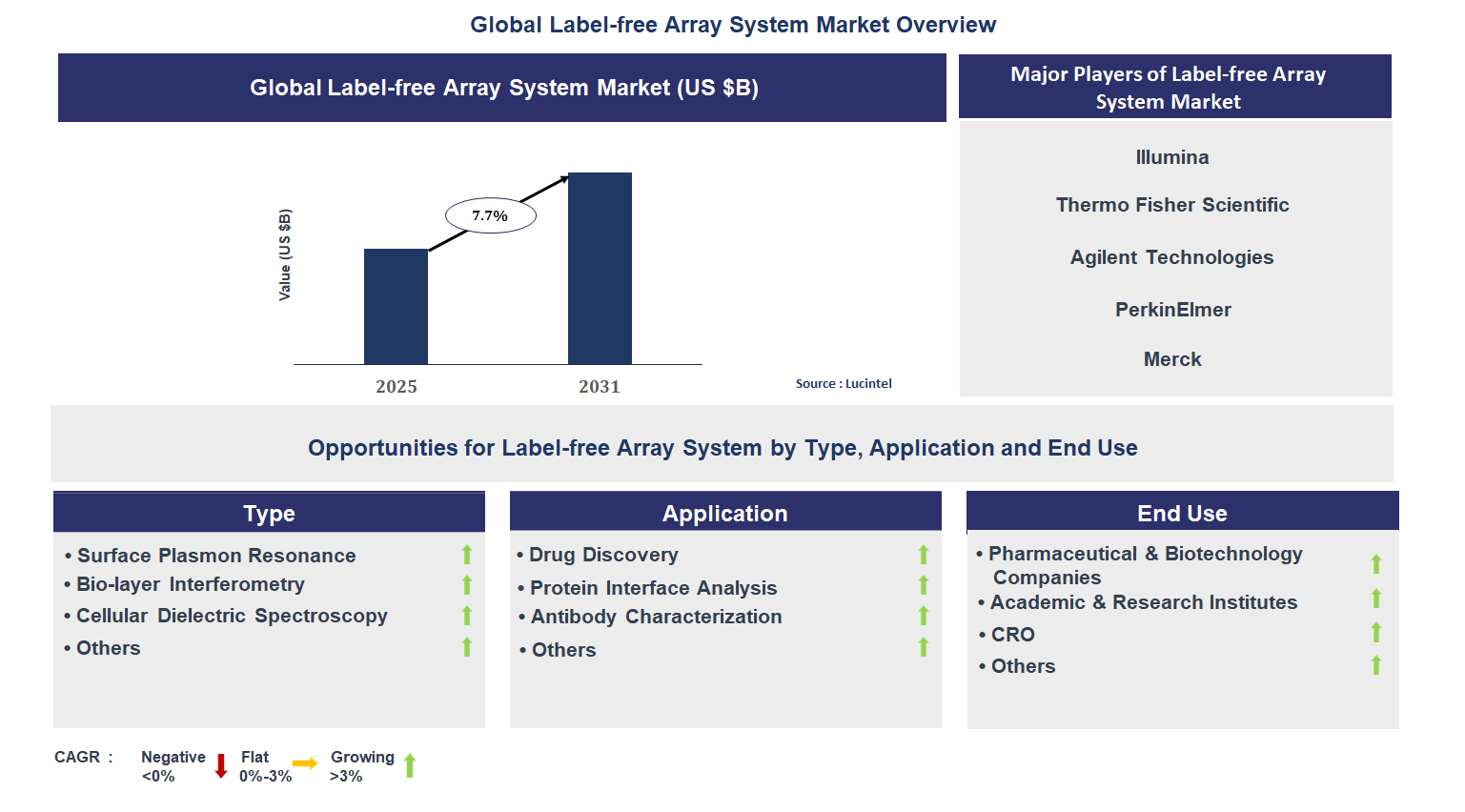
The future of the global label-free array system market looks promising with opportunities in the pharmaceutical & biotechnology company, academic & research institute, and CRO markets. The global label-free array system market is expected to grow with a CAGR of 7.7% from 2025 to 2031. The major drivers for this market are the increasing adoption in drug discovery research, the rising demand for high-throughput screening solutions, and the growing focus on real-time biomolecular interaction analysis.• Lucintel forecasts that, within the type category, surface plasmon resonance is expected to witness the highest growth over the forecast period.
• Within the end use category, pharmaceutical & biotechnology company is expected to witness the highest growth.
• In terms of region, APAC is expected to witness the highest growth over the forecast period. Gain valuable insights for your business decisions with our comprehensive 150+ page report. Sample figures with some insights are shown below.
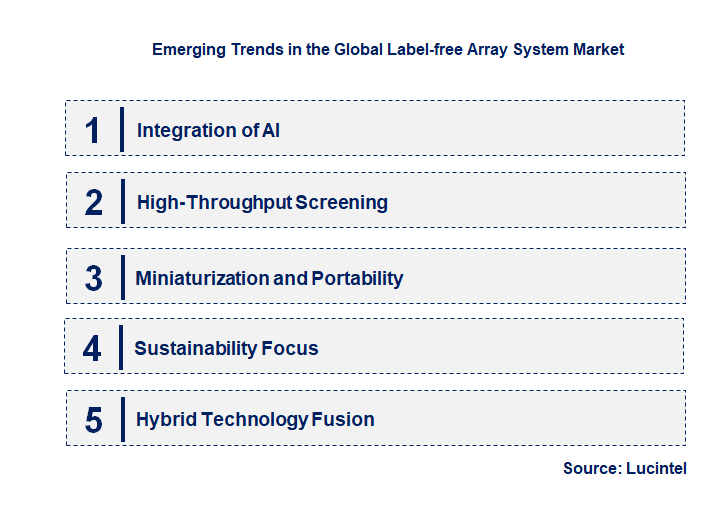
Emerging Trends in the Label-free Array System Market
Emerging trends in the label-free array system market are shaped by technological integrations and expanding applications in precision healthcare, reflecting a shift toward more efficient, data-driven research methodologies that address the complexities of modern biomolecular studies and therapeutic innovation.• Integration of AI: Artificial intelligence integration enhances data analytics from label-free arrays, enabling predictive modeling of molecular interactions and accelerating drug candidate selection; this trend reduces analysis time and improves accuracy, significantly impacting market growth by optimizing R&D workflows in pharma and biotech sectors for faster, more reliable outcomes in personalized treatments.
• High-Throughput Screening: High-throughput capabilities allow simultaneous analysis of multiple biomolecular interactions, streamlining drug discovery processes and minimizing resource use; its impact lies in boosting efficiency for large-scale screening, enabling quicker identification of viable therapeutics and reshaping market dynamics toward scalable, cost-effective research platforms.
• Miniaturization and Portability: Miniaturized portable systems facilitate on-site diagnostics and field research, breaking barriers to traditional lab-bound analysis; this drives broader accessibility in clinical and environmental applications, profoundly influencing market expansion by enabling real-time decisions in remote healthcare settings and fostering innovation in point-of-care technologies.
• Sustainability Focus: Emphasis on eco-friendly, low-waste detection methods aligns with global sustainability goals, reducing reliance on chemical labels and reagents; the impact is a greener research ecosystem that lowers operational costs and environmental footprint, propelling market adoption in regulated industries and enhancing long-term viability of biomolecular studies.
• Hybrid Technology Fusion: Fusion with microfluidics and nanotechnology creates versatile hybrid platforms for complex assays; this trend revolutionizes sensitivity and multiplexing, impacting the market by expanding use cases in proteomics and genomics, ultimately driving efficiency gains and opening new avenues for advanced therapeutic development. These trends are collectively reshaping the label-free array system market by fostering innovation, reducing barriers to adoption, and aligning with demands for precision and sustainability in biomedical research. This evolution promises enhanced accessibility, faster time-to-market for therapies, and a more integrated role in global health strategies, positioning the market for sustained expansion.
Recent Development in the Label-free Array System Market
Recent key developments in the label-free array system market underscore a pivotal shift toward enhanced analytical precision and broader therapeutic applications, propelled by strategic industry collaborations and technological breakthroughs that address longstanding challenges in biomolecular research and drug validation.• Acquisition of ACEA: Agilent Technologies‘ acquisition of ACEA Biosciences expanded its label-free portfolio, integrating advanced detection tools for biomolecule analysis; this development accelerates innovation in real-time interaction studies, impacting the market by consolidating expertise and enabling faster commercialization of diagnostics for chronic diseases.
• Bruker Sierra Acquisition: Bruker‘s purchase of Sierra Sensors introduced high-sensitivity SPR biosensors, combining them with mass spectrometry for comprehensive drug discovery; its impact enhances kinetic rate measurements, streamlining protein interaction profiling and boosting market efficiency in lead optimization for novel therapeutics.
• Impedimetric Immunosensor Innovation: Development of microelectrode array-based immunosensors for COVID-19 antibody detection exemplifies adaptive label-free tech; this advances point-of-care diagnostics, profoundly influencing market growth by validating rapid, non-invasive tools for infectious disease monitoring and pandemic preparedness.
• Octet Red System Launch: ForteBio‘s Octet Red biosensor rollout supports protein-ligand interaction studies without labels; it impacts pharma R&D by providing real-time stability data, reducing assay times and fostering wider adoption in antibody development pipelines for targeted therapies.
• Sartorius Vaccine Solutions: Sartorius‘ expansion of bio-layer interferometry tools for vaccine research addresses whole-cell biologics needs; this development enhances fragment characterization, driving market transformation through improved throughput in immuno-oncology and enabling scalable production of next-gen vaccines. These developments are profoundly impacting the label-free array system market by accelerating integration into core R&D processes, lowering barriers to advanced analytics, and amplifying collaborative innovation. Overall, they cultivate a more agile ecosystem, hastening therapeutic breakthroughs and solidifying the market‘s role in precision medicine advancements.
Strategic Growth Opportunities in the Label-free Array System Market
Strategic growth opportunities in the label-free array system market by application highlight untapped potential in precision healthcare and research, where evolving demands for accurate, real-time biomolecular insights drive innovation and market penetration across diverse therapeutic and diagnostic domains.• Drug Discovery Pipelines: Enhancing high-throughput screening in drug discovery leverages label-free systems for rapid candidate validation; this opportunity transforms R&D timelines, reducing failure rates and costs, thereby impacting market expansion by attracting investments in novel molecule identification for chronic therapies.
• Antibody Characterization: Opportunities in antibody development arise from kinetic affinity analysis without labels, optimizing therapeutic design; its impact accelerates monoclonal antibody production, bolstering market growth through efficient characterization that supports immunotherapy advancements and personalized treatment efficacy.
• Protein Interface Analysis: Advancing protein-protein interaction studies via sensitive detection opens avenues for complex pathway mapping; this drives precision in target validation, influencing market dynamics by enabling deeper insights into disease mechanisms and fostering breakthroughs in protein-based drug modalities.
• Biomarker Detection: Real-time biomarker profiling in diagnostics presents growth in early disease identification; the impact lies in enabling proactive interventions, expanding market reach into clinical settings and enhancing outcomes for chronic conditions through non-invasive, scalable screening protocols.
• Protein Complex Studies: Cascade analysis of protein complexes unlocks opportunities in signaling pathway elucidation; this propels therapeutic targeting accuracy, reshaping the market by integrating into multi-omics research and accelerating development of cascade inhibitors for oncology and neurology applications. These opportunities are significantly impacting the label-free array system market by diversifying applications, spurring R&D collaborations, and aligning with precision medicine trends. Collectively, they amplify efficiency, broaden accessibility, and catalyze innovation, positioning the market as a cornerstone for future healthcare advancements.
Label-free Array System Market Driver and Challenges
The label-free array system market is propelled and constrained by a complex interplay of technological innovations, economic investments in R&D, and evolving regulatory landscapes that shape adoption in biomedical and pharmaceutical sectors. These factors collectively determine the pace of market maturation and accessibility for diverse stakeholders. The factors responsible for driving the label-free array system market include: 1. Rising Chronic Diseases: The escalating prevalence of chronic conditions like cancer and diabetes fuels demand for efficient drug discovery tools, as label-free systems enable precise biomolecular interaction studies; this driver implies accelerated R&D investments, shortening development cycles and enhancing therapeutic outcomes through targeted interventions. 2. R&D Investments: Substantial funding from pharma and biotech firms supports advanced system integrations, driving innovation in real-time analytics; its implications include cost reductions in screening processes, fostering market expansion by enabling scalable, high-fidelity research that aligns with precision medicine goals. 3. Personalized Medicine Demand: Growing emphasis on tailored therapies necessitates biomarker and affinity profiling without artifacts; this propels adoption by improving patient-specific efficacy predictions, implying broader clinical integration and market growth through enhanced translatability from bench to bedside applications. 4. Technological Advancements: Innovations in SPR and BLI enhance sensitivity and throughput, addressing limitations of traditional methods; implications involve streamlined workflows in protein analysis, boosting market competitiveness by reducing assay times and enabling multiplexed studies for complex disease modeling. 5. High-Throughput Needs: Demand for rapid compound screening in large-scale pharma pipelines favors label-free efficiency; this driver facilitates quicker lead identification, implying economic benefits via minimized resource waste and accelerated market entry for novel candidates in global health challenges. Challenges in the label-free array system market are: 1. High Equipment Costs: Elevated initial and maintenance expenses deter adoption by smaller labs and emerging markets; this challenge limits accessibility, implying a need for cost-optimized models to democratize technology and sustain inclusive market growth amid budget constraints in R&D sectors. 2. Skilled Personnel Shortage: Lack of trained experts in operating and interpreting complex data hampers widespread use; implications include potential delays in research timelines, underscoring the urgency for educational initiatives to bridge gaps and ensure proficient deployment across diverse institutional settings. 3. Data Interpretation Complexity: Intricate outputs from real-time analyses require advanced bioinformatics, posing barriers for non-specialists; this restricts efficiency gains, implying investments in user-friendly software to mitigate errors and maximize the technology‘s potential in routine biomolecular investigations. While drivers like R&D funding and chronic disease burdens propel robust market advancement, challenges such as costs and skill gaps necessitate strategic mitigations. Balancing these elements will determine the market‘s trajectory, fostering equitable innovation and broader therapeutic impacts in the evolving biomedical landscape.List of Label-free Array System Companies
Companies in the market compete on the basis of product quality offered. Major players in this market focus on expanding their manufacturing facilities, R&D investments, infrastructural development, and leverage integration opportunities across the value chain. With these strategies label-free array system companies cater increasing demand, ensure competitive effectiveness, develop innovative products & technologies, reduce production costs, and expand their customer base. Some of the label-free array system companies profiled in this report include-• Illumina
• Thermo Fisher Scientific
• Agilent Technologies
• PerkinElmer
• Merck
• Danaher Corporation
• Bio-Rad Laboratories
• F. Hoffmann-La Roche
• Becton Dickinson and Company
• Sartorius
Label-free Array System Market by Segment
The study includes a forecast for the global label-free array system market by type, application, end use, and region.Label-free Array System Market by Type [Value from 2019 to 2031]:
• Surface Plasmon Resonance
• Bio-layer Interferometry
• Cellular Dielectric Spectroscopy
• Others
Label-free Array System Market by Application [Value from 2019 to 2031]:
• Drug Discovery
• Protein Interface Analysis
• Antibody Characterization
• Others
Label-free Array System Market by End Use [Value from 2019 to 2031]:
• Pharmaceutical & Biotechnology Companies
• Academic & Research Institutes
• CRO
• Others
Label-free Array System Market by Region [Value from 2019 to 2031]:
• North America
• Europe
• Asia Pacific
• The Rest of the World
Country Wise Outlook for the Label-free Array System Market
The label-free array system market is experiencing robust growth driven by advancements in biotechnology and pharmaceutical research, particularly in drug discovery and personalized medicine applications across key global regions. This evolution is fueled by rising investments in R&D, increasing prevalence of chronic diseases, and the demand for efficient, non-invasive biomolecular analysis tools that enable real-time interaction studies without labeling artifacts.• United States: In the United States, the market leads globally due to extensive government funding and a surge in drug discovery initiatives targeting chronic illnesses, with innovations like microelectrode array-based immunosensors for antibody monitoring enhancing diagnostic capabilities and accelerating therapeutic development in pharmaceutical pipelines.
• China: China‘s market is expanding rapidly through heavy investments in biotechnology infrastructure and adoption of label-free technologies for protein interaction analysis, supporting the growth of domestic pharma sectors and enabling faster biomarker identification in emerging personalized medicine programs.
• Germany: Germany benefits from a strong pharmaceutical industry focus on advanced diagnostics, with label-free systems integrated into drug development workflows to study biomolecular interactions, bolstered by robust R&D collaborations that improve efficiency in antibody characterization and chronic disease research.
• India: India‘s market is gaining momentum via increasing R&D in academic institutions and CROs, where label-free arrays facilitate cost-effective drug screening and biomarker detection, aligning with the rise in generic drug production and healthcare infrastructure enhancements for chronic ailment management.
• Japan: Japan is advancing through high adoption in academic and pharma research for real-time molecular analysis, with surface plasmon resonance technologies driving innovations in vaccine development and protein studies, supported by national initiatives to bolster biotech capabilities amid an aging population.

Features of the Global Label-free Array System Market
Market Size Estimates: Label-free array system market size estimation in terms of value ($B). Trend and Forecast Analysis: Market trends (2019 to 2024) and forecast (2025 to 2031) by various segments and regions. Segmentation Analysis: Label-free array system market size by type, application, end use, and region in terms of value ($B). Regional Analysis: Label-free array system market breakdown by North America, Europe, Asia Pacific, and Rest of the World. Growth Opportunities: Analysis of growth opportunities in different types, applications, end uses, and regions for the label-free array system market. Strategic Analysis: This includes M&A, new product development, and competitive landscape of the label-free array system market. Analysis of competitive intensity of the industry based on Porter’s Five Forces model.
FAQ
Q1. What is the growth forecast for label-free array system market? Answer: The global label-free array system market is expected to grow with a CAGR of 7.7% from 2025 to 2031. Q2. What are the major drivers influencing the growth of the label-free array system market? Answer: The major drivers for this market are the increasing adoption in drug discovery research, the rising demand for high-throughput screening solutions, and the growing focus on real-time biomolecular interaction analysis. Q3. What are the major segments for label-free array system market? Answer: The future of the label-free array system market looks promising with opportunities in the pharmaceutical & biotechnology company, academic & research institute, and CRO markets. Q4. Who are the key label-free array system market companies? Answer: Some of the key label-free array system companies are as follows:• Illumina
• Thermo Fisher Scientific
• Agilent Technologies
• PerkinElmer
• Merck
• Danaher Corporation
• Bio-Rad Laboratories
• F. Hoffmann-La Roche
• Becton Dickinson and Company
• Sartorius Q5. Which label-free array system market segment will be the largest in future? Answer: Lucintel forecasts that, within the type category, surface plasmon resonance is expected to witness the highest growth over the forecast period. Q6. In label-free array system market, which region is expected to be the largest in next 5 years? Answer: In terms of region, APAC is expected to witness the highest growth over the forecast period. Q7. Do we receive customization in this report? Answer: Yes, Lucintel provides 10% customization without any additional cost.
Table of Contents
List of Figures
List of Tables
Methodology
- In-depth interviews of the major players in this market
- Detailed secondary research from competitors’ financial statements and published data
- Extensive searches of published works, market, and database information pertaining to industry news, company press releases, and customer intentions
- A compilation of the experiences, judgments, and insights of Lucintel’s professionals, who have analyzed and tracked this market over the years.


Buy Now
Choose a license that fits your team. Instant PDF delivery.
Prices exclude taxes. Instant delivery. Custom licensing available on request.
Key Questions
- • What are some of the most promising, high-growth opportunities for the label-free array system market by type (surface plasmon resonance, bio-layer interferometry, cellular dielectric spectroscopy, and others), application (drug discovery, protein interface analysis, antibody characterization, and others), end use (pharmaceutical & biotechnology companies, academic & research institutes, CRO, and others), and region (North America, Europe, Asia Pacific, and the Rest of the World)?
- • Which segments will grow at a faster pace and why?
- • Which region will grow at a faster pace and why?
- • What are the key factors affecting market dynamics? What are the key challenges and business risks in this market?
- • What are the business risks and competitive threats in this market?
- • What are the emerging trends in this market and the reasons behind them?
- • What are some of the changing demands of customers in the market?
- • What are the new developments in the market? Which companies are leading these developments?
- • Who are the major players in this market? What strategic initiatives are key players pursuing for business growth?
- • What are some of the competing products in this market and how big of a threat do they pose for loss of market share by material or product substitution?
- • What M&A activity has occurred in the last 5 years and what has its impact been on the industry? For any questions related to Label-free Array System Market, Label-free Array System Market Size, Label-free Array System Market Growth, Label-free Array System Market Analysis, Label-free Array System Market Report, Label-free Array System Market Share, Label-free Array System Market Trends, Label-free Array System Market Forecast, Label-free Array System Companies, write Lucintel analyst at email: helpdesk@lucintel.com. We will be glad to get back to you soon.


