
Report Feature
Jojoba Bead Market Trends and Forecast
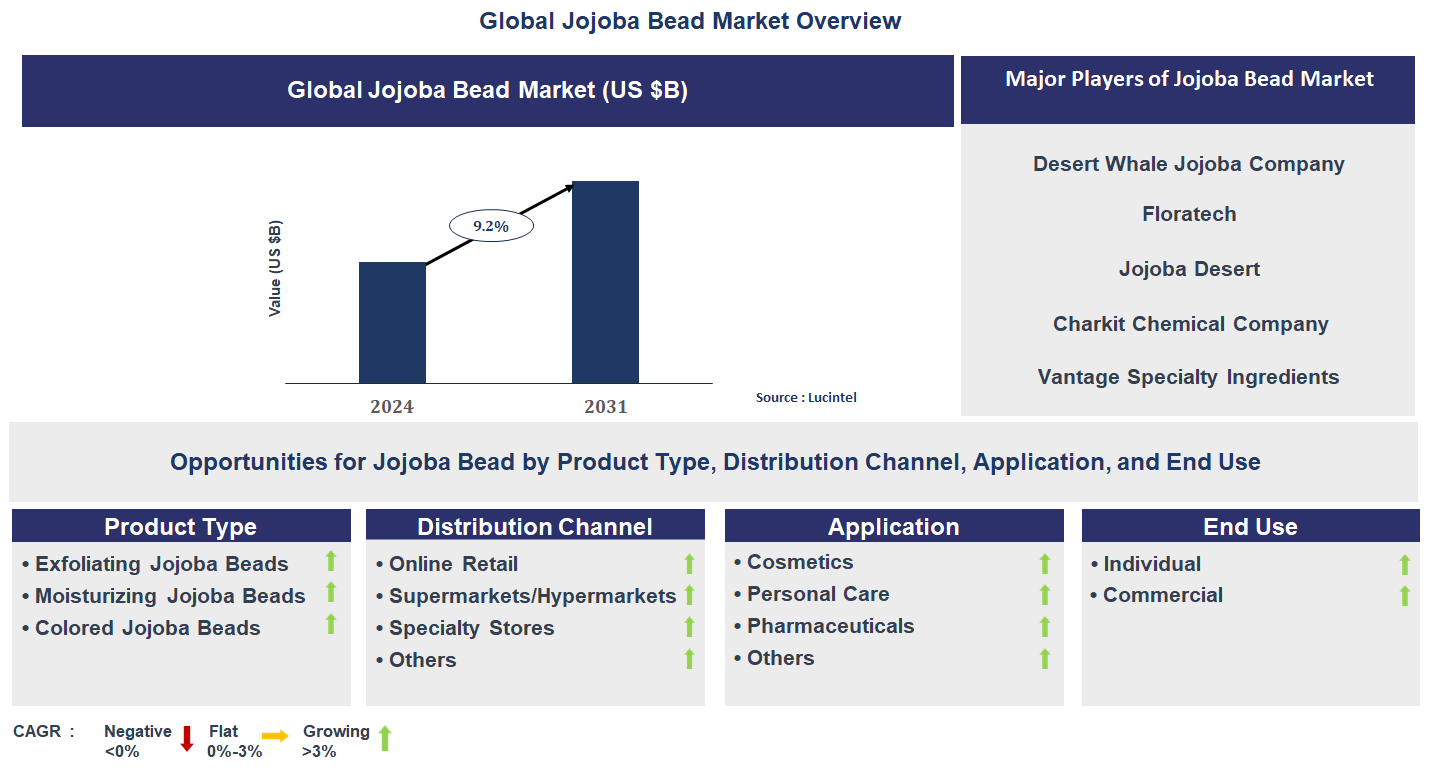
The future of the global jojoba bead market looks promising with opportunities in the cosmetic, personal care, and pharmaceutical markets. The global jojoba bead market is expected to grow with a CAGR of 9.2% from 2025 to 2031. The major drivers for this market are the increasing demand for natural exfoliants, the rising popularity of eco-friendly skincare, and the growing preference for sustainable beauty ingredients.• Lucintel forecasts that, within the product type category, exfoliating jojoba bead is expected to witness the highest growth over the forecast period.
• Within the application category, cosmetic is expected to witness the highest growth.
• In terms of region, Europe is expected to witness the highest growth over the forecast period. Gain valuable insights for your business decisions with our comprehensive 150+ page report. Sample figures with some insights are shown below.
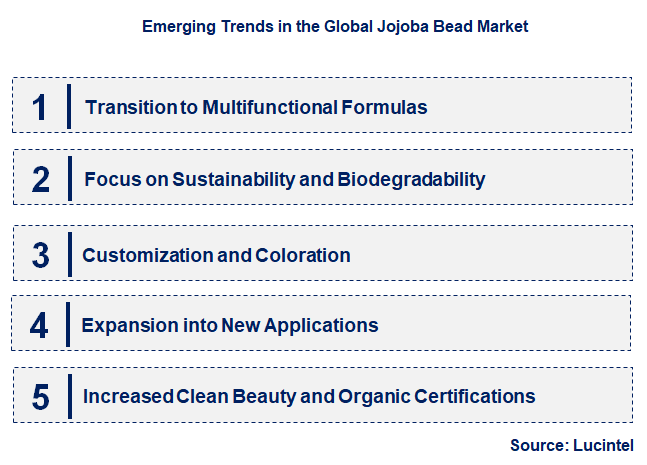
Emerging Trends in the Jojoba Bead Market
The jojoba bead market is experiencing a significant shift, fueled by a series of trends that are transforming the role of the product from an ordinary exfoliant to a high-end, multi-functional component. This transformation is a direct consequence of shifting consumer values, such as increased awareness of the environment, the need for clean and natural products, and the desire for gentler, more individualized formulations. These trends are not only affecting product formulation but also transforming the overall supply chain, from sourcing to marketing. Brands that are able to incorporate these trends well in their approaches are likely to gain considerable market share and generate strong consumer loyalty.• Transition to Multifunctional Formulas: This trend is taking jojoba beads out of their classic position as a scrub. Brands are including them in formulas that deliver numerous advantages, including exfoliating, hydrating, and moisturizing. These new products tend to mesh jojoba beads mild scrubbing action with the moisturizing capabilities of jojoba oil or other active ingredients. Consumers looking for simplified beauty rituals and products that confer a total benefit find this trend appealing, thereby making the beads a more desirable and multifaceted ingredient in cosmetics.
• Focus on Sustainability and Biodegradability: As the world bans plastic microbeads in accordance with international regulations, the industry is focusing heavily on sustainable and biodegradable replacements. Jojoba beads, being sourced from a natural and renewable resource, fit the bill. Companies are shifting their focus to market the eco-friendliness of their products in campaigns, touting their capability to break down naturally without compromising marine life or the environment.
• Customization and Coloration: The visual attractiveness of cosmetics is an emerging trend, and jojoba beads are being utilized to fulfill this requirement. Producers are now making jojoba beads in large color varieties, including bright colors, and can be utilized to add visual appeal to a product without the need for artificial dyes. This is a trend that is widely popular among rinse-off products such as body wash and face scrubs, where the beads can provide an exciting and luxurious feeling.
• Expansion into New Applications: Although historically utilized in facial and body scrubs, jojoba beads are increasingly being used in a broader range of personal care items. This includes hair care items such as shampoos and scalp scrubs, as well as cosmetics such as lip scrubs and foundations. This is because people want a gentle exfoliation and the beads melt-away on the skin without leaving a residue. In opening up new and lucrative market opportunities, jojoba beads are gaining increased overall demand.
• Increased Clean Beauty and Organic Certifications: The "clean beauty" trend is a strong one. Consumers are reading ingredient labels and wanting products that contain no toxics. Jojoba beads, being a natural and gentle product, are well-suited for this movement. This has seen brands increasingly ask for organic and natural certifications for their jojoba bead products. These certifications establish consumer trust and reinforce a brands stance on clean formulations, serving as an important selling factor in a saturated market. These trends are, in essence, redefining the jojoba bead market by driving it toward a more sustainable, innovative, and consumer-driven future. The inherent benefits of the product are being complemented with innovative technologies and marketing efforts, and it is thus a leading player in the clean beauty trend. The market is also becoming increasingly diverse, with products that provide more benefits and uses, mirroring the evolving preferences and values of contemporary consumers.
Recent Development in the Jojoba Bead Market
The jojoba bead industry has experienced a string of new trends that are extremely affecting its growth and direction. These trends are a straight response to international regulatory shifts, changes in consumer attitudes, and innovations in cosmetic ingredient production. The industry is transitioning from an alternative ingredient to a desired one, with companies more and more emphasizing the exclusive advantages of jojoba beads. These innovations are not only about product innovation but also about establishing a more transparent and sustainable industry.• Regulatory Bans on Plastic Microbeads: One of the most important developments has been the worldwide enforcement of regulations prohibiting plastic microbeads in personal care products. This legislation has been passed in the US, UK, Canada, and the European Union. It has generated an enormous demand for biodegradable and natural alternatives. Jojoba beads, as a plant wax, are the ideal substitute because they are harmless to aquatic life and biodegrade naturally.
• Development in Bead Technology and Manufacturing: Companies are investing in new manufacturing technology to produce jojoba beads with varied properties. This involves manufacturing beads of various sizes, shapes, and hardness to meet particular uses, ranging from sensitive facial exfoliants to stronger body exfoliators. A few companies are actually creating beads that dissolve at body temperature, releasing a moisturizing film.
• Introduction of Specialty and Colored Beads: To meet the cosmetic needs of the market regarding beauty, manufacturers are now introducing a range of colored jojoba beads. These are colored with food-grade, natural pigments to keep them within clean beauty requirements. This innovation enables beauty brands to have visually appealing products without having to use synthetic coloring agents.
• Strategic Collaborations and Supply Chain Consolidation: Growing demand for jojoba beads has triggered supply chain consolidation. Large ingredient suppliers are entering into strategic alliances with consumer goods manufacturers to have a reliable and consistent supply of high-quality jojoba beads. This is important to sustain the quality of the product as well as keep up with rising demand. It also enables higher traceability and sustainability, with brands being able to provide assurance that their ingredients are sustainably and ethically sourced.
• Consumer Education and Marketing: One major progress is the change in marketing strategies from merely putting "plastic-free" to actually educating people on the benefits of jojoba beads. Companies are coming up with campaigns that describe how jojoba beads exfoliate safely without scratching the skins surface, while also giving moisturizing benefits. This emphasis on consumer education is working to place jojoba beads in the position of a premium and superior ingredient, distinct from other natural abrasives such as nutshells or sugar. These advances are all together contributing to the jojoba bead market by bringing it to a position of prominence from being a mere replacement material to a major ingredient in todays contemporary, sustainable, and effective personal care products. The synergy between regulatory drivers and consumer-driven demand is forging a strong and innovative market with quality, transparency, and sustainability at the forefront.
Strategic Growth Opportunities in the Jojoba Bead Market
The jojoba bead market is fertile with strategic opportunities for expansion in different applications, going beyond being used as a facial scrub active. Opportunities stem from consumer needs for mild, natural, and effective products across all areas of personal care. With the utilization of the specialty properties of jojoba beads, including gentle exfoliation and moisturizing, new market segments may be addressed and innovative, premium products can be developed.• Scalp Treatments and Hair Care: A major growth prospect is the hair care sector, specifically in scalp treatments. Since scalp health is a growing concern in hair care regimens, jojoba beads can be added to shampoos and scalp scrub products. They can carefully exfoliate the scalp, clearing product residue, dead cells, and excessive sebum, which may trigger healthier hair development. This application taps into the growing trend of "Sinification" of hair care, where the scalp is treated with the same level of care as facial skin.
• Oral Care Products: Jojoba beads may serve as a kind and effective substitute for polyethylene microbeads in oral hygiene products. They can be used in toothpastes to create a polishing effect that removes stains and plaque without causing abrasions to the gums or tooth enamel. This use provides a distinctive selling point for manufacturers marketing to health-oriented consumers seeking a more natural and gentle method of oral care.
• Cosmetic and Makeup Formulations: The use of jojoba beads in makeup is an emerging opportunity. They can be integrated into primers, foundations, and powders to create a smooth, blurring effect on the skin. The beads can fill in fine lines and pores, creating a more even base for makeup application. Additionally, their moisturizing properties can help prevent makeup from settling into dry patches. This product enables brands to introduce multi-purpose makeup products that both beautify and care for the skin.
• Spa and Professional Treatments: Spa and professional beauty is a high-end opportunity for growth. Jojoba beads are a prime ingredient in high-end facial care, body wraps, and massage products. They are non-irritating and gentle, so theyre a good choice for sensitive skin and professional applications where efficacy and quality are important. This use enables brands to address a high-end customer base and charge a premium.
• Pet Grooming Products: Humanization of pets is a prominent trend, with pet owners looking for superior, natural products for their pets more and more. Jojoba beads may be a safe and gentle exfoliating component in pet shampoos and conditioners. They can gently remove dander and loose hair and massage the skin. This niche category presents a valuable opportunity for growth for brands that are willing to innovate within the pet care space where natural and safe ingredients are in high demand. These prospects are influencing the jojoba bead industry by broadening its application and adding value to it. Through their diversification in applications, jojoba beads are emerging as a key and multifunctional component in numerous products and causing the market to grow, further solidifying their status as a superior, natural substitute for chemical ingredients.
Jojoba Bead Market Driver and Challenges
The jojoba bead market is influenced by a multifaceted interplay of influential drivers and notable challenges. The drivers, largely driven by international environmental regulations and evolving consumer attitudes, are propelling the industry with a high degree of push towards natural and sustainable ingredients. The market is also, though, confronted with challenges like excessive competition from other natural alternatives and the necessity of mass consumer education. The factors responsible for driving the jojoba bead market include: 1. Global Plastic Microbead Ban: The biggest stimulus is the global ban on plastic microbeads. Governments and governments-in-exile have legislated against these non-biodegradable micro-particles from draining into waterways and devastating marine habitats. This has triggered an unprecedented level of demand for a strong and sustainable product that can replace them. Jojoba beads, being biodegradable and a gentle exfoliant, have become the go-to option, delivering a robust and long-term growth stimulus to the market. 2. Clean Beauty Movement: Consumers are more and more educated about ingredients and are increasingly looking for products that contain no synthetic chemicals, preservatives, and dyes. This "clean beauty" trend is a natural fit for jojoba beads, which are a plant-based, natural ingredient. Companies that utilize jojoba beads are able to easily appeal to this trend and gain consumer confidence and loyalty by having a clear and safe ingredient. 3. Preference for Gentle Exfoliation among Consumers: Contemporary skincare ideologies are shifting away from strong, abrasive exfoliants in favor of gentler alternatives that dont break down the protecting barrier of the skin. Jojoba beads are spherical in nature and soft, which makes them an excellent fit for this phenomenon. In contrast to ground nut shells or seeds, they dont produce micro-tears in the skin. This soothing quality is a major selling factor that appeals to a broad spectrum of consumers, especially those with dry or sensitive skin. 4. Multi-functionality and Versatility: Jojoba beads are not only exfoliants; they are also moisturizing. Since they melt on body temperature, they deliver the moisturizing properties of jojoba oil, imparting a hydrated sensation to the skin. This dual-action capability is one of the key drivers, enabling manufacturers to produce products that provide multiple benefits under a single product, for instance, a moisturizing scrub. This versatility increases their use and gives them more value proposition for manufacturers as well as consumers. 5. Growing Emphasis on Sustainability: In addition to biodegradability, consumers want brands that demonstrate a broader passion for sustainability. Jojoba beads come from a drought-resistant desert plant that can thrive on little water and is a renewable resource. Brands are using this sustainable heritage as a marketing tool to attract consumers who care about the environment. This emphasis on environmentally friendly sourcing and production is an influential driver that helps build a brands overall reputation and consumer draw. Challenges in the jojoba bead market are: 1. Competition with Other Natural Exfoliants: Although plastic microbeads have been prohibited, the market remains competitive with other natural exfoliants like sugar, salt, coffee grounds, and ground seeds. These competitors tend to be less expensive and more accessible. The challenge to the jojoba bead industry is to clearly make its own key benefits—namely its gentle, non-abrasive character and moisturizing properties—known in order to distinguish itself from these less expensive alternatives. 2. High Production Costs and Pricing: Converting jojoba oil to uniform, high-quality beads may be a more complicated and expensive process than grinding a natural substance. This could drive up the price of the final product. The task is to create a premium price that justifies the cost to cosmetic manufacturers and final buyers alike, emphasizing the greater performance and benefits that justify the expenditure. 3. Quality Control and Consistency: There needs to be consistency in the size, shape, and hardness of the beads for the performance of the product and the user experience. Inconsistent beads may not exfoliate well or may feel gritty and uncomfortable. Manufacturers dilemma is to have strict quality control techniques in place so that every production batch of beads is of a high quality, which is not easy to scale for large volume manufacture. The key drivers and challenges are molding the jojoba bead market into a high-end, niche, and highly competitive segment. The drivers, first among which are regulations and consumer values, have established a distinct and increasing demand for the product. The challenges, however, are compelling brands to innovate and differentiate their offerings with better quality, good marketing, and a robust value proposition.List of Jojoba Bead Companies
Companies in the market compete on the basis of product quality offered. Major players in this market focus on expanding their manufacturing facilities, R&D investments, infrastructural development, and leverage integration opportunities across the value chain. With these strategies jojoba bead companies cater increasing demand, ensure competitive effectiveness, develop innovative products & technologies, reduce production costs, and expand their customer base. Some of the jojoba bead companies profiled in this report include-• Desert Whale Jojoba Company
• Floratech
• Jojoba Desert
• Charkit Chemical Company
• Vantage Specialty Ingredients
• ECOBIONIC
• Innospec
• The Innovation Company
• Gustav Heess
• Purcell Jojoba International
Jojoba Bead Market by Segment
The study includes a forecast for the global jojoba bead market by product type, distribution channel, application, end use, and region.Jojoba Bead Market by Product Type [Value from 2019 to 2031]:
• Exfoliating Jojoba Beads
• Moisturizing Jojoba Beads
• Colored Jojoba Beads
Jojoba Bead Market by Distribution Channel [Value from 2019 to 2031]:
• Online Retail
• Supermarkets/Hypermarkets
• Specialty Stores
• Others
Jojoba Bead Market by Application [Value from 2019 to 2031]:
• Cosmetics
• Personal Care
• Pharmaceuticals
• Others
Jojoba Bead Market by End Use [Value from 2019 to 2031]:
• Individual
• Commercial
Jojoba Bead Market by Region [Value from 2019 to 2031]:
• North America
• Europe
• Asia Pacific
• The Rest of the World
Country Wise Outlook for the Jojoba Bead Market
The jojoba bead industry is experiencing a revolutionary change with a worldwide move away from synthetic plastic microbeads used in personal and cosmetic care products. As a biodegradable, natural, and gentle exfoliant, the jojoba beads find themselves with a singular opportunity to capture this gap. This marketplace is experiencing explosive innovation, with manufacturers and brands prioritizing new formulation, green production, and creative marketing to reach a more eco-aware customer base.• United States: The US jojoba bead market is led by stringent regulations and strong consumer interest in "clean beauty." The 2015 Microbead-Free Waters Act has succeeded in banning plastic microbeads in rinse-off personal care products, establishing a distinct and constant demand for natural alternatives. Some recent trends involve more emphasis on supply chain transparency and traceability, with the ethical and sustainable sourcing of the jojoba oil being highlighted by brands.
• China: The China market for Jojoba Bead is growing at a fast pace, driven by a growing middle-class population with rising disposable income and a higher consciousness of environmental concerns. Although the market is intensely competitive, recent trends indicate a strong shift towards domestic manufacturing and R&D. Chinese companies are taking advantage of the "Guacharo" (China chic) fashion trend, combining traditional Chinese medicine philosophies with cosmetic products containing jojoba beads. E-commerce and social media platforms are also significant in the market, where live streaming and influencer marketing play key roles in informing consumers and promoting new product sales.
• Germany: Germany is a global leader in the organic and sustainable beauty market, and its Jojoba Bead market is no exception. Current trends revolve around rigorous quality control and certification. German customers are highly educated and value highly certified organic products with no synthetic additives. The EUs comprehensive ban on deliberately added plastic microparticles has consolidated the market for natural exfoliants. This has encouraged technical innovation, with companies producing varying sizes, hues, and textures of jojoba beads to suit the particular needs of different cosmetic uses.
• India: Indias market for Jojoba Beads is at an initial but fast-growing stage. Although traditional herbal and Ayurvedic ingredients predominate, urban demand is increasingly for Western-type personal care products that are both effective and natural. Of particular significance is the use of jojoba beads as a major ingredient by both domestic and foreign players in India. The industry is witnessing growing product availability through the use of electronic commerce platforms, which are making consumers familiar with more products that use jojoba beads as an eco-friendly option against conventional abrasives.
• Japan: Japans Jojoba Bead market is advanced and consumer-oriented, with a high focus on product safety, quality, and gentle user experience. New trends include a refinement in the particle size to deliver the "J-Beauty" ideal of gentle, non-abrasive exfoliation. Japanese consumers are extremely educated and look for products that have established efficacy, together with a comfortable sensory feel. There is also a strong trend towards aesthetic innovation, where companies are adding brightly colored jojoba beads to clear formulas to create colorfully decorative and aesthetically attractive products.

Features of the Global Jojoba Bead Market
Market Size Estimates: Jojoba bead market size estimation in terms of value ($B). Trend and Forecast Analysis: Market trends (2019 to 2024) and forecast (2025 to 2031) by various segments and regions. Segmentation Analysis: Jojoba bead market size by various segments, such as by product type, distribution channel, application, end use, and region in terms of value ($B). Regional Analysis: Jojoba bead market breakdown by North America, Europe, Asia Pacific, and Rest of the World. Growth Opportunities: Analysis of growth opportunities in different product types, distribution channels, applications, end uses, and regions for the jojoba bead market. Strategic Analysis: This includes M&A, new product development, and competitive landscape of the jojoba bead market. Analysis of competitive intensity of the industry based on Porter’s Five Forces model.
FAQ
Q1. What is the growth forecast for jojoba bead market? Answer: The global jojoba bead market is expected to grow with a CAGR of 9.2% from 2025 to 2031. Q2. What are the major drivers influencing the growth of the jojoba bead market? Answer: The major drivers for this market are the increasing demand for natural exfoliants, the rising popularity of eco-friendly skincare, and the growing preference for sustainable beauty ingredients. Q3. What are the major segments for jojoba bead market? Answer: The future of the jojoba bead market looks promising with opportunities in the cosmetic, personal care, and pharmaceutical markets. Q4. Who are the key jojoba bead market companies? Answer: Some of the key jojoba bead companies are as follows:• Desert Whale Jojoba Company
• Floratech
• Jojoba Desert
• Charkit Chemical Company
• Vantage Specialty Ingredients
• ECOBIONIC
• Innospec
• The Innovation Company
• Gustav Heess
• Purcell Jojoba International Q5. Which jojoba bead market segment will be the largest in future? Answer: Lucintel forecasts that, within the product type category, exfoliating jojoba bead is expected to witness the highest growth over the forecast period. Q6. In jojoba bead market, which region is expected to be the largest in next 5 years? Answer: In terms of region, Europe is expected to witness the highest growth over the forecast period. Q7. Do we receive customization in this report? Answer: Yes, Lucintel provides 10% customization without any additional cost.
Table of Contents
List of Figures
List of Tables
Methodology
- In-depth interviews of the major players in this market
- Detailed secondary research from competitors’ financial statements and published data
- Extensive searches of published works, market, and database information pertaining to industry news, company press releases, and customer intentions
- A compilation of the experiences, judgments, and insights of Lucintel’s professionals, who have analyzed and tracked this market over the years.


Buy Now
Choose a license that fits your team. Instant PDF delivery.
Prices exclude taxes. Instant delivery. Custom licensing available on request.
Key Questions
- • What are some of the most promising, high-growth opportunities for the jojoba bead market by product type (exfoliating jojoba beads, moisturizing jojoba beads, and colored jojoba beads), distribution channel (online retail, supermarkets/hypermarkets, specialty stores, and others), application (cosmetics, personal care, pharmaceuticals, and others), end use (individual and commercial), and region (North America, Europe, Asia Pacific, and the Rest of the World)?
- • Which segments will grow at a faster pace and why?
- • Which region will grow at a faster pace and why?
- • What are the key factors affecting market dynamics? What are the key challenges and business risks in this market?
- • What are the business risks and competitive threats in this market?
- • What are the emerging trends in this market and the reasons behind them?
- • What are some of the changing demands of customers in the market?
- • What are the new developments in the market? Which companies are leading these developments?
- • Who are the major players in this market? What strategic initiatives are key players pursuing for business growth?
- • What are some of the competing products in this market and how big of a threat do they pose for loss of market share by material or product substitution?
- • What M&A activity has occurred in the last 5 years and what has its impact been on the industry? For any questions related to Jojoba Bead Market, Jojoba Bead Market Size, Jojoba Bead Market Growth, Jojoba Bead Market Analysis, Jojoba Bead Market Report, Jojoba Bead Market Share, Jojoba Bead Market Trends, Jojoba Bead Market Forecast, Jojoba Bead Companies, write Lucintel analyst at email: helpdesk@lucintel.com. We will be glad to get back to you soon.


