
Market Report · July 16, 2026

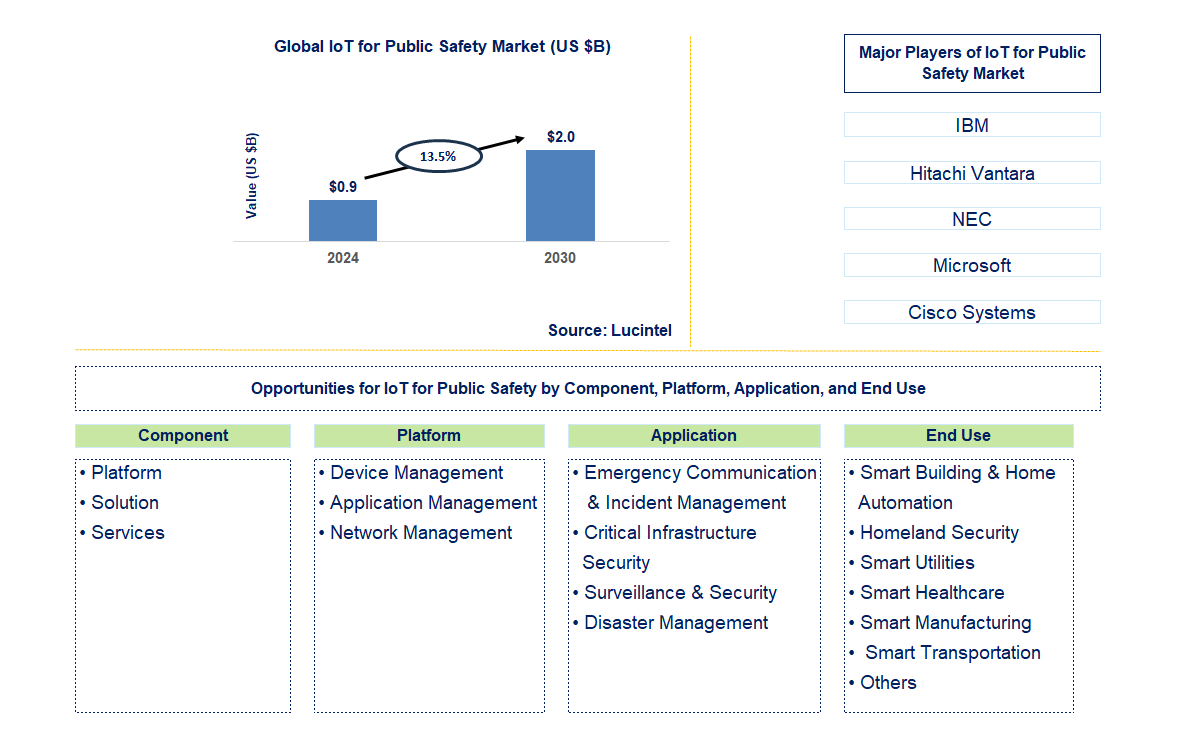
Key data points: The market size in 2030 = $2.0 billion, growth forecast = 13.5% annually next 6 years. Scroll below to get more insights. This market report covers trends, opportunities, and forecast in the global IOT for public safety market to 2030 by component (platform, solution, and services), platform (device management, application management, and network management), application (emergency communication & incident management, critical infrastructure security, surveillance & security, and disaster management), end use (smart building & home automation, homeland security, smart utilities, smart healthcare, smart manufacturing, smart transportation, and others), and region (North America, Europe, Asia Pacific, and the Rest of the World)
We'll send your sample report shortly.
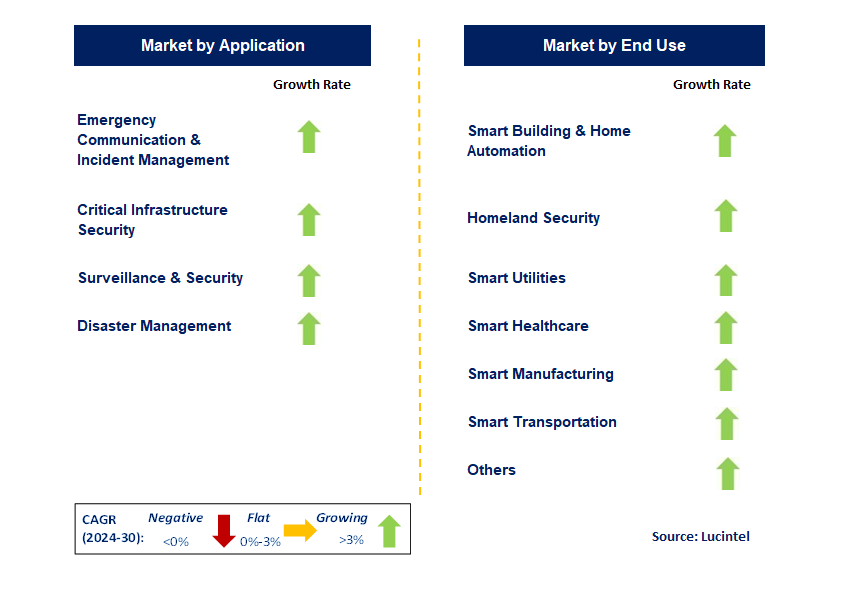
• Lucintel forecasts that surveillance & security segment is expected to witness the highest growth over the forecast period.
• Through this market, smart healthcare is expected to witness the highest growth over the forecast period.
• APAC is expected to witness the highest growth over the forecast period. A more than 150-page report is developed to help in your business decisions.
• United States: The U.S. has seen significant advancements in integrating IoT with emergency response systems and surveillance. New smart sensors and connected devices are improving real-time monitoring and response to incidents, enhancing public safety management and disaster preparedness.
• China: China is leading in deploying IoT solutions for urban safety and surveillance. Recent developments include the implementation of smart city technologies that utilize IoT for real-time monitoring of public spaces, traffic management, and disaster response, contributing to enhanced public safety.
• Germany: Germany is focusing on advanced IoT applications for public safety, including smart emergency services and connected infrastructure. Recent developments involve integrating IoT with existing safety systems to improve response times and coordination during emergencies, while addressing cybersecurity concerns.
• India: In India, the IoT for public safety market is growing with a focus on smart city initiatives and emergency management. Developments include deploying IoT-enabled sensors for traffic management, crime detection, and disaster response, aimed at improving urban safety and efficiency.
• Japan: Japan is advancing IoT integration for disaster management and public safety. Recent developments include the deployment of IoT-based early warning systems and smart infrastructure to enhance preparedness and response to natural disasters, as well as improving urban safety through connected technologies.
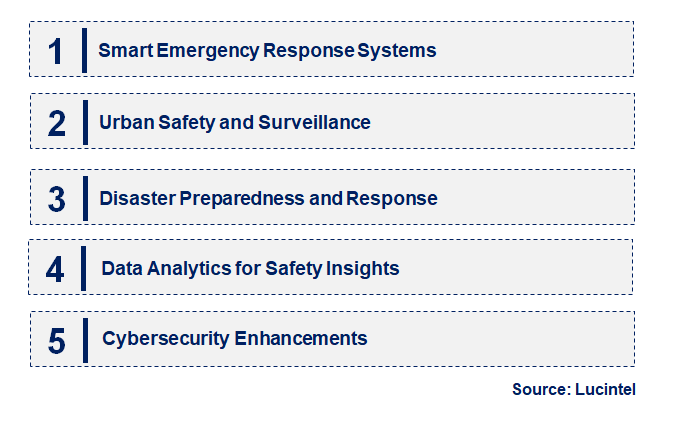
• Smart Emergency Response Systems: IoT is increasingly integrated into emergency response systems to enhance real-time communication and coordination. Smart sensors and connected devices are improving incident detection, response times, and overall emergency management effectiveness.
• Urban Safety and Surveillance: IoT applications in urban safety are expanding with smart city technologies. Connected surveillance cameras and sensors are being deployed for real-time monitoring of public spaces, traffic management, and crime detection, contributing to safer urban environments.
• Disaster Preparedness and Response: IoT is playing a critical role in disaster preparedness and response. IoT-based early warning systems and connected infrastructure are being used to enhance detection and response capabilities for natural disasters, improving overall public safety.
• Data Analytics for Safety Insights: The use of data analytics in IoT systems is providing valuable insights for public safety. Analyzing data from connected devices and sensors helps in predicting and preventing incidents, optimizing resource allocation, and improving safety strategies.
• Cybersecurity Enhancements: As IoT adoption in public safety grows, so does the focus on cybersecurity. Advanced security measures are being implemented to protect connected systems and data from cyber threats, ensuring the integrity and reliability of public safety solutions. These trends are reshaping the IoT for public safety market by enhancing capabilities, improving response times, and addressing emerging challenges, driving the evolution of connected safety solutions.
• Advanced IoT Sensors: New IoT sensors with enhanced capabilities are being deployed for real-time monitoring and data collection. These sensors improve incident detection and response, supporting better management of public safety and emergency situations.
• Integration with Smart City Initiatives: IoT solutions are being integrated into smart city projects to enhance urban safety. Connected devices and systems are improving traffic management, crime detection, and overall public safety in urban environments.
• Development of Early Warning Systems: IoT-based early warning systems are being developed to enhance disaster preparedness. These systems provide real-time alerts and information, helping communities prepare for and respond to natural disasters more effectively.
• Improved Data Analytics Platforms: Advanced data analytics platforms are being utilized to analyze data from IoT devices. These platforms provide insights into safety trends, incident patterns, and resource allocation, optimizing public safety strategies and responses.
• Enhanced Cybersecurity Measures: As IoT adoption grows, there is a focus on enhancing cybersecurity measures to protect public safety systems. Advanced security protocols and technologies are being implemented to safeguard connected devices and data from cyber threats. These developments are enhancing the effectiveness of IoT in public safety, improving incident management, and addressing emerging challenges, contributing to a safer and more responsive environment.
• Smart City Infrastructure: There is growth potential in integrating IoT with smart city infrastructure for enhanced public safety. This includes applications in traffic management, surveillance, and emergency response, improving overall urban safety and efficiency.
• Disaster Management Systems: IoT-based disaster management systems offer significant growth opportunities. Implementing early warning systems and connected infrastructure can enhance preparedness and response to natural disasters, benefiting communities and emergency services.
• Emergency Response Solutions: The development of advanced emergency response solutions using IoT technology presents growth opportunities. Connected devices and smart systems can improve real-time communication and coordination during emergencies, enhancing overall response effectiveness.
• Public Health and Safety Monitoring: IoT applications for monitoring public health and safety are expanding. This includes the use of connected devices for tracking environmental conditions, detecting health hazards, and improving public health initiatives.
• Cybersecurity Solutions: With the increase in IoT adoption, there is a growing need for cybersecurity solutions. Developing advanced security measures to protect connected public safety systems and data provides opportunities for growth and innovation. These growth opportunities are driving the expansion of IoT applications in public safety, enhancing capabilities, and addressing emerging needs in safety and emergency management.
• Technological Advancements: Innovations in IoT technology, including sensors, connectivity, and data analytics, drive market growth by enhancing public safety solutions and capabilities.
• Increased Demand for Smart City Solutions: The growing demand for smart city technologies supports the adoption of IoT for public safety, improving urban management and safety.
• Focus on Disaster Preparedness: Enhanced disaster preparedness and response capabilities through IoT solutions drive market growth, benefiting communities and emergency services.
• Real-Time Data and Analytics: The ability to provide real-time data and insights through IoT enhances incident management and decision-making, contributing to market expansion.
• Government Support and Investment: Government initiatives and investments in smart city projects and public safety technology support market growth and innovation. Challenges in the IoT for public safety market are:
• Privacy and Data Security Concerns: Privacy and data security concerns related to IoT devices and systems pose challenges for market adoption and regulatory compliance.
• Integration with Existing Systems: Integrating IoT solutions with existing public safety infrastructure can be complex and may require significant adjustments and investments.
• Cost of Implementation: The cost of implementing IoT solutions for public safety can be a barrier, particularly for smaller municipalities and organizations with limited budgets.
• Cybersecurity Threats: The risk of cyber threats and attacks on connected public safety systems presents challenges for ensuring the security and reliability of IoT solutions.
• Regulatory Compliance: Navigating regulatory requirements and standards for IoT in public safety can be challenging, impacting market entry and implementation. These drivers and challenges collectively shape the IoT for public safety market, influencing its growth and development. Understanding these factors is essential for addressing market needs and driving innovation.
• IBM
• Hitachi Vantara
• NEC
• Microsoft
• Cisco Systems
• Nokia Networks
• Sierra Wireless
• Telit
• West Corporation
• ThroughTek
• Platform
• Solution
• Services
• Device Management
• Application Management
• Network Management
• Emergency Communication & Incident Management
• Critical Infrastructure Security
• Surveillance & Security
• Disaster Management
• Smart Building & Home Automation
• Homeland Security
• Smart Utilities
• Smart Healthcare
• Smart Manufacturing
• Smart Transportation
• Others
• North America
• Europe
• Asia Pacific
• The Rest of the World
• Lucintel forecasts that surveillance & security segment is expected to witness the highest growth over the forecast period.
• Through this market, smart healthcare is expected to witness the highest growth over the forecast period.
• APAC is expected to witness the highest growth over the forecast period.


• IBM
• Hitachi Vantara
• NEC
• Microsoft
• Cisco Systems
• Nokia Networks
• Sierra Wireless
• Telit
• West Corporation
• ThroughTek Q6. Which IoT for public safety market segment will be the largest in future? Answer: Lucintel forecasts that surveillance & security is expected to witness the highest growth over the forecast period. Q7. In IoT for public safety market, which region is expected to be the largest in next 5 years? Answer: APAC is expected to witness the highest growth over the forecast period. Q.8 Do we receive customization in this report? Answer: Yes, Lucintel provides 10% customization without any additional cost.


Choose a license that fits your team. Instant PDF delivery.
Prices exclude taxes. Instant delivery. Custom licensing available on request.
Market Report · July 16, 2026
Market Report · July 15, 2026
Market Report · July 15, 2026
Trusted partner for strategic intelligence and business growth


Receive a complimentary market analysis tailored to your industry. Our analysts will identify key growth opportunities and competitive dynamics specific to your business.

Market size, growth rate, and key trend analysis for your specific sector.

Top competitor positioning and market share analysis.

Strategic recommendations backed by data-driven insights.
Get curated market intelligence and competitive moves straight to your inbox.
By subscribing, you agree to receive our monthly insights. Unsubscribe anytime.
Receive a complimentary market analysis tailored to your industry. Our analysts will identify key growth opportunities and competitive dynamics specific to your business.
Market size, growth rate, and key trend analysis for your specific sector.
Top competitor positioning and market share analysis.
Strategic recommendations backed by data-driven insights.
Get curated market intelligence, emerging trends, and competitive moves straight to your inbox each month.
By subscribing, you agree to receive our monthly insights. Unsubscribe anytime.
We'll send your sample report shortly.