
GPS Tracking Market Trends and Forecast
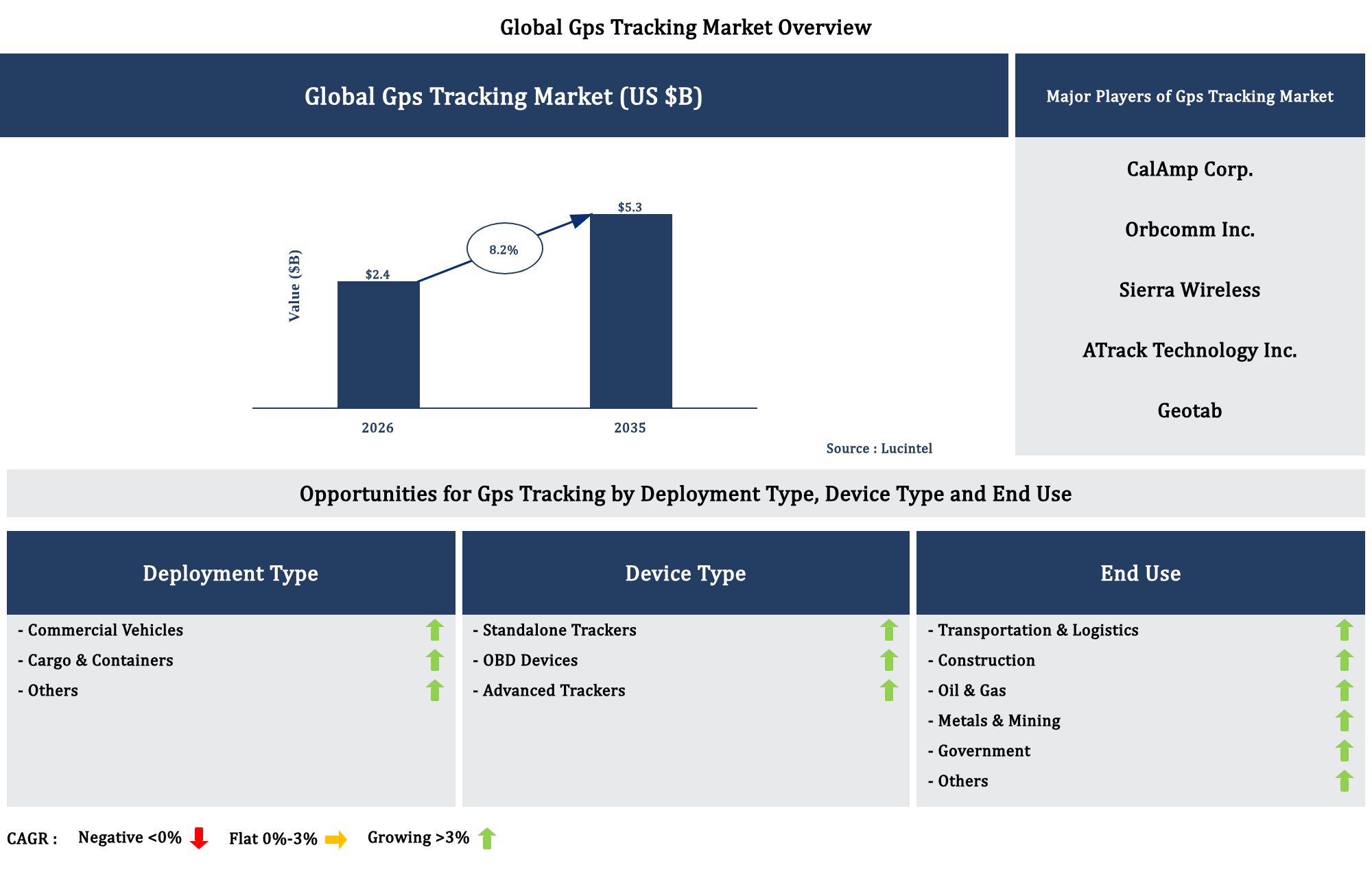
The future of the global GPS tracking market looks promising with opportunities in the transportation & logistic, construction, oil & gas, metal & mining, and government markets. The global GPS tracking market is expected to reach an estimated $5,380 million by 2035 with a CAGR of 8.2% from 2026 to 2035. The major drivers for this market are the rising demand for fleet management in logistics & transport, the increasing adoption in e-commerce delivery services, and the growing integration with iot & smart technologies.
• Lucintel forecasts that, within the deployment type category, commercial is expected to witness higher growth over the forecast period.
• Within the end use category, transportation & logistic is expected to witness the highest growth.
• In terms of region, APAC is expected to witness the highest growth over the forecast period.
Gain valuable insights for your business decisions with our comprehensive 150+ page report. Sample figures with some insights are shown below.
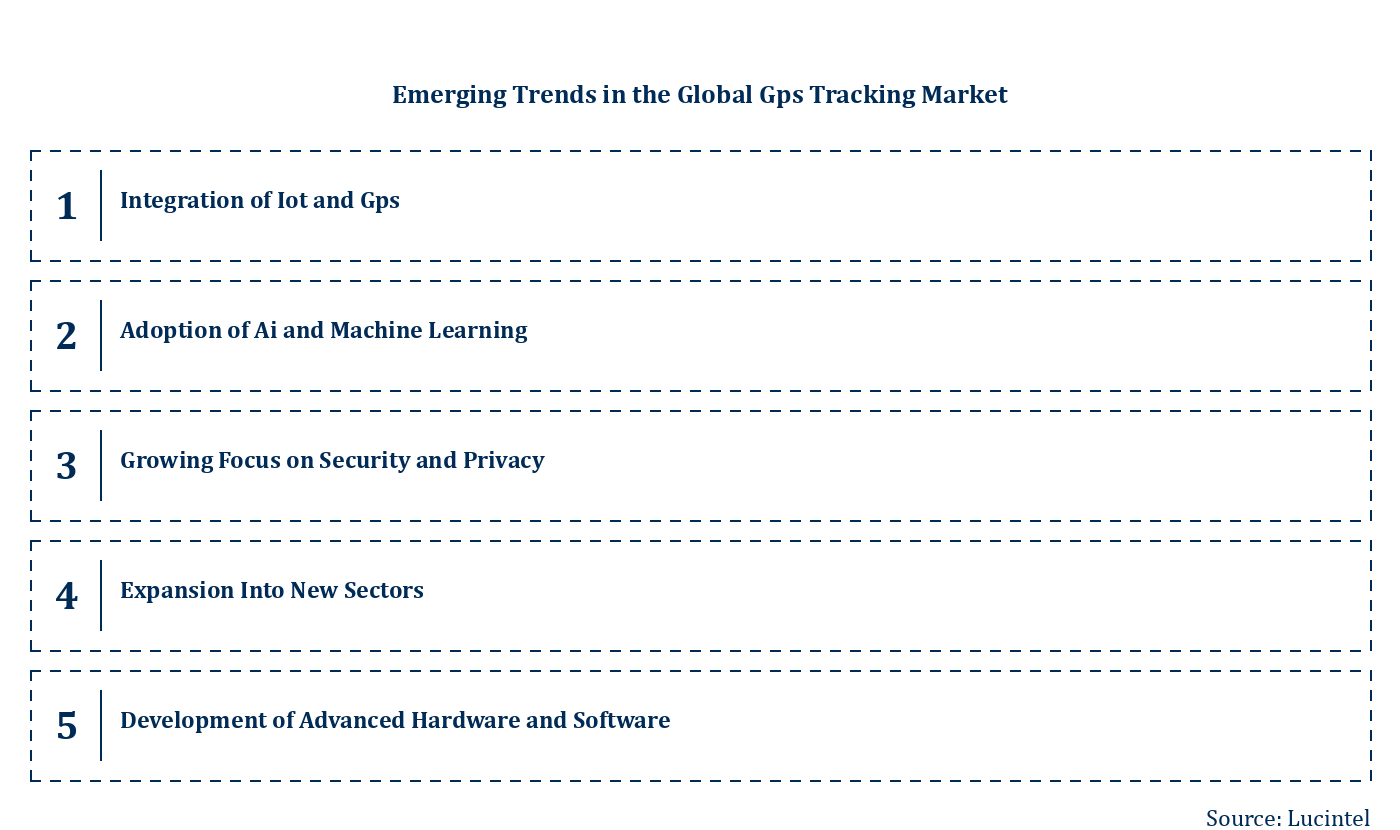
Emerging Trends in the GPS Tracking Market
The GPS tracking market is experiencing rapid evolution driven by technological advancements, increasing demand for real-time location data, and expanding applications across various industries. As businesses and consumers seek more efficient, secure, and integrated solutions, emerging trends are shaping the future landscape of this market. These developments are not only enhancing the capabilities of GPS tracking systems but also broadening their adoption across sectors such as logistics, personal safety, and asset management. Understanding these key trends is essential for stakeholders aiming to capitalize on new opportunities and stay competitive in a dynamic environment.
• Integration of IoT and GPS: The convergence of Internet of Things (IoT) with GPS technology is creating smarter, interconnected tracking solutions. IoT-enabled GPS devices can communicate with other systems, providing real-time data and analytics. This integration enhances asset management, fleet optimization, and predictive maintenance, leading to increased efficiency and reduced operational costs. As IoT adoption grows, GPS tracking systems are becoming more intelligent, scalable, and capable of supporting complex, multi-device ecosystems, thereby transforming traditional tracking into a comprehensive, data-driven process.
• Adoption of AI and Machine Learning: Artificial Intelligence (AI) and machine learning are increasingly being incorporated into GPS tracking systems to improve accuracy, predictive capabilities, and decision-making. These technologies enable systems to analyze vast amounts of location data, identify patterns, and predict future movements or potential issues. AI-driven insights help businesses optimize routes, prevent theft, and enhance safety protocols. The integration of AI is making GPS solutions more proactive and autonomous, which significantly boosts operational efficiency and customer satisfaction across various industries.
• Growing Focus on Security and Privacy: As GPS tracking becomes more widespread, concerns over data security and user privacy are intensifying. Market players are investing in advanced encryption, secure data storage, and compliance with privacy regulations to protect sensitive information. Enhanced security measures are crucial for gaining user trust and meeting legal standards, especially in sectors like personal safety, healthcare, and government. This trend underscores the importance of balancing technological innovation with robust security protocols to ensure sustainable growth and user confidence in GPS tracking solutions.
• Expansion into New Sectors: The versatility of GPS technology is driving its adoption in emerging sectors such as agriculture, healthcare, and construction. In agriculture, GPS aids precision farming; in healthcare, it supports patient monitoring and asset tracking; and in construction, it enhances equipment management. This diversification is expanding the market beyond traditional logistics and vehicle tracking, opening new revenue streams and opportunities for innovation. As GPS solutions become more tailored to sector-specific needs, their market reach and impact are expected to grow significantly.
• Development of Advanced Hardware and Software: Innovations in hardware, such as miniaturized, energy-efficient GPS modules, and sophisticated software platforms are enhancing system performance. These advancements enable longer battery life, improved accuracy, and easier integration with other technologies. Software improvements include user-friendly interfaces, cloud-based management, and real-time analytics. These developments are making GPS tracking more accessible, reliable, and customizable, thereby increasing adoption rates across various industries and applications. Enhanced hardware and software are critical drivers of the market’s ongoing growth and technological sophistication.
These emerging trends are collectively transforming the GPS tracking market by making solutions more intelligent, secure, versatile, and user-centric. The integration of IoT and AI is driving smarter systems, while increased focus on security ensures trust and compliance. Expansion into new sectors broadens market opportunities, and hardware/software innovations improve performance and usability. Together, these developments are reshaping the landscape, enabling more efficient, secure, and innovative tracking solutions that meet the evolving needs of businesses and consumers worldwide.
Recent Development in the GPS Tracking Market
The GPS tracking market has experienced significant advancements driven by technological innovations and increasing demand across various sectors. These developments are transforming how businesses and consumers utilize location-based services, enhancing efficiency, security, and user experience. As industries adopt GPS solutions, new opportunities emerge, fostering growth and competition. The following key developments highlight the current trajectory and future potential of this dynamic market.
• Expansion of IoT Integration: The integration of GPS with IoT devices is creating smarter, interconnected systems. This development enables real-time tracking, predictive maintenance, and enhanced asset management across logistics, agriculture, and healthcare. IoT-GPS synergy improves operational efficiency, reduces costs, and offers valuable data insights, positioning the market for sustained growth as industries seek more connected solutions.
• Advancements in Real-Time Data Analytics: Enhanced data analytics capabilities allow for more precise and actionable insights from GPS data. This development supports fleet management, navigation, and security applications by providing real-time updates and predictive analytics. Businesses can optimize routes, improve safety, and reduce downtime, leading to increased adoption and a competitive edge in the market.
• Growth of Consumer GPS Devices: The proliferation of smartphones, wearables, and personal tracking devices is expanding consumer demand for GPS solutions. This trend boosts market revenue through increased sales of navigation apps, fitness trackers, and personal safety devices. Consumer-centric innovations foster user engagement and open new revenue streams, driving overall market expansion.
• Enhanced Security and Anti-Theft Features: New GPS-based security solutions are improving asset and vehicle protection. Features like geofencing, remote immobilization, and real-time alerts help prevent theft and unauthorized use. These advancements increase trust among users and organizations, encouraging wider adoption in automotive, logistics, and personal security sectors, thereby strengthening market growth.
• Adoption of AI and Machine Learning: Incorporating AI and machine learning with GPS technology enhances accuracy, predictive capabilities, and automation. This development enables smarter routing, anomaly detection, and maintenance forecasting. It benefits industries by reducing operational costs and improving decision-making, positioning the GPS tracking market as a critical component of intelligent, automated systems.
The overall impact of these developments is a robust, innovative market characterized by increased adoption, improved efficiency, and expanded applications across multiple sectors, promising sustained growth and competitive advantages.
Strategic Growth Opportunities in the GPS Tracking Market
The GPS tracking market is experiencing rapid expansion driven by technological advancements, increasing demand for asset and personnel management, and the need for enhanced security solutions across various industries. Growing adoption in sectors such as transportation, logistics, and personal safety is creating significant growth opportunities. As organizations seek real-time location data for operational efficiency and safety, the market is poised for substantial development, supported by innovations in IoT, AI, and cloud computing that enable smarter, more integrated GPS tracking solutions.
• Expansion in Fleet Management Solutions: The increasing need for real-time vehicle tracking to optimize routes, reduce fuel consumption, and improve safety is driving growth in fleet management. Companies are adopting GPS solutions to monitor vehicle performance, ensure compliance, and enhance customer service. The integration of telematics and IoT devices further enhances fleet efficiency, making GPS tracking indispensable for logistics and transportation sectors seeking cost savings and operational transparency.
• Growing Adoption in Personal Safety and Security: Rising concerns over personal safety and asset protection are fueling demand for GPS tracking devices in personal safety applications. Wearable devices, child trackers, and senior safety solutions are becoming more prevalent, providing real-time location updates to caregivers and users. This trend is supported by advancements in miniaturization, battery life, and connectivity, making GPS trackers more accessible and reliable for individual safety, thereby expanding the market significantly.
• Increasing Use in Asset and Inventory Management: Businesses are leveraging GPS tracking to monitor high-value assets, equipment, and inventory in real time. This application reduces theft, loss, and misplacement, especially in industries like construction, manufacturing, and retail. The integration of GPS with RFID and IoT systems enhances visibility and control over assets, leading to improved operational efficiency, reduced downtime, and better inventory accuracy, which collectively drive market growth.
• Rising Demand for GPS Solutions in Agriculture and Farming: Precision agriculture is increasingly adopting GPS technology for field mapping, crop monitoring, and automated machinery guidance. GPS-enabled systems improve yield, reduce resource wastage, and optimize farm operations. The integration of GPS with drones and IoT devices enables farmers to make data-driven decisions, enhance productivity, and promote sustainable practices, creating a substantial growth avenue within the agricultural sector.
• Development of Advanced Location-Based Services (LBS): The proliferation of smartphones and connected devices is expanding the scope of location-based services, including navigation, targeted advertising, and personalized content delivery. Enhanced GPS accuracy, combined with AI and big data analytics, enables more sophisticated LBS applications. These services are increasingly used in retail, hospitality, and entertainment sectors, offering new revenue streams and customer engagement opportunities, thus fueling overall market expansion.
These growth opportunities collectively position the GPS tracking market for robust expansion across diverse sectors. Innovations in technology, increasing adoption for safety, operational efficiency, and asset management are transforming the landscape. As industries continue to leverage GPS solutions for strategic advantages, the market is expected to experience sustained growth, driven by evolving customer needs and technological advancements.
GPS Tracking Market Driver and Challenges
The GPS tracking market is influenced by a variety of technological, economic, and regulatory factors that shape its growth and development. Advances in satellite technology, increasing adoption of IoT devices, and the need for enhanced security are key drivers. Simultaneously, regulatory frameworks and privacy concerns pose significant challenges. Economic factors such as rising demand for fleet management solutions and the proliferation of connected devices further impact the market dynamics. Understanding these drivers and challenges is essential for stakeholders to navigate the evolving landscape effectively and capitalize on emerging opportunities while addressing potential risks.
The factors responsible for driving the GPS tracking market include:-
• Technological Advancements: The continuous evolution of GPS technology, including improved accuracy, real-time data transmission, and integration with IoT devices, has significantly expanded the market. These innovations enable more precise tracking, better fleet management, and enhanced security solutions. As technology becomes more affordable and accessible, adoption rates increase across various sectors such as logistics, personal tracking, and asset management. The integration of AI and machine learning further enhances predictive analytics and operational efficiency, making GPS tracking indispensable for modern businesses.
• Growing Adoption in Fleet Management: The rising demand for efficient fleet management solutions is a major driver. Companies seek to optimize routes, reduce fuel consumption, and improve safety, all of which are facilitated by GPS tracking systems. The ability to monitor vehicle location, driver behavior, and maintenance schedules in real-time leads to cost savings and improved service delivery. As logistics and transportation industries expand globally, the need for advanced tracking solutions continues to grow, fueling market expansion.
• Increasing Use in Personal and Asset Tracking: The proliferation of smartphones and wearable devices has driven consumer interest in personal GPS tracking for safety and fitness. Additionally, asset tracking solutions are increasingly used to monitor valuable goods, equipment, and livestock. This broadening application base boosts market demand, especially in retail, healthcare, and agriculture sectors. The convenience, security, and peace of mind provided by GPS tracking are compelling factors encouraging widespread adoption.
• Rising Investment and Strategic Partnerships: Major technology firms and startups are investing heavily in GPS tracking innovations. Strategic alliances, mergers, and acquisitions facilitate the development of advanced solutions tailored to specific industry needs. Governments and private organizations are also funding research and deployment initiatives, which accelerate market growth. These investments foster innovation, improve product offerings, and expand market reach, making GPS tracking more accessible and versatile.
The challenges facing the GPS tracking market include:-
• Privacy and Regulatory Concerns: The increasing use of GPS tracking raises significant privacy issues, especially regarding data collection and user consent. Regulatory frameworks vary across regions, with some imposing strict restrictions on data usage and sharing. Non-compliance can lead to legal penalties and damage to reputation. Balancing technological benefits with privacy rights remains a complex challenge, potentially hindering market growth and adoption in certain sectors.
• High Implementation and Maintenance Costs: Although GPS technology has become more affordable, the costs associated with deploying and maintaining comprehensive tracking systems can be substantial. Small and medium-sized enterprises may find these expenses prohibitive, limiting their ability to adopt advanced solutions. Additionally, ongoing costs for data management, system updates, and technical support can strain budgets, slowing market penetration in cost-sensitive segments.
• Technological and Connectivity Limitations: Dependence on satellite signals and cellular networks can pose reliability issues, especially in remote or urban canyon areas where signals may be weak or obstructed. Technological limitations such as battery life constraints and device durability also impact performance. These factors can lead to inaccurate tracking or system failures, affecting user trust and adoption rates, and pose ongoing challenges for market expansion.
The GPS tracking market is driven by rapid technological innovations, expanding applications across industries, and increased investments, all contributing to its growth potential. However, privacy concerns, high costs, and technological limitations present notable challenges that could impede progress. The overall impact of these drivers and challenges will shape the market’s evolution, requiring stakeholders to innovate responsibly and address regulatory and technical hurdles to sustain growth and maximize opportunities.
List of GPS Tracking Companies
Companies in the market compete on the basis of product quality offered. Major players in this market focus on expanding their manufacturing facilities, R&D investments, infrastructural development, and leverage integration opportunities across the value chain. With these strategies GPS tracking companies cater increasing demand, ensure competitive effectiveness, develop innovative products & technologies, reduce production costs, and expand their customer base. Some of the GPS tracking companies profiled in this report include-
• CalAmp Corp.
• Orbcomm Inc.
• Sierra Wireless
• ATrack Technology Inc.
• Geotab
• Concox Information Technology
• Trackimo
• Meitrack Group
• Ruptela UAB
• Geoforce Inc.
GPS Tracking Market by Segment
The study includes a forecast for the global GPS tracking market by deployment type, device type, end use, and region.
GPS Tracking Market by Deployment Type [Value from 2019 to 2035]:
• Commercial Vehicles
• Cargo & Containers
• Others
GPS Tracking Market by Device Type [Value from 2019 to 2035]:
• Standalone Trackers
• OBD Devices
• Advanced Trackers
GPS Tracking Market by End Use [Value from 2019 to 2035]:
• Transportation & Logistics
• Construction
• Oil & Gas
• Metals & Mining
• Government
• Others
GPS Tracking Market by Region [Value from 2019 to 2035]:
• North America
• Europe
• Asia Pacific
• The Rest of the World
Country Wise Outlook for the GPS Tracking Market
The GPS tracking market has experienced rapid growth driven by technological advancements, increasing demand for asset and personnel management, and expanding applications across various industries. As digital transformation accelerates globally, countries are adopting innovative solutions to enhance security, efficiency, and operational oversight. Regulatory changes and rising consumer awareness also influence market dynamics, prompting companies to develop more sophisticated and integrated GPS tracking systems. The following summaries highlight recent developments in the GPS tracking market within the United States, China, Germany, India, and Japan, reflecting their unique market trends and technological progress.
• United States: The US market has seen significant growth with increased adoption of GPS tracking in fleet management, logistics, and personal safety applications. Innovations include integration with IoT devices and AI-powered analytics for real-time decision-making. Regulatory frameworks are evolving to address privacy concerns, while major tech firms are investing heavily in advanced GPS solutions to enhance security and operational efficiency. The rise of connected vehicles and smart city initiatives further propels market expansion, making the US a leader in GPS technology deployment.
• China: China’s GPS tracking market is rapidly expanding, driven by government initiatives to improve urban management and transportation infrastructure. The country is focusing on integrating GPS with 5G networks and big data analytics to optimize logistics and public safety. Domestic companies are developing cost-effective, high-precision GPS devices, boosting adoption across sectors like agriculture, transportation, and personal devices. The government’s emphasis on smart city projects and digital infrastructure development continues to fuel market growth, positioning China as a key player in innovative GPS solutions.
• Germany: Germany’s market emphasizes precision and reliability, especially within automotive, manufacturing, and logistics sectors. Recent developments include the deployment of advanced GPS systems integrated with vehicle telematics and Industry 4.0 initiatives. The country is also focusing on enhancing data security and privacy standards, aligning with strict EU regulations. German companies are investing in R&D to develop more accurate, energy-efficient GPS devices and solutions that support sustainable transportation and smart factory automation, reinforcing Germany’s reputation for technological excellence.
• India: The Indian GPS tracking market is witnessing rapid adoption across transportation, agriculture, and personal safety sectors. Recent advancements include the deployment of affordable, rugged GPS devices tailored for rural and urban environments. The government’s push for digital infrastructure and smart city projects is accelerating market growth. Additionally, local startups are innovating with AI and IoT integration to offer smarter fleet management and asset tracking solutions. The expanding telecom network and decreasing device costs are making GPS technology more accessible, fostering widespread adoption across diverse industries.
• Japan: Japan’s GPS market is characterized by high-precision applications in robotics, transportation, and disaster management. Recent developments include the integration of GPS with autonomous vehicle systems and advanced navigation solutions for urban mobility. The country is also investing in resilient GPS infrastructure to support disaster preparedness and response. Japanese firms are focusing on miniaturization and energy efficiency of GPS devices, alongside compliance with stringent security standards. These innovations support Japan’s leadership in technology and contribute to smarter, safer urban environments.
Features of the Global GPS Tracking Market
Market Size Estimates: Gps tracking market size estimation in terms of value ($M).
Trend and Forecast Analysis: Market trends (2019 to 2025) and forecast (2026 to 2035) by various segments and regions.
Segmentation Analysis: Gps tracking market size by deployment type, device type, end use, and region in terms of value ($M).
Regional Analysis: Gps tracking market breakdown by North America, Europe, Asia Pacific, and Rest of the World.
Growth Opportunities: Analysis of growth opportunities in different deployment type, device type, end use, and regions for the GPS tracking market.
Strategic Analysis: This includes M&A, new product development, and competitive landscape of the GPS tracking market.
Analysis of competitive intensity of the industry based on Porter’s Five Forces model.
FAQ
Q1. What is the GPS tracking market size?
Answer: The global GPS tracking market is expected to reach an estimated $5,380 million by 2035.
Q2. What is the growth forecast for GPS tracking market?
Answer: The global GPS tracking market is expected to grow with a CAGR of 8.2% from 2026 to 2035.
Q3. What are the major drivers influencing the growth of the GPS tracking market?
Answer: The major drivers for this market are the rising demand for fleet management in logistics & transport, the increasing adoption in e-commerce delivery services, and the growing integration with iot & smart technologies.
Q4. What are the major segments for GPS tracking market?
Answer: The future of the GPS tracking market looks promising with opportunities in the transportation & logistic, construction, oil & gas, metal & mining, and government markets.
Q5. Who are the key GPS tracking market companies?
Answer: Some of the key GPS tracking companies are as follows:
• CalAmp Corp.
• Orbcomm Inc.
• Sierra Wireless
• ATrack Technology Inc.
• Geotab
• Concox Information Technology
• Trackimo
• Meitrack Group
• Ruptela UAB
• Geoforce Inc.
Q6. Which GPS tracking market segment will be the largest in future?
Answer: Lucintel forecasts that, within the deployment type category, commercial is expected to witness higher growth over the forecast period.
Q7. In GPS tracking market, which region is expected to be the largest in next 8 years?
Answer: In terms of region, APAC is expected to witness the highest growth over the forecast period.
Q8. Do we receive customization in this report?
Answer: Yes, Lucintel provides 10% customization without any additional cost.
This report answers following 11 key questions:
Q.1. What are some of the most promising, high-growth opportunities for the GPS tracking market by deployment type (commercial vehicles, cargo & containers, and others), device type (standalone trackers, OBD devices, and advanced trackers), end use (transportation & logistics, construction, oil & gas, metals & mining, government, and others), and region (North America, Europe, Asia Pacific, and the Rest of the World)?
Q.2. Which segments will grow at a faster pace and why?
Q.3. Which region will grow at a faster pace and why?
Q.4. What are the key factors affecting market dynamics? What are the key challenges and business risks in this market?
Q.5. What are the business risks and competitive threats in this market?
Q.6. What are the emerging trends in this market and the reasons behind them?
Q.7. What are some of the changing demands of customers in the market?
Q.8. What are the new developments in the market? Which companies are leading these developments?
Q.9. Who are the major players in this market? What strategic initiatives are key players pursuing for business growth?
Q.10. What are some of the competing products in this market and how big of a threat do they pose for loss of market share by material or product substitution?
Q.11. What M&A activity has occurred in the last 7 years and what has its impact been on the industry?
For any questions related to GPS Tracking Market, GPS Tracking Market Size, GPS Tracking Market Growth, GPS Tracking Market Analysis, GPS Tracking Market Report, GPS Tracking Market Share, GPS Tracking Market Trends, GPS Tracking Market Forecast, GPS Tracking Companies, write Lucintel analyst at email: helpdesk@lucintel.com. We will be glad to get back to you soon.
