
Interposer Market Trends and Forecast
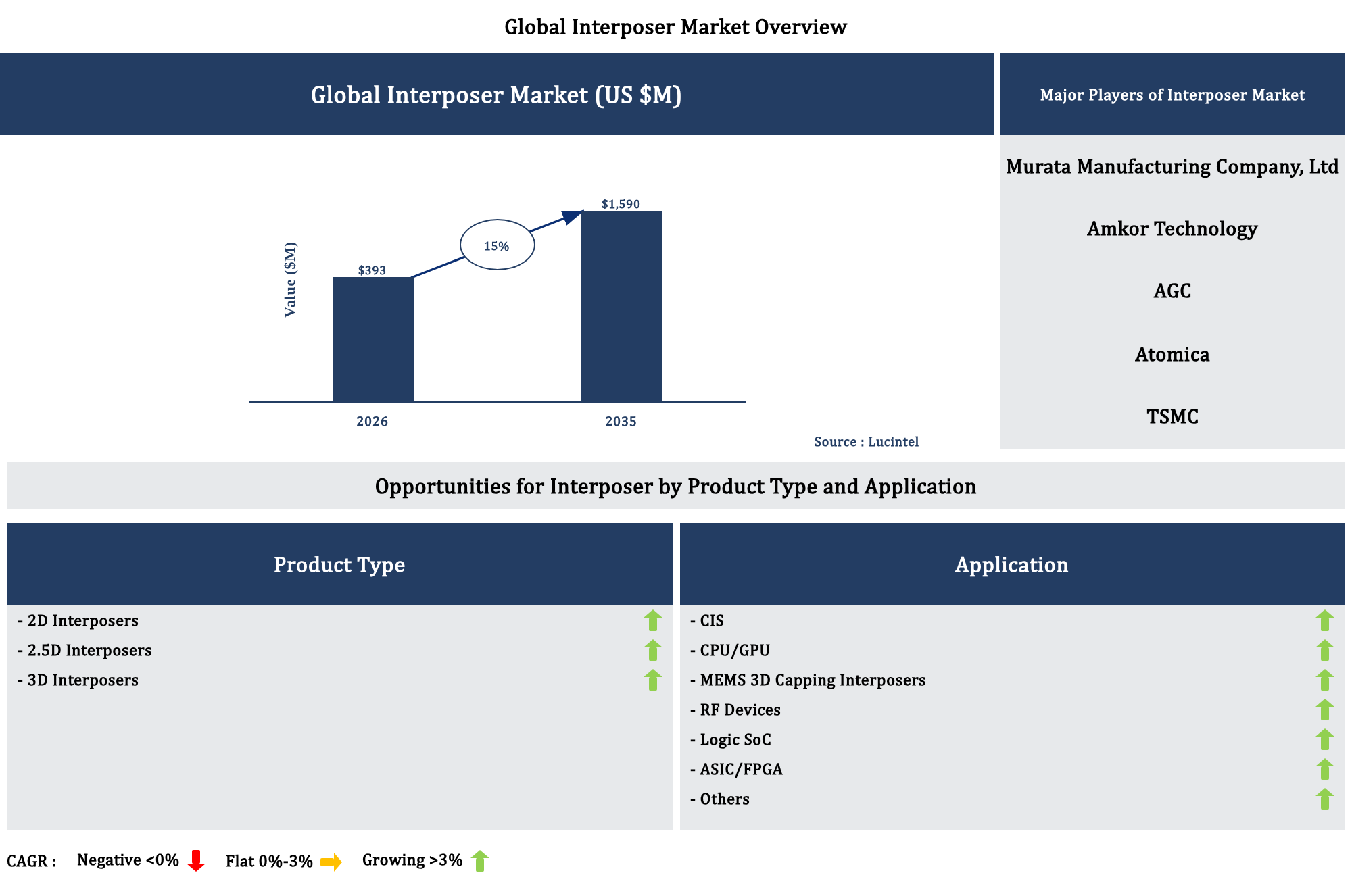
The future of the global interposer market looks promising with opportunities in the CIS, CPU/GPU, MEMS 3D capping interposer, RF device, logic SoC, and ASIC/FPGA markets. The global interposer market is expected to reach an estimated $1590 million by 2035 with a CAGR of 15.0% from 2026 to 2035. The major drivers for this market are the increasing demand for high-performance computing chips, the rising demand for miniaturized electronic devices, and the growing demand for automotive electronics & ev semiconductor usage.
• Lucintel forecasts that, within the type category, 2.5d interposer is expected to witness the highest growth over the forecast period.
• Within the application category, CPU/GPU is expected to witness the highest growth.
• In terms of region, APAC is expected to witness the highest growth over the forecast period.
Gain valuable insights for your business decisions with our comprehensive 150+ page report. Sample figures with some insights are shown below.
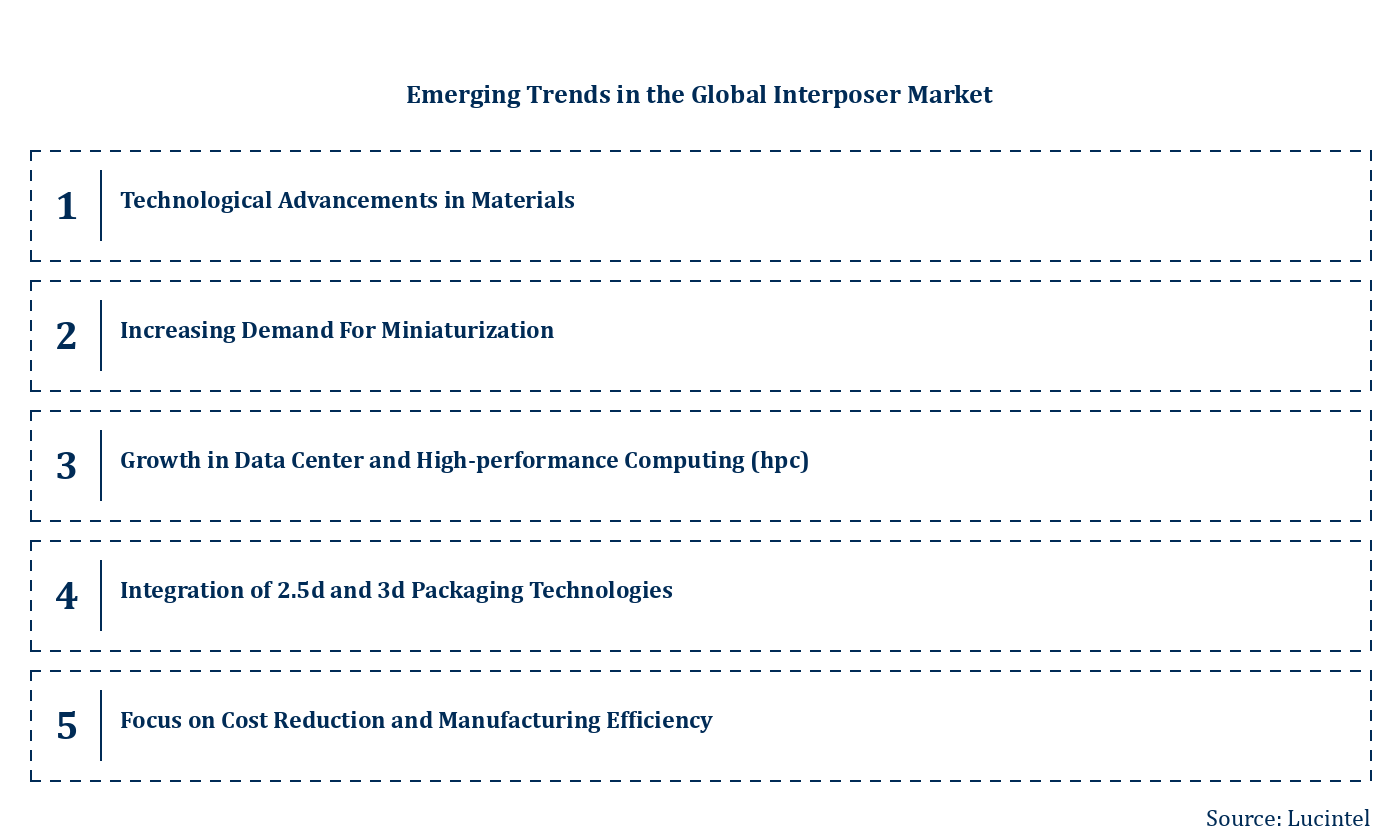
Emerging Trends in the Interposer Market
The Interposer Market is experiencing rapid growth driven by advancements in semiconductor technology, increasing demand for high-performance electronics, and the need for miniaturization in various applications such as data centers, consumer electronics, and automotive industries. As devices become more complex and compact, the role of interposers in enhancing connectivity, thermal management, and signal integrity has become crucial. Innovations in materials, manufacturing processes, and integration techniques are shaping the future of this market. These developments are not only improving device performance but also reducing costs and energy consumption, thereby transforming the landscape of electronic manufacturing and design.
• Technological Advancements in Materials: The market is witnessing a shift towards advanced materials like silicon, glass, and organic substrates for interposers. These materials offer better electrical performance, thermal management, and mechanical stability, enabling higher density and faster data transfer rates. The adoption of 3D integration and through-silicon vias (TSVs) is also expanding, allowing for more compact and efficient designs. This trend enhances the overall performance of electronic devices and supports the development of next-generation technologies such as AI and 5G.
• Increasing Demand for Miniaturization: As consumer electronics and IoT devices demand smaller, more powerful components, interposers are playing a vital role in enabling this miniaturization. They facilitate high-density interconnections and reduce the overall size of electronic assemblies. This trend is driven by the need for portable, lightweight devices with enhanced capabilities, impacting product design and manufacturing processes by emphasizing compactness without compromising performance.
• Growth in Data Center and High-Performance Computing (HPC): The surge in data traffic and the expansion of cloud computing are fueling demand for high-speed, reliable interposers in data centers and HPC systems. These interposers support high-bandwidth connections and improve signal integrity, which are critical for efficient data processing. As data centers evolve to handle larger workloads, the market for advanced interposers is expected to grow significantly, influencing infrastructure investments and technological standards in the industry.
• Integration of 2.5D and 3D Packaging Technologies: The adoption of 2.5D and 3D packaging solutions using interposers is increasing, enabling stacking of multiple chips for enhanced performance and reduced footprint. This integration allows for faster data transfer, lower power consumption, and improved thermal management. It is particularly impactful in applications like high-performance GPUs, memory modules, and mobile devices, driving innovation in packaging techniques and influencing the supply chain dynamics within the market.
• Focus on Cost Reduction and Manufacturing Efficiency: Manufacturers are investing in new fabrication techniques and automation to lower production costs and improve yield rates. Innovations such as wafer-level packaging and advanced lithography are making interposers more affordable and accessible. This trend broadens market reach, enabling smaller players to participate and accelerating adoption across various sectors. It also encourages sustainable manufacturing practices, reducing waste and energy consumption, which is vital for long-term market growth.
These trends are collectively reshaping the Interposer Market by enhancing device performance, enabling miniaturization, and reducing costs. They are fostering innovation in packaging and materials, supporting the growth of high-demand sectors like data centers and consumer electronics, and driving the industry toward more efficient, high-performance solutions. This evolution is positioning the market for sustained growth and technological leadership in the coming years.
Recent Development in the Interposer Market
The interposer market is experiencing rapid growth driven by advancements in semiconductor technology, increasing demand for high-performance electronics, and the expansion of data centers. Innovations in materials and manufacturing processes are enhancing interposer capabilities, making them more efficient and cost-effective. The integration of 2.5D and 3D packaging solutions is revolutionizing device performance, while the rise of AI, IoT, and 5G applications is fueling market expansion. These developments are shaping a competitive landscape with significant opportunities for industry players.
• Growing Demand for High-Speed Data Transfer: The need for faster, more efficient data communication in data centers and consumer electronics is boosting interposer adoption. Advanced interposers enable high-bandwidth connections, reducing latency and improving overall device performance. As data traffic surges globally, the market benefits from increased investments in high-performance interposers, supporting the development of next-generation computing and communication systems.
• Advancements in 2.5D and 3D IC Packaging: Innovations in 2.5D and 3D integration techniques are enhancing interposer functionality, allowing for more compact and powerful electronic devices. These packaging solutions improve electrical performance, reduce power consumption, and enable higher component density. The adoption of these technologies is accelerating in sectors like consumer electronics, automotive, and aerospace, driving market growth and encouraging further research into new interposer materials and designs.
• Rising Adoption of Advanced Materials: The development of novel materials such as silicon, glass, and organic substrates is improving interposer performance and cost-efficiency. These materials offer better thermal management, electrical properties, and mechanical stability, which are crucial for high-density interposers. The shift towards innovative materials is enabling manufacturers to produce more reliable, miniaturized, and high-performance interposers, thus expanding their application scope across various industries.
• Increasing Integration of AI, IoT, and 5G Technologies: The proliferation of AI, IoT, and 5G networks demands high-speed, reliable interconnect solutions. Interposers facilitate the integration of complex chips and components, supporting faster data processing and communication. This technological convergence is driving market growth by creating new opportunities for interposer applications in smart devices, autonomous vehicles, and telecommunication infrastructure, fostering innovation and competitive advantage for industry players.
• Expansion of Data Centers and Cloud Computing infrastructure: The surge in data center construction and cloud service adoption is a key driver for the interposer market. High-performance interposers enable efficient interconnects within servers and storage systems, improving data transfer rates and reducing energy consumption. As digital transformation accelerates, the demand for scalable, reliable interposers increases, supporting the growth of cloud computing and enterprise data management solutions globally.
The overall impact of these developments is a robust expansion of the interposer market, driven by technological innovation and increasing demand across multiple sectors. These opportunities are fostering a competitive environment, encouraging investment in research and development, and enabling the creation of more efficient, miniaturized, and high-performance electronic systems.
Strategic Growth Opportunities in the Interposer Market
The interposer market is experiencing rapid expansion driven by advancements in semiconductor packaging, increasing demand for high-performance electronics, and the need for miniaturization in various applications. Innovations in materials and manufacturing processes are creating new opportunities for growth across multiple sectors. As the electronics industry evolves, interposers play a crucial role in enhancing device performance, reducing size, and improving thermal management. This dynamic environment offers significant potential for market players to capitalize on emerging trends and technological developments.
• Growing Demand for High-Density Packaging Solutions: The increasing need for compact, high-performance electronic devices is fueling the adoption of advanced interposers. These components enable better electrical connectivity and thermal management, supporting miniaturization and improved device efficiency. As consumer electronics, data centers, and automotive sectors demand more powerful yet smaller devices, the interposer market is poised for substantial growth driven by technological innovation and industry adoption.
• Expansion of 2.5D and 3D IC Integration: The shift toward 2.5D and 3D integrated circuits is a key growth driver for the interposer market. These technologies allow stacking of multiple chips, reducing footprint and enhancing performance. Interposers serve as critical interconnection platforms in these architectures, enabling faster data transfer and lower power consumption. As demand for high-speed computing and AI applications increases, the market for specialized interposers tailored for 2.5D and 3D ICs is expected to expand significantly.
• Increasing Adoption in the Automotive Industry for Advanced Driver-Assistance Systems (ADAS): The automotive sector is increasingly integrating complex electronic systems for safety and automation, requiring reliable interconnection solutions. Interposers facilitate high-speed data transfer and thermal management in automotive electronics, supporting the development of autonomous vehicles and ADAS. Growing vehicle electrification and the need for robust, miniaturized components are driving the demand for specialized interposers, creating new growth opportunities within this sector.
• Rising Investments in Semiconductor Manufacturing and Packaging Innovations: Investments by leading semiconductor companies in advanced manufacturing and packaging technologies are propelling the interposer market. Innovations such as fan-out wafer-level packaging and embedded interposers improve performance and reduce costs. These advancements enable the production of smaller, more efficient devices, attracting new customers and applications. As the industry continues to prioritize cost-effective, high-performance solutions, the market for innovative interposers is expected to grow rapidly.
• Increasing Focus on Materials Innovation for Enhanced Interposer Performance: The development of new materials, such as high-performance ceramics, polymers, and advanced substrates, is critical for improving interposer capabilities. These materials offer better electrical properties, thermal management, and mechanical stability. Material innovations enable the creation of thinner, more reliable interposers suitable for next-generation electronics. As research progresses, the adoption of novel materials will open new avenues for performance enhancement and market expansion.
The interposer market is set to benefit from technological advancements, industry-specific demands, and material innovations. These growth opportunities will drive increased adoption across sectors such as consumer electronics, automotive, and data centers. As companies leverage these trends, the market is expected to experience robust expansion, fostering innovation and enabling the development of more efficient, compact, and high-performance electronic devices.
Interposer Market Driver and Challenges
The Interposer Market is influenced by a variety of technological, economic, and regulatory factors that shape its growth and development. Advances in semiconductor technology, increasing demand for high-performance electronics, and evolving manufacturing processes are key drivers. Simultaneously, regulatory standards related to environmental impact and supply chain security pose challenges. Market dynamics are also affected by economic fluctuations, geopolitical tensions, and the need for innovation to meet industry standards. Understanding these drivers and challenges is essential for stakeholders to navigate the complex landscape and capitalize on emerging opportunities while addressing potential risks.
The factors responsible for driving the Interposer Market include:
• Technological Advancements: The rapid evolution of semiconductor fabrication techniques and the development of 3D integration technologies have significantly propelled the interposer market. These innovations enable higher performance, reduced size, and improved power efficiency in electronic devices. As consumer demand for faster, smaller, and more efficient electronics grows, manufacturers are increasingly adopting advanced interposers to meet these needs. Additionally, the integration of new materials and manufacturing processes enhances interposer capabilities, further fueling market growth. The continuous push for miniaturization and performance optimization makes technological progress a primary driver in this sector.
• Rising Demand for High-Performance Electronics: The proliferation of data centers, AI applications, and 5G infrastructure has driven the need for high-speed, reliable interconnect solutions. Interposers facilitate high-bandwidth data transfer and signal integrity, which are critical for advanced computing and communication systems. As industries shift towards more data-intensive applications, the demand for sophisticated interposers increases. Consumer electronics, automotive electronics, and industrial automation are also contributing to this trend. The market benefits from the expanding ecosystem of high-performance devices that require efficient interconnection solutions, making this a key growth driver.
• Increasing Adoption of 2.5D and 3D IC Packaging: The integration of multiple chips in a single package through 2.5D and 3D IC technologies relies heavily on interposers. These packaging solutions offer improved performance, reduced form factor, and lower power consumption, which are highly desirable in modern electronic devices. The adoption of these technologies is driven by the need for compact, high-speed, and energy-efficient systems across various sectors. As manufacturers seek to optimize space and performance, the demand for advanced interposers tailored for 2.5D and 3D integration continues to rise, significantly impacting market growth.
• Growing Investment in R&D and Innovation: Companies and research institutions are investing heavily in developing new interposer materials, designs, and manufacturing techniques. This focus on innovation aims to overcome current limitations such as thermal management, electrical performance, and cost-effectiveness. Enhanced R&D efforts lead to the creation of more reliable, scalable, and versatile interposers, opening new application avenues. The ongoing innovation cycle sustains competitive advantage and accelerates market expansion, making R&D investment a crucial driver for future growth.
• Expansion of the Semiconductor Industry: The overall growth of the semiconductor industry, driven by increasing demand for consumer electronics, automotive electronics, and IoT devices, directly impacts the interposer market. As semiconductor devices become more complex and integrated, the need for advanced packaging solutions like interposers grows correspondingly. The expansion of manufacturing capacities and technological capabilities in semiconductor fabrication plants worldwide further supports this trend. This broad industry growth creates a robust demand for interposers, reinforcing their importance in modern electronic systems.
The challenges facing this Market include:
• High Manufacturing Costs: Producing advanced interposers involves complex fabrication processes, expensive materials, and precise manufacturing techniques. These factors contribute to high costs, which can limit adoption, especially among smaller players or in cost-sensitive applications. The need for specialized equipment and cleanroom environments further escalates expenses. As a result, high manufacturing costs can hinder market growth and reduce profit margins for manufacturers, posing a significant challenge to widespread adoption and innovation.
• Technological Complexity and Integration Challenges: Developing interposers that meet the demanding requirements of high-speed, high-density applications involves overcoming significant technical hurdles. Integration issues such as thermal management, electrical performance, and mechanical stability are complex and require sophisticated solutions. These challenges can lead to delays in product development, increased R&D costs, and potential reliability concerns. Overcoming technological complexity is essential for market expansion but remains a persistent challenge for industry players.
• Regulatory and Environmental Concerns: Increasing regulations related to environmental impact, such as restrictions on hazardous materials and waste management, pose compliance challenges for interposer manufacturers. Additionally, the need for sustainable manufacturing practices and eco-friendly materials adds complexity to product development. Navigating diverse regulatory landscapes across regions can increase costs and slow down time-to-market. Addressing these regulatory and environmental issues is critical for long-term market sustainability but presents significant hurdles.
The Interposer Market is driven by rapid technological advancements, rising demand for high-performance electronics, and innovative packaging solutions, all supported by ongoing R&D investments and industry growth. However, high manufacturing costs, technological complexities, and regulatory challenges pose significant hurdles. These factors collectively influence the market‘s trajectory, requiring stakeholders to balance innovation with cost management and compliance. Overall, the market‘s future depends on how effectively these drivers are leveraged and challenges mitigated, shaping a landscape of opportunities and risks for industry participants.
List of Interposer Companies
Companies in the market compete on the basis of product quality offered. Major players in this market focus on expanding their manufacturing facilities, R&D investments, infrastructural development, and leverage integration opportunities across the value chain. With these strategies interposer companies cater increasing demand, ensure competitive effectiveness, develop innovative products & technologies, reduce production costs, and expand their customer base. Some of the interposer companies profiled in this report include-
• Murata Manufacturing Company, Ltd
• Amkor Technology
• AGC
• Atomica
• TSMC
• Tezzaron
• Plan Optik AG
• Xilinx
• ALLVIA
• UMC (United Microelectronics Corporation).
Interposer Market by Segment
The study includes a forecast for the global interposer market by product type, application, and region.
Interposer Market by Product Type [Value from 2019 to 2035]:
• 2D Interposers
• 2.5D Interposers
• 3D Interposers
Interposer Market by Application [Value from 2019 to 2035]:
• CIS
• CPU/GPU
• MEMS 3D Capping Interposers
• RF Devices
• Logic SoC
• ASIC/FPGA
• Others
Interposer Market by Region [Value from 2019 to 2035]:
• North America
• Europe
• Asia Pacific
• The Rest of the World
Country Wise Outlook for the Interposer Market
The interposer market has experienced significant growth driven by advancements in electronics, semiconductor manufacturing, and increasing demand for high-performance computing devices. As technology evolves, countries are investing heavily in research, development, and manufacturing capabilities to stay competitive. Innovations in materials, miniaturization, and integration techniques are shaping the future of interposers, which are critical components in 3D integrated circuits and advanced packaging solutions. The following summaries highlight recent developments in the United States, China, Germany, India, and Japan, reflecting their strategic focus and technological progress in this dynamic market.
• United States: The US has seen substantial investments in R&D, with leading tech companies and startups developing advanced interposer solutions for AI, data centers, and 5G applications. Major semiconductor firms are expanding manufacturing capacity and collaborating with research institutions to enhance interposer performance and integration techniques. The focus is on developing high-density, low-cost interposers using novel materials like silicon and glass. Government initiatives also support innovation through funding and policy incentives, fostering a competitive edge in the global market
• China: China is rapidly advancing its interposer technology to reduce reliance on imports and bolster its semiconductor industry. Key developments include the establishment of new fabrication facilities and investments in research to improve material quality and manufacturing processes. Chinese firms are focusing on integrating interposers into 3D ICs for consumer electronics, AI, and automotive sectors. The government’s strategic plans aim to achieve self-sufficiency and technological independence, with significant progress in developing high-performance, cost-effective interposers.
• Germany: Germany’s market activity is characterized by a focus on high-precision manufacturing and integration of interposers in automotive and industrial applications. Leading research institutions and companies are working on miniaturization and improving thermal management. Germany emphasizes sustainable and environmentally friendly materials, aligning with its broader industrial innovation goals. Collaborations within the European Union are also fostering shared advancements in interposer technology, supporting the region’s competitiveness in high-end electronics.
• India: India is emerging as a key player in the interposer market through government initiatives and private sector investments. The country is focusing on developing indigenous manufacturing capabilities and R&D for advanced packaging solutions. Indian companies are exploring applications in telecommunications, consumer electronics, and defense sectors. Efforts are underway to establish research centers and partnerships with global firms to accelerate innovation, aiming to position India as a significant hub for interposer technology in Asia.
• Japan: Japan maintains a strong presence in the interposer market with a focus on high-performance, reliable solutions for consumer electronics, automotive, and industrial applications. Japanese firms are investing in advanced materials and fabrication techniques to improve interposer durability and thermal performance. The country emphasizes innovation in 2.5D and 3D integration, leveraging its expertise in semiconductor manufacturing. Collaborative projects with global companies and government support are driving technological advancements and expanding Japan’s influence in the global interposer landscape.
Features of the Global Interposer Market
Market Size Estimates: Interposer market size estimation in terms of value ($M).
Trend and Forecast Analysis: Market trends (2019 to 2025) and forecast (2026 to 2035) by various segments and regions.
Segmentation Analysis: Interposer market size by product type, application, and region in terms of value ($M).
Regional Analysis: Interposer market breakdown by North America, Europe, Asia Pacific, and Rest of the World.
Growth Opportunities: Analysis of growth opportunities in different product type, application, and regions for the interposer market.
Strategic Analysis: This includes M&A, new product development, and competitive landscape of the interposer market.
Analysis of competitive intensity of the industry based on Porter’s Five Forces model.
FAQ
Q1. What is the interposer market size?
Answer: The global interposer market is expected to reach an estimated $1590 million by 2035.
Q2. What is the growth forecast for interposer market?
Answer: The global interposer market is expected to grow with a CAGR of 15.0% from 2026 to 2035.
Q3. What are the major drivers influencing the growth of the interposer market?
Answer: The major drivers for this market are the increasing demand for high-performance computing chips, the rising demand for miniaturized electronic devices, and the growing demand for automotive electronics & ev semiconductor usage.
Q4. What are the major segments for interposer market?
Answer: The future of the interposer market looks promising with opportunities in the CIS, CPU/GPU, MEMS 3D capping interposer, RF device, logic SoC, and ASIC/FPGA markets.
Q5. Who are the key interposer market companies?
Answer: Some of the key interposer companies are as follows:
• Murata Manufacturing Company, Ltd
• Amkor Technology
• AGC
• Atomica
• TSMC
• Tezzaron
• Plan Optik AG
• Xilinx
• ALLVIA
• UMC (United Microelectronics Corporation).
Q6. Which interposer market segment will be the largest in future?
Answer: Lucintel forecasts that, within the type category, 2.5d interposer is expected to witness the highest growth over the forecast period.
Q7. In interposer market, which region is expected to be the largest in next 8 years?
Answer: In terms of region, APAC is expected to witness the highest growth over the forecast period.
Q8. Do we receive customization in this report?
Answer: Yes, Lucintel provides 10% customization without any additional cost.
This report answers following 11 key questions:
Q.1. What are some of the most promising, high-growth opportunities for the interposer market by product type (2D interposers, 2.5D interposers, and 3D interposers), application (CIS, CPU/GPU, MEMS 3D capping interposers, RF devices, logic SoC, ASIC/FPGA, and others), and region (North America, Europe, Asia Pacific, and the Rest of the World)?
Q.2. Which segments will grow at a faster pace and why?
Q.3. Which region will grow at a faster pace and why?
Q.4. What are the key factors affecting market dynamics? What are the key challenges and business risks in this market?
Q.5. What are the business risks and competitive threats in this market?
Q.6. What are the emerging trends in this market and the reasons behind them?
Q.7. What are some of the changing demands of customers in the market?
Q.8. What are the new developments in the market? Which companies are leading these developments?
Q.9. Who are the major players in this market? What strategic initiatives are key players pursuing for business growth?
Q.10. What are some of the competing products in this market and how big of a threat do they pose for loss of market share by material or product substitution?
Q.11. What M&A activity has occurred in the last 7 years and what has its impact been on the industry?
For any questions related to Interposer Market, Interposer Market Size, Interposer Market Growth, Interposer Market Analysis, Interposer Market Report, Interposer Market Share, Interposer Market Trends, Interposer Market Forecast, Interposer Companies, write Lucintel analyst at email: helpdesk@lucintel.com. We will be glad to get back to you soon.