
Report Feature
Integrated Photonic Quantum Computing Core Market Trends and Forecast
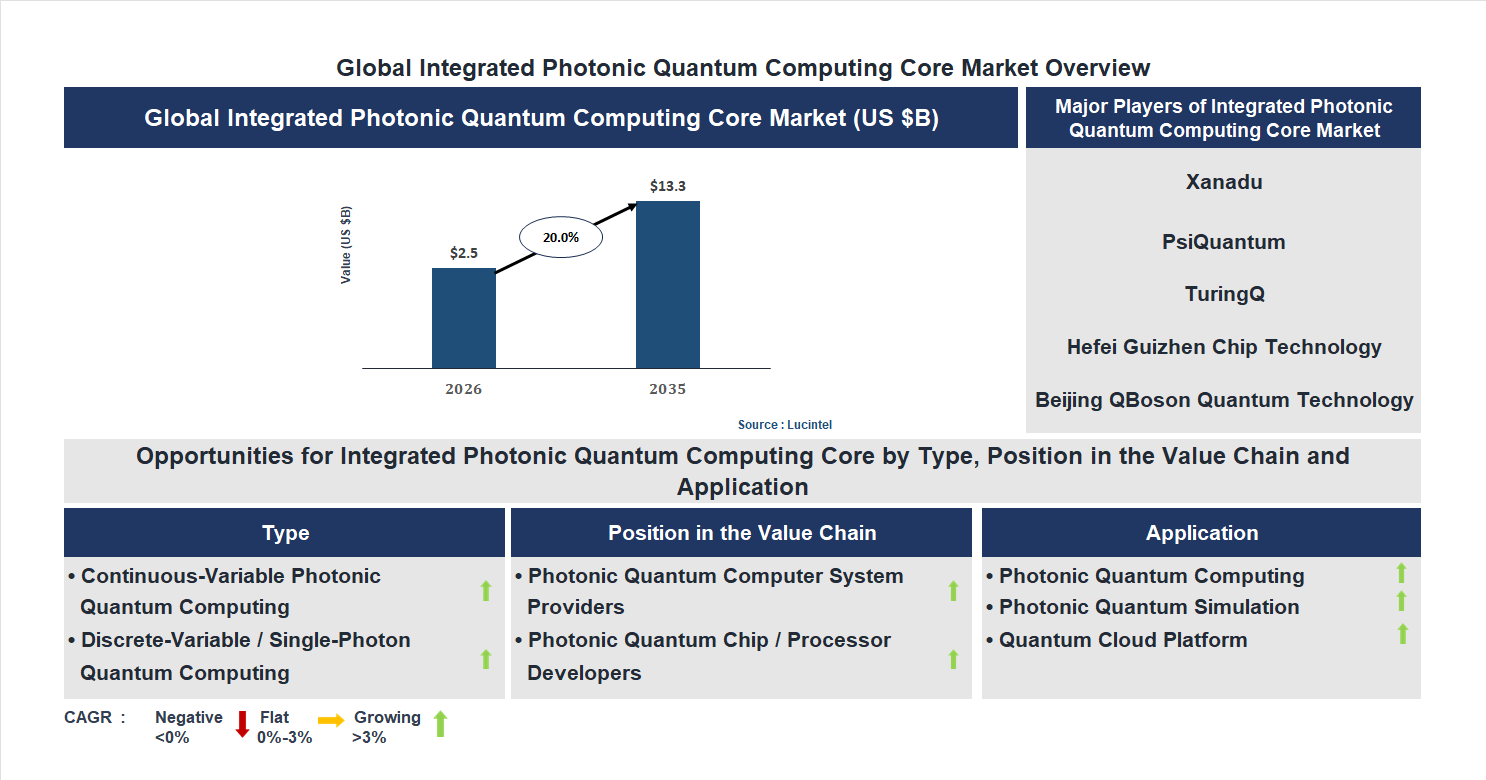
The future of the global integrated photonic quantum computing core market looks promising with opportunities in the photonic quantum computing, photonic quantum simulation, and quantum cloud platform markets. The global integrated photonic quantum computing core market is expected to reach an estimated $13.3 billion by 2035 with a CAGR of 20% from 2026 to 2035. The major drivers for this market are the increasing investment in integrated quantum photonics, the rising demand for scalable quantum processors, and the growing adoption of on chip photonic platforms.• Lucintel forecasts that, within the type category, discrete-variable / single-photon quantum computing is expected to witness higher growth over the forecast period.
• Within the application category, photonic quantum computing is expected to witness the highest growth.
• In terms of region, APAC is expected to witness the highest growth over the forecast period. Gain valuable insights for your business decisions with our comprehensive 150+ page report. Sample figures with some insights are shown below.
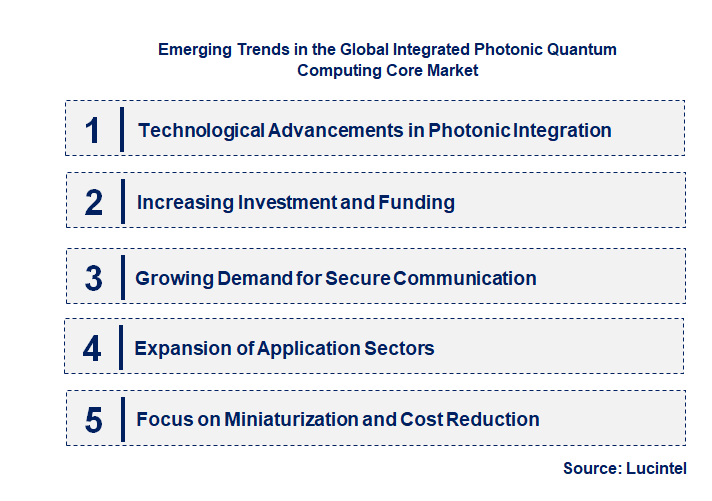
Emerging Trends in the Integrated Photonic Quantum Computing Core Market
The integrated photonic quantum computing core market is experiencing rapid evolution driven by technological advancements and increasing demand for secure, high-speed computing solutions. As quantum technologies mature, the integration of photonic components into quantum computing systems is becoming more prevalent, offering enhanced performance, scalability, and energy efficiency. These developments are attracting investments from both government and private sectors, fueling innovation and expanding applications across various industries such as healthcare, finance, and cybersecurity. The markets growth is also influenced by the need for more robust, miniaturized, and cost-effective quantum computing solutions, positioning it as a critical area of technological progress in the coming years.• Technological Advancements in Photonic Integration: The development of more sophisticated photonic chips and integrated circuits is enabling higher qubit stability and coherence times. Innovations in materials like silicon photonics and lithium niobate are improving the efficiency and scalability of quantum processors. These advancements reduce system complexity and cost, making quantum computing more accessible for commercial applications. As integration techniques improve, the market is expected to see increased adoption of compact, high-performance quantum devices, accelerating the overall growth of integrated photonic quantum computing.
• Increasing Investment and Funding: Governments, venture capitalists, and technology giants are significantly investing in quantum computing research and development. Funding initiatives aim to overcome current limitations in qubit coherence and error rates, fostering innovation in integrated photonic solutions. This influx of capital is enabling startups and established companies to accelerate product development, expand research facilities, and collaborate across sectors. The surge in investment is a key driver propelling the market forward, ensuring rapid technological progress and competitive positioning in the global landscape.
• Growing Demand for Secure Communication: The rise in cyber threats and data breaches is fueling demand for quantum-secure communication systems. Integrated photonic quantum devices are crucial for implementing quantum key distribution (QKD), which offers theoretically unbreakable encryption. As organizations seek to protect sensitive information, the market for quantum communication infrastructure is expanding. This trend not only boosts the adoption of integrated photonic quantum components but also positions the market as a vital player in the future of secure digital communication networks.
• Expansion of Application Sectors: Beyond traditional computing, integrated photonic quantum technologies are finding applications in diverse fields such as drug discovery, financial modeling, and artificial intelligence. These sectors benefit from quantum’s ability to process complex computations at unprecedented speeds. The integration of photonic components allows for miniaturized, scalable solutions suitable for real-world deployment. This diversification broadens the market scope, attracting new customers and investment, and driving innovation across multiple industries, ultimately transforming the landscape of quantum technology applications.
• Focus on Miniaturization and Cost Reduction: Efforts to develop smaller, more affordable quantum photonic components are gaining momentum. Advances in fabrication techniques and material science are enabling the production of compact, integrated devices suitable for commercial use. Cost reduction is critical for widespread adoption, especially in enterprise and consumer markets. As miniaturization progresses, the market will see increased deployment of portable, user-friendly quantum systems, making quantum computing more mainstream and accessible. This trend is essential for transitioning quantum technology from research labs to practical, everyday applications. In summary, these emerging trends are collectively reshaping the integrated photonic quantum computing core market by enhancing technological capabilities, expanding application areas, and making quantum solutions more accessible and secure. The market is poised for significant growth, driven by innovation, investment, and the increasing demand for advanced computing and communication technologies.
Recent Development in the Integrated Photonic Quantum Computing Core Market
The integrated photonic quantum computing core market is experiencing rapid advancements driven by technological innovations and increasing demand for secure, high-speed computing solutions. These developments are opening new avenues for industries such as healthcare, finance, and defense, fostering increased investment and research. As quantum technologies mature, the market is poised for significant growth, transforming computational capabilities and enabling unprecedented processing power. This evolving landscape presents both opportunities and challenges, shaping the future of quantum computing and its integration into mainstream applications.• Growing Investment in Quantum Technologies: Increased funding from governments and private sectors is accelerating research and development in integrated photonic quantum computing, fostering innovation and commercialization. This influx of capital is enabling startups and established companies to develop scalable, efficient quantum processors, which will likely lead to faster deployment and broader adoption across various industries. The markets expansion is driven by the strategic importance of quantum computing in solving complex problems beyond classical capabilities.
• Advances in Photonic Integration Techniques: Recent breakthroughs in photonic integration are enabling more compact, reliable, and scalable quantum chips. These innovations reduce manufacturing costs and improve performance, making quantum devices more accessible. Enhanced integration techniques facilitate the development of complex quantum circuits on a single chip, which is crucial for practical applications. This progress is expected to accelerate the deployment of quantum solutions in real-world scenarios, boosting market growth and technological adoption.
• Development of Quantum Algorithms and Software: The creation of specialized algorithms and software tailored for photonic quantum processors is expanding their application scope. These developments improve the efficiency and accuracy of quantum computations, making them more viable for commercial use. As software ecosystems mature, they will enable easier programming and integration with existing systems, broadening user adoption. This evolution is critical for translating quantum hardware capabilities into tangible business and scientific benefits.
• Increasing Collaborations and Strategic Partnerships: Industry-academic collaborations and strategic alliances are fostering knowledge exchange and resource sharing. These partnerships accelerate innovation, reduce development risks, and facilitate market entry. Joint efforts are also promoting standardization and interoperability, essential for widespread adoption. Such collaborations are vital for overcoming technical challenges and ensuring the markets sustainable growth, ultimately driving the commercialization of integrated photonic quantum computing solutions.
• Rising Demand for Secure Computing Solutions: The need for unbreakable encryption and secure data processing is propelling the adoption of quantum technologies. Photonic quantum computing offers promising solutions for quantum cryptography, ensuring data security against cyber threats. This demand is particularly strong in finance, defense, and healthcare sectors, where data integrity is critical. The market is witnessing increased investments in secure quantum communication networks, which will likely expand the application landscape and reinforce the importance of integrated photonic quantum computing. The overall impact of these developments is significantly transforming the integrated photonic quantum computing core market by enhancing technological capabilities, reducing costs, and expanding application areas. These advancements are attracting increased investments, fostering innovation, and accelerating commercialization, which collectively are driving rapid market growth. As a result, quantum computing is poised to revolutionize industries, offering unprecedented processing power and security solutions, shaping the future of digital technology.
Strategic Growth Opportunities in the Integrated Photonic Quantum Computing Core Market
The integrated photonic quantum computing core market is poised for significant expansion driven by technological advancements, increasing demand for secure communication, and the need for high-performance computing solutions. As industries seek faster, more efficient processing capabilities, integrated photonics offers scalable, miniaturized, and energy-efficient quantum systems. Strategic investments and research collaborations are accelerating innovation, opening new avenues for commercialization. This evolving landscape presents numerous opportunities for market players to capitalize on emerging applications and address complex computational challenges.• Growing Demand for Secure Communication Drives Market Expansion: The increasing need for unbreakable encryption and secure data transmission fuels the adoption of integrated photonic quantum computing. Quantum key distribution (QKD) systems leverage photonic technologies to provide unparalleled security, prompting investments from governments and private sectors. As cyber threats escalate, organizations seek scalable, reliable quantum solutions, creating a substantial growth opportunity for integrated photonic quantum computing in secure communication networks.
• Advancements in Quantum Hardware Enable Commercialization: Innovations in integrated photonic components such as waveguides, detectors, and modulators are enhancing quantum hardware performance. These developments facilitate the creation of compact, stable, and scalable quantum processors suitable for real-world applications. The reduction in manufacturing costs and improved integration techniques accelerate commercialization, attracting startups and established players to develop practical quantum computing devices for diverse industries.
• Increasing Investment in Quantum Research and Development: Governments, academia, and private enterprises are significantly investing in quantum research to overcome existing technological barriers. Funding initiatives and collaborative projects focus on improving qubit coherence, error correction, and system integration within photonic platforms. This influx of capital accelerates technological breakthroughs, expands the application scope, and fosters a competitive environment, ultimately propelling market growth and establishing integrated photonic quantum computing as a key technological frontier.
• Expansion of Applications in Healthcare and Material Science: Integrated photonic quantum computing offers transformative potential in drug discovery, molecular modeling, and material design by enabling complex simulations at unprecedented speeds. Pharmaceutical companies and research institutions are exploring these capabilities to accelerate innovation cycles. The ability to process vast datasets and perform precise quantum calculations opens new avenues for personalized medicine and advanced material development, creating a lucrative market segment for integrated photonic quantum solutions.
• Integration with Classical Computing Systems Enhances Performance: Combining photonic quantum processors with existing classical computing infrastructure improves overall computational efficiency and problem-solving capacity. Hybrid systems enable seamless data exchange and leverage the strengths of both paradigms. This integration facilitates practical deployment in industries such as finance, logistics, and artificial intelligence, broadening market reach. As integration techniques mature, the market for hybrid quantum-classical systems is expected to grow substantially, offering scalable solutions for complex computational tasks. In conclusion, these growth opportunities collectively drive the evolution of the integrated photonic quantum computing core market, fostering innovation, expanding application domains, and attracting investments. The convergence of technological advancements and strategic collaborations will accelerate commercialization, positioning integrated photonics as a pivotal technology in the future of quantum computing. This dynamic landscape promises substantial market growth and transformative impacts across multiple sectors.
Integrated Photonic Quantum Computing Core Market Driver and Challenges
The integrated photonic quantum computing core market is influenced by a range of technological, economic, and regulatory factors. Rapid advancements in photonic technologies, increasing investments in quantum research, and growing demand for secure communication are key drivers. However, the market also faces challenges such as high development costs, complex integration processes, and regulatory uncertainties. These factors collectively shape the growth trajectory of the market, impacting innovation, commercialization, and adoption rates. Understanding these drivers and challenges is essential for stakeholders aiming to capitalize on emerging opportunities while navigating potential obstacles in this rapidly evolving sector. The factors responsible for driving the integrated photonic quantum computing core market include:-• Technological Advancements: Rapid progress in photonic integration, quantum hardware, and error correction techniques are enabling more efficient and scalable quantum computing solutions. Innovations such as integrated waveguides, single-photon sources, and detectors are reducing size, cost, and complexity, making quantum systems more practical for commercial applications. These technological improvements are attracting investments and fostering collaborations among industry players and research institutions, accelerating market growth and expanding application possibilities across sectors like cryptography, drug discovery, and complex simulations.
• Increasing Investment and Funding: Governments, private enterprises, and venture capitalists are significantly increasing funding for quantum computing research and development. Major tech companies are establishing dedicated quantum labs, while governments are launching strategic initiatives to maintain technological leadership. This influx of capital is facilitating the development of integrated photonic components, testing new architectures, and scaling up production. The financial support not only accelerates innovation but also helps overcome technical barriers, fostering a competitive environment that propels market expansion and attracts new entrants.
• Growing Demand for Secure Communication: The rising need for secure data transmission in government, military, banking, and healthcare sectors is a major driver. Quantum communication, leveraging photonic technologies, offers theoretically unbreakable encryption through quantum key distribution (QKD). As cyber threats become more sophisticated, organizations are investing in quantum-secure communication networks. This demand is pushing the development of integrated photonic quantum devices that are compact, reliable, and suitable for real-world deployment, thereby expanding the market scope and encouraging further technological breakthroughs.
• Expansion of Quantum Computing Applications: The increasing recognition of quantum computings potential to solve complex problems beyond classical capabilities is fueling market growth. Industries such as pharmaceuticals, finance, and logistics are exploring quantum algorithms for optimization, simulation, and machine learning. Integrated photonic platforms are particularly attractive due to their scalability and compatibility with existing semiconductor manufacturing processes. As application use cases multiply and demonstrate tangible benefits, demand for integrated photonic quantum cores is expected to rise, driving market expansion and innovation. The challenges facing this integrated photonic quantum computing core market include:-
• High Development and Manufacturing Costs: Developing integrated photonic quantum components involves sophisticated fabrication processes, expensive materials, and precise engineering, leading to substantial costs. These high expenses hinder widespread commercialization and limit accessibility for smaller players. Additionally, scaling production while maintaining quality and performance remains a significant challenge, impacting pricing strategies and market penetration. Overcoming cost barriers is crucial for broader adoption and for establishing a sustainable ecosystem for integrated photonic quantum computing.
• Complex Integration and Scalability Issues: Integrating multiple quantum components such as sources, detectors, and waveguides onto a single chip presents technical difficulties. Ensuring coherence, minimizing losses, and managing thermal effects are complex tasks that require advanced fabrication techniques. Scalability is further challenged by the need to maintain high fidelity and low error rates as systems grow larger. These integration challenges slow down development cycles and hinder the transition from laboratory prototypes to commercial products, impacting market growth.
• Regulatory and Standardization Uncertainties: The evolving nature of quantum technologies means that regulatory frameworks and standards are still under development. Unclear policies regarding data security, privacy, and export controls create uncertainties for market participants. Lack of standardized testing and certification procedures complicates product validation and acceptance in critical sectors. These regulatory ambiguities can delay deployment, increase compliance costs, and hinder international collaboration, thereby affecting overall market momentum. In summary, the integrated photonic quantum computing core market is driven by technological innovations, increased investments, and expanding application areas, which collectively foster growth and competitiveness. However, high costs, integration complexities, and regulatory uncertainties pose significant hurdles that could slow progress. Balancing these drivers and challenges will be essential for stakeholders to realize the full potential of integrated photonic quantum computing, ensuring sustainable development and widespread adoption in the coming years.
List of Integrated Photonic Quantum Computing Core Companies
Companies in the market compete on the basis of product quality offered. Major players in this market focus on expanding their manufacturing facilities, R&D investments, infrastructural development, and leverage integration opportunities across the value chain. With these strategies integrated photonic quantum computing core companies cater increasing demand, ensure competitive effectiveness, develop innovative products & technologies, reduce production costs, and expand their customer base. Some of the integrated photonic quantum computing core companies profiled in this report include-• Xanadu
• PsiQuantum
• TuringQ
• Hefei Guizhen Chip Technology
• Beijing QBoson Quantum Technology
• QuiX Quantum
• Quandela
Integrated Photonic Quantum Computing Core Market by Segment
The study includes a forecast for the global integrated photonic quantum computing core market by type, position in the value chain, application, and region.Integrated Photonic Quantum Computing Core Market by Type [Value from 2019 to 2035]:
• Continuous-Variable Photonic Quantum Computing
• Discrete-Variable / Single-Photon Quantum Computing
Integrated Photonic Quantum Computing Core Market by Position in the Value Chain [Value from 2019 to 2035]:
• Photonic Quantum Computer System Providers
• Photonic Quantum Chip / Processor Developers
Integrated Photonic Quantum Computing Core Market by Application [Value from 2019 to 2035]:
• Photonic Quantum Computing
• Photonic Quantum Simulation
• Quantum Cloud Platform
Integrated Photonic Quantum Computing Core Market by Region [Value from 2019 to 2035]:
• North America
• Europe
• Asia Pacific
• The Rest of the World
Country Wise Outlook for the Integrated Photonic Quantum Computing Core Market
The integrated photonic quantum computing core market is experiencing rapid growth driven by technological advancements, increasing investments, and expanding applications in various sectors such as healthcare, cybersecurity, and data processing. Countries are competing to lead in quantum technology, with significant breakthroughs enhancing computational power and security protocols. Governments and the private sector are collaborating to develop scalable, reliable quantum systems, fostering innovation and economic growth. The markets evolution reflects a global push toward harnessing quantum capabilities for practical, real-world solutions, with each country focusing on unique strengths and strategic initiatives to secure a competitive edge in this transformative field.• United States: The US continues to lead in integrated photonic quantum computing, with major tech firms and research institutions making significant breakthroughs in qubit stability and scalability. Investments from government agencies like the Department of Energy and private companies such as Google and IBM are accelerating development. Recent advancements include the integration of photonic chips with error correction techniques, enhancing system reliability. The US also focuses on commercial applications, including secure communications and complex simulations, positioning itself as a pioneer in the global quantum race.
• China: China has made remarkable progress in integrated photonic quantum technology, emphasizing large-scale quantum networks and secure communication systems. The government has increased funding for quantum research, leading to breakthroughs in chip fabrication and quantum encryption. Notably, Chinese researchers have demonstrated high-fidelity quantum teleportation over long distances using integrated photonics. The country aims to establish a national quantum information infrastructure, integrating photonic quantum processors into existing communication networks to bolster cybersecurity and data security.
• Germany: Germany is advancing in the development of integrated photonic quantum components, focusing on industrial applications and collaboration between academia and industry. The Fraunhofer Institute and several universities are pioneering research in photonic chip manufacturing and quantum sensors. Recent developments include the creation of compact, scalable quantum photonic devices suitable for commercial deployment. Germany’s strategic emphasis is on integrating quantum photonics into existing manufacturing processes, aiming to enhance precision measurement, secure communications, and quantum computing solutions for industrial use.
• India: India is rapidly expanding its quantum research capabilities, with government initiatives supporting integrated photonic quantum computing development. The Department of Science and Technology has launched programs to foster innovation and skill development in quantum technologies. Recent advancements include the development of integrated photonic chips for quantum key distribution and secure communication. India aims to build a robust quantum ecosystem by collaborating with international partners and establishing dedicated research centers, positioning itself as a key player in the global quantum landscape.
• Japan: Japan is focusing on the commercialization of integrated photonic quantum technologies, leveraging its strong semiconductor industry. The country has made progress in developing miniaturized, high-performance quantum photonic devices for practical applications. Recent efforts include integrating quantum photonics with existing optical communication infrastructure and advancing quantum sensing technologies. Japan’s strategy emphasizes industrial integration, aiming to deploy quantum solutions in sectors like healthcare, manufacturing, and cybersecurity, thereby fostering innovation and economic growth in the quantum domain.

Features of the Global Integrated Photonic Quantum Computing Core Market
Market Size Estimates: Integrated photonic quantum computing core market size estimation in terms of value ($B). Trend and Forecast Analysis: Market trends (2019 to 2025) and forecast (2026 to 2035) by various segments and regions. Segmentation Analysis: Integrated photonic quantum computing core market size by type, position in the value chain, application, and region in terms of value ($B). Regional Analysis: Integrated photonic quantum computing core market breakdown by North America, Europe, Asia Pacific, and Rest of the World. Growth Opportunities: Analysis of growth opportunities in different types, position in the value chain, applications, and regions for the integrated photonic quantum computing core market. Strategic Analysis: This includes M&A, new product development, and competitive landscape of the integrated photonic quantum computing core market. Analysis of competitive intensity of the industry based on Porter’s Five Forces model.
FAQ
Q1. What is the market size and growth forecast for integrated photonic quantum computing core market? Answer: The global integrated photonic quantum computing core market is expected to reach an estimated $13.3 billion by 2035 and grow with a CAGR of 20% from 2026 to 2035. Q2. What are the major drivers influencing the growth of the integrated photonic quantum computing core market? Answer: The major drivers for this market are the increasing investment in integrated quantum photonics, the rising demand for scalable quantum processors, and the growing adoption of on chip photonic platforms. Q3. What are the major segments for integrated photonic quantum computing core market? Answer: The future of the integrated photonic quantum computing core market looks promising with opportunities in the photonic quantum computing, photonic quantum simulation, and quantum cloud platform markets. Q4. Who are the key integrated photonic quantum computing core market companies? Answer: Some of the key integrated photonic quantum computing core companies are as follows:• Xanadu
• PsiQuantum
• TuringQ
• Hefei Guizhen Chip Technology
• Beijing QBoson Quantum Technology
• QuiX Quantum
• Quandela Q5. Which integrated photonic quantum computing core market segment will be the largest in future? Answer: Lucintel forecasts that, within the type category, discrete-variable / single-photon quantum computing is expected to witness higher growth over the forecast period. Q6. In integrated photonic quantum computing core market, which region is expected to be the largest in next 5 years? Answer: In terms of region, APAC is expected to witness the highest growth over the forecast period. Q7. Do we receive customization in this report? Answer: Yes, Lucintel provides 10% customization without any additional cost.
Table of Contents
List of Figures
List of Tables
Methodology
- In-depth interviews of the major players in this market
- Detailed secondary research from competitors’ financial statements and published data
- Extensive searches of published works, market, and database information pertaining to industry news, company press releases, and customer intentions
- A compilation of the experiences, judgments, and insights of Lucintel’s professionals, who have analyzed and tracked this market over the years.


Buy Now
Choose a license that fits your team. Instant PDF delivery.
Prices exclude taxes. Instant delivery. Custom licensing available on request.
Key Questions
- • What are some of the most promising, high-growth opportunities for the integrated photonic quantum computing core market by type (continuous-variable photonic quantum computing and discrete-variable / single-photon quantum computing), position in the value chain (photonic quantum computer system providers and photonic quantum chip / processor developers), application (photonic quantum computing, photonic quantum simulation, and quantum cloud platform), and region (North America, Europe, Asia Pacific, and the Rest of the World)?
- • Which segments will grow at a faster pace and why?
- • Which region will grow at a faster pace and why?
- • What are the key factors affecting market dynamics? What are the key challenges and business risks in this market?
- • What are the business risks and competitive threats in this market?
- • What are the emerging trends in this market and the reasons behind them?
- • What are some of the changing demands of customers in the market?
- • What are the new developments in the market? Which companies are leading these developments?
- • Who are the major players in this market? What strategic initiatives are key players pursuing for business growth?
- • What are some of the competing products in this market and how big of a threat do they pose for loss of market share by material or product substitution?
- • What M&A activity has occurred in the last 7 years and what has its impact been on the industry? For any questions related to Integrated Photonic Quantum Computing Core Market, Integrated Photonic Quantum Computing Core Market Size, Integrated Photonic Quantum Computing Core Market Growth, Integrated Photonic Quantum Computing Core Market Analysis, Integrated Photonic Quantum Computing Core Market Report, Integrated Photonic Quantum Computing Core Market Share, Integrated Photonic Quantum Computing Core Market Trends, Integrated Photonic Quantum Computing Core Market Forecast, Integrated Photonic Quantum Computing Core Companies, write Lucintel analyst at email: helpdesk@lucintel.com. We will be glad to get back to you soon.


